TECHNICAL UNIVERSITY OF CLUJ-NAPOCA
ACTA TECHNICA NAPOCENSIS
Series: Applied Mathematics, Mechanics, and Engineering Vol. 61, Issue III, September, 2018
THEORETICAL ANALYSIS AND PRACTICAL CASE STUDIES OF
SLA, POLYJET AND FDM MANUFACTURING TECHNIQUES
Catalin MOLDOVAN, Cosmin COSMA, Petru BERCE, Nicolae BALC
Abstract: Among the most advanced technologies developed in recent years, Additive Manufacturing (AM) is one that meets the requirements of the Fourth Industrial Revolution. In this paper, we present some AM methods such as stereolithography (SLA), polyjet and fused deposition modeling (FDM). The AM technologies analyzed use raw material in liquid form and filament. The study is focused on three important aspects like the processing principle, the material used by each technology and the latest practical examples developed. The products exposed are from various domains such us medicine, automotive, aerospace and industry. Furthermore, we detailed the main manufacturers of AM systems, their equipments and the cost range.
Key words: stereolithography, polyjet, fused deposition modeling, materials.
1. INTRODUCTION
3D Printing or Additive Manufacturing (AM) is a technology capable to process a wide range of complex structures and geometries from a virtual model. Generally, the AM technologies produce parts or assemblies by successive printing of layers that are formed one over the other, using various materials such as: plastics, metals, ceramic or composites. The AM technologies are growing very fast and promise to revolutionize the manufacturing sector through shorter production times, less material loss and the ability to print multi-materials [1]. Post-processing of parts 3D printed can include removing supports, polishing the surfaces, sintering, infiltration or heat treatments for stress relieved [2], [3]. These AM processes possess some benefits as compared to conventional technologies based on material removal. Firstly, the amount of material required is less than the traditional processing methods where the material is removed from a blank to the desired geometry [4]. In the case of AM methods, the part is made layer by layer, and the amount of material used can be controlled much better. Secondly, the AM processes are able to fabricated parts
that many of the traditional methods can hardly make, such as creating multi-material parts and biomedical parts even organs. Last but not least, these technologies can reduce production times and costs [1]. Of course, in the case of the parts made by adding material, due to the method of production, layer by layer, the material has anisotropic properties [5]. Depending on the material used, the additive fabrication includes several technologies like processes that use raw materials in liquid forms, powders and filaments.
The objective of this review is to present the AM methods which use raw materials in liquid forms and filaments, and the latest developed applications. Knowing the AM methods are considered to be an essential ingredient for the latest industrial revolution (Industry 4.0), the purpose of this article is to provide some best practice for engineers, designers and other people who are interested to see how AM can be integrated in various domains like medicine, automotive, aerospace or industry.
2. STEREOLITHOGRAPHY
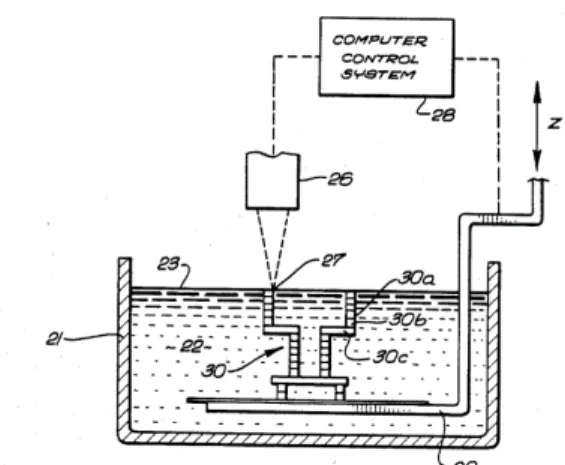
great advantage due to the flexibility of the process that can manufacture parts of various sizes and complex geometries. Also, manufacturing accuracy places this process at the leading positions of additive technologies. Moreover, SLA process has achieved remarkable success in the manufacturing of porous structures for tissue engineering [7]. At the base of SLA there is a polymerization process whereby a liquid resin is solidified with UV (Fig. 1). It uses the CAD model which is divided into layers of predetermined thickness, representing the horizontal sections of the part to be manufactured. In order to achieve the work piece, UV radiation is concentrated on the surface of the resin and solidified it by the strategy adopted for each layer. After the layer is polymerized, the machine platform descends with a distance equal to the thickness of a layer and thus a new layer of liquid resin covers the part. This procedure is repeated until the production is completed.
Once the piece has been built, it must be cleaned, fully solidified and finished. During the cleaning and finishing phase, the operator of the SLA machine will remove the supporting structures. During the completion, the operator can spend considerable time sanding the piece to ensure the desired surface quality [8].
The first US patents describing SLA resins were published in 1989 and 1990 [9], [10]. These resins were prepared from acrylates which had high reactivity but usually produced weak parts due to inaccuracies caused by shrinkage and bending [8]. The first Japan patents that prepared an epoxy composition for SLA resins appeared in 1988 [8]. Epoxy resins have produced more accurate, tougher and stronger parts than acrylic resins. While the polymerization of the acrylate compositions results in a contraction of 5-20%, the polymerisation of the epoxy compositions results in only a 1-2% contraction [11].
However, epoxy resins have disadvantages like slow photo-polymerization and fragility of manufactured parts. Addition of acrylic resins to epoxy resins is required to quickly build up partial strength so they have sufficient integrity to resist without distortion during manufacture. Acrylates are also useful to reduce the elasticity of the epoxy parts.
Fig. 1. Image from U.S. Patent 4575330 introduction of
the term and the concept of SLA
The emergence of nano-composites has attracted great interest among researchers. Typically, nano-dispersion phases include metals [12], inorganic particles [13], [14] [15], [16], [17], graphite nano-fibres [18], clay [19], [20] and carbon nano-tubes [21], [22]. Nano-composites consisting of a polymer and silicone containing nano-materials often exhibit remarkably high properties including mechanical properties [23], [24], heat resistance [25], low gas permeability [26] and non-flammable [27]. These improved properties in nano-composites are mainly due to the stronger interaction between the polymer matrix and the silicon-containing nano-materials. Due to the special surface chemistry, silicon-containing nano-materials can be readily functional and can be easily modified and dispersed in polymers to form nano-composites.
With decreasing costs of SLA equipments, the process has been applied to different types of materials in many laboratories. Recently, intelligent materials have been printed through SLA, and they can subsequently change their form in response to various stimuli such as light, heat, water or acid [8], [28]. This property adds a fourth dimension, which is considered to change the 3D printing into 4D printing.
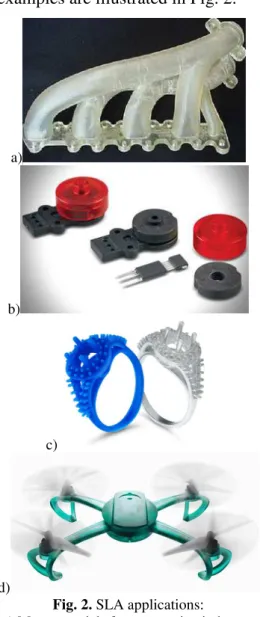
accessible desktop unit was created by FormLabs and the price is around 4000 €. The Form 2 delivers accurate parts at a fraction of the cost compared to industrial machines. The applications of SLA process are multiple. In medical field, some authors developed a concept for a custom intervertebral fixing implant starting with the medical data of a specific patient [29]. Also, custom medical tools can be fabricated in order to assist the surgeons during some complex operations. In industry, SLA technologies can make 3D models of parts for better appreciation and inspection of them, master model for future moulds (eq. jewellery industry), in electronics as supports or cases for different circuits and sensors, decorative pieces and drones. Some of these examples are illustrated in Fig. 2.
a)
b)
c)
d)
Fig. 2. SLA applications:
a) Master models for automotive industry, b) Housing for electric sensor, www.proto3000.com,
c) Jewelry models for casting, d) Drone www.formlabs.com
3. POLYJET PROCESS
PolyJet is a technology similar to SLA, but the difference lies in the fact that it uses a print head to deposit material. This process is also called lithographic inkjet. The material used is a photopolymer which is polymerized by means of a UV light source. The photopolymers processed by PolyJet poses different properties comparing to SLA. In the case of SLA, the raw material has a higher viscosity coefficient. Also, adding reinforcement particles to the composition of resins, composite materials can create more problems for PolyJet printing due to high viscosity.
The main manufacturers of PolyJet systems are: Stratasys (Objet500 Connex), 3D Systems (ProJet MJP 3600 MultiJet), HP (Jet Fusion 3D 4200), Solidscape (Pro), Massivit (1500 MASSIVit 3D), etc. The price of such equipment varies between 50,000 - 150,000 € depending on work platform size, precision of manufactured parts and productivity. Desktop versions were developed as low-cost equipments and the prices ranging from 10,000 to 30,000 €. The producers for desktop PolyJet systems are Stratasys (Objet30), Keyence (Agilista 3100) and Solidscape (Max²).
PolyJet technology has applications in areas such as automotive, rapid prototyping, respectively in dental medicine to manufacture mobile prostheses (Fig. 3).
a)
b)
Fig. 3. PolyJet applications:
4. FUSED DEPOSITION MODELING
Fused Deposition Modeling (FDM) is a process that uses a nozzle or an orifice to selectively deposit a melted plastic. For 3D printers using FDM technology, a thermoplastic material thread is fed through a heated extruder that melts and extrudes the filament through the print head to a thickness that depends on program and machine settings (Fig. 4). FDM printers deposit layer-layer thermoplastic material to form the 3D piece. FDM technology use thermoplastic filaments from different plastics such as: acrylonitrile butadiene styrene (ABS), polycarbonate (PC), polystyrene (PS) and polyamide (PA). The most common material for FDM printing is polylactic acid (PLA). All these materials are available in different colours [30].
Fig. 4. FDM process [1]
The leading manufacturers of FDM systems are: Stratasy (uPrint SE), MakerGear (Makergear M2), Ultimaker (Ultimaker 2+), Prusa Research (Original Prusa i3 MK2S), Zortrax (M200), and MakerBot (Replicator 2). The price of such equipment varies between 3,000 - 15,000 € depending on the work platform size, productivity and accuracy of the manufactured parts. There are even companies which provide just the kit of a desktop systems and the end-user has to assembly the system. The products printed are just for hobby and the system posses open source software. The price for these 3D printers starts at 100 €. On the other hand, a new system is produced by Millebot in order to incorporate various features to a large 3D printer. The MILLE LE system is an industrial all-in-one FDM machine with build size 1600 x 3050 x 1600 mm. The main features include CNC milling spindle, plasma cutter, fibre laser cutter and water-jet cutter. The price for this system is around 250,000 €.
3D printing of polymers has found the possibilities of using it in many applications
such as automotive, architecture, sports (Fig. 5). In dental domain, it is possible to
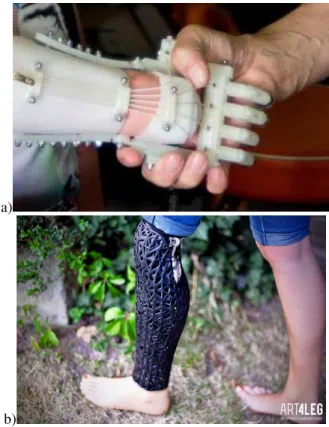
obtain the patients’ dental arches in order to allow the clinician to analyze, diagnose or to monitor the anomalies [31]. Also, customized prosthetics could be produced for new treatments resulting an improvement design and functionality of this orthopedic tools (Fig. 6). All these products are manufactured in concordance with mechanical properties of human body [32].
a)
b)
c)
d)
Fig. 5. FDM applications:
a) Architecture www.paradigm3d.com/architecture-aec, b) Shoes for sport, c) First 3D Printed Car Series in 2016,
a)
b)
Fig. 6. 3D Printed prosthetics for:
a) Hand www.tractus3d.com, b) Leg www.art4leg.com
However, many of the parts 3D printed are used as prototypes and conceptual models, and not as functional parts, due to the fact that the PLA filament possesses low tensile strength. Such disadvantage restricts the widespread use in the industrial field of FDM-manufactured parts.
3D printing of polymeric composites partly solves the mechanical characteristics by combining matrix and reinforcements to create a system with several useful structural or functional properties that cannot be achieved by any single constituent. Incorporating reinforcements (particles, fibres or nano-materials) into polymers allows the manufacture of polyether matrix composites, characterized by high mechanical performance and good functionality. [33], [34]. The main reasons for switching to composites are due to their properties and performance comparable to conventional materials (metals, plastics and wood), keeping their advantages such as low weight, corrosion resistance and strength.
There are three configurations of FDM printers which can use composite materials. The first one has an extruder head and prints
parts using a composite filament that is
Fig. 7. 3D Printing with a single extruder head and
reinforcement fibre coating inside the print head [36]
pre-extruded with the reinforcement material included therein. The second configuration has also an extrusion head, but the reinforcement process takes place inside the extruder (Fig. 7). The reinforcing fibre is covered with a layer of thermoplastic material at the time of extrusion being passed through the material bath formed inside the print head. In this configuration one of the problems that may arise is that of the non-uniform coating of the extruded fibre [35]. The third construction of a 3D printer for composite materials possesses two deposition heads, one for the thermoplastic matrix and the other for the reinforcement fibre This construction provides a better distribution of the thermoplastic material, so a better coverage of the reinforcement fibres than that in which the combination of the two materials takes place inside the extruder head.
The most commonly used fibres as reinforcement material for composite materials are: carbon fiberglass and aramid fibres (Kevlar), and in Fig. 8 are shown some recent applications. Other reinforcing fibres can be: boron, ceramic polyethylene ceramic carbide and natural fibre or cellulose. Through FDM, both continuous reinforcement fibres (using two printheads) and composite thermoplastic filaments (Onix Markforged) that already contain short reinforcement fibres can be printed. The Onyx is a black filament, made by combining the carbon micro-fibre with nylon [37].
through Manufacturing Innovation” aims to bring together leading innovators from across Europe, to develop a new method of producing composite material parts with optimised fibre directionality (see www.dicomi.eu). The project will draw upon advanced expertise and know-how in directional fibre-reinforced
polymers, processing methods and
manufacturing systems design in order to develop an innovative hybrid manufacturing system capable of producing composite parts with increased accuracy, reduced cost and enhanced functionality.
The main manufacturers of 3D printers for composite materials are Cosine Additives (AM1), Markforged (X3) and Stratasys (Fortus 450mc - Nylon 12CF).
a)
b)
c)
Fig. 8. FDM applications using fiber reinforced
composites: a) Helicopter part develop by Thermwood Corporation, b) First 3D Printed Bike, c) All-electric
commuter aircraft develop by Eviation Aircraft, www.compositesmanufacturingmagazine.com
5. CONCLUSIONS
This study presents some AM techniques, focused on processing methods, materials used by each process and latest practical examples developed. Continuous progress of AM equipments and materials science leads to
improved processes and quality of
manufactured products. In the last years, a downward trend of prices has been observed regarding the AM systems and materials. More and more companies take the benefits of these technologies, making their production flexible. Practically, these manufacturing processes are part of Industry 4.0 and allow mass customization of parts. Innovation of AM has contributed to a vast growing of new applications fabricated in various fields such as automotive, medicine, industry or aerospace. From our point of view, AM will remain relevant and important in production of personalized goods.
6. ACKNOWLEDGMENTS
This paper was supported by the OpTi-DeP Project (no. BG101/2016) financed from the UEFISCDI by the Romanian Government, and
within the H2020 AMaTUC project (GA 691787).
7. REFERENCES
[1] Bharat B., Caspers M., An overview of additive manufacturing (3D printing) for
microfabrication, Micro Tec, vol. 23, 2017.
[2] Cosma, C., Balc, N., Moldovan, M.,
Morovic, L., Gogola, P., Borzan C.,
Post-processing of customized implants made by laser beam melting from pure
Titanium, Journal of Optoelectronics
Advanced Materials, vol. 19, No. 11-12, p. 738-747, 2017.
[3] Borzan, C., Dudescu, C., Ceclan, V., Trif, A., Ridzon, M., Berce, P., PA 2200 vs.
PMMA: Comparison Between the
Mechanical Properties Obtained for the 2
Biocompatible Materials, Revista Materiale
[4] Popan, I.A., Carean, A., Luca, A., Ceclan, V., Balc, N., Research on 3D metal sculpturing by water jet cutting versus CNC
machining, Academic Journal of
Manufacturing Engineering, vol. 11(4), p. 74-79, 2013.
[5] Ispas, A., Cosma, C., Craciun, A., Constantiniuc, M., Lascu, L., Leordean, D., Vilau, C., Influence of Ti-Ceramic or Ti-Composite crown on stress distribution:
finite element study and additive
manufacturing, J. Optoelectronics Advanced
Materials, vol. 18 (9-10), p. 904 – 912, 2016. [6] Pan Y., Chen Y., Meniscus process
optimization for smooth surface
fabrication in Stereolithography, Additive
Manufacturing, vol. 12, p. 143-344, 2016. [7] Melchels F.P.W., Feijen J., Grijpma D.W.,
A review on stereolithography and its applications in biomedical engineering,
Biomaterials, vol. 31, p. 6121–6130, 2010.
[8] Gibson I., Rosen D. W., Stucker B., Rapid
Prototyping to Direct Digital
Manufacturing, Additive Manufacturing
Technologies, p. 36-100, 2010.
[9] Hull, C.W., Method for production of
three-dimensional objects by stereolithography,
3D Systems, US Patent 4,929,402, 1990. [10] Murphy E.J., Ansel R.E., Krajewski J.J.,
Investment casting utilizing patterns
produced by stereolithography, DeSoto,
US Patent 4,844,144, 1989.
[11] Crivello J..V, Dietliker K., Photoinitiators for free radical, cationic & anionic
photopolymerisation, 2nd edn. John Wiley
& Sons, New York, 1998.
[12] Bogdanova L.M., Kuzub L.I., et all,
Mechanical properties of epoxy composites
based on silver nanoparticles formed in situ,
Polym Sci Ser A, vol. 56(3), p.304–10, 2014.
[13] Wetzel B., Rosso P., Haupert F., Friedrich
K., Epoxy nanocomposites – fracture and
toughening mechanisms, Eng Fract Mech,
vol.73(16), p.2375–98, 2006.
[14] Kumar S., Hofmann M., et all,
Reinforcement of stereolithographic resins
for rapid prototyping with cellulose
nanocrystals, ACS Appl Mater Interfaces,
vol. 4(10), 2012.
[15] Gurr M., Hofmann D., et all, Acrylic
nanocomposite resins for use in
stereolithography and structural light
modulation based rapid prototyping and
rapid manufacturing technologies, Adv
Funct Mater, vol. 18(16), 2008.
[16] Postiglione G., Natale G., et all,
UV-assisted threedimensional printing of
polymer nanocomposites based on inorganic
fillers, Polym Compos, vol. 38(8), 2015.
[17] Huang Z.M., Zhang Y.Z., Kotaki M., Ramakrishna S., A review on polymer nanofibers by electrospinning and their
applications in nanocomposites, Compos Sci
Technol, vol. 63(15), p.2223–53, 2003. [18] Stankovich S., Dikin D.A., et all, Synthesis
of graphene-based nanosheets via chemical
reduction of exfoliated graphite oxide,
Carbon, vol. 45(7), p. 1558–65, 2007.
[19] Ceccia S., Turcato E.A., et all,
Nanocomposite UV-cured coatings:
organoclay intercalation by an epoxy resin,
Prog Org Coat, vol. 63, 2008.
[20] Sangermano, M., Lak N., et all., UV-curing and characterization of polymer-clay
nanocoatings by dispersion of
acrylatefunctionalized organoclays, Prog
Org Coat, vol. 61(1), p.89–94, 2008.
[21] Dos Santos M.N., Opelt C.V., et all,
Thermal and mechanical properties of a nanocomposite of a photocurable epoxy-acrylate resin and multiwalled carbon
nanotubes, Mater Sci Eng A – Struct Mater
Prop Microstruct Process, vol. 528, 2011. [22] Sandoval J.H., Soto K.F., et all,
Nanotailoring photocrosslinkable epoxy
resins with multi-walled carbon
nanotubes for stereolithography layered
manufacturing, J Mater Sci, vol. 42, 2007.
[23] Kojima Y., Usuki A., et all,
Mechanical-properties of nylon 6-clay hybrid, J Mater
Res, vol.8, p.1185–9, 1993.
[24] Suin S., Maiti S., et all, Mechanically
improved and optically transparent
polycarbonate/clay nanocomposites using
phosphonium modified organoclay, Mater
Des, vol. 54, 2014.
montmorillonite nanocomposites, Polym
Degrad Stab, vol. 80 (2), 2003.
[26] Choudalakis G., Gotsis A.D., Permeability
of polymer/clay nanocomposites: a review,
Eur Polym J, vol. 45(4), p. 967–84, 2009. [27] Liu J.C., Fu M.Y., Jing M.M., Li Q.Y.,
Flame retardancy and charring behavior of
polystyrene-organic montmorillonite
nanocomposites, Polym Adv Technol.,
vol. 24(3), p.273–81, 2013.
[28] Yuan C., Roach D.J., et all, 3D printed reversible shape changing soft actuators
assisted by liquid crystal elastomers, Soft
Matter, vol. 13, 2017.
[29] Doicin, C.V., Ulmeanu, M.E., Neagu, C., Popa, L., Designing and prototyping a bespoke spinal implant using additive
technologies, Materiale Plastice, vol. 53(1),
p. 139-143, 2016.
[30] Milde, J., Morovič, L., Blaha, J., Influence of the layer thickness in the Fused Deposition Modeling process on the dimensional and shape accuracy of the
upper teeth model, MATEC Web Conf.,
vol. 137, art. no. 02006, 2017.
[31] Burde, A.V., Gasparik, C., Baciu, S., Manole, M., Dudea, D., Campian R.S.,
Three-Dimensional Accuracy Evaluation of Two Additive Manufacturing Processes in
the Production of Dental Models,
Key Engineering Materials, vol. 752, p. 119-125, 2017.
[32] Vescan, S.D., Arghir, M., Contributions to the study of mechanical properties of
human body, Acta Technica Napocensis
Series: Applied Mathematics, Mechanics and Engineering, vol. 58 (4), 2015.
[33] Moldovan, C., Study on 3D printing of
composite materials, Lucrare de Disertatie,
Univ. Tehnica din Cluj-Napoca, 2017. [34] Bere, P., Popescu, A., Dudescu, C.,
Hancu, L., Influence of the stacking sequence on the mechanical proprieties of
glass fiber reinforced polymer, Innovative
Manufacturing Engineering and Energy International Conference, MATEC Web of Conferences, vol. 112, 2017.
[35] Mori K., Maeno T., Dieless forming of carbon fibre reinforced plastic parts using 3D printer, 11th International Conference
on Technology of Plasticity, ICTP vol. 81,
p. 1595-1600, 2014.
[36] Li N., Li Y., Rapid prototyping of
continuous carbon fiber reinforced
polylactic acid composites by 3D printing,
Journal of Materials Processing Technology, vol. 238, p.218-225, 2016.
[37] Van Der Klift, F., Koga, Y., 3D Printing of Continuous Carbon Fibre Reinforced
Thermo-Plastic (CFRTP) Tensile Test
Specimens, Open J. Comp Mat,
vol. 6(1), p. 18-27, 2016.
Analiză teoretică și studii de caz practice privind tehnicile de fabricație SLA, PolyJet și FDM
Rezumat: Printre cele mai avansate tehnologii dezvoltate în ultimii ani, fabricația aditivă (Additive Manufacturing
-AM) este una care îndeplinește cerințele celei de-a patra revoluții industriale. În această lucrare se prezintă câteva metode AM cum ar fi stereolitografia (SLA), polyjet și modelarea prin extrudare termoplastica (FDM). Tehnologiile AM analizate utilizează materii prime sub formă lichidă sau filament. Lucrarea este axată pe trei aspecte importante ca principiul procesări, materialul utilizat de fiecare tehnologie și cele mai recente exemple de bune practici dezvoltate. Aplicațiile expuse sunt din domenii diverse precum medicină, industria auto, aerospațială și manufacturieră. Mai mult, s-au detaliat principalii producători de sisteme AM, echipamentele fabricate de aceștia și intervalul de costuri ale acestor echipamente.
Catalin MOLDOVAN, PhD Student, Technical University of Cluj-Napoca, Department of Manufacturing Engineering, [email protected].
Cosmin COSMA, Dr. eng., Researcher, Technical University of Cluj-Napoca, Department of Manufacturing Engineering, [email protected].
Petru BERCE, Prof. dr. eng., Technical University of Cluj-Napoca, Department of Manufacturing Engineering, [email protected].
![Fig. 4. FDM process [1]](https://thumb-us.123doks.com/thumbv2/123dok_us/7997379.2120550/4.892.445.777.377.1095/fig-fdm-process.webp)