TECHNICAL UNIVERSITY OF CLUJ-NAPOCA
ACTA TECHNICA NAPOCENSIS
Series: Applied Mathematics, Mechanics, and Engineering Vol. 60, Issue IV, November, 2017
AN INVERSE PROBLEM FOR EVALUATION OF THE BOND QUALITY
BY USING STONELEY WAVES
Veturia CHIROIU, Dan DUMITRIU, Iulian GIRIP, Valeria MOSNEGUTU
Abstract: An inverse approach for evaluation the quality of the adhesive layer is formulated in this paper, based on the sensibility of Stoneley wave to defects. The inverse problem minimizes the least square distance between computed and measured wave signals arriving to receiver. The minimization algorithm has two steps: a genetic algorithm and a global minimisation procedure (quasi-Newton) in order to obtain a single solution. Based on the interplay of Stoneley waves with properties of the adhesive bond we show that it is possible to identify in a unique manner the location and size of the defect.
Key words: Inverse problems, Stoneley waves, adhesive layer, genetic algorithm. 1. INTRODUCTION
Adhesive bonding is the process of joining together two materials by an adhesive layer. A bond quality implies that the layer has fewer amounts of defects, a higher mechanical strength, and a longer durability. Bond strength refers to the value of the load, which is applied in tension, compression, flexure, peel, impact, or shear, required to break an adhesive layer with failure in or near the plane of the bond.
Ultrasonic techniques utilize a piezoelectric transducer to generate energy into the structure. The waves interact with the material and are propagated back to the transmission transducer or to the receiving transducer [1,2].
The interaction of Stoneley waves in a multilayered medium with elastic bond conditions at the interfaces was studied in [3,4]. The existence of the Rayleigh, Stoneley, Love and slip waves, respectively in a plate or layered plate was investigated in [5].
In this article, the plane-strain elastic wave propagation for two dissimilar half-spaces joined together at a plane interface by an elastic bond, is investigated. The bond thickness is assumed to be small compared to the wavelength. The existence of interface waves is shown to be governed by a parameter involving
bond stiffness and wavelength. The infinitely stiff bond produces Stoneley waves and the infinitely soft bond, two Rayleigh surface waves, one in each medium. As the bond became stiff, the Rayleigh waves change into two interface waves, each involving motion of both media. One of these waves, the one with the higher velocity, disappears for a sufficiently stiff bond. With further increase in bond stiffness, the remaining interface wave either transforms into a Stoneley wave or disappears, depending on whether or not Stoneley waves exist or not.
Furthermore, when the Rayleigh wave velocity in the faster medium is greater than the S-wave velocity in the slower medium, the Rayleigh waves in the faster medium exist only for zero bond stiffness. As soon as the stiffness becomes finite, the wave disappears, and only a wave similar to the Rayleigh wave in the slower medium may occur. A new method for analyzing interfacial conditions in adhesive bonds is suggested in [3,6].
fabric of defects that participate in the elastic response of the material.
The method is based on the sensibility of Stoneley wave to change its propagation strategy along the interfaces with defects between dissimilar solid media, Stoneley wave attenuation is found to increase as a function of increasing interface damage [7-9].
2. BASIC THEORY
Consider the interface of two layers filled with different materials. The Lame constants and the mass density of these materials are
,
i i
λ µ , and ρi, i=1, 2. Both media are supposed homogeneous and isotropic. The interface between layers contains defects. The criterion for Stoneley waves is that the displacements decays exponentially with distance from the interface x2 =0, in both media [10]. For the first layer 0<x2 ≤l1, we consider the displacement field of the form
2 1
exp( ) exp[i ( )]
i i
u = A −αx k x −vt , i=1, 2, (1) where the real part of α is positive.
Substitution of (1) into the motion equations
1ui jj, ( 1 1)uj ji, 1ui
µ + λ + µ = ρ &&, (2)
yields to a homogeneous system of equations in the unknowns Ai, i=1, 2. Vanishing condition for the determinant of this equations leads to
2 2 2 2 2
1 1
2 2 2 2 2
1 1
[ ( ) ]
[ ( ) ] 0,
L L
T T
v v v k v v v k
α − −
× α − − = (3) Where 2 1 1
1
1
2
L
v = λ + µ
ρ ,
2 1
1 1 T v =µ
ρ are the
longitudinal and transversal waves phase velocities in the medium 1, respectively, k the wavenumber and v the phase velocity of Stoneley waves. The roots of (3) are kα1 and
2
kα , where
2 1 2 1 1 L v v
α = − ,
2 2 2 1 1 T v v
α = − , (4)
and we calculate two solutions for A2 /A1
2 1 1
i
A
A = α , 2
1 2
i
A
A = α . (5)
For v<vT1<vL1 the constants αi, i=1, 2 are real and positive. So, the general solutions of the displacement equations of motion for the first layerare
1 1 1 2 2 2 2
1
[ exp( ) exp( )]
exp[i ( )],
u A x A k x
k x vt
= −α + − α
× −
[
]
2 1 1 1 2
2 2 2 1
2
i exp( )
1
exp( ) exp[i ( )].
u A k x
A k x k x vt
= α − α +
+ − α −
α
(6)
For the second layer − ≤l2 x2 <0 the similar displacements components u1 and u2 are obtained
1 3 3 2 4 4 2
1
[ exp( ) exp( )]
exp[i ( )],
u A k x A k x
k x vt
= α + α
−
]
2 3 3 3 2
4 4 2 1
4
i[ exp( )
1
exp( ) exp[i ( )],
u A k x
A k x k x vt
= −α α −
− α −
α (7) 2 3 2 2 1 L v v
α = − ,
2 4 2 2 1 T v v
α = − , (8)
where 2 2 2 2
2
2
L
v =λ + µ
ρ ,
2 2
2 2 T v =µ
ρ are the
longitudinal and transversal waves phase velocities in the medium 2. For v<vT2 <vL2
the constants αi, i=3, 4 are real and positive. So, we consider that the components of displacements u u1, 2 and the components of the stresses t22,t21 are not continuous at the interface x2 =0, where
22 1,1 ( 2 ) 2,2
t = λu + λ + µ u , (9)
21 ( 2,1 1,2)
t = µ u +u . (10) We suppose that there exist jumps in displacements and stresses at the interface
2 0
0
1 1
[ ]u =u , [u2]=u20, [t22]=t220 , [t21]=t210 . (11) The jump is characterized by two no dimensionless quantities φ φ1, 2 defined as
fractions of the displacement field in x2 >0,
2 0
x →
1 1 1 1 2 2 2 2
1
[ exp( ) exp( )]
exp[i ( )],
o
u A k x A k x
k x vt
= φ − α + − α
−
[
]
0
2 2 1 1 1 2
2 2 2 1
2
i exp( )
1
exp( ) exp[i ( )],
u A k x
A k x k x vt
= φ α − α +
+ − α −
α
(12)
0 0 0
22 1 1,1 ( 1 2 )1 2,2
t = λu + λ + µ u ,t210 = µ1(u2,10 +u1,20 )
Substitution of (6), (7), (9), (10) in (11) yields to a system of four homogeneous equations in unknowns Ai, i=1, 2,3, 4.
The condition of vanishing of the determinant gives the dispersion equation. Stoneley waves exist when this equation has real roots. This equation determines the nature of the phase velocity of the Stoneley waves
Stoneley
c in terms of the quantities φ φ1, 2 and the wavenumber k. For φ =1 0 and φ =2 0 the dispersion equation does not depend on k and Stoneley waves are not dispersive, but in the case φ ≠1 0 and/or φ ≠2 0, the waves become dispersive.
A practical criterion for knowing the real roots of the dispersion equation is the following ]10-12]
1 2 Stoneley 1 2
max(cR ,cR )<c <min(cT ,cT ),
where c cT, R are the velocities of transverse and Rayleigh waves, respectively.
3. RESULTS AND DISCUSSION
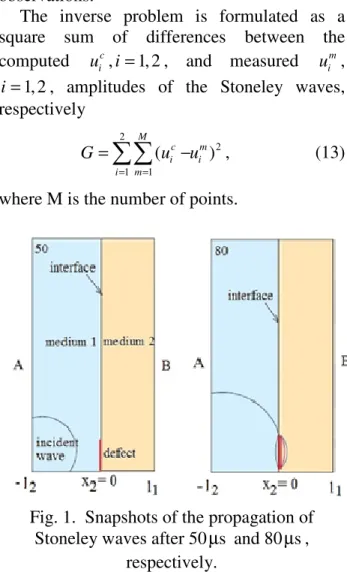
Snapshots of the propagation of Stoneley waves in the vicinity of the interface x2 =0 are shown in Figs. 1-3 for different moments of time. Dimension of layers are l1 =l2 =10cm, and the height is 25cm. Time progression is to the right. One rectangular small effect of size
1×0.5 mm into the bond x2 =0 is represented by a red line. The source located on the face A send a signal to the interface, and the receiver on the face B measures the amplitudes of the arriving signals.
The problem to be addressed here is the inverse of the forward problem. We seek to determine information about the location and size of the defect by using measured signals on the face B.
The aim is to use the difference between measured amplitudes of waves and predicted by theory amplitudes to provide a procedure, which iteratively corrects the results to the least discord between predictions and experimental observations.
The inverse problem is formulated as a square sum of differences between the computed uic,i=1, 2, and measured uim,
1, 2
i= , amplitudes of the Stoneley waves, respectively
2
2
1 1
( )
M
c m i i i m
G u u
= =
=
∑∑
− , (13)where M is the number of points.
Fig. 1. Snapshots of the propagation of Stoneley waves after 50 sµ and 80 sµ ,
respectively.
denoted byΓn. Expression of the indicator εA
in terms of boundary integrals is
2
( ) 1 ( )
n A
A A
Γ
ε = −
Γ , A S( 0)=
∫
S dSy, (14)where S is an arbitrary sphere of radius 0.5 that contains the defect.
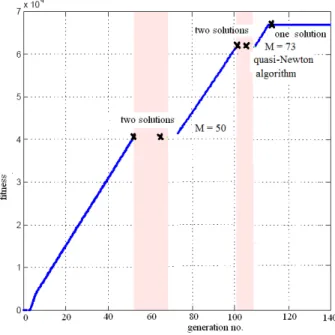
The knowledge of measured Stoneley signals is sufficient to determine the location and the defect. Our numerical experiments show that for M<30, the genetic algorithm has no solution. For M above this value, we obtain two solutions independent of the number of generations.
Fig. 2. Snapshots of the propagation of Stoneley waves after 120 sµ and 150 sµ ,
respectively.
Fig. 3. Snapshots of the propagation of Stoneley waves after 200 sµ and 250 sµ ,
respectively.
The genetic algorithm presents two solutions if number of generations is smaller than 107 and one solution after 112 iterates. For example, after 107 iterates, two solutions are obtained for M = 50 (see Fig. 4).
To get a single solution, we complete the genetic algorithm with a global minimisation procedure. So, the minimization algorithm has two steps: a genetic algorithm and a global minimisation procedure (quasi-Newton).
Fig. 4. Number of solutions of the genetic algorithm depending on the number of
generations.
Fig. 5. Displacement u1 in the interface with/without defects.
for a quasi-Newton algorithm. The final results give the size of the defect 0.98×0.53 mm. The location is also obtained in a unique manner.
The fitness value shows a closer correspondence of predicted and measured values of amplitudes. Fig.5 presents the displacement u1 for the interface with/without defects. It is observed the difference between the response of the Stoneley waves when the interface contains a defect.
4. CONCLUSIONS
Stoneley’s waves occur at the interface between two solids. The higher energy, as well as Rayleigh’s waves, is present in the interface and shows an exponential decay away from the interface. Stoneley waves are sharply attenuating outside of boundary. Properties of these waves show intensiveness of those waves which is considerably higher than of compressional waves. Their velocity is smaller than one of shear wave.
The inverse approach for evaluation the quality of the adhesive layer is based on the sensibility of Stoneley wave to defects. The inverse problem minimizes the least square
distance between computed and measured wave signals arriving to receiver. The minimization algorithm has two steps: a genetic algorithm and a global minimisation procedure (quasi-Newton) in order to obtain a single solution.
Based on the interaction of Stoneley waves with defects we show that it is possible to identify, in a unique manner, the location and size of the defect.
REFERENCES
[1] Light, G.M., Kwun, H., Nondestructive evaluation of adhesive bond quality, Southwest Research Institute, San Antonio, Texas, 1989.
[2] Jones, J.P., Whittier, J.S., Waves at a flexibly bonded interface, Journal of Applied Mechanics, 905-909, 1967.
[3] Claus, R.O., Kline, R.A., Adhesive bond line interrogation using Stoneley wave methods, Journal of Applied Physics, 50(12), 8066-8069, 1979.
[4] Franklin, H., Rousseau, M., Gatignol, P.,
Scholte-Stoneley Waves in a multilayered medium with elastic bond conditions at an interface, Physical Acoustics, pp 327-334, 1991.
[5] Ting, T.C.T., Rayleigh waves, Stoneley waves, Love waves, Slip waves and one-component waves in a plate or layered plate, Journal of Mechanics of Materials and Structures, 4(4), 631-647, 2009.
[6] Ting, T.C.T., Steady waves in an anisotropic elastic layer attached to a half-space or between two half-half-spaces - a generalization of Love waves and Stoneley waves, Math. Mech. Solids, 14(1-2), 52-71, 2009.
[7] Wang, L., Gundersen, S.A., Existence of one component surface waves in anisotropic elastic media, Phys. Scripta. 47(3), 3394-404, 1993.
[8] Shuvalov, A.L., General relationship for guided acoustic waves in anisotropic plates, P. Roy. Soc. Lond. A Mat., 460, 2049, 2671–2679, 2004.
[9] Shuvalov, A.L., Every, A.G., Some properties of surface acoustic waves in anisotropic-coated solids, studied by the impedance method, Wave Motion, 36(3), 257–273, 2002.
[10] Achenbach, J.D., Wave propagation in elastic solids, North-Holland Publ. Comp., Amsterdam, 1976.
[11] Pham, C. V., Pham, T.H.G., On formulas for the velocity of Stoneley waves propagating along the loosely bonded interface of two elastic half-spaces, Wave Motion, 48, 46–56, 2011.
[12] Qiang L,B., Lu, T., A Stoneley wave method to detect interlaminar damage of metal layer composite pipe, Frontiers of Mechanical Engineering, 10(1), 89–94, 2015.
O PROBLEMA INVERSA PENTRU EVALUAREA OBLIGATIUNILOR DE CALITATE PRIN UTILIZAREA UNDELOR STONELEY
Abstract: Lucrarea investighează evaluarea calității stratului adeziv pe baza sensibilitatii propagarii undelor Stoneley in prezenta defectelor. Problema inversă utilizeaza metoda celor mai mici pătrate pentru a minimiza distanta dintre semnalele de undă calculate și semnalele de unda inregistrate. Algoritmul de minimizare are doi pași: un algoritm genetic și o procedură globală de minimizare (cvasi-Newton), in scopul de a obtine o solutie unica. Bazându-ne pe interacțiunea undelor Stoneley cu proprietățile adezivului si cu defectul, arătăm că este posibil să identificam, într-o manieră unică, pozitia și dimensiunea defectului.
Veturia CHIROIU, PhD., Senior Researcher CS1, Institute of Solid Mechanics, Dept. of Deformable Media and Ultrasonics, E-mail: [email protected], Office Phone: +40213153810, Mobil: +40745989267.
Dan DUMITRIU, PhD., Senior Researcher, Institute of Solid Mechanics, Dept. of Deformable Media and Ultrasonics, E-mail: [email protected], Office Phone: +40213153810, Mobil: +40721397848
Iulian GIRIP, PhD., Scientific Researcher, Institute of Solid Mechanics, Dept. of Deformable Media and Ultrasonics, E-mail: [email protected], Office Phone: +40213153810, Mobil: +40726614014.
Valeria MOSNEGUTU, PhD., Senior Researcher, Institute of Solid Mechanics, Dept. of Deformable Media and Ultrasonics, E-mail: [email protected], Office Phone: +40213153810, Mobil: +40723286618.