INTEREST GROUPS IN THE FIELD OF AGRICULTURAL
POLICY: WHO ARE THEY AND WHAT DO THEY DO?
Vitalija Simonaitytė, Ligita Šarkutė
Lithuanian Institute of Agrarian Economics A. Vivulskio Str. 4A-13, LT-03220, Vilnius
DOI: 10.13165/VPA-20-19-2-09
Annotation. This article analyses interest groups in the agricultural sector in Lithu-ania, and compares them with the rest of the population of interest groups across other sec-tors at the national level. The analysis is based on data from the International Comparative Interest Group Survey (CIGS). A survey of organizations representing various interests was carried out from September to November 2016, and covered all Lithuanian interest organi-zations operating at the national level. The survey was designed to clarify the development of these organizations, their daily activities, and their applied strategies, as well as identify-ing the challenges they face. In accordance with this study, the aim of this article is to iden-tify the profile and specificity of interest groups in the field of agricultural policy. The data showed that the share of agricultural interest groups is one of the largest amongst the rest of the population of Lithuanian national interest groups, but the number of members of this sector’s interest groups is lower than average. In the agricultural sector, interest groups are distinguished by the fact that they are clearly dominated by sectoral associations – one of the types of business groups. The Lithuanian agricultural interest organizations that were analysed apply both direct and indirect pressure strategies equally, but they are more likely than other organizations to contact the representatives of the state bureaucratic apparatus. These are predominantly bureaucrats working in ministries and ministers themselves, al-though it has to be mentioned that members of the Seimas were also frequently in contact with the Lithuanian agricultural interest organizations under study.
Keywords: interest groups, mapping interest groups, agricultural policy, lobbying, pressure strategies.
Introduction
Interest organizations are an integral part of any democratic process and, more gen-erally, of a democratic state, because they are the structure that expresses or distinguishes socially relevant needs and requirements from society to political system (Krupavičius 1999, 155). Researchers analysing interest organizations emphasize the study of various aspects of them, including: the typology and/or degree of institutionalization; the type and size of membership; the involvement of interest groups in public policy; their activi-ties and the strategies by which they seek to influence public policy; their activity chan-nels, i.e. what institutions and/or politicians interest organizations are seeking access to and how often; and many other aspects of interests groups’ behaviour.
Interest groups are defined as formal membership-based organizations that do not seek political authority but may seek to influence public policy (Beyers et al. 2008, 1106; Lukošaitis 2004, 184). According to this definition, organizations that meet four criteria are considered to be interest groups: first, they are voluntary membership organizations; second, they have certain supporters, such as members or supporters of common in-terest, and they represent their interests or the interests of those who cannot represent themselves (e.g. children, animals, environment); third, they have a clear organizational structure and operate in accordance with certain rules laid down in the organisation’s statute; and fourth, they do not seek political authority but seek or have the potential to influence government decisions.
One of the factors defining interest groups is their type. Although there have been many attempts to classify interest groups, there is no unified typology of interest groups so far. M. T. Vassallo (2015, 50–55) proposes to classify interest groups according to four criteria. First, the most widely used criteria for categorizing interest groups is the functional, or representational, basis. In this regard, groups are classified according to the policy domain in which they are active, such as economic, socio-cultural, environmen-tal, equality and justice, faith, and public interest. Second, groups can also be differenti-ated in accordance with their core mission(s) or raison d’être, which can be categorized into two broad sections: protectionist, which protect the interests of their supporters; and promotional, which raise and protect the public interest. Third, interest groups can be divided into insider and outsider groups (a notion developed by Grant [2000]), depend-ing on their relationship with central executive authorities. Fourth, regarddepend-ing their scale of operations and routes of influence, interest groups can be local, regional, national, European, or worldwide.
In this article, according to the project design and the adapted INTERARENA re-search logic (according to Fiske [2012]), all interest organizations analysed are grouped into nine types: trade unions, professional associations, business groups (associations), institutional associations, social groups, leisure or hobby groups, religious groups, public interest groups, and groups not belonging to any of the aforementioned types.
per-sons’ membership interest groups tend to act in areas of social and moral concern, such as human rights, environmental protection, or animal rights, i.e. where personal involve-ment is important but at the same time these groups are less institutionalized (Salisbury 1969; Gerber 1999, 66). Meanwhile, members of interest groups uniting legal persons participate in the activities of the interest group by representing their organization. Thus, membership of legal entities often requires greater involvement, harder representation of their interests, more extensive lobbying activities, and usually these groups are more institutionalized (Gerber 1999, 67).
Finally, when analysing interest groups, another very important question is not just what interest organizations are, but what they do, how they do it, and where they rep-resent their interest and lobby. The impact of interest groups can be observed at various stages of the public policy process – from the formation of the political agenda to the pos-sible implementation of public policy (Bernhagen 2012, 559). Interest groups generally choose one of two types of pressure strategies: direct (or internal), or indirect (or external) strategies (Jordan and Halpin 2003; Grant 2004; Binderkrantz 2005; Fraussen et al. 2015; Dür and Mateo 2016; Hanegraaff et al. 2016). Internal strategies refer to direct access to decision-makers at political or administrative levels, which are not usually clearly vis-ible in the public arena. Many interest groups choose to influence public policy silently and try to gain direct access to decision-makers. In addition to direct strategies, interest groups may try to attract the attention of policymakers via indirect activities, such as media campaigns to inform the public. Interest groups use a variety of media strategies to raise public awareness of a problem and put pressure on policymakers in the non-institutional area. Such external pressure helps to mobilize support from interest groups’ members and the general public, and to show policymakers the importance of a given problem. It can be argued that internal pressure strategies privatize and reduce conflict, while external lobbying strategies, by engaging relevant stakeholder audiences, social-ize the conflict (Kollman 1998; E. E. Schattschneider’s book The Semisovereign People: A Realist’s View of Democracy in America, published in 1960 [quoted in Jankauskaitė 2018, 49]).
Research methodology1
This article analyses data from the survey of Lithuanian national interest groups con-ducted from September to November in 2016.2 In the project (and in this article), interest groups have been defined as voluntary membership-based organized groups that bring together individuals with common goals to represent their interests and the interests of those who cannot represent themselves (children, animals, environment) as they seek to influence public policy on those interests. Such a definition of interest groups includes trade unions at the national level, business associations, public interest groups, leisure groups, religious groups, and many others.
In order to be able to conduct a representative survey of Lithuanian national inter-est groups it was first necessary to identify them, which is why a map of national in-terest groups in Lithuania was developed. In scientific literature there are two types of approaches to developing a map of interest groups: the ‘bottom-up’ and ‘top-down’ ap-proaches. In the first case, researchers are concerned with interest mobilization and the changes of interest groups, i.e. which organizations are emerging and disappearing, what interests they represent, and whether they are interested in processes that regulate the density and diversity of interest groups and their development (Berkhout et al. 2018, 46). A second mapping strategy for interest organizations is the ‘top-down’ strategy, and it is related to the identification of interest organizations based on the monitoring of their political activities in relation to ongoing policy processes in a particular area of public policy. This strategy is most appropriate when looking at how organized interests influ-ence policy decisions (Berkhout et al. 2018, 46). As no map of national interest groups has been developed in Lithuania at all, and in order to identify all interest organizations operating at a national level, a ‘bottom-up’ strategy was employed.
The selection of the national interest groups was carried out in five stages. As there is no publicly accessible register of interest organizations in Lithuania, the online busi-ness register (rekvizitai.vz.lt)3 was chosen for their mapping. In the first phase, 13,215 different unions, foundations, and associations active at national, regional, and local lev-els were selected. In the second selection phase, 3,540 interest groups remained after all regional and local interest organizations were rejected, as well as those which did not meet the definition of an interest group. In the third stage, the list of interest groups was supplemented by the lists of interest groups published by the ministries of the Republic of Lithuania, as well as those that were not included in any of the above lists but were
1 The research methodology of Lithuanian interest group mapping was developed by the research group (L. Šarkutė, A. Krupavičius, V. Jankauskaitė, and V. Simonaitytė) who carried out the comparative interest group research project in Lithuania. The methodology has also been previously described by Jankauskaitė (2017; 2018).
2 The survey in Lithuania was carried out in the framework of the scientific project “Party-Interest Group Relationship: Character, Causes, Consequences”, funded by the Research Council of Lithuanian (Contract No. MIP-030/2015).
known to the research group as they were quite active in the public policy process. At this stage a total of 3,628 interest groups that operate at the national level were selected. In the fourth stage, each interest group was re-examined according to two criteria: whether the organization had a website (or an active account on the Facebook social network); and whether its statutes had the interest-based functions of advocacy, representation, or lobbying activities, as well as the aim to advocate for the organisation’s values and/or the aim to influence public policy. After the fourth stage, out of 3,628 organizations, only 1,242 interest groups active at the national level remained. A ‘cross-examination’ of all the interest groups selected was carried out in the fifth stage of interest group selection procedure, eventually leading to the selection of 904 national interest organizations for the study. Forty percent of the interest groups selected participated in the survey, which allows us to draw reliable conclusions about the entire system of national interest groups in Lithuania. The survey questionnaire was answered in detail by 365 representatives of their organizations.
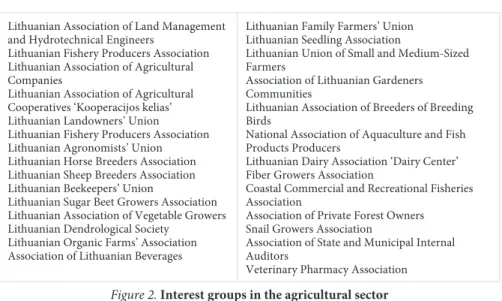
Thirty-three organisations (of the 365 which participated in the survey) were active in the field of agricultural policy, or 9% of the sample. This included not only associations such as the Lithuanian Farmers’ Union, the Lithuanian Organic Farms’ Association, or The Lithuanian Grain Processors’ Association, but also inter-sectoral organizations such as the Association of Lithuanian Banks, the Lithuanian Business Employers’ Confedera-tion, the National Beverage Producers AssociaConfedera-tion, the Eastern Europe Partnership and Investment Association, and others.
Research results and discussion Profile of agricultural interest groups
0.3 1.6 2.4 2.5 2.9 3.1 3.5 4.7 5.4 6.1 6.3 10.8 14.8 15.2 20.2
0 5 10 15 20 25
Foreign Affairs National Defence Energy Environment Social Security Transport and Communications
Financial Affairs Justice and Law Labor Market Agriculture Other Education and Science Culture Economy and Industry
Health Protection
Figure 1. Lithuanian national interest groups which participated in the survey, by public policy area, per cent (N = 365)
Interest groups active in the field of agriculture are listed in Figure 2.
The Association of Agricultural and Forestry Research Institutes
Garlic Industry Association Union of Associations ‘Fishermen’s Chambers’
Baltic Association of Fiber Growers and Processors
Association of Organic Producers and Traders
Livestock Practitioners Association Association of Rural Development and Business Consultants
Association of Fishermen’s Enterprises, Lampetra
Lithuanian Sea Buckthorn Growers Association
Lithuanian Shepherd Sheep Breeders Association
Lithuanian Greenhouse Association Lithuanian Farmers’ Union
Lithuanian Association of Planters and Ornamental Plant Growers
Lithuanian Cereal Growers Association The Lithuanian Grain Processors’ Association Lithuanian Union of Young Farmers and Youth Lithuanian Young Farmers’ Circles Union Lithuanian Black-and-White Cattle Breeders’ Association
Lithuanian Fur and Rabbit Breeders’ Association Lithuanian Pig Producers Association
Lithuanian Association of Beef Cattle and Breeders Lithuanian Association of Meat Processors Lithuanian Food Exporters Association Lithuanian Wood Industry Association
Lithuanian Association of Reclamation Companies Lithuanian Foresters Union
Lithuanian Forest Owners Association Lithuanian Association of Poor Land Users Lithuanian Association of Independent Wood Measurers
Lithuanian Orchid Society
Lithuanian Association of Land Management and Hydrotechnical Engineers
Lithuanian Fishery Producers Association Lithuanian Association of Agricultural Companies
Lithuanian Association of Agricultural Cooperatives ‘Kooperacijos kelias’ Lithuanian Landowners’ Union Lithuanian Fishery Producers Association Lithuanian Agronomists’ Union Lithuanian Horse Breeders Association Lithuanian Sheep Breeders Association Lithuanian Beekeepers’ Union
Lithuanian Sugar Beet Growers Association Lithuanian Association of Vegetable Growers Lithuanian Dendrological Society
Lithuanian Organic Farms’ Association Association of Lithuanian Beverages
Lithuanian Family Farmers’ Union Lithuanian Seedling Association
Lithuanian Union of Small and Medium-Sized Farmers
Association of Lithuanian Gardeners Communities
Lithuanian Association of Breeders of Breeding Birds
National Association of Aquaculture and Fish Products Producers
Lithuanian Dairy Association ‘Dairy Center’ Fiber Growers Association
Coastal Commercial and Recreational Fisheries Association
Association of Private Forest Owners Snail Growers Association
Association of State and Municipal Internal Auditors
Veterinary Pharmacy Association Figure 2. Interest groups in the agricultural sector
Membership type. The type of membership of agricultural interest groups is usually mixed, i.e. involving both personal and organizational membership, as 43% of all agri-cultural interest groups have mixed membership (see Figure 3). Almost one third of the agricultural sector interest groups have only organizational membership, i.e. where the association has only legal members, while the smallest amount of agricultural interest groups have personal membership, i.e. where the association has only ‘natural persons’ as members. Personal membership appears in one quarter of all agricultural interest groups. Comparing organizations in the agricultural sector with the analysed population of interest groups, the situation is different: almost half (46.1%) of all interest groups have only ‘natural persons’ as members, one third (33.3%) have only legal persons, and only around one fifth (20.6%) have a mixed membership.
33.3
46.1 20.6
32.1 25.0
42.9
0 5 10 15 20 25 30 35 40 45 50
Organisational Personal Mixed
Agricultural IG Final survey sample of IG
Interest group size. Analysing the size of interest groups in the agricultural sector, the number of members (including mixed membership) of ‘natural persons’ ranges from 4,000 to only 2, with a mean of 440 and a median of 26. The number of members of legal organizations (including mixed membership) ranges from 3 to 59, with a mean of 21 and a median of 17. Comparing organizations in the agricultural sector with the entire surveyed population of interest groups, the mean number of members of an agricultural interest group is lower than the mean of other groups: the number of members (includ-ing mixed membership) of natural persons’ organizations ranges from 1 to 40,000 (with a mean of 736 and a median of 76) and the number of members of legal persons’ orga-nizations (including mixed membership) ranges from 1 to 3 528 (mean 61, median 17).
Interest groups by type. The following classification has been applied for the analysis of the type of interest groups:
I. Trade unions.
II. Occupational associations.
III. Business groups (associations): the employers’ association; sectoral association; umbrella association; or other business associations.
IV. Institutional associations: associations of public administration institutions; or as-sociations of other public sector bodies.
V. Identity groups: patient groups; groups of seniors; student and youth groups; mi-nority groups; or other social groups.
VI. Hobby/leisure groups: sports organizations; or other leisure and hobby organiza-tions.
VII. Religious groups: Christian groups; or other religious groups.
VIII. Public interest groups: environmental protection; humanitarian-international; hu-manitarian-local; consumers; human rights and equal opportunities organizations; or others.
IX. Other groups.
5.0
29.3 26.7 4.6
12.8 10.5 0.1
8.8 2.2
11.5
77.0 3.3
3.2 3.3 0.0
1.6 0.0
0 20 40 60 80
Trade unions Occupational associations Bussiness groups (associations) Institutional associations Identity groups Hobby/leasure groups Religious groups Public interest groups Other groups
Agricultural interest groups (N=33) Final survey sample (N=365)
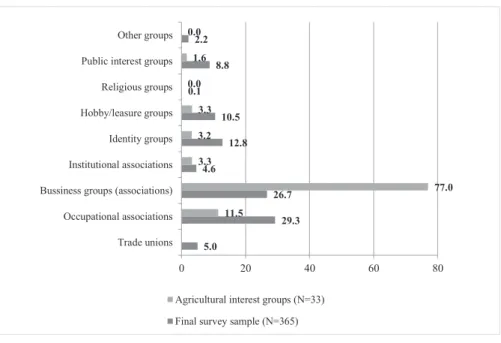
Figure 4. Final survey sample and agricultural interest groups by group type (%)
Most of the organizations representing agricultural interests are sectoral associations, which accounts for almost three quarters of all organisations. More than a tenth of the agricultural sector interest groups are professional associations, while umbrella asso-ciations, non-governmental public sector assoasso-ciations, and non-sports based leisure or hobby organizations account for just over 3% of the population of all agricultural interest groups. Organizations representing the interests of students, youth groups, and other social groups, as well as environmental groups, are active in the agricultural sector. It is noteworthy that there are no trade unions or sports organizations in the agricultural sec-tor. Professional associations (29.3%) and sectoral associations (21.2%) have the highest proportion of the total population of national interest groups. It should be noted that the population of agricultural sector interest groups is distinguished by the fact that it is clearly dominated by business groups – more specifically, sectoral associations.
Specific activities of interest groups in the field of agricultural policy
they were acting in the field of defence policy (3.6%). A substantially larger proportion of the interest groups identifying themselves as being involved in agricultural policy (20 or-ganizations) stated that they were very involved, while others (13 oror-ganizations) said that they were only somewhat involved. Interest groups involved in the field of agricultural policy are presented in Figure 5.
Environmental Coalition
Association ‘Lithuanian Food Industry’ Association ‘National Food Cluster
Baltic Hanoverian Horse Breeders’ Association Association for Nature Conservation ‘Baltic Wolf’
Association of Rural Development and Business Consultants
Lithuanian Horse Breeders’ Association Association of Lithuanian Banks Lithuanian Employers’ Confederation Lithuanian Vegetable Producers Association Lithuanian Grain Processors’ Association Lithuanian White Backed Cattle Improvers’ Association Lithuanian Rural Communities Union
Lithuanian Pig Breeders’ Association Lithuanian Trade Union of Food Producers Lithuanian Association of Beef Cattle Breeders and Improvers
Lithuanian Meat Processors’ Association Forest Owners Association of Lithuania Lithuanian Scientific Society
Lithuanian Ornithological Society Lithuanian Confederation of Industrialists Lithuanian Trade Union Confederation Association of Local Authorities in Lithuania Lithuanian Builders Association
Lithuanian Farmers’ Union
Lithuanian Association of University Botanical Gardens
Lithuanian Wind Power Association Lithuanian Veterinary Association
Union of Local Community Organizations in Lithuania
Association of Lithuanian Agricultural Cooperatives ‘The Way of Cooperation’ National Association of Beverage Manufacturers Association of Private Forest Owners
Eastern Europe Partnership and Investment Association
Figure 5. Interest groups involved in the field of agricultural policy
In Figure 5 it can be seen that in the field of agricultural policy not only those interest groups that are exceptionally attributable to this field are involved, but also business in-terest groups such as the Association of Lithuanian Banks, the Lithuanian Confederation of Industrialists, and the Eastern Europe Partnership and Investment Association, which usually act in different public policy sectors. Issues of agricultural policy are also impor-tant to the Association of Local Authorities in Lithuania, the Lithuanian Trade Union Confederation, and the Lithuanian Scientific Society, as well as for associations dealing with issues of the environment and energy such as the Environmental Coalition and the Lithuanian Wind Power Association.
entire population, there is a similar trend in the size of membership in interest groups uniting corporations or firms, while the interest groups consisting of individuals are much bigger in membership size.
Table 1. Number of different types of members of interest groups in the field of agricultural policy
Number of members
Types of members
Individuals Corporations or firms Government entities organizationsOther
None 10 6 14 11
Up to 10 1 4 5 4
11–50 3 11 0 4
51–100 4 1 1 1
101–500 2 2 0 1
501–1 000 3 0 0 0
1 001–25 000 2 1 0 1
25 001– 50 000 0 0 0 0
50 001– 75 000 1 0 0 0
Total (N) 26 25 20 22
8 10
13 13 14
16 17
18 23
29 31
0 5 10 15 20 25 30 35
Monitoring the election campaigns of political parties Promoting volunteering Research Recruiting members, supporters or donors
Fundraising
Advocacy/lobbying Support or advice to clients or beneficiaries Media campaigns Mobilizing members Support or advice to members Representation
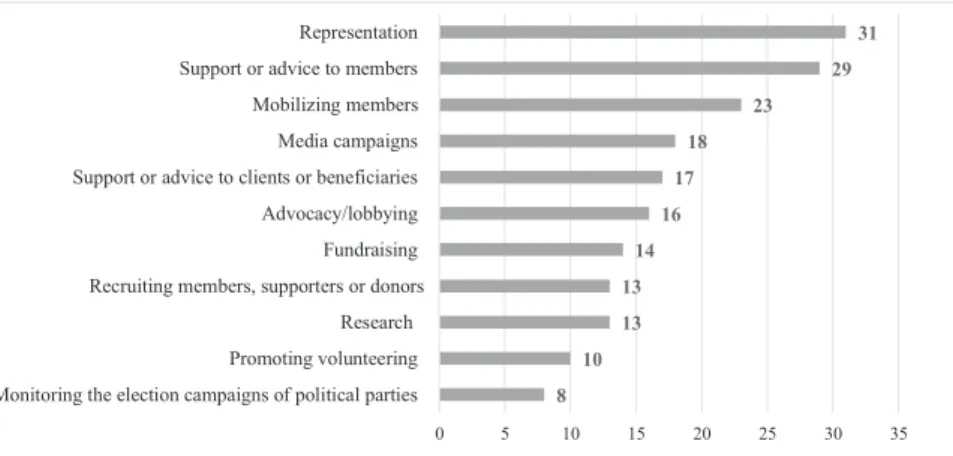
Figure 6.Activities in which interest groups in the field of agricultural policy were involved (N = 32)
Compared to the answers of the other interest groups which participated in the sur-vey, it is evident that the most frequently mentioned activity was providing support and advice to members, and only then representation of interests followed. Media campaigns were mentioned less often than in the case of agricultural interest groups, and the pro-motion of volunteering was mentioned more often than fundraising. The least frequently mentioned activity, as with interest groups in the agricultural sector, was the monitor-ing of political campaigns, which was mentioned by only one tenth of the organizations surveyed.
When discussing the frequency of interest groups’ activities, it is evident that a large percentage of the interest groups in the field of agricultural policy stated that they very frequently engage in interest representation, support or advice to members, mobilizing members, advocacy or lobbying, and promoting volunteering. Media campaigns, fund-raising, and monitoring of the election campaigns of political parties were mentioned as activities in which agricultural interest groups said that they engage only occasionally. In terms of involvement in research, recruiting members, supporters, and donors, and offering support or advice to clients or other beneficiaries, there was quite an equal dis-tribution between claiming to engage in these activities very often and claiming to engage in these activities only occasionally.
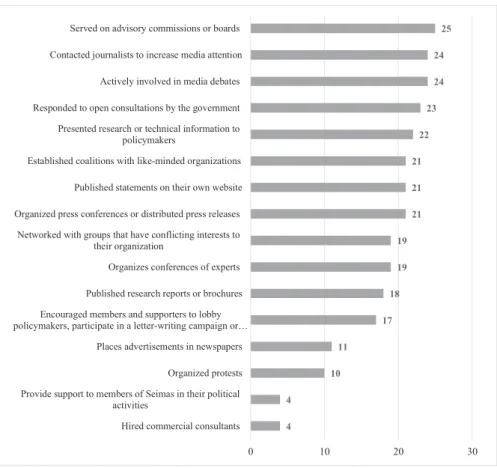
open consultations by the government; presenting research or technical information to policymakers; establishing coalitions with like-minded organizations; publishing state-ments and position papers on the organization’s website; organizing press conferences or distributing press releases; networking with groups that have conflicting interests to their organization; publishing research reports or brochures; and encouraging members and supporters to lobby policymakers by participating in a letter-writing campaign or signing petitions directed at public officials (see Figure 7). Placing advertisements in newspapers and magazines and organizing protests involving members and supporters (e.g. strikes, consumer boycotts, public demonstrations) were much less frequently mentioned. The least used activities, mentioned only by less than one tenth of agricultural sector interest groups, were providing support to members of Seimas in their political activities (elec-toral campaigns) and hiring commercial consultants (agents who are paid to try to influ-ence policymakers on behalf of their organization).
4 4
10 11
17 18
19 19
21 21 21 22
23 24 24 25
0 10 20 30
Hired commercial consultants Provide support to members of Seimas in their political
activities
Organized protests Places advertisements in newspapers Encouraged members and supporters to lobby policymakers, participate in a letter-writing campaign or…
Published research reports or brochures Organizes conferences of experts Networked with groups that have conflicting interests to
their organization
Organized press conferences or distributed press releases Published statements on their own website Established coalitions with like-minded organizations Presented research or technical information to
policymakers
Responded to open consultations by the government
Actively involved in media debates
Contacted journalists to increase media attention Served on advisory commissions or boards
Interest groups’ pressure strategies can be divided into direct strategies (e.g. meetings with politicians and civil servants) and indirect strategies (e.g. media use, letter writ-ing, email or social media campaigns, rallies and demonstrations). In the survey, interest groups were asked how they divide their time between direct and indirect strategies to influence public policy. The data shows that the majority of interest groups, 12 organiza-tions, were engaged with direct strategies, and more than half of their time was devoted to influencing political decisions. A somewhat smaller number, 9 organizations, were likely to rely on indirect pressure strategies. Finally, 8 interest groups said that they divide their time equally between direct and indirect strategies. Comparing the responses of agricultural interest groups with those of other sectors, there is an even more clear trend towards devoting a much larger share of their time to direct pressure strategies. 75% of these interest groups even stated they devoted half or more of their time to implementing direct strategies to affect public policy.
Interaction between interest groups and policy decision-makers can be initiated by either side – i.e. by both the interest organizations and politicians or civil servants them-selves. The survey data, presented in Figure 8, shows that these interactions are more often initiated by agricultural interest groups, but policymakers are also quite active. The opposite trend is seen in the case of interest groups form other public policy sectors, where policymakers are much less proactive – 40% of these respondents even said that communication with interest groups has never been initiated by policymakers. In this respect, the agricultural sector could be distinguished by the willingness of policymakers to initiate and maintain dialogue with interest groups in this sector.
6 7
12 8
6
15 8
4
0 5 10 15 20
Never At least once during past year At least once every three
months At least once a month
Initiated by policymakers Initiated by organization
Figure 8. Frequency of interactions between interest groups in the field of agricultural policy and policymakers(N = 33)
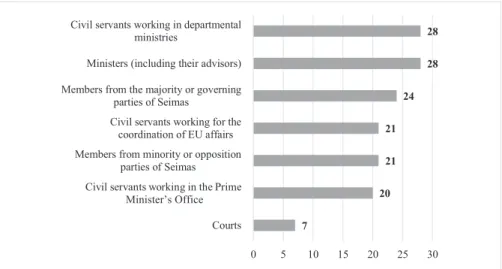
interest groups which participated in the survey said that they had actively sought access to these institutions at least once during the past year (see Figure 9). Somewhat rarer, but still quite frequent, were attempts made to seek access to members from the majority or governing parties of Seimas, as well as civil servants working for the coordination of EU affairs, members from minority or opposition parties of Seimas, and civil servants work-ing in the Prime Minister’s Office. Courts as a potential arena of interest groups’ pressure were mentioned by one fifth of respondents only.
7
20 21 21
24 28 28
0 5 10 15 20 25 30
Courts Civil servants working in the Prime
Minister’s Office Members from minority or opposition
parties of Seimas Civil servants working for the
coordination of EU affairs Members from the majority or governing
parties of Seimas
Ministers (including their advisors) Civil servants working in departmental
ministries
Figure 9. Institutions to which interest groups in the field of agricultural policy actively sought access (N = 33)
Compared to interest groups in other sectors, a very similar trend has been observed: the main influence of interest groups is directed towards the executive, and the courts are the institutions through which public policy is least likely to be influenced.
Conclusions
proportion of interest-based organizations at the national level. Thus, the data shows that agricultural interest groups constitute a relatively large proportion compared to other public policy sectors.
2. The analysis of empirical data revealed that the general population of interest groups acting at the national level is predominantly composed of professional associations and sectoral associations, but the population of interest groups acting in the agricultural sector is clearly dominated by business groups, specifically by sectoral associations. In the field of agricultural policy there are not only traditional agricultural interest groups involved, but also a variety of business interest groups such as the Association of Lithu-anian Banks and the LithuLithu-anian Confederation of Industrialists. Issues of agricultural policy are also a target for pressure groups representing the interests of local govern-ments, scientists, or associations dealing with environmental issues and energetics. 3. The Lithuanian interest groups analysed in the field of agricultural policy use both
di-rect and indidi-rect pressure strategies. Most agricultural interest groups that participated in the survey said that they had served on advisory commissions or boards, contacted journalists, participated in media debates, or responded to open consultations by the government. It should also be noted that a large number of the organizations analysed not only actively engaged in the existing policy agenda, but also sought to influence it by using such instruments as providing research results to policy makers, publish-ing statements, organizpublish-ing press or experts conferences, or networkpublish-ing with groups that have conflicting interests to their organization in order to raise awareness of their concerns.
4. Interaction between interest groups and policymakers can be initiated by either side. In the case of Lithuanian agricultural interest groups, this interaction is more often initiated by interest groups themselves, but policymakers are also quite active. The op-posite trend is seen in the case of interest groups from other public policy sectors, where almost half of them said that communication with interest groups has never been initi-ated by policymakers. In this respect, the agricultural sector could be distinguished by the willingness of policymakers to initiate and maintain dialogue with interest groups in this sector.
References
1. Berkhout, J., J. Beyers, C. Braun, M. Hanegraaff, and D. Lowery. 2018. “Making In-ference across Mobilization and Influence Research: Comparing Top-Down and Bottom-Up Mapping of Interest Systems.” Political Studies 66 (1): 43–62. https://doi. org/10.1177/0032321717702400.
2. Bernhagen, P. 2012. “Who Gets What in British Politics – and How? An Analysis of Media Reports on Lobbying around Government Policies, 2001-7. Political Studies 60 (3): 557–77. https://doi.org/10.1111%2Fj.1467-9248.2011.00916.x.
3. Beyers, J., R. Eising, and W. Maloney. 2008. “Researching Interest Group Politics in Europe and Elsewhere: Much we Study, Little we Know?” West European Politics 31 (6): 1103–28. https://doi.org/10.1080/01402380802370443.
4. Binderkrantz, A. 2005. “Interest Group Strategies: Navigating Between Privileged Access and Strategies of Pressure.” Political Studies 53 (4): 694–715. https://doi. org/10.1111%2Fj.1467-9248.2005.00552.x.
5. Dür, A., and G. Mateo 2016. Insiders versus Outsiders: Interest Group Politics in Multi-level Europe. Oxford: Oxford University Press.
6. Fiske, H. M. 2012. Development of the Danish Interest Group Population. Project de-scription prepared for the annual meeting of the Danish Political Science Association, Vejle, 25–26 October 2012.
7. Fraussen, B., J. Beyers, and T. Donas. 2015. “The Expanding Core and Varying Degrees of Insiderness: Institutionalized Interest Group Involvement through Advisory Coun-cils.” Political Studies 63 (3): 569–88. https://doi.org/10.1111/1467-9248.12112. 8. Gerber, E. R. 1999. The Populist Paradox: Interest Group Influence and the Promise of
Direct Legislation. Princeton: Princeton University Press.
9. Grant, W. 2000. Pressure Groups and British Politics. Palgrave London. https://doi. org/10.1007/978-1-349-15022-9.
10. Grant, W. 2004. “Pressure Politics: The Changing World of Pressure Groups.” Parlia-mentary Affairs 57 (2): 408–19. https://doi.org/10.1093/pa/gsh033.
11. Hanegraaff, M., J. Beyers, and I. De Bruycker. 2016. “Balancing Inside and Outside Lob-bying: The Political Strategies of Lobbyists at Global Diplomatic.” European Journal of Political Research 55 (3): 568–88. https://doi.org/10.1111/1475-6765.12145.
12. Jankauskaitė, V. 2017. “Lietuvos interesų grupių europeaizacijos veiksniai [European-isation of Lithuanian Interest Groups and Its Determinants].” Viešoji politika ir admini-stravimas [Public Policy and Administration] 16 (1): 24–39. http://dx.doi.org/10.5755/ j01.ppaa.16.1.18011.
13. Jankauskaitė, V. 2018. “Lietuvos interesų grupių organizacinė ir politinė elgsena ir jos veiksniai [Organizational and Political Behaviour of Lithuanian Interest Groups and Its Determinants].”PhD diss., Kaunas University of Technology.
15. Kollman, K. 1998. Outside Lobbying: Public Opinion and Interest Group Strategies. Princeton, NJ: Princeton.
16. Krupavičius, A. 1999. “Interesų grupės: sandara, klasifikacija ir efektyvumas [Interest Groups: Structure, Classification, and Effectiveness].” In Šiuolaikinė valstybė [Contem-porary State], by J. Matakas. Kaunas: Technologija.
17. Lukošaitis, A. 2004. “Interesų grupės [Interest Groups].” In Lietuvos politinė sistema: sąranga ir raida [Lithuanian Political System: Structure and Development], by A. Krupavičius and A. Lukošaitis. Kaunas: Poligrafija ir informatika.
18. Salisbury, R. H. 1969. “The Exchange Theory of Interest Groups.” Midwest Journal of Political Science 13 (1): 1–32. https://doi.org/10.2307/2110212.
19. Thomas, C. S. 2004. “Interests and Interest Groups in the Public Policy Process: (II) The Traditional Interests—Business, Labor, Agriculture, Education, and Government.” In Research Guide to U.S. and International Interest Groups, edited by C. S. Thomas, 197–234. Westport: Praeger Publishers.
20. Vassallo, M. T. 2015. The Europeanization of Interest Groups in Malta and Ireland, A Small State Perspective. Palgrave Macmillan.
Vitalija Simonaitytė, Ligita Šarkutė
Žemės ūkio politikos srityje veikiančios interesų grupės:
kas jos ir ką veikia?
Santrauka
pat ir ministrais. Paminėta ir tai, kad Lietuvos žemės ūkio sektoriuje veikiančios interesų grupės siekia daryti poveikį ir įstatymui leidžiamajai valdžiai, t. y. Seimo nariams.
Vitalija Simonaitytė, PhD in Social Sciences, researcher at the Department of Rural Development at Lithuanian Institute of Agrarian Economics.
E-mail: [email protected]
Ligita Šarkutė, PhD in Social Sciences, senior researcher at Department of Rural Development at Lithuanian Institute of Agrarian Economics.
E-mail: [email protected]
Vitalija Simonaitytė, socialinių mokslų daktarė, Lietuvos agrarinės ekonomikos instituto Kaimo plėtros skyriaus mokslo darbuotoja.
El. paštas: [email protected]
Ligita Šarkutė, socialinių mokslų daktarė, Lietuvos agrarinės ekonomikos instituto Kaimo plėtros skyriaus vyresnioji mokslo darbuotoja.