HOME LITERACY PRACTICES AT 36 MONTHS AND
CHILDREN’S CONCURRENT AND LATER LANGUAGE AND LITERACY SKILLS FOR FAMILIES LIVING IN RURAL AREAS OF HIGH POVERTY
Eleni Zgourou
A dissertation submitted to the faculty of the University of North Carolina at Chapel Hill in partial fulfillment of the requirements for the degree of Doctor of Philosophy in the School of
Education
Chapel Hill 2018
Approved by:
Lynne Vernon-Feagans Mary Bratsch-Hines Harriet Able
iii ABSTRACT
Eleni Zgourou: Home Literacy Practices at 36 Months and Children’s Concurrent and Later Language and Literacy Skills for Families Living in Rural Areas of High Poverty
(Under the direction of Lynne Vernon-Feagans, Ph.D.)
iv
ACKNOWLEDGMENTS
This dissertation is dedicated to my family and all people who supported me throughout this path. First, I would like to thank my parents who instilled in me virtues like hard work, patience, determination, and passion on what I do. Although far from Chapel Hill, they have always been encouraging and supportive of my dreams. Their unconditional love has been my companion in both happy and challenging times since I left Greece.
I would like to thank my friend Anastasia who was the first to discern my scholarly qualities and paved the way for me to come to the United States. Next, I would like to thank my friend Sotiris who inspired and motivated me to follow an academic career and guided me in many ways throughout the process. I am also very thankful to all of my friends I met in Chapel Hill for their companionship, friendship, encouragement, and support throughout these years. Many thanks to Mark for carefully proofreading my dissertation.
v
TABLE OF CONTENTS
LIST OF TABLES ... vii
LIST OF FIGURES ... viii
Chapter I. INTRODUCTION ...1
Statement of the Problem ...1
Theoretical Foundations...5
II. LITERATURE REVIEW ...9
Introduction ...9
Importance of Early Language and Literacy Skills ...9
The Home Literacy Environment, Socioeconomic Status, and Ethnicity ...14
Home Literacy Practices and Children’s Language and Literacy Skills ...18
The Rural Context ...38
Limitation in the Existing Literature...40
Research Question ...42
III. METHODS ...44
Participants ...44
vi
Measures ...45
Data Analysis Plan ...49
IV. RESULTS ...51
Descriptive Information ...51
Home Literacy Practices and Child Language Skills at 36 Months of Age ...53
Home Literacy Practices and Child Language and Literacy Skills at Pre-K ...54
Home Literacy Practices and Child Language and Literacy Skills at Kindergarten ...55
V. DISCUSSION ...57
Frequency of Home Literacy Practices in High-Poverty Rural Areas ...57
Child Literacy Practices and Child Language and Literacy Skills ...61
Parent Literacy Practices and Child Language and Literacy Skills ...63
Parent-Child Literacy Practices and Child Language and Literacy Skills ...65
Limitations of the Study and Future Directions ...72
Significance of the Study ...76
Implications for Practice and Policy ...77
Conclusion ...81
APPENDIX ...99
vii
LIST OF TABLES Table
1. Descriptive Data (n = 1117 ...82
2. Descriptive Data on Home Literacy Practices Items (n = 1117) ...83
3. Frequencies of Home Literacy Practices (n = 1117) ...84
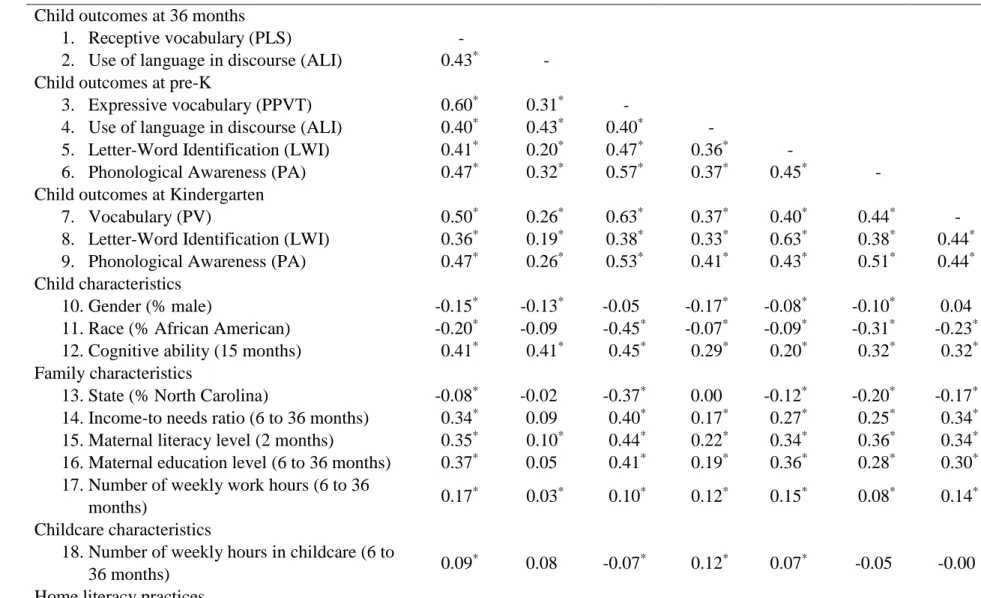
4. Correlations ...86
5. Regression Results with 36-Month Child Outcomes (n = 1117) ...92
6. Regressions Results with Pre-K Child Outcomes (n = 1117) ...93
viii
LIST OF FIGURES Figure
1. Conceptual Model ...95
2. Frequencies of Child Literacy Practices ...96
3. Frequencies of Parent Literacy Practices ...97
1
CHAPTER ONE Introduction Statement of the Problem
Language and literacy skills emerge long before children begin formal instruction and are important for children’s academic success (Whitehurst & Lonigan, 1998). The early language and literacy skills children bring at entry to kindergarten often predict their later academic achievement (Farver, Xu, Lonigan, & Eppe, 2013). Children who enter kindergarten with greater language and literacy skills are more likely to do better in later grades (Duncan et al., 2007). Other children, particularly children from low-income families, reportedly experience more reading difficulties, which are often evident at entry to kindergarten, compared to their middle-income peers (Snow, Burns, & Griffin, 1998; Washington, 2001).
In the United States, nearly half of children under the age of six, about 10.5 million children (45%), live in low-income1 families and about 5.3 million children (23%) live in poor2 families (National Center for Children in Poverty [NCCP], 2017). The percentage of children under the age of six living in poor and low-income families varies by race and region in which they live. African American children, in particular, are disproportionately low-income, with more than half of them (68%), about 2 million, living in low-income families. Given the disheartening national statistics on child poverty and the importance of language and literacy
2
skills in early years, research studies have placed increased attention on the ways these early language and literacy skills develop and the factors that support early language and literacy acquisition, especially for children who live in poverty (Farver et al., 2013; Snow et al., 1998). Because these skills emerge before children start school, a considerable body of research has acknowledged the role of the home literacy environment in the development of children’s early language and literacy skills (Farver et al., 2013; Sénéchal, Pagan, Lever, & Ouellette, 2008).
The home literacy environment encapsulates many different language and literacy experiences to which children are exposed at home. From one point of view, the provision of books, magazines, print and writing materials, as well as literacy and language games provides an opportunity for children to explore the world of literacy (Rodriquez et al., 2009). With access to materials, children can look at books by themselves and engage in their own literacy activities. Beyond merely exposing children to literacy-rich environments, parents can support children’s language and literacy development by modeling literacy behaviors, such as reading a newspaper when children are present (Symons, Szuskiewicz, & Bonnell, 1996). From another point of view, parents can play a more active role in children’s literacy development by promoting parent-child literacy practices, such as shared book reading, oral storytelling, teaching activities (Bus, van IJzendoorn, & Pelligrini, 1995; Scarborough & Dobrich, 1994), rhyming games (Bryant, MacLean, & Bradley, 1990), and library visits (Payne, Whitehurst, & Angell, 1994; Sénéchal, 2006).
3
book reading play a significant role in advancing child language and literacy skills (Raikes et al., 2006; Scarborough & Dobrich, 1994). Less is known, however, about children’s independent involvement in their own literacy practices (e.g., looking at books on their own) as well as parents’ engagement in their own literacy practices (e.g., reading a newspaper when children are present) in relation to children’s early language and literacy skills (Baroody & Diamond, 2012; Farver, Xu, Eppe, & Lonigan, 2006; Scarborough, Dobrich & Hager, 1991).
Moreover, by age three, most typically developing children, regardless of culture, talk well (Hoff, 2009; Kuhl, 2004; Topping, Dekhinet, & Zeedyk, 2013), and therefore, the language and literacy practices children experience by age three are critical (Rodriguez &
Tamis-LeMonda, 2011; Zauche, Thul, Mahoney, & Stapel-Wax, 2016). For example, Rodriquez and Tamis-LeMonda (2011) emphasized that the early home literacy environment children
experienced between 15 and 37 months of life was a significant predictor of their pre-K
vocabulary skills; on the contrary, the later home environment experienced at 60 months was not. Beyond looking at home literacy practices during a critical developmental period, it is important to consider the community context in which children live. Research has documented that the opportunities and limitations afforded by the community context may foster or hinder academic outcomes (Sharkey & Faber, 2014). In the domain of language and literacy
development, most studies have been conducted in urban and suburban areas. Little is known, however, about how home literacy practices operate in rural communities with high poverty rates.
Low-income rural regions are often characterized by limited access to resources, such as libraries, schools, childcare centers, and other health and human services (O’Hare, 2009;
4
limited access to theaters, zoos, aquariums, and museums, which could provide opportunities for language and cognitive stimulation (Froiland, 2011). Due to this more limited language and literacy exposure outside of the home, the literacy practices children experience in their homes may be even more important than those children experience in literacy-rich areas (Vernon-Feagans et al., 2013). Therefore, investigating home literacy practices in relation to child emergent language and literacy skills in families residing in rural areas is crucial. In addition, given the considerable percentage (22%) of children under the age of 18 living in rural areas (U.S. Census Bureau, 2016), understanding the role of home literacy practices on young children’s language and literacy development becomes imperative.
Taking all the above into consideration, the aim of this study was to examine how home literacy practices at 36 months of age relate to child early and later language and literacy skills in families living in low-income rural areas. Three types of home literacy practices were examined: (a) child literacy practices, defined as the practices in which children engage on their own (e.g., looking at books by themselves, (b) parent literacy practices, defined as the practices in which parents engage on their own (e.g., reading a newspaper), and (c) parent-child literacy practices, defined as the practices in which parents engage with their children (e.g., reading a book
together). The focus of this study was on the frequency of home literacy practices. In other words, the focus was on the active agents (child, parent, and parent-child) participating in the language and literacy-based interactions, and examined whether child literacy practices, parent literacy practices, and parent-child literacy practices contribute to children’s early language and literacy abilities above and beyond a number of demographic characteristics.
5
outcomes at three time points: at 36 months, in pre-K, and in kindergarten, controlling for a host of demographic and background characteristics.
Theoretical Foundations
The conceptual model that supports this dissertation posits that home literacy practices play a role on child language and literacy skills concurrently and longitudinally in a sample of families living in high poverty rural areas above and beyond demographic variables (see Figure 1). This model has its foundation in the bioecological theory of development, which purports that the proximal processes, or the interactive relationships between children and adults in children’s immediate environments, are the drivers of human development (Bronfenbrenner & Morris, 2006). Therefore, children’s early language and literacy skills are likely influenced by these adult/child relationships. These proximal processes vary as a function of the characteristics of the developing person, the environmental context, and the time in which these processes take place. Furthermore, the bioecological theory emphasizes that proximal processes are not limited to interactions among individuals but they include interactions with objects and symbols as well (Bronfenbrenner & Morris, 2006). With regard to literacy practices, proximal processes could include children’s interactions with literacy materials, their literacy-related interactions with parents, and their subjective experience of parents’ own literacy practices.
6
Morris, 2006). For bidirectional interactions to happen between children and objects, such as literacy materials, these objects must invite exploration, manipulation, and attention
(Bronfenbrenner & Morris, 2006). For instance, clean, well-maintained, colorful books with pictures that interest young children may attract their attention and make children more willing to interact with them.
Bidirectionality is also reflected in the relationship between child characteristics and home literacy practices (Bronfenbrenner & Morris, 2006). As Sameroff and MacKenzie (2003) argued, interactions between the child and the experiences provided by the family and the broader social environment influence child development (Sameroff & MacKenzie, 2003). For example, child characteristics like temperament may influence parenting behaviors, and parenting behaviors may impact child development as well (Sameroff & MacKenzie, 2003). Similarly, child characteristics appear twice in the bioecological model: (a) as factors that influence the power and direction of the interactive relationships and (b) as child qualities, “developmental outcomes” that emerge at a later time point as a result of the interactive relationships (Bronfenbrenner & Morris, 2006). For example, children’s biological
characteristics, such as cognitive ability, may influence the kinds and variety of literacy practices children and parents initiate, as well as the frequency with which these literacy practices are employed. In turn, the capacity of child characteristics to influence these interactions may impact later child skills, such as literacy abilities (Bronfenbrenner & Morris, 2006).
7
neighborhoods, in which children reside may influence language- and literacy-related
interactions and children’s language and literacy development. For instance, church or other religious institutions may play an important role on people’s lives in rural areas, and in turn on the kinds of literacy practices promoted at home (Teale, 1986). In addition, childcare centers and schools may be potential sources of home literacy practices. Literacy-related interactions
occurring in the neighborhood may also influence children’s language and literacy skills. In poor rural neighborhoods, however, chances for literacy exposure outside of the home may be slim and accessibility of high quality childcare centers and other educational institutions may be challenging. Such contextual factors may influence child literacy abilities (Clarke, Koziol, & Sheridan, 2017).
Lastly, time, during which proximal processes take place, influences child development as well. The timing in which interactions occur matters for child language and literacy
development (Rodriquez et al., 2011). In the present study, home literacy practices were measured at 36 months of child age. The bioecological theory emphasizes that in order for interactions to influence child development, they must take place regularly over a period of time. The frequency of home literacy practices was measured using a parent-reported tool and
distributed to parents when children were 36 months old. At the time of data collection, parents were asked to report how often specific home literacy practices take place in their households over a period of several months.
To summarize, this dissertation is grounded in a bioecological perspective with the aim of expanding our knowledge of the associations between different kinds of home literacy practices (child literacy practices, parent literacy practices, and parent-child literacy practices) at 36
8
(at 36 months, pre-k, and kindergarten) on the other, focusing on families in high-poverty rural areas. The context of low-income rurality is an important element of the study, given that most studies on home literacy practices concentrated on urban and suburban environments.
Furthermore, rather than simply investigating parent-child literacy practices, this study added child literacy practices and parent literacy practices to examine how their frequency contributes to child language and literacy skills above and beyond a number of background characteristics.
9
CHAPTER TWO
Literature Review
Introduction
In order to understand the role of home literacy practices in child language and literacy development, it is necessary to review the early language and literacy skills that are important for later literacy competencies. Next follows a review of studies on how each type of home literacy practices (child literacy practices, parent literacy practices, and parent-child literacy practices) is conceptualized and linked to child language and literacy outcomes. Limitations of the existing literature are discussed last, leading into the context and form of the research question of this study.
Importance of Early Language and Literacy Skills
10
awareness (e.g., identifying the individual sounds in a word) and alphabetic/grapheme knowledge (e.g., understanding that letters stand for sounds in words; Storch & Whitehurst, 2002). Both oral language and literacy skills have been linked to children’s reading competences (Storch & Whitehurst, 2002).
Language skills are associated with reading competences either directly (Dickinson, Gollinkoff, & Hirsh-Pasek, 2010; Dickinson, McCabe, Peisner-Feinberg, & Poe, 2003; Hammer, Farkas, & Maczuga, 2010; Hindman, Skibbe, Miller, & Zimmerman, 2010), or indirectly,
through other precursor abilities, such as phonological awareness (NICHD, Early Childcare Research Network, 2005; Storch & Whitehurst, 2002). Below, two of the key language skills, vocabulary and use of language in discourse, which were used in this study, are discussed.
Vocabulary. One of the major components of language is vocabulary, an important skill that facilitates children’s transition to school (Whitehurst & Lonigan, 1998). A larger
vocabulary is associated with greater alphabetic knowledge (Hindman et al., 2010), better word reading and spelling skills (Kim, Al Otaiba, Puranik, Folsom, & Gruelich, 2014), and improved number naming competences (LeFevre et al., 2010). Moreover, children with richer
vocabularies are more likely to have greater self-regulation and fewer internalizing and externalizing behavioral problems (Morgan, Farkas, Hillemeier, & Hammer, 2015). Similar associations between vocabulary and child emergent literacy skills were found in specific
groups, such as low-income samples (Hammer et al., 2010; Hindman et al., 2010). For example, Hindman and colleagues (2010) investigated 945 Head Start children’s learning trajectories from preschool through first grade and found that vocabulary skills in preschool were related to
11
vocabulary skills predicted their reading abilities (reading comprehension, print awareness, and letter recognition) in kindergarten.
Furthermore, vocabulary trajectories from 14 to 46 months of age, predicted children’s vocabulary at kindergarten (Rowe, Raudenbush, & Goldin-Meadow, 2012). These findings demonstrated that the faster children acquired vocabulary in their first years of life, the larger their vocabulary was at kindergarten. Most importantly, the relationship between early
vocabulary growth and later language skills was stronger for low-SES children than for higher-SES children (Rowe et al, 2012). This may be due to the fact that higher-higher-SES children may have other ways to improve their vocabulary in case they start out behind compared to their low-SES children (Rowe et al., 2012). Therefore, the need for children of low-SES backgrounds to get a jump start in vocabulary is especially important (Rowe et al., 2012).
12
helps children understand the story, fostering reading comprehension skills (Gardner-Neblett & Iruka, 2015; Schick & Melzi, 2010; Whitehurst & Lonigan, 1998).
Several empirical studies have found links between oral narrative skills and a number of child language and literacy competences (Feagans & Farran., 1994; Gardner-Neblett & Iruka, 2015; Gardner-Neblett & Sideris, 2017; Terry, et al., 2013). For example, in a low-income sample, Terry and colleagues (2013) found that the more complex children’s narrative skills were in terms of syntax and vocabulary at the beginning of preschool, the better children’s subsequent language skills were at the end of preschool. In another study, utilizing a large nationally representative sample of kindergarten children, Gardner-Neblett and Iruka (2015) found that children’s narrative skills had an impact on children’s later literacy competencies, particularly for African American boys. The researchers noted that this could be because African-American communities seem to particularly foster the practice of narrating stories. In a more recent study, African American girls’ narrative skills in preschool were associated with reading comprehension in the first few grades of elementary school (Gardner-Neblett & Sideris, 2017).
In the present dissertation, the use of language in discourse was measured with a teacher-reported tool, the Adaptive Language Inventory (ALI), which assessed children’s narrative and discourse skills necessary for classroom learning (Feagans & Farran, 1978). This tool is an easy-to-administer and cost-effective tool that could potentially be used as a screening measure, assessing children’s early narrative skills.
13
Phonological awareness. Often confused with phonemic awareness, which refers to the “ability to manipulate and detect the smallest sounds pieces in words, the phonemes,”
phonological awareness “represents a range of manipulation and detection skills across different sizes of sound pieces” (Phillips Clancy-Menchetti, & Lonigan, 2008, p. 3-4). In other words, phonemic awareness is an important element of phonological awareness (Phillips et al., 2008). Phonological awareness encompasses multiple skills based on the task being performed, such as blending (combining phonemes into words) and segmenting (breaking down a word into its phonemes), or it is based on the part of the word (e.g., phoneme, syllable) on which the task is focused (Anthony & Francis, 2005).
Phonological awareness has also been identified as a precursor of later literacy skills (Phillips et al., 2008; Storch & Whitehurst, 2002). If children cannot identify the phonemes in a word or manipulate sounds in words, they will most likely have difficulties in reading (Anthony & Francis, 2005). Children’s understanding that words are comprised by smaller units (syllables, phonemes) helps them realize that there is a correspondence between a letter, or in some cases more letters, and a sound which facilitates learning to read (Phillips et al., 2008). Empirical studies also have demonstrated the link between phonological awareness and later language and literacy abilities (Storch & Whitehurst, 2002; Lonigan et al., 2013).
14
difficulties understanding letter-sound correspondences (Bond & Dykstra, 1967). Letter knowledge has also been associated with spelling abilities (Puranik, Lonigan, & Kim, 2011).
This dissertation investigated children’s vocabulary, use of language in discourse, phonological awareness, and letter-word identification skills as measures of child language and literacy skills at multiple time points. More specifically, it examined vocabulary and teacher-reported use of language in discourse at 36 months of child age; vocabulary, teacher-teacher-reported use of language in discourse, letter-word identification, and phonological awareness in pre-K; and vocabulary, letter-word identification, and phonological awareness in kindergarten.
Because children enter school with differences in their language and literacy skills, many researchers focus on the home literacy environment and compare children’s literacy experiences at home across and within families.
The Home Literacy Environment, Socioeconomic Status, and Ethnicity
Comparative research studies identified fundamental differences in the home literacy environment between low-socioeconomic status (SES) and middle- and/or upper-SES families as well as between minority and White families (Washington, 2001), linking, in this way,
15
On the other hand, many research studies acknowledged the substantial variation in home literacy experiences even within low-income and minority families, emphasizing that many home literacy practices do take place in low-income families at different frequencies (Bracken & Fischel, 2008; Farver et al, 2006; Hammer, Nimmo, Cohen, Drahein, & Johnson, 2005; Payne, Whitehurst, & Angell, 1994; Phillips & Lonigan, 2009; Rodriguez et al., 2009). For instance, in a low-income sample, comprised predominantly by African American children, Wasik and Hindman (2010) found that some families engaged in reading, talking, and playing with their children more frequently (daily or a few times a week) than other families. Shared book reading was also an important activity in another low-income African American sample (Hammer et al., 2005). Mothers in this sample reported that they viewed shared book reading as a way to bond with their preschool children, and they described several reading styles they implemented (Hammer et al., 2005).
Shared book reading may not be a common practice in all families. For example, in some cultural groups, oral storytelling may be especially prevalent (Caspe, 2009; Heath, 1983; Reese, 2012; Vernon-Feagans, 1996). Oral storytelling refers to a range of oral narratives, such as family stories, folklores, jokes, horror stories, and historical anecdotes related to one’s cultural history. This activity is perceived as a highly social activity and as an opportunity to entertain, share cultural values, promote family and cultural identity, and reinforce family bond (Reese, 2012). Sometimes a storytelling activity may serve even the role of a bedtime routine, preparing children to sleep (Caspe, 2009).
With respect to exposure to print, Purcell-Gates (1996) found that within 20 low-income families, some of them embedded print into their daily activities, such as writing grocery
16
too busy to interact with print. Heath (1983) observed that in an African American low-income community, adults made a plethora of print materials (newspapers, church materials) available to children but did not provide those materials directly to their children.
Lastly, families may engage in academically-focused activities aiming to teach letters and words (Phillips & Lonigan, 2009). For instance, in a recent qualitative study, Jarrett and
colleagues (2015) asked 20 low-income African-American families to describe the activities they implemented at home to prepare their preschool children for kindergarten. Besides engaging in shared book reading, most participants indicated that they got involved in academically-focused practices, such as teaching letters, helping children recognize letters and words, introducing new vocabulary, helping children learn spelling, and promoting letter and name writing. One mother noted: “To be sure Darryl was ready for kindergarten, we made sure he knew his alphabet” (Jarett et al., 2015, p. 87). Holloway and colleagues (1995), in one of their case studies, found that one African American mother preferred to incorporate letter and number learning activities in daily routines as opposed to directly teaching letters and numbers. For instance, in order to introduce numeracy to her children, she was helping them count the stairs, or showing the amount of money on a bill (Holloway, Rambaud, Fuller, & Eggers-Pierola 1995).
17
demographics (e.g., high-SES children are more likely to grow up in married-type families than children in low-SES households; Kalil, Ziol-Guest, Ryan, & Markowitz, 2016).
On the other hand, they found a decrease in the SES-related gaps in book ownership and library attendance (Kalil et al., 2016). Low-SES families exhibited a higher number of books owned at home and more frequent library visits in more recent years than what was demonstrated in previous years. The authors speculated that higher-quality childcare, such as Head Start, which mandates home literacy practices, may have been more accessible to low-income families in more recent years. Another explanation could be that libraries may have started providing more outreach programs (Kalil et al., 2016). Although these findings present good news, they raise the question of whether such resources (Head Start, libraries) are available and accessible to all low-income families, especially to those who live in low-income rural regions where such resources may be more limited.
Overall, these studies show that families engage in home literacy practices in a variety of ways, with different types of practices employed at different frequencies within low-income and minority samples. Therefore, a comparison of home literacy environments and child
18
To further illustrate this complexity, Phillips and Lonigan (2009) analyzed the variation of home literacy practices by conducting a cluster analysis in a large sample of two- to five-year- old children and their primary caregivers. They found variations in the frequency of shared book reading and teaching-oriented activities among this group of parents based not only on family socioeconomic status but also on caregiver stress and caregiver literacy ability, concluding that the associations between socioeconomic status and home literacy practices are complex and nonlinear (Phillips & Lonigan, 2009).
Understanding how home literacy practices are being used by specific families could have important implications for early childhood educators interested in promoting literacy practices at home (Wasik & Hindman, 2010). Beyond acknowledging the variation of home literacy practices within specific groups and across time, researchers focused on understanding how home literacy practices influence child language and literacy skills in specific groups and contexts. A review of the literature discussing the role of home literacy practices in child language and literacy skills follows.
Home Literacy Practices and Children’s Language and Literacy Skills
19
The reason that these three types of home literacy practices were chosen to be examined over an aggregate home literacy environment composite was because I was interested in
understanding how each type of home literacy practices, rather than the whole literacy environment, is related to child language and literacy skills. An aggregate home literacy practices composite would give generic information on how the overall home literacy environment plays a role in child language and literacy development. Although this is an important research topic, I was more interested in identifying how specific aspects of the home literacy environment, the three types of home literacy practices, are related to child language and literacy skills. Each one of these types, in relation to child language and literacy skills, are discussed in the following sections of this literature review.
Child literacy practices. One way parents can support child language and literacy skills is by enriching their homes with a plethora of literacy materials, such as books, magazines, educational toys and games, and writing materials. The availability of literacy materials at home provides opportunities for adult-child interactions that foster child language and literacy
competencies (Farver et al., 2013). Empirical studies have linked the provision of home literacy materials (e.g., the number of books at home) to children’s current and later language and literacy skills (Johnson, Martin, Brooks-Gunn, & Petrill, 2008; Payne et al., 1994; Rodriquez et al., 2009).
20
literacy practices may create or seek out more opportunities to engage in literacy activities and thus practice their language and literacy skills (Baroody & Diamond, 2016). Beyond playing with literacy materials by themselves, children may ask their parents to read to them more frequently (Baroody & Diamond, 2016; Farver et al., 2006).
Other ways to examine child literacy interest focus on children’s enjoyment of
participating in literacy activities. These studies utilized child-reported measures or observations of children’s engagement during a literacy activity (Baroody & Diamond, 2012; Deckner,
Adamson, & Bakeman, 2006; Frijters, Barron, & Brunello, 2000; Malin, Cabrera, & Rowe, 2014; Roberts, Jurgens, & Burchinal, 2005). Children’s enjoyment in a literacy activity often encourages adults to continue implementing the literacy activity or to promote more literacy practices (Baroody & Diamond, 2016). Child literacy interest, measured by children’s enjoyment in engaging in literacy practices was found to be significantly related to children’s language and literacy skills (Frijters et al., 2000; Baroody & Diamond, 2016).
Because the focus of this study is on one indicator of child literacy interest—the frequency with which children participate in literacy activities on their own—the following review of the literature will concentrate on this indicator.
Links between child literacy practices and child language and literacy skills. Several
research studies found positive associations between the frequency with which children
literacy-21
related toys, such as alphabet cards and books from birth up to pre-K age; conversely, children who were non-readers at pre-K preferred more gross motor and construction toys (Thomas, 1984). Parents in this sample had an average educational background of 16 years. Similarly, children who amused themselves alone with books frequently (almost daily) at 36, 42, and 46 months of age were better readers at second grade than children who engaged in book reading activities less frequently (two-three times a week) in an urban, middle-income sample
(Scarborough et al., 1991). The frequency with which children amused themselves with books was significantly associated with their concurrent expressive vocabulary skills and reading competencies, including phonological awareness and a composite of letter identification, word identification, and nonsense word decoding skills in another socioeconomically diverse sample of kindergarten and first grade children living in several metropolitan areas (Johnson et al., 2008).
22
vocabulary, letter identification and phonological awareness in a low-income ethnically diverse sample of 4-5 year old children drawn from both rural and urban areas in the Midwest (Baroody & Diamond, 2016). Similarly, the frequency with which children looked at books by themselves in combination with the frequency with which they asked to be read to and the level of
enjoyment they displayed during a literacy activity was also associated with letter knowledge skills in a low-income urban preschool sample (Bracken & Fischel, 2008).
Non-significant associations. One previous study, however, failed to find an association between child literacy practices and child vocabulary skills (Bracken & Fischel, 2008). Bracken and Fischel (2008) explained that this inconsistency with previous studies may be due to the presence of parent-child literacy practices in the same regression model. Although bivariate correlations showed a significant relationship between child literacy interest and child
vocabulary skills, in the regression analysis, which included parent-child literacy practices, child literacy interest was not significantly related to child vocabulary skills (Bracken & Fischel, 2008). Future studies should try to uncover whether there is a similar inconsistency in other samples.
In sum, most studies that focused on adult reports of the frequency with which children engage in literacy activities on their own or the frequency with which children ask to participate in literacy activities found associations with vocabulary skills (Baroody & Diamond, 2016; Johnson et al., 2008; Farver et al., 2006), letter-word identification (Baroody & Diamond, 2016; Bracken & Fischel, 2008), and phonological awareness (Baroody & Diamond, 2016; Johnson et al., 2008) concurrently.
23
be a more meaningful measure than just the availability of home literacy materials. Most of the above studies, however, used vocabulary as a measure of child language skills. Extending these findings by including additional language skills, such as the use of language in discourse, is needed. Moreover, these studies concentrated on urban samples or nationally representative samples without a clear focus on rural areas. The study by Baroody and Diamond (2016) used both urban and rural children, but the findings were not discussed separately based on their area of residence. Therefore, studies examining the role of child literacy practices in their language and literacy development in rural areas may provide us with unique information.
24
In addition to modeling literacy behaviors, and providing more literacy opportunities directly or indirectly, avid readers usually have a more advanced vocabulary and use a more syntactically complex language than adults who do not often read (Symons et al., 1996; Van Steensel, 2006). Consequently, when parents interact with their children around a literacy
practice, they may expose their children to such language qualities, which may explain children’s advanced language and literacy skills (van Steensel, 2006).
Links between parent literacy practices and child language and literacy skills. Few
studies have examined empirically the direct associations between the frequency with which parents engage in their own literacy practices and children’s language and literacy skills (Davidse, de Jong, Bus, Huijbregts, & Swaab, 2011; van Steensel, 2006). Some of them have found significant associations. For example, in a study utilizing an urban ethnically and
socioeconomically diverse sample in the Netherlands, parents (and older siblings) who engaged in personal reading and writing activities (e.g., reading books, reading magazines, writing letters and postcards) more frequently had children with higher concurrent vocabulary scores in first grade than parents who engaged in such activities less frequently (van Steensel, 2006).
Similarly, in another study, taking place again in the Netherlands, parents’ reading for pleasure, measured by their familiarity of adult books, was positively associated with children’s
vocabulary and letter knowledge skills in a low- to middle-income sample of native Dutch children with a mean age of 54 months (Davidse et al., 2011). In a Canadian urban sample, parents’ familiarity with adult books was associated with 4-year old children’s syntax comprehension, indicating that children were able to understand grammatically complex
25
2008). In another study involving children with reading disorders, parent literacy practices were positively associated with child literacy competences, such as spelling, controlling for child IQ and maternal education (Rashid, Morris, & Sevcik, 2005).
Non-significant associations. Not all studies, however, found links between parent literacy practices and children’s language and literacy skills. Bracken and Fischel (2008) failed to find significant associations between parents’ literacy interest, measured by their daily duration of reading for pleasure and their enjoyment of reading, on one hand, and children’s concurrent vocabulary skills, letter-word identification, letter knowledge, and print concepts, on the other, in an urban ethnically-diverse low-income pre-K sample. Likewise, Baroody and Diamond (2012) failed to find an association between parent literacy practices and children’s literacy skills, specifically letter-word identification and alphabet knowledge in an urban ethnically-diverse low-income sample of 4-5 year old children. Their composite of parent literacy practices included a range of book-reading-related items, such as number of times per week parents read, number of minutes per day parents read (not including reading to the child), number of grown-up books in the home, extent to which parents enjoyed reading, likelihood that parents would read, frequency of parental reading, and frequency of children seeing their parents read (Baroody & Diamond, 2012).
In sum, studies that investigated the associations between parent literacy practices and child language and literacy skills varied on their sample’s socioeconomic status, ethnic
26
number of studies examining these associations and the variations of samples and measures among diverse studies, conclusions are difficult to draw. Future studies could further our understanding of the role of parent literacy practices in child language and literacy skills in specific groups. In addition, because the majority of studies examining parent literacy practices focused on families living in urban areas, research studies would benefit from investigating parent literacy practices in families living in high-poverty rural communities.
Parent-child literacy practices. Parents can engage in numerous literacy activities with their children. They can read books to them, tell stories, sing songs, play rhyming games, teach letters and words, and visit the library. A large body of research investigated parent-child literacy practices in relation to child language and literacy skills (e.g., Raikes et al., 2006). Despite the abundant information on the topic, several challenges impeded the synthesis of this review and the identification of common themes.
27
skills are discussed. Then, a review of studies utilizing a broader conceptualization of parent-child literacy practices, combining multiple practices at once is presented. Within this section, first, studies are described that measured child school readiness combining both language and literacy skills at once, followed by studies focusing on child language and literacy skills as two separate factors.
Individual parent-child literacy practices and child language and literacy skills.
Individual parent-child literacy practices have been associated with child language and literacy outcomes. A quintessential parent-child literacy practice, shared book reading, has received considerable research attention (Luo, Tamis-LeMonda, Kuchirko, Ng, & Liang, 2014; Piasta, Justice, McGindy, & Kaderavek, 2012; Raikes et al., 2006). During shared book reading, parents have the opportunity to converse with their children beyond the content of the book, and introduce, in this way, new vocabulary (Dickinson & Snow, 1987). Studies have demonstrated that children are exposed to more novel vocabulary and grammatically complex language during a shared book activity than during their play, routines, and daily interactions with adults (Evans & Shaw, 2008; Sénéchal, 2008). The diversity and the complexity of the language parents use during a shared book reading activity has been linked to child language outcomes (Hart & Risley, 1995; Panscofar et al., 2010).
28
(Payne et al., 1995), probably because libraries expose children to a variety of books and educational events (Wasik & Hindman, 2010).
A growing body of research has begun to examine oral storytelling (e.g., Gardner-Neblett & Iruka, 2015). Several researchers identified narrative skills as a strength in specific cultural groups, such as African American and Latino children (Caspe, 2009; Gardner-Neblett & Iruka, 2015; Vernon-Feagans, 1996). For instance, Vernon-Feagans (1996), analyzing children’s talk in poor African American and White communities in semi-rural North Carolina, described that low-income African-American children were able to use complex language, especially when teasing their siblings or engaging in imaginative storytelling, but this did not translate to better performance at school.
Few studies, examined the association between the practice of oral storytelling and academic achievement. Most studies focused on the impact of children’s narrative skills, which can be developed during an oral storytelling activity, on children’s literacy competences
(Currenton, Craig, & Flanigan, 2008). During an oral storytelling activity, such as conversations about past events, children practice their narrating and discourse skills as well as listen to
29
because of the increased use of decontextualized talk during mother-child discussions about past events (Reese, 1995).
Beyond looking at book reading and oral storytelling, many parents engage in teaching-oriented literacy practices with their children, aiming to teach letters and words (Jarret et al., 2015). For example, parents may point at letters while reading a book, or use flashcards and magnetic letters (Moreno, 2002; Wasik & Hindman, 2010). This type of instructional activities have been associated mostly with literacy skills, including child alphabet and phonological awareness (Martini & Sénéchal, 2012; Sénéchal, 2008). Lastly, singing songs and playing rhyming games have been found to improve phonological awareness skills (Foy & Mann, 2003).
30
Following this recommendation, the current study combines multiple literacy practices, including shared-book reading, oral storytelling, singing songs, playing rhyming games, and teaching letters in one construct.
Links between parent-child literacy practices and child language and literacy skills
combined together. Conceptualizing parent-child literacy practices as multifaceted structures,
several studies have found significant associations between home literacy practices and child language and literacy skills (Baker, 2014; Foster et al., 2005). For example, Baker (2014) found that a combination of parent-child literacy practices at 24 months of age predicted a combination of children’s early language and literacy skills at preschool in a nationally representative sample, comprised by preschool Mexican-American children at or above the poverty threshold. The parent-child literacy practices measure encompassed the frequency of parent-child reading, singing songs, telling stories, and visiting libraries, as well as the provision of reading materials at home. The outcome variable, in this study, was also measured as one factor consisting of both language and literacy skills, including English language, phonological awareness, letter-word sound knowledge, print awareness, word identification, and receptive/expressive vocabulary competencies.
31
African American children drawn from Head Start programs located in both rural and urban areas. Although this study included rural children, findings were not discussed based on the area of residence.
These studies used a broad concept of parent-child literacy practices as well as a broad concept of child ability, including multiple language and literacy skills in one composite or factor. Beyond understanding the role of parent-child literacy practices on children’s language and literacy skills combined together, it would also be important to clarify whether parent-child literacy practices are associated with specific language and/or literacy abilities. Prior research has emphasized the need to identify whether specific language and/or literacy skills arise from the same array of literacy practices (Whitehurst & Lonigan, 1998). Besides, home literacy practices have often been differentially linked to language and literacy skills (Kim et al., 2015). For instance, in their literature review, Scarborough and Dobrich (1995) supposed that shared book reading is related to at least language abilities and suggested that its association with literacy skills might be indirect. Furthermore, researchers claimed that language and literacy skills are differentially linked to reading competencies at different stages in the reading acquisition process (Whitehurst & Lonigan, 1998). According to this perspective, language skills seem to be more important earlier in the reading acquisition process when, for example, children start developing pre-literacy skills, but literacy competencies may be more important at a later time point in the process, perhaps when children are able to read more fluently
(Whitehurst & Lonigan, 1998). Therefore, literacy practices may have a differential effect on language and literacy skills at different time points.
32
literacy skills weaken. Thus, it would be crucial to understand whether the same array of home literacy practices at age of three influence individual language and/or literacy skills at different developmental stages (at 36 months, pre-K, and/or Kindergarten).
Links between parent-child literacy practices and child individual language and
literacy skills. With respect to the role of parent-child literacy practices on child language and
literacy skills measured separately, most findings have been consistent. The majority of studies, using either socioeconomically diverse or low-income samples, ethnically diverse or more ethnically homogeneous populations, indicated that parent-child literacy practices are positively associated with child language and literacy skills at least concurrently (Bracken & Fischel, 2008; Farver et al., 2006; Mendive et al., 2016; Meng, 2015). For example, using a large nationally representative sample of ethnically diverse children, Meng (2015) found positive concurrent associations between parent-child literacy practices, including reading and teaching activities and child receptive vocabulary at entry to preschool. In an urban socioeconomically diverse sample in Canada, Evans and colleagues (2000) found that teaching-oriented parent-child literacy practices were associated with child letter knowledge, sound knowledge, and phonological sensitivity skills concurrently in kindergarten.
Similarly, in another urban socioeconomically diverse sample in Australia, comprised by mostly Caucasian children, Hood and colleagues (2008) found that parent-child literacy
practices, including teaching children to read, to name letters, and to write, all combined into one category, predicted children’s letter-word identification concurrently in preschool.
33
ethnically-diverse preschool children, Bracken and Fischel (2008) found that a combination of parent-child literacy practices was associated with children’s concurrent receptive vocabulary as well as with print and story concepts. Their composite of parent-child literacy practices was comprised of frequency of shared book reading, child’s age at which parents started reading to their child, duration of shared book reading interactions, number of books at home, and
frequency of library visits. Similarly, in another urban low-income pre-k sample residing in Chile, Mendive and colleagues (2016) found that shared book reading in combination with the number of child and adult books at home was associated with concurrent vocabulary at
preschool. Helping children to read and write letters and numbers was related to child letter-word identification and dictation skills in the same sample (Mendive et al., 2016).
Broader measures capturing a wider range of parent-child literacy practices in
socioeconomically and/or ethnically similar groups were also positively related to child language and literacy skills (Farver et al., 2006). For example, in an urban low-income sample of
34
programs; as well as number of minutes children were read to the previous day; number of picture books at home; and age of children when parents started reading to their child.
In addition to concurrent relations, longitudinal associations between parent-child literacy practices and children’s language and literacy skills have also been documented (Kim et al., 2015). In a large nationally-representative, ethnically-, and socioeconomically-diverse sample, Kim and colleagues (2015) found that parent-child literacy practices when children were two years old, predicted their language skills, receptive and expressive vocabulary combined together, as well as a composite of literacy skills two years later at preschool, controlling for socioeconomic status. The composite of literacy skills included phonological awareness, letter sound knowledge, letter recognition, print conventions, and word recognition (Kim et al, 2015). The parent-child literacy practices measure combined the frequency of a variety of parent-child literacy practices, including shared book reading, singing songs, and telling stories, as well as the number of books at home (Kim et al., 2015). The researchers made the case that the same array of parent-child literacy practices predicted both language and literacy skills longitudinally.
In another socioeconomically diverse study, focused mostly on Caucasian children, residing in an urban area, Hood and colleagues (2008) found that parent-child literacy practices, including frequency of shared book reading, the number of children’s books at home and a score of a book-title recognition test, in which preschool children had to identify the titles of children’s books, predicted child vocabulary skills in first grade. Similarly, in their middle-income
preschool sample, Weigel and colleagues (2010) found that parent-child literacy practices in preschool predicted children’s print knowledge and writing ability a year later.
35
experiences predicted children’s language and literacy skills. The home literacy environment composite included the frequency of adult-child literacy practices (e.g., shared book reading, oral storytelling, singing songs), the quality of maternal engagement, and the provision of home literacy materials. The researchers calculated the overall score of early learning environments, at 15, 25, and 37 months as well as the overall score of later learning environments measured at 60 months to pre-K. Regression analyses indicated that only the early home literacy environment was associated with higher vocabulary skills in pre-K; the later home literacy environment was not a significant predictor of these skills. In contrast, both early and later home literacy
environments were significant predictors of pre-K literacy skills (Rodriquez et al., 2011). The researchers, in this way, discussed the timing in developing specific language skills and highlighted the importance of early home literacy experiences from 15 to 37 months on child pre-k vocabulary skills (Rodriquez et al., 2011).
Non-significant associations. Despite the fact that the majority of studies revealed positive associations between parent-child literacy practices and children’s language and literacy skills concurrently and longitudinally, some studies failed to corroborate such findings (Baroody & Diamond, 2012; Bracken & Fischel, 2008). For instance, utilizing a low-income and
36
mostly related to book interactions, such as the number of times per week parents read to their child, number of minutes per day parents read to their child, number of children’s books in the home, frequency of trips to the library, and age of child when shared reading began (Baroody & Diamond, 2012). On the other hand, Farver and colleagues (2006) used a measure that included, in addition to shared book reading, the frequency of other activities, such as teaching letters and words, singing songs, and playing rhyming games. Alternatively, Baroody and Diamond (2012) discussed that their small sample size (n = 81) may have not allowed them to detect significant results.
Similar non-significant findings were revealed in another study utilizing an urban low-income sample (Bracken & Fischel, 2008). Bracken and Fischel (2008) failed to find a significant association between parent-child literacy practices and child letter knowledge concurrently at preschool. The researchers noted that their parent-child literacy practices measure did not include practices focusing on teaching letters, rhyming, or joint writing (Bracken & Fischel, 2008), which may have been the reason for these non-significant results.
Because most of the above studies used child vocabulary skills as an outcome, more research studies are needed to further our understanding of how additional language competences are influenced by parent-child literacy practices. The present study will utilize language use in discourse as an additional language outcome, along with child vocabulary skills.
37
documented. Associations between parent-child literacy practices and child literacy skills are less clear in groups of children before they enter school as some studies failed to find
associations between parent-child literacy practices and child literacy outcomes (Bracken & Fischel, 2008; Baroody et al., 2012). Furthermore, drawing conclusions is difficult because different studies measured different child literacy skills. Some studies used letter-word
identification (Hood et al., 2008; Rodriquez et al., 2011), others used print awareness (Weigel et al., 2010), and others used composites of multiple literacy skills combined together (Bracken & Fischel, 2008). Therefore, future studies to enhance our understanding of the relationship between parent-child literacy practices and child literacy skills would be worthwhile.
Overall, taking into account the three types of home literacy practices, child, parent, and parent-child literacy practices, based on the studies cited above, associations between home literacy practices and child language skills appear more consistent than associations with literacy skills. Most researchers agree that child literacy practices, parent literacy practices, and parent-child literacy practices are positively associated with parent-child language skills, especially with vocabulary (e.g., Farver et al., 2006; Kim et al., 2015). In contrast, a comparison among studies on the associations between home literacy practices and child literacy skills is more problematic because diverse studies used different measures of literacy skills and samples of different socioeconomic and ethnic background, as well as different child age (Baroody & Diamond, 2012).
38
language and literacy skills in groups of children living in rural areas comprised by a
considerable number of both African American and non-African American children would offer additional information on the topic.
The Rural Context
According to the bioecological theory (Bronfenbrenner & Morris, 2006), the context (home, poverty, rural communities) in which children live and interact with others and with their environment matters in understanding child development. Yet, home literacy practices have been examined mostly in urban and suburban areas, not in rural regions. Therefore, examining home literacy practices in rural areas of high poverty will extend previous findings and further our understanding of how these practices influence child language and literacy development.
Comparative studies found disparities in school readiness skills between children living in rural areas and children residing in non-rural areas (Grace et al., 2006; Miller & Votruba-Drzal, 2013). Utilizing a large, nationally representative sample, Miller and Votruba-Drzal (2013) found that children living in large rural areas had lower math and reading competences at kindergarten entry than children living in small urban areas. Grace and colleagues (2006), analyzing baseline data from the Early Childhood Longitudinal Study using birth (ECLS-B) and kindergarten (ECLS-K) cohorts, reported that rural White and rural African American children were approximately 10%-15% less likely to have proficient letter- and sound-identification skills at kindergarten entry than their non-rural White and African American peers respectively.
39
(O’Hare, 2009; Froiland, 2011; Vernon-Feagans et al., 2010). Indeed, in a recent empirical study, Clarke and colleagues (2017) found that preschool children living in rural communities had lower exposure to resources, such as libraries, than urban children. Limited exposure to libraries was negatively associated with rural children’s reading scores in kindergarten (Clarke et al., 2017).
In addition, parents in low-income rural regions may often have to work nonstandard hours (Mather & Scopilliti, 2004) and commute long distances (Vernon-Feagans, Cox et al., 2013). Women in particular with less education (high school degree or less) in rural areas may even have fewer working opportunities (e.g., they are more likely to work nonstandard work hours than college-educated women; Vernon-Feagans, Burchinal, & Mokrova, 2015). These factors may impede parents’ ability to spend time with their children (Vernon-Feagans, et al., 2015; Vernon-Feagans et al., 2010; Enchautegui, 2013). Parent interactions with their children at this early age may be especially important because, during this time, children develop critical language and literacy skills (Vernon-Feagans et al., 2010).
Most importantly, families in low-income rural areas are more likely to be poorer than urban poor families (O’Hare, 2009). Although rural parents may work more hours, their
40
Nonetheless, qualities of living in rural areas may function as protective factors and compensate for the above-mentioned challenges (Clarke et al., 2017). For instance, children in rural areas are more likely to grow up in two-parent households compared to urban children (Vernon-Feagans et al., 2010). In addition, rural families are more likely to own a house (Vernon-Feagans et al., 2010). In their study, Clarke and colleagues (2017) found that despite the limited exposure to libraries, living in rural areas versus urban and suburban did not make a difference on the provision of home literacy materials or on parents’ engagement in home literacy practices, such as reading books, singing songs, and telling stories to their children. Furthermore, rural children’s kindergarten reading scores did not differ from those of urban children (Clarke et al., 2017). The researchers discussed that other factors, such as access to open space and nature, may alleviate the negative consequences of living in rural areas (Clarke et al., 2017). Thus, the low-income rural context presents a unique landscape to investigate home literacy practices.
Limitations in the Existing Literature
Several limitations have been identified in the literature review. First, a considerable body of research has concentrated on urban/suburban samples or nationally representative samples without a focus on rural areas. The majority of the studies cited above used urban samples (e.g., Bracken & Fischel, 2008; Evans, Shaw, & Bell, 2000; Farver et al., 2006; Johnson et al., 2008; van Steensel, et al., 2006; Weigel et al., 2010) or nationally representative samples without a clear focus on rural areas (e.g., Baker, 2014; Kim et al., 2015; Meng, 2015). Studies that used samples drawn from both urban and rural areas, such as the one by Foster and
41
Although the importance of home literacy environment on child language and literacy
development is well documented, little is known about how home literacy practices shape these domains of child development in rural communities. Previous studies showed that rural parents read less often to their children and that they have fewer reading materials at home (Lee & Burkam, 2002). Therefore, developing new research findings about families living in rural areas is crucial. This dissertation aimed to fill this gap by focusing on a representative sample of families living in rural areas with high-poverty rates.
Second, the majority of research has focused on parent-child literacy practices whereas few studies examined child literacy practices and parent literacy practices. This study examined associations between each of these additional types of home literacy practices, along with parent-child literacy practices, and parent-children’s skills. In regards to the parent-parent-child literacy practices, shared book reading has gained the most substantial research attention. Few studies have included other parent-child literacy practices, such as storytelling, singing songs, and teaching letters into one category. This study included several parent-child literacy practices. Coupled with child literacy practices and parent literacy practices, this dissertation followed a more holistic approach of examining home literacy practices in relation to child language and literacy competencies.
42
Fourth, most research studies focused on vocabulary as a measure of child language skills. The present study included an additional language measure: child language use in discourse. With respect to literacy skills, this study included letter-word identification and phonological awareness at different time points.
The above gaps in the existing literature led to formulating the following research question:
Research Question
In a sample of families living in low-income rural areas and controlling for a number of variables, including maternal education, maternal literacy, number of work hours per week; income-to-needs ratio and state of residence; as well as child gender, race, mental ability, and number of hours spent at child care:
1. How does the frequency of three types of home literacy practices (child literacy practices, parent literacy practices, and parent-child literacy practices) at age three relate to children’s 3-year, pre-k, and kindergarten language and literacy skills? Based on bioecological framework and empirical evidence, I hypothesized that child literacy practices and parent-child literacy practices at 36 months of child age would be
43
with child language longitudinally and literacy skills concurrently and/or longitudinally will be tested as an exploratory hypothesis.
Research Question Measures Analyses
How does the frequency of three types of home
literacy practices (child literacy practices, parent literacy practices, and parent-child literacy practices) at age three relate to children’s 3-year, pre-k, and kindergarten language and literacy skills?
Predictors at 36 months: a) Child literacy practices b) Parent literacy practices c) Parent-child literacy
practices
Outcomes at 36 months: a) Expressive vocabulary
skills (PLS-4; Zimmerman, Steiner, & Pond, 2002) b) Language use (ALI;
Feagans & Farran, 1978) Child outcomes in pre-K:
a) Vocabulary (PPVT; Dunn & Dunn, 2007)
b) Language use (ALI; Feagans & Farran, 1978) c) Letter-word identification
(LW; McGrew & Woodcock, 2001) d) Phonological awareness
(TOPEL; Lonigan, Wagner, Torgeson, & Rashotte, 2007)
Child outcomes in kindergarten: a) Vocabulary (PV;
Woodcock-Johnson, McGrew & Mather, 2001) b) Letter-word identification
(LW; Woodcock-Johnson, McGrew & Mather, 2001) c) Phonological Awareness
(TOPEL; Lonigan, Wagner, Torgeson, & Rashotte, 2007)
44
CHAPTER THREE Methods Participants
45
girls in the excluded sample. Significantly fewer boys remained in the study than those who did not, compared to the girls.
Procedures
Data for this study were collected through home visits at 2, 6, 15, 24, and 36 months. Each home visit lasted approximately 2-3 hours and involved a variety of measures, including questionnaires (e.g., background characteristics, maternal literacy level, home literacy practices) and child assessments (e.g., cognitive ability and emergent literacy skills). Efforts were made to ensure that research assistants both resided in the counties in which the families lived and matched the families’ race/ethnicity. For children who were in out-of-home childcare, FLP childcare visits were conducted by research assistants when children were 6, 15, 24, and 36 months of age as well as during pre-K and kindergarten.
Measures
Home literacy practices. The frequency of home literacy practices was assessed using 21 items from the Family Activities Questionnaire (FAQ; Vernon-Feagans, Odom, & Pancsofar, 2006), on a 5-point Likert-style scale: (1) every day, (2) a few times/week, (3) once a week, (4) 2-3 times a month, and (5) once a month or less. Raw scores were obtained, reverse coded, and
then the mean for each home literacy practice variables (i.e., child literacy practices, parent literacy practices, and parent-child literacy practices) was calculated. Higher scores indicated greater frequency of literacy practices. Child literacy practices included five items related to practices children engage in on their own, such as “Look at a book or magazine by
himself/herself” (α = .56). Parent literacy practices included eight items related to practices
46
parents engage with their children, such as “Tell your child the names of new objects and people (i.e. names of animals)” (a = .77). Nine non-literacy related items (e.g., Take your child to a fast
food restaurant) were not included (see Appendix A for full measure).
Child language and literacy skills. Child language and literacy skills included expressive vocabulary, use of language in discourse, receptive vocabulary, letter-word identification, and phonological awareness.
Language skills at 36 months. Two language skills were measured at 36 months of age:
expressive vocabulary and language use in discourse.
Expressive vocabulary at 36 months of age was assessed using the Expressive
Communication Subscale of the Preschool Language Scale, 4th Edition (PLS-4; Zimmerman, Steiner, & Pond, 2002). The child was asked to name and describe objects, express quantity, and use grammar and syntax (α = .91). Scores were obtained, and then the mean was calculated. The standard score was used in analyses.
Language use in discourse at 36 months of age was assessed using the Adaptive
Language Inventory (ALI; Feagans & Farran, 1978). The ALI was designed as a teacher tool to assess children’s narrative and discourse skills on a 5-point scale, where 1=well below average to 5=well above average. Children’s teachers at childcare completed the ALI. A sample item included: [Target Child] “Asks questions about information which is unclear to him/her” (α = .97). Raw scores were obtained, and then the mean was calculated. The standard score was used in analyses.
Language and literacy skills in pre-K. Four language and literacy skills were used at