C H A P T E R
10
Developing Therapeutic
Relationships
ELIZABETH M. VARCAROLIS155 Visit the Evolve website at http://evolve.elsevier.com/Varcarolisfor a pretest on the content in this chapter.
OBJECTIVES
After studying this chapter, the reader will be able to 1.Contrast and compare the purpose, focus, communications
styles, and goals for (a) a social relationship, (b) an intimate relationship, and (c) a therapeutic relationship.
2.Define and discuss the role of empathy, genuineness, and positive regard on the part of the nurse in a nurse-client re-lationship.
3.Identify two attitudes and four actions that may reflect the nurse’s positive regard for a client.
4.Analyze what is meant by boundaries and the influence of transference and countertransference on boundary blurring.
5.Contrast and compare the three phases of the nurse-client relationship.
6.Role-play how you would address the four areas of concern during your first interview with a client.
7.Explore aspects that foster a therapeutic nurse-client rela-tionship and those that are inherent in a nontherapeutic nursing interactive process as identified in the research of Forchuk and associates (2000).
8. Describe four testing behaviors a client may demonstrate and discuss possible nursing interventions for each behavior.
The therapeutic nurse-client relationship is the basis, the very core, of all psychiatric nursing treatment ap-proaches regardless of the specific aim. The very first process between nurse and client is to establish an un-derstanding in the client that the nurse is entering into a relationship with the client that essentially is safe, confidential, reliable, and consistent with appropriate and clear boundaries (LaRowe, 2004). It is true that disorders that have strong biochemical and genetic components such as schizophrenia and major affective disorders cannot be healed through therapeutic means. However, many of the accompanying emo-tional problems such as poor image and low self-esteem can be significantly improved through a
thera-peutic nurse-client alliance or relationship (LaRowe, 2004).
Randomized clinical trials have repeatedly found that development of a positive alliance (therapeutic re-lationship) is one of the best predictors of outcomes in therapy (Kopta et al., 1999). The authors analyzed data from the large-scale National Institute of Mental Health Treatment of Depression Collaborative Re-search Program that compared treatments for depres-sion. Analysis indicated that the development of a therapeutic alliance (therapeutic relationship) was pre-dictive of treatment success for all conditions.
Establishing a therapeutic alliance or relationship with a client takes time. Skills in this area gradually im-KEY TERMS and CONCEPTS
The key terms and concepts listed here appear in color where they are defined or first discussed in this chapter.
confidentiality, 165 contract, 164
countertransference, 159 empathy, 157
genuineness, 157 intimate relationship, 156 orientation phase, 164 social relationship, 156 termination phase, 167 therapeutic encounter, 163 therapeutic relationship, 156 transference, 159
values, 162
values clarification, 162 working phase, 165
prove with guidance from those with more skill and ex-perience. When clients do not engage in a therapeutic al-liance, chances are that, no matter what plans of care or planned interventions are made, nothing much will hap-pen except mutual frustration and mutual withdrawal.
THERAPEUTIC VERSUS OTHER
TYPES OF RELATIONSHIPS
The nurse-client relationship is often loosely defined, but a therapeutic relationship incorporating principles of mental health nursing is more clearly defined and differs from other relationships. A therapeutic nurse-client relationship has specific goals and func-tions. Goals in a therapeutic relationship include the following:
Facilitatingcommunication of distressing thoughts and feelings
Assistingclients with problem solving to help facil-itate activities of daily living
Helping clients examine self-defeating behaviors and test alternatives
Promotingself-care and independence
A relationship is an interpersonal process that in-volves two or more people. Throughout life, we meet people in a variety of settings and share a variety of ex-periences. With some individuals we develop long-term relationships; with others the relationship lasts only a short time. Naturally, the kinds of relationships we enter into vary from person to person and from sit-uation to sitsit-uation. Generally, relationships can be de-fined as (1) social, (2) intimate, or (3) therapeutic.
Social Relationships
Asocial relationshipcan be defined as a relationship that is primarily initiated for the purpose of friendship, socialization, enjoyment, or accomplishment of a task. Mutual needs are met during social interaction (e.g., participants share ideas, feelings, and experiences). Communication skills used in social relationships may include giving advice and (sometimes) meeting basic dependency needs, such as lending money and helping with jobs. Often the content of the communication re-mains superficial. During social interactions, roles may shift. Within a social relationship, there is little empha-sis on the evaluation of the interaction.
Intimate Relationships
An intimate relationshipoccurs between two or more individuals who have an emotional commitment to each other. Those in an intimate relationship usually react naturally to each other. Often the relationship is a partnership in which each member cares about the other’s needs for growth and satisfaction. Within the relationship, mutual needs are met and intimate
de-sires and fantasies are shared. Short- and long-range goals are usually mutual. Information shared between these individuals may be personal and intimate. People may want an intimate relationship for many reasons, such as procreation, sexual and/or emotional satisfaction, economic security, social belonging, and reduced loneliness. Depending on the style, level of maturity, and awareness of both parties, evaluation of the interactions may or may not be ongoing.
Therapeutic Relationships
The therapeutic relationshipbetween nurse and client differs from both a social and an intimate relationship in that the nurse maximizes his or her communication skills, understanding of human behaviors, and per-sonal strengths to enhance the client’s growth. The fo-cus of the relationship is on the client’s ideas, experi-ences, and feelings. Inherent in a therapeutic (helping) relationship is the nurse’s focus on significant personal issues introduced by the client during the clinical in-terview. The nurse and the client identify areas that need exploration and periodically evaluate the degree of change in the client. Although the nurse may as-sume a variety of roles (e.g., teacher, counselor, social-izing agent, liaison), the relationship is consistently focused on the client’s problem and needs. Nurses must get their needs met outside the relationship. When nurses begin to want the client to “like them,” “do as they suggest,” “be nice to them,” or “give them recognition,” the needs of the client cannot be ade-quately met and the interaction could be detrimental (nontherapeutic) to the client. Working under supervi-sion is an excellent way to keep the focus and bound-aries clear. Communication skills and knowledge of the stages of and phenomena occurring in a therapeu-tic relationship are crucial tools in the formation and maintenance of that relationship. Within the context of a helping relationship, the following occur:
■ The needs of the client are identified and explored. ■ Alternate problem-solving approaches are taken. ■ New coping skills may develop.
■ Behavioral change is encouraged.
Staff nurses as well as students may struggle with requests by clients to “be my friend.” In fact, students often feel more comfortable “being a friend” because it is a more familiar role. However, when this occurs, the nurse or student needs to make it clear that the rela-tionship is a therapeutic (helping) one. This does not mean that the nurse is not friendly toward the client at times. It does mean, however, that the nurse follows the stated guidelines regarding a therapeutic relation-ship; essentially, the focus is on the client, and the relationship is not designed to meet the nurse’s needs. The client’s problems and concerns are explored, potential solutions are discussed by both client and nurse, and solutions are implemented by the client.
FACTORS THAT ENHANCE
GROWTH IN OTHERS
Rogers and Truax (1967) identified three personal char-acteristics that help promote change and growth in clients which are still valued today as vital components for establishing a therapeutic alliance or relationship: (1) genuineness, (2) empathy, and (3) positive regard.
Genuineness
Genuineness, or self-awareness of one’s feelings as they arise within the relationship and the ability to commu-nicate them when appropriate, is a key ingredient in building trust. Essentially, genuineness is the ability to meet person to person in a therapeutic relationship. It is conveyed by actions such as not hiding behind the role of nurse, listening to and communicating with others without distorting their messages, and being clear and concrete in communications with clients. Being genuine in a therapeutic relationship implies the ability to use therapeutic communication tools in an appropriately spontaneous manner, rather than rigidly or in a parrot-like fashion. Genuine helpers do not take refuge in a role such as that of “nurse” or “clinical practitioner.”
Empathy
Empathyis a complex multidimensional concept that has moral, cognitive, emotional, and behavioral com-ponents (Mercer & Reynolds, 2002). Empathy means that one understands the ideas expressed, as well as the feelings that are present in the other person. Empathy signifies a central focus and feeling with and in the client’s world. It involves the following (Mercer & Reynolds, 2002):
■ Accurately perceiving the client’s situation,
per-spective, and feelings
■ Communicating one’s understanding to the client
and checking with the client for accuracy
■ Acting on this understanding in a helpful
(thera-peutic) way toward the client
Actually, empathy may even have a new biological dimension as well. Leslie, Johnson-Frey, and Grafton (2004) believe that the discovery of the mirror neuron suggests that the nervous system can map the ob-served actions of others onto the premotor cortex of the self. The authors suggest that there may be a right hemisphere mirroring system that could provide a neural substrate for empathy.
There is much confusion regarding empathy versus sympathy. Being empathetic and being sympathetic are defined by many as two different things. For ex-ample, sympathy is thought to have more to do with feelings of compassion, pity, and commiseration. Although these are human traits, they may not be
par-ticularly useful in a counseling situation. However, as Rich (2003) points out, “compassion is central to holis-tic nursing care, it involves the recognition that all hu-mans desire happiness and not suffering” (p. 203).
When people express sympathy, they express agree-ment with another, which may in some situations dis-courage further exploration of a person’s thoughts and feelings. Sympathy is the actual sharing of another’s feel-ings and consequently the experiencing of the need to re-duce one’s own personal distress. When a helping person is feeling sympathy with another, objectivity is lost, and the ability to assist the client in solving a personal prob-lem ceases. For the sake of simplicity, the following two examples are given to clarify the distinction between em-pathy and symem-pathy. A friend tells you that her mother was just diagnosed with inoperable cancer. Your friend then begins to cry and pounds the table with her fist.
Sympathetic response: “I know exactly how you feel. My mother was hospitalized last year and it was awful. I was so depressed. I still get upset just thinking about it.” You go on to tell your friend about the incident.
Sometimes, when nurses try to be sympathetic, they are apt to project their own feelings onto the client’s, which thus limits the client’s range of responses. A more useful response might be as follows:
Empathetic response:“How upsetting this must be for you. Something similar happened to my mother last year and I had so many mixed emo-tions. What thoughts and feelings are you hav-ing?” You continue to stay with your friend and listen to his or her thoughts and feelings.
In the practice of psychotherapy or counseling, em-pathy is an essential ingredient in a therapeutic rela-tionship both for the better-functioning client and for the client who functions at a more primitive level. In a review of the nursing literature from 1992 to 2000, Kunyk and Olson (2001) identified five conceptualiza-tions of empathy: (1) a human trait, (2) a professional state, (3) a communication process, (4) a caring process, and (5) a special relationship. Various nurse authors have approached empathy from a range of perspectives as well. Some looked at empathy from the perspective of time frames, others at measurements of empathy, and still others at outcomes when empathy was evident. Empathy as a concept, then, is maturing and gathering more breadth and depth. Kunyk and Olson view all of these concepts as valuable but state that a more mature concept of empathy will eventually emerge.
Positive Regard
Positive regard implies respect. It is the ability to view another person as being worthy of caring about and as someone who has strengths and achievement poten-tial. Respect is usually communicated indirectly by ac-tions rather than directly by words.
Attitudes
One attitude through which a nurse might convey re-spect is willingness to work with the client. That is, the nurse takes the client and the relationship seriously. The experience is viewed not as “a job,” “part of a course,” or “time spent talking” but as an opportunity to work with the client to help him or her develop personal resources and actualize more of his or her potential in living.
Actions
Some actions that manifest an attitude of respect are attending, suspending value judgments, and helping clients develop their own resources.
Attending. Attending behavior is the foundation of
interviewing (Ivey & Ivey, 1999). To succeed, nurses must pay attention to their clients in culturally and in-dividually appropriate ways (Sommers-Flanagan & Sommers-Flanagan, 2003). Disturbances in thinking, feeling, and behaving are ways that individuals ex-press themselves. Special expertise in listening (at-tending) is a vital component in identifying these dis-turbances. Attending refers to an intensity of presence, or being with the client. At times, simply being with another person during a painful time can make a dif-ference. Some nonverbal behaviors that reflect the de-gree of attending are the following:
■ The nurse’s body posture (leaning forward
to-ward the client, arms comfortably at sides)
■ The nurse’s degree of eye contact
■ The nurse’s body language (e.g., degree of
relax-ation during the interaction and evalurelax-ation of the client’s response to nurse behaviors)
It must be noted that body posture, eye contact, and body language are highly culturally influenced and need to be assessed with regard to the client’s cultural norms.
Suspending Value Judgments. Nurses are more
effective when they guard against using their own value systems to judge clients’ thoughts, feelings, or behaviors. For example, if a client is taking drugs or is involved in sexually risky behavior, you might recog-nize that these behaviors are hindering the client from living a more satisfying life, posing a potential health threat, or preventing the client from developing satis-fying relationships. However, labeling these activities as bad or good is not useful. Rather, focus on exploring the behavior of the client and work toward identifying the thoughts and feelings that influence this behavior. Judgmental behavior on the part of the nurse will most likely interfere with further exploration.
The first steps in eliminating judgmental thinking and behaviors are to (1) recognize their presence, (2) identify how or where you learned these responses to the client’s behavior, and (3) construct alternative ways to view the client’s thinking and behavior. Just denying judgmental thinking will only compound the problem.
Client: I am really sexually promiscuous and I love to gamble when I have money. I have sex when-ever I can find a partner and spend most of my time in the casino. This has been going on for at least 3 years.
A judgmental response would be the following:
Nurse A:So your promiscuous sexual and
compul-sive gambling behaviors really haven’t brought you much happiness, have they? You are running away from your problems and could end up with acquired immunodeficiency syndrome and broke. A more helpful response would be the following:
Nurse B:So, your sexual and gambling activities are part of the picture also. You sound as if these ac-tivities are not making you happy.
In this example, Nurse B focuses on the client’s be-haviors and the possible meaning they might have to the client. Nurse B does not introduce personal value statements or prejudices regarding promiscuous be-havior, as does Nurse A. Empathy and positive regard are essential qualities in a successful nurse-client rela-tionship. See the discussion of the results of the study of Forchuk and associates (2000) later in this chapter.
Helping Clients Develop Resources. The
nurse becomes aware of clients’ strengths and encour-ages clients to work at their optimal level of function-ing. The nurse does not act for clients unless ab-solutely necessary, and then only as a step toward helping them act on their own. It is important that clients remain as independent as possible to develop new resources for problem solving.
Client: This medication makes my mouth so dry.
Could you get me something to drink?
Nurse:There is juice in the refrigerator. I’ll wait here for you until you get back.
or
Nurse:I’ll walk with you while you get some juice
from the refrigerator.
Another example of this follows:
Client:Could you ask the doctor to let me have a
pass for the weekend?
Nurse: Your doctor will be on the unit this
after-noon. I’ll let her know that you want to speak with her.
Consistently encouraging clients to use their own resources helps minimize the clients’ feelings of help-lessness and dependency and also validates their po-tential for change.
ESTABLISHING BOUNDARIES
The nurse’s role in the therapeutic relationship is the-oretically rather well defined. The client’s needs are separated from the nurse’s needs, and the client’s role is different from that of the nurse. Therefore, the boundaries of the relationship seem to be well stated. In reality, boundaries are at risk of blurring, and a shift
in the nurse-client relationship may lead to nonthera-peutic dynamics. Pilette and associates (1995) de-scribed the following two common circumstances that can produce blurring of boundaries:
■ When the relationship slips into a social context ■ When the nurse’s needs are met at the expense of
the client’s needs
The nursing actions that may be manifested when boundaries are blurred include the following (Pilette et al., 1995):
Overhelping—doing for clients what they are able to do themselves or going beyond the wishes or needs of clients
Controlling—asserting authority and assuming control of clients “for their own good”
Narcissism—having to find weakness, helplessness, and/or disease in clients to feel helpful, at the ex-pense of recognizing and supporting clients’ healthier, stronger, and more competent features Table 10-1 identifies potential client behaviors in re-sponse to the overinvolvement or underinvolvement of the nurse. When situations such as these arise, the relationship has ceased to be a helpful one and the phenomenon of control becomes an issue. Role blur-ring is often a result of unrecognized transference or countertransference.
Transference
Transference is a phenomenon originally identified by Sigmund Freud when he used psychoanalysis to treat clients. Transferenceis the process whereby a person unconsciously and inappropriately displaces (trans-fers) onto individuals in his or her current life those patterns of behavior and emotional reactions that orig-inated in relation to significant figures in childhood. Although the transference phenomenon occurs in all relationships, transference seems to be intensified in relationships of authority. Because the process of trans-ference is accelerated toward a person in authority, physicians, nurses, and social workers all are potential objects of transference. It is important to realize that the client may experience thoughts, feelings, and reac-tions toward a health care worker that are realistic and appropriate; these are not transference phenomena.
Common forms of transference include the desire for affection or respect and the gratification of depen-dency needs. Other transferential feelings the client might experience are hostility, jealousy, competitive-ness, and love. Requests for special favors (e.g., ciga-rettes, water, extra time in the session) are concrete ex-amples of transference phenomena.
Countertransference
Countertransference refers to the tendency of the nurse clinician to displace onto the client feelings re-lated to people in the therapist’s past. Frequently, the
client’s transference to the nurse evokes countertrans-ference feelings in the nurse. For example, it is normal to feel angry when attacked persistently, annoyed when frustrated unreasonably, or flattered when ideal-ized. A nurse might feel extremely important when de-pended on exclusively by a client. If the nurse does not recognize his or her own omnipotent feelings as countertransference, encouragement of independent growth in the client might be minimized at best. Recognizing our countertransference reactions maxi-mizes our ability to empower our clients. When we fail to recognize our countertransferences toward our clients (and others, for that matter) the therapeutic re-lationship stalls, and essentially we disempower our clients by experiencing them not as individuals but rather as inner projections.
If the nurse feels either a strongly positive or a strongly negative reaction to a client, the feeling most often signals countertransference in the nurse. One common sign of countertransference in the nurse is overidentification with the client. In this situation the nurse may have difficulty recognizing or understand-ing problems the client has that are similar to the nurse’s own. For example, a nurse who is struggling with an alcoholic family member may feel disinter-ested, cold, or disgusted toward an alcoholic client. Other indications of countertransference occur when the nurse gets involved in power struggles, competi-Developing Therapeutic RelationshipsCHAPTER 10 159
TA B L E 1 0 - 1
Client and Nurse Behaviors That
Reflect Blurred Boundaries
When the Nurse When the Nurse Is Overly Involved Is Not Involved
More frequent requests by the cli-ent for assistance, which causes increased dependency on the nurse
Inability of the client to perform tasks of which he or she is known to be capable prior to the nurse’s help, which causes regression
Unwillingness on the part of the client to maintain performance or progress in the nurse’s absence
Expressions of anger by other staff who do not agree with the nurse’s interventions or percep-tions of the client
Nurse’s keeping of secrets about the nurse-client relationship
Data from Pilette, P. C., et al. (1995). Therapeutic management of helping boundaries.
Journal of Psychosocial Nursing and Mental Health Services, 33(1), 40-47.
Client’s increased verbal or physical expression of isolation
(depression) Lack of mutually
agreed goals
Lack of progress toward goals
Nurse’s avoidance of spending time with the client
Failure of the nurse to follow through on agreed interventions
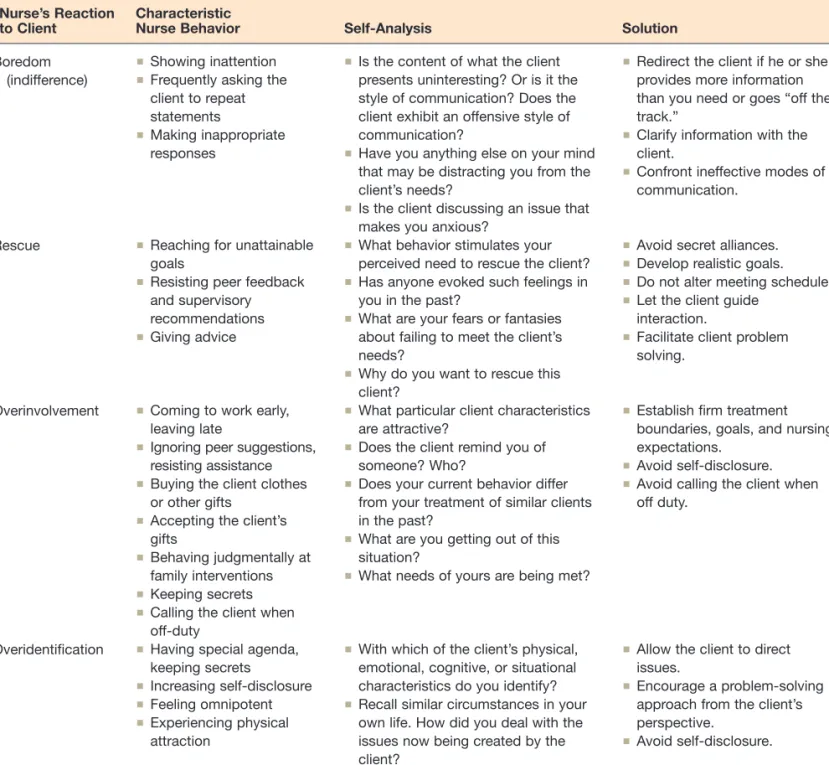
tion, or argument with the client. Table 10-2 identifies some common countertransferential reactions and gives some suggestions for self-intervention.
Identifying and working through various transfer-ence and countertransfertransfer-ence issues is crucial if the nurse is to achieve professional and clinical growth and if the possibility is to be created for positive change in the client. These issues are best dealt with through the use of supervision by either the peer group or thera-peutic team. Regularly scheduled supervision sessions provide the nurse with the opportunity to increase
self-awareness, clinical skills, and growth, as well as allow for continued growth of the client.
Self-Check on Boundary Issues
It is helpful for all of us to take time out to be reflective and to try to be aware of our thoughts and actions with clients, as well as with colleagues, friends, and family. Figure 10-1 is a helpful self-test you can use through-out your career, no matter what area of nursing you choose.
TA B L E 1 0 - 2
Common Countertransference Reactions
As a nurse, you will sometimes experience countertransference feelings. Once you are aware of them, use them for self-analysis to understand those feelings that may inhibit productive nurse-client communication.
Nurse’s Reaction Characteristic
to Client Nurse Behavior Self-Analysis Solution
Boredom (indifference)
Rescue
Overinvolvement
Overidentification
Data from Aromando, L. (1995).Mental health and psychiatric nursing(2nd ed.). Springhouse, PA: Springhouse.
■ Showing inattention ■ Frequently asking the
client to repeat statements
■ Making inappropriate responses
■ Reaching for unattainable goals
■ Resisting peer feedback and supervisory recommendations ■ Giving advice
■ Coming to work early, leaving late
■ Ignoring peer suggestions, resisting assistance ■ Buying the client clothes
or other gifts ■ Accepting the client’s
gifts
■ Behaving judgmentally at family interventions ■ Keeping secrets ■ Calling the client when
off-duty
■ Having special agenda, keeping secrets
■ Increasing self-disclosure ■ Feeling omnipotent ■ Experiencing physical
attraction
■ Is the content of what the client presents uninteresting? Or is it the style of communication? Does the client exhibit an offensive style of communication?
■ Have you anything else on your mind that may be distracting you from the client’s needs?
■ Is the client discussing an issue that makes you anxious?
■ What behavior stimulates your perceived need to rescue the client? ■ Has anyone evoked such feelings in
you in the past?
■ What are your fears or fantasies about failing to meet the client’s needs?
■ Why do you want to rescue this client?
■ What particular client characteristics are attractive?
■ Does the client remind you of someone? Who?
■ Does your current behavior differ from your treatment of similar clients in the past?
■ What are you getting out of this situation?
■ What needs of yours are being met?
■ With which of the client’s physical, emotional, cognitive, or situational characteristics do you identify? ■ Recall similar circumstances in your
own life. How did you deal with the issues now being created by the client?
■ Redirect the client if he or she provides more information than you need or goes “off the track.”
■ Clarify information with the client.
■ Confront ineffective modes of communication.
■ Avoid secret alliances. ■ Develop realistic goals. ■ Do not alter meeting schedule. ■ Let the client guide
interaction.
■ Facilitate client problem solving.
■ Establish firm treatment boundaries, goals, and nursing expectations.
■ Avoid self-disclosure. ■ Avoid calling the client when
off duty.
■ Allow the client to direct issues.
■ Encourage a problem-solving approach from the client’s perspective.
Have you ever received any feedback about your be-havior being overly intrusive with patients and their families?
Do you ever have difficulty setting limits with patients? Do you ever arrive early or stay late to be with your patient for a longer period?
Do you ever find yourself relating to patients or peers as you might to a family member?
Have you ever acted on sexual feelings you have for a patient?
Do you feel that you are the only one who understands the patient?
Have you ever received feedback that you get “too in-volved” with patients or families?
Do you derive conscious satisfaction from patients’ praise, appreciation, or affection?
Do you ever feel that other staff members are too criti-cal of “your” patient?
Do you ever feel that other staff members are jealous of your relationship with your patient?
Have you ever tried to “match-make” a patient with one of your friends?
Do you find it difficult to handle patients’ unreasonable requests for assistance, verbal abuse, or sexual language?
Please rate yourself according to the frequency with which the following statements reflect your behavior, thoughts, or feelings within the past 2 years while providing patient care.*
NURSING BOUNDARY INDEX SELF-CHECK
Never _____
Never _____ Never _____ Never _____ Never _____ Never _____ Never _____ Never _____ Never _____ Never _____ Never _____ Never _____
* Any item that is responded to with “Sometimes” or “Often” should alert the nurse to a possible area of vulnerability. If the item is responded to with “Rarely,” the nurse should determine whether it is an isolated event or a possible pattern of behavior.
Rarely _____
Rarely _____ Rarely _____ Rarely _____ Rarely _____ Rarely _____ Rarely _____ Rarely _____ Rarely _____ Rarely _____ Rarely _____ Rarely _____
Sometimes _____
Sometimes _____ Sometimes _____ Sometimes _____ Sometimes _____ Sometimes _____ Sometimes _____ Sometimes _____ Sometimes _____ Sometimes _____ Sometimes _____ Sometimes _____
Often _____
Often _____ Often _____ Often _____ Often _____ Often _____ Often _____ Often _____ Often _____ Often _____ Often _____ Often _____ 1.
2. 3. 4. 5. 6. 7. 8. 9. 10. 11. 12.
FIGURE 10-1 Nursing boundary index self-check. (From Pilette, P., Berck, C., & Achber, L. [1995]. Therapeutic management. Journal of Psychosocial Nursing, 33[1], 45.)
TA B L E 1 0 - 2
Common Countertransference Reactions—cont’d
Nurse’s Reaction Characteristic
to Client Nurse Behavior Self-Analysis Solution
Misuse of honesty
Anger
Helplessness or hopelessness
■ Withholding information ■ Lying
■ Withdrawing ■ Speaking loudly ■ Using profanity
■ Asking to be taken off the case
■ Feeling sadness
■ Why are you protecting the client? ■ What are your fears about the
client’s learning the truth?
■ What client behaviors are offensive to you?
■ What dynamic from your past may this client be re-creating?
■ Which client behaviors evoke these feelings in you?
■ Has anyone evoked similar feelings in the past? Who?
■ What past expectations were placed on you (verbally and nonverbally) by this client?
■ Be clear in your responses and aware of your hesitation; do not hedge.
■ If you can provide information, tell the client and give your rationale.
■ Avoid keeping secrets. ■ Reinforce the client with
regard to the interdisciplinary nature of treatment.
■ Determine the origin of the anger (nurse, client, or both). ■ Explore the roots of client
anger.
■ Avoid contact with the client if the anger is not understood. ■ Maintain therapeutic
involvement.
■ Explore and focus on the client’s experience rather than on your own.
UNDERSTANDING SELF
AND OTHERS
Relationships are complex. We bring into our relation-ships a multitude of thoughts, feelings, beliefs, and attitudes—some rational and some irrational. It is helpful, even crucial, that we have an understanding of our own personal values and attitudes so that we may become aware of the beliefs or attitudes we hold that may interfere with the establishment of positive relationships with those under our care.
Values
Increasingly we are working with, living with, and caring for people from diverse cultures and subcul-tures whose life experiences and life values may be quite different from our own. Valuesare abstract stan-dards and represent an ideal, either positive or nega-tive. For example, in the United States, to create a so-cial order in which people can live peaceably together and feel secure in their persons and property, society has adopted the two values of respecting one an-other’s liberty and working cooperatively for a com-mon goal. Not all the nation’s people live up to these ideals all the time, and there may exist for some a di-chotomy between theory and practice. For example, some people may pay lip service to the values of au-thority, whereas their behavior contradicts these val-ues. They may stress honesty and respect for the law, yet cheat on their taxes and in their business practices. They may love their neighbors on Sunday and demean or downgrade them for the rest of the week. They may declare themselves patriots, but label others traitors or even deny freedom of speech to any dissenters whose concept of patriotism differs from theirs.
A person’s value system greatly influences both everyday and long-range choices. Values and beliefs provide a framework for what life goals people de-velop and for what they want their life to include. Our values are usually culturally oriented and influenced in a variety of ways through our parents, teachers, re-ligious institutions, workplaces, peers, and political leaders as well as through Hollywood and the media. All these influences attempt to instill their values and to form and influence ours (Simon, Howe, & Kirschenbaum, 1995).
We also form our values through the example of others. Modeling is perhaps one of the most potent means of value education because it presents a vivid example of values in action (Simon et al., 1995). We all need role models to guide us in negotiating life’s many choices. Young people in particular are hungry for role models and will find them among peers as well as adults. As nurses, parents, bosses, co-workers, friends, lovers, teachers, spouses, singles, or whatever, we are
constantly (in either a positive or negative manner) providing a role model to others.
One of the steps in the nursing process is to plan outcome criteria. We emphasize that the client and the nurse identify outcomes together. What happens when the nurse’s beliefs and values are very different from those of a client? For example, the client wants an abortion, which is against the nurse’s values (or vice versa). The client engages in irresponsible sex with multiple partners, and that is against the nurse’s val-ues. The client puts material gain and objects far ahead of loyalty to friends and family, in direct contrast with the nurse’s values (or vice versa). The client’s lifestyle includes taking illicit drugs, and substance abuse is against the nurse’s values. The client is deeply reli-gious, and the nurse is a nonbeliever who shuns orga-nized religion. Can a nurse develop a working rela-tionship and help a client solve a problem when the values and goals of the client are so different from his or her own?
As nurses, it is useful for us to understand that our values and beliefs are not necessarily right, and cer-tainly not right for everyone. It is helpful for us to re-alize that our values (1) reflect our own culture, (2) are derived from a whole range of choices, and (3) are those we have chosen for ourselves from a variety of in-fluences and role models. These chosen values guide us in making decisions and taking the actions we hope will make our lives meaningful, rewarding, and full. Personal values may change over time; indeed, per-sonal values may change many times over the course of a lifetime. The values you held as a child are differ-ent from those you held as an adolescdiffer-ent and change in young adulthood, and so forth. Self-awareness re-quires that we understand what we value and those beliefs that guide our behavior. It is critical that as nurses we not only understand and accept our own values but also are sensitive to and accepting of the unique and different values of others.
Values Clarification
Values clarificationis a process that helps people un-derstand and build their value systems, addressing some questions in the process. For example, “Where do we learn whether to stick to the old moral and value standards or try new ones? How do we learn to relate to people whose values differ from our own? What do we do when two important values are in con-flict?” (Simon et al., 1995).
A popular approach to values clarification was ini-tially formulated by Louis Raths and colleagues (1966). In their framework, a value has three compo-nents: emotional, cognitive, and behavioral. We do not just hold our values; we feel deeply about them and will stand up for them and affirm them when appro-priate. We choose our values from a variety of options after weighing the pros and cons, including the
conse-quences of these choices and positions. And, ulti-mately, we act upon our values. Our values determine how we live our lives. Values, according to Raths, Harmin, and Simon (1966), are composed of seven subprocesses:
Prizing one’s beliefs and behaviors (emotional) 1. Prizing and cherishing
2. Publicly affirming, when appropriate
Choosing one’s beliefs and behaviors (cognitive) 3. Choosing from alternatives
4. Choosing after consideration of consequences 5. Choosing freely
Acting on one’s beliefs (behavioral) 6. Acting
7. Acting with a pattern, consistency, and repetition The suggestion of Flanagan and Sommers-Flanagan (2003) for enhancing psychosocial awareness is to reflect intentionally on your own values and ca-reer goals:
1. What are my important values?
2. What are my life goals? What do I really want out of life? Does my everyday behavior move me to-ward my life goals?
3. What are my career goals? If I want to be a nurse, nurse therapist, or other specialist, how will I achieve this? Why do I want to be a nurse or other specialist?
4. How would I describe myself in a few words? How would I describe myself to a stranger? What do I particularly like and what do I dislike about myself?
PHASES OF THE NURSE-CLIENT
RELATIONSHIP
The ability of the nurse to engage in interpersonal in-teractions in a goal-directed manner for the purpose of assisting clients with their emotional or physical health needs is the foundation of the nurse-client rela-tionship.
The nurse-client relationship is synonymous with a professional helping relationship. Behaviors that have relevance to health care workers, including nurses, are as follows:
Accountability. The nurse assumes responsibility for his or her conduct and the consequences of his or her actions.
Focus on client needs. The interest of the client rather than the nurse, other health care workers, or the institution is given first consideration. The nurse’s role is that of client advocate.
Clinical competence. The criteria on which the nurse bases his or her conduct are principles of knowledge and those that are appropriate to the specific situation. This involves awareness and incorporation of the latest knowledge made avail-able from research (evidence-based practice).
Supervision. Validation of performance quality is through regularly scheduled supervisory ses-sions. Supervision is conducted either by a more experienced clinician or, more commonly, through discussion with a therapeutic team (nurses, physician, social worker, etc.).
Nurses interact with clients in a variety of settings, such as emergency departments, medical-surgical units, obstetric and pediatric units, clinics, community settings, schools, and clients’ homes. Nurses who are sensitive to clients’ needs and have effective assess-ment and communication skills can significantly help clients confront current problems and anticipate future choices.
Sometimes, the type of relationship that occurs may be informal and not extensive, such as when the nurse and client meet for only a few sessions. However, even though it is brief, the relationship may be substantial, useful, and important for the client. This limited rela-tionship is often referred to as a therapeutic en-counter. When the nurse really is concerned with an-other’s circumstances (has positive regard, empathy), even a short encounter with the individual can have a powerful impact on that individual’s life.
At other times, the encounters may be longer and more formal, such as in inpatient settings, mental health units, crisis centers, and mental health facilities. This longer time span allows the development of a therapeutic nurse-client relationship.
Hildegard Peplau introduced the concept of the nurse-client relationship in 1952 in her ground-breaking book Interpersonal Relations in Nursing. This model of the nurse-client relationship is well accepted in the United States and Canada and has become an important tool for all nursing practice. Peplau (1952) proposed that the nurse-client relationship “facilitates forward movement” for both the nurse and the client (p. 12). Peplau’s interactive nurse-client process is de-signed to facilitate the client’s boundary management, independent problem solving, and decision making that promotes autonomy (Haber, 2000).
It is most likely that in the brief period you have for your psychiatric nursing rotation, all the phases of the nurse-client relationship will not have time to develop. However, it is important for you to be aware of these phases because you must be able to recognize and use them later.
Peplau (1952, 1999) described the nurse-client rela-tionship as evolving through interlocking, overlap-ping phases. The following distinctive phases of the nurse-client relationship are generally recognized:
■ Orientation phase ■ Working phase ■ Termination phase
Although various phenomena and goals are identi-fied for each phase, they often overlap from phase to phase. Even before the first meeting, the nurse may Developing Therapeutic RelationshipsCHAPTER 10 163
have many thoughts and feelings related to the first clinical session. This is sometimes referred to as the preorientation phase.
Preorientation Phase
Beginning health care professionals who are new to the psychiatric setting usually have many concerns and experience a mild to moderate degree of anxiety on their first clinical day. One common concern in-volves fear of physical harm or violence. Your instruc-tor usually discusses this common concern in your first preconference. There are unit protocols for inter-vening with clients who have poor impulse control, and staff and unit safeguards should be constantly in place to help clients gain self-control. Although such disruptions are not common, the concern is valid. Most unit staff are trained in and practice interven-tions for clients who are having difficulty with im-pulse control. Hospital security is readily available to give the staff support.
Some of you may be concerned with saying the wrong thing, using the client as a guinea pig, feeling inadequate about new and developing communica-tion skills, feeling vulnerable without the uniform as a clear indicator of who is the nurse and who is the client, and feeling exposed as you relate to your own earlier personal experiences or crises. These are uni-versal and valid feelings; if they were not discussed in class, they will be brought up on the first clinical day, either by you or by your instructor. Chapter 11 deals with a variety of clinical concerns student nurses have when beginning their psychiatric nursing rotation (e.g., what to do if clients do not want to talk, if they ask the nurse to keep a secret, if they cry). Usually af-ter the first clinical day your anxiety is much lower, and it is easier to focus on clinical issues with the sup-port of your instructor and classmates. The preorienta-tion phase revolves around planning for the first inter-action with the client.
Orientation Phase
The orientation phasecan last for a few meetings or can extend over a longer period. This first phase may be prolonged in the case of severely and persistently ill mental health clients.
The first time the nurse and the client meet, they are strangers to each other. When strangers meet, whether or not they know anything about each other, they in-teract according to their own backgrounds, standards, values, and experiences. This fact—that each person has a unique frame of reference—underlies the need for self-awareness on the part of the nurse.
As the relationship evolves through an ongoing se-ries of reactions, each participant may elicit in the other a wide range of positive and negative emotional
reactions. Remember that the projection of feelings in the client to the nurse is referred to as transference, and the projection of feelings in the nurse or clinician to the client is referred to as countertransference. As discussed earlier, the nurse is responsible for identifying these two phenomena and maintaining appropriate bound-aries.
Establishing Trust
A major emphasis during the first few encounters with the client is on providing an atmosphere in which trust can grow. As in any relationship, trust is nurtured by demonstrating genuineness and empathy, developing positive regard, showing consistency, and offering as-sistance in alleviating the client’s emotional pain or problems. This may take only a short period, but in many instances it may be a long time before a client feels free to discuss painful personal experiences and private thoughts.
During the orientation phase, four important issues need to be addressed:
1. Parameters of the relationship 2. Formal or informal contract 3. Confidentiality
4. Termination
Parameters of the Relationship. The client needs
to know about the nurse (who the nurse is and what the nurse’s background is) and the purpose of the meetings. For example, a student might furnish the following information:
Student:Hello, Mrs. James. I am Nancy Rivera from
Orange Community College. I am in my psychi-atric rotation, and I will be coming to York Hospital for the next six Thursdays. I would like to spend time with you each Thursday if you are still here. I’m here to be a support person for you as you work on your treatment goals.
Formal or Informal Contract. A contract
empha-sizes the client’s participation and responsibility be-cause it shows that the nurse does something with the client rather than for the client. The contract, either stated or written, contains the place, time, date, and duration of the meetings. During the orientation phase, the client may begin to express thoughts and feelings, identify problems, and discuss realistic goals. Therefore, the mutual agreement on goals is also part of the contract. If the goals are met, the client’s level of functioning will return to a previous level, or at least improve from the present level. If fees are to be paid, the client is told how much they will be and when the payment is due.
Student: Mrs. James, we will meet at 10 AM each
Thursday in the consultation room at the clinic for 45 minutes, from September 15th to October 27th. We can use that time for further discussion
of your feelings of loneliness and anger you men-tioned and explore some things you could do to make the situation better for yourself.
Confidentiality. The client has a right to know who
else will be given the information being shared with the nurse. He or she needs to know that the informa-tion may be shared with specific people, such as a clin-ical supervisor, the physician, the staff, or other stu-dents in conference. The client also needs to know that the information will not be shared with his or her rela-tives, friends, or others outside the treatment team, ex-cept in extreme situations. Extreme situations include those in which (1) the information may be harmful to the client or to others, (2) the client threatens self-harm, or (3) the client does not intend to follow through with the treatment plan. If information must be given to others, this is usually done by the physi-cian, according to legal guidelines (see Chapter 8). The nurse must be aware of the client’s right to confiden-tialityand must not violate that right.
Student:Mrs. James, I will be sharing some of what
we discuss with my nursing instructor, and at times I may discuss certain concerns with my peers in conference or with the staff. However, I will not be sharing this information with your husband or any other members of your family or anyone outside the hospital without your per-mission.
Termination. Termination begins in the orientation
phase. It may also be mentioned when appropriate during the working phase if the nature of the relation-ship is time limited (e.g., six or nine sessions). The date of the termination phase should be clear from the be-ginning. In some situations the nurse-client contract may be renegotiated when the termination date has been reached. In other situations, when the therapeu-tic nurse-client relationship is an open-ended one, the termination date is not known.
Student:Mrs. James, as I mentioned earlier, our last meeting will be on October 27th. We will have three more meetings after today.
During the orientation phase and later, clients often unconsciously employ behaviors to test the nurse. The client wants to know if the nurse will do the following:
■ Be able to set limits when the client needs them. ■ Still show concern if the client acts angry, babyish,
unlikable, or dependent.
■ Still be there if the client is late, leaves early,
re-fuses to speak, or is angry.
Table 10-3 identifies some testing behaviors and possible responses by nurses.
In summary, the initial interview includes the fol-lowing:
■ The nurse’s role is clarified and the
responsibili-ties of both the client and the nurse are defined.
■ The contract containing the time, place, date, and
duration of the meetings is discussed.
■ Confidentiality is discussed and assumed. ■ The terms of termination are introduced (these
are also discussed throughout the orientation phase and beyond).
■ The nurse becomes aware of transference and
countertransference issues (which will later be discussed in the team conference or peer supervi-sion setting).
■ An atmosphere is established in which trust can
grow.
■ Client problems are articulated and mutually
agreed goals are established.
Working Phase
Moore and Hartman (1988) identified specific tasks of the working phaseof the nurse-client relationship that are relevant in current practice:
■ Maintain the relationship. ■ Gather further data.
■ Promote the client’s problem-solving skills,
self-esteem, and use of language.
■ Facilitate behavioral change. ■ Overcome resistance behaviors.
■ Evaluate problems and goals and redefine them
as necessary.
■ Promote practice and expression of alternative
adaptive behaviors.
During the working phase, the nurse and client to-gether identify and explore areas in the client’s life that are causing problems. Often, the client’s present ways of handling situations stem from earlier means of cop-ing devised to survive in a chaotic and dysfunctional family environment. Although certain coping methods may have worked for the client at an earlier age, they now interfere with the client’s interpersonal relation-ships and prevent him or her from attaining current goals. The client’s dysfunctional behaviors and basic assumptions about the world are often defensive, and the client is usually unable to change the dysfunctional behavior at will. Therefore, most of the problem be-haviors or thoughts continue because of unconscious motivations and needs that are out of the client’s awareness.
The nurse can work with the client to identify these unconscious motivations and assumptions that keep the client from finding satisfaction and reaching po-tential. Describing, and often reexperiencing, old con-flicts generally awakens high levels of anxiety in the client. Clients may use various defenses against anxi-ety and displace their feelings onto the nurse. Therefore, during the working phase, intense emo-tions such as anxiety, anger, self-hate, hopelessness, and helplessness may surface. Behaviors such as act-ing out anger inappropriately, withdrawact-ing, intellec-Developing Therapeutic RelationshipsCHAPTER 10 165
tualizing, manipulating, and denying are to be ex-pected.
During the working phase, strong transference feelings may appear. The emotional responses and behaviors in the client may also awaken strong coun-tertransference feelings in the nurse. The nurse’s awareness of personal feelings and reactions to the client is vital for effective interaction with the client.Common transference feelings, as well as the
reactions that nurses experience in response to dif-ferent client behaviors and situations, are discussed in the planning component of each of the clinical chapters.
The development of a strong working relationship can allow the client to experience increased levels of anxiety and demonstrate dysfunctional behaviors in a safe setting, and try out new and more adaptive cop-ing behaviors.
TA B L E 1 0 - 3
Testing Behaviors Used by Clients
Client Behavior Client Example Nurse Response Rationale
Shifts focus of interview
to the nurse, off
the client
Tries to get the nurse to take care of him or her
Makes sexual advances toward the nurse (e.g., touches the nurse’s arm, wants to hold hands with or kiss the nurse)
Continues to arrive late for meetings
“Do you have any chil-dren?” or “Are you married?”
“Could you tell my doctor?”
“Should I take this job?”
“Would you go out with me? . . . Why not?” or “Can I kiss you? . . . Why not?”
“I’m a little late because (excuse).”
“This time is for you.” If appropriate, the nurse should add:
■ “Do you have any children?” or “What about your children?” ■ “Are you married?” or “What about
your relationships?”
“I’ll leave a message with the unit clerk that you want to see the doctor” or “You know best what you want the doctor to know. I’ll be interested in what the doctor has to say.” “What do you see as the pros and
cons of this job?”
“I am not comfortable having you touch (kiss) me.”
The nurse briefly reiterates the nurse’s role: “This time is for you to focus on your problems and concerns.” If the client stops: “I wonder what this
is all about?”
1. Is the client afraid the nurse will not like him or her?
2. Is the client trying to take the focus off the problems?
If the client continues: “If you can’t stop this behavior, I’ll have to leave. I’ll be back at (time) to spend time with you then.”
The nurse arrives on time and leaves at the scheduled time. (The nurse does not let the client manipulate him or her or bargain for more time.) After a couple of such instances, the
nurse can explore behavior (e.g., “I wonder if there is something going on that you don’t want to deal with?” or “I wonder what these latenesses mean to you?”).
1. The nurse refocuses back to the client and the client’s concerns.
2. The nurse sticks to the con-tract.
1. The nurse validates that the client is able to do many things for himself or herself. This aids in increasing self-esteem.
2. The nurse always encourages the person to function at the highest level, even if he or she doesn’t want to. 1. The nurse needs to set clear
limits on expected behavior. 2. Frequently restating the
nurse’s role throughout the relationship can help maintain boundaries.
3. Whenever possible, the meaning of the client’s be-havior should be explored. 4. Leaving gives the client time
to gain control. The nurse re-turns at the stated time.
1. The nurse keeps the contract. Clients feel more secure when “promises” are kept, even though clients may try to manipulate the nurse through anger, helplessness, and so forth.
2. The nurse does not tell the client what to do, but the nurse and the client need to explore the meaning of the behavior.
Termination Phase
Termination is discussed during the first interview. During the working stage, the fact of eventual termi-nation may also be raised at appropriate times. Reasons for terminating the nurse-client relationship include the following:
■ Symptom relief
■ Improved social functioning ■ Greater sense of identity
■ Development of more adaptive behaviors ■ Accomplishment of the client’s goals
■ Impasse in therapy that the nurse is unable to
re-solve
In addition, forced termination may occur, such as when the student completes the course objectives, a nurse clinician leaves the clinical setting, or the insur-ance coverage runs out and there is a change of staff. The termination phaseis the final phase of the nurse-client relationship. Important reasons for the student or nurse counselor to address the termination phase are as follows:
1. Termination is an integral phase of the therapeu-tic nurse-client relationship, and without it the relationship remains incomplete.
2. Feelings are aroused in both the client and the nurse with regard to the experience they have had; when these feelings are recognized and shared, clients learn that it is acceptable to feel sadness and loss when someone they care about leaves.
3. The client is a partner in the relationship and has a right to see the nurse’s needs and feelings about their time together and the ensuing sepa-ration.
4. Termination can be a learning experience; clients can learn that they are important to at least one person.
5. By sharing the termination experience with the client, the nurse demonstrates caring for the client.
6. This may be the first successful termination ex-perience for the client.
Termination often awakens strong feelings in both nurse and client. Termination of the relationship be-tween the nurse and the client signifies a loss for both, although the intensity and meaning of termination may be different for each. If a client has unresolved feelings of abandonment or loneliness, or feelings of not being wanted or of being rejected by others, these feelings may be reawakened during the termination process. This process can be an opportunity for the client to express these feelings, perhaps for the first time.
It is not unusual to see a variety of client behaviors that indicate defensive maneuvers against the anxiety
of separation and loss. For example, a client may withdraw from the nurse and not want to meet for the final session or may become outwardly hostile and sarcastic—for instance, accusing the student of using the client for personal gains (“like a guinea pig”) as a way of deflecting the awakening of anger and pain that are rooted in past separations. Often, a client will deny that the relationship had any impact or that end-ing the relationship evokes any emotions whatsoever. Regression is another behavioral manifestation; it may be seen as increased dependency on the nurse or a re-turn of earlier symptoms.
It is important for the nurse to work with the client to bring into awareness any feelings and reactions the client may be experiencing related to separations. If a client denies that the termination is having an effect (assuming the nurse-client relationship was strong), the nurse may say something like, “Good-byes are dif-ficult for people. Often they remind us of other good-byes. Tell me about another separation in the past.” If the client appears to be displacing anger, either by withdrawing or by being overtly angry at the nurse, the nurse may use generalized statements such as, “People may experience anger when saying goodbye. Sometimes they are angry with the person who is leav-ing. Tell me how you feel about my leavleav-ing.” New practitioners as well as students in the psychiatric set-ting need to give thought to their last clinical experi-ence with their client and work with their supervisor or instructor to facilitate communication during this time.
Summarizing the goals and objectives achieved in the relationship is part of the termination process. Ways for the client to incorporate into daily life any new coping strategies learned during the time spent with the nurse can be discussed. Reviewing situations that occurred during the time spent together and ex-changing memories can help validate the experience for both nurse and client and facilitate closure of that relationship.
A common response of beginning practitioners is feeling guilty about terminating the relationship. These feelings may be manifested by the student’s giving the client his or her telephone number, making plans to get together for coffee after the client is discharged, continuing to see the client afterward, or exchanging letters. Beginning practitioners need to understand that such actions may be motivated by their own sense of guilt or by misplaced feelings of responsibility, not by concern for the client. Indeed, part of the termination process may be to ex-plore, after discussion with the client’s case manager, the client’s plans for the future: where the client can go for help in the future, which agencies to con-tact, and which specific resource persons may be available.
During the student affiliation, the nurse-client re-lationship exists for the duration of the clinical course only. The termination phase is just that. Thoughts and feelings the student may have about continuing the relationship are best discussed with the instructor or shared in conference with peers, be-cause these are common reactions to the student’s experience.
WHAT HINDERS AND WHAT
HELPS THE NURSE-CLIENT
RELATIONSHIP
Not all nurse-client relationships follow the classic phases as outlined by Peplau. Some nurse-client rela-tionships start in the orientation phase but move to a mutually frustrating phase and finally to mutual with-drawal (Figure 10-2).
Forchuk and associates (2000) conducted a qualita-tive study of the nurse-client relationship. They exam-ined the phases of both the therapeutic and the non-therapeutic relationship. From this study, they identified certain behaviors that were beneficial to the progression of the nurse-client relationship as well as those that hampered the development of this relation-ship. The study emphasized the importance of consis-tent, regular, and private interactions with clients as essential to the development of a therapeutic alliance. Nurses in this study stressed the importance of listen-ing, paclisten-ing, and consistency.
Specifically, Forchuk and associates (2000) identi-fied the following factors that were inherent in a nurse-client relationship that progressed in a mutually satisfying manner:
Consistency includes ensuring that a nurse is al-ways assigned to the same client and that the client has a regular routine for activities. Interactions are facilitated when they are fre-quent and regular in duration, format, and loca-tion. Consistency also refers to the nurse’s being
honest and consistent (congruent) in what is said to the clients.
Pacingincludes letting the client set the pace and letting the pace be adjusted to fit the client’s moods. A slow approach helps reduce pressure, and at times it is necessary to step back and real-ize that developing a strong relationship may take a long time.
Listeningincludes letting the client talk when this is the client’s need. The nurse becomes a sound-ing board for the client’s concerns and issues. Listening is perhaps the most important skill for nurses to master. Truly listening to another per-son, attending to what is behind the words, is a learned skill and is addressed in Chapter 11. Initial impressions,especially positive initial
atti-tudes and preconceptions, are significant consid-erations in how the relationship will progress. Preconceived negative impressions and feelings toward the client usually bode poorly for the positive growth of the relationship. In contrast, the nurse’s feeling that the client is “interesting” or a “challenge” and a positive attitude about the relationship are usually favorable signs for the developing therapeutic alliance.
Comfort and control,that is, promoting client com-fort and balancing control, usually reflect caring behaviors. Control refers to keeping a balance in the relationship: not too strict and not too lenient.
Client factorsthat seem to enhance the relationship include trust on the part of the client and the client’s active participation in the nurse-client re-lationship.
In relationships that did not progress to therapeutic levels, there seemed to be some specific factors that hampered the development of positive relationships. These included the following:
Inconsistency and unavailabilityon the part of the nurse or the client or both, as well as lack of con-tact (infrequent meetings, meetings in the hall-way, and client reluctance or refusal to spend time with the nurse), play a key role (mutual avoidance).
The nurse’s feelings and awarenessare significant factors. Major elements that contributed to the lack of progression of positive relationships were the lack of self-awareness on the part of the nurse and the nurse’s own feelings. Negative precon-ceived ideas about the client and negative feel-ings (e.g., discomfort, dislike of the client, fear, and avoidance) seem to be a constant in relation-ships that end in frustration and mutual with-drawal. This is in contrast with more successful relationships in which the nurse’s attitude is that of positive regard and interest in understanding the client’s story.
Orientation
Working
Resolution Mutual withdrawal
Grappling and struggling
FIGURE 10-2 Phases of therapeutic and nontherapeutic relationships. (From Forchuk, C., et al. [2000]. The developing nurse-client relationship: Nurse’s perspectives. Journal of the
Developing Therapeutic RelationshipsCHAPTER 10 169 KEY POINTS to REMEMBER
■ The nurse-client relationship is well defined, and the roles of
the nurse and the client must be clearly stated.
■ It is important that the nurse be aware of the differences
be-tween a therapeutic relationship and a social or intimate rela-tionship. In a therapeutic nurse-client relationship, the focus is on the client’s needs, thoughts, feelings, and goals. The nurse is expected to meet personal needs outside this rela-tionship, in other professional, social, or intimate arenas.
■ Genuineness, positive regard, and empathy are personal
strengths in the helping person that foster growth and change in others.
■ Although the boundaries of the nurse-client relationship
gen-erally are clearly defined, these boundaries can become blurred, and this blurring can be insidious and may occur on an unconscious level. Usually, transference and counter-transference phenomena are operating when boundaries are blurred. A blurring of boundaries may be indicated when the nurse is too helpful or not helpful enough.
■ It is important to have a grasp of common
countertransferen-tial feelings and behaviors and of the nursing actions to coun-teract these phenomena.
■ The importance of supervision cannot be overemphasized.
Supervision often takes the form of peer or therapeutic team
supervision. Supervision aids in promoting the professional growth of the nurse as well as in safeguarding the integrity of the nurse-client relationship. It enhances the progression of the nurse-client relationship, allowing the client’s goals to be worked on and met.
■ The phases of the nurse-client relationship include the
orien-tation, working, and termination phases.
■ At the first interaction of the orientation phase, certain matters
need to be addressed: (1) the parameters of the relationship— who the nurse is and the purpose of the meetings; (2) the contract—specifying the who, what, where, when, and how long of the nurse-client meetings; (3) the issue of confiden-tiality; and (4) the date of termination, if known. During the ori-entation phase (and at times throughout the relationship), a number of common client testing behaviors may arise that will require specific nursing interventions.
■ Forchuk and associates (2000) identified six specific factors
that seem to be characteristic of a successful nurse-client lationship and two that may foreshadow an unsuccessful re-lationship.
Visit the Evolve website at http://evolve.elsevier.com/Varcarolisfor a posttest on the content in this chapter.
Critical Thinking and Chapter Review
Visit the Evolve website at http://evolve.elsevier.com/Varcarolisfor additional self-study exercises.
CRITICAL THINKING
1. On your first clinical day you spend time with an older woman, Mrs. Schneider, who is very depressed. Your first impression is “Oh my, she looks like my mean Aunt Helen. She even sits like her.” Mrs. Schneider asks you, “Who are you and how can you help me?” She tells you that “a stu-dent” could never understand what she is going through. She then says, “If you really wanted to help me you could get me a good job after I leave here.”
A. Identify transference and countertransference is-sues in this situation. What is your most important course of action? What in the study of Forchuk and associates (2000) indicates that this is a time for you to exercise self-awareness and self-insight to establish the potential for a therapeutic encounter or relationship to occur?
B. How could you best respond to Mrs. Schneider’s question about who you are? What other informa-tion will you give her during this first clinical en-counter? Be specific.
C. What are some useful responses you could give her regarding her legitimate questions about ways you could be of help to her?
D. Analyze Mrs. Schneider’s request that you find her a job. How does this request relate to boundary
is-sues, and how can this be an opportunity for you to help Mrs. Schneider develop resources? Keeping in mind the aim of Peplau’s interactive nurse-client process, describe some useful ways you could respond to this request.
CHAPTER REVIEW Choose the most appropriate answer.
1. Which of the following is an accurate statement about trans-ference?
1. Transference occurs when the client attributes thoughts and feelings toward the therapist that pertain to a person in the client’s past.
2. Transference occurs when the therapist attributes thoughts and feelings toward the client that pertain to a person in the client’s past.
3. Transference occurs when the therapist under-stands and builds a value system consistent with the client’s value system.
4. Transference occurs when the therapist recalls cir-cumstances in his or her life similar to those the client is experiencing and shares this with the client.