Understanding and Evolving
the ML Module System
Derek Dreyer
May 2005
CMU-CS-05-131
School of Computer Science Carnegie Mellon University
Pittsburgh, PA 15213
Thesis Committee:
Robert Harper (co-chair) Karl Crary (co-chair)
Peter Lee
David MacQueen (University of Chicago)
Submitted in partial fulfillment of the requirements for the degree of Doctor of Philosophy
Copyright c2005 Derek Dreyer
This research was sponsored in part by the National Science Foundation under grant CCR-0121633 and EIA-9706572, and the US Air Force under grant F19628-95-C-0050 and a generous fellowship. The views and conclusions contained in this document are those of the author and should not be interpreted as representing the official policies, either expressed or implied, of any sponsoring institution, the U.S. government or any other entity.
Abstract
The ML module system stands as a high-water mark of programming language support for data abstraction. Nevertheless, it is not in a fully evolved state. One prominent weakness is that module interdependencies in ML are restricted to be acyclic, which means that mutually recursive functions and data types must be written in the same module even if they belong conceptually in different modules. Existing efforts to remedy this limitation either involve drastic changes to the notion of what a module is, or fail to allow mutually recursive modules to hide type information from one another. Another issue is that there are several dialects of ML, and the module systems of these dialects differ in subtle yet semantically significant ways that have been difficult to account for in any rigorous way. It is important to come to a clear assessment of the existing design space and consolidate what is meant by “the ML module system” before embarking on such a major extension as recursive modules.
In this dissertation I contribute to the understanding and evolution of the ML module system by: (1) developing a unifying account of the ML module system in which existing variants may be understood as subsystems that pick and choose different features, (2) exploring how to extend ML with recursive modules in a way that does not inhibit data abstraction, and (3) incorporating the understanding gained from (1) and (2) into the design of a new, evolved dialect of ML. I formalize the language of part (3) using the framework of Harper and Stone, in which the meanings of “external” ML programs are interpreted by translation into an “internal” type system.
In my exploration of the recursive module problem, I also propose a type system for statically detecting whether or not recursive module definitions are “safe”—that is, whether they can be evaluated without referring to one another prematurely—thus enabling more efficient compilation of recursive modules. Future work remains, however, with regard to type inference and type system complexity, before my proposal can be feasibly incorporated into ML.
For Constance and Benard Dreyer,
Acknowledgments
First and foremost, I would like to thank my advisors, Bob Harper and Karl Crary. Many of the ideas in this thesis were developed together with them, and my character as a researcher has been influenced to a large degree by their rigorous approach to programming language research and their profound sense of aesthetics. I would also like to thank Peter Lee for his warm guidance as my former advisor and his continual encouragement of all my endeavors, and Dave MacQueen for many interesting discussions and for his extremely careful and thorough perusal of this dissertation.
There are many other friends and colleagues whom I would like to thank for making my ex-perience at CMU such a memorable (and long!) journey. To name a few: Melissa and Umut Acar, Mihai and Raluca Budiu, Sharon Burks, Franklin Chen, Andr´es Cladera, Catherine Copetas, Kathy Copic, Nathaniel Daw, Mark Fuhs, Anna Goldenberg, Beth and Jeff Helzner, Heather Hen-drickson, Rose Hoberman, Yan Karklin, Cathy Kelley, Adam Klivans, Sue Lee, Adriana Moscatelli, Mike Murphy, Tom Murphy VII, Aleks and Emi Nanevski, Leaf Petersen, Martha Petersen, Frank Pfenning, Chris Richards, Chuck Rosenberg, Dan Spoonhower, Chris Stone, Dave Swasey, Desney Tan, Joe Vanderwaart, Dave Walker, Kevin Watkins.
I would like to give special thanks to Aleks Nanevski. I am very lucky to have had such an intellectually stimulating (if occasionally infuriating) officemate for seven whole years. I will always remember our spirited discussions about life, love, politics and programming languages with great fondness.
I would also like to thank Kevin Watkins for initiating, and Dan Spoonhower for revamping, the ConCert reading group. One of the strengths of CMU is its strong graduate student community, and it was wonderful to be able to hash out the details of research papers with such an informed and motivated group of colleagues.
Finally, I would like to thank Rose Amanda Hoberman for all the love, companionship and delicious food she has given me over the past four and a half years, and my parents, Constance and Benard, for all the love and encouragement they have given me throughout my life.
Contents
Introduction 1
I Understanding the ML Module System 5
1 The Design Space of ML Modules 7
1.1 Key Features of the ML Module System . . . 7
1.1.1 Structures and Signatures . . . 7
1.1.2 Data Abstraction via Sealing and Functors . . . 9
1.1.3 Translucent Signatures . . . 10
1.2 Key Points and Axes in the Design Space of ML Modules . . . 12
1.2.1 Precursors to Translucency . . . 13
1.2.2 First-Class vs. Second-Class, Higher-Order vs. First-Order . . . 13
1.2.3 Harper and Lillibridge’s First-Class Modules . . . 14
1.2.4 SML/NJ’s Higher-Order Functors . . . 15
1.2.5 Leroy’s Applicative Functors . . . 16
1.2.6 The Importance of Generativity . . . 17
1.2.7 Supporting Both Applicative and Generative Functors . . . 18
1.2.8 Notions of Module Equivalence . . . 19
1.2.9 Conclusion . . . 20
2 A Unifying Account of ML Modules 21 2.1 An Analysis of ML-Style Modularity . . . 21
2.1.1 Projectibility and Purity . . . 21
2.1.2 Phase Separation . . . 23
2.1.3 Module Equivalence . . . 25
2.1.4 Total vs. Partial Functors . . . 25
2.1.5 Sealing as a Form of Information Hiding . . . 27
2.1.6 Squeezing the Balloon . . . 30
2.1.7 Projectibility and Transparency . . . 31
2.2 Fruits of the Analysis . . . 32
2.2.1 Understanding the Existing ML Module System Designs . . . 32
2.2.2 A Unifying Design . . . 35
2.2.3 A Modular Design . . . 36
3 A Type System for ML Modules: Core Language 41
3.1 Type Constructors and Kinds . . . 41
3.1.1 Syntax . . . 41
3.1.2 Static Semantics . . . 43
3.1.3 Basic Structural Properties . . . 46
3.1.4 Other Declarative Properties . . . 47
3.1.5 Admissible Rules . . . 48
3.1.6 Kind Checking and Synthesis . . . 50
3.1.7 Deciding Constructor Equivalence . . . 51
3.2 Terms . . . 54
3.2.1 Syntax . . . 54
3.2.2 Static Semantics . . . 55
3.2.3 Declarative Properties . . . 56
3.2.4 Type Checking and Synthesis . . . 57
3.2.5 Dynamic Semantics and Type Safety . . . 58
4 A Type System for ML Modules: Module Language 59 4.1 Signatures . . . 59
4.1.1 Syntax . . . 59
4.1.2 Static Semantics . . . 62
4.1.3 Declarative Properties . . . 63
4.1.4 Signature Phase-Splitting . . . 67
4.2 Modules . . . 68
4.2.1 Syntax . . . 68
4.2.2 Projectible Modules . . . 70
4.2.3 Static Semantics . . . 72
4.2.4 Declarative Properties . . . 74
4.2.5 Signature Checking and Synthesis . . . 74
4.2.6 The Avoidance Problem . . . 77
4.2.7 Module Phase-Splitting . . . 80
II Recursive Modules 85 5 The Recursive Module Problem 87 5.1 Motivating Examples . . . 87
5.2 Key Issues in the Design of a Recursive Module Extension . . . 92
5.2.1 Dynamic Semantics . . . 92
5.2.2 Recursively Dependent Signatures . . . 93
5.2.3 The Double Vision Problem . . . 97
5.2.4 Separate Compilation . . . 100
5.3 Existing Approaches to Recursive Modules . . . 101
5.3.1 A Foundational Account . . . 101
5.3.2 Moscow ML . . . 102
5.3.3 O’Caml . . . 104
5.3.4 Units . . . 107
5.3.5 Mixins . . . 108
CONTENTS xi
5.4.1 Overview . . . 109
5.4.2 Elaboration of Recursive Modules . . . 110
6 Type-Theoretic Extensions for Recursive Modules 117 6.1 Constructor-Language Extensions . . . 117
6.2 Term-Language Extensions . . . 120
6.3 Signature-Language Extensions . . . 128
6.4 Module-Language Extensions . . . 132
7 Safe Recursion 137 7.1 Evaluability . . . 138
7.1.1 The Evaluability Judgment . . . 139
7.1.2 A Total/Partial Distinction . . . 139
7.1.3 Limitations of the Total/Partial Distinction . . . 140
7.2 A Type System for Safe Recursion . . . 141
7.2.1 Syntax . . . 142
7.2.2 Static Semantics . . . 143
7.2.3 Separate Compilation, Non-strictness and Name Abstractions . . . 145
7.2.4 Basic Declarative Properties . . . 148
7.2.5 Decidability of Typechecking . . . 148
7.2.6 Dynamic Semantics and Type Safety . . . 150
7.3 Adding Computational Effects . . . 154
7.4 Encoding Unrestricted Recursion . . . 155
7.5 Related Work . . . 158
7.6 Directions for Future Work . . . 160
7.6.1 Names and Type Inference . . . 160
7.6.2 Names and Modules . . . 161
III Evolving the ML Module System 165 8 Evolving the ML Internal Language 167 8.1 Overview . . . 167
8.1.1 Differences from the Simplified IL . . . 167
8.1.2 Differences from the Harper-Stone IL . . . 168
8.2 IL Syntax . . . 169
8.3 IL Static Semantics . . . 177
8.4 IL Dynamic Semantics . . . 187
9 Evolving the ML External Language 189 9.1 EL Syntax . . . 190
9.2 Overview of Elaboration . . . 194
9.2.1 Preliminaries . . . 194
9.2.2 Guide to the Elaboration Judgments . . . 197
9.3 Elaboration . . . 203
9.3.1 A Few More Preliminaries . . . 203
9.3.2 Main Translation Rules . . . 206
9.3.4 Coercive Signature Matching . . . 222
9.3.5 Signature Patching . . . 223
9.3.6 Signature Peeling . . . 224
9.3.7 Label Lookup . . . 225
9.3.8 Recursive Module Elaboration . . . 226
9.4 Notes on Implementation . . . 234
10 Conclusion and Future Work 237 10.1 Conclusion . . . 237
10.2 Future Work . . . 238
List of Figures
1.1 ML Module for Integer Sets . . . 8
1.2 ML Interface for Integer Sets . . . 8
1.3 ML Functor for Generic Sets . . . 9
1.4 Instantiating the Set Functor . . . 10
1.5 Generic ML Signature for Sets . . . 11
1.6 Sealed ML Functor for Generic Sets . . . 11
1.7 Higher-Order Functor Example . . . 15
1.8 Symbol Table Functor Example . . . 17
2.1 Scenario Illustrating Consequences of Projectibility . . . 22
2.2 Classifications of Module Expressions . . . 24
2.3 Semantic Behavior of Different Types of Functors . . . 27
2.4 Semantic Effects of Sealing . . . 29
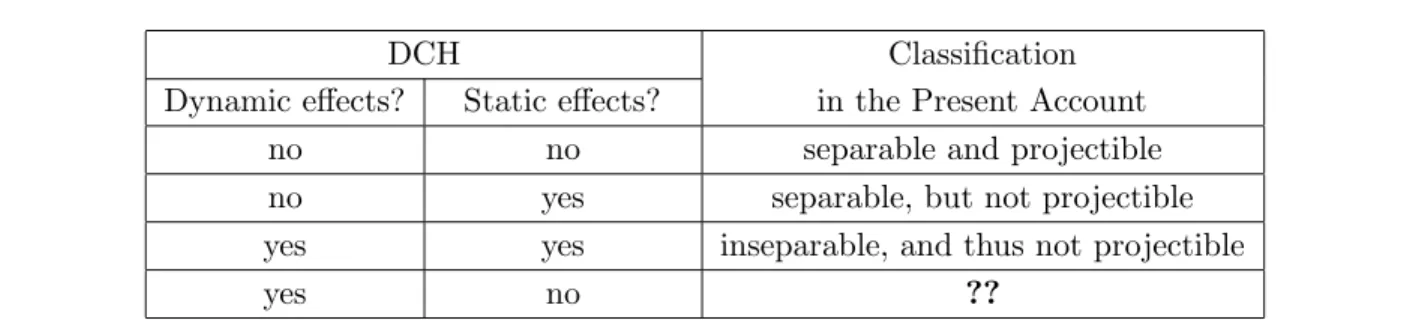
2.5 Correspondence Between Classifications in DCH and in This Chapter . . . 40
3.1 Syntax of Type Constructors and Kinds . . . 42
3.2 Singletons at Higher Kinds . . . 43
3.3 Canonical Constructors of Transparent Kinds . . . 43
3.4 Inference Rules for Kinds and Static Contexts . . . 44
3.5 Inference Rules for Type Constructors . . . 45
3.6 Typing and Equivalence Judgments for Static Substitutions . . . 47
3.7 Kind Checking and Principal Kind Synthesis . . . 51
3.8 Weak Head Normalization for Type Constructors . . . 52
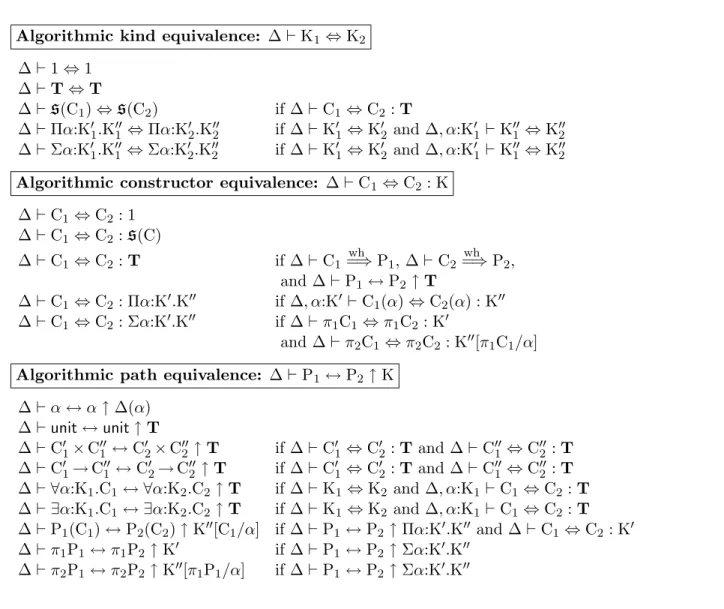
3.9 Equivalence Algorithm for Constructors and Kinds . . . 53
3.10 Syntax of Terms and Values . . . 55
3.11 Less Restrictive Versions of Term Constructs . . . 55
3.12 Inference Rules for Terms and Dynamic Contexts . . . 56
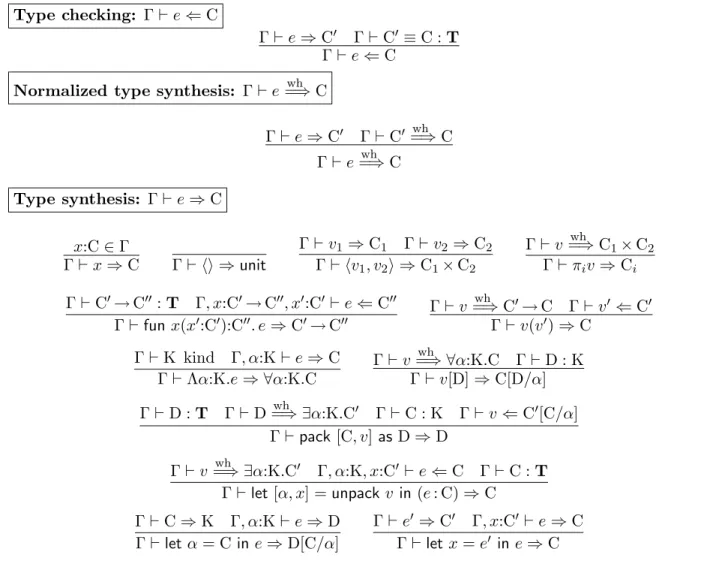
3.13 Type Checking and Type Synthesis . . . 57
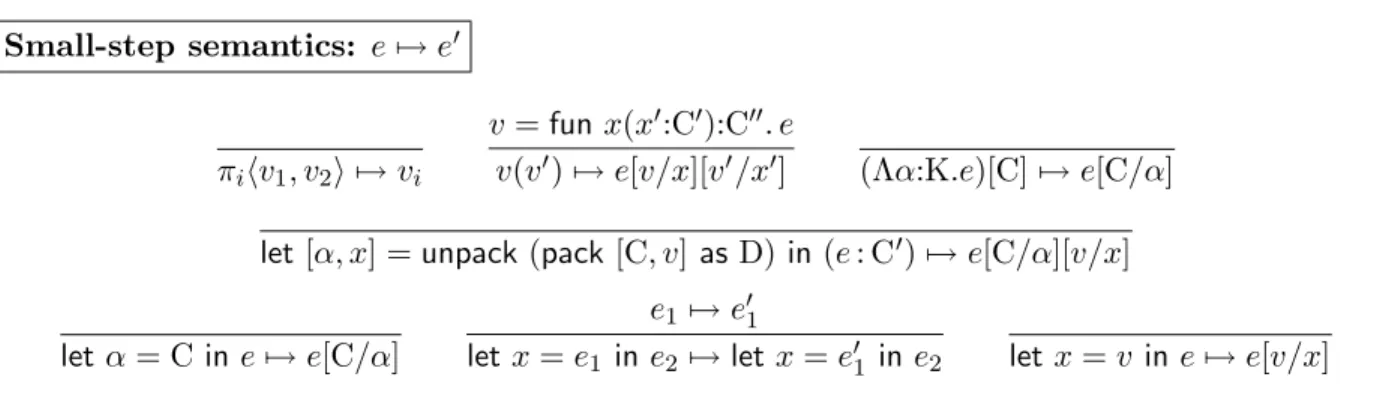
3.14 Dynamic Semantics of the Core Language . . . 58
4.1 Syntax of Signatures . . . 60
4.2 Correspondence With ML Signatures . . . 60
4.3 Extracting the Static Part of a Signature . . . 61
4.4 Singleton Signatures . . . 62
4.5 Inference Rules for Signatures . . . 63
4.6 Signature Phase-Splitting and Definition of Package Type . . . 67
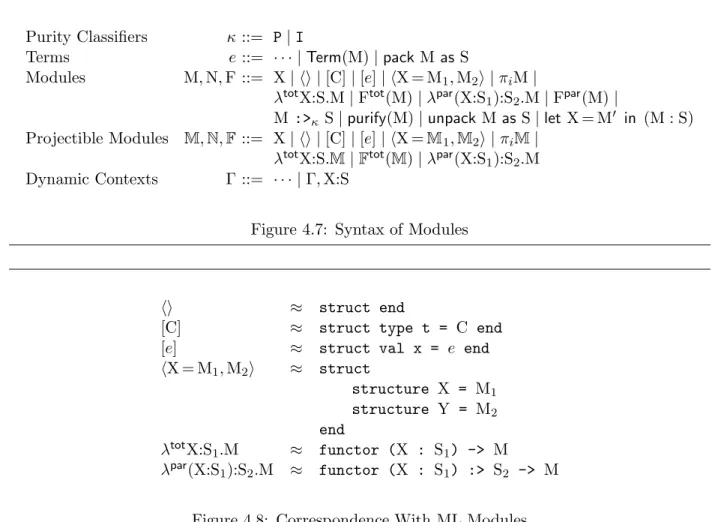
4.8 Correspondence With ML Modules . . . 69
4.9 Extracting the Static Part of a Projectible Module . . . 71
4.10 Inference Rules for Modules . . . 73
4.11 Signature Checking and Principal Signature Synthesis . . . 75
4.12 Encoding of the Avoidance Problem in O’Caml . . . 79
4.13 Module, Term and Context Translation . . . 81
4.14 Module, Term and Context Translation (continued) . . . 82
5.1 Mutually Recursive ModulesExpr and Bind . . . 88
5.2 Parameterization Workaround for Separating Recursive Function Definitions . . . 89
5.3 Backpatching Workaround for Separating Recursive Function Definitions . . . 89
5.4 Bootstrapped Heap Example . . . 90
5.5 Encoding Polymorphic Recursion Using a Recursive Module . . . 91
5.6 Example of Recursive Module with Effects . . . 93
5.7 Problematic Signature for Exprand Bind . . . 94
5.8 Recursively Dependent Signature for Expr and Bind . . . 95
5.9 Rds forExpr and Bindwith Mutually Recursive Datatype Specifications . . . 96
5.10 The Double Vision Problem Arising in Exprand Bind . . . 98
5.11 Attempted Separate Compilation of Expr and Bind. . . 100
5.12 Expr and Bindin Moscow ML: First Try . . . 103
5.13 Expr and Bindin Moscow ML: Second Try . . . 103
5.14 Separate Compilation of Exprand Bind in Moscow ML . . . 104
5.15 Signature for Exprand Bind in O’Caml . . . 105
5.16 Strange Behavior of O’Caml Recursive Module Typechecking . . . 106
5.17 Closed Static Signature of Expr and Bind . . . 111
5.18 Canonical Implementation of Expr and Bind’s Closed Static Signature . . . 112
5.19 Elaboration of Exprand Bind: First Try . . . 112
5.20 Elaboration of Exprand Bind: Second Try . . . 113
5.21 Elaboration of Exprand Bind With Sealing: First Try . . . 113
5.22 Elaboration of Exprand Bind With Sealing: Second Try . . . 114
5.23 Problematic Elaboration of ModifiedExprBindExample . . . 114
5.24 Meta-signature for Modified ExprBind . . . 115
6.1 Extensions to Type Constructor Syntax . . . 118
6.2 Inference Rules for Type Constructors . . . 118
6.3 Extensions to Kind Synthesis . . . 119
6.4 Extensions to Constructor Equivalence Algorithm . . . 119
6.5 Extensions to Term Syntax . . . 120
6.6 New Inference Rules for Terms . . . 120
6.7 Expandable Kinds and Types . . . 121
6.8 Extensions to Type Synthesis . . . 121
6.9 Abstract Machine Semantics With Explicit Store and Control Stack . . . 126
6.10 Well-Formed Continuations . . . 126
6.11 Extensions to Signature Syntax and Related Functions . . . 128
6.12 New Inference Rules for Signatures . . . 129
6.13 New Signature Phase-Splitting Rules . . . 131
6.14 Extensions to Module Syntax . . . 132
LIST OF FIGURES xv
6.16 Extensions to Signature Synthesis . . . 134
6.17 New Module Phase-Splitting Rules . . . 135
7.1 Modified Example of Recursive Module With Effects . . . 140
7.2 Syntax of Safe Recursion Language . . . 142
7.3 Static Semantics for Safe Recursion Language . . . 144
7.4 Revised Separate Compilation Scenario . . . 146
7.5 Recursive Module Example With Non-strict Functor Application . . . 147
7.6 Typechecking Algorithm for Safe Recursion Language . . . 149
7.7 Dynamic Semantics for Safe Recursion Language . . . 150
7.8 Well-Formed Continuations for Safe Recursion Language . . . 152
7.9 Static Semantics Extensions for References and Continuations . . . 154
7.10 Dynamic Semantics Extensions for References and Continuations . . . 155
7.11 Static Semantics Extensions for Memoized Computations . . . 156
7.12 Dynamic Semantics Extensions for Memoized Computations . . . 157
8.1 IL Constructors and Kinds . . . 171
8.2 IL Values and Expressions . . . 172
8.3 IL Modules and Signatures . . . 173
8.4 IL Valuable Expressions . . . 174
8.5 IL Projectible Modules and Transparent Kinds/Signatures . . . 174
8.6 IL Expandable Kinds and Recursive Type Paths . . . 175
8.7 IL Definition of Package Type . . . 175
8.8 IL Meta-level Function Definitions . . . 176
9.1 Syntax of the External Language . . . 191
9.2 Syntax of the External Language (continued) . . . 192
Introduction
Nearly all programming languages that are intended for the implementation of real-world appli-cations provide some facility for structuring programs as a network of smaller modules. While structuring a program in this fashion typically incurs some initial development overhead, it also reaps several huge rewards. First, it allows multiple programmers to work on different modules of the same program simultaneously. Second, it delineates the high-level structure of the program, which in turn makes the program easier to understand and maintain. Third, it can make the program significantly more reliable through the use ofdata abstraction.
The idea of data abstraction is that the weaker the dependencies between program modules, the more robust the program structure will be. In particular, for the purpose of enforcing program invariants, it is useful for the implementor of a module to be able to hide information from clients of the module regarding the structure of data that it operates on. For example, the correctness of a module implementing binary search trees as red-black trees depends on the invariant that the trees it operates on have no two adjacent red nodes. The tree operations provided by the module assume this invariant about the trees they are given as input and preserve this invariant for the trees they produce as output. To ensure that the input assumptions are valid, the implementor should be able to restrict the clients of the module so that they may only construct red-black trees via the invariant-preserving operations that the module provides. Such a restriction, which constitutes a weakening of the dependency between the module and its clients, also makes the client code more reusable. One may make arbitrary changes to the implementation of the binary search tree module without precipitating changes to its clients, so long as the external functionality of the module—i.e.,the set of operations it provides—remains the same.
Many modern programming languages provide some form of support for data abstraction. For example, in mainstream object-oriented languages like C++ and Java, “classes” support data abstraction by allowing certain fields or methods of a class to be designated as “private” and therefore invisible to the clients of the class. However, classes also embody a host of other features of object-oriented programming, such as inheritance, subtyping and dynamic dispatch. The subtle and sometimes undesirable interplay of these features makes classes a tricky object for formal study. In this dissertation I will be exploring an altogether different approach to modular program-ming, namely that of the ML module system. Unlike the class mechanism in object-oriented languages, the module mechanism in ML is focused entirely on supporting data abstraction. It ensures implementor-side data abstraction by allowing the implementor of a module to “seal” it behind an abstract interface, thereby hiding information about its internal data representation from its clients. Furthermore, ML’s notion of an interface is very flexible, enabling one to reveal partial information about the identity of an abstract data type or to express equivalences between abstract data types exported by different modules. ML also exploits a form of client-side data abstraction through the “functor” mechanism. Functors, which are functions at the level of modules, allow one to develop and compile a module independently from the modules on which it depends, given only
abstract interfaces for them. These dependencies can then be instantiated with multiple different modules during the execution of the program, enabling a powerful form of code reuse.1
Nevertheless, despite its strengths, the ML module system is not in a fully evolved state. One prominent weakness is that module interdependencies in ML are restricted to be acyclic, which means that mutually recursive functions and data types must be written in the same module even if they belong conceptually in different modules. In addition to hindering independent development of mutually recursive components, this restriction inhibits data abstraction because it prevents mu-tually recursive components from hiding implementation details from one another. Furthermore, although there are justifications for ML’s restriction, it still seems rather unintuitive to most new-comers to the language, who are accustomed to languages like Java and C++ that do allow cyclic dependencies between program components. As a consequence, support for mutually recursive modules has been one of the most frequently requested extensions to ML.
In response, there has been much work in recent years on extending ML and other functional languages with recursive modules. Most of the current proposals suggest replacing ML modules with some alternative mechanism such as “units” or “mixins,” which are subject to severe syntactic restrictions but, as a result, are easier to recursively link [20, 16]. The only concrete proposals that remain within the framework of ML modules are Russo’s extension to the Moscow ML compiler [66] and Leroy’s extension to the Objective Caml compiler [44]. Both of these are based to a large extent on Craryet al.’s foundational account of recursive modules [6]. Neither extension, however, provides full support for data abstraction between, or separate compilation of, mutually recursive modules. Before we can consider ways of improving on the existing proposals for extending ML with recursive modules, there are two more basic questions that need to be addressed. First, what language should we be extending? There is not just one language called ML; there are several dialects of ML, the most popular being Standard ML (SML) [52] and Objective Caml (O’Caml) [41]. These implemented dialects are both the result of and inspiration for a large body of research on the theoretical underpinnings of ML and in particular its module system. However, as these formal accounts of the ML module system employ a variety of different formalisms, the relationships and tradeoffs between different designs have been difficult to understand or compare in a rigorous way. It is important that we come to a clear assessment of the existing design space and consolidate what is meant by “the ML module system” before embarking on such a major extension as recursive modules.
Second, once we decide on the basis for our extension, what is the right way to go about defining the extension? Type theory and operational semantics have proven to be an ideal setting for defin-ing and reasondefin-ing about fundamental concepts like polymorphism, data abstraction and subtypdefin-ing, with established methods for proving properties like type safety and decidability of typechecking. However, while there exist a number of type-theoretic accounts of ML-style modularity, they typ-ically describe some idealized subset of the ML language. On the other hand, the Standard ML dialect has been given a full formal definition, and the very existence of the Definition of SML [52] has encouraged the development of independent implementations of the language while providing stability of SML code across those implementations. The flip side of that stability is that the Definition is closely tailored to the needs of SML, often to the point of seemingad hoc from a more general semantic perspective. For example, it is not clear how the “semantic object” language that the Definition uses to formalize SML’s static semantics corresponds to traditional type structures. The approach I take in this dissertation follows the work of Harper and Stone [33], who give an alternative interpretation of Standard ML by translating well-formed SML programs into a type
1
I will give concrete examples of how ML’s sealing and functor mechanisms are used in Chapter 1. For a detailed comparison of the ML approach and the object-oriented approach to modularity, see MacQueen [48].
INTRODUCTION 3
theory. The Harper-Stone approach provides one with a flexible method of evolving a full-fledged programming language. The key concepts of the language are modeled at the level of the type theory, where they can be more clearly understood. The features of the language that are not so much semantically interesting as syntactically convenient—e.g., type inference, pattern matching, theopen’ing of a module’s namespace—are handled by the translation (calledelaboration), which formalizes how these features are to be de-sugared into more basic constructs.
Another advantage of the Harper-Stone approach is that it fits neatly into the model of type-directed compilation [31, 77, 70, 68]. In traditional compilers, type information is discarded after typechecking. In type-directed compilers, the intermediate languages of the compiler are typed so as to enable optimizations that rely on type information. For instance, the TILT compiler for SML developed at CMU [77, 74, 61] maintains type information throughout compilation in order to implement intensional type analysis [31] and tag-free garbage collection [55]. Thus, regardless of how ML programs are typechecked, a type-directed ML compiler will at some point need to translate them into an internal typed language. TILT performs this translation as part of typechecking, based closely on Harper and Stone’s elaboration algorithm.
In summary, the goal of this dissertation is to contribute to the evolution of the ML module system in the following ways:
Part I: To develop a unifying account of existing variants of the ML module system that can serve as a basis for future research on module systems.
Part II: To explore the problem of extending ML with recursive modules, with the goal of emend-ing the deficiencies of existemend-ing proposals.
Part III: To formally define a language based on the work of Parts I and II within the type-theoretic framework of Harper and Stone.
The document is structured as follows:
Part I:In Chapter 1, I give an overview of the design space of ML modules, as well as a discussion of the key ideas and motivations behind a variety of existing designs. In Chapter 2, I give a high-level semantic analysis of what makes ML-style data abstraction work, leading to a unifying framework in which several variants of the ML module system can be understood as subsystems that pick and choose different features. I also describe the design of a type system, based on this unifying framework, that harmonizes and improves on the existing designs. This type system is formally defined in Chapters 3 and 4: the first chapter presents the “core” language of the type system, and the second chapter presents the “module” language. In addition to providing detailed discussion of the rationale behind various typing rules, these chapters present the key meta-theoretic properties of the core and module languages, which include type safety and decidability of typechecking.
Part II: In Chapter 5, I give an overview of the design space of existing recursive module exten-sions to ML and discuss the deficiencies of these proposals, which suggest two key directions for improvement. One direction for improvement involves the interaction of recursive modules and data abstraction. I describe (in Chapter 5) an intuitive semantics that allows for real data abstraction between recursive modules. Some aspects of this semantics can be captured in type theory, and in Chapter 6 I show how to extend the type theory of Chapters 3 and 4 accordingly. However, there is a significant component of my intuitive semantics for recursive modules that I do not know how to account for directly in type theory. I formalize it instead in Part III using elaboration techniques. The other direction for improvement on existing recursive module designs involves statically detect-ing whether a recursive module is “safe.” In Chapter 7, I explore this direction in the context of the
simply-typedλ-calculus, setting aside the orthogonal issues involving type components in modules. At the end of the chapter, I discuss what would be involved in scaling my proposed approach to the level of modules with type components.
Part III:In Chapters 8 and 9, I use the Harper-Stone framework as a starting point for defining a new dialect of ML. Following Harper-Stone, the language is defined in two parts. The “internal” language, defined in Chapter 8, is a type system based very closely on the work of Chapters 3, 4 and 6. The “external” programmer-level language, defined in Chapter 9 by translation into the internal language, is an evolved dialect of Standard ML that supports recursive and higher-order modules. Finally, in Chapter 10, I conclude and suggest directions for future work.
Part I
Understanding
Chapter 1
The Design Space of ML Modules
What is the ML module system? It is difficult to say. There are several dialects of the ML language, and while the module systems of these dialects are certainly far more alike than not, there are important and rather subtle differences among them, particularly with regard to the semantics of data abstraction. The goal of Part I of this thesis is to offer a new way of understanding these differences, and to derive from that understanding a unifying module system that harmonizes and improves on the existing designs.
In this chapter, I will give an overview of the existing ML module system design space. I begin in Section 1.1 by developing a simple example—a module implementing sets—that establishes some basic terminology and illustrates some of the key features shared by all the modern variants of the ML module system. Then, in Section 1.2, I describe several dialects that represent key points in the design space, and discuss the major axes along which they differ.
1.1
Key Features of the ML Module System
1.1.1 Structures and Signatures
In ML, code and data are grouped together in modules. The basic module construct is called a
structure, and Figure 1.1 shows an example of a structure implementing integer sets.1 The structure
IntSetis defined by a structure expressionstruct ... end, which contains a sequence of bindings.
The first binding defines the type namesetas an abbreviation for the typeint listof integer lists, thus indicating that sets are being implemented by this module as lists. Type bindings are much like typedefs in C; the typesetand the typeint listare interchangeable. The second binding in
IntSetis a value binding, definingemptysetto be the empty list[], which has type setbecause
it has type int list. The remaining bindings are function bindings: an insert operation that takes an integer and a set and returns the result of pushing the integer onto the front of the list representing the set, and a member operation that checks whether an integer belongs to a set by performing a sequential search on the list representing the set.2 Although this example does not illustrate it, structures in ML may also contain substructure bindings, thereby allowing modules to be built up as composites of other modules and enabling flexible namespace management.
Now that we have defined this module IntSet, we can use it essentially as we would use an object in Java or a structin C—by projecting out its components using the “dot notation.” For
1
This example, as well as the others in this section, is written in Standard ML syntax.
2
Note that, in keeping with functional programming style, this is a persistent implementation of sets,e.g.,inserting an integer into a set does not modify the input set but merely returns a new set containing the integer.
structure IntSet = struct
type set = int list val emptyset : set = []
fun insert (x : int, S : set) : set = x::S fun member (x : int, S : set) : bool = ... ...
end
Figure 1.1: ML Module for Integer Sets
signature INT SET = sig
type set
val emptyset : set
val insert : int * set -> set val member : int * set -> bool ...
end
Figure 1.2: ML Interface for Integer Sets
instance, we might define the set Sby the following value binding:
val S : IntSet.set = IntSet.insert(5, IntSet.emptyset)
This defines Sby inserting 5 into the empty set. A distinguishing feature of ML modules is that, in addition to having data and function components, they have type components, such as the set type component of IntSet. Correspondingly, we can also use the dot notation to project out the
type IntSet.set, which is the return type ofIntSet.insertand thus the type ofS.
As mentioned above, IntSet.setis merely an abbreviation forint list. However, there is no need for clients of the IntSetmodule to know this. In the interest of data abstraction, we would thus like to hide the knowledge that IntSet.set is equivalent to int list. This is achieved by first defining an interface that describes what the clients do need to know. In ML, interfaces are calledsignatures, and Figure 1.2 shows an appropriately abstract signature for integer sets.
The signature INT SETis defined by a signature expressionsig. . .end, which contains a list of specifications for the components of theIntSetmodule. The specifications foremptyset, insert
and memberare straightforward, assigning to each value component a type. (In a functional
lan-guage like ML, function components are just value components with arrow types.) The interesting specification is the one for thesettype, which holds its definition abstract. A more precise interface for the IntSetmodule would replace INT SET’s abstract specification of the setcomponent with the transparent specification type set = int list, which exposes the implementation of sets as lists. ML allows one to specify type components in interfaces with or without their definitions, thus providing fine-grained control over the propagation of type information (see Section 1.1.3). In this case, however, the abstract INT SET interface is a more appropriate description of sets, as it does not allow clients to depend on any particular implementation strategy.
1.1. KEY FEATURES OF THE ML MODULE SYSTEM 9
signature COMPARABLE = sig
type item
val compare : item * item -> order end
functor Set (Item : COMPARABLE) = struct
type set = Item.item list val emptyset : set = []
fun insert (x : int, S : set) : set = x::S fun member (x : int, S : set) : bool =
... Item.compare(x,y) ... ...
end
Figure 1.3: ML Functor for Generic Sets
1.1.2 Data Abstraction via Sealing and Functors
Just defining theINT SETsignature does not do anything by itself. To ensure that the clients’ view
of IntSetis limited to what appears in INT SET, we must seal IntSetwith INT SET, as follows:
structure IntSet = IntSet :> INT SET
Given this new definition for IntSet, we may still project out the typeIntSet.set, but it is not known to be equivalent to int list. Consequently, the only way clients of IntSet can create values of typeIntSet.setis by usinginsertandemptyset(and presumably other operations like
unionandintersection), which are explicitly specified inINT SET. Although theIntSetexample
does not illustrate it, sealing can also be used to hide the existence of certain value components in a module. We will see an example of this in Section 1.2.6.
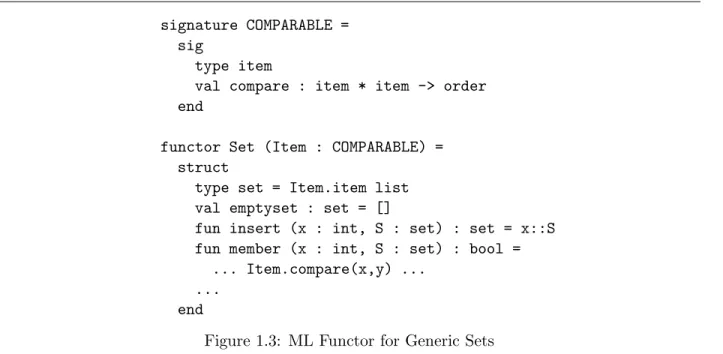
Another distinguishing feature of the ML module system is its functor mechanism. Functors are simply functions from modules to modules. Much as functions allow a piece of code to be reused with different instantiations of its parameters, functors allow a module to be reused with different instantiations of the modules it depends on. To continue theIntSetexample, the implementation of sets is largely indifferent to the type of items stored in the sets and would be more useful if it were not restricted to sets of integers. The only reason the type of items matters at all is that the implementation of a function likememberassumes an ordering on items. Functors allow us to make the implementation of sets generic with respect to the item type, as shown in Figure 1.3.
First, we define a signature COMPARABLEdescribing what the set module needs to know about the item type. This signature characterizes modules that provide some type item—which one it is is irrelevant—together with a functioncompare for ordering values of that type. The Set module is then defined as a functor that takes as input a module Item of signature COMPARABLE and returns a module implementing sets containing items of type Item.item. Note that the settype is now defined as Item.item list, and the member function invokes Item.compare for ordering
Item.item’s instead of relying on integer comparison.
We can now generate sets of different item types very easily. For example, as shown in Fig-ure 1.4, we can reproduce the functionality of our originalIntSetmodule by first defining a module
structure IntItem = struct
type item = int
fun compare (x,y) = Int.compare(x,y) end
structure StringItem = struct
type item = string
fun compare (x,y) = String.compare(x,y) end
structure IntSet = Set(IntItem)
structure StringSet = Set(StringItem) Figure 1.4: Instantiating the Set Functor
IntItem, which providesintas theitemtype along with the built-in integer comparison function,
and then applyingSettoIntItem. If we want to generate an implementation of integer sets based on a different ordering of the integers, we can apply the Set functor to an item module with the same definition of theitemtype but with a different comparison function. A module implementing sets of strings or any other type can also be generated in a similar manner.
To summarize, we have seen two mechanisms that ML provides for supporting data abstraction. First, the sealing mechanism supports implementor-side data abstraction by allowing the imple-mentor of the set module to hide information about the implementation of sets from its clients. Second, by thinking of the set module as itself being a client of an item module with an abstract interface, we see that ML functors exploit the idea of client-side data abstraction to provide a powerful form of code reuse.
1.1.3 Translucent Signatures
The natural next step in the development of the Set example is to combine ML’s two forms of data abstraction by sealing the body of the Set functor with an abstract signature that hides the implementation of sets as lists. The question is what signature to use. Now that we have generalized the implementation of sets to support an arbitrary item type, theINT SETsignature is no longer applicable. The most obvious answer is to use a signature that replaces all occurrences
of intin INT SETwith references to Item.item. However, the type Item.itemonly makes sense
inside the body of the Set functor, and we would like to be able to define a generic signature for sets separately from this particular implementation of them.
One way to define a generic interface for sets would be to allow a signature to be parameterized by a module [37], in which case one could define a parameterized signatureSETas follows:
signature SET (Item : COMPARABLE) = sig
type set ...
val insert : Item.item * set -> set ...
1.1. KEY FEATURES OF THE ML MODULE SYSTEM 11
signature SET = sig
type item type set
val emptyset : set
val insert : item * set -> set val member : item * set -> bool ...
end
Figure 1.5: Generic ML Signature for Sets
functor Set (Item : COMPARABLE) = struct
type item = Item.item type set = item list
... (* same as before *) ... end
:> SET where type item = Item.item Figure 1.6: Sealed ML Functor for Generic Sets
The body of the Setfunctor could then be sealed with the signatureSET(Item).
In fact, however, one need not introduce an explicit form of parameterized signature in order to characterize a generic interface for sets. ML provides implicit support for parameterized sig-natures through the idea of translucency. As we have seen, type components in ML signatures may be specified “opaquely” (e.g., type set), but they may also be specified “transparently” (e.g., type set = int list). Signatures that support both kinds of specifications are known as “translucent.”
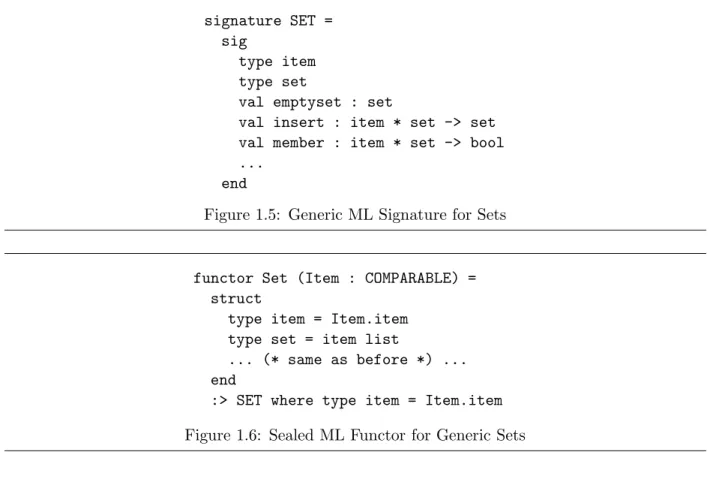
Figure 1.5 shows the signature for generic sets that one would write in the ML style. Instead of making theitem type a parameter of the SETsignature, the ML approach is to includeitem as an abstract type component in the signature. In other words, a module implementing sets carries the type of items along with it, whatever that type may be, thus enabling the generic interface for sets to be self-contained.
Figure 1.6 shows how the implementation of the Set functor is made abstract. The item component of theItemargument is copied into the body of the functor; the body is then sealed with the signature SET where type item = Item.item, which is shorthand in ML for the signature formed by taking the abstract SETsignature and making theitem component transparently equal
toItem.item. Thus, the signature with which the body of theSetfunctor is sealed is translucent—
it reveals the identity of the item type, which is necessary in order for the resulting set module to be of any use, but it holds the identity of the settype abstract.
Translucency subsumes the utility of parameterized signatures, but it is useful for other reasons as well. First, it allows one to reveal partial information about the identity of a type. For instance, suppose a module exports a typetwhich is defined internally to be int * string, and the imple-mentor of the module wishes to reveal that values of typet are pairs whose first component is an integer, but does not wish to reveal that the second component is a string. Then the implementor
can seal the module with a signature containing an opaque type u, which is defined internally to
bestring, and a transparent type t = int * u.
In addition, the support for transparent type specifications in signatures means that for most modules in ML there is aprincipal signature,i.e.,a most-specific signature that encapsulates all that can be observed about the module during typechecking.3 For example, the principal signature of the
module IntItem defined in Figure 1.4 is COMPARABLE where type item = int. The existence of principal signatures is advantageous for modular program development because it allows a program to be divided at relatively arbitrary points, with the assurance that all the typing information about any one component of the program is expressible in the form of a signature that the programmer can write independently of the implementation of that component.
Lastly, translucency accounts naturally for the concept of type sharing. It often happens that one wants to take as input to a functor two modules (call themAand B), each of which provides a type componentt, and in order for the body of the functor to make any sense it is necessary that A.tis equal toB.t. ML supports such a “type sharing” constraint by letting the programmer attach
sharing type A.t = B.tto the specification of the functor arguments. In earlier versions of ML,
such as SML ’90, type sharing constraints provided an increase in expressive power that proved difficult to account for in type-theoretic studies of the module system [47, 29]. In modern dialects of ML, however, type sharing can be seen as just an instance of translucency. The constraint
sharing type A.t = B.t can be seen as syntactic sugar that has the effect of modifying the
signature of argumentBso that its type componenttis specified transparently astype t = A.t.4 For further illustrations of the power of translucent signatures, I refer the reader to one of the more pedagogical treatments of ML programming that are available, such as Harper [26].
1.2
Key Points and Axes in the Design Space of ML Modules
Since its inception [46], the ML module system has been associated with the mechanisms of sig-natures, structures and functors. The sealing mechanism5 was proposed early on by MacQueen in the form of an abstraction binding, which was implemented in 1993 in an early version of the SML/NJ compiler (version 0.93) [71]. Translucent signatures were also implemented in version 0.93 of SML/NJ, but were not treated formally until 1994, when Harper and Lillibridge [28] and Leroy [42] independently proposed similar formalisms for them at the same POPL symposium.
Although the formal accounts prior to that point still provide much valuable insight—particularly Harper, Mitchell and Moggi’s work on higher-order modules [30], which introduces the concept of
phase separation that underlies much of the analysis in Chapter 2 and the formal system in Chap-ter 4—I am focused in this thesis on accounting for the semantic variations among the “modern” variants of the ML module system that support all of the features described in Section 1.1, includ-ing translucency. In this section I will describe several such variants and how they relate to one another in the design space of ML modules. I will begin, though, with a bit of historical context.
3
As we will see in Section 4.2.6, due to the “avoidance problem,” not all modules in ML have principal signatures, but there is a considerable subset of ML in which modules do have principal signatures. Also, to avoid confusion, it is worth noting that the Commentary on the original Definition of SML [50] also uses the termprincipal signature, but to describe a concept unrelated to the notion of fully-descriptive signature intended here.
4
Or, if moduleBcomes beforeA in the order of the functor arguments, modifying the signature ofA so that its type componenttis specified transparently as type t = B.t. For details on how type sharing constraints may be desugared in general, see Chapter 9.
5
I meansealing here in its “opaque” form (:>), as described in Section 1.1.2. In contrast, the “transparent” form of sealing (:) was part of the Definition from the beginning, but does not provide full support for data abstraction and is not present in other dialects of ML, such as O’Caml. For further discussion of the difference between opaque and transparent sealing, see Section 9.3.2.
1.2. KEY POINTS AND AXES IN THE DESIGN SPACE OF ML MODULES 13
1.2.1 Precursors to Translucency
The idea of translucency present in modern variants of ML arose in response to a bifurcation that had developed in the late ’80s and early ’90s in the semantics of modularity. On one hand there was the approach taken by SML ’90 [51], which is modeled in formal accounts by MacQueen [47] and Harper et al. [29, 30] in terms of “strong sum” types. While it supports client-side data abstraction via functors, SML ’90 does not fully support implementor-side data abstraction. In particular, sealing in SML ’90 is “transparent,” that is, sealing a module with a signature limits which components of the module are externally visible but does not hide the definitions of any visible type components, even those that are specified opaquely in the signature. (Lillibridge correspondingly termed the SML ’90 approach the “transparent” approach to modularity [45].) In addition, as I have already mentioned, the type-theoretic treatments of SML ’90-style modularity were not able to account for the idea of type sharing constraints in signatures.
On the other hand there was the “opaque” approach, due to Mitchell and Plotkin [53], in which abstract data types are modeled as existential types. Existentials provide an elegant logical foundation for type abstraction and, unlike the transparent approach, provide full support for implementor-side data abstraction. They are awkward, however, as a basis for modular program construction. In particular, a value of existential type is not as flexible as an ML module. One cannot refer to the abstract types and associated operations provided by such a value via the standard “dot notation” (e.g., IntSet.insert) used for modules. Rather, in order to use a value v of type ∃α.C, one must “open” or “unpack” v—as in the expression “open v as [α, x] in e”—in which case the scope of the abstract type α and of the associated operations represented byx (of type C) is limited to the expression e. In contrast, unless otherwise delimited, the scope of the types and values provided by an ML module is “the rest of the program,” which may not even have been written yet. Furthermore, whereas the transparent approach suffers from allowing too much type information to be propagated, the opaque approach suffers from not allowing enough. For example, if one applies the identity function id to a value v of type ∃α.C, there is no way to tell that v and id(v) share their abstract type component because there is no way to even refer to v’s abstract type component. In contrast, applying the identity functor to theIntSetmodule in ML (even in SML ’90) will result in a module whose settype is transparently equal toIntSet.set.
As illustrated in Section 1.1.3, translucent signatures and opaque sealing address the deficiencies of both the opaque and the transparent approaches to modularity, combining the flexibility of ML-style modules with the support for implementor-side abstraction provided by existentials.6 Although Harper and Lillibridge [28] and Leroy [42] differ in their terminology, the former speaking of “translucent sums” and the latter of “manifest types,” the basic idea of translucency put forth by both papers is the same. The key point that distinguishes these two accounts is that Harper and Lillibridge’s supportsfirst-class modules whereas Leroy’s supports second-class modules.
1.2.2 First-Class vs. Second-Class, Higher-Order vs. First-Order
The primary feature that distinguishes functional programming languages from other kinds of languages is that in functional languages functions are treated as “first-class” entities, i.e., they may be produced as the result of arbitrary computations and stored inside data structures, just like any other kind of data. As a consequence of being first-class, functions are also “higher-order,”
i.e.,they can take functions as arguments and return functions as results.
Unlike functions, modules are not treated as first-class entities in most dialects of the ML module 6
system. They are “second-class” in the sense that the module language exists on a separate plane from the so-called “core” language of ML. Modules may not be passed as arguments to or results from core-language functions, nor can they be stored in data structures. In some sense this is justified by thinking about modules as primarily serving to structure code in a pre-existing core language.
A less defensible aspect of the Standard ML module system in particular—and one not shared by all dialects of ML—is that functors are restricted to be “first-order,” meaning that they may only be defined at the top level of the program, not as components of other modules, and thus functors cannot be parameterized over other functors or return other functors as results. It is difficult to explain why functions at the module level of SML are restricted in a way that functions at the core level are not. As a consequence, whether or not they treat modules in general as first- or second-class, most modern variants of ML—including most implementations of Standard ML—do provide support for higher-order functors. The semantics of higher-order functors, however, is an axis in the design space of modules along which we will find considerable variety.
1.2.3 Harper and Lillibridge’s First-Class Modules
Harper and Lillibridge’s “translucent sums” calculus does not distinguish the language of modules from the core language of terms, thus treating modules as first-class values. The fusion of the module and term levels leads to a pleasantly economical design, in which structures are merely records, and functors are merely functions. In addition, the first-class status of modules allows one to choose between different implementations of an abstract data type at run time based on information that may only be available dynamically.
To steal an example from Lillibridge’s thesis [45], suppose one is defining a module implementing dictionaries. Depending on the size of the dictionaries that one will be creating, one may wish to use different implementations. For large dictionaries, a hash table implementation may be appropriate, but for small ones, a linked list implementation will be more space-efficient. If the size is not known statically, first-class modules enable one to make this choice at run time by defining the dictionary module with a conditional expression:
structure Dictionary = if n < 20 then LinkedList else HashTable
At the same time, however, merging the core and module levels also complicates the type structure of the core language, interfusing it with notions of dependent types and subtyping. As a result, typechecking in the Harper-Lillibridge system is proven undecidable, and moreover it is not clear how ML-style type inference could be adapted to it. For the moment, though, I will ignore the more practical problems with the Harper-Lillibridge approach, in favor of exposing a lack of expressiveness with respect to higher-order functors.
Since functors are just functions in the Harper-Lillibridge system, they are naturally higher-order. Consider, however, a simple canonical example of a higher-order functor, namely the Apply functor shown in Figure 1.7. Apply takes a functor argument F of signature SIG -> SIG and a structure argument Xof signature SIG—where SIG is a signature with an opaque specification of some typet—and it applies Fto X. Ideally, Apply(F)(X)should be semantically indistinguishable from F(X). Unfortunately, this turns out not to be the case.
First of all, what is the type (i.e., signature) of Apply? The obvious answer—and the one given in Harper and Lillibridge’s system—is(SIG -> SIG) -> (SIG -> SIG). Given this type, if we instantiate Applywith any arguments of the appropriate types, regardless of what they are, we get out a structure of signatureSIG. In particular, if we applyApplyto the identity functorIdent, also defined in Figure 1.7, and a particular structureArgof typeSIG, then the resultRes1has type SIGas well, giving us no indication that its type component tis in fact equal toArg.t.
1.2. KEY POINTS AND AXES IN THE DESIGN SPACE OF ML MODULES 15
signature SIG = sig type t ... end
functor Apply (F : SIG -> SIG) (X : SIG) = F(X) functor Ident (X : SIG) = X
structure Res1 = Apply(Ident)(Arg)
(* Res1.t 6= Arg.t *)
structure Res2 = Ident(Arg)
(* Res2.t = Arg.t *)
Figure 1.7: Higher-Order Functor Example
On the other hand, consider what happens when we apply Ident to Arg directly and bind the result to Res2. AlthoughIdent does indeed match the type SIG -> SIG, its principal type is
(X:SIG) -> (SIG where type t = X.t). (This is a dependent function type, where the argument
Xis bound in the right-hand side of the arrow.) Thus, substitutingArgforX, we see that the type
of Res2 is SIG where type t = Arg.t, from which we can infer that Res2.t= Arg.t. In order
to observe this equivalence forRes1, we would need to require that Apply’s functor argument have the more specific type ofIdent, but that would in turn place a rather arbitrary restriction on the potential arguments to Apply.
1.2.4 SML/NJ’s Higher-Order Functors
One approach to remedying this problem was proposed by MacQueen and Tofte [49] and incor-porated into the SML/NJ compiler. Their solution is to “re-typecheck” the body of the Apply functor at every application site, exploiting knowledge of Apply’s actual arguments to propagate more type information. Thus, under their semantics, typechecking the Res1 module in Figure 1.7 prompts a re-typechecking ofApplygiven the knowledge thatFin this instance has a more specific type, namely the principal type of Ident. Given this added information, the typechecker can then observe that Res1.t=Arg.t.7
MacQueen and Tofte essentially argue that since ML’s signature language is too weak to express the dependency between the result ofApplyand its argument, one must inspect the implementation instead. This is a sensible argument when one has access to Apply’s implementation. In the context of separate compilation, however, it is inapplicable, as Apply’s implementation may not be available. Moreover, the MacQueen-Tofte solution is fundamentally non-type-theoretic, in the sense that signatures in their language do not encapsulate the information about a higher-order functor that may be needed during typechecking.8 As I am ultimately concerned with developing
an account of ML modules that can be formalized in type theory and that makes sense in the presence of separate compilation, I will focus attention in this thesis on the following alternative approach to higher-order functors.
7
In practice, the SML/NJ compiler does not actually re-typecheck the body of a higher-order functor every time it is applied. Rather, it employs an implementation technique that mimics re-typechecking without actually doing it. This technique, described by Cr´egut and MacQueen [7], produces a static representation for each functor that contains all information concerning the “compile-time behavior” of the functor.
8
In the SML/NJ implementation, the static representation of a functor (described in the previous footnote)
does encapsulate all information needed about it during typechecking. However, this static representation may not correspond to any signature that the ML programmer can write. Furthermore, Cr´egut and MacQueen do not provide any formal semantics for it [7].
1.2.5 Leroy’s Applicative Functors
Leroy’s “manifest types” calculus, while second-class, suffers from the same problem as Harper and Lillibridge’s with respect to poor propagation of type information in higher-order functors
like Apply. In a follow-up paper the following year, however, Leroy [43] presents a solution to the
problem that is quite different from SML/NJ’s. He proposes an “applicative” semantics for functors as an alternative to Standard ML’s “generative” semantics.
Functors in SML, as well as in the translucent sum and manifest type calculi, behave “genera-tively,” in the sense that every time a functor is applied it generates fresh abstract types. In other words, if a functor Fis applied to the same argument twice, and the results are bound toAand B, then A.tand B.t will be considered distinct for any type component tthat is specified opaquely in the result signature ofF. For example, since the argumentFof the Applyfunctor has signature
SIG -> SIG, the application of F in the body of Apply results in a module with a fresh abstract
typet. According to this generative semantics, it makes sense thatRes1.tis distinct fromArg.t, because every application of Apply produces a new type t, distinct from all others. Nevertheless, as I have argued, this is not the desired behavior for the Applyfunctor.
Leroy proposes instead that, when a functor is applied to the same argument module more than once, it should produce the same abstract types in each result module. In order to realize this “applicative” semantics for functors, Leroy extends the dot notation so that, in addition to projecting types from named structures, one can project types from functor applications.
For example, given thatFhas signatureSIG -> SIG, the principal signature forF(X)in Leroy’s applicative functor calculus is SIG where type t = F(X).t, which indicates that the type t in the result of Apply is precisely the one obtained by applying Fto X. Thus, substituting Identfor F and Arg forX, we see that Res1 (defined as Apply(Ident)(Arg)) can under Leroy’s semantics be given the signature SIG where type t = Ident(Arg).t. The signature of Identallows us, in turn, to observe that Ident(Arg).t=Arg.t, so that Res1.t=Arg.t as desired.
It is natural to ask whether Leroy’s solution carries over to the setting of a first-class module system like Harper and Lillibridge’s. The answer is that it does not, and the reason is that in a first-class module system it does not in general make sense to write a type likeF(X).t. For instance, in the Harper-Lillibridge system, a functor of signature SIG -> SIG, when applied, may very well consult some dynamically changing condition—e.g., whether a mouse button is pressed—and the identity of the type components in the module it returns may depend on that condition. Thus, one evaluation of F(X) may result in a module whose t component is defined to be int and another may result in one whose t component is defined to bestring. Since the evaluation of F(X) does not always produce the same tcomponent, it is senseless to refer to the typeF(X).t.
This is not an issue, however, for a second-class system like Leroy’s, which obeys the principle of
phase separation. A module system obeying phase separation is one in which every module can be split into a static part (comprising its type components) and a dynamic part (comprising its term components), such that the static part does not depend on the dynamic part. In such a system, the type components of modules cannot depend on any dynamic conditions—they are the same every time the module is evaluated. Phase separation is ensured in the case of Leroy’s system by the restricted “second-class” nature of the language in which modules are written. A consequence of phase separation is that it makes sense to talk aboutthe typeF(X).tbecause the type components of F(X)are guaranteed to be the same every time it is evaluated.
Although Leroy’s calculus, which serves as the basis of the Objective Caml module system, has succeeded in popularizing the idea of applicative functors, both the concepts of phase separation and applicative functor semantics were actually introduced in earlier work by Harper, Mitchell and Moggi [30]. While their calculus admittedly lacks any account of sealing or translucency, it has
1.2. KEY POINTS AND AXES IN THE DESIGN SPACE OF ML MODULES 17
signature SYMBOL TABLE = sig
type symbol
val string2symbol : string -> symbol val symbol2string : symbol -> string ...
end
functor SymbolTable () = struct
type symbol = int
val table : HashTable.t =
(* allocate internal hash table *)
HashTable.create (initial size, NONE)
fun string2symbol x =
(* lookup (or insert) x *) ... fun symbol2string n =
(case HashTable.lookup (table, n) of SOME x => x
| NONE => raise (Fail "bad symbol")) ...
end
:> SYMBOL TABLE
structure ST1 = SymbolTable() structure ST2 = SymbolTable()
Figure 1.8: Symbol Table Functor Example
been a strong influence on other module languages, not least on the design of my own type system for modules. I will discuss their calculus’ relationship to mine in more detail in Section 2.2.3.
1.2.6 The Importance of Generativity
The discussion so far might lead one to the conclusion that the applicative semantics for functors is a clear improvement over the generative semantics, but this is not the case—the two are incomparable. As we have seen, the applicative semantics allows for the desired propagation of type information in higher-order functors. For other kinds of functors, however, generativity is essential for guaranteeing the desired degree of data abstraction.
Consider, for example, theSymbolTablefunctor shown in Figure 1.8, which takes no arguments but, when applied, generates a module implementing a symbol table as a hash table. The module represents symbols as integer indices into the hash table, and thus defines the symboltype to be int. It defines the hash table itself by invoking the create function from the standard library
HashTablemodule and binding the result to table. It then defines two functions for converting
between strings and symbols: string2symbol, which inserts a string into the table and returns the corresponding symbol, andsymbol2string, which looks up a symbol in the table and returns the corresponding string. The latter function raises a Fail exception if the given symbol is invalid.
Finally, the body of the SymbolTablefunctor is sealed with the SYMBOL TABLEsignature. The sealing serves two purposes. One is to prevent the actual table from being exported, so that the implementation in terms of a hash table is not revealed. The other is to prevent the clients of the functor from being able to observe thatsymbolis equal tointand attempting to pass off arbitrary integers as valid indices into the hash table.
The intention of this implementation is that theFailexception should never be raised because the only values of type symbol that clients should ever have access to are those obtained through calls to string2symbol, which are clearly valid symbols. Under an applicative functor semantics, however, this intention will not be upheld. Specifically, suppose that structures ST1 and ST2 are both defined by calls to SymbolTable, as shown in Figure 1.8. According to the applicative semantics, ST1.symbol = ST2.symbol because both types are equal to SymbolTable().symbol. As a result, symbols generated by calls to ST1.string2symbolmay be passed as arguments to
ST2.symbol2string, even though such symbols are not necessarily valid indices into ST2’s hash
table and may cause itssymbol2stringfunction to raise the Failexception. Therefore, although it is perfectly sound to consider the SymbolTable functor applicative, the functor ought to be considered generative. Everysymboltype it produces classifies valid indices into a newly generated symbol table and is thus semantically incompatible with every other symboltype.
On the other hand, for a functor like theSetfunctor defined in Figure 1.6, the applicative seman-tics is perfectly appropriate. Suppose we applySetto the same item module—e.g.,IntItem—twice and bind the results toIntSet1andIntSet2. The typesIntSet1.setand IntSet2.setboth de-scribe sets of integers ordered according to the same IntItem.compare function, so there is no reason to distinguish them.
1.2.7 Supporting Both Applicative and Generative Functors
Each of the major dialects of ML, SML and O’Caml, supports only one semantics for functors: generative or applicative, but not both. The analysis above, however, suggests that since each semantics is appropriate in different circumstances, it would be preferable to have a module language that does support both.
The module system of the Moscow ML dialect [56], based to a large extent on Russo’s thesis work [65], represents one such hybrid design. In Moscow ML, the programmer can choose, when defining a functor, whether it should behave applicatively or generatively. While the simplicity of this approach is appealing, it is semantically problematic. In particular, one would expect that every application of a generative functor produces distinct abstract types, but this is not the case. For example, if one were to define theSymbolTablefunctor from Figure 1.8 in Moscow ML and label it generative, there would be nothing to prevent one from defining another functorSymbolTable’as the eta-expansion of SymbolTable—i.e.,functor SymbolTable’() = SymbolTable()—and then labelingSymbolTable’as applicative. Consequently, different instances ofSymbolTable’would be considered to have equivalentsymboltypes, even though “under the hood” they are really different instances ofSymbolTable, which according to generativity should have distinctsymboltypes. What is even more troublesome is that the ability to subvert the generativity ofSymbolTablein this way can be further exploited to break the soundness of the type system [9].
The problems with Moscow ML suggest that in order to guarantee that generativity is respected by the type system, one must restrict the class of functors that may behave applicatively. This is precisely what Shao does in his type system for ML-style modules [69]. Like Moscow ML, Shao’s calculus supports both applicative and generative functors. The key idea in Shao’s system is to only allow functors to be treated as applicative if their bodies are transparent. (Correspondingly, Shao
1.2. KEY POINTS AND AXES IN THE DESIGN SPACE OF ML MODULES 19
refers to applicative functors as “transparent” and generative functors as “opaque.”) As a result, the eta-expansion ofSymbolTablefrom the previous paragraph could not be labeled as applicative in Shao’s system because the principal signature of its body is SYMBOL TABLE, which specifies the
symboltype opaquely.
Although Shao’s approach ensures that generativity is respected, I argue that it is overly re-strictive. For example, theSetfunctor from Figure 1.6 could not be treated as applicative in Shao’s system, at least not as written, because its body is sealed with an abstract interface. In the case of our implementation of sets as lists, we can work around this problem by hoisting the sealing outside of the functor. In other words, we can leave the body of the functor alone and instead seal the functor itself with the signature
(Item : COMPARABLE) -> SET where type item = Item.item
Since the sealing no longer occurs inside the functor body, the body has a transparent signature, and thus Shao’s system will treat the functor as applicative.
However, this technique does not always apply. For instance, suppose that we define a new functor implementation of sets, Set’, in which the set type is defined by an ML datatype dec-laration instead of as an abbreviation for item list. Types defined by datatype declarations in ML are abstract and distinct from all other types. Therefore, even without explicitly sealing it, the body of the Set’functor will contain an opaquesettype, and Shao’s type system will treat Set’ as generative. Semantically speaking, however, there is no reason why Set’ should not behave applicatively, since repeated application of Set’ to the same item module produces modules with perfectly compatible settypes.
To summarize, whereas Moscow ML allows one to write too many applicative functors, Shao’s language allows one to write too few.
1.2.8 Notions of Module Equivalence
In the above discussion, I have defined applicative semantics of functors informally by saying that a functor behaves applicatively if, when applied to the same module twice, it produces results with equivalent type components. I have implicitly taken for granted in this definition that “the same module” has some agreed-upon meaning. In fact, however, the manner in which equivalence of modules is defined is yet another axis along which several variants of the ML module system differ. In Leroy’s applicative functor calculus (and hence in O’Caml), module equivalence issyntactic: two modules are equivalent only if they have the same name. For example, moduleXis equivalent to itself but not to any other moduleY, even ifYis defined by the module bindingstructure Y = X. Consequently, supposing that functor F returns an opaque type t in its result, then F(X).t is equivalent to itself, but not to F(Y).t. This is unfortunate, as bindings like structure Y = Xare commonly used in ML programming in order to give an abbreviated name to a module that will be frequently referred to. Distinguishing between a module name and its abbreviation, based not on any semantic distinction but on a purely syntactic consideration, makes for a somewhat brittle semantics.9
Connected to Leroy’s syntactic characterization of module equivalence is his requirement that functor applications appearing inside types be in “named form.” For example, F(X).t is a well-formed type, but F(struct ... end).t is not. This named form restriction is useful in order to avoid having the well-formedness of a program depend on the syntactic equivalence of arbitrary module expressions, which is a rather fragile property.
9