Typologies of Male Batterers: Three Subtypes
and the Differences Among Them
Amy Holtzworth-Munroe and Gregory L. Stuart
Previous typologies of male batterers, including typologies developed by means of rational-deductive and empirical-inductive strategies, are reviewed. On the basis of this review, 3 descriptive dimensions (i.e., severity of marital violence, generality of the violence [toward the wife or toward others], and psychopathology/personality disorders) that consistently have been found to distinguish among sub-types of batterers are identified. These dimensions are used to propose a typology consisting of 3 subtypes of batterers (i.e., family only, dysphoric/borderline, and generally violent/antisocial). A developmental model of marital violence is then presented, and the previous literature is reviewed to examine how each batterer subtype might differ on variables of theoretical interest. Finally, some of the methodological limitations of previous typology research are reviewed, and suggestions for future work are offered.
Marital violence is a serious problem in the United States. Data from the 1985 National Family Violence Survey indicated that one of eight husbands carried out at least one violent act toward his wife and 1.8 million wives were beaten by their hus-bands during the year of the study (Straus & Gelles, 1988). The costs of this problem are staggering in terms of marital dissatis-faction, psychological and physical health problems, and nega-tive effects on the children of such marriages (e.g., McDonald & Jouriles, 199 l;Sonkin, Martin, & Walker, 1985). Although data indicate that both husbands and wives engage in violence (e.g., O'Leary et al., 1989; Straus & Gelles, 1988), husband violence has consistently been found to have more detrimental effects than wife violence; for example, wives are more likely than hus-bands to suffer severe physical injuries and depressive symp-tomatology (Cascardi, Langhinrichsen, & Vivian, 1992; Stets & Straus, 1990).
Recent evidence suggests that, when one is trying to un-derstand husband-to-wife violence, studies examining the hus-band may be the most productive line of inquiry. After review-ing the available data, Hotalreview-ing and Sugarman (1986) con-cluded that "men's violence is men's behavior. As such, it is not surprising that the more fruitful efforts to explain this behavior have focused on male characteristics" (p. 120). Similarly, exam-ining the marital interactions of violent couples, Boeke and Markman (1992) found that "most of the differences between couples were due to differences between the abusive and non-abusive husbands" (p. 13). Such findings suggest that research-ers should focus their attention on violent husbands.
Researchers studying maritally violent men have often
Amy Holtzworth-Munroe and Gregory L. Stuart, Department of Psychology, Indiana University.
We would like to thank the anonymous reviewers for their helpful comments and feedback.
Correspondence concerning this article should be addressed to Amy Holtzworth-Munroe, Department of Psychology, Indiana University, Bloomington, Indiana 47405.
treated batterers as a homogeneous group, averaging scores on measures of interest across all of the violent husbands in their sample and then comparing the mean score of the violent sam-ple with that of a nonviolent samsam-ple. However, averaging scores across different violent men may result in a lack of significant violent-nonviolent group differences, leading researchers to discount the potential importance of some variables. For exam-ple, some researchers have failed to distinguish batterers and nonbatterers on measures of attitudes toward women (e.g., Nei-dig, Collins, & Friedman, 1986). Saunders (1992) noted that the reason may be the variability of such attitudes among violent men; in his sample of batterers, scores on a measure of attitudes toward women were distributed bimodally (i.e., one group with liberal attitudes and another with conservative attitudes). Sim-ilarly, in recent research, violent husbands have been found to vary along a number of important dimensions, including sever-ity of violence, anger, depression, and alcohol abuse (see later review of typologies).
Such findings suggest that a reliable and valid typology of male batterers would yield valuable information. Comparing the various subtypes of violent husbands with each other, and pinpointing how each type of violent man differs from nonvio-lent men, could increase the understanding of marital violence and help in identifying different underlying processes resulting in violence. Developing a typology of violent men would allow a systematic examination of how and why different men use violence against their wives.
Moreover, such a typology could lead to increases in therapy effectiveness, eventually resulting in patient-treatment match-ing. Many current treatment programs for batterers are stan-dardized and uniformly applied to all violent men seeking help. However, one treatment may be better suited for one subtype of violent men than for another. Tailoring treatments to meet the needs of each subtype of violent men might improve therapy efficacy (Gondolf, 1988; Saunders, 1992).
Researchers have occasionally derived subtypes of violent couples (i.e., Deal & Wampler, 1986—study of dating couples; 476
TYPOLOGIES OF MALE BATTERERS 477 Hanks, 1992—clinical descriptions of couples; Johnston &
Campbell, 1993—clinical descriptions of couples involved in child custody disputes during divorce proceedings; Steinmetz, 1978—clinical descriptions of couples; Whitchurch, 1988— unpublished dissertation) or battered women (i.e., two cluster-analytic studies of battered women in marital-type relation-ships—Follingstad, Laughlin, Polek, Rutledge, & Hause, 1991, and Snyder & Fruchtman, 1981; clinical descriptions of women married to violent and alcohol-abusing men—Hanks & Rosen-baum, 1977; one study of dating violence, comparing women who had experienced only one violent incident with those who experienced ongoing violence—Follingstad, Rutledge, Polek, & McNeill-Hawkins, 1988). We do not review these studies here for two reasons. First, and most important, our interest is in research delineating subtypes of male batterers rather than vio-lent couples or battered women; it is unclear whether studies of women or couples are applicable to male batterers. Second, as can be noted in the studies just listed, previous research exam-ining typologies of couples or women is limited in scope, often lacks empirical data (i.e., descriptions based on clinical descrip-tions only), and has involved varied methodologies, making it difficult to draw conclusions across studies. For example, re-searchers studying couples or women have examined a wide va-riety of samples (e.g., dating couples, alcohol-abusing men, and couples in child custody disputes).
In this article, we have chosen to examine existing male bat-terer typologies to determine the subtypes that consistently ap-pear across typological models and to identify the underlying descriptive dimensions used by previous researchers to discrim-inate subgroups. On the basis of this review, we suggest three possible subtypes of batterers. We also present a developmental model of marital violence, identifying variables of theoretical interest that may distinguish among subtypes of batterers. Fi-nally, we examine the methodological limitations of previous typology research and make suggestions for future work.
Review of Previous Typologies
To locate previous batterer typology research, we reviewed the available marital violence literature and contacted col-leagues who were conducting this type of research (e.g., Ham-berger and Saunders); we used both sources to locate additional studies. We also conducted a computer search, using a wide va-riety of topic keywords (e.g., marital violence, relationship vio-lence, dating viovio-lence, or couple viovio-lence, combined with sub-types or typology) to search for relevant journal articles, books, and book chapters. Given the early stage of research in this area, we chose to include all of the studies we located.
Table 1 summarizes the previous research, presenting the studies in the order in which they are reviewed in the text. In Table 1, each previous typology is presented, along with infor-mation (if such inforinfor-mation was available) regarding how the identified subtypes differed along the three descriptive dimen-sions used in previous research (i.e., severity of marital vio-lence, generality of viovio-lence, and psychopathology or personal-ity disorders; see later discussion).
Rational/Deductive Studies
Early attempts to develop typologies of batterers generally used one of two rational/deductive strategies. Researchers ei-ther described subtypes of batterers on the basis of their clinical observations (e.g., Elbow, 1977) or split batterers into groups on the basis of a priori theoretical speculation and compared them on available data (e.g., Hershorn & Rosenbaum, 1991). In gen-eral, work using a rational/deductive approach has identified three major dimensions for classifying batterers.
The first dimension identified is the severity of marital vio-lence; with few exceptions (i.e., Hershorn & Rosenbaum, 1991), severity and frequency have been positively correlated, and usu-ally considered together, in previous typologies. Some early ty-pologies simply split batterers into groups on the basis of this one dimension. For example, Mott-McDonald Associates (1979) distinguished "hitters" from "batterers," with batterers engaging in more frequent and severe violence and more psy-chological abuse; Sweeney and Key (1982) proposed that there are "infrequent," "frequent," and "mixed" batterers.
The second major dimension that has been used to differen-tiate subtypes of batterers is the generality of the husband's vio-lence: Is the batterer violent only with his wife and family or in other relationships as well? Some previous researchers (i.e., J. A. Pagan, Stewart, & Hansen, 1983, who interviewed 270 abused women; Shields, McCall, & Hanneke, 1988, who interviewed more than 80 men referred by social service agencies; and Cad-sky & Crawford, 1988, who interviewed and tested 172 men seeking domestic violence treatment) have split batterers into two groups—family only and generally violent—on the basis of this distinction. Across these studies, generally violent men have been found to engage in more severe violence than family-only men.
The third dimension emerging from rational/deductive methods of identifying subtypes of batterers is the batterer's psy-chopathology or personality disorders, or both. Previous re-searchers have often discussed these potentially separate cate-gories—psychopathology (e.g., Axis I), personality disorders (e.g., Axis II), and motivation for violence—interchangeably.1
Three early researchers used psychopathology and personal-ity disorders to explain possible motivations for violence among subtypes of batterers. After interviewing 23 men arrested for marital violence, Faulk (1974) proposed five types of male bat-terers: the stable/affectionate batterer (17% of the sample), who has a stable marriage but uses violence during a time of mental disturbance, particularly during a depressive episode; the de-pendent/passive batterer (39% of the sample), who generally tries to please his wife but explodes violently in response to some precipitating action by the wife; the dependent/suspicious batterer (17% of the sample), who is irrationally jealous of his wife, very dependent on her, and controlling of her actions; the
1 In future research, it is possible that these dimensions (e.g., Axis I
psychopathology, Axis II personality disorders, and motivation for vio-lence) may emerge as separate dimensions, each contributing uniquely to an understanding of the subtypes of batterers. At this point, however, given the nature of the past research, we leave these distinctions merged into one dimension.
Table 1
Summary of Previous Batterer Typologies
Descriptive dimension
Study
Severity of marital
violence Generality of violence Psychopathology/personality disorder
Mott-McDonald Associates (1979) Hitter
Batterer
Sweeney & Key (1982) Infrequent
Mixed Frequent
J. A. Pagan, Stewart, & Hansen (1983) Family only
Generally violent
Shields, McCall, & Hanneke (1988) Family only
Generally violent Cadsky & Crawford (1988)
Family-only/wife assaulter
Generally violent/mixed assaulter
Faulk(1974) Stable/affectionate
Dependent/passive Dependent/suspicious Dominating Violent/bullying Elbow (1977)
Approval seeker Defender Incorporator Controller Caesar (1986)
Nonexposed altruist Exposed rescuer Tyrant
Hershorn & Rosenbaum (1991) Overcontrolled
Undercontrolled
Rational/deductive Low
High,
more psychological abuse
Low Varying High Low High Low High Low
High
Less frequent
Psychological abuse Psychological abuse More frequent
psychological abuse
High High,
high psychological abuse
Psychological abuse More severe, less frequent Less severe, more frequent
Family
In and out of home Family
In and out of home Only violent toward female
partner in past year Violent toward female partner
and other men or women in past year; assaulted others less frequently than partner
Family
In and out of home
Rigidly inhibited
Aggressive whenever frustrated
More criminal and drug involvement Normal levels of self-esteem, not
depressed, not diagnosed as having antisocial personality disorder Lower self-esteem, not depressed,
almost one third received diagnosis of antisocial personality disorder
Marital violence occurred during time of mental disturbance (e.g., depression)
Tries to please wife
Jealous; very dependent on wife Needs to control wife
Uses violence to solve problems
Dependent on wife's approval Overprotects wife
Wife is part of himself Controls wife
Unassertive, dependent Histrionic traits Psychopathic, paranoid Overcontrolled hostility More general hostility
Hamberger&Hastings(1985, 1986) Normal
Passive-dependent/compulsive Schizoidal/borderline Narcissistic/antisocial Hale, Zimostrad, Duckworth, &
Nicholas (1988) Normal (Cluster 2) All MM PI scales elevated
(Cluster 1)
MMPI Scales 2 and 4 elevated (Cluster 3)
Empirical/inductive
Normal
Passive-dependent/compulsive Schizoidal/borderline Narcissistic/antisocial
Normal
Faking bad or very disturbed Antisocial
Table 1 (continued)
Descriptive dimension
Study
Severity of marital
violence Generality of violence Psychopathology/personality disorder
Flournoy & Wilson (1991) Normal (Cluster 2)
MMPI Scales 2 and 4 elevated (Cluster 1)
Saunders(1992) Family only Emotionally volatile Generally violent
Low
High, but less frequent than generally violent High
Family Family
In and out of home
Normal Antisocial Low distress High distress
Arrest, alcohol; Low-moderate distress
Gondolf(l 988; Gondolf with Fisher, 1988)
Typical Sporadic Chronic Antisocial Sociopathic
Stith, Jester, & Bird (1992) Secure lover
Stable minimizer Hostile pursuer Hostile disengaged
Low
Low-moderate High
High
Low, low psychological abuse
Low, low psychological abuse
Moderate, high psychological abuse Severe, frequent, low
psychological abuse
Family Mostly family In and out of home In and out of home
Substance use Substance abuse, arrest High self-esteem and mastery
Note. MMPI = Minnesota Multiphasic Personality Inventory.
dominating batterer (22%), who wants to control his wife and uses violence to do so; and the violent/bullying batterer (4%), who uses violence and intimidation to solve many of his prob-lems and to get what he wants. On the basis of clinical observa-tions, Elbow (1977) identified four groups of batterers: the ap-proval seeker, who needs his wife to approve of him and uses violence to bolster his self-image; the defender, who is dependent on his wife and overprotects her, mixing love and hate; the in-corporator, who sees his partner as part of himself and needs her to define himself; and the controller, who views his wife as an object he controls and will use violence to achieve that control. Caesar (1986), on the basis of interviews and administration of the Minnesota Multiphasic Personality Inventory (MMPI; Hathaway & McKinley, 1967) to 26 wife assaulters, suggested three types of batterers. The first type, the nonexposed altruist, is unassertive and tries to inhibit his anger and please his wife, but he is ambivalent about his dependence on her. The exposed rescuer has histrionic personality traits, is unable to express his resentment, and wants his wife to be dependent on him. Finally, the tyrant shows psychopathic, hostile, and paranoid traits; uses fear and psychological abuse; and shows little remorse for his violence.
In a recent study, Hershorn and Rosenbaum (1991) used an MMPI-derived scale measuring overcontrolled hostility to di-vide 41 batterers in domestic violence treatment into two sub-groups: those who overcontrol their hostility (i.e., do not express anger until it summates and explodes) and those who
undercon-trol hostility (i.e., have few conundercon-trols against the expression of angry and aggressive impulses). They found that overcontrolled hostile batterers engaged in more severe marital violence; un-dercontrolled hostile batterers engaged in less severe but more frequent violence, were more likely to engage in aggression out-side of their marital relationship, and were more generally hostile.
Empirical/Inductive Studies
Other researchers have used an empirical/inductive strategy, employing factor analysis or cluster analysis to identify sub-groups of batterers. The typologies derived with these empiri-cal/inductive strategies have resulted in the same three descrip-tive dimensions used to categorize batterers in the rational/de-ductive literature: the severity of marital violence, the generality of the violence, and the batterer's psychopathology or personal-ity disorders.
Several research groups have factor or cluster analyzed bat-terers' scores on standardized tests (i.e., the Millon Clinical Multiaxial Inventory [MCMI; Millon, 1983] or the MMPI [Hathaway & McKinley, 1967]) to identify subgroups of batter-ers. These typologies have focused only on the psychopathology/ personality disorders dimension.
The first typology derived in this way was developed and rep-licated by Hamberger and Hastings (1985, 1986). They factor analyzed batterers' scores on the MCMI (Millon, 1983), a
ques-tionnaire measure of personality disorders, and then compared identified subtypes on measures of depression and anger. One hundred five male subjects participated in the 1985 investiga-tion, and 99 men participated in the 1986 replication study; all were attending a domestic violence treatment program.
Factor analysis of the MCMI data revealed three key person-ality factors: schizoidal/borderline, narcissistic/antisocial, and passive-dependent/compulsive. On the basis of descriptions of typical individuals with similar MCMI profiles and data gath-ered from the men in their studies, Hamberger and Hastings (1985, 1986) concluded that passive-dependent/compulsive men are tense and rigid individuals who lack self-esteem and depend on one or a few significant others; rebellious feelings and hostility may break through when their needs are not met by these others. These men were depressed, but findings regarding their anger proneness were contradictory across the two sam-ples. Schizoidal/borderline men are withdrawn, asocial, moody, and hypersensitive to interpersonal slights; they are vol-atile and likely to overreact to trivial interpersonal disputes. The men in this group had high levels of anxiety, depression, and anger proneness and may have had alcohol problems. Narcissis-tic/antisocial men have a self-centered approach to life, using others to meet their own needs and believing that they are enti-tled to be treated well by others; this group did not report feeling depressed or angry but showed tendencies for alcohol and drug problems.
On the basis of various combinations of these three personal-ity factors, Hamberger and Hastings (1985, 1986) identified eight subgroups of violent men; the men fell almost evenly into each of the subtypes (i.e., 10-16 subjects per group in each study). Seven of the subtypes involved psychopathology, whereas one "normal" subgroup, constituting 12% of the sam-ple, had no clinical elevations on any MCMI scale and did not report depression or anger problems.
Similarly focusing on psychopathology to distinguish sub-types of batterers, other researchers have examined the MMPI (Hathaway & McKinley, 1967) profiles of male batterers. Hale, Zimostrad, Duckworth, and Nicholas (1988) cluster analyzed the MMPI profiles of 67 men who were seeking spouse abuse treatment. The analysis revealed three clusters. Cluster 1 (10% of the sample) included men who were either "faking bad" or had severe psychopathology, with elevations on nearly all of the MMPI scales. Fifteen percent of the sample fell into Cluster 2, having no MMPI scale elevations. Men in Cluster 3 (75%) had elevations on MMPI Scales 2 (depression) and 4 (psychopathy), indicating psychopathy or antisocial personality disorder with depressive features that may be produced by specific situations and may be short lived; this profile is often associated with alco-hol, drug, and legal problems and suggests a group with antiso-cial personality characteristics and/or external stressors caused by family disputes and legal problems.
In a similar study, Flournoy and Wilson (1991) cluster ana-lyzed the MMPI profiles of 56 batterers court ordered to treat-ment. Two profiles emerged. The first (44% of the sample) in-volved elevations on Scales 2 (depression) and 4 (psychopathy), similar to Hale et al.'s (1988) Cluster 3. The second group (56% of the sample) did not have clinical elevations on any MMPI scale, similar to Hale et al.'s (1988) Cluster 2.
Two researchers (Gondolf, 1988;Saunders, 1992) used cluster analysis to examine what subtypes of male batterers emerged from available data and then compared the resulting clusters on other, external variables. These researchers examined more than one descriptive dimension in their studies.
Saunders (1992) performed a cluster analysis on self-report data gathered from 165 maritally violent men entering treat-ment for spouse abuse. Saunders entered 6 variables into a clus-ter analysis (i.e., depression, anger, generalized violence, severity of marital violence, attitudes toward women, and alcohol use during violent incidents); he compared the resulting clusters on 10 external variables, with significant differences emerging on 6 (i.e., marital satisfaction, psychological abuse, marital conflict, impression management, childhood abuse, and arrests for drunk driving). Three subtypes emerged.
Family-only aggressors (52% of the sample) were the least likely to be violent outside the home. They had the highest mar-ital satisfaction and the least marmar-ital conflict, were the least psy-chologically abusive, and held the most liberal attitudes toward women. They reported low levels of anger, depression, and jeal-ousy but had the highest scores on measures of impression man-agement; their violence was associated with alcohol use about half of the time. They were the least likely to have been abused as children. Generally violent aggressors (29% of the sample) were the most likely to report extrafamilial violence and en-gaged in the most severe marital violence. They were the most severely abused as children. Their violence was usually associ-ated with alcohol use, and they had relatively high rates of arrest for drunk driving and violence. They reported moderate mari-tal satisfaction, moderate marimari-tal conflict, and low to moderate levels of anger and depression, and they held the most rigid, conservative attitudes toward women. Emotionally volatile ag-gressors (19% of the sample) reported being severely violent less frequently than the generally violent men. However, they were the most psychologically abusive and were the least satisfied with their marriages. They had the highest levels of anger, de-pression, and jealousy and had the most suicidal ideation and guilt; approximately half of these men had received previous psychological treatment. Alcohol use was generally not associ-ated with their violence.
Gondolf (1988; Gondolf, with Fisher, 1988) developed a ty-pology of wife assaulters using data obtained during intake in-terviews with 6,000 women seeking help at shelters. Data from a random subsample of 525 of the women were used to establish preliminary clusters; the replicability of these clusters was ex-amined with two replication subsamples, each involving 525 women. Six variables were entered into a cluster analysis (i.e., amount of physical abuse, amount of verbal abuse, how the man responded after the abuse in terms of blame or remorse, the man's substance abuse, his use of general violence, and his previous arrest record); the derived clusters were compared on other variables (e.g., demographic variables).
Three main clusters of abusive men were consistently derived. Two clusters—sociopathic (5%-8% of the samples) and antiso-cial (30%-42% of the samples)—were characterized by severely abusive actions, including sexual abuse and child abuse, and antisocial behavior. These groups were likely to use weapons and tended to inflict injuries on their wives, and both engaged
TYPOLOGIES OF MALE BATTERERS in extrafamilial violence. However, these two groups were
dis-tinguished from one another in that the sociopathic group had higher levels of substance abuse and more previous arrests for violence against nonfamily members than the antisocial group; sociopathic batterers were characterized by extensive arrest rec-ords. The third cluster, typical batterers (approximately 50% of the samples), was substantially less abusive than the other sub-types. Men in this cluster engaged in less severe physical and verbal abuse and were less likely than the other batterers to have used weapons or to have engaged in sexual abuse of their part-ners or child abuse. In addition, this group engaged in less gen-eral aggression and was less likely to have arrest records; these men were the most likely to apologize, and the least likely to blame their partners, after their violence. In an early analysis of these data, Gondolf, with Fisher (1988), divided the typical batterer group into two subcategories: chronic and sporadic batterers. Relative to sporadic batterers, chronic batterers abused their partners more frequently and severely and were more likely to commit extrafamilial violence and to threaten their partners or hold their partners accountable for the abuse. Of all of the groups, the sporadic batterers exhibited the least physical, verbal, and sexual abuse; were least likely to have had previous arrest records and alcohol problems; and were most likely to apologize after the violence.
Stith, Jester, and Bird (1992) used cluster analysis to derive subtypes of male and female college students who had used vio-lence in their dating relationships. This study differed from the others reviewed in two important ways. First, Stith et al. (1992) examined dating violence among college students rather than violence in the context of a marital-type relationship. Second, in their sample, they included both men (n = 69) and women (« = 97) who had used physical aggression. Thus, their batterer subtypes may or may not be directly comparable to those de-rived in studies examining only male batterers involved in mar-ital-type relationships. However, given the similarity of their de-rived subtypes to those already reviewed, we included this study in our review.
In their cluster analysis, Stith et al. (1992) entered question-naire measures of relationship functioning (i.e., love, relation-ship maintenance activities, relationrelation-ship conflict, and ambiva-lence about the relationship), relationship negotiation styles, and general coping strategies. Four clusters of physically aggres-sive individuals were derived. These clusters were then com-pared on additional variables (e.g., severity of violence, level of emotional/verbal abuse, self-esteem, mastery, and length of relationship).
One cluster was labeled secure lovers. For these individuals, use of physical violence and emotional abuse was rare and less severe than that of the other subtypes. These individuals had the highest levels of self-esteem and mastery, suggesting a lack of psychological problems. They had relatively good relationships (e.g., the most love, least relationship conflict, and least ambiv-alence about their relationships). Stable minimizers also re-ported low levels of violence and emotional abuse. Whereas they reported moderate levels of relationship functioning (e.g., love and conflict), they had been in their relationships the lon-gest of any subgroup. A third cluster, hostile pursuers, engaged in the highest levels of emotional abuse and in moderate levels
of physical violence. They were the most ambivalent about their relationships; they reported a high level of involvement in rela-tionship maintenance activities but also had the highest levels of relationship conflict. The final group, hostile disengaged in-dividuals, reported using the most frequent and most severe physical violence, although they did not engage in high levels of emotional abuse. Their relationships were the shortest and the most troubled (i.e., high levels of conflict and low levels of love and relationship maintenance activities).
Three Major Descriptive Dimensions
In summary, across existing typologies, including those de-veloped with a rational/deductive approach and those devel-oped with an empirical/inductive approach, three major di-mensions have been used to distinguish among subtypes. These dimensions are (a) the severity of marital physical violence and related abuse, such as frequency of the violence and psycholog-ical and sexual abuse; (b) the generality of the violence (i.e., family-only or extrafamilial violence) and related variables such as criminal behavior and legal involvement; and (c) the batterer's psychopathology or personality disorders.
The three dimensions are primarily descriptive in nature. Al-though it is possible to view the psychopathology/personality disorders dimension as causally important (e.g., generally vio-lent/antisocial men are maritally violent as part of their more general pattern of antisocial behavior), this has generally not been the case in previous research. Past researchers have often used the psychopathology/personality disorders dimension de-scriptively to distinguish among subtypes of batterers rather than integrating this dimension into a theoretical model regard-ing the development of maritally violent behavior.
Proposed Typology of Male Batterers
Given this literature review, we hypothesize that researchers using these three descriptive dimensions will usually identify three major subtypes of batterers; we label these subtypes family only, dysphoric/borderline, and generally violent/antisocial. Our estimates regarding the percentage of batterers who will fall into each subtype are based on our review of the previous literature, adjusted for the fact that previous researchers have primarily examined clinical samples, whereas we are interested in prevalence rates among all batterers irrespective of whether they are in treatment. For example, we hypothesize that a lower percentage of generally violent/antisocial batterers will be found among batterers in the community than among batterers who have been arrested and are in court-ordered treatment. The proposed differences between these subgroups on the three de-scriptive dimensions are presented in Table 2 and discussed subsequently.
First, family-only batterers should engage in the least severe marital violence and be the least likely to engage in psychologi-cal and sexual abuse. The violence of this group is generally restricted to family members; these men are the least likely to engage in violence outside the home or to have related legal problems. Also, they evidence little psychopathology and either no personality disorder or a passive-dependent personality
dis-Table 2
Proposed Subtypes of Male Batterers: How They Differ on the Descriptive Dimensions Dimension
Severity of marital violence Psychological and sexual abuse Generality of violence
Extrafamilial violence
Criminal behavior, legal involvement Psychopathology/personality disorder
Personality disorder Alcohol/drug abuse Depression Anger
Family-only batterer
Low Low Low Low
None or passive/dependent Low-moderate
Low-moderate Moderate
Dysphoric/borderline batterer Moderate-high Moderate-high Low-moderate Low-moderate Borderline or schizoidal Moderate
High High
Generally violent/ antisocial batterer Moderate-high Moderate-high High
High
Antisocial/psychopathy High
Low
Moderate
order. They are similar to men included in the following groups by previous researchers: hitters (Mott-McDonald Associates, 1979), infrequent batterers (Sweeney & Key, 1982), some of the family-only batterers (e.g., Cadsky & Crawford, 1988; J. A. Fa-gan et al., 1983; Shields et al., 1988), stable/affectionate and dependent/passive batterers (Faulk, 1974), approval seekers (El-bow, 1977), nonexposed altruists (Caesar, 1986), some of the overcontrolled hostile batterers (Hershorn & Rosenbaum, 1991), normal and passive-dependent/compulsive batterers (Hamberger & Hastings, 1986), batterers with no clinical eleva-tions on MMPI scales (Flournoy & Wilson, 1991; Hale et al., 1988), Saunders's (1992) family-only batterer, Gondolf's (1988) sporadic typical batterer, and Stith et al.'s (1992) secure lovers and stable minimizers. This group could constitute up to 50% of batterer samples if researchers recruit violent husbands not only from treatment programs but also from the community (i.e., we hypothesize that many men who are not seeking ther-apy will be found to have engaged in only less severe violence and only violence inside the home).
Second, dysphoric/borderline batterers should be found to engage in moderate to severe wife abuse, including psychologi-cal and sexual abuse. This group's violence is primarily con-fined to the family, although some extrafamilial violence and criminal behavior may be evident. These men are the most dys-phoric, psychologically distressed, and emotionally volatile. They may evidence borderline and schizoidal personality char-acteristics and may have problems with alcohol and drug abuse. These men parallel some of the batterers (Mott-McDonald As-sociates, 1979) and frequently violent men (Sweeney & Key, 1982) categorized in previous studies, as well as some of the family-only batterers (Cadsky & Crawford, 1988; J. A. Pagan et al., 1983; Shields et al., 1988), and overcontrolled hostility batterers (Hershorn & Rosenbaum, 1991). Also, they are sim-ilar to Faulk's (1974) dependent/suspicious batterers, Elbow's (1977) incorporator and defender batterers, Caesar's (1986) ex-posed rescuers, Hamberger and Hastings's (1986) schizoidal/ borderline batterers, Hale et al.'s (1988) group of batterers with elevations on every MMPI scale, Saunders's (1992) emotionally volatile batterers, Gondolf's (1988) chronic typical batterers, and Stith et al.'s (1992) hostile pursuers. Estimates from past research indicate that this group should constitute approxi-mately 25% of batterer samples.
We hypothesize that the third cluster of batterers, the gener-ally violent/antisocial batterers, engages in moderate to severe marital violence, including psychological and sexual abuse. These men should engage in the most extrafamilial aggression and have the most extensive history of related criminal behavior and legal involvement. They are likely to have problems with alcohol and drug abuse, and they are the most likely to have an antisocial personality disorder or psychopathy. These men resemble some of the batterers (Mott-McDonald Associates, 1979), frequently violent men (Sweeney & Key, 1982), and gen-erally violent men (e.g., Cadsky & Crawford, 1988; J. A. Pagan et al., 1983; Shields et al., 1988) identified in previous research, and they parallel Faulk's (1974) dominating and violent/bully-ing batterers, Elbow's (1977) controllers and Caesar's (1986) ty-rants, Hershorn and Rosenbaum's (1991) undercontrolled hos-tility batterers, Hamberger and Hastings's (1986) narcissistic/ antisocial subgroup, batterers with MMPI Scale 2 and 4 eleva-tions (Flournoy & Wilson, 1991; Hale et al., 1988), Saunders's (1992) generally violent batterers, Gondolf's (1988) antisocial and sociopathic batterers, and Stith et al.'s (1992) hostile disen-gaged batterers. Given past research, we estimate that this group will constitute approximately 25% of batterer samples.
Developmental Model of the Various Subtypes of Male Batterers
The previous research regarding typologies of batterers has generally been descriptive in nature, using dimensions to distin-guish among subtypes of violent husbands. With few exceptions (e.g., Hershorn & Rosenbaum, 1991), previous researchers have not examined explicit theoretical assumptions; they have not systematically attempted to differentiate identified subtypes on the basis of variables hypothesized to be related to the use of violence by each subtype.
Although further work is needed to more firmly establish the existence and replicability of various subtypes of batterers (see later discussion of methodological issues), we believe that the ultimate purpose of such work is to provide information on the correlates of violence within each of the identified subtypes of batterers so that the risk factors and causes of marital violence in each subtype can be better understood. Such an approach was discussed by Gondolf (1988): "Each type of batterer, in this
TYPOLOGIES OF MALE BATTERERS 483
Distal Correlates
Genetic/Prenatal Influences (e.g., temperament)
Proximal Correlates
Childhood Family Experiences (e.g., parental violence, child abuse, discipline)
Peer Experiences (e.g.. deviancy)
Attachment (Dependency, Empathy) to Others
Impulsivity
Social Skills
Attitudes Toward Women Toward Violence
Groups
Nonviolent: Maritally Distressed
Nondistressed
Family Only
Dysphoric/ Borderline
Generally Violent/ Antisocial Figure 1. Developmental model of marital violence.
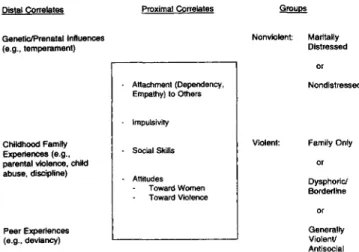
view, is liable to be distinguished by a unique set of causal fac-tors. . . . A subtheory for each type of batterer may be con-structed around these factors" (p. 198). To move toward this goal, we propose a developmental model of marital violence. The model is presented in Figure 1.
Before discussing our model, we should note that many models of marital violence have been offered by previous re-searchers (e.g., see reviews of theories in Bersani & Chen, 1988; Gelles & Straus, 1979). In general, these theories can be divided into three groups on the basis of their level of analysis (see Mar-golin, Sibner, & Gleberman, 1988, for a similar distinction). At the broadest level, sociocultural theories have been offered, in-cluding feminist (e.g., Ganley, 1989; Pence, 1989; Smith, 1990) and culture of violence (e.g., Gelles & Straus, 1979) theories that propose that marital violence exists because today's violent and patriarchal society tolerates, and even encourages, the use of physical aggression in families and the use of violence to dominate women. At the next level of analysis, interpersonal theories have been offered, with dyadic and family-level vari-ables being examined. For example, family systems models pro-pose that the etiology of marital violence lies in family interac-tion patterns (e.g., Lane & Russell, 1989; Madanes, 1990). Fi-nally, a variety of models have been offered at the individual, or intrapersonal, level. These theories attempt to explain why particular individuals engage in physical aggression and others do not, and they assume that some characteristic, or combina-tion of characteristics, of the individual increases the risk that the individual will engage in marital violence. Some examples of theories at the intrapersonal level are social learning/social skills models (e.g., Hamberger & Lohr, 1989; Holtzworth-Munroe, 1992;O'Leary, 1988; Saunders, 1989), psychopathol-ogy models (focusing, for example, on the role of attachment, jealousy, and dependency [e.g., Dutton & Browning, 1988; Holtzworth-Munroe, Hutchinson, & Stuart, 1994; Sonkin et al., 1985]; impulse control problems [e.g., Faulk, 1974]; or low self-esteem [e.g., Sonkin et al., 1985]), and attitudinal or cogni-tive models (including a focus on attitudes toward women [e.g., Sonkin et al., 1985; Walker, 1979] and attitudes regarding the
acceptability of violence [e.g., Saunders, Lynch, Grayson, & Linz, 1987]).
We thought it necessary to develop a model of marital vio-lence because previous theorists have virtually ignored the ques-tion of subtypes of marital violence; existing theories of marital violence generally have not provided hypotheses regarding the etiology of various subtypes of male batterers. Given that we were interested in explaining the etiology of marital violence in various subtypes of batterers (i.e., individuals), we thought that it was most appropriate to focus on factors at the intrapersonal, or individual, level. We do not discuss potentially theoretically relevant variables related to broader systems (e.g., couples' in-teractions) and societal/cultural influences (e.g., a patriarchal society and violence in the media), at least directly (e.g., an in-dividual's negative attitudes toward women may reflect society's views of women, whereas the poor social skills of a violent hus-band would presumably be observed in a couple's interactions). Although we are interested in intrapersonal factors, we did not directly include psychopathology (e.g., personality disorder) in our model because we considered it to be a descriptive dimen-sion used to differentiate the subtypes of batterers.
In developing our model, we chose to integrate many of the currently available intrapersonal theories; integration of exist-ing theories rarely occurs in the marital violence literature (see Gelles & Straus, 1979, for an exception). Thus, we included im-portant variables from several major intrapersonal-level theo-ries of marital violence (e.g., family of origin violence, social skills, attachment, and attitudes toward women and toward vi-olence). In our model, we used time to demarcate two major sets of proposed etiological variables. Distal variables are fac-tors occurring in childhood or before (e.g., genetic facfac-tors); as revealed by our literature search (described later), these vari-ables have rarely been examined in previous marital violence research. Proximal variables are adult characteristics believed to increase the risk that an individual man will engage in marital violence. Relative to the distal variables, the proximal variables have more frequently been discussed by previous theorists and have received more empirical attention.
In the following sections, we introduce each etiological vari-able proposed in our model. When possible, we present exam-ples of data (i.e., not an exhaustive review) linking these vari-ables to the occurrence of marital violence in general. Then, in Table 3 (and briefly in the text), we present data from the previ-ous typology studies regarding how the proposed subtypes of batterers differ on each of the variables in our model.
Distal, Historical Correlates of Marital Violence
As can be seen in Figure 1, we propose that certain back-ground variables are distal, historical correlates of marital vio-lence. These include genetic/prenatal influences, early child-hood family experiences, and peer experiences.
Genetic/prenatal factors are believed to include an inherited tendency for impulsivity, an irritable temperament, or both. In-terest in such factors comes both from behavioral genetic re-search, suggesting that aggressive and criminal or antisocial be-havior patterns can be inherited (e.g., Dilalla & Gottesman, 1989; Mednick & Kandel, 1988; Mednick, Pollock, Volavka, &
Table 3
Relationship Between Previous Typologies and Variables in the Developmental Model
Batterer subtype
Variable Family only Dysphoric/borderline Generally violent/antisocial
Genetic/prenatal factors
Early childhood family experiences Witnessed parental violence
J. A. Pagan, Stewart, & Hansen(1983) Hershorn & Rosenbaum
(1991)
Cadsky& Crawford (1988)
Abused as child
Shields, McCall, & Hanneke (1988)
Hershorn & Rosenbaum (1991)
J.A. Pagan etal. (1983)
Saunders(1992)
Cadsky& Crawford (1988)
Peer experience
Cadsky& Crawford (1988)
Attachment
Marital relationship/dependency Shields etal. (1988)
Cadsky & Crawford (1988)
Saunders(1992)
Family-only batterers less likely to witness parental violence as child
Overcontrolled batterers less likely to have witnessed father abusing mother Wife assaulters tended to report
lower rates of violence between parents
Family-only batterers more likely to have fathers who were violent toward them as children
Overcontrolled batterers more likely to have rejecting mothers and parents who were firm disciplinarians Family-only batterers less likely
to have been abused as a child
Family-only batterers least likely to have been abused Wife assaulters tended to report
less violence from parents
Wife assaulters: as juveniles, were less likely to join a street gang or engage in other deviant behavior
Family-only batterers more maritally satisfied; more stable relationships; more committed to marriage; less likely to have extramarital affair
Wife assaulters: more likely to be legally married, longer current relationship, tended to be more satisfied with relationship
Family-only batterers more maritally satisfied and less marital conflict; lowest levels of jealousy
Emotionally volatile batterers least maritally satisfied and most jealous
Generally violent batterers more likely to witness parental violence as child
Undercontrolled batterers more likely to have witnessed father abusing mother
Mixed assaulters tended (nonsignificantly) to report higher rates of violence between parents
Generally violent batterers less likely to have fathers who were violent toward them as children
Generally violent batterers more likely to have been abused as a child
Generally violent batterers most severely physically abused Mixed assaulters tended
(nonsignificantly) to report more violence from parents and were more likely to require medical attention as a result
Mixed assaulters: as juveniles, were more likely to join a street gang, more likely to skip school, be expelled from school, run away from home, set fires, hit others, get drunk, smash a car, be arrested; left home at younger age
Generally violent batterers less maritally satisfied; less stable relationships; less committed to marriage; more likely to have extramarital affair Mixed assaulters: less likely to
be married, shorter current relationship, tended (nonsignificantly) to be less satisfied with relationship Generally violent batterers:
moderate marital satisfaction and conflict
TYPOLOGIES OF MALE BATTERERS 485
Table 3 (continued)
Variable Batterer subtype
Family only Dysphoric/borderline Generally violent/antisocial
Faulk(1974)
Elbow (1977)
Caesar (1986)
Hamberger & Hastings (1985, 1986)
Stith, Jester, & Bird (1992)
Remorse/empathy Caesar (1986)
Mott-McDonald Associates (1979)
Elbow (1977)
Gondolf(1988)
Hamberger & Hastings (1985, 1986)
Shields etal. (1988) Impulsivity
Anger: substance abuse and criminal behavior Hershorn & Rosenbaum
(1991)
Cadsky & Crawford (1988)
Hamberger & Hastings (1985, 1986)
Stable/affectionate batterers: long-standing relationship; dependent/passive batterers: dependent on wife
Approval seekers dependent on wife; needs wife's approval
Nonexposed altruists dependent on wife Passive-dependent/compulsive
batterers: dependent on significant others Secure lovers: most love for
partners, most relationship maintenance activities, lowest levels of relationship conflict and ambivalence, long relationships; stable minimizers: moderate love and relationship
maintenance, moderate relationship conflict and ambivalence, longest relationships
Hitters feel more remorse, will take responsibility for violence and seek treatment Approval seekers experience
guilt
Sporadic batterers most likely to apologize and least likely to blame wife
Family-only batterers more likely to seek treatment for marital problems
Overcontrolled batterers most likely to explode after letting anger simmer
Wife assaulters: lower levels of hostility and fewer problems with behavior control; less likely to abuse alcohol, be arrested for drunk driving, or meet criteria for alcohol abuse; first conviction for crime at older age and fewer criminal convictions Passive-dependent/compulsive
batterers: mixed findings regarding anger proneness across two samples
Dependent/suspicious batterers: very jealous; very dependent on wife Incorporators and defenders
view wife as part of self; very needy/clingy to wife; want wife to depend on them and are jealous Exposed rescuers want wife
dependent on them Schizoidal/borderline
batterers: high levels of strife in relationships Hostile pursuers: high level of
relationship maintenance activities and moderate levels of love, highest levels of relationship conflict and high level of ambivalence regarding relationship
Exposed rescuers feel remorse
Chronic typical batterers blame victim
Schizoidal/borderline batterers overreact to trivial interpersonal disputes, high levels of anger, some alcohol problems
Controllers view wife as an object they control; relationship lacks reciprocity Controllers view wife as object, are emotionally void in close relationships
Narcissistic/antisocial batterers: self-centered in relationships; use others to meet own needs Hostile disengaged batterers:
lowest levels of love and relationship maintenance activities, high levels of relationship conflict and ambivalence, shortest relationships
Tyrants show little remorse Batterers feel little remorse and
refuse to take responsibility for violence
Controllers project blame for violence onto others; believe their violence is justified Sociopathic and antisocial
batterers most likely to blame victim
Narcissistic/antisocial batterers least likely to feel empathy Generally violent batterers less
likely to seek treatment for marital problems
Undercontrolled batterers impulsive, with few controls over anger or aggression Mixed assaulters: higher levels
of hostility and more symptoms of behavior noncontrol; more likely to abuse alcohol, be arrested for drunk driving, and meet criteria for alcohol abuse; first conviction for crime at younger age and more criminal convictions Narcissistic/antisocial batterers:
lower levels of anger, tendency for alcohol/drug problems
Table 3 (continued)
Variable Batterer subtype
Family only Dysphoric/borderline Generally violent/antisocial
Hale, Zimostrad, Duckworth, & Nicholas (1988) Flournoy& Wilson (1991) J. A. Pagan etal.( 1983) Shields etal. (1988)
Faulk(1974)
Elbow (1977)
Saunders(1992)
Gondolf(1988)
Social skills
Stith etal. (1992)
Faulk(1974) Caesar (1986) Attitudes
Toward women Saunders(1992) Toward violence*
Shields etal. (1988)
Cadsky & Crawford (1988)
Family-only batterers: violence less likely to be accompanied by drinking
Family-only batterers less likely to use drugs when violent; less likely to have sought help for alcohol/drug problem; less likely to have been arrested; less likely to support self illegally or gamble large sums of money; higher occupational status Dependent/passive batterers:
violent outbursts
Approval seekers: drinking may or may not be part of violence
Family-only batterers: low levels of anger; violence associated with alcohol about half of the time
Sporadic batterers had fewest alcohol problems; fewest arrests
Secure lovers: highest level of direct relationship
negotiation, use nonavoidant coping strategies; stable minimizers: wide variety of direct and indirect coping strategies and relationship negotiation styles
Nonexposed altruists unassertive
Family-only batterers had most liberal sex role attitudes Family-only batterers have
most remorse/guilt Family-only batterers least
likely to believe violence is justified or to have positive attitudes toward violence Wife assaulters: less likely to
find circumstances under which they believe it is permissible to hit partner
Dependent/suspicious batterers: violent outbursts Incorporates have public
displays of anger; are impulsive; may heavily use alcohol/drugs
Emotionally volatile batterers: highest levels of anger; least likely to have used alcohol before/during a violent incident Chronic typical batterers had
moderate levels of substance abuse; few arrests
Hostile pursuers: wide variety of direct and indirect coping strategies and relationship negotiation styles
Emotionally volatile batterers had relatively conservative sex role attitudes
Elevated on MMPI Scales 2 and 4; alcohol/drug/legal problems
Elevated on MMPI Scales 2 and 4; alcohol/drug/legal problems
Violence of generally violent batterers more likely to be accompanied by drinking Generally violent batterers more
likely to use illegal drugs when violent; more likely to have sought help for alcohol or drug problem; more likely to have been arrested for any crime; more likely to support self through illegal means; more likely to have gambled large sums of money; lower occupational status Dominating batterers: violent
outbursts; violent/bullying batterers: violence sometimes associated with alcohol abuse Controllers have most extensive
involvement in illegal activities
Generally violent batterers: low to moderate anger levels; had most violent episodes when under influence of alcohol; most arrests for drunk driving and violence
Sociopathic batterers had extensive arrest records (for violence, drug use, property crimes) and highest levels of substance abuse
Hostile disengaged batterers: use violence to resolve
relationship conflicts
Violent/bullying batterers: use violence and intimidation to solve many problems
Generally violent batterers had most rigid, conservative sex role attitudes
Generally violent batterers have least remorse
Generally violent men had positive attitudes toward violence and believed that violence is justified Mixed assaulters: more easily
find circumstances under which they believe it is permissible to hit partner
Note. MMPI = Minnesota Multiphasic Personality Inventory.
TYPOLOGIES OF MALE BATTERERS 487
Gabrielli, 1982; Rutter et al., 1990), and from general theories of personality, suggesting that certain personality dimensions, specifically impulsivity, are related to aggression and are inher-ited and biologically based (i.e., specific neurological substrates for each personality dimension; see the brief review, under the later section on impulsivity, of work conducted by Gray, Fowles, Eysenck, Newman, Cloninger, and Zuckerman).
To our knowledge, research has not been conducted examin-ing the relationship between genetic/prenatal influences and the occurrence of marital violence in general, although researchers have documented a relationship between growing up in a vio-lent home and becoming viovio-lent oneself (e.g., see review by Ho-taling & Sugarman, 1986) that could be based, in part, on ge-netics. In addition, as can be seen in Table 3, researchers have not directly examined possible links between genetic/prenatal influences and the development of various subtypes of marital violence. However, as reviewed later, some attention has been given to personality dimensions, such as impulsivity, that may result from genetic/prenatal influences.
The second distal factor, early childhood family experiences (e.g., witnessing parental violence, experiencing child abuse, and methods of child discipline), has been examined more ex-tensively in the general marital violence literature. First, re-searchers have repeatedly documented a general link between growing up in a violent home and using physical aggression against one's spouse in adulthood (see review by Hotaling & Sugarman, 1986). Although such a link may be genetic, other theoretical explanations are possible, including social learning theory (i.e., violent men observed the use and reinforcement of marital violence in their family of origin, learning to use vio-lence and failing to learn nonviolent methods for resolving mar-ital disputes) and attachment theory (i.e., violent men were un-able to form trusting relationships with an abusive parent and thus have relationship difficulties as adults).
Regarding previous typologies of male batterers, several re-searchers have gathered retrospective reports of childhood fam-ily experiences (see Table 3). In studies of whether or not a man witnessed his parents engaged in marital violence, the data con-sistently demonstrate that generally violent batterers are the most likely to have witnessed physical violence between their parents, whereas family-only batterers are the least likely to have been exposed to parental violence (Cadsky & Crawford, 1988; J. A. Pagan et al., 1983; Hershorn & Rosenbaum, 1991). Thus, we propose that the more parental violence a man wit-nessed as a child, the more violent he will end up being himself as an adult (i.e., a generally violent/antisocial batterer).
In contrast, data regarding the relationship of childhood abuse of the batterer himself to the various batterer subtypes are contradictory. Two research groups have found evidence that family-only batterers are more likely than generally violent bat-terers to have abusive or rejecting parents (Hershorn & Rosen-baum, 1991; Shields et al., 1988). In direct contrast, other re-searchers have found that generally violent batterers are more likely than family-only batterers to have experienced child abuse (Cadsky & Crawford, 1988;J. A.Faganetal., 1983;Saun-ders, 1992). For theoretical reasons (discussed later), we would argue that child abuse is also a risk factor for dysphoric/border-line batterers.
The third distal variable we have proposed is peer
experi-ences, specifically involvement with delinquent and deviant
peers. This factor is discussed extensively in general theories of criminal and antisocial behavior, such as theories of differential association (e.g., Burgess & Akers, 1966; Sutherland, 1947) and social interaction models (e.g., Elliott, Huizinga, & Ageton, 1985; Patterson, Reid, & Dishion, 1992). Research also sup-ports the notion that association with deviant peers is related to antisocial behavior and substance use or abuse in adolescents (e.g., Elliott & Huizinga, 1985; Huba & Bentler, 1983; Patter-son, Reid, & Dishion, 1992) and to adult criminality (e.g., West & Farrington, 1977). Similarly, involvement with delinquent peers has been related to the development of male sexual aggres-sion toward women (Malamuth, Sockloskie, Koss, & Tanaka, 1991).
Few researchers have, to date, examined the role of delin-quent peer relationships in the development of marital violence in general. In one of the few studies of this issue, wives of abusive husbands were more likely than wives of nonabusive husbands to report that their husbands' friends approved of violence against women and believed that men should be in control in the marital relationship (Smith, 1991). Similarly, on the basis of interviews with battered wives, Bowker (1983) found that husbands who spent more time with male peers (e.g., daily con-tact) were more likely to engage in frequent and severe marital violence and were less likely to make efforts to end their marital violence; he suggested that such men were immersed in a sub-culture of violence, with peers who encouraged their use of violence.
As shown in Table 3, previous batterer typology researchers generally have not examined this variable. In the one exception, Cadsky and Crawford (1988) found that generally violent bat-terers were more likely than family-only batbat-terers to have joined a street gang in their youth. In addition, generally violent bat-terers were more likely than family-only batbat-terers to have en-gaged in a wide variety of delinquent behaviors during child-hood and adolescence; such activities might reflect involvement with deviant peers.
On the basis of previous work, we propose that association with deviant peers is related to more deviant and delinquent behavior. Thus, it should be a factor related to violence, partic-ularly among the generally violent/antisocial group of batterers.
Proximal Correlates of Marital Violence
As shown in Figure 1, we propose that the three distal vari-ables influence the development of five more proximal corre-lates of marital aggression. These correcorre-lates are attachment to others, impulsivity, social skills, attitudes toward women, and attitudes toward violence.
The first proximal variable, attachment to other individuals (including dependency on others and empathy for others, par-ticularly the wife), is generally viewed as resulting from child-hood experiences with caregivers. These experiences lead to se-cure or insese-cure cognitive representation of relationships, or "working models" of attachment, that influence one's attitudes toward later adult relationships (e.g., Bowlby, 1973, 1988). Along with others (e.g., Bowlby, 1988), we have proposed that
men who are ambivalently attached to, and preoccupied with, their wives (e.g., experiencing pathological levels of dependency, jealousy, and fear of rejection) are at risk to engage in marital violence when threatened with the loss of their relationships (Holtzworth-Munroe, Hutchinson, & Stuart, 1994).
Although few researchers have examined the role of attach-ment in marital violence in general, emerging findings support our proposed link between these variables. For example, when maritally violent men are presented with conflicts involving is-sues of wife abandonment, rejection from their wives, or jeal-ousy (i.e., situations that can be conceptualized as threats to the relationship, eliciting attachment behaviors), they report more anger and provide less competent responses than nonviolent men (Dutton & Browning, 1988; Holtzworth-Munroe & An-glin, 1991). In a recent study using measures of attachment pat-terns, batterers were more preoccupied with and more depen-dent on their wives and had more unresolved attachment strat-egies than nonviolent husbands (Holtzworth-Munroe et al.,
1994).
Similarly, childhood experiences are assumed to teach, or fail to teach, children to empathize with others. We assume that the more empathy a man feels for others, the less likely he is to engage in aggression.
As seen in Table 3, previous typology researchers have not directly examined attachment. However, some have measured related constructs, such as marital satisfaction and dependency on the wife, and others have gathered indirect measures of em-pathy (e.g., remorse for violence). A review of these related vari-ables suggests that, in contrast to the limited data linking one particular type of attachment (i.e., ambivalent/preoccupied) to marital violence in general, each subtype of male batterer may be characterized by a different pattern of attachment.
In examining marital functioning, previous researchers have found that, relative to other subgroups of batterers, family-only batterers have better marriages; they are more maritally satis-fied, have more stable and less conflictual marriages, and are more committed to their marriage and less likely to have extra-marital affairs (Cadsky & Crawford, 1988; Faulk, 1974; Saun-ders, 1992; Shields etal., 1988;Stithetal., 1992). However, they may be overly dependent on their wives (Caesar, 1986; Elbow, 1977; Faulk, 1974; Hamberger & Hastings, 1985, 1986). These findings suggest that family-only batterers will have the fewest attachment problems, although they may show evidence of a preoccupied attachment style.
In contrast, previous researchers have usually portrayed gen-erally violent/antisocial batterers as experiencing marital prob-lems (Cadsky & Crawford, 1988;Saunders, 1992; Shields etal., 1988; Stith et al., 1992) and as viewing their wives as objects, because these men are narcissistic and self-centered in close re-lationships (Caesar, 1986; Elbow, 1977; Hamberger & Hastings, 1985, 1986); such factors might be reflected in a dismissing at-tachment style. Regarding dysphoric/borderline batterers, re-searchers have generally hypothesized that these men are patho-logically dependent on their wives, viewing their wives as part of themselves (Caesar, 1986; Elbow, 1977; Faulk, 1974) and expe-riencing high levels of jealousy, marital dissatisfaction, relation-ship strife, and ambivalence about their relationrelation-ships (Faulk, 1974; Hamberger & Hastings, 1985, 1986; Saunders, 1992;
Stith et al., 1992); this would be reflected in a preoccupied at-tachment style.
Previous typology researchers have also gathered indirect measures of empathy (see Table 3), examining feelings of re-morse and attributions of blame for violence. Researchers have found that the generally violent/antisocial batterer feels little remorse and is the most likely to blame his victim (Caesar, 1986; Elbow, 1977; Gondolf, 1988; Hamberger & Hastings, 1985, 1986; Mott-McDonald Associates, 1979). In contrast, family-only batterers are the most likely to feel remorse and the most likely to admit having marital problems and to seek help for such problems (Elbow, 1977; Gondolf, 1988; Mott-McDonald Associates, 1979; Shields et al., 1988). Less information is able regarding the dysphoric/borderline batterer, and the avail-able data are contradictory (i.e., Caesar, 1986, found that the exposed rescuer feels remorse, but Gondolf, 1988, found that the chronic typical batterer blames his victim). In summary, consistent with their attachment patterns, generally violent/an-tisocial batterers feel the least empathy for their wives, whereas family-only batterers are the most empathetic toward their wives; dysphoric/borderline batterers may experience an inter-mediate level of empathy.
As mentioned earlier, the second proximal variable, impul-sivity, is presumably an inherited, biologically based personality dimension related to temperament, physiological reactivity, and neurologically based behavioral control systems. Of particular interest, personality theorists have related impulsivity to aggres-siveness and psychopathy, or antisocial personality disorder.
H. J. Eysenck (1967; S. B. G. Eysenck & Eysenck, 1978) iden-tified three personality dimensions: neuroticism, introversion-extraversion, and psychoticism (i.e., tough-mindedness). Vari-ous combinations of these traits presumably predispose an in-dividual to engage in impulsive or aggressive behavior; specifi-cally, primary (low-anxiety) psychopaths tend to score low on the neuroticism dimension but high on the extraversion and psychoticism dimensions (Eysenck & Eysenck, 1976, cited in Gray, 1981). Similarly focusing on personality dimensions, Gray (e.g., Gray, 1981, 1987; Gray, Owen, Davis, & Tsaltas, 1983) rotated Eysenck's neuroticism and introversion-extra-version dimensions 45 degrees to form dimensions of anxiety and impulsivity. Although the relationship between these per-sonality dimensions and underlying emotional systems is com-plex, Gray (e.g., 1987) suggested that there are three interacting systems governing the control of emotional behavior: The be-havioral activation system (BAS) regulates behavior in response to unconditioned rewards or nonpunishment (e.g., it activates behavior in response to cues for reward); the behavioral inhibi-tion system (BIS) regulates appetitively motivated behavior in response to stimuli indicating that punishment will occur if the response is made (e.g., it inhibits behaviors that would other-wise occur when cues for response-contingent punishment are present); and the fight/flight system regulates behavior in re-sponse to unconditioned punishment or unconditioned nonre-ward. Presumably, individuals who have either high activity in the BAS or low activity in the BIS may be impulsive (Gray et al., 1983); for example, Gray (1987) suggested that primary psy-chopaths are more sensitive to stimuli related to rewards than to stimuli related to punishment. Although both systems may