Improved Alpha-Tested Magnification for Vector Textures and Special Effects
Chris Green∗Valve
(a) 64x64 texture, alpha-blended (b) 64x64 texture, alpha tested (c) 64x64 texture using our technique Figure 1:Vector art encoded in a 64x64 texture using (a) simple bilinear filtering (b) alpha testing and (c) our distance field technique
Abstract
A simple and efficient method is presented which allows improved rendering of glyphs composed of curved and linear elements. A distance field is generated from a high resolution image, and then stored into a channel of a lower-resolution texture. In the simplest case, this texture can then be rendered simply by using the alpha-testing and alpha-thresholding feature of modern GPUs, without a custom shader. This allows the technique to be used on even the lowest-end 3D graphics hardware.
With the use of programmable shading, the technique is extended to perform various special effect renderings, including soft edges, outlining, drop shadows, multi-colored images, and sharp corners.
1
Introduction
For high quality real-time 3D rendering, it is critical that the limited amount of memory available for the storage of texture maps be used efficiently. In interactive applications such as computer games, the user is often able to view texture mapped objects at a high level of magnification, requiring that texture maps be stored at a high resolution so as to not become unpleasantly blurry, as shown in Figure 1a, when viewed from such perspectives.
When the texture maps are used to represent “line-art” images, such as text, signs and UI elements, this can require the use of very high resolution texture maps in order to look acceptable, particularly at high resolutions.
In addition to text and UI elements, this problem is also common in alpha-tested image-based impostors for complicated objects such as foliage. When textures with alpha channels derived from cover-age are magnified with hardware bilinear filtering, unpleasant “wig-gles” as seen in Figure 1b appear because the coverage function is not linear.
In this chapter, we present a simple method to generate and ren-der alpha-tested texture maps in orren-der to minimize the artifacts that arise when such textures are heavily magnified. We will demon-strate several usage scenarios in a computer game context, both for
∗e-mail: [email protected]
3D renderings and also user-interface elements. Our technique is capable of generating high quality vector art renderings as shown in Figure 1c.
2
Related work
Many techniques have been developed to accurately render vec-tor graphics using texture-mapping graphics hardware. In [Frisken et al. 2000], distance fields were used to represent both 2-dimensional glyphs and 3-2-dimensional solid geometry. Quadtrees and octrees were used to adaptively control the resolution of the distance field based upon local variations. While GPU rendering of such objects was not discussed, recent advances in the general-ity of GPU programming models would allow this method to be implemented using DirectX10 [Blythe 2006].
In [Sen 2004] and [Tumblin and Choudhury 2004], texture maps are augmented with additional data to control interpolation between texel samples so as to add sharp edges in a controllable fashion. Both line-art images and photographic textures containing hard edges were rendered directly on the GPU using their representa-tion.
In [Loop and Blinn 2005], implicit cubic curves were used to model the boundaries of glyphs, with the GPU used to render vector tex-tures with smooth resolution-independent curves.
In [Qin et al. 2006], a distance based representation is used, with a precomputed set of “features” influencing each Voronoi region. Given these features, a pixel shader is used to analytically compute exact distance values.
Alpha-testing, in which the alpha value output from the pixel shader is thresholded so as to yield a binary on/off result, is widely used in games to provide sharp edges in reconstructed textures. Unfortu-nately, because the images that are generally used as sources for this contain “coverage” information which is not properly reconstructed at the subtexel level by bilinear interpolation, unpleasant artifacts are usually seen for non-axis-aligned edges when these textures are magnified.
4 RENDERING
3
Representation and Generation
In order to overcome the artifacts of simple alpha testing while keeping storage increase to a minimum, we sought a method for displaying vector textures that could
• work on all levels of graphics hardware, including systems lacking programmable shading
• run as fast as, or nearly as fast as, standard texture mapping • take advantage of the bilinear interpolation present in all
mod-ern GPUs
• function inside of a pre-existing complex shader sys-tem [Mitchell et al. 2006] with few changes
• add at most a few instructions to the pixel shader so that vector textures can be used in existing shaders without overflowing instruction limits
• not require that input images be provided in a vector form. • use existing low-precision 8-bit texture formats
• be used as a direct replacement for alpha-tested impostor im-ages
We chose to implement a simple uniformly-sampled signed-distance field representation, with the signed-distance function stored in an 8-bit channel. By doing so, we are able to take advantage of the native bilinear texture interpolation which is present in all mod-ern GPUs in order to accurately reconstruct the distance between a sub-texel and a piecewise-linear approximation of the true high-resolution image. While this representation is limited in terms of the topology of features which can be represented compared to other approaches, we felt that its high performance, simplicity, and ease of integration with our existing rendering system made it the right choice for Valve’s Source engine.
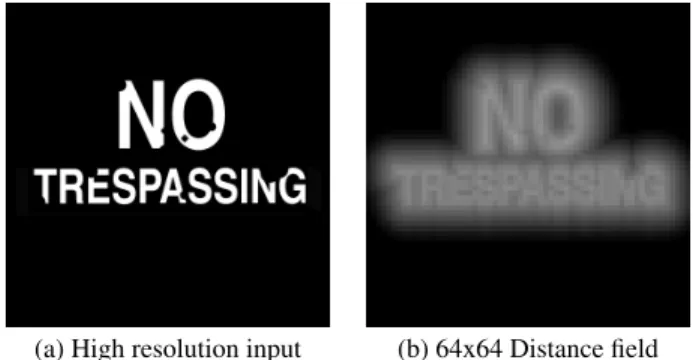
While it is possible to generate the appropriate distance data from vector-based representations of the underlying art, we choose in-stead to generate the low-resolution distance fields from high reso-lution source images. In a typical case, a 4096x4096 image will be used to generate a distance field texture with a resolution as low as 64x64, as shown in Figure 2.
At texture-generation time, the generator takes as its input a high resolution binary texture where each texel is classified as either “in” or “out.” The user specifies a target resolution, and also a “spread factor,” which controls the range which is used to map the signed distance into the range of 0 to 1 for storage in an 8-bit texture chan-nel. The spread factor also controls the domain of effect for such special rendering attributes as drop-shadows and outlines, which will be discussed in section 4.2.
For each output texel, the distance field generator determines whether the corresponding pixel in the high resolution image is “in” or “out.” Additionally, the generator computes 2D distance (in tels) to the nearest texel of the opposite state. This is done by ex-amining the local neighborhood around a given texel. While there are more efficient and complex algorithms to compute the signed distance field than our simple “brute-force” search, because of the limited distance range which may be stored in an 8-bit alpha chan-nel, only a small neighborhood must be searched. The execution time for this simple brute-force method is negligible.
Once this signed distance has been calculated, we map it into the range 0..1, with 0 representing the maximum possible negative dis-tance and 1.0 representing the maximum possible positive disdis-tance. A texel value of 0.5 represents the exact position of the edge and, hence, 0.5 is generally used for the alpha threshold value.
(a) High resolution input (b) 64x64 Distance field Figure 2: (a) A high resolution (4096x4096) binary input is used to compute (b) a low resolution (64x64) distance field
4
Rendering
In the simplest case, the resulting distance field textures can be used as-is in any context where geometry is being rendered with alpha-testing. Under magnification, this will produce an image with high-resolution (albeit, aliased) linear edges, free of the false curved con-tours (see Figure 1b) common with alpha-tested textures generated by storing and filtering coverage rather than a distance field. With a distance field representation, we merely have to set the alpha test threshold to 0.5. Since it is fairly common to use alpha testing rather than alpha blending for certain classes of primitives in or-der to avoid the costly sorting step, this technique can provide an immediate visual improvement with no performance penalty.
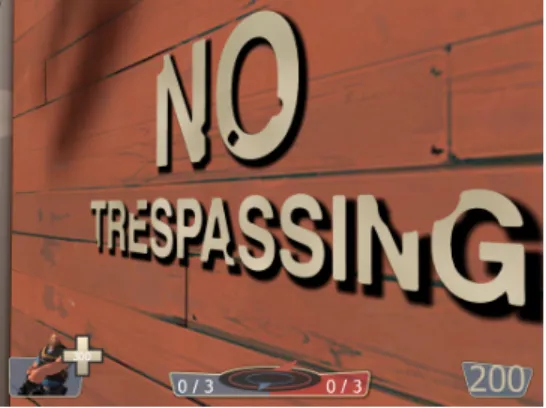
Figure 3: 128x128 “No trespassing” distance image applied to a surface in Team Fortress 2
In Figure 3, we demonstrate a 128x128 distance field representation of a “No Trespassing” sign rendered as a decal over the surface of a wall in the gameTeam Fortress 2. The apparent resolution of this decal is incredibly high in world space and holds up well under any level of magnification that it will ever undergo in the game. We will refer to this particular decal example in the next section as we discuss other enhancements available to us when representing our vector art in this manner.
4.1 Antialiasing
If alpha-blending is practical for a given application, the same dis-tance field representation can be used to generate higher quality
4.3 Sharp corners 4 RENDERING
Figure 4:Zoom of 256x256 “No Trespassing” sign with hard (left) and softened edges (right)
renderings than mere alpha testing, at the expense of requiring cus-tom fragment shaders.
Figure 4 demonstrates a simple way to soften up the harsh aliased pixel edges. Two distance thresholds, Distminand Distmax, are
defined and the shader maps the distance field value between these two values using thesmoothstep()function. On graphics hardware which supports per-pixel screen-space derivatives, the derivatives of the distance field’s texture coordinates can be used to vary the width of the soft region in order to properly anti-alias the edges of the vec-tor art [Qin et al. 2006]. When the texture is minified, widening of the soft region can be used to reduce aliasing artifacts. Addition-ally, when rendering alpha-tested foliage, the alpha threshold can be increased with distance, so that the foliage gradually disappears as it becomes farther away to avoid LOD popping.
4.2 Enhanced Rendering
In addition to providing crisp high resolution antialiased vector art using raster hardware, we can apply additional manipulations using the distance field to achieve other effects such as outlining, glows and drop shadows. Of course, since all of these operations are func-tions of the distance field, they can be dynamically controlled with shader parameters.
4.2.1 Outlining
By changing the color of all texels which are between two user-specified distance values, a simple texture-space outlining can be applied by the pixel shader as shown in our decal example in Fig-ure 5. The outline produced will have crisp high quality edges when magnified and, of course, the color and width of the outline can be varied dynamically merely by changing pixel shader constants.
4.2.2 Glows
When the alpha value is between the threshold value of 0.5 and 0, the smoothstep function can be used to substitute a “halo” whose color value comes from a pixel shader constant as shown in Fig-ure 6. The dynamic natFig-ure of this effect is particularly powerful in a game, as designers may want to draw attention to a particular piece of vector art in the game world based on some game state by animating the glow parameters (blinking a health meter, emphasiz-ing an exit sign etc).
Figure 5:Outline added by pixel shader
4.2.3 Drop Shadows
In addition to effects which are simple functions of a single dis-tance, we can use a second lookup into the distance field with a texture coordinate offset to produce drop shadows or other similar effects as shown in Figure 7.
In addition to these simple 2D effects, there are surely other ways to reinterpret the distance field to give designers even more options. 4.3 Sharp corners
As you may have noticed in all of the preceding examples, encoding edges using a single signed distance “rounds off” corners as the resolution of the distance field decreases [Qin et al. 2006]. For example, the hard corners of the letter G in Figure 2a become more rounded off as illustrated in Figures 5, 6 and 7.
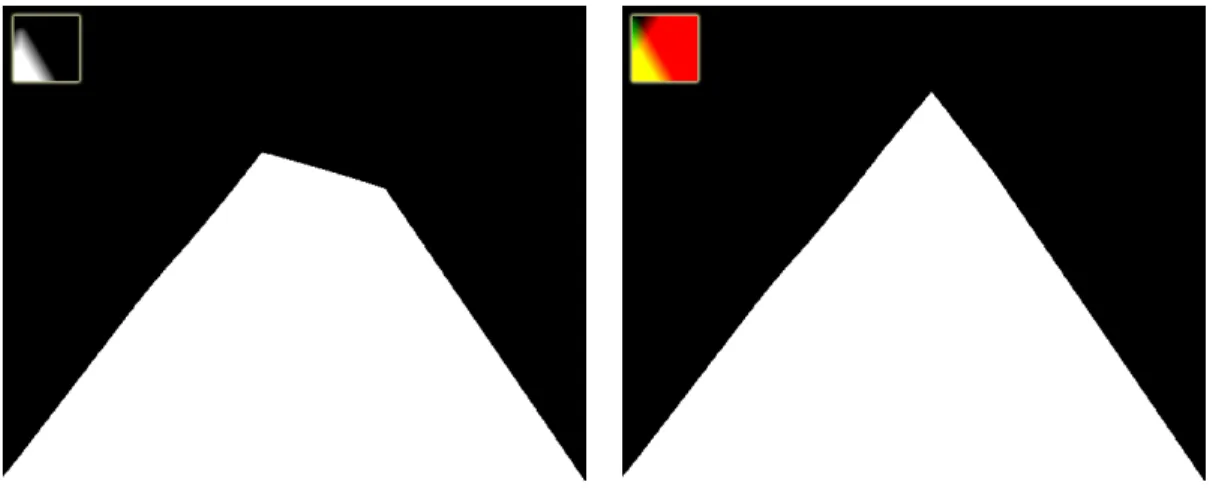
Sharp corners can be preserved, however, by using more than one channel of the texture to represent different edges intersect-ing within a texel. For instance, with two channels, the intersection of two edges can be accurately represented by performing a logical AND in the pixel shader. In Figure 8, we have stored these two edge distances in the red and green channels of a single texture, resulting in a well-preserved pointy corner. This same technique could also be performed on the “No Trespassing” sign if we wished to repre-sent sharper corners on our text. As it stands, we like the rounded style of this text and have used a single distance field for this and other decals inTeam Fortress 2.
REFERENCES REFERENCES
Figure 6:Scary flashing “Outer glow” added by pixel shader
Figure 7:Soft drop-shadow added by the pixel shader. The direc-tion, size, opacity, and color of the shadow are dynamically con-trollable.
5
Conclusion
In this chapter, we have demonstrated an efficient vector texture system which has been integrated into the Source game engine which has been previously used to develop games such as the Half-Life 2series,Counter-Strike: SourceandDay of Defeat: Source. This vector texture technology is used in the upcoming gameTeam Fortress 2with no significant performance degradation relative to conventional texture mapping. We were able to effectively use vector-encoded images both for textures mapped onto 3D geom-etry in our first person 3D view and also for 2D screen overlays. This capability has provided significant visual improvements and savings of texture memory.
References
BLYTHE, D. 2006. The direct3d 10 system. InSIGGRAPH ’06: ACM SIGGRAPH 2006 Papers, ACM Press, New York, NY, USA, 724–734.
FRISKEN, S. F., PERRY, R. N., ROCKWOOD, A. P.,ANDJONES, T. R. 2000. Adaptively sampled distance fields: a general representation of shape for computer graphics. InSIGGRAPH ’00: Proceedings of the 27th annual conference on Com-puter graphics and interactive techniques, ACM Press/Addison-Wesley Publishing Co., New York, NY, USA, 249–254. LOOP, C., ANDBLINN, J. 2005. Resolution independent curve
rendering using programmable graphics hardware. In
SIG-f l o a t d i s t A l p h a M a s k = b a s e C o l o r . a ; i f ( OUTLINE && ( d i s t A l p h a M a s k >= OUTLINE MIN VALUE0 ) && ( d i s t A l p h a M a s k <= OUTLINE MAX VALUE1 ) )
{
f l o a t o F a c t o r = 1 . 0 ;
i f ( d i s t A l p h a M a s k <= OUTLINE MIN VALUE1 )
{
o F a c t o r = s m o o t h s t e p ( OUTLINE MIN VALUE0 , OUTLINE MIN VALUE1 , d i s t A l p h a M a s k ) ;
} e l s e {
o F a c t o r = s m o o t h s t e p ( OUTLINE MAX VALUE1 , OUTLINE MAX VALUE0 ,
d i s t A l p h a M a s k ) ;
}
b a s e C o l o r = l e r p ( b a s e C o l o r , OUTLINE COLOR , o F a c t o r ) ;
}
i f ( SOFT EDGES ) {
b a s e C o l o r . a ∗= s m o o t h s t e p ( SOFT EDGE MIN , SOFT EDGE MAX , d i s t A l p h a M a s k ) ;
} e l s e {
b a s e C o l o r . a = d i s t A l p h a M a s k >= 0 . 5 ;
} i f ( OUTER GLOW ) {
f l o a t 4 g l o w T e x e l =
t e x 2 D ( B a s e T e x t u r e S a m p l e r ,
i . b a s e T e x C o o r d . xy+GLOW UV OFFSET ) ; f l o a t 4 g l o w c = OUTER GLOW COLOR ∗ s m o o t h s t e p (
OUTER GLOW MIN DVALUE , OUTER GLOW MAX DVALUE, g l o w T e x e l . a ) ;
b a s e C o l o r = l e r p ( glowc , b a s e C o l o r , mskUsed ) ;
}
Figure 9: HLSL source code for outline, glow/dropshadow, and edge softness.
GRAPH ’05: ACM SIGGRAPH 2005 Papers, ACM Press, New York, NY, USA, 1000–1009.
MITCHELL, J., MCTAGGART, G.,ANDGREEN, C. 2006. Shading in valve’s source engine. InSIGGRAPH ’06: ACM SIGGRAPH 2006 Courses, ACM Press, New York, NY, USA, 129–142. QIN, Z., MCCOOL, M. D.,ANDKAPLAN, C. S. 2006. Real-time
texture-mapped vector glyphs. InI3D ’06: Proceedings of the 2006 symposium on Interactive 3D graphics and games, ACM Press, New York, NY, USA, 125–132.
RAY, N., NEIGER, T., CAVIN, X.,ANDLEVY, B. 2005. Vector texture maps. InTech Report.
SEN, P. 2004. Silhouette maps for improved texture magnifica-tion. InHWWS ’04: Proceedings of the ACM SIGGRAPH/EU-ROGRAPHICS conference on Graphics hardware, ACM Press, New York, NY, USA, 65–73.
TUMBLIN, J.,ANDCHOUDHURY, P. 2004. Bixels: Picture sam-ples with sharp embedded boundaries. InRendering Techniques, 255–264.
REFERENCES REFERENCES