toral Program in Physics at Maharishi International University. Dr. Hagelin received his A.B. Summa Cum Laude from Dart-mouth College in 1975. After completing his Ph. D. at Harvard University in 1981, Dr. Hagelin joined the theoretical physics groups at the European Laboratory for Particle Physics (CERN) and the Stanford Linear Accelerator Center (SLAC), where he became actively engaged in fundamental research at the forefront of supersymmetric unified field theories. Following his positions at CERN and at SLAC, Dr. Hagelin joined the faculty of Maharishi International University, where he established a doc-toral program in elementary particle physics and unified quan-tum field theories. Dr. Hagelin has published extensively in the area of supersymmetric unified quantum field theories in such journals as Physics Letters, Nuclear Physics and The Physical
Is Consciousness the Unified Field?
A Field Theorist's Perspective
John S. Hagelin
Maharishi International University Fairfield, Iowa
Abstract
Progress in theoretical physics during the past decade has led to a progressively more unified understanding of the laws of nature, culminating in the recent discovery of completely unified field theories. The parallel discovery of a unified field of consciousness raises
fundamen-tal questions concerning the relationship between the two. Following a general introduc-tion to unified quantum field theories, we consider the proposal due to Maharishi Mahesh Yogi that the unified field of modern theoretical physics and the field of "pure consciousness" are identical. We show that the proposed identity between consciousness and the unified field is consistent with all known physical principles, but requires an expanded physical framework for the understanding of consciousness. Such a framework may indeed be
re-quired to account for experimentally observed field effects of consciousness and phenomeno-logical aspects of higher states of consciousness.
2 9 CONTENTS
PART I: An Introduction to Unified Quantum Field Theories
1. Quantum Field Theory 30 2. Electro-Weak Unification and Broken Symmetry 35
3. Grand Unification 41 4. Supersymmetry 43 5. Quantum Gravity and Supergravity 48
6. The Heterotic String 52 PART II: Consciousness and the Unified Field
1. Historical Perspectives 56 2. A Unified Field of Consciousness 60
3. Field Effects of Consciousness 64 4. Pure Consciousness and the Unified Field 73
5. Higher States of Consciousness and the Sidhis 78
FOREWORD
This article is divided into two parts. Part I is a general introduction to unified quantum field theories, which provides a conceptual foundation for the analysis in Part II. Although written for the nonspecialist, it is our hope that this presentation of fundamental principles will be of sufficient depth and clarity to be of interest to the specialist as well. The specialist may however, if he chooses, proceed directly to Part II, as both Part I and Part II are in-tended to be self-contained.
PART I:
AN INTRODUCTION TO UNIFIED QUANTUM FIELD THEORIES
I
t was Einstein's deep conviction that the laws of nature had a simple, geometric, unifiedfoundation and that this unification could be understood by the human intellect. In an at-tempt to construct such a unified theory, he devoted the later part of his life to extend-ing his geometric theory of gravity, known as general relativity, to include the electromag-netic force. Unfortunately, the theoretical tools and understanding needed to achieve such a unification were not yet available, and his quest for a unified field theory remained largely unfulfilled.
Within the past decade, there have been a number of significant breakthroughs that have led to a revitalization of progress and hope in this fundamental research area. One of these is the principle of spontaneously broken symmetry, which locates deeply hidden symmetries of nature at fundamental space-time scales and explains the emergence of diverse forces from an initially unified field. A second breakthrough has been the discovery of a profound symmetry principle called supersymmetry, which is capable of unifying force fields and mat-ter fields in the context of a single field. A third is the discovery of superstring theories.
Here we present an introduction to the conceptual foundations of unified field theories. This analysis includes a discussion of quantum field theory, spontaneous symmetry breaking and the Higgs mechanism, electro-weak unification and grand unification, supersymmetry, supergravity and superstring theories. In our presentation, we have strived to maintain some of the quantum-mechanical and field theoretic aspects of these subjects that are usually omitted in an introductory treatment. We also provide an up-to-date appraisal of the exper-imental and theoretical status of these theories.
1.1 Quantum Field Theory
The quantized theory of fields, in both its particle and string formulations, is the most sophisticated and successful framework to emerge within the field of physics. It provides a natural extension of quantum mechanics from the nonrelativistic domain of atomic and molecular systems to the relativistic domain of nuclear and elementary particle physics.
Quantum field theory is fundamentally a theory of fields, which formally stands in rela-tion to classical field theory as nonrelativistic quantum mechanics stands in relarela-tion to the classical mechanics of a point particle. The application of quantum mechanics to fields has immediate and profound consequences. One such consequence is that the energy levels of the field become discrete or "quantized." Unlike a classical field, whose propagating waves can have any amplitude and can thereby possess arbitrary energy, the stable propagating states of a quantum field are constrained to have discrete energies.
UNIFIED Q U A N T U M FIELD THEORIES
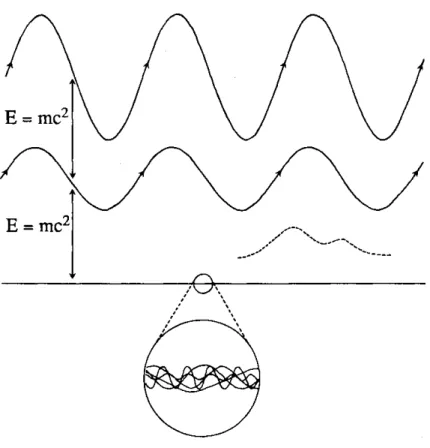
Figure 1. The modes of activity of a quantum field include 1) the stable, propagating states of the field with well-defined, discrete energies, which have a natural interpretation as elementary particles; 2) transient field configura-tions which do not propagate and play the role of forces between particles (dashed); and 3) vacuum fluctuaconfigura-tions—the continuous, quantum-mechanical activity of the field present in the vacuum state and in all the excited states.
tween photons and thereby acts as a force. One can therefore conclude that any quantum field can assume either the role of particle or force, depending on whether that quantum field is in a physical particle state or in a "virtual" state. The historical distinction between the fundamental force fields such as the photon field and matter fields such as the electron field is nevertheless useful, and we will return to it shortly.
The scattering of light by light (Figure 2b) is an interesting process because there is no analogous effect in classical electromagnetic theory. Because the classical equations gov-erning the electromagnetic field (i.e., Maxwell's equations) are linear in the field strength, light does not interact with itself and the scattering of two electromagnetic waves does not occur in vacuo. The scattering of light by light is therefore a uniquely quantum-mechanical effect and is consequently miniscule at ordinary energies and distances.
The fact that electron scattering corresponds to a familiar classical process whereas the scattering of light does not is explained by the fact that the Feynman diagrams in Figures 2a and 2b belong to different classes. Figure 2a is called a "tree" diagram. Tree diagrams are diagrams without closed loops and correspond to processes associated with classical field behavior. Figure 2b is representative of a "loop" diagram. Each loop in a Feynman diagram is accompanied by one power of Planck's constant (ft), hence Figure 2b represents
UNIFIED Q U A N T U M FIELD THEORIES
just as the position and momentum of a particle are incompatible in nonrelativistic quan-tum mechanics. The result is very similar to what occurs in the nonrelativistic theory. In nonrelativistic quantum mechanics, the point particle assumes a description in terms of a wave function, which expresses the indefiniteness of the particle's position and momentum. In quantum field theory, at every point in space the amplitude of the field is described by a "wave function" that expresses the indefiniteness of the field and rate of change of the field at that particular point. This result can be expressed in a more global but equivalent way: whereas the amplitude of a classical field has a definite shape described by a definite function of space and time, a quantum field can be seen as coexisting in all possible shapes at once—i.e., in a superposition of field shapes.
It is instructive to consider the vacuum state of a quantum field from this perspective. Classical expectations would lead us to expect that the least excited state of a field would be a state in which the field amplitude is zero everywhere. However, such a state would be highly unnatural from the standpoint of the uncertainty principle, according to which a definite field shape (flat, or otherwise) necessarily implies that the rate of change of the field is completely unspecifiable, corresponding to a state of infinite energy density. This situation is directly analogous to the nonrelativistic quantum theory of a point particle, in which the localization of the particle to a definite position in space requires a sharply peaked wave function which, according to the uncertainty principle, implies an infinite spread in momentum and therefore an infinite spread in energy. Hence, a quantum field that is everywhere flat would constitute a poor candidate for the lowest energy state of the field. The vacuum state of a quantum field must therefore correspond to a coexistence of field shapes (see Figure 1).
Another constraint that must be satisfied in constructing the vacuum state of a quantum field is Poincare invariance. Since the vacuum state corresponds to the absence of all physical particles and forces, it actually corresponds to the dynamics of empty space. It must therefore possess all the symmetries of space, which include invariance with respect to translations, rotations, and "boosts" (changes in the velocity of an observer's frame of reference). An arbitrary superposition of field shapes would not be invariant with respect to translations, rotations and boosts, but would in general have a "lumpy" structure. The vacuum state must therefore correspond to a very definite balance of field shapes which is stable in time, uniform in space, etc.—i.e., Poincare invariant. This state is not the state of complete inertia associated with the classical vacuum. The true, quantum vacuum possesses an intrinsic dynamism which is increasingly evident at more fundamental scales. A high resolution "picture" or measurement of a quantum field in vacuo would reveal highly energetic field shapes, as shown in Figure l.3
UNIFIED QUANTUM FIELD THEORIES
These energetic field shapes, which are present in the vacuum state as well as in all the excited states of the field, are known as vacuum fluctuations. They formally give rise to a large vacuum energy, which for convenience is usually subtracted out of the theory. However, it should not be felt that these quantum-mechanical fluctuations are consequently less real, for they have important physical ramifications, which include the spontaneous de-excitation of atoms and the Lamb shift. In addition, the energy associated with these vacuum fluctuations is expected to have additional consequences in any theory which includes gravi-ty. In particular, it can lead to a potentially large gravitational self-attraction of space that is experimentally not seen. In fact, the astrophysical bounds on this gravitational self-attraction are approximately one hundred orders-of-magnitude smaller than the vacuum energy one would expect from a naive calculation. This enormous discrepancy remains a persistent puzzle that has not been satisfactorily resolved, although several clues have recent-ly appeared in the context of supergravity and superstring theories.
We have thus identified three distinct modes of activity of a quantum field:
1) the stable "particle" states of a field, which possess well-defined, discrete energies and lend themselves naturally to an interpretation in terms of particles;
2) transient field configurations that do not propagate and do not have well-defined energy, which appear as internal lines in Feynman diagrams and play the role of forces between particles; and
3) vacuum fluctuations—the continuous, purely quantum-mechanical activity of a quan-tum field present in the vacuum state as well as in all the excited states.
Quantum field theory thereby presents a rather simple and profound view of nature in which the previously unrelated concepts of particle and force are naturally unified within a single theoretical construct: "particle" and "force" simply correspond to different modes of activity of an underlying quantum field.
Over the past fifty years, quantum field theory has enjoyed profound success as a theory of the electromagnetic interactions. Within the last decade, it has seen renewed success as a fundamental theory of the strong interactions and weak interactions as well. There is at present no experimental evidence to indicate that quantum field theory is in any sense in-complete. There are, however, recent theoretical arguments that this quantum field theoretic framework of elementary particles may need to be expanded into a quantum field theory of elementary strings. This will be the topic of a later section.
1.2 Electro-Weak Unification and Broken Symmetry
In recent years, the primary challenge in theoretical physics has been to further simplify our understanding of nature by reducing the number of fundamental fields needed to
count for the very rich and diverse particle phenomenology observed in accelerators dur-ing the past few decades. This search for simplicity led to the introduction of the quark model by physicists Murray Gell-Mann and George Zweig, which replaced a large number of strongly interacting particles or "hadrons" by a few fundamental subconstituents called quarks. The quark model in turn led to the modern theory of the strong interactions, known as quantum chromodynamics, in which the strongly interacting hadrons are described as bound states of quarks held together by gluons. These quarks and gluons are believed to be inextricably confined within the interior of hadrons by a dynamical mechanism known as "quark confinement." As a consequence, quarks and gluons can never exist as free par-ticles, implying that their associated quantum fields are dynamically prevented from assum-ing free particle states, further illustratassum-ing the inadequacy of the particle concept for physics at fundamental scales.
Much of the recent progress towards a unification of the fundamental particles and forces has been based on the principle of spontaneously broken symmetry, which locates deeply hidden symmetries of nature at fundamental space-time scales. The application of this pro-found, unifying principle has resulted in the successful unification of the weak and elec-tromagnetic forces by physicists Glashow, Salam and Weinberg. In addition to the unification of the weak and electromagnetic forces, this unified electro-weak theory unites various mat-ter fields into "doublets," which include the electron and the neutrino, the up-quark and the down-quark, etc. (see Table 1).
The electron and the neutrino belong to a class called leptons—matter fields that do not participate in the strong interactions. Apart from this common feature, the electron and the neutrino appear to have little in common. The neutrino is a massless particle and is therefore constrained to move at the speed of light. In addition, the neutrino has no electric charge and as a consequence does not interact electromagnetically. The neutrino interacts with other matter only through the weak force, which is extremely feeble in comparison with the elec-tromagnetic force. As a consequence, a neutrino can pass directly through the sun or the earth with very little chance of scattering.
In contrast to the neutrino, the electron has a mass and is therefore forbidden to move with the speed of light. Due to the electron's charge, it interacts very readily with matter via the electromagnetic force. This interaction is responsible for upholding atomic and molecular structure, for chemical interactions, and thus for the majority of macroscopic, observable behavior.
It may seem peculiar, given these distinctions, that the electron and the neutrino are believed to be fundamentally indistinguishable—unified components of a single field known as a left-handed lepton doublet.4 The apparent difference between these two fields is in a sense superficial—the result of spontaneous symmetry breaking.
One way in which to understand the fundamental indistinguishability of these apparent-ly diverse fields is to compare the scattering of electrons (Figure 2a) to the scattering of neutrinos (Figure 3). Because the neutrino has no electric charge, neutrino scattering cannot occur through the agency of the electromagnetic field. It occurs by virtue of the neutral Z° boson, one of the force fields responsible for the weak interaction (see Table 1). In com-parison with electron scattering via the electromagnetic field (Figure 2a), the scattering of
4It is actually the left-handed component of the electron field which is unified with the neutrino. Any massive fermion, such as the electron, really consists of two separate components or chiralities, cor-responding to a left-handed and a right-handed polarization state.
UNIFIED QUANTUM FIELD THEORIES
UNIFIED QUANTUM FIELD THEORIES
UNIFIED QUANTUM FIELD THEORIES
UNIFIED QUANTUM FIELD THEORIES
UNIFIED QUANTUM FIELD THEORIES
The desired cancellation of quantum-mechanical contributions only occurs if the new supersymmetric particles have masses that are comparable to the familiar particles and forces: the cancellation is precise if and only if supersymmetry is unbroken, in which case all the supersymmetric particles have precisely the same mass as their familiar partners. One can use this argument to conclude that all the new supersymmetric particles should have masses that are not much heavier than the known particles and forces, otherwise a suf-ficiently precise cancellation would not occur. This raises exciting prospects for the discovery of supersymmetric particles at existing particle accelerators and at those presently under construction.
There are many experimental searches for supersymmetric particles currently underway. For example, there have been experimental searches for strongly interacting supersymmetric particles in hadron colliders, such as the proton-antiproton collider at CERN in Geneva. So far, these experimental searches have been able to put lower bounds on the masses of strongly interacting supersymmetric particles, which include "gluinos" (the spin - ½ super-symmetric partners of the spin-1 gluons) and "squarks" (the spin-0 supersuper-symmetric part-ners of the spin -½ quarks).
It would appear sensible to focus experimental attention on looking for what should theoretically be the lightest supersymmetric particles, since they would be expected to show up first in today's particle accelerators. According to theoretical and experimental constraints (Ellis et al., 1984), the lightest supersymmetric particle or " L S P " is probably some type of neutral gaugino or Higgsino, which are respectively the s p i n - ½ supersymmetric part-ners of spin-1 force fields and spin-0 Higgs fields. Of these the photino, which is the super-symmetric partner of the photon, is perhaps the most plausible from the standpoint of astrophysical and cosmological constraints.
Although the photino formally interacts with electromagnetic strength, being the super-symmetric partner of the photon, its interaction with ordinary matter is very much sup-pressed because such interactions necessarily involve the exchange of charged supersym-metric virtual particles, which are known to be quite heavy. Hence the photino, much like a neutrino, would escape detection in ordinary particle detectors, which makes the photino difficult to see experimentally. It is nevertheless possible to search for "missing energy" in particle interactions, which can be a signal for a photino escaping the interaction region. Missing energy and momentum can be a distinctive signature for photino production and is currently being used to search for photinos in e+e - annihilation experiments and in hadron colliders as well.
In most supersymmetric theories the LSP is absolutely stable against decay (Fayet, 1980). This fact has profound cosmological and astrophysical implications. It means, for exam-ple, that photinos might populate the universe today in large numbers and contribute significantly to the overall mass density of the universe. This follows from the fact that the photino, along with all other particles, would have been present in thermal equilibrium in the very early universe, when according to the Big Bang cosmology, temperatures were ex-tremely high. Later, as the universe expands and cools, the heavier particles naturally decay into lighter ones, leaving a universe that is populated by only the lightest particles. However, the LSP is stable against decay, and can disappear from the universe only by pair annihila-tion. Since pair annihilation is rather inefficient, many of the primordial L S P s should sur-vive today as supersymmetric relics of the Big Bang.
The presence of photinos in the universe today would be rather inconspicuous since they interact so weakly with ordinary matter. However, if their numbers are as large as
calcula-UNIFIED Q U A N T U M FIELD THEORIES
tions imply, they can contribute significantly to the overall mass density of the universe. They can consequently change the geometrical structure of the universe from an open universe to a closed universe.
An open universe is a universe that continues to expand forever, and for which the cur-vature of space-time is negative (similar to the geometry of a saddle). A closed universe is a universe which stops expanding after a finite time and begins to recollapse, and where the curvature of space-time is positive (similar to the surface of a sphere).
According to the equations of general relativity, whether the universe is open or closed depends on the average mass density of the universe. The observed mass density of the universe associated with luminous objects like stars suggests that our universe is open, since this mass density is a factor of five or more below the critical density required for a closed universe. However, this observation is incompatible with the new, inflationary cosmology, which predicts that the universe must appear to be on the brink of closure whether the universe is fundamentally open or closed (for reviews, see Guth, 1984; Linde, 1984). In-flationary cosmologies therefore require considerably more mass density than can be ascrib-ed to luminous matter. This additional mass density must be in the form of "dark matter" whose presence would have thus far been undetected.
The LSP is a natural candidate for this dark matter. In fact, the mass density of photinos predicted within the framework of the most promising supersymmetric theories, i.e., supergravity and superstring theories, agrees very well with the cosmological mass den-sity needed to close the universe (Ellis, Hagelin and Nanopoulos, 1985; Campbell et al., 1986). This contrasts with other, non-supersymmetric dark matter candidates, which do not naturally predict the correct amount of dark matter needed to close the universe, but which are made to fit in an ad hoc way.
Supersymmetric dark matter has an added advantage of belonging to a category known as "cold" dark matter. Cold dark matter consists of relatively massive particles, which would have been nonrelativistic at the time when galaxy formation occurred. Cold dark mat-ter has a tendency to coalesce gravitationally into clumps of all sizes and mass scales. This leads to the prediction that cold dark matter would be concentrated in galaxies, galactic clusters, stellar clusters, etc. and would actually have participated in the formation of these objects (for a review, see J. Primack, 1984).
The fact that supersymmetric dark matter would cluster in galaxies, etc. leads to a possible solution to a second dark matter puzzle related to the dynamics of these gravitationally bound systems. For example, the rotational velocities of stars within galaxies suggests that the true mass of a galaxy is much larger than that which can be ascribed to its visible com-ponents. Indeed, the rotational dynamics of galaxies suggests that as much as 90% of their mass is dark matter, which surrounds the galaxy in the form of an invisible "halo." Cold dark matter, such as supersymmetric dark matter, can thereby provide a simultaneous solu-tion to both the universal and galactic dark matter puzzles.
It may be that supersymmetric dark matter in the galaxy is observable (Silk et al., 1985). Galactic photinos passing through the sun would scatter and become trapped at a predic-table rate. As photinos accumulate within the sun, the probability that two photinos will collide and annihilate increases. An equilibrium concentration results when the rate at which photinos annihilate is equal to the rate of trapping. The annihilation of photinos can give rise to neutrinos in the final state, which can easily escape the sun due to their weak interac-tion with matter. These neutrinos would strike the earth at a calculable rate and could then be observed in underground detectors designed to look for proton decay. For photino masses
greater than 6 GeV and less than 0(40) GeV, the estimated neutrino fluxes can easily ex ceed the isotropic cosmic ray neutrino flux backgrounds, and are therefore potentially ob servable (Hagelin et al., in press).
Rather than attempt an exhaustive survey of the numerous experimental proposals for discovering supersymmetry at various experimental facilities, we would like to discuss a long-standing problem of fundamental importance to which supersymmetry has recently brought great hope.
1.5 Q u a n t u m Gravity a n d Supergravity
Since the publication of his Principia in 1686, Newton's inverse square law of gravity has continued to provide an adequate computational framework for nearly all terrestrial and celestial applications. However, it became clear near the beginning of this century that Newton's gravitational theory would require substantial modification in order to be com patible with Einstein's special relativity. This, in part, led Einstein to develop his general theory of relativity, an elegant geometrical framework in which gravity is viewed as the cur vature of space-time geometry.
Einstein's theory led to more precise computations of conventional gravitational phenomena as well as to entirely new predictions, such as the bending of light in a gravita tional field and the formation of black holes. However, it was soon after the introduction of general relativity that quantum mechanics replaced classical mechanics as the founda tional theory of nature, and that the classical theory of general relativity was recognized to be fundamentally incomplete.
During the past few decades, there have been many attempts to reformulate Einstein's general relativity as a quantum theory. These efforts have been largely unsuccessful. One positive outcome has been the realization that the force of gravity must be described by a massless spin-2 "graviton" field. This spin is sufficient to guarantee that the gravitational force will attract all objects proportionally to their mass-energy. It is this universally at tractive nature of the gravitational field which lends itself to a geometrical interpretation. In this respect, gravity is different from the other fundamental forces, which have spin-1 and therefore possess both attractive and repulsive aspects.
A quantum theory of gravity raises fundamental questions concerning the structure of space-time and the causal framework on which our understanding of nature rests. It is relatively easy to understand why this is so based on our previous consideration of quan tum field theory. We can apply our description of a quantum field to the field of space-time geometry itself, since the field of gravity can be viewed as the curvature of space-time geometry. The uncertainty principle then implies that space-time itself cannot have a definite shape, but instead exists as a quantum-mechanical superposition of shapes (see Figure 1).
This fact has profound implications regarding the nature of time and distance. The measured distance between any two points A and В depends upon the curvature of the geometry in which one imbeds one's measuring stick. Since many geometries coexist simultaneously, the distance between any two points is not well-defined. The concept of distance has, at best, a statistical meaning, pertaining to measurements that are repeated numerous times.
In practice, when we measure distances at laboratory scales, we are effectively averag ing over such quantum fluctuations, since the time and distance scales over which measurements are typically sustained are very large compared to the scale of such quan tum fluctuations. The scale at which quantum gravitational effects are expected to become
UNIFIED Q U A N T U M FIELD THEORIES
The key point here is that the evolution of pure states into mixed states cannot (Hawking, 1984) be accommodated within a local framework, or even a framework that is local on scales much larger than the Planck length, for such would necessarily involve unacceptably large violations of energy and momentum conservation (Banks et al., 1984). Such an ef-fect therefore requires a nonlocal framework relating pure states in the infinite past to mixed states in the infinite future.
Further progress in quantum gravity during the past quarter of a century has been blocked by serious technical difficulties. The quantization of Einstein's general relativity leads to problems when quantum-mechanical contributions to gravitational processes are computed. These quantum-mechanical contributions, which result from Feynman loop diagrams, ap-pear to be infinite, whereas such quantum corrections are known to be very small. Many years of research in quantum gravity have found no simple solution to this difficult problem, which has led to a consensus among theorists that general relativity as a quantum theory is fundamentally inconsistent.
One clue to the solution to this problem is that the formal behavior of the theory is im-proved if all the force and matter fields apart from gravity are removed from the theory: pure, self-interacting gravity has been shown to be free of infinities resulting from Feynman diagrams containing up to one loop. This technical improvement suggests an avenue for progress, wherein gravity is unified with other fields through supersymmetry. Rather than introducing other fields into the theory in an arbitrary way, if the gravitational field itself were expanded through supersymmetry to incorporate other spin types, perhaps the formal behavior of the theory would be as good as for pure self-interacting gravity. Such an approach turns out to be very successful. The extension of the gravitational field by super-symmetry to include additional spin types preserves all the technical advantages of pure, self-interacting gravity, and in many cases improves them (for a review, see van Nieuwenhuizen, 1981).
The application of supersymmetry to quantum gravity is called supergravity. The simplest example of a supergravity theory is N = 1 supergravity, in which gravity is unified with its nearest spin neighbor—the spin-3/2 gravitino field. For such a theory to be realistic, it is also necessary to add the other known force and matter fields into the theory, which can also be done in a supersymmetric way, as in the N = 1 supersymmetric models discussed earlier. Although a great deal of attention has been given to these N=1 supergravity models, which provide a highly successful description of physics at energies well below the Planck scale, as a fundamental theory they are inadequate. In these theories, only the gravitino is actually unified with gravity: force fields and matter fields are still added to the theory as separate fields, and infinities reappear once these fields interact with gravity.
It would therefore seem desirable to extend the principle of supersymmetry so that more fields can be unified with gravity in a fundamental way. It turns out that such "extended" supergravity theories are not difficult to formulate. The number of spin types that can be unified with the spin-2 graviton can be sequentially expanded to include spin 3/2, 1, 1/2 and 0. N = 1 supergravity is the simplest theory, in which only one other spin type, spin-3/2, is unified with gravity via supersymmetry. In N = 2 supergravity, two other spin types, spin-3/2 and spin-1, become unified with gravity, and so forth. The maximum number of
supersym-7This effect can be viewed as a violation of unitary time evolution as a result of quantum-mechanical phase information falling irreversibly across gravitational event horizons associated with micro black holes (Hawking, 1984).
UNIFIED QUANTUM FIELD THEORIES
merries is N = 8 , since any larger number would necessarily introduce fields with spins greater than 2. It is widely held to be impossible to construct quantum field theories in-volving spins greater than 2, since such theories contain infinities that appear to be fun-damentally incurable. N = 8 supergravity is therefore the largest and richest supergravity theory one can construct.
The formal properties of N = 8 supergravity are remarkably good for a quantum field theory of gravity involving many other spin types. N = 8 supergravity is known to be free of infinities for Feynman diagrams with as many as three loops, and it is conceivable that N = 8 supergravity may be free of infinities altogether, although at present this seems unlike-ly. The absence of infinities in the N = 8 theory for diagrams with up to three loops does not occur by magic, nor is it simply the attitude or conviction that all fields are unified with gravity which renders the theory finite. It results from a precise cancellation of infinities among the many loop diagrams that contribute to a given scattering process. Such cancella-tions occur as a result of the precise number and nature of the different spin components united by supersymmetry. Taken together, these spin components constitute a unified family of fields known as the N = 8 supermultiplet (see Table 2).
It follows that the number and type of fields present in a unified supersymmetric theory is strictly determined, which gives the theory considerable predictive power. For example, one can examine the particle content specified by N = 8 supergravity theory to check whether or not it resembles the observed elementary particles in nature. Comparing Table 2 with the observed structure of elementary particles in Table 1, one finds an apparent discrepancy between the number of fields associated with each spin type. For example, there are 28 spin-1 fields belonging to the N = 8 supermultiplet, which is in apparent conflict with the 8 strong interaction gluons, 3 weak bosons, and 1 photon, which is a total of 12 spin-1 force fields seen in nature.
Furthermore, the 12 known force fields do not fit mathematically within the 28-member structure of the N = 8 supermultiplet. The formal structure of the relationship of the 12 force fields among themselves shown in Figure 5 is such that they cannot be made to fit within the structure of the supermultiplet. (The situation is analogous to fitting a tall cigar into a wide-mouthed jar—the volume may be sufficient but the shape is inappropriate.) One is forced to conclude that the N = 8 supermultiplet is simply not big enough to accommodate the observed force fields of nature, let alone the extra spin-1 forces required for grand unification. The same conclusion applies to the spin-1/2 matter fields—the 56 spin-1/2 members of the N = 8 supermultiplet are insufficient to account for three "generations" of quarks and leptons (Table 1).
UNIFIED Q U A N T U M FIELD THEORIES
gravitino. One of the E8 families contains the familiar spin-1 force fields along with their spin -1/2 supersymmetric partners. The fields associated with the other E8 family decouple from the observable universe—they do not interact with ordinary matter except through the force of gravity. It has been a source of speculation that this "invisible" E8 family might
U N I F I E D Q U A N T U M FIELD THEORIES
be a natural candidate for the dark matter needed to close the universe and to explain the gravitational dynamics of galaxies and galactic clusters. Such hopes are probably misplaced, since there is not expected to be much of this "shadow matter" left in the universe today.8 However, there is a natural dark matter candidate in the visible E8 sector of the superstring theory. In realistic low-energy models derived from the superstring (Ellis, Enqvist et al., 1985, 1986), the lightest supersymmetric particle (LSP) is similar to that of previous super-symmetric theories, namely a gaugino-Higgsino mixture which is predominantly a photino (Campbell et al., 1986). However, in the superstring case, the mass and composition of the LSP are more tightly constrained, leading to a more definite prediction for the density of dark matter in the universe today. Fortunately, this prediction agrees remarkably well with the estimated quantity of dark matter required to close the universe. The superstring theory therefore appears highly successful from a cosmological standpoint.
There are many other phenomenological predictions from the superstring, limited only by our calculational ability to unfold its detailed dynamics. As a consequence of the com-pactification from 10 dimensions to 4, the E8 symmetry associated with the visible sector is broken at the Planck scale to a smaller grand unified symmetry known as E6, or possibly to a subgroup of E6. E6 is one of the few generalizations of SU(5) that is known to provide a realistic grand unified theory. At the same time, the extra 6 dimensions of space which undergo compactification form a compact geometric manifold that has its own states of vibration. The massless vibrational modes associated with this manifold give rise to the ap-pearance at low energies of several generations of matter fields, which provide natural can-didates for the quarks and leptons along with their supersymmetric partners. According to the underlying E6 symmetry, each generation contains twenty-seven matter fields as opposed to the fifteen quarks and leptons associated with each generation in the standard low-energy theory (Table l).9 The extra twelve fields represent new particles predicted by the super-string, which include an extra charge - 1/3 quark and a pair of Higgs doublets that can be used to break the weak interaction symmetry.
A key feature of these theories is that they are supersymmetric. The supersymmetric struc-ture of the underlying 10-dimensional string theory survives the compactification process, leading to precisely the type of low-energy supersymmetric model that has successfully been used to address the gauge hierarchy problem.
Thus superstring theory, in addition to providing the first consistent quantum theory of gravity, automatically leads to a realistic low-energy structure in which the gauge hierar-chy is naturally protected by supersymmetry. These are significant achievements which were not possible in the context of previous unified field theories based on supergravity. These achievements have resulted in a consensus among many theorists that the E8x E8 heterotic string theory may ultimately provide the fulfillment of Einstein's quest for a completely unified understanding of the fundamental particles and forces of nature.
8The hidden sector gauge interactions are expected to become strong at some high mass scale and have a spectrum of bound states which are gauge and flavor singlets. There is therefore no quantum number to prevent them from decaying gravitationally into pairs of observable sector particles, and thus one does not expect the hidden sector to contain a stable dark matter candidate.
9Each of the matter fields in Table 1, with the exception of the neutrinos, has both a left-handed and a right-handed polarization state, leading to a total of 15 states for each generation of quarks and leptons.
Part II:
Consciousness and the Unified Field
Progress towards a foundational theory of consciousness has recently become possible through the investigation of the simplest and most fundamental structures of awareness using experiential technologies provided by Vedic science. These fundamental states of con-sciousness have been observed to possess a close structural correspondence to the physical structure of natural law at fundamental scales. Indeed, the discovery of a unified field of consciousness at the foundation of conscious experience has prompted the proposal that this unified field of consciousness and the unified field of modern theoretical physics are identical, providing a possible framework for a completely unified understanding of both subjective and objective existence.
Following a brief historical perspective, we will review the research pertaining to this unified state of consciousness. In light of this research, we will consider the proposal made by Maharishi Mahesh Yogi that the unified field of modern theoretical physics and the field of pure consciousness are identical. We will then discuss recent experimental evidence in support of field effects of consciousness predicted on the basis of this proposal. We will show that the proposed identity between pure consciousness and the unified field is consistent with all known physical principles, but requires an expanded physical framework for the understanding of consciousness which leads to a more integrated picture of the physical world and the full range of human experience. Indeed, such a framework appears to be re-quired to account for experimentally observed field effects of consciousness and other phenomenological aspects of higher states of consciousness, which are otherwise anomalous
within the paradigms that are currently in vogue. II.l Historical Perspectives
In our previous discussion of unified quantum field theories, there has been no reference to consciousness or to any subjective aspect of experience. Indeed, the empirical approach of modern science has been designed to remove the element of subjectivity as much as possi-ble from the field of scientific investigation. The term "consciousness" has been exclud-ed from science largely because it has been too vague and indefinite in its meaning to lend itself to scientific discussion. Moreover, because consciousness by its very nature can never be the object of sensory experience, it would seem to lie outside the realm of objective in-vestigation.
This same empirical approach has come to dominate the field of psychology, which has adopted a behavioral approach to the study of human interaction. Indeed, of the more than forty divisions of the American Psychological Association, none are directly concerned with the phenomenon of consciousness per se. Each of these divisions is concerned only with a specific and isolated aspect of conscious experience (Knibbeler, 1985). Within this em-pirical framework, no single, foundational theory of consciousness comparable to a unified quantum field theory in physics has emerged. Thus there remains a critical need in modern psychology to develop a single, comprehensive theory of mind and consciousness that can account for the structure and full range of mental processes (Vroon, 1975).
Now, for the first time in history, Maharishi Mahesh Yogi has provided a highly coherent theoretical account of what consciousness is and how it relates to the objective field of in-vestigation. Even more importantly, he has provided a reliable, systematic method by which consciousness can be isolated and directly experienced in its most fundamental state.
CONSCIOUSNESS A N D THE U N I F I E D FIELD
Maharishi's work, which will be further outlined in subsequent sections, is based on his revival of an ancient science of consciousness known as Vedic science. Vedic science gives consciousness a unique ontological status. According to the Vedic tradition, consciousness is not an emergent property of matter that comes into existence through the functioning of the human nervous system, but is considered fundamental in nature. It is the essential core of life—a vast, unbounded, unified field which gives rise to and pervades all manifest phenomena (Maharishi Mahesh Yogi, 1966; Bhagavad Gita, 1975; Sankaracharya, 1977; Principal Upanishads, 1974). The nature of consciousness which is said to characterize this unified field is pure consciousness—an abstract, unbounded field of consciousness which is not qualified by any object or individual experience. From this viewpoint, the crucial role of the human nervous system is to provide a material structure of sufficient integrated com-plexity to reflect, qualify and individualize consciousness, providing the potential for in-dividual experience (Maharishi Mahesh Yogi, 1977; Dillbeck et al., 1986).
The Vedic tradition also holds that it is possible for the individual to experience pure consciousness—the essential nature of consciousness itself. For this to occur, individual consciousness must be allowed to experience its "pure, self-interacting state," in which con-sciousness is awake only to itself, rather than identified with objects of perception, thought, or feeling. In this state, the knower, the process of knowing, and the known are said to be unified, since consciousness itself constitutes both the knower and the content of experience (Maharishi Mahesh Yogi, 1985, pp. 64-66). A systematic refinement of the functioning of mind and body is said to be necessary for this experience to take place, and a set of pro-cedures for such a refinement is described in the Vedic texts (Maharishi Mahesh Yogi, 1966, 1969; Patanjali, 1978).
Although historically this perspective has inspired a number of thinkers within psychology and philosophy, its empirical consequences have lain dormant for lack of availability of the experiential procedures critical to validating the theoretical principles. Over the past thir-ty years, however, Maharishi has revived the experiential and empirical basis of this knowledge through a simple mental technology taught to over three million people around the world and has stimulated scientific research on its effects (Chalmers et al., in press; Orme-Johnson and Farrow, 1977). At the same time, by reformulating the theoretical basis of Vedic knowledge in a scientific framework that is accessible and empirically testable, he has placed the Vedic knowledge in a position to enter the intellectual mainstream of the West and revived it in the East as well. This modern scientific formulation of the Vedic knowledge is known as Maharishi Vedic Science (Maharishi Mahesh Yogi, 1985).
The Vedic perspective, in which consciousness occupies an ontologically fundamental position, contrasts with the largely mechanistic view of nature characteristic of our par-ticular time and culture. This mechanistic world view is the product of more than three cen-turies of scientific investigation dedicated almost entirely to the analysis of macroscopic, inert matter. The extremely inert and mechanical view of nature that has emerged from the physics of prior centuries defines a certain paradigm or world view which is deeply inscribed in our thinking and in our educational institutions (Kuhn, 1970). This paradigm would seem to preclude the possibility that nature could possess in any fundamental sense the lively and dynamical characteristics that we normally associate with consciousness.
According to this inherited perspective, consciousness is entirely the product of complex biochemical processes occurring within the brains of man and other higher animals. Thus to impute conscious characteristics to nature (or specifically to the unified field) is, accord-ing to this perspective, to anthropomorphize. It must be emphasized, however, that this point
of view is merely one among many. It has no direct foundation in knowledge and should not therefore be formally associated with science. At present, it represents only a particular
metaphysics, and one which is not well supported by facts. Within this limited framework,
for example, there has been essentially no progress in the development of a consistent in terpretation of the quantum theory in the last half century (Herbert, 1985). We will also see that this view of consciousness is incompatible with a growing body of data in the domain of individual and collective consciousness.
There are many indications that consciousness may require a more fundamental position in our conception of nature. Within particle physics, for example, many authors have noted the emergence at fundamental scales of characteristically subjective qualities, such as dynamism, intelligence, and attributes of self-awareness (Davies, 1984, pp. 104-112; Llewellyn Smith, 1981; Pagels, 1982). Dynamism, for instance, results from the fact that quantum-mechanical operators associated with position and momentum do not commute,10
leading to a reciprocal relationship between distance and momentum known as the uncer
tainty principle, which results in the fact that nature becomes increasingly energetic at more
fundamental space-time scales. The vastly greater energy associated with nuclear transi tions compared with chemical transformations provides a practical demonstration of the increasing dynamism intrinsic to more fundamental scales. An extension of the same prin ciple to the scale of super-unification leads to an estimated energy density of 10112 ergs per
cubic centimeter [i.e., one Planck energy (1.2 X 10¹⁹ GeV/c2) per Planck volume (10~33
cm)3]. This can be compared to the observable mass-energy of the known universe, which
is an estimated 1080 ergs.11 Hence the historically inert view of the universe resulting from
the investigation of macroscopic matter is a poor characterization of nature at microscopic scales.
It may also be said that "intelligence" is more concentrated at fundamental scales. This can be seen, for instance, in the context of grand unified theories, in which the strong, elec tromagnetic and weak interactions become unified components of a single field whose behavior is governed by a single compact expression. Since the laws of nature formally ex press the order and intelligence governing the behavior of natural phenomena, as the laws of nature become more compact and concentrated, intelligence can be said to become more concentrated. If, as particle theorists are inclined to believe, all the laws of nature have their ultimate origin in the dynamics of the unified field, then the unified field must itself em body the total intelligence of nature's functioning.
From a field theorist's perspective, an attribute of "self-awareness" can be seen in the
non-Abelian property of self-interaction present in unified, non-Abelian gauge fields. An
example of an Abelian field is electromagnetism, which governs most phenomena at macroscopic scales. Because the equations governing the electromagnetic field are linear in the field strength, the electromagnetic field does not possess the self-interacting property of a non-Abelian field. As a consequence, two rays of light pass through each other with no interaction and hence no "awareness" of the other's presence. A non-Abelian field, such as the gluon field of quantum chromodynamics, a grand unified field or a super-unified field, possesses the nonlinear property of self-interaction which is not found in an Abelian
10Please refer to Part I of this article for details regarding these and other technical subjects where necessary.
CONSCIOUSNESS A N D THE UNIFIED FIELD
field. As a consequence, a non-Abelian field responds dynamically to its own presence. As these characteristically subjective qualities begin to emerge, much of the objective character of macroscopic matter begins to disappear at microscopic scales. The concrete notion of a particle is supplanted in nonrelativistic quantum mechanics by a more abstract and unlocalized wave function, which represents only the probability for a particle to ex-ist. In a second quantized field theory, this wave function (which is technically a field) is replaced by a still more abstract and unlocalized quantum field, in which the state of the field is described by a wave functional, representing only the probability that a given field shape exists (see Figure 7). Furthermore, in the context of quantum gravity, even the essen-tial framework of space-time itself becomes indefinite, being replaced by a quantum-mechanical superposition of space-time metrics. Thus one could argue that as certain sub-jective characteristics become more dominant, the concrete and obsub-jective nature of existence
starts to become more tenuous at fundamental scales.
One interpretation of these observations is that the distinction between "subjectivity" and "objectivity" becomes less meaningful at microscopic scales. This point has already become clear in the context of quantum measurement. Because the uncertainty principle implies that the act of measurement inevitably disturbs the system under observation, the classical notion of an objective and independent observer is inconsistent with the structure of quantum-mechanical reality. Indeed, one of the few significant developments in the understanding of the measurement process is based on a framework in which the quantum-mechanical system and the measurement apparatus are formally treated as a single quan-tum system evolving under the influence of a Schroedinger-like equation (Hepp, 1972; Bell,
1975; Zurek, 1982, 1983). From this viewpoint, the separation between the observer and the observed is seen as a rather artificial construction from a mathematical standpoint. Thus the clear separation between the observer and the observed, which is the cornerstone of modern empiricist thinking, is ultimately a conception whose utility may be limited to the classical domain.
According to Vedic science, the separation between the observer and the observed is a matter of viewpoint only. It represents a particular perspective which is viable only on a gross sensory level, but which must ultimately be abandoned for a fully consistent understanding of self and the environment (Maharishi Mahesh Yogi, 1985; Sankaracharya,
1977; Patanjali, 1978). The unified field, experienced as the most fundamental state of human awareness, is considered to be a level of reality at which such a separation cannot be in-ferred. The experience of the unified field of consciousness, in which the observer, the pro-cess of observation and the observed are unified, is considered to be a means of realizing the ultimate inseparability of the observer and the observed, leading to a completely unified view of self and the environment traditionally known as "enlightenment" or "unity con-sciousness" (Maharishi Mahesh Yogi, 1966, 1985).
The structure of the unified field from the standpoint of modern theoretical physics is con-sistent with this view in which the unified field is both a subjective and an objective reali-ty. Since it is generally assumed that the unified field is the only dynamical degree of freedom present at the super-unified scale, to the extent that a subject-object relationship can be defined there at all, the "observer" and the "observed" must both be found within the dynamical self-interaction of the unified field itself. From this perspective, the unified field is formally as much a field of subjectivity as a field of objectivity. Hence the proposed identity between the "objective" unified field of modern theoretical physics and a "sub-jective" unified field of consciousness is consistent from a logical standpoint.
Most particle theorists would agree that the unified field is the source of both subjective and objective existence. This is because most physicists would like to avoid the necessity of introducing anything external to the laws of physics, such as a metaphysical explanation for consciousness, feeling that the unified field should be the dynamical origin of all phenomena. This point of view has been frequently attacked by individuals outside the sciences as being too "reductionistic," i.e., reducing one's inner experience to the "billiard ball" behavior of elementary particles. This objection may result from a misunderstanding of the nature of physics at fundamental scales, which is not mechanical in the Newtonian sense, but is increasingly dynamic and subtle. Recall that the classical notion of a particle is supplanted in the nonrelativistic quantum theory by a more abstract and unlocalized wave function, which in turn gets replaced by a still more abstract and unlocalized quantum field in a second quantized theory. Thus "reducing" subtle mental phenomena to the Poincare invariant dynamics of a unified quantum field might more accurately be described as "ex-pansionism" as opposed to reductionism.
II.2 A Unified Field of Consciousness
A detailed consideration of the relationship between the unified field and consciousness would benefit from a precise and comprehensive theory of consciousness comparable to the understanding of the unified field available through modern theoretical physics. Unfor-tunately, no single, comprehensive theory of consciousness has historically been available. In fact, psychologists have avoided theorizing about consciousness because they have felt conceptually ill-equipped to do so. According to Neisser (1976), "To tackle the issue of con-sciousness [within the framework of existing ideas] would lead only to philosophically naive and fumbling speculation." Thus there still remains a critical need in modern psychology for a single, comprehensive theory of consciousness that can account for the structure and full range of mental processes (Vroon, 1975).
Progress in the direction of a foundational theory of consciousness has recently been made possible through the investigation of the simplest and most fundamental structures of aware-ness using experiential technologies provided by Maharishi Vedic Science.
In this section, we will attempt to summarize and interpret some of the most important and relevant experimental and theoretical developments in this field. Throughout this in-vestigation, it will be useful to consider consciousness from the most universal perspec-tive, resisting the egocentric tendency to confine one's view of consciousness to the very limited range of ordinary waking experience. Indeed, much of the recent progress in this field has come from accessing a broader data base of conscious experience than has tradi-tionally been available through the waking, dreaming and deep sleep states of consciousness. Waking consciousness is a complex form of awareness which results from an excited state of the brain physiology. As a consequence, it has been difficult to construct a simple and coherent theory of consciousness based on the analysis of waking experience. This obstacle has prevented any single, universally accepted theory of consciousness from arising in the field of psychology. This situation would be analogous in physics to developing the quan-tum theory through an analysis of complex macro-molecules in a high temperature environ-ment (Domash, 1977). The solution in physics is to replace the complex macro-molecule with the hydrogen atom. Similarly, in psychology the solution primarily comes from study-ing simpler, more fundamental structures of awareness.
Whereas waking consciousness represents a complex form of awareness corresponding to a complex state of neurophysiological functioning, the brain is also capable of
sustain-CONSCIOUSNESS A N D THE UNIFIED FIELD
ing simpler and more integrated states of functioning, corresponding to more silent and more unified states of awareness (Maharishi Mahesh Yogi, 1966, 1977; Wallace, 1986). These unified states are fundamental to the understanding of psychology from the classical Vedic perspective, and the Vedic texts prescribe specific procedures for the experience and in-vestigation of these states (Maharishi Mahesh Yogi, 1966, 1969; Patanjali, 1978).
According to Vedic science, the mind is hierarchically structured in layers from gross to subtle, from excited to de-excited, from localized to unlocalized or field-like, and from diversified to unified. Underlying the subtlest level of mind is said to be the Self—a pure-ly abstract, least excited, completepure-ly unified field of consciousness, identified as the dynamic and self-sufficient source of all mental processes (Maharishi Mahesh Yogi, 1966). While we are typically aware of only the more active, surface levels of the mind which are engaged in thought, perception and action, according to Vedic science, every thought or perception undergoes a "vertical" microgenesis from a least excited, holistic or seed form to a more precipitated and concretely articulated manifestation until it is finally available to conscious awareness and participates in the process of experience and action (Maharishi Mahesh Yogi, 1966).
Hence Vedic science posits a vast realm of subtle levels of mind and cognitive process-ing that typically lies outside of conscious awareness. The traditional view in the psychodynamic literature is that the unconscious domain of mind serves as a repository for primitive or repressed thoughts and desires. In contrast, Vedic science describes deeper levels of the mind as causally prior, intrinsically more dynamic, abstract, comprehensive and unified—parallel to the structure of more fundamental levels in physics (Alexander, Davies et al., 1987).
Subjectively, these unified states of awareness arise when the mind systematically ex-periences, through a subjective technology, more abstract and fundamental stages in the development of a thought. As the mind thereby becomes less and less localized by the specific boundaries of a thought, awareness becomes correspondingly more expanded. When the faintest impulse of thought or feeling is "transcended" in this manner, con-sciousness is left alone to experience itself. In this state of pure concon-sciousness, said to be the least excited state of consciousness, consciousness is experienced as an abstract, un-bounded field (Maharishi Mahesh Yogi, 1966).
From a structural standpoint, ordinary waking consciousness is characterized by the three-fold structure of "observer" (i.e., the lively field of subjectivity itself or rishi in the language of Vedic science), the "process of observation" (the mechanics of thought and perception or devata), and the "observed" (the content of experience or chandas) (Maharishi Mahesh Yogi, 1985). Thus, in the waking state of consciousness there is always an object of percep-tion, whether this is a gross object of sensory experience, or a thought, or merely an abstract feeling. Although the object of perception provides the essential content of waking ex-perience, both the observer and the process of observation are necessarily also present. At deeper levels of awareness, the object of perception is experienced as more intimate to the subject, i.e., the separation between the "observer" and the "observed," which is the defin-ing characteristic of wakdefin-ing consciousness, becomes less distinct. In the state of least ex-citation or "ground state" of consciousness, the three essential components of waking experience—the observer, the process of observation, and the observed—are unified in one structure of "pure, self-interacting consciousness" known as samhita in Maharishi Vedic Science (Maharishi Mahesh Yogi, 1985).
This unified ground state of consciousness is marked by the onset of a unique complex of physiological and neurophysiological changes indicating profound integration and coherence of brain functioning. Physiological research on this unified state of awareness began in 1970 with the work of R.К. Wallace (1970).
This research, together with much of our discussion, focuses on the Transcendental Meditation (TM) and TM-Sidhi programs developed by Maharishi. The Transcendental Meditation technique has been described as a systematic means for taking the conscious mind from active levels of awareness to more abstract and fundamental levels of mental ac tivity, resulting in the experience of pure consciousness. The TM-Sidhi program trains the individual to engage thought from the level of pure consciousness as a means to more quick ly stabilize the experience of pure consciousness. There are several reasons for confining our discussion to this unique set of mental procedures:
1) The TM technique is widely practiced throughout North America and most of the world, resulting in the widespread availability of subjects with experience ranging from several months to over 25 years.
2) The TM technique is taught throughout the world in a highly standardized manner, which ensures that different subjects are practicing the identical mental procedure. 3)There now exists a large body of published scientific research on the physiological,
psychological, and even sociological effects of the TM and TM-Sidhi programs. There is no comparable body of literature connected with other specific mental techniques, and an analysis of what literature is available finds little evidence that other meditative practices affect basic physiological or psychological parameters to the same degree (Eppley et al., in press; Ferguson, 1981).
It was Maharishi who originally proposed that each state of consciousness should be ac companied by a unique style of physiological functioning, and who thereby predicted that the experience of pure consciousness would have physiological correlates distinct from wak ing, dreaming, and deep sleep states of consciousness (Maharishi Mahesh Yogi, 1966, p. 132-134). This prediction motivated Wallace's original research on the TM technique, which found evidence from studies of the electroencephalogram (EEG), skin resistance, and metabolic indicators that a fourth state of consciousness might indeed be occurring dur ing the TM practice (Wallace, 1970; Orme-Johnson, 1973).
Subsequent research has produced a variety of physiological and biochemical data in dicating that the state occurring during TM differs markedly from eyes-closed relaxation and that the repeated experience of this state is accompanied by lasting changes in the style of physiological functioning (see reviews by Alexander et al., 1986; Wallace and Jevning, in press). Many of the observations appear to fall into one of the following three categories: (1) indicators of deep rest, which include alternative breathing patterns, reduced blood lac tate, and decreased glycolytic metabolism (Jevning et al., 1983; Wolkove et al., 1984; Jevning et al., 1985; Kesterson, 1986); (2) signs of increased alertness, such as faster reac tion times and faster recovery of motor reflexes (Appelle and Oswald, 1974; Haynes et al., 1977; Wallace et al., 1983); and (3) indications of reduced levels of stress and improved
resiliency to stressful experiences, for example, lowered plasma Cortisol and faster recovery
of normal galvanic skin resistance following a loud noise (Jevning, Wilson and Davidson, 1978; Orme-Johnson, 1973).
A recent in-depth study of breathing patterns during TM (Kesterson, 1986) concluded that a highly distinctive feature of the physiology of meditation is the maintenance of