Point Matching as a Classification Problem
for Fast and Robust Object Pose Estimation
Vincent Lepetit
Julien Pilet
Pascal Fua
Computer Vision Laboratory
Swiss Federal Institute of Technology (EPFL)
1015 Lausanne, Switzerland
Email:
Vincent.Lepetit, Julien.Pilet, Pascal.Fua
@epfl.ch
Abstract
We propose a novel approach to point matching under large viewpoint and illumination changes that is suitable for ac-curate object pose estimation at a much lower computa-tional cost than state-of-the-art methods.
Most of these methods rely either on using ad hoc local descriptors or on estimating local affine deformations. By contrast, we treat wide baseline matching of keypoints as a classification problem, in which each class corresponds to the set of all possible views of such a point. Given one or more images of a target object, we train the system by syn-thesizing a large number of views of individual keypoints and by using statistical classification tools to produce a compact description of this view set. At run-time, we rely on this description to decide to which class, if any, an ob-served feature belongs. This formulation allows us to use a classification method to reduce matching error rates, and to move some of the computational burden from matching to training, which can be performed beforehand.
In the context of pose estimation, we present experimen-tal results for both planar and non-planar objects in the presence of occlusions, illumination changes, and cluttered backgrounds. We will show that our method is both reliable and suitable for initializing real-time applications.
1. Introduction
While there are many effective approaches to tracking, they all require an initial pose estimate, which remains difficult to provide automatically, fast and reliably. Among meth-ods that can be used for this purpose, those based on feature point matching have become popular since the pioneering work of Schmid and Mohr [1] because this approach ap-pears to be more robust to scale, viewpoint, illumination changes and partial occlusions than edge or eigen-image based ones. Recently, impressive wide-baseline matching
This work was supported in part by the Swiss Federal Office for Edu-cation and Science in the context of the EU STAR and VIBES projects.
results have been obtained [2, 3, 4, 5, 6], which make this approach even more attractive.
These wide baseline matching methods, however, are typically designed to match two images but not to take advantage of the fact that, for pose estimation purposes, both a 3D object model and several training images may be available. In this paper, we propose a method that al-lows us to use this additional information to build compact descriptors that allow recognition of key feature points at a much reduced computational cost at run-time, without loss of matching performance. It also allows to relax the locally planar assumption. We will demonstrate this approach both on piecewise planar objects, such as books or boxes, and non-planar objects such as faces.
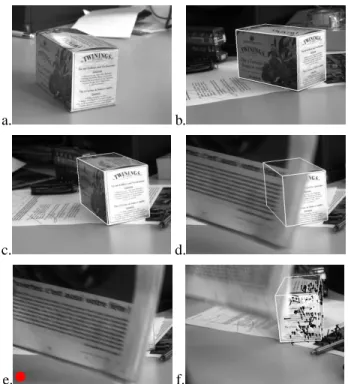
The key ingredient of our approach is to treat wide base-line matching of feature points as a classification problem, in which each class corresponds to the set of all possible views of such a point. During training, given at least one image of the target object, we synthesize a large number of views of individual keypoints. If the object can be assumed to be locally planar, this is done by simply warping image patches around the points under affine or homographic de-formations. Otherwise, given the 3D model, we use stan-dard Computer Graphics texture-mapping techniques. This second approach is more complex but relaxes the planarity assumptions. At run-time, we can then use powerful and fast classification techniques to decide to which view set, if any, an observed feature belongs, which is as effective and much faster than the usual way of computing local de-scriptors and comparing their responses. Once potential correspondences have been established between the inter-est points of the input image and those lying on the object, we apply a standard RANSAC-based method to estimate 3D pose. In Figure 1, we show how it can be used to initial-ize a 3D tracker we developed in previous work [7], and to re-initialize if it loses track.
Here, we do not focus on interest point extraction and use the Harris corner detector for our experiments. A more
a. b.
c. d.
e. f.
Figure 1: Automated pose estimation of a box to initialize a 3D tracker. (a): One of the training images; (b): An in-put image in which the box is automatically detected and its pose estimated; (c) and (d): Feature points are tracked to register the camera, even in case of partial occlusions; (e): The tracker fails because of a complete occlusion of the tracked object, the failure is detected and the initialization procedure is reinvoked; (f): This procedure recognizes the object when it reappears.
advanced detector such as the one described in [8] could be used instead. It is therefore noteworthy that we never-theless obtain excellent results, which can be attributed to the fact that our method tolerates imprecision in point lo-calization. In short, this paper introduces a novel approach to point matching that goes a long way towards reducing the computational burden, thus making it suitable for fast object recognition under viewpoint and illumination changes.
In the remainder of the paper, we first discuss related work. We introduce our approach in Section 3 and present our results in Section 4. We conclude with our plans for future work.
2. Related Work
In the area of automated 3D object detection, we can distin-guish between “Global” and “Local” approaches.
Global ones use statistical classification techniques to compare an input image to several training images of an object of interest and decide whether or not it appears in this input image. The methods used range from relatively
simple methods such as Principal Component Analysis and Nearest Neighbor search [9] to more sophisticated ones such as AdaBoost and classifiers cascade to achieve real-time detection of human faces at varying scales [10]. Such approaches, however, are not particularly good at handling occlusions, cluttered backgrounds, or the fact that the pose of the target object may be very different from the ones in the training set. Furthermore, these global methods cannot provide accurate 3D pose estimation.
By contrast, local approaches use simple 2D features such as corners or edges [11], which makes them resis-tant to partial occlusions and cluttered backgrounds: Even if some features are missing, the object can still be detected as long as enough are found and matched. Spurious matches can be removed by enforcing geometric constraints, such as epipolar constraints between different views or full 3D constraints if an object model is available [12].
For local approaches to be effective, feature point extrac-tion and characterizaextrac-tion should be insensitive to viewpoint and illumination changes. Scale-invariant feature extraction can be achieved by using the Harris detector [13] at several Gaussian derivative scales, or by considering local optima of pyramidal difference-of-Gaussian filters in scale-space [8]. Mikolajczyck et al. [4] have also defined an affine in-variant point detector to handle larger viewpoint changes, that have been used for 3D object recognition [14], but it relies on an iterative estimation that would be too slow for our purposes.
Given the extracted feature points, various local descrip-tors have been proposed: Schmid and Mohr [1] compute rotation invariant descriptors as functions of relatively high order image derivatives to achieve orientation invariance. Baumberg [3] uses a variant of the Fourier-Mellin transfor-mation to achieve rotation invariance. He also gives an algo-rithm to remove stretch and skew and obtain an affine invari-ant characterization. Allezard et al. [12] represent the key point neighborhood by a hierarchical sampling, and rotation invariance is obtained by starting the circular sampling with respect to the gradient direction. Tuytelaars and al. [2] fit an ellipse to the texture around local intensity extrema and use the Generalized Color Moments [15] to obtain correspon-dences remarkably robust to viewpoint changes. Lowe [6] introduces a descriptor called SIFT based on several orien-tation histograms, that is not fully affine invariant but toler-ates significant local deformations. This last descriptor has been shown in [16] to be one of the most efficient, which is why we compare our results against it in the Section 4.
In short, local approaches have been shown to work well on highly textured objects, to handle partial occlusions, and to tolerate errors in the correspondences. However, even if they can be used for object detection and pose estimation, they rely on relatively expensive point matching between a sample and an input image. By contrast, our approach is
geared towards shifting much of the computational burden to a training phase during which we build descriptors from the set of sample images and, as a result, reducing the cost of online matching while increasing its robustness.
3. Feature Point Matching as a
Classi-fication Problem
3.1. Approach
Matching interest points found in an input image against feature points on a target object can be naturally
formu-lated as a classification problem as follows. During train-ing, we construct a set of prominent feature points
lying on . Given an input patch , the space of all
image patches of a given size, we want to decide whether or not it can be an image of one of the interest points.
In other words, we want to assign to a class label in
"!#%$ $%$&')( , where the label
de-notes all the points that do not belong to the object — the background.
cannot be directly observed, but our goal is to construct a classifier *
,+
.-/ such as0 132
4*
is
small.
In other recognitions tasks, such as face or character recognition, large training sets of labeled data are usually available. However, for automated pose estimation, it would be impractical to require very large number of sample im-ages. Instead, to achieve robustness with respect to pose and complex illumination changes, we use a small number of images and synthesize many new views of the feature points in using simple rendering techniques to train our
classifier.
For each feature point, this constitutes a sampling of its
view set, that is the set of all its possible appearances
un-der different viewing conditions. We can then use statistical classification techniques to describe them compactly and, finally, use these descriptors to perform the actual classifi-cation at run-time. This gives us a set of matches that lets us to estimate the pose.
3.2. Creating View Sets
Constructing the viewset of points is relatively simple, and we focus here on some of the implementation details that ensure invariance to illumination changes and also robust-ness to point localization error that can occur while extract-ing the feature points.
3.2.1 Construction Under Local Planarity Assump-tions
For a given point in the training image, if the surface can be assumed to be locally planar, a new view of its neighbor-hood can be synthesized by warping using an affine
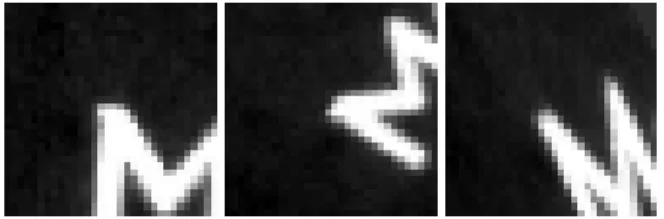
trans-Figure 2: The patch around a keypoint detected in the train-ing image of a book cover, and two patches synthesized us-ing random affine transformations.
formation, that approximates the actual homography:
65 587 9;: 1< <=7 ?>A@ (1) where<=7
are the coordinates of the keypoint detected in the training image,5B7
are the coordinates of the patch cen-ter, and5
the new coordinates of the warped point<
. The matrix: can be decomposed as::C;DFEGDIHKJ
LNM
D
L
, where
DOE andD
L
are two rotation matrices respectively parame-terized by the anglesP andQ , and
M
diagRS
J
TSVUGW is a
scaling matrix;@XYRZ\[]^Z\_%Wa` is a 2D translation vector [17].
The view set is created by generating the views cor-responding to a regular sampling of the space of the
PbTQ8"S
J
TS U ^Z[ ^Z_ parameters. As discussed below, we
use non null values of@ to handle possible localization error
of the keypoints.
3.2.2 Robustness To Localization Error
When a keypoint is detected in two different images, its pre-cise location may shift a bit due to image noise or viewpoint changes. In practice, such a positional shift results in large errors of direct cross-correlation measures. One solution is to iteratively refine the point localization [4]. The keypoint descriptor in [8] handles this problem by carefully assur-ing that a gradient vector contributes to the same local his-togram even in case of small positional shifts.
In our case, we simply allow the translation vector@ of
the affine transformation of Equation 1 to vary in the range of few pixels when generating the view sets. These small shift corresponds to the noise that arises in corner detection.
3.2.3 Invariance To Illumination Changes
Handling illumination changes can be done by normalizing the views intensities. After experimenting with many nor-malization techniques, we concluded that scaling the views intensities so that all the views have the same minimum and maximum intensity values is both cheap and effective as shown in Figure 2: This has the advantage of emphazing the view contrast. Because the normalization is performed independently on each keypoint at run-time, it handles cor-rectly complex illumination changes.
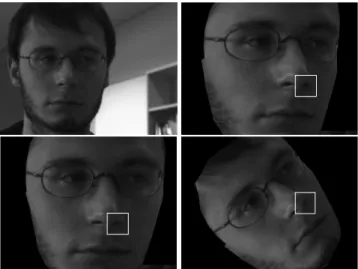
Figure 3: Three synthetic views of a human face, generated from the original image on the top left. The patches ex-tracted from these images to build a viewset of a keypoint on the nose are represented.
Figure 4: Using two different training images to build the viewset of the same keypoint.
3.2.4 Relaxing the Planarity Assumptions
In our target applications such as initialization of model-based 3D tracking, an object model is available. It may be a precise one, as in the case of the box of Figure 1, or a generic one as in the case of faces that we use to illus-trate our technique. Such a model is very useful to capture complex appearance changes due to changes in pose of a non convex 3D object, including occlusions and non-affine warping. For example, as shown in Figure 3, we generate several views of a keypoint on the left side of the nose by texture mapping the face in several positions.
This approach also lets us merge the information from several training images in a natural way: The generated viewsets can simply be combined when they correspond to the same 3D point as depicted in Figure 4.
3.3. Classification
The classifier must be carefully designed for our prob-lem. Even if we eventually use a robust estimator such as RANSAC to eliminate outliers, the mis-classification rate
should be low. A high rate would slow down the robust es-timator and the advantage of our fast matching procedure would be lost.
The classifier should also be able to retrieve a sufficient number of points to estimate the object pose even in pres-ence of partial occlusion. On the other hand, not all the keypoints detected during the training stage have to be con-sidered: If some keypoints appear not to be characteristic enough to be matched reliably, it is better to ignore them to reduce the risk of mis-classification.
Classification should also be performed sufficiently fast for interactive applications. To achieve all these require-ments, we perform this task as follows.
First, the viewsets are computed for object points de-tected in one or more training images. Optionnaly, we can create a background class by taking patches around points detected in images of typical background. This step is not necessary but helps to deal with cluttered background.
To reduce the dimensionality, we perform a Principal Component Analysis on the set of patches. This is followed by K-mean estimation on each viewset independently to handle its potentially complex shape while compacting the viewset representation. In practice, we compute 20 means per viewset.
Then the classifier can attribute a class to an input patch by a Nearest Neighbor search through the set of means and background points. The keypoints most likely to lead to mis-classification can be found during training, by estimat-ingced1fhg
ikj
fml\n o from the training set. When it is above a
given threshold (say 10%) for a class, this class is removed from the class set p . This way, we keep the more
charac-teristic object points.
Finally we build an efficient data structure [9] to perform an efficient run time Nearest Neighbor search in the eigen space computed by the PCA.
3.4. Why Our Approach Is Fast
First, our method does not involve any time consuming pre-treatment such as orientation or affine transformation ex-traction. It is made possible by matching the input points against the compact representation of the viewsets, that con-tain the possible views under such transformations.
Next the eigen space allows to reduce the dimensionality of each input patch, with negligible loss of information: The eigen images computed by the PCA can be seen as a filter bank like in previous methods, but they are specialized for the object to detect, since they are directly computed on the training set.
Finally, the PCA lets us to build an efficient data struc-ture for fast Nearest Neighbor search at run-time, since it sorts dimensions by order of importance.
(a) (b) (c)
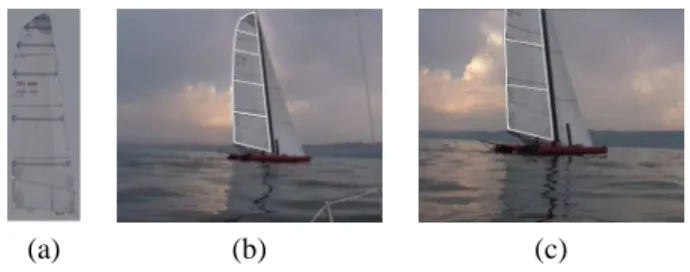
Figure 5: Detecting a sail. (a) The model used to detect the sail. (b and c) Two frames from a 4000 frame video acquired using a home camcorder during a regatta. Even though the camera jerks, the zoom changes and the lighting conditions are poor, the sail is detected in all frames, such as those shown above, where a sufficient portion of the sail is seen.
4. Results
4.1. Experiments on a Planar object
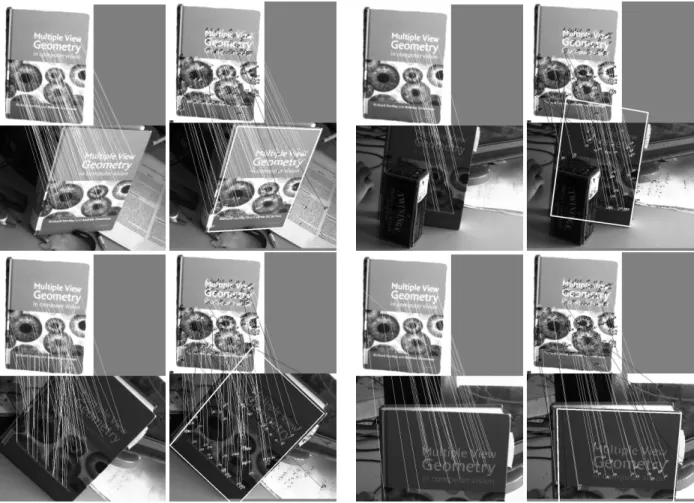
Figure 6 depicts a first set of experiments on a planar ob-ject. About 200 key points have been detected in the train-ing image ustrain-ing the Harris detector. For each we con-structed a viewset made of 100 samples, synthesized from random affine transformations withqrAd^stvubwTtvuxo degrees,
y
rzd\s|{~}uVw {%}uo degrees,Arzd6uVw {xo,Xr d^s#wTo
pix-els. The original size of the patches isA pixels, it
is then divided by two to reduce the computation cost. We kept the first 20 dimensions given by the PCA. 1000 feature points have been detected in the input images, and matched against the learned features, which lets us robustly estimate an homography between the two sets. The input images present perspective, intensity, scale and orientation changes, and the object pose is nevertheless correctly recovered. The whole process takes about 200 milliseconds on a 2GHz PC. We compared our results with those obtained using the executable that implements the SIFT method [6] and kindly provided by David Lowe. Our method usually gives a lit-tle fewer matches, and has a litlit-tle higher outlier rate (about 10% of about 5%). Nevertheless, it is largely enough to accurately estimate the object pose after a few tens of RANSAC samples, and it runs faster: About 0.2 seconds for our non-optimized executable against 1 second for the Lowe executable on the same machine.
4.2. Detecting a Sail
We applied our method for the detection of a sail over a 4000 thousand frame video taken with a home camcorder during a regatta. Despite the bad conditions: the sail is not well textured as it is shown Figure 5, it moves in and out of the field of view, the camera motions are very jerky and the illumination changes all the time, the sail is detected in all frames, such as those shown Figure 5, where a sufficient portion of the sail is seen.
4.3. 3D Object Pose Estimation
In the case of a 3D object, the full pose is recovered from the matches using the POSIT algorithm [18] in tandem with RANSAC.
A Simple Box The method successfully recovers the pose of a textured box disposed in almost any position, using around six very different views for training (Figure 1). In practice, the pose is recovered in less than a second.
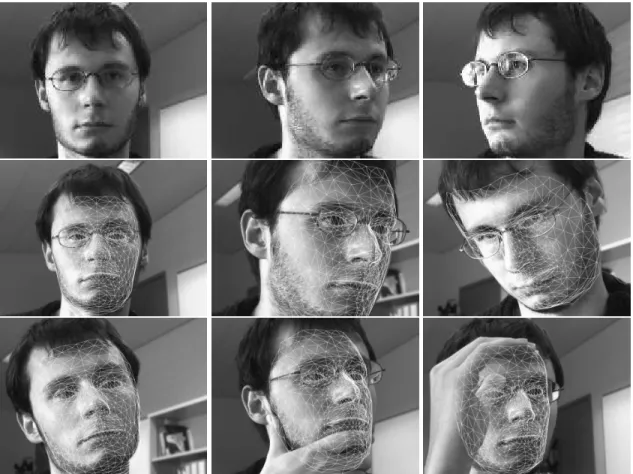
A Human Face We applied the same method to a human face, using the 3 training images of first row of Figure 7 and a generic 3D face model. The training images have been registered by hand, by moving the 3D model to the right location. Even if the 3D model is far from perfect — it does not have glasses and its shape does not match exactly — we are able to recover the pose of a specific human face under both illumination changes and partial occlusions as depicted by Figure 7.
Working on faces is much harder than on a textured box because faces provide far fewer feature points and their 3D nature produces complex appearance changes. Neverthe-less, only three training images where is enough to recover the poses shown in Figure 7. The process is robust enough to support some occlusion and still work if the subject re-moves its glasses. It takes around one second.
5. Conclusion and Perspectives
We proposed an approach to point matching for object pose estimation based on classification. It runs to be faster than previous methods in the planar case, and, unlike these meth-ods, still works for the non-planar case.
Our approach is also very general, and lets us relax the locally planar assumption. In fact, it has the potential to rec-ognize complex shaped textured objects, under large view-point and illumination changes even with specular materi-als, assuming we can generate images of the object under such changes. This is a realistic assumption since there are many Computer Graphics methods designed for this pur-pose, which opens new avenues of research.
We expect that allowing more complex appearance changes than the ones we have been dealing with so far will result in the view-sets becoming more difficult to separate. In pattern recognition it is common to address variability by normalization. Similarly, our approach can take advantage of a scale-space based point detector to deal with more sig-nificant scale changes, without influencing the within class variation. Additional partial invariance can be introduce by removing the rotation in the manner of Lowe could also fa-cilitate the classification. Whether or not this is warranted depends on finding the optimal compromise between the computation time of partial invariance and the gain in clas-sification computation time.
Figure 6: Comparison between SIFT method (left image) and ours (right) for a planar object. Our method usually gives a little less matches, and has a little higher outlier rate. Nevertheless, it is largely enough to accurately estimate the object pose after a few tens of RANSAC samples, with a lower computation cost than SIFT method.
We also intend to replace the simple classification meth-ods we have described here by more sophisticated one that can deal with the facts that each class can exhibit huge vari-ability and thus requires a large number of samples and interest points can belong to several classes or to none at all. We will therefore investigate the use of decision trees [19, 20, 21], which we believe to be most suitable for our specific problem because they naturally handle multi-class multi-classification, can be enhanced by using powerful sta-tistical methods such as bagging [22] and boosting [23, 24]. These methods are very fast, and achieve very good recog-nition rate, usually more than 90%. Thus, we believe that our approach is an important step toward much better object recognition and detection methods, and opens good possi-bilities for future research.
References
[1] Cordelia Schmid and Roger Mohr, “Local grayvalue invariants for image retrieval,” IEEE Transactions on Pattern Analysis and
Ma-chine Intelligence, vol. 19, no. 5, pp. 530–534, May 1997.
[2] T. Tuytelaars and L. VanGool, “Wide Baseline Stereo Matching based on Local, Affinely Invariant Regions,” in British Machine
Vi-sion Conference, 2000, pp. 412–422.
[3] Adam Baumberg, “Reliable feature matching across widely sepa-rated views,” in Conference on Computer Vision and Pattern
Recog-nition, 2000, pp. 774–781.
[4] K. Mikolajczyk and C. Schmid, “An affine invariant interest point detector,” in European Conference on Computer Vision. 2002, pp. 128–142, Springer, Copenhagen.
[5] F. Schaffalitzky and A. Zisserman, “Multi-view matching for un-ordered image sets, or ”How do I organize my holiday snaps?”,” in
Proceedings of European Conference on Computer Vision, 2002, pp.
414–431.
[6] David Lowe, “Distinctive image features from scale-invariant key-points (Accepted),” International Journal of Computer Vision, 2004. [7] L. Vacchetti, V. Lepetit, and P. Fua, “Fusing Online and Offline In-formation for Stable 3–D Tracking in Real-Time,” in Conference on
Computer Vision and Pattern Recognition, Madison, WI, June 2003.
[8] David G. Lowe, “Object recognition from local scale-invariant fea-tures,” in International Conference on Computer Vision, 1999, pp. 1150–1157.
Figure 7: Face pose estimation. First row: the three training images for face pose estimation. They have been registered manually. The 3D model (not shown) is a generic human face model, and does not include the glasses of the subject. Second row: recovered pose under normal conditions. Third row: recovered pose under more difficult conditions. The subject removed his glasses in the first image, and the face is partially occluded in the two last images.
[9] Shree K. Nayar, Sameer A. Nene, and Hiroshi Murase, “Real-Time 100 Object Recognition System,” IEEE Transactions on Pattern Analysis and Machine Intelligence, vol. 18, no. 12, pp. 1186–1198,
1996.
[10] Paul Viola and Michael Jones, “Rapid Object Detection using a Boosted Cascade of Simple Features,” in Proceedings of Conference
on Computer Vision and Pattern Recognition, 2001, pp. 511–518.
[11] F. Jurie, “Solution of the Simultaneous Pose and Correspondence Problem Using Gaussian Error Model,” Computer Vision and Image
Understanding, vol. 73, no. 3, pp. 357–373, 1999.
[12] N. Allezard, M. Dhome, and F. Jurie, “Recognition of 3d textured objects by mixing view-based and model-based representations,” in
International Conference on Pattern Recognition, Barcelona, Spain,
Sep 2000, pp. 960–963.
[13] C.G. Harris and M.J. Stephens, “A combined corner and edge detec-tor,” in Fourth Alvey Vision Conference, Manchester, 1988. [14] F. Rothganger, S. Lazebnik, C. Schmid, and J. Ponce, “3D object
modeling and recognition using affine-invariant patches and multi-view spatial constraints,” in Proceedings of Conference on Computer
Vision and Pattern Recognition, jun 2003.
[15] F. Mindru, T. Moons, and L. VanGool, “Recognizing color patterns irrespective of viewpoint and illumination,” in Conference on
Com-puter Vision and Pattern Recognition, 1999, pp. 368–373.
[16] K. Mikolajczik and C. Schmid, “A performance evaluation of local descriptors,” in Conference on Computer Vision and Pattern
Recog-nition, June 2003, pp. 257–263.
[17] R. Hartley and A. Zisserman, Multiple View Geometry in Computer
Vision, Cambridge University Press, 2000.
[18] D. DeMenthon and L. S. Davis, “Model-based object pose in 25 lines of code,” in European Conference on Computer Vision, 1992, pp. 335–343.
[19] L. Breiman, J. H. Friedman, R. A. Olshen, and C. J. Stone,
Classifi-cation and Regression Trees, Chapman & Hall, New York, 1984.
[20] Yali Amit and Donald Geman, “Shape quantization and recognition with randomized trees,” Neural Computation, vol. 9, no. 7, pp. 1545– 1588, 1997.
[21] Y. Amit, D. Geman, and K. Wilder, “Joint induction of shape fea-tures and tree classifiers,” IEEE Transactions on Pattern Analysis
and Machine Intelligence, vol. 19, pp. 1300–1306, 1997.
[22] Leo Breiman, “Bagging predictors,” Machine Learning, vol. 24, no. 2, pp. 123–140, 1996.
[23] Y. Freund and R.E. Schapire, “Experiments with a New Boosting Al-gorithm,” in International Conference on Machine Learning. 1996, pp. 148–156, Morgan Kaufmann.
[24] L. Mason, J. Baxter, P. Bartlett, and M. Frean, “Boosting algorithms as gradient descent,” in Neural Information Processing Systems. 2000, pp. 512–518, MIT Press.