On: 14 April 2014, At: 00:54 Publisher: Routledge
Informa Ltd Registered in England and Wales Registered Number: 1072954 Registered office: Mortimer House, 37-41 Mortimer Street, London W1T 3JH, UK
Teaching in Higher Education
Publication details, including instructions for authors and subscription information:
http://www.tandfonline.com/loi/cthe20
Development of a tool to evaluate
lecturers' verbal repertoire in action
R.M. van der Rijsta, G.J. Visser-Wijnveena, N. Verloopa & J.H. van Drielaa
ICLON – Graduate School of Teaching, Leiden University, Leiden, The Netherlands
Published online: 01 Apr 2014.
To cite this article: R.M. van der Rijst, G.J. Visser-Wijnveen, N. Verloop & J.H. van Driel (2014): Development of a tool to evaluate lecturers' verbal repertoire in action, Teaching in Higher Education, DOI: 10.1080/13562517.2014.901959
To link to this article: http://dx.doi.org/10.1080/13562517.2014.901959
PLEASE SCROLL DOWN FOR ARTICLE
Taylor & Francis makes every effort to ensure the accuracy of all the information (the “Content”) contained in the publications on our platform. However, Taylor & Francis, our agents, and our licensors make no representations or warranties whatsoever as to the accuracy, completeness, or suitability for any purpose of the Content. Any opinions and views expressed in this publication are the opinions and views of the authors, and are not the views of or endorsed by Taylor & Francis. The accuracy of the Content should not be relied upon and should be independently verified with primary sources of information. Taylor and Francis shall not be liable for any losses, actions, claims, proceedings, demands, costs, expenses, damages, and other liabilities whatsoever or howsoever caused arising directly or indirectly in connection with, in relation to or arising out of the use of the Content.
Development of a tool to evaluate lecturers
’
verbal repertoire in action
R.M. van der Rijst*, G.J. Visser-Wijnveen, N. Verloop and J.H. van Driel
ICLON–Graduate School of Teaching, Leiden University, Leiden, The Netherlands
(Received 23 April 2013; final version received 26 January 2014)
A broad communicative repertoire can help university lecturers to motivate and engage diverse student populations. The aim of this study is to develop and explore the usefulness and validity of a tool to identify patterns in lecturers’ verbal repertoire. Speech act theory is presented as a framework to study lecturers’verbal communica-tion during teaching. A descripcommunica-tion of the tool and the analysis of verbal accommunica-tions are presented. In order to explore the validity, patterns of 12 university lecturers’verbal actions during instruction were examined. Characteristic speech act sequences were identified, similar sequences were clustered and associations with other teaching behaviours were explored to analyse the construct validity. We explain the instrument in detail to assist future use and we discuss to what extent it can provide ways to reflect on lecturers’verbal repertoire in action.
Keywords:approaches to teaching; classroom interaction; communication; discourse analysis; speech acts analysis; university teaching
Introduction
Research on classroom discourse suggests that lecturers’verbal actions have a persistent influence on student learning (cf. Fisher2010; Rogers et al. 2005; Scott, Mortimer, and Aguiar2006; Walshaw and Anthony 2008). However, detailed analyses of the elements of verbal actions during teaching practice are not yet presented. In-depth insight into lecturers’ verbal actions is relevant to gain a better understanding of its influence on student learning and provides the opportunity to strengthen teachers’verbal repertoires to improve teaching in higher education.
Research on classroom interactions shows that teachers who display dominant interaction behaviour often induce submissive student behaviours and vice versa. On the other hand, teachers who display friendly interaction behaviour generally invite similar behaviour among their students. Both behavioural tendencies are called comple-mentary interaction sequences (De Jong et al.2012). A teacher, who has knowledge of these communication patterns and has the verbal repertoire to influence these patterns, is likely to be able to use it for the benefit of student learning. For example, a student who is insecure about his/her problem-solving abilities is likely to be asking a lot of factual questions without showing proactive problem-solving behaviour. There are many ways to approach such a student. Two opposite approaches are: by dictating the student the steps to find the answer or by posing open questions to the student. The first teacher interaction might lead to even more inactive and insecure student behaviour. The second approach
*Corresponding author. Email:[email protected]
© 2014 Taylor & Francis
will lead to proactive student behaviour and eventually to improved self-confidence of the student’s problem-solving abilities.
The current studies into classroom discourse provide general analyses of lecturers’ verbal actions (Rogers et al.2005). In order to study lecturers’verbal repertoire in detail during teaching practice a tool is developed, which provides detailed descriptions of the verbal actions of lecturers during instruction (construct validity), is easy to use in teaching practice (applicability) and is applicable in diverse instructional approaches. The aim of this study is to develop a transferable research tool which can identify patterns in lecturers’verbal repertoire in a wide variety of contexts. We intent to develop a transfer-able research tool, while explicitly being aware that the results gained with such a tool will only add to our understanding when interpreted and applied within specific contexts. In this study we only focus on the lecturers’ verbal actions at one point in time, while acknowledging that verbal actions vary over time, and other variables, such as nonverbal communication, the mood of the group and the set-up of the room, are also important in the teaching process. When a reliable and valid tool is developed for the measurement of lecturers’verbal actions, further analyses may also incorporate students’ verbal actions. However, in this study we will focus on lecturers’verbal repertoire in action. We will explore the usefulness and validity of the developed tool for teaching practice. This study, consequently, is relevant for scholars who are interested in methods to study verbal interactions in teaching practice as well as to lecturers in higher education.
Discourse analysis and speech act theory
In this study teachers’verbal actions are analysed through a lens of linguistic speech act theory. Speech act theory was first developed by Austin (1962), and later extended by Searle (1969), as a part of the philosophy of language (Bach and Harnish 1979). Their typology of speech acts is still in line with contemporary philosophy of language and provides a theoretical basis for this study of language in action. According to Searle (1969), language is more than simply the transmission of information, because each lingual expression or utterance has a particular intention. The intention of an act is often indicated by performative verbs, such as to inform, to claim, to state, to demand or to advise. Although these verbs may occur in specific speech acts, this is not a requirement. The speech act with the intention of demanding something, for example, can be expressed by saying, ‘I hereby demand that you do this exercise’, but also by saying ‘do this exercise’or‘finish the exercise, please’. Five main speech act types based on the purpose of the act can be distinguished: acts with assertive, commissive, declarative, directive and expressive points (Austin1962; Bach and Harnish1979; Searle1969).Table 1displays a detailed description of the types. The analysis of speech acts is a type of discourse analysis used to improve our understanding of lecturers’verbal actions in the context of teaching and learning (e.g. Huisman2006; Rogers et al.2005).
Instructional formats
Instructional formats also provide insight into lecturers’ teaching intentions and can, therefore, provide additional information about lecturers’ intentions expressed in their verbal interactions with students. University lecturers apply different instructional formats for their courses, for example, lectures, seminars or lab classes. Although there are no absolute barriers between these instructional formats, we might assume that in various
instructional formats the lecturers have distinct roles and intentions. During a lecture, for example, the lecturer has the role of the‘expert’, during a lab class the lecturer has the role of a‘guide’, and during a seminar the lecturer is more or less a ‘discussion leader’. Lecturers behave differently in different instructional formats, and, therefore, it is likely that lecturers use different verbal interactions. For example, we expect that lecturers in lab classes apply more directive speech acts in order to guide the students through the
Table 1. Categories and intentions behind lecturers’speech acts.
Categories of
speech acts Intention behind speech act
Assertive acts Assertive speech acts express the lecturers’intention that the students have or form a similar belief. An utterance that asserts a thing that can be judged as true or false. The intentional point of an assertive act focuses on persuading the students to form a parallel belief. Assertive acts are divided into three subcategories:
(1) Inform: the lecturer articulates assertions about factual situations or phenomena at this moment.
(2) Predict: the lecturer talks about expectations for future situations, or asserts consequences or predictions.
(3) Reflect: the lecturer formulates assertions about past situations and reflects in a non-normative way.
Commissive acts Commissive speech acts express the lecturers’intention that his utterance obligates him to do something. The intentional point of a commissive act focuses on the behaviour and cognition of the students.
Declarative acts Declarative speech acts are judgments that by convention have official, binding import in the context of the institution in which they occur. For example, the lecturer utters a thing as part of his function or position. The effect of a declarative act changes an institutional state of affairs. The intentional point of a directive act focuses on change of a current situation. Directive acts Directive speech acts express the lecturers’attitude towards some prospective
action by the students and his intention that his utterance, or the attitude it expresses, be taken as a reason for the students’action. The intentional point of a directive act focuses on the students’behaviour. Directive acts are divided into three subcategories:
(1) Question: the lecturer formulates questions. In transcripts often, but not always, indicated with a question mark.
(2) Instruct: the lecturer gives instructions to the students. (3) Advise: the lecturer formulates advice or a recommendation. Evaluative acts Evaluative speech acts express the lecturers’perceived evaluation of
something. This expressed value is clearly the main point of the utterance; thus, the act comprises a normative load. Speech acts including words such as‘better’,‘more effective’or‘nicer’are often evaluative. The intentional point of an evaluative act focuses on communication of a perceived value or norm of the students.
Expressive acts Expressive speech acts express the lecturers’feelings regarding the hearer or, where the utterance is clearly perfunctory or formal, the lecturers’intention that his utterance satisfies a social expectation of expression of certain feelings and his belief that it does so. The intentional point of an expressive act focuses on communication of an emotional state of the lecturer.
assignments and procedures; while we expect lecturers to use assertive speech acts in lecturers in which they explain the course content. Both lecturers’verbal interactions and the selected instructional format are inspired by the intentions a lecturer has with the course meeting.
Lecturers’intentions and approaches to teaching
Comparable to instructional formats, lecturers’ approaches to teaching provide insight into lecturers’teaching intentions. On the one hand, intentions are influenced by generic conceptions of what teaching and learning should involve, conceptions of the context in which lecturers teach and perceived control over the teaching practice; on the other hand, intentions determine a person’s actions (Ajzen and Fishbein 2005). The Approaches to Teaching Inventory (ATI; Prosser, Trigwell, and Taylor 1994) is frequently used to examine lecturers’ intentions and strategies. The approach of a lecturer gives a characterisation of his/her typical teaching style, comparable to how a student’s approach to learning describes the student’s learning style (Kember 1997). Broadly two types of approaches to teaching can be distinguished in the research literature in higher education: a student-centred/learning-oriented and a teacher-centred/content-oriented approach (Kember 1997; Prosser et al. 1994). The student-centred/learning-oriented approach is characterised by a focus of the lecturer on changing students’ conceptions, while a teacher-centred/content-oriented approach is characterised by a focus of the lecturers on transmitting information to students. Therefore, we expect that lecturers who adopt a teacher-centred/content-oriented approach utter assertive speech acts without a lot of questions to the students, while lecturers who adopt a student-centred/learning-oriented approach use rhetorical and direct questions (i.e. directive speech acts) to stimulate student thinking. To explore the construct validity of the speech act tool, in this study, we will examine lecturers’ speech act in relation to the instructional formats and their approaches to teaching.
Research question
In this study, we focused on speech act analysis as a tool for exploring lecturers’ communication patterns during teaching practice. The aim of this study is to develop a tool to identify patterns in lecturers’ verbal interactions in action and to explore the usefulness and validity. The guiding research question was: to what extent is speech act analysis useful and valid as a method to study lecturers’verbal repertoire?
Method
In order to develop a tool to study lecturers’verbal repertoire, we collected empirical data of the teaching practice of university lecturers in action. Additionally, we collected data on the instructional formats and the approaches to teaching from the same lecturers to provide insight into the validity of the developed tool.
Sample and procedure
The participants were 12 university lecturers (2 female, 10 male) at a research-intensive university. Guest, Bunce, and Johnson (2006) found that generally in qualitative analyses of interview data 80% of all codes emerge after the analysis of approximately 12
transcripts. The participants ranged in position from assistant professor to full professor, and taught undergraduate courses in a variety of science disciplines. Different instructional formats were used in the courses. These instructional formats were categorised into three main groups: lectures, seminars and lab classes. The amount of time students were to spend on each course ranged between 3 and 7 credits based on the European Credit Transfer System, in which 1 credit represents 28 hours of study load.
Data collection
Participants’course meetings were audio tape-recorded using a tie-clip microphone. The lecturers’classroom communication was transcribed verbatim, with transcription accur-acy confirmed by the first author. After the final course meetings, the lecturers were asked to complete the ATI (Prosser et al. 1994). The ATI scores and the instructional formats were used to get understanding of the validity of the speech act method in authentic teaching situations. The ATI and the instructional formats both are measures of related constructs, namely lecturers’teaching intentions. In this study, we assume that lecturers’ verbal interactions in action reflect their teaching intentions (cf. Murray and MacDonald 1997; Searle1969).
Development of the category system
Lecturers’speech acts were captured using categories retrieved from linguistic theory. The individual utterances are classified and their semantic relationships taken into considera-tion to categorise the intenconsidera-tion behind the utterance. In this study, we explored patterns in the speech act sequences of each participant. The qualitative analysis procedure can be divided into two phases: (1) development of a category system and (2) determination of the inter-rater reliability. These phases are similar to classic content analysis or related qualitative methodologies in which predeveloped category system based on findings of previous studies is used. We explain the phases of the qualitative analysis procedure in detail and provide insight into the establishment of assessor agreement.
Phase 1 – development of a category system: speech act types and matching performative verbs were retrieved from the literature on the philosophy of language (Austin 1962; Searle 1969). Five main speech act categories were distinguished in the literature, namely, assertive, commissive, declarative, directive and expressive purposes. Especially in educational contexts, utterances with an evaluative intent also occur. For example, in explaining to students the most effective way to solve a problem, a lecturer may say:‘That’s a good way to approach the problem’or‘you are doing very well, now’. Therefore, evaluative acts were assessed as specific categories. Expressive speech acts articulate an emotional state of the lecturer, while evaluative acts articulate lecturers’ normative values. The six primary categories were discussed by the research team and applied to a first sample of transcripts, resulting in a preliminary category system.Table 1 depicts the main categories of speech acts with additional explanations. Compound sentences were split into single sentences before assigning the sentences to the categories. Based on the initial reading of the transcripts and re-listening of the audio tape-recorded fragments subcategories were proposed and negotiated by the research team. During this dialogic negotiation, our aim was to capture the intention behind the speech act. This meant that beside semantic cues, such as performative verbs and sentence construction, we also took non-semantic cues, such as intonation and pace, into account as indicators of
the intention of the speech acts. As a result, three categories of directive speech acts were distinguished: question, advice and instruct. The assertive acts were subcategorised into inform, predict and reflect. Students’responses were categorised as‘student speech acts’. This category was not divided into subcategories, because the focus of this study was on lecturers’utterances. The category system was applied to a sample of four transcripts and adapted according to the results. Demarcation rules were described to distinguish between categories.
Phase 2 – estimation of the inter-rater reliability: an independent assessor was consulted to verify if the category system could be used by people other than members of the research team. First, a sample of four transcripts was assessed independently by the independent assessor and the first author. The categories, the demarcation rules and all differences in assigned categories were discussed. The demarcation rules were modified according to the results of the discussion. Finally, the inter-rater reliability was determined based on the categories assigned by both assessors to a sample of four new transcripts. Inter-rater agreement (Cohen’s kappa) on the level of the subcategories was .69 and on the level of the main categories .73.
Agreement on the categories of all transcripts was established by the independent assessor and first author following negotiation of the differences. Dissimilarity between assessors could be related to mainly two issues. First, most of the dissimilarities were found within the main category of assertive speech acts, thus between assertive-inform, assertive-predict and assertive-retrospect. Second, some fragments had double intentional directions. For example, the utterance ‘don’t do that foolish thing’ includes both an evaluative and a directive point.
Analysis of speech act sequences
The frequencies of the speech act categories alone provide a first-order representation of lecturers’complex verbal interactions in action. The progression of speech acts potentially provides a more authentic illustration of the distinctive features of lecturers’ verbal communications. Therefore, we explored patterns in sequences of lecturers’speech act categories to be precise a series of four successive speech act categories were analysed. O’Connor (1999) presents a statistical procedure to determine the frequencies of successive speech acts. With the help of this procedure we can determine the frequencies of any succession of speech acts in the transcripts of the participants.
Analysis of approaches to teaching
The ATI was moderately adapted to the national higher education context (cf. Stes, Gijbels, and Van Petegem2008). The questionnaire consisted of 22 items, which could be subdivided into two main scales, conceptual-change/student-focus (CCSF) and informa-tion-transmission/teacher-focused (ITTF). Cronbach’s alpha reliabilities of the two scales for the sample in this study were .98 (CCSF) and .87 (ITTF). For all participants, the scores on the two scales CCSF and ITTF were determined.
Results
In total, more than half of lecturers’speech acts in our sample were coded as assertive acts (60%), roughly 20% as directive acts and 8% consisted of evaluative acts. Only a
small number of lecturers’speech acts consisted of commissive acts (5%) and expressive acts (2%). Ten per cent were student responses. No declarative acts were found in this sample.
Table 2depicts the frequencies of the speech act for each participant, and shows the actual uttered acts of the participants during the meetings. The names of the participants are fictitious to preserve anonymity.
Speech act sequences
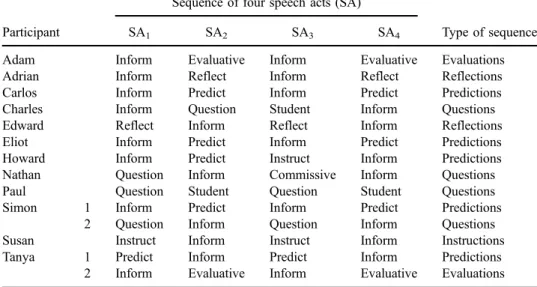
Generally two groups of speech act sequences can be defined in our sample: sequences with assertive acts and sequences with directive acts. Table 3 depicts the characteristic sequences of speech acts for each lecturer.
The assertive speech act sequences can be subdivided into two groups, one with predictions and the other with reflections. The directive sequence group can be divided into a group with questions and a group with instructions.Table 4gives descriptions of the five types of speech act sequences found in our sample.
The characteristic speech act sequences of Tanya and Adam are distinct from the two larger speech act types, assertive acts (predictions and reflections) and directive acts (questions and instructions). Adam and Tanya typically use evaluative acts during their teaching. Note that Simon and Tanya have two characteristic sequences which were both present during that particular class.
The sequences of Charles and Paul both represent lecturer–student dialogues. Simon on the other hand also poses questions, but these questions almost never are followed by student responses but by additional explanations (assertive-inform acts) of the lecturer. The questions in the sequence of Paul can be interpreted in a different way than the questions in the sequence of Simon, because of the succession of the speech acts. From the transcripts it becomes clear that Simon’s questions are posed to stimulate student thinking, for example as rhetorical questions, and these speech acts did not have the
Table 2. Frequencies of speech acts.
Participant Fragments Assertive Directive Evaluative Commissive Expressive
Student response
Adam 148 89 26 15 6 4 8
Adrian 285 161 45 22 16 6 24
Carlos 62 47 2 7 4 0 1
Charles 189 78 48 18 7 6 32
Edward 103 70 10 7 4 2 10
Eliot 200 158 13 11 14 2 2
Howard 176 102 44 9 12 3 4
Nathan 110 66 22 5 14 2 1
Paul 178 48 45 11 1 7 64
Simon 174 139 26 3 5 1 0
Susan 125 71 36 5 1 8 3
Tanya 120 85 13 16 4 1 1
Total absolute (%) 1870 1114 (.60) 330 (.18) 129 (.07) 88 (.05) 42 (.02) 150 (.08)
intention to stimulate student responses. Thus, in speech act sequences the interpretation of acts depends on the consecutive order of the acts.
Sometimes lecturers demonstrate two or more qualitatively different speech acts sequences. This is an indication of a variety of verbal interactions present during the course meeting, which can be interpreted as a sign that the particular lecturer has a broad repertoire of verbal interactions. For example, Simon used two different characteristic speech act sequences in his course meetings, one with questions and the other with predictions. Both sequences were characteristic of his verbal interactions during the course meeting. A closer look at the transcripts indeed shows that Simon gave information to his students followed by rhetorical questions, as well as making
Table 3. Participants’characteristic speech act sequences.
Sequence of four speech acts (SA)
Participant SA1 SA2 SA3 SA4 Type of sequence
Adam Inform Evaluative Inform Evaluative Evaluations Adrian Inform Reflect Inform Reflect Reflections Carlos Inform Predict Inform Predict Predictions Charles Inform Question Student Inform Questions Edward Reflect Inform Reflect Inform Reflections Eliot Inform Predict Inform Predict Predictions Howard Inform Predict Instruct Inform Predictions Nathan Question Inform Commissive Inform Questions Paul Question Student Question Student Questions Simon 1 Inform Predict Inform Predict Predictions
2 Question Inform Question Inform Questions Susan Instruct Inform Instruct Inform Instructions Tanya 1 Predict Inform Predict Inform Predictions
2 Inform Evaluative Inform Evaluative Evaluations
Table 4. Typology of lecturers’speech act sequences in teaching practice.
Type of sequence
Number of
lecturers Description
Predictions 5 The lecturer articulates assertions about course content in combination with explaining expectations, consequences or predictions in new situations.
Questions 4 The lecturer formulates rhetorical questions or direct questions to the students.
Evaluations 2 The lecturer articulates assertions about factual situations or phenomena in combination with perceived evaluation of theoretical assumptions, students’work or students’comments.
Reflections 2 The lecturer articulates assertions about course content in combination with reflections and explanations of previously studied situations.
Instructions 1 The lecturer gives direct instructions to the students.
predictions, for example in an ‘if-then’ format, about theoretical implications in new situations. The characteristic speech act sequences are an illustration of the applied verbal repertoires of the participating university lecturers.
Cases of speech act sequences
To illustrate the usefulness of the speech act method, fragments from course meetings are presented. The assigned speech act categories for each sentence uttered by the lecturers are presented between brackets. The first fragment illustrates a typical assertive speech act sequence (reflections). This fragment, with assertive-reflect acts, was taken from the transcripts of Adrian.
(1) In the last meeting we discussed the benefits of alternative splicing, a single gene produces multiple products. (Assertive-reflect)
(2) We will talk again about transposons, cell-typical structures of proteins, which we have already seen. (Assertive-reflect)
(3) And, ladies and gentleman, here we are again, is it male or female? (Directive-question)
(4) We often have this kind of conversation in this room, that’s not my fault; it is part of the course content. (Assertive-reflect)
(5) Yesterday, we talked about why female genes are more often used in offspring than male genes. (Assertive-reflect)
(6) And after the meeting, one of the men came up to me and said,‘Sir, are we going to get some bonus points in the final test, because we got so depressed during your course?’(Assertive-reflect)
This sequence illustrates how assertive-reflect acts can be used in lecture-type courses.
The second fragment was selected from the transcripts of Tanya and illustrates an application of evaluative acts during a lecture-based meeting. She described the Hans effectin a lecture about animal behaviour.
(1) Actually, almost nobody had noticed it. (Assertive-reflect)
(2) It was so subtle; the horse went on tipping until he got the sign. (Assertive-reflect)
(3) This, now, is known as the Hans effect. (Assertive-inform)
(4) That really is the well-known name of these kinds of phenomena. (Assertive-inform)
(5) So, Hans could not count, but very remarkable it was. (Evaluative act) (6) And that’s what many forget; it was a remarkably clever horse, because it
completed the task in a very innovative way. (Assertive-inform) (7) He likely didn’t have any clue whatsoever. (Assertive-reflect) (8) But it was an extremely good student. (Evaluative act)
(9) He knew that in many different tasks and many different contexts, and so on, that he just had to pay close attention to what his boss did. (Assertive-reflect) (10) And he learned in an associative way what the sign was for when to stop, when his boss looked happy and when he was going to receive his reward. (Assertive-reflect)
(11) It really is a magnificent example in two ways. (Expressive act)
(12) One is how to pay close attention when training animals. (Assertive-inform) (13) Very close, actually, because you almost never know what you do.
(Evaluat-ive act)
Throughout this part of her course meeting, Tanya used evaluative acts and assertive-reflect acts in succession with assertive-inform acts. Other parts of her course meeting comprised assertive-predict acts in succession with assertive-inform acts (see Table 3). Tanya, like Adam, characteristically used evaluative acts, such as ‘that is a good question!’or‘generally, that is good for the observations’. These evaluative speech acts can be broadly divided into two kinds of evaluative acts, namely first, lecturers sharing their opinions about course content or methodologies and, second, lecturers evaluating the learning processes of students. The previous fragment also illustrates many assertive speech acts. This speech act category was frequently present in the verbal interactions of all participants.
Directive speech acts also played an important role in lecturers’classroom discourse. The following fragment selected from the transcripts of a lab class of Susan illustrates directive speech acts when she provided details about the laboratory assignments.
(1) So, I mean, as long as we have enough, check and see how many seawater plates there are before you do anything. (Directive-instruct)
(2) Because everybody needs to make at least one fresh plate for next week, but if there are more than that, then try other temperatures if you can. (Directive-instruct)
(3) Sometimes they won’t. (Assertive-inform)
(4) Most bugs got a plus or minus 15 degrees around their optimum. (Assertive-inform)
(5) But some of these bugs seem to grow quite happily from room temperature down to almost freezing. (Assertive-inform)
(6) So check this and see, because it would be nice to have some bugs growing at room temperature or at 18 degrees, just so we can pack them all in. (Directive-instruct)
(7) Otherwise we have to turn the 18 degrees stove down I think. (Assertive-predict) (8) Also, now that I have a brand new 18-degree shaker, it would be nice to be able
to use it. (Assertive-predict)
Susan provided her students with helpful instructions for getting through the laboratory assignments. She gave instructions and explained to the students some of the consequences if the instructions were not followed. During lab classes these strict instructions are often necessary not only with regard to completion of the assignments but also in relation to safety regulations when working with living organisms (‘bugs’).
Construct validity
In order to explore the construct validity of the speech act method developed in this study, we used two measures related to lecturers’ intentions, namely the instructional formats and the ATI.
Instructional formats
In Table 5, the instructional formats, divided into three types, lecture, seminars and lab classes, are presented alongside the speech act sequences found in this sample. Generally, lecturers in our sample use directive speech acts most often during lab classes, while they use more assertive acts during lectures. The speech act sequence of Edward seems to be contradicting this statement. However, the recorded meeting in this lab class series was more similar to a lecture than other meetings later in the course, because the lecturer reflected on previous work and talked about what to do next. Therefore, it is conceivable that Edward used more assertive-reflect speech acts than lecturers would have done in a typical lab class course meeting. The trend in the data coincides with our expectations that lecturers apply directive speech acts in their verbal interaction during lab classes, while lecturers show speech act sequences with assertive speech acts during lectures. No indication was found in the data about a tendency towards a relation between disciplinary background of the lecturers and their speech acts.
Approaches to teaching
Table 5also depicts the score on the two ATI scales CCSF and ITTF. The speech acts of participants with high scores on the CCSF scale (Simon, 4.70; Paul, 4.30) both have characteristic sequences with directive and student acts. These participants often asked questions and encouraged students to react. Adrian and Howard both score high on the ITTF scale (respectively 4.73 and 3.82) and both characteristic speech act sequences are a combination of assertive-reflect and assertive-predict. Susan on the contrary also scores high on the ITTF scale, but applies many directive speech acts. Susan also scores high on the CCSF scale, which might suggest that Susan had teaching intentions during the
Table 5. Distribution of instructional formats and approach to teaching among participants, ordered according to their instructional format.
Approaches to Teaching
Participant Discipline
Type of sequences
Instructional
format CCSF ITTF Simon (1) Chemistry Predictions Lab class 4.70 (.48) 2.18 (.87) Simon (2) Chemistry Questions
Paul Chemistry Questions Lab class 4.30 (.68) 2.91 (1.30) Edward Chemistry Reflections Lab class 3.80 (1.03) 3.00 (1.10) Susan Biology Instructions Lab class 4.00 (1.63) 3.91 (1.30) Howard Informatics Predictions Seminar 2.70 (1.06) 3.82 (.87) Charles Informatics Questions Seminar 2.20 (1.23) 2.45 (1.13) Nathan Astrophysics Questions Seminar 3.70 (.68) 3.18 (1.40) Adam Astrophysics Evaluations Seminar 3.90 (1.29) 2.73 (1.27) Carlos Mathematics Predictions Lecture 4.10 (.74) 2.27 (.47) Eliot Physics Predictions Lecture 2.40 (1.51) 2.91 (1.22) Tanya (1) Biology Predictions Lecture 3.60 (.84) 2.91 (1.45) Tanya (2) Biology Evaluations
Adrian Chemistry Reflections Lecture 3.5 (1.18) 4.73 (.47)
meeting both directed to transmitting information (instructions for the assignments) and to conceptual change among students. Finally, Charles is remarkable with respect to his approach, because both his CCSF score and his ITTF score are rather low. This may be related to the type of instructional format, a seminar, or it may be interpreted as showing that the respondent found few links between the ATI items and his particular course. In summary, lecturers who score high on the CCSF scale tend to adopt verbal interactions focused on lecturer–student interactions, while lecturers who score high on the ITTF scale tend to use speech acts focused on explaining, such as assertive acts.
Conclusions and discussion
The aim of this study was to develop a method to identify patterns in lecturers’ verbal actions during teaching practice and to explore its applicability and validity. We described the development of the speech act categories and the applied procedure in order to deduce characteristic sequences in the data of lecturers’ verbal actions. We described several cases of verbal interactions during teaching practices in order to illustrate the kind of results to expect when using this method. We showed that the speech act tool provides a detailed description of lecturers’verbal actions in teaching practice.
Applicability
The developed tool provides detailed information about lecturers’verbal actions during teaching practices. The method explores both the types and the frequencies of speech acts a lecturer uses and provides insight into characteristic patterns in the verbal repertoire. Furthermore, the tool has the potential to be applied in a wide variety of research issues related to classroom communication. For example, the relationship between lecturers’ verbal actions and student engagement for the topic can be studied, or relationships between lecturers’speech act sequences and students’learning can be analysed within the boundaries of speech act analysis. Additionally, this tool can be used for professional development purposes for lecturers. Through the analysis of video fragments of teaching episodes with the speech act tool lecturers might first become aware of their own verbal repertoire, second they can relate this to a structured theoretical framework and draw specific learning objectives for themselves to improve their verbal repertoire. Because the data collection process does not interfere with the lecturers’ instruction, repeated measurements are feasible and longitudinal studies into the development of lecturers’ verbal abilities become possible. In this study we developed a tool to analyse lecturers’ verbal repertoire in action without paying specific attention to the context of the classroom. Future studies applying this speech act tool should overcome this limitation. For example, the development of early career lecturers’verbal teaching repertoire can be studied over time in order to improve our understanding of expertise development in teaching.
Validity
From the analysis of lecturers’speech acts, we observed that during lecture-based formats mostly assertive speech acts are used, while during laboratory courses directive speech acts were more common. During the lecture-based formats course content was explained, while during laboratory courses lecturers’ intentions were more often focused on
students’ instructions about how to precede with the assignments. This finding corresponds with previous studies on instructional formats and teaching strategies (e.g. Murray and MacDonald 1997) and can be interpreted as an argument in favour of the construct validity of the presented method. The data also showed that lecturers who scored high on the CCSF teaching approach more often used directive speech acts, such as questions or instructions, while lecturers who scored high on the ITTF approach more often used assertive acts. This corresponds to teaching practices in which lecturers who put emphasis on conceptual change engage in dialogue with students more often than lecturers who have the intention to transmit information (Kane, Sandretto, and Heath 2002). The findings of the ATI are in line with the speech act sequences found in this study and provide an argument in favour of the applicability of the presented tool in a variety of instructional formats. Although the empirical evidence presented in this study is limited, the three data sources direct our interpretations about lecturers’ teaching intentions in the same direction. Future studies need to focus on the confirmation of the validity of this method in diverse contexts.
Limitations and future studies
The presented speech act tool has promising potential for future research. Besides providing detailed information about lecturers’ verbal repertoire, the method has the potential to study students’ verbal performances. Alongside the advantages of the proposed analysis of lecturers’speech acts, some limitations of the tool should be noted. First, during the development of the speech act category system, we noticed that speech acts with an evaluative purpose often seemed to co-occur with assertive or directive speech acts. This means that the category of evaluative speech act was not always clearly demarcated from other types of speech acts. Therefore, we suggest that the use of evaluative acts should be re-evaluated. Second, the findings showed associations between lecturers’speech act sequences and the instructional formats; however, the discipline or lecturers’ identities and roles might be underlying constructs which explain lecturers’ variety in speech acts better than lecturers’ intentions alone. Further studies in which lecturer roles are related to lecturers’speech acts might give a better understanding of the lecturers’ verbal interactions in action. Finally, future research in which students’ and lecturers’ speech acts are analysed concurrently and in relation to each other might provide an enhanced understanding of the discourse between students and lecturers in higher education settings.
Speech act theory provides scholars in the field of teaching and learning in higher education with a theoretical framework and a research instrument to explore lecturers’ verbal repertoire in action. The presented tool provides a window into lecturers’verbal repertoire during course meetings, and can potentially be used in future studies and in professional development activities for lecturers.
References
Ajzen, I., and M. Fishbein. 2005. “The Influence of Attitudes on Behavior.”In The Handbook of Attitudes, edited by D. Albarracín, B. T. Johnson, and M. P. Zanna, 173–221. Mahwah, NJ: Lawrence Erlbaum.
Austin, J. L. 1962.How to Do Things with Words. Oxford: Oxford University Press.
Bach, K., and R. M. Harnish. 1979.Linguistic Communication and Speech Acts. Cambridge: MIT Press.
De Jong, R. J., J. Van Tartwijk, T. Wubbels, I. Veldman, and N. Verloop. 2012. “Teachers’ Expectations of Teacher-Student Interaction: Complementary and Distinctive Expectancy Patterns.”Teaching and Teacher Education28 (7): 948–956. doi:10.1016/j.tate.2012.04.009. Fisher, A. 2010.“Speech-Act Theory as a New Way of Conceptualizing the‘Student Experience.’”
Studies in Higher Education35 (5): 505–512. doi:10.1080/03075070903118039.
Guest, G., A. Bunce, and L. Johnson. 2006.“How Many Interviews Are Enough? An Experiment with Data Saturation and Variability.” Field Method 18 (1): 59–82. doi:10.1177/1525822X0 5279903.
Huisman, J. 2006.“Analysing University Welcome Addresses: A Linguistic Turn.”Paper presented at the annual meeting of the Society for Research into Higher Education, Brighton, UK, December 12–14.
Kane, R., S. Sandretto, and C. Heath. 2002.“Telling Half the Story: A Critical Review of Research on the Teaching Beliefs and Practices of University Academics.” Review of Educational Research72 (2): 177–228. doi:10.3102/00346543072002177.
Kember, D. 1997.“A Reconceptualisation of the Research into University Academics’Conceptions of Teaching.”Learning and Instruction7 (3): 255–275. doi:10.1016/S0959-4752(96)00028-X. Murray, K., and R. MacDonald. 1997. “The Disjunction between Lecturers’ Conceptions of
Teaching and Their Claimed Educational Practice.” Higher Education 33 (3): 331–349. doi:10.1023/A:1002931104852.
O’Connor, B. P. 1999. “Simple and Flexible SAS and SPSS Programs for Analyzing Lag-Sequential Categorical Data.”Behavior Research Methods, Instruments,and Computers31 (4): 718–726. doi:10.3758/BF03200753.
Prosser, M., K. Trigwell, and P. Taylor. 1994. “A Phenomenographic Study of Academics’ Conceptions of Science Learning and Teaching.” Learning and Instruction 4 (3): 217–231. doi:10.1016/0959-4752(94)90024-8.
Rogers, R., E. Malancharuvil-Berkes, M. Mosley, D. Hui, and G. O’Garro Joseph. 2005.“Critical Discourse Analysis in Education: A Review of the Literature.”Review of Educational Research
75 (3): 365–416. doi:10.3102/00346543075003365.
Scott, P. H., E. F. Mortimer, and O. G. Aguiar. 2006. “The Tension between Authoritative and Dialogic Discourse: A Fundamental Characteristic of Meaning Making Interactions in High School Science Lessons.”Science Education90 (4): 605–631. doi:10.1002/sce.20131.
Searle, J. R. 1969.Speech Acts. Cambridge, UK: Cambridge University Press.
Stes, A., D. Gijbels, and P. Van Petegem. 2008. “Student-Focused Approaches to Teaching in Relation to Context and Teacher Characteristics.” Higher Education 55 (3): 255–267. doi:10.1007/s10734-007-9053-9.
Walshaw, M., and G. Anthony. 2008.“The Teacher’s Role in Classroom Discourse: A Review of Recent Research into Mathematics Classrooms.” Review of Educational Research 78 (3): 516–551. doi:10.3102/0034654308320292.