Diphotons from Diaxions
THESIS
submitted in partial fulfillment of the requirements for the degree of
MASTER OF SCIENCE
in PHYSICS
Author : Anastasia Sokolenko
Student ID : s1576194
Supervisor : Alexey Boyarsky
2ndcorrector : Vadim Cheianov
Diphotons from Diaxions
Anastasia Sokolenko
Instituut-Lorentz, Leiden University 2300 RA Leiden, The Netherlands
May 31, 2016
Abstract
At the end of 2015 two collaborations ATLAS and CMS reported the diphoton excess at the invariant mass 750 GeV. In this work we consider the extension of the Standard Model where this peak can be explained. This model involves a heavy scalar particle and
a light scalar particle (axion) that come from the Peccei-Quinn symmetry breaking. Using different experimental data we find
the allowed parameter space of the model. We study the possibility to search for the light axion of this model at the intensity frontier experiments and show that, unfortunately, SHiP
and NA62 experiments will not be sensitive to the model. At the end we show that this model of 750 GeV excess can be falsified at
√
s=13 TeV LHC run. We make quantitative predictions for new
Contents
1 The Standard Model 1
1.1 Introduction 1
1.2 Gauge Transformation 3
1.2.1 Gauge invariance in the electrodynamics 3
1.2.2 Electroweak gauge group of the Standard Model 4
1.3 The Higgs Mechanism 6
1.3.1 The abelian Higgs mechanism 6
1.3.2 The non-abelian Higgs mechanism 8
1.4 The Standard Model Phenomenology 11
1.4.1 Introduction 11
1.4.2 W-boson decay width 11
1.4.3 Z-boson decay width 12
1.4.4 Bounds on the Higgs boson mass 14
1.4.5 The decay modes of the Higgs boson 18
2 Diphoton excess at the LHC 23
2.1 Overview of the Diphoton Excess 23
2.2 A Simple Model 27
2.3 Diphotons from Diaxions 32
2.4 Production of the Heavy Scalar Particle 35
2.4.1 The production of the heavy scalar particle via the
gluon fusion 35
2.4.2 The production of the heavy scalar particle with jets
in the final state 36
2.4.3 The production of the heavy scalar particle via the
vi CONTENTS
2.4.4 The production of the heavy scalar particle via the
photon fusion 41
2.4.5 Summary of the production of the heavy scalar particle 41
2.5 Decay Properties of the New Particles 44
2.5.1 Decay width of the heavy scalar particle into two ALP 44
2.5.2 Decay width of the heavy scalar particle into two
gluons 44
2.5.3 Decay width and decay length of the ALP 45
2.6 Constraints on the Parameters 47
2.6.1 The constraint on f 47
2.6.2 Constraints from two jets in the final state 47
2.6.3 The mass of the ALP 49
2.6.4 Constraint on the probability of the ALP decay
in-side the detector from one photon and a missing
en-ergy 49
2.6.5 Constraints from the diphoton signal cross section 52
2.6.6 Other constraints from one photon and a missing
en-ergy 53
2.6.7 Summary of the constraints on the parameters 54
2.7 Prediction on the missing energy at the√s=13 TeV 57
3 Predictions of the Axion Model 59
3.1 Introduction 59
3.2 Partial Decay Width of Z Boson into a Photon and an ALP 62
3.3 Constraints on the Parameters 63
3.4 Decay Width of the Heavy Scalar Particle into Two Z Bosons
and an ALP 64
3.5 Decay Width of the Heavy Scalar Particle into Z Boson,
Pho-ton and ALP 66
3.6 Decay Width of the Heavy Scalar Particle into W Bosons
and ALP 68
3.7 Decay Width of the Heavy Scalar Particle into a Photon,
ALP and Two Leptons 70
4 Summary 73
Appendices 75
A The Dimension of the Matrix Element 77
B The gauge part of the Standard Model Lagrangian 79
vi
CONTENTS vii
C The Delta Function Approximation 83
D Cross Section 85
E Luminosity 87
F Comparing the Decay Width via a Real and Virtual Particle 89
Chapter
1
The Standard Model
1.1
Introduction
The Standard Model of particle physics is a theory that combine three (electromagnetic, weak and strong) of four fundamental forces together. The pioneers in the development of this model was Glashow, Salam and Weinberg in the middle of sixtieth. During the next 30 years the model was
successfully tested. It was foundWandZbosons with the expected
prop-erties. Experimentally it was confirmed the existence of quarks. Then it was discovered the Higgs boson that increased confidence in the model.
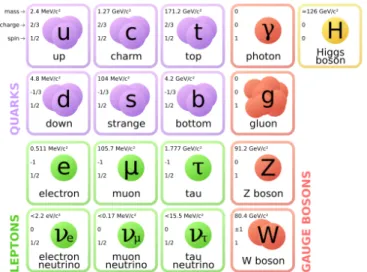
The Standard Model includes (Fig. 1.1) fermions, gauge bosons and the
Higgs boson. There are 12 elementary particles (antiparticles) with spin 1/2 called a fermions. This group involves six leptons (electron, electron neutrino, muon, muon neutrino, tau, tau neutrino) and six quarks (up, down, charm, strange, top, bottom). Quarks can not exist independently, in contrast to leptons. This phenomena is called color confinement. Thus quarks can not be observed as a free particle, they can be found only in some combination like mesons (quark and antiquark) and baryons (three quarks).
The word”quark” was appeared in the novel ”Finnegans Wake”, written
2 The Standard Model
The other particles, that have spin 1/2 are called leptons. From Greek the wordleptonmeans small, delicate or lightweight. At the beginning it was considered that leptons are ”light” particles comparing to hadrons (”heavy”). But in 1975 it was discovered the tau lepton and the word ”light” has lost its meaning.
Next let us go to bosons. All bosons have integer spin. The bosons play role in three of the four fundamental forces — electromagnetism, the strong force, and the weak force (gravity is not included in the standard model). These bosons are called gauge bosons. As we will see latter, each boson associated with some force: photon for electromagnetism, gluons for the strong force, and theWand Zbosons for the weak force.
In the standard model all particles are massless. The interaction that gives mass to elementary particles is called theHiggs mechanismand the particle that mediates the interaction is called theHiggs boson. The scalar field that is added to the Lagrangian to generate the masses to the fermions and vector bosons is theHiggs field.
Figure 1.1:The Standard Model of elementary particles.
The standard model is a successful model of elementary particles, how-ever it does not describe some phenomena such as dark matter, dark en-ergy, neutrino oscillations and baryogenesis.
2
1.2 Gauge Transformation 3
1.2
Gauge Transformation
The symmetries play an important role in physics. As it happens, all in-teractions between the fundamental particles can be described using the principle oflocal gauge invariance. In this section we show an examples of local gauge invariance in the electrodynamics and in the electroweak part of the Standard Model .
1.2.1
Gauge invariance in the electrodynamics
Let us start from the free Dirac Lagrangian
LΨ =Ψ¯(i∂µγµ−m)Ψ. (1.1)
The Lagrangian is clearlynot invariantunder the local gauge transforma-tion
Ψ0 →e−iα(x)Ψ (1.2)
because of the term∂µΨ.
Thus, we need to modify the partial derivative tosavethe invariance
∂µ →Dµ =∂µ−ieAµ, (1.3)
whereeis the charge of the electron and the vector field Aµtransforms in
the following way
A0µ =Aµ+
1
e∂µα. (1.4)
The strength tensor is defined as
Fµν =
i
e[Dµ,Dν]. (1.5)
The main property of the strength tensor (1.5) is its invariance under the vector field transformation (1.4). In the abelian theory we can express the strength tensor in terms of the vector field Aµ as
Fµν =∂µAν−∂νAµ. (1.6)
The kinetic term can be construct from the strength tensors as
Lkin =−
1 4FµνF
4 The Standard Model
This Lagrangian describes the free electromagnetic field.
Summing up, the gauge Lagrangian of the electrodynamics is
Lgauge =−1
4FµνF
µν+Ψ¯(iD
µγµ−m)Ψ. (1.8)
This is an example of the abelian gauge theory.
It is needed to stress that the mass termm2AµAµ for the vector field is not
gauge invariant, so we can not add it to the gauge Lagrangian.
1.2.2
Electroweak gauge group of the Standard Model
Let us consider the electroweak group of the standard model
SU(2)L⊗U(1)Y . (1.9)
In the Standard Model there are two types of fermion fields: left and right. The right fermion field is a singlet and do not transform under SU(2)
transformation. The left fermion field is a doublet which transform under SU(2) transformation. The covariant derivatives for these left and right fermion fields are
DL →∂µ+i
g 2τ
iWi
µ−i
g0
2Bµ, (1.10)
DR →∂µ−ig0Bµ, (1.11)
where the gauge fields corresponding to each generator are
SU(2)L →Wµ1,W
2
µ,W
3
µ, (1.12)
U(1)Y → Bµ. (1.13)
The strength tensors for the gauge fields construct as in the case of the abelian theory (1.5). The results are
Wµνi ≡∂µWνi −∂νWµi +ge ijkWj
µW
k
ν, (1.14)
Bµν ≡∂µBν−∂νBµ, (1.15)
whereeijk is completely anti-symmetric tensor and gis the coupling
con-stant.
4
1.2 Gauge Transformation 5
Now we are able to write the Lagrangian for the electroweak part of the Standard Model,
LEW =Ψ¯RiD/RΨR+Ψ¯LiD/LΨL−
1
4W
i
µνW
iµν−1
4BµνB
µν . (1.16)
Let us notice that it is impossible to add mass terms to the fermion fields, as it should be in the formm(Ψ¯LΨR+Ψ¯RΨL), but the left fermion fieldΨL
is a doublet and the right fermion fieldΨRis a singlet. So its product is not
6 The Standard Model
1.3
The Higgs Mechanism
In the previous section (1.2) we have seen that the mass terms arenot gauge invariantand that is why we are not allowed to add these terms to the
La-grangian. However, we know that some fundamental particles are
mas-sive. Thus, in this section we introducethe Higgs mechanism, which lets to add mass terms to the Lagrangian without explicit breaking of the gauge invariance. We start from the abelian Higgs mechanism as the simple ex-ample and than we consider how the Higgs mechanics works in the elec-troweak Standard Model.
1.3.1
The abelian Higgs mechanism
Let us consider the complex scalar Lagrangian
L=∂µφ∗∂µφ−V(φ∗φ), (1.17)
where the potential is
V(φ∗φ) = µ2φ∗φ+λ(φ∗φ)2, (1.18)
withλ>0.
It is needed to stress that the Lagrangian (1.17) is invariant under the global transformation
φ→ e−iθφ. (1.19)
We redefine the complex scalar field in terms of two real fields
φ= (φ1√+iφ2)
2 , (1.20)
and the Lagrangian (1.17) becomes
L = 1
2(∂µφ1∂
µ
φ1+∂µφ2∂µφ2)−V(φ1,φ2), (1.21)
which is invariant underSO(2)transformation.
The next step is to require a invariance under the local transformation
φ→eiqα(x)φ. (1.22)
6
1.3 The Higgs Mechanism 7
To make the Lagrangian (1.17) invariant under the local transformation (1.22), we need to introduce a gauge bosonAµand the covariant derivative
Dµ
∂µ → Dµ =∂µ−ieAµ, (1.23)
Aµ → A0µ = Aµ+
1
e∂µα. (1.24)
We have two possible forms of the potential, depending on the sign of the parameterµ2.
• µ2>0
The vacuum is at
φ1 =φ2 =0. (1.25)
It means that we have two scalar fieldsφ1andφ2with massµ2.
• µ2<0
The vacuum is
q
φ21+φ22= −µ
2
2λ ≡
v2
2. (1.26)
The spontaneous symmetry breaking occurs forµ2<0. Indeed, when we
choose a particle vacuum, the SO(2)symmetry is spontaneously broken. Let us choose the vacuum in the following form
φ1 =v,
φ2 =0.
Introducing a small perturbations of the fieldsφ1andφ2
φ10 =φ1+v,
φ20 =φ2,
and the Lagrangian (1.17) becomes
L= 1
2∂µφ
0
1∂µφ10 +µ2φ012+ e2µ2
2
Aµ+
1 eµ∂
µ φ02
2
+ interaction terms.
(1.27) If we introduce new fieldBµ in the following way
Bµ = Aµ+
1 eµ∂
µ
φ02, (1.28)
than we see that this field Bµ is massive. As we can see, the field φ10 also
8 The Standard Model
1.3.2
The non-abelian Higgs mechanism
From the experiment we know the masses of the gauge bosonsW and Z.
In this section we will show the origin of these masses and how it could derive from the scalar Lagrangian. Also we will show that the photon remain massless.
Let us start from the scalar Lagrangian
Lscalar =∂µΦ†∂µΦ−V(Φ†Φ), (1.29)
whereΦis the scalar doublet
Φ≡ φ+ φ0 . (1.30)
The potential is
V(Φ†Φ) = µ2Φ†Φ+λ(Φ†Φ)2, (1.31)
withλ>0.
We assume that the scalar Lagrangian should be invariant underSU(2)L⊗
U(1)Y. It means that we need to introduce the covariant derivative in the
following form
∂µ →Dµ =∂µ+ig τi
2W
i
µ+i
g0
2Bµ . (1.32)
We break the original symmetrySU(2)L⊗U(1)Y toU(1)EM choosing the
vacuum expectation value as
Φ0 =
0 v/√2
, (1.33)
where
v =
r
−µ2
λ . (1.34)
Substituting it into the scalar Lagrangian we get
Lscalar =
∂µ+ig τi
2W
i
µ+
ig0 2 Bµ
(v+H)
√ 2 0 1 2
−µ2(v+H)
2
2 −λ
(v+H)4
4 . (1.35)
8
1.3 The Higgs Mechanism 9
Let us define the charged gauge bosons as
Wµ± = √1
2(W
1
µ∓iW
2
µ). (1.36)
From the Lagrangian (1.35) we get non diagonal mass terms for the fields Wµ3 and Bµ. Thus we need to diagonalize the mass matrix firstly. As a
result we obtain the physical fields Aµand Zµ
Aµ Zµ =
cosθW sinθW −sinθW cosθW
Bµ
Wµ3
, (1.37)
whereθW is the Weinberg angle is defined in terms of theSU(2)andU(1)
coupling constants
cosθW =
g p
g2+g02 , (1.38)
sinθW =
g0 p
g2+g02 . (1.39)
As we would like to get the Lagrangian in terms of the fields which we can observe experimentally, with the proper charge and mass, we need to rewrite the gauge fields for the generators in terms ofWµν±,Aµ and Zµ.
These fields, as we will see later, are physical fields corresponding to W boson,Zboson and photon respectively.
One can rewrite the Lagrangian (1.35) it in terms of the fields W± and Z bosons and get the masses of these bosons.
Lscalar = igW 1 µ
2 +g Wµ2
2
(v√+H)
2
∂√µH
2 −
igW
3
µ
2 −ig0 Bµ
2
(v√+H)
2 2 −
−µ2(v+H)
2
2 −λ
(v+H)4
4 =
= 1
2H
2M2 H +
1
2W
+
µW
−µM2 W+
1 2ZµZ
µM2
Z
+(∂µH)
2
2 +
µ4
4λ −H
3q
−µ2λ2−H4λ
4
+g
2
4 (2Hv+H
2)
Wµ+W−µ+ 1
2cos2θ W
ZµZµ
10 The Standard Model
where MH =
p
−2µ2, MA =0, MW = gv
2 and MZ =
gv 2 cosθW
.
As we can see the photon remains massless. The reason is that from the spontaneous symmetry breaking we obtain three Goldstone bosons, thus three gauge bosons get masses and one does not.
Finally, combining this result with the Standard Model gauge fields La-grangian (see appendix B), the structure of the SM LaLa-grangian for the scalar and gauge fields is
Lgauge+Lscalar =−
1 4FµνF
µν−1
2W
+
µνW
−µν−1
4ZµνZ
µν
+1
2H
2M2 H +
1
2W
+
µW−
µM2
W+
1 2ZµZ
µM2
Z+
(∂µH)2
2
+ W+W−A + W+W−Z + W+W−ZZ + W+W−AA
+ W+W−ZA + W+W−W+W−
+ HHH + HHHH + W+W−HH
+ W+W−H + ZZHH + ZZH (1.40)
As one can see all parameters in the SM Lagrangian for gauge and scalar fields depends only on four constants —µ,g,g0andv. It is highly non
triv-ial prediction and it is entirely consistent with all available experimental data.
10
1.4 The Standard Model Phenomenology 11
1.4
The Standard Model Phenomenology
1.4.1
Introduction
In this ”warm-up” section we will remind how to use the Lagrangian of
the Standard Model expressed in terms of physical fields γ, Z and W to
calculate physical observables. In sections 1.4.2 and 1.4.3 we will
calcu-late decay width ofWandZbosons and compare them with experimental
values. In section 1.4.4 we show how the mass of the Higgs boson can be constrained from the requirement of tree-level unitarity inW,W scat-tering. In section 1.4.5 we study decay channels of the Higgs boson in the Standard Model. This analysis of the SM phenomenology will be in-structive for the attempts to identify an extension of the SM that could be responsible for the reported access in di-photon signal. Although this signal still has to be confirmed, it provides and interesting possibility for Beyond Standard Model model building. This will be the main subject of the current thesis.
1.4.2
W
-boson decay width
W−, p1
e−, k2
ν, k1
Figure 1.2:Feynman diagram theWboson decay into a neutrino and an electron.
The matrix element for this process is
iM =us1(k
2)√g
2γµ
1−γ5
2
vs2(k
1)eµ,r(p1). (1.41)
ele-12 The Standard Model
ment
|M|2= g
2
24Tr
"
γµ(1−γ5)/k1γν(1−γ5)(/k2−Me) −gµν+
pµ1pν
1 MW2
!#
=
= g
2
24MW2 Tr[γµ(1−γ5)/k1γν(1−γ5)(/k2−Me)p
µ
1p
ν
2]
− g2
24Tr[g
µν
γµ(1−γ5)/k1γν(1−γ5)(/k2−Me)] =
= g
2
24{16(k1·k2) +8/M
2
W[2(k1·p)(k2· p)−(k1·k2)p21]} =
g2M2W 3
The decay width for the process when a particle of mass Mdecays into 2
particles of massesm1andm2, is given by
dΓ = 1
32π2|M|
2|k1|
M2dΩ, (1.42)
where |k1| = [(M2−(m1+m2)2)(M2−(m1−m2)2)]1/2/2M and dΩ is
the solid angle. In our case it leads to
ΓW→νe =
g2MW
48π . (1.43)
Computing the decay width, we obtain the value ΓW→νe = 0.227 GeV.
Due this channel theW boson decay with 10.75% probability [16], so the
full decay width is equal to ΓtheoryW = 2.112 GeV. Our result is consistent with the experimental valueΓWexp =2.085±0.042 GeV.
1.4.3
Z
-boson decay width
Without any difficulties, one can find the matrix element
iM =us1(p
1)
− ig
2 cosθW
γµ(vf −afγ5)
vs2(p
2)eµ,r(k), (1.44)
The axial and the vector couplingaf andvf defined as,
vf =T3−2Qsin2θW , (1.45)
12
1.4 The Standard Model Phenomenology 13
Z, k
f, p1
f , p2
Figure 1.3: Feynman diagram for theZboson decay into a fermion and an anti-fermion pair.
af = T3, (1.46)
whereQ =T3+12Yis the hypercharge.
The square of the matrix element, where we again average over the spins and polarizations of the final state and neglect the mass of the fermion,
|M|2 = −g
2
12 cos2θ WTr
[γµ(vf −afγ5)(/p2−Mf)γµ(vf−afγ5)(/p1−Mf)] =
= 8g
2
12 cos2θ W
(a2f +v2f)(p1·p2) = g 2
3 cos2θ W
(a2f +v2f)M2Z.
Thus the decay width for the processZ → f f is given by
ΓZ→f f = g
2
48π cos2θW
MZ(a2f +v2f) . (1.47)
The value of the constantsaf andvf for the different fermion flavors are
f f pairs af vf
ee,µµ,ττ -1/2 -0.06
uu,cc 1/2 0.21
dd,ss,bb -1/2 -0.35
νeνe,νµνµ,ντντ 1/2 1/2
14 The Standard Model
f f pairs Decay width(theory), GeV Decay width(experimental [16]), GeV
ee,µµ,ττ 0.086 0.084
uu,cc 0.30 0.29
dd,ss,bb 0.38 0.39
νeνe,νµνµ,ντντ 0.170 0.167
We see that our theoretical predictions are in good agreement with the data. Comparing theoretical predictions and experimental values we can constrain many possibilities to extend the SM. For example, we can con-clude that there are no more SM-like generations of fermions. Indeed, if a fourth generation existed, than the decay width would be large then in the real world. The same we can say about the three colors of quarks, the theory is consistent with the experimental date only for three colors of quarks.
1.4.4
Bounds on the Higgs boson mass
The existence of the Higgs boson is necessary for the consistency of the Standard Model. Namely, from the requirement of tree-level unitarity one can obtain an upper bounds on the Higgs boson mass. Bellow we demon-strate this analyzingWW scattering at tree level.
Using the Goldstone Boson Equivalence Theorem [19], which states that at
high energies the amplitude M for emission or absorption of a
longitu-dinally polarized gauge boson is equal to the amplitude for emission or absorption of the corresponding Goldstone boson,
M(WL±,ZL0) ≈ M(ω±,z0) +O(M2W,Z/E2). (1.48)
The scalar Lagrangian
Lscalar =∂µΦ†∂µΦ−V(Φ†Φ) (1.49)
can be rewritten if we express the Higgs doublet in terms ofω±andz0,
Φ = √1
2
i√2ω+
v+H−iz0
. (1.50)
14
1.4 The Standard Model Phenomenology 15
Thus the scalar Lagrangian in terms ofω±andz0is
Lscalar =∂µω−∂µω++
1 2∂µH∂
µH+1
2∂µz
0
∂µz0− −µ21
2[2ω
−ω++ (v+H)2+ (z0)2]
−λ1
4[4(ω
−ω+)2+ (v+H)4+ (z0)44
ω−ω+(v+H)2+
+4ω−ω+(z0)2+2(v+H)2(z0)2] =
=∂µω−∂µω++
1 2∂µH∂
µH+1
2∂µz
0
∂µz0
−1
2H
2M2 H−
M2Hg 4MW
H[H2+2ω+ω−+ (z0)2]− − g
2M2 H
32MW2 [H 2+2
ω+ω−+ (z0)2]2
The structure of this Lagrangian shows immediately all needed interaction and vertices,
Lscalar =∂µω−∂µω++
1 2∂µH∂
µH+1
2∂µz
0
∂µz0
−1
2H
2M2 H−
M2Hg 4MW
HHH +2 Hω+ω− + Hz0z0
− g
2M2 H
32MW2
HHHH +4ω+ω−ω+ω− + z0z0z0z0
+4 HHω+ω− +2 HHz0z0 +4z0z0ω+ω−
.
Now we are ready to compute the scatteringω+ω− → ω+ω−. There are
16 The Standard Model
•
ω+, k 1
ω−, k2
ω−, p1
ω−, p2
Figure 1.4:Feynman diagram for theωωscattering.
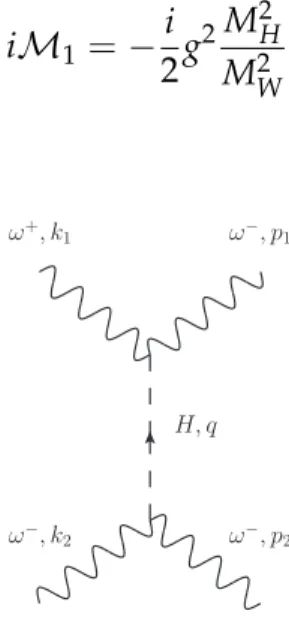
The matrix element is
iM1=−i
2g
2M2H
MW2 . (1.51)
•
ω+, k 1
ω−, k
2
ω−, p1
ω−, p
2
H, q
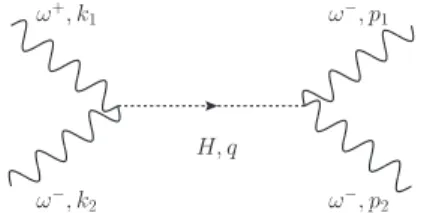
Figure 1.5:Feynman diagram for theωωscattering via the Higgs boson.
The matrix element is
iM2 = −i
2g
2M2H
M2W !2
i
(k1−p1)2−M2H
. (1.52)
16
1.4 The Standard Model Phenomenology 17
•
ω+, k 1
ω−, k2
ω−, p1
ω−, p2 H, q
Figure 1.6:Feynman diagram for theωωscattering via the Higgs boson.
The matrix element is
iM3 = −i
2g
2M2H
M2W !2
i
(k1+k2)2−M2H
. (1.53)
Therefore the total matrix element is the sum of these three processes,
iM=−i
2g
2M2H
M2W+ − i 2g
2M2H
M2W !2
i
(k1−p1)2−M2H
+ i
(k1+k2)2−M2H !
.
(1.54) Introducing the Mandelstam variables, which are defined by
s = (k1+k2)2 =2k1k2, (1.55)
t = (k1−p1)2=−2k1p1, (1.56)
the matrix element could be present as,
iM=−ig
2M2 H
4M2 W
2+ M
2 H
s−M2 H
+ M
2 H
t−M2 H
!
. (1.57)
At the high energies limit we obtain the following expression for the am-plitudeM(WL±,ZL0) ≈ M(ω±,z0)
|M|=
g2M2H 2MW2
. (1.58)
Unitarity requires, that the amplitude shoul be less than some constant,
|M| < 16π. From this restriction we get the upper limit on the Higgs
mass,
4√2π
GF
> M2H . (1.59)
18 The Standard Model
1.4.5
The decay modes of the Higgs boson
Here we will compute the Higgs branching ratios, depending on the Higgs mass, by considering the tree level diagrams for the possible decay modes of the Higgs boson. At the tree level the Higgs boson interacts only with a
fermions,W± andZbosons.
• H → f f
H, q
f , k1
f, k2
Figure 1.7:Feynman diagram for the Higgs boson decay into a fermion and anti-fermion pair.
The matrix element is
iM1=v(k2)
−igM
f
2MW
u(k1), (1.60)
and the square of the matrix element is
|M1|2 = g2M2f
4M2WTr[(/k1−Mf)(/k2−Mf)] =
= g
2M2 f
4MW2 4(k1·k2) = g2M2f
2M2W(M 2
H +2M2f). (1.61)
Here we are not able to neglect the mass of the fermion! So the decay width is given by
Γ= g
2M2 f
32πMHMW2
(M2H +2M2f)
s
1−
2M f
MH 2
. (1.62)
If the Higgs boson is heavy enough, so it is possible to decay into theW±
andZbosons,
18
1.4 The Standard Model Phenomenology 19
• H →W+W−
H, q
W+, k 1
W−, k2
Figure 1.8: Feynman diagram for the Higgs boson decay into the W+ and W− bosons.
The matrix element and the square of the matrix element are,
iM2 =eµ(k1)eν(k2)igMWgµν, (1.63)
|M2|2 =g2M2W 2+
(M2H −2M2W)2
4M4W
!
. (1.64)
Thus, the decay width is
Γ = g
2M2 W
16πMH 2+
(M2H−2MW2 )2
4M4 W
! s
1−
2MW
MH 2
. (1.65)
• H → Z0Z0
H, q
Z, k1
Z, k2
Figure 1.9:Feynman diagram for the Higgs boson decay into twoZbosons.
The only difference of this process withH →W+W− is the coupling con-stant, so
iM3=eµ(k1)eν(k2) ig cosθW
MZgµν, (1.66)
|M3|2 =
g2M2Z cos2θ
W
2+(M
2
H −2M2Z)2
4M4Z
!
20 The Standard Model
with the decay width
Γ = g
2M2 Z
32πMHcos2θW
2+(M
2
H −2M2Z)2
4M4Z
! s
1−
2MW
MH 2
. (1.68)
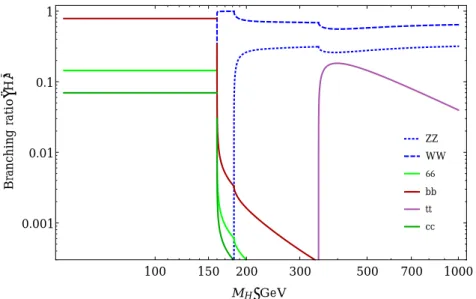
Let us demonstrate these results graphically, depending on the Higgs bo-son mass for the different gauge bobo-sons and fermion flavors.
ZZ WW ΤΤ bb tt cc
100 150 200 300 500 700 1000
0.001 0.01 0.1 1
MH@GeVD
Branching
ratio
H
H
L
Figure 1.10:Predicted branching ratio of the Higgs boson at the tree level.
20
1.4 The Standard Model Phenomenology 21
The precise calculation leads to the following dependence [20],
Figure 1.11: Predicted branching ratio of the Higgs boson including loop contri-butions.
The vivid differences between our calculations (Fig. 1.10) and the precise calculations with taking into account the loop contributions (Fig. 1.11) are the following:
1. The behavior of the curves forZZ andWW in the Higgses mass
re-gion between 100 and 200 GeV. It is because of the fact that our cal-culation consider thatZandW should be real particles. Thus in our calculations the Higgs with the mass lower that about 200 GeV can not decay into these bosons, while in reality it can via virtualZand
Wbosons.
2. The presence of the decay channels into γγ and γZ. In the SM
La-grangian there not exist the vertices like Hγγ and HZγ. So at the
Chapter
2
Diphoton excess at the LHC
2.1
Overview of the Diphoton Excess
At the end of 2015 year two collaborations ATLAS [10] and CMS [9] re-ported the excess in the diphoton resonance. From the data of proton-proton collisions at the LHC at the center-of-mass energy√s = 13 TeV it was observed an diphoton excess near the invariant mass 750 GeV. One of the explanation of this signal is a new particle with spin zero or two (spin 1 is forbidden because ofthe Landau-Yang theorem). This signalhas notbeen confirmed as we do not have enough data.
Both experiments, ATLAS and CMS, were present the diphoton excess at the center-mass-energy√s =13 TeV.
The ATLAS collaboration reports the following numbers of events (see table 2.1) in the interested region with the luminosity L = 3.2 fb−1 (see appendix E) and the SM background. The local significance at the dipho-ton invariant mass∼ 750 GeV is 3.9σ and the global significance is 2.3σ.
Thelocal significancemeans the deviation from the expectation divided by
the standard deviation in the region of the resonance peak. The global
significance considers the Look Elsewhere Effect, i.e. with taking into ac-count a probability of accidental fluctuations in the hole region of mea-surements.
Bin, GeV 650 690 730 770 810 850
Nevents 10 10 14 9 5 2
24 Diphoton excess at the LHC
[GeV]
γ γ
m 200 400 600 800 1000 1200 1400 1600
Events / 40 GeV
1 − 10 1 10 2 10 3 10 4 10 ATLAS Preliminary -1
= 13 TeV, 3.2 fb s Data Background-only fit [GeV] γ γ m 200 400 600 800 1000 1200 1400 1600 Data - fitted background −15
10 − 5 − 0 5 10 15
Figure 2.1:Invariant mass distribution of the selected diphoton events at ATLAS detector.
With regards to CMS collaboration, they reported the results with 2.6 fb−1 for two distinct categories. In the first one both photons are detected in the barrel (EBEB) and in the second one the first photon is detected in the barrel and the other one is found in the end cap (EBEE). The numbers of events in the interested region at the diphoton invariant mass around 750 GeV with the local significance 2.6σ and with the global significance
2σ, for both categories in presented below.
Bin, GeV 700 720 740 760 780 800
Nevents(EBEB) 3 3 4 5 1 1
Nbackground(EBEB) 2.7 2.5 2.1 1.9 1.6 1.5
Nevents(EBEE) 16 4 1 6 2 3
Nbackground(EBEE) 5.2 4.6 4.0 3.5 3.1 2.8
From the experimental data it is complicated to determine the resonance decay width. The data from the ATLAS collaboration indicates the wide decay width, while the CMS collaboration data favors the narrow decay
24
2.1 Overview of the Diphoton Excess 25
Events / ( 20 GeV )
-1 10 1 10 2 10 Data Fit model σ 1 ± σ 2 ± -2 10 ⋅ 2 × γ γ → ) =0.01 κ∼ G( EBEE category (GeV) γ γ m 2 10 ×
3 4×10² 5×10² 103 2×10³
stat σ (data-fit)/ -4 -2 0 2 4 (13 TeV) -1 2.6 fb CMS Preliminary
Figure 2.2:Observed invariant mass spectrum for the EBEB at CMS detector.
Events / ( 20 GeV )
-1 10 1 10 2 10 Data Fit model σ 1 ± σ 2 ± -2 10 ⋅ 2 × γ γ → ) =0.01 κ∼ G( EBEB category (GeV) γ γ m 2 10 ×
3 4×10² 5×10² 103 2×10³
stat σ (data-fit)/ -4 -2 0 2 4 (13 TeV) -1 2.6 fb CMS Preliminary
Figure 2.3:Observed invariant mass spectrum for the EBEE at CMS detector.
width. In this work we assume the wide decay width
Γ=40 GeV . (2.1)
The experimental cross-section is defined as (see appendix D and E)
σ(pp →s) = BR×N(pp→s)/L, (2.2)
whereN(pp →s)is the number of events,Lis a luminosity andBRis the branching ratio.
In the paper [7] was analyzed the data for ATLAS (√s = 8 TeV with
26 Diphoton excess at the LHC
19.7 fb−1 and √s = 13 TeV with 2.6 fb−1), and to be consistent with the data we have some constraints for the ratio of the cross sections at differ-ent energies:
σ(pp →γγ) ≈
(0.5±0.6)fb CMS[11] √s =8TeV,
(0.4±0.8)fb ATLAS[12] √s=8TeV,
(6±3)fb CMS[9] √s =13TeV,
(10±3)fb ATLAS[10] √s=13TeV.
The data from 8 to 13 TeV are satisfy to each other at 2σ if the gain
fac-tor
r =σ13TeV/σ8TeVat least more than 5 [8] (2.3)
Combining four data sets (see table 2.1) and assuming the invariant mass 750 GeV and the decay width 40 GeV, one can get the best fit for the cross
section for the diphoton resonance at the invariant mass energy√s = 13
TeV,
σ(pp →s)×BR(s →γγ)∼6 fb . (2.4)
Thus, while we are waiting for new data to justify or falsify the diphoton excess, knowing some parameters, such as the number of events, the decay width and the cross section, we are able to construct a theory which may describe the resonance.
26
2.2 A Simple Model 27
2.2
A Simple Model
The toy model which could describe such resonance involves some heavy scalar partial s with spin zero, decays into two photons [8]. The natural question is: How this particle was produced? As we will see letter this
par-ticlecan not produced only from photons. Indeed, if s is produced from
photons, we can calculate the cross section of s production, scales with the energy. From this calculation, one can conclude that in this case a
simi-lar diphoton signal would beobservedalready at LCH run at 8 TeV! But
we did not find any signal above the background. Thus we assume that the heavy scalar particle produced from gluons. In the end of this
chap-ter it will shown that the theory with only the gluons and photons also
contradict with the experimental data.
The corresponding Lagrangian is
L=LSM+Lint+Lkin, (2.5)
whereLSMis the Lagrangian of the SM,Lint is the interaction Lagrangian
of the new scalar particle with gluons and photons, and Lkin its kinetic
Lagrangian.
In the next chapters we redefineLint asLfor the convenience.
Thus,
L= cgαs
12π
s
ΛGµνGµν+
2α
9πcF
s
ΛFµνFµν , (2.6)
where cg and cF are the coupling constants, α and αs are the electroweak
force and the strong force coupling constants,Λis some energy scale of a new physics, which shows when our theory stops work.
The strength tensors for the gauge fields are
Gµν ≡∂µGν−∂νGµ+cg[Gµ,Gν], (2.7)
Fµν ≡∂µFν−∂νFµ. (2.8)
The cross section for A+B → R→ C+D[15] scattering process is given
by
σ(s) =32π 2JR+1
(2JA+1)(2JB+1)
ΓABΓCD
(s−m2) +m2Γ2 , (2.9)
28 Diphoton excess at the LHC
We are interested in the proton-proton collisions with two photons in the final state (Fig. 2.4). The cross-sectionσαα→s→γγ is described by formula
(2.9), whereαis a type of the particle (in our case a gluon or photon).
s
γ
γ
p p
α α
Figure 2.4: Production of the heavy scalar particle from the proton-proton colli-sion viaαfusion.
To find out the full cross-section σpp→αα→s→γγ we need to use the
Par-ton Distribution Functions fα(x) (PDFs), where x is a Bjorken variable that
shows a fraction of proton’s momentum carried by the particle. With the PDFs we are able to calculate the full cross-section by the formula
σpp→αα→s→γγ(s) =
∑
α=g,γ1
Z
0
dx1fα(x1) 1
Z
0
dx2fα(x2)σαα→s→γγ(sαα). (2.10)
In the laboratory frame the particleαhas the momentums
p1 = (x1√s/2, 0, 0, x1√s/2)and p2= (x2√s/2, 0, 0, −x2√s/2).
Using the formula sαα = (p1 + p2)2 we find out relation between sαα
ands
sαα=x1x2s. (2.11)
We have the final result for the cross section
σpp→αα→s→γγ(s) =
∑
α=g,γ1
Z
0
dx1fα(x1)×
×
1
Z
0
dx2fα(x2)
32π
(2Jα+1)2
ΓγγΓαα
(x1x2s−m2)2+m2Γ2
, (2.12)
whereΓ=Γgg+Γγγ =40 GeV (2.1).
28
2.2 A Simple Model 29
To simplify this, let us use the delta-function approximation for the narrow
width, which is valid formΓ(see appendix C),
dx
(x−m2)2+m2Γ2 mΓ
π →δ(x−m
2)dx, (2.13)
and we get the following expression
σpp→s→γγ(s) =
∑
α=g,γ1
Z
m2/s
dx fα(x)
32π
xs
π
mΓfα
m2 sx
1
(2Jα+1)2
ΓγγΓαα.
Rewriting the cross section in terms of the dimensionless partonic integrals we get,
σpp→s→γγ(s) = Γγγ
mΓsα=
∑
g,γCααΓαα, (2.14)where the partonic integrals are
Cgg = π 2
8
1
Z
m2/s
dx
x fg(x)fg
m2 sx
, (2.15)
Cγγ =8π2
1
Z
m2/s
dx
x fγ(x)fγ
m2 sx
. (2.16)
The numerical values [8] of the partonic integrals are the following, √
s,TeV Cgg Cγγ
8 174 11
13 2137 54
In particular, from the equation (2.14) one can find the value of the gain factors (2.3) for the gluon and photon fusions as
rαα =σ13 TeV(pp →αα →s→γγ)/σ8 TeV(pp →αα →s→γγ),
Thus the gain factors for the gluon and photon fusions are
30 Diphoton excess at the LHC
As we mentioned above (2.3), to satisfy the experimental data we need r/5 ∼1. It means thatsproduces mainlyvia gluon fusion.
Using the equation for the cross section (2.14) and the fact that the new
heavy scalar particle with mass ∼ 750 GeV produces mainly via gluon
fusion with the cross-section σpp→s→γγ = 6 fb (2.4), we can find out Γgg
andΓγγfrom the following system of equations
Γγγ
m
Γgg
m ≈1.2×10
−6Γ
m ≈7.1×10
−8,
Γ
m =
Γgg
m +
Γγγ
m ≈0.06.
We find two solutions:
1. Γgg/m=5.3×10−2andΓγγ/m =1.3×10⁻⁶,
2. Γgg/m=1.3×10−6andΓγγ/m =5.3×10⁻².
We chose the first one as we know, from the gain factor argument, that the production from the photon fusion should be suppressed.
Thus,
Γgg/m=5.3×10−2and Γγγ/m =1.3×10⁻⁶. (2.18)
Next we will show why this solution can not be satisfactorily. From the experiment [13] we have the constraint on the value of Γgg. It can notbe too large, as the processgg→s →ggispossible. If we want to produce the new scalar particle from the gluons, we need to take into account that it
de-cays mainly into two gluons! Based on the data from CMS at√s =8 TeV
we can find out the upper limit on the gluon-gluon production. From the plot 2.5 at the energy 750 GeV we get the cross section
σ×BR(X → jj) ≤1.8pb, (2.19)
and from the formula (2.14) we find the upper limit onΓgg/m
Γgg
m =
s
σ×BR(X →jj)Γs
mcgg ≤2.7×10
−3. (2.20)
Itcontradictsour theoretical prediction (2.18).
The decay width istoo big. Too big means that the heavy scalar particle s should interacts strongly with photons and gluons. Thus we reached the
30
2.2 A Simple Model 31
conclusion that this big decay width not because of gluons! So to try to explain the resonance, we probe the simple model that involves only new heavy scalar particle and the SM particles. But we convinced ourself that any SM particlescan notsolve the problem with large decay width.
One way to solve this problem is to add a new light scalar particle, as one can see in the next chapter.
Resonance Mass [GeV]
600 800 1000 1200
A [pb]
×
jj)
→
BR(X
×
σ
2
−
10
1
−
10 1 10
2
10
3
10
95 % CL Upper Limit
Gluon-Gluon
Quark-Gluon
Quark-Quark
| < 1.3
η ∆
| < 2.5 & |
η
|
(8 TeV) -1 18.8 fb
CMSPreliminaryData
32 Diphoton excess at the LHC
2.3
Diphotons from Diaxions
In this section we will consider the simple extension of the SM [2]. We add some non-SM particle in the simple theory (2.2) in such way, that this large decay widthis because of thisnew particle. In this case weavoidthe contradiction with the experimental data that we have had before. We cal-culate the productions and decays of the new particles (see sections (2.4) and (2.5)). Than we test this theory and find the constraints on the param-eters (see section (2.6)) by using the different experimental data.
Despite the fact that in the literature [2] it was discussed that the axion can be searched at SHiP and NA62 experiments, we will show that it is impossible.
The so-calledaxion-like particle (ALP) arises from the spontaneously
sym-metry breaking of a globalU(1) Peccei-Quinn (PQ) symmetry by a
com-plex fieldφ
φ= f√+s
2 e
ia
f . (2.21)
where f is the energy scale.
We expect themassiveparticlesandmasslessparticlea(the Goldstone bo-son), which comes from the Peccei-Quinn symmetry. If the Peccei-Quinn symmetry isslightlybroken, the axion becomesmassive, but much lighter that the heavy scalar particles.
The Lagrangian for the generic interactions for the diphoton resonance is
L= cgαss
12πfGµνG
µν+3αcγa
4πf e
αβγδF
αβFγδ+s
(∂µa)2
f , (2.22)
where like in the simple model,cgandcFare the coupling constants,αand αs are the electroweak force and the strong force coupling constants, f is
some scale constant with the dimension of the energy.
The first term in the Lagrangian (2.22) is the same as in the simple model (2.6). The second term expresses how axions interacts with the photons. The anti-symmetric tensor eαβγδ shows that a is the pseudo-field, which
means that in the mirror it is not the same. The last term in the Lagrangian comes from the kinetic term of the fieldφ. That is why it does not have
coupling constants.
32
2.3 Diphotons from Diaxions 33
p
p
s
a
a
γ
γ γ
γ α
α
Figure 2.6: Production of the heavy scalar particle from the proton collision and its decay into two axions.
Thus in our model a heavy scalar particle s decays into two axions and
each axion decays into two photons (Fig. (2.6)). At the end we get four
photons, but we detectonly two photons!How does it agree with the experi-mental data? To solve this contradiction we assume that the axion-like par-ticle isvery lightandvery relativisticand photons from its decay arehighly collimated! Indeed, when the heavy scalar particlesdecay into two very light particles, each of them would have a large kinetic energy. And when the light particle with a great kinetic energy decays into massless photons, they are highly collimated, and the detector isunableto distinguish these
two photons from one photon. Thus we detect two photons, not four
pho-tons.
So, we avoid the contradiction with the experimental data that we had before, assuming that the large decay width is because of the axions. Now
we have the theory that describes the resonance. How to check that this
description is correct?
First of all let us derive the Feynman rules for this theory. From the La-grangian (2.22) we are able to conclude that a heavy scalar particles inter-acts with gluons and the light scalar particles a, the light scalar particles interacts withsand photons. Thus we get the vertices
a, k1
a, k2
s, p
= −2i f k
µ
1kν2gµν
34 Diphoton excess at the LHC
g, k1
g, k2
s, p µ
ν
= icgαs 3πf [(k
µ
2·kν1)−gµν(k1·k2)]
Figure 2.8:The vertex forggs
ν µ
γ, k2
γ, k1
a, p
= −6iαcγ
πf e
αµβνk
1αk2β
Figure 2.9:The vertex forγγs
34
2.4 Production of the Heavy Scalar Particle 35
2.4
Production of the Heavy Scalar Particle
The heavy scalar particlescan produced via thegluon production, photon fu-sionsand also via theassociated productionof the photons. Using the Feyn-man rules for this theory (2.22), which we derive in the previous section, we are able to calculate the cross sections for the s production at the tree level.
2.4.1
The production of the heavy scalar particle via the
gluon fusion
g, k1
g, k2
s, p µ
ν
Figure 2.10:Production ofsvia gluon fusion
The matrix element consequently is
iM=icgαs
3πf[gµν(k1·k2)−(k2µ·k1ν)]e µ(k
1)eν(k2). (2.23)
The square of the matrix element is
|M|2 = c
2 gα2s
9π2f2[gµν(k1·k2)−(k2µ·k1ν)]e µ(k
1)eν(k2)×
×[gγδ(k1·k2)−(k2γ·k1δ)]eγ(k1)eδ(k2). (2.24)
Averaging over the polarizations of the initial state and taking into account that we have 8 types of the gluons one can get
|M|2 = c 2 gα2s
144π2f2(k1·k2)
2 = c 2 gα2sM4s
576π2f2. (2.25)
The differential cross-section (see appendix D) is given by
dσ(sgg) = (2π) 4
4
|M|2 p
(k1·k2)2
36 Diphoton excess at the LHC
wheredΦ(k1+k2,p) =δ4(k1+k2−p) d 3p
(2π)32Es.
Thus the cross section is
σ(sgg) = π|M| 2
2M3 s
δ(√sgg−Ms) = π|M| 2
2M3 s
2Msδ(sgg−Ms2) =
= π
576
cgαsMs
πf 2
δ(sgg−Ms2), (2.27)
and the full cross section can be find as in the case of (2.10),
σpp→s(s) = 1
Z
0
dx1f(x1) 1
Z
0
dx2f(x2)σ(sgg) =
Cgg
72πs
cgαsMs
πf 2
. (2.28)
Thus the cross section for the gluon fusion at√s=13 TeV is
σpp→s =107 fbc2g
320 GeV f
2
. (2.29)
The gain factorris,
rgg =σ13 TeV/σ8 TeV =4.7 . (2.30)
2.4.2
The production of the heavy scalar particle with jets
in the final state
In QCD there are a lot of ways to get jets in the final state in the proton-proton collision.
First of all let us consider one jet and s in the final state. There are 19 different processes with 22 diagrams (we do not distinguish the type of gluons and the color of quarks): gg→ gs,qq¯ → gs,qg → qsand ¯qg →qs¯ , some diagrams of these processes are presented on Figure 2.11.
For two jets and the heavy scalar particle in the final state we have 133 different processes with 344 diagrams.
For three jets and the heavy scalar particle we get 205 different processes with 4526 diagrams.
36
2.4 Production of the Heavy Scalar Particle 37 g g g s (a) g g g s g (b) g g s g (c) q ¯ q g g s (d) g q q g s (e) g ¯
q q¯
g s
(f)
Figure 2.11: Feynman diagrams of the production of the heavy scalar particle with one jet in the final state.
However, the logic of perturbation theory tells us that the contributions of the processes with many out coming jets should be suppressed. Only soft (low energy) multiple jets can contribute significantly, dues to strong coupling of QCD in the infra red. Therefore in our perturbative calcu-lations we have to take into account only the jets with large pt and the
non-perturbative soft jets contributions are already effectively encoded in the PDFs. To take this into account we will calculate this diagrams using
the packageMadGraph 5.
At the beginning let us find out the parametric dependence of all these processes. Regardless how many jets we have in the final state, we will always get thatσ ∼c2g/f2. In this way thecross sectionfor the production
swithnjets in the final state is
σpp→s+nj =Bnjfbc2g
320 GeV f
2
, (2.31)
where Bnj is some number, the numerical value of which we calculate in
the packageMadGraph5. We use the cut on the transverse momentum of
jets pT >150 GeV. The result forBnjat√s =13 TeV is present below with
38 Diphoton excess at the LHC
Channel r Bnj, fb
pp→jS 5.8 28.2
pp→jjS 8 4.9
One can notice, that with increasing the number of jets, the cross section decrease quite fast, and we can neglect the cross section with three and higher jets.
The parametric dependence of the gluon fusion (2.29) and the production ofswith njets in the final state (2.31) isthe same. The contribution from the production of the heavy scalar particlesvia gluon channel is the sum of the gluon fusion and the production ofs with n jets in the final state. Thus the total cross section forthe gluon productionis
σpp→s+nj =140.1 fbc2g
320 GeV f
2
. (2.32)
2.4.3
The production of the heavy scalar particle via the
photon associated production
γ, k1
γ, k2
a, q
a, p1
s, p2
µ
ν
Figure 2.12:Photon associated production of the heavy scalar particles.
The corresponding matrix element is
iM = 6iαcγ πf e
αµβνk
1αk2β
i q2
2
f(p1·q)eµ(k1)eν(k2), (2.33) 38
2.4 Production of the Heavy Scalar Particle 39
and the square of the matrix element is given by
|M|2 = 36α 2c2
γ π2f2 e
αµβνk
1αk2β
1 q4
4
f2(p1·q) 2
eµ(k1)eν(k2)× ×eγρδσk1γk2δeρ(k1)eσ(k2) =
= 288α
2c2
γ π2f4
(p1·q)2
q4 (k1·k2)
2 = 18α 2c2
γ
π2f4 (sγγ−M
2
s)2 (2.34)
The cross-section for two outgoing particles is defined as (see appendix D)
dσ = 1
64π2s |p1|
|k1||M|
2dΩ, (2.35)
where the module of the momentum is
|k|= 1
2√s q
s2−2(m2
1+m22)s+ (m21−m22)2. (2.36)
Thus the cross-section for the production of the heavy scalar particlesvia the photon associated production is
σ(sγγ) =
9 8πs2γγ
α2c2γ
π2f4(sγγ−M
2
s)3θ(sγγ−M2s), (2.37)
where θ(x−x0) is thetheta function. It is equal to one, if x0 is less thanx
40 Diphoton excess at the LHC
Thus the full cross section is
σpp→sa(s) = 1
Z
0
dx1fγ(x1) 1
Z
0
dx2fγ(x2)σ(sγγ) =
= 9α
2c2
γ
8π3f4
1
Z
0
dx1fγ(x1)
1
Z
0
dx2fγ(x2)
(sγγ−Ms2)3
s2
γγ
θ(sγγ−M2s) =
= 9α
2c2
γ
8π3f4
1
Z
0
dx1fγ(x1)
1
Z
0
dx2fγ(x2)
(sx1x2−M2s)3
s2x2 1x22
θ(sx1x2−M2s) =
= 9α
2c2
γ
8π3f4
1
Z
M2s s
dx1fγ(x1)
1
Z
M2s x1s
dx2fγ(x2)
(sx1x2−M2s)3
s2x2 1x22
=
= 9α
2c2
γs
8π3f4
1
Z
λ
dx1fγ(x1)
1
Z
λ
x1
dx2fγ(x2)
(x1x2−λ)3
x21x22
whereλ= M2s/s.
We are interested in two cases, when√s =8 TeV and√s=13 TeV, corre-sponding toλ8 = 0.0088 andλ13 = 0.0033 consequently. As one can see,
the integral is just some number. Let us denote this number asB,
σpp→sa(s) =
9α2c2γs
8π3f4B . (2.38)
As we are consider only two cases at the different energies (√s = 13 TeV and√s= 8 TeV), we can findBnumerically, usingMadGraph 5[17]. We get the following results,B8 TeV =0.21·10−5andB13 TeV =0.85·10−5.
The corresponding gain factorris,
rγγ =σ13 TeV/σ8 TeV =4.1 , (2.39)
and the total cross section forthe photon associated production is
σpp→sa =0.12 fbc2γ
320 GeV f 4 . (2.40) 40
2.4 Production of the Heavy Scalar Particle 41
2.4.4
The production of the heavy scalar particle via the
photon fusion
γ, k1
γ, k2
µ
ν
a, q1
a, q2
s, p3
γ, p1
γ, p2
ρ
σ
Figure 2.13: Production ofsvia the photon fusion with two ALPs in the middle state
The matrix element for this process is
iM=
6αcγ πf
2
eαµβρk1αp1βeγνδσk2γp2δ
2
f(q1·q2)×
× 1
q21q22eµ(k1)eν(k2)eρ(p1)eσ(p2). (2.41)
To compute the cross section, one can use the formula (A17) from the paper [18]. The explicit expression is quite hard to compute by hand and that is why to simplify our task we take the parametric dependence from the
matrix element (2.41) and using the packageMadGraph 5we will compute
the cross section. At the energy √s = 13 TeV the cross section for the
photon fusion is
σpp→sγγ =4.6·10−6fbc4γ
320 GeV f
6
. (2.42)
The corresponding gain factorris,
rγγ =σ13 TeV/σ8 TeV =9.4 . (2.43)
2.4.5
Summary of the production of the heavy scalar
parti-cle
All three production mechanisms ofs described above (the photon
42 Diphoton excess at the LHC
cΓ
0.01 0.1 1 10 100
1 10 100 1000
cg
Figure 2.14: The lines represent the equality between the production channels: the gluon production — the photon associated production (smooth line), the pho-ton associated production — the phopho-ton fusion (dot-dashed line) and the gluon production — the photon fusion (dashed line). There are three regions: the gluon production dominates (green), the photon fusion dominates (yellow) and the pho-ton associated production dominates (cyan).
forbidden(the gain factorr &5 at 2σ). One can see the resulting plot at the
Figure 2.14 for the different dominating channels.
42
2.4 Production of the Heavy Scalar Particle 43
44 Diphoton excess at the LHC
2.5
Decay Properties of the New Particles
In this section we consider the decay widths for the non-SM particlessand the axion.
2.5.1
Decay width of the heavy scalar particle into two ALP
s, p
a, k1
a, k2
Figure 2.15:Decaying the heavy scalar particlesinto two ALPs
To compute the decay width, first of all we need to find the matrix ele-ment,
iM = 2
fk
µ
1kν2gµν, (2.44)
and the square of the matrix element
|M|2= 4
f2(k
µ
1·k2µ)
2. (2.45)
Thus, using formula (1.42) we immediately find the decay width
Γs→aa = 1
32π
M3s
f2 . (2.46)
2.5.2
Decay width of the heavy scalar particle into two
glu-ons
The matrix element is
iM =icgαs
3πf[gµν(k1·k2)−(k2µ·k1ν)]e µ(k
1)eν(k2). (2.47)
44
2.5 Decay Properties of the New Particles 45
s, p
g, k1
g, k2
Figure 2.16:Decaying the heavy scalar particlesinto two gluons
The square of the matrix element is
|M|2= c
2 gα2sM4s
18π2f2. (2.48)
The correspondingdecay width, summed up for 8 gluon types, is
Γs→gg =
c2gα2sM3s
72π3f2 . (2.49)
2.5.3
Decay width and decay length of the ALP
a, k
γ, k1
γ, k2
Figure 2.17:Decaying ALP into two photons
The decay width of the ALP depends on two constants f andcγ. It follows
from the matrix element
iM = 6iαcγ πf e
αµβνk
46 Diphoton excess at the LHC
Computing the square of the matrix element, one can get
|M|2= 36α 2c2
γ π2f2 e
αµβνk
1αk2βe
γρδσk
1ρk2σeµ(k1)eν(k2)eγ(k1)eδ(k2) =
= 72α
2c2
γ
π2f2 (k1·k2)
2= 18α2c2γ π2f2 M
4
a. (2.51)
Thus, we obtainthe decay width(1.42) of the axion,
Γa→γγ =
9M3ac2γα
2
16f2π3 . (2.52)
The decay length is given by formula
L=τcγ, (2.53)
whereτ = Γah¯ →γγ
is the mean life time of the ALP,c is the speed of light
and γ is the gamma factor. We estimate the gamma factor as γ ≈ Ms
2Ma
,
assuming the axion’s energy is equal toMs/2.
Substituting it into the expression forLwe getthe decay length
L =4.9 m
f 320 GeV
2
0.2 GeV Ma
4
1 c2
γ
. (2.54)
46
2.6 Constraints on the Parameters 47
2.6
Constraints on the Parameters
We have seen that unlike with the simple model (2.2), the axion model is consistent with the data. Thus we have a theory that could describe the diphoton resonance. The next step is to study this theory, describe its allowed parameter space and find a way to check if the model is the right one using additional experimental predictions specific for this model. In this section we get the constraints on the coupling constantscgandcγ, on
the energy scale f and on the mass and decay length of the axion.
2.6.1
The constraint on
f
First of all let us start with the energy scale f. We work in the
approx-imation for the total decay width Γ = 40 GeV (2.1). This total decay
width is consist from two terms Γ = Γs→aa +Γs→gg. The partial decay
width for the decay of the heavy scalar particle s into two axion (2.46) is
Γs→aa = 1
32π
Ms3
f2 and the decay of the heavy scalar particlesinto two
glu-ons (2.49) isΓs→gg =
c2gα2sMs3
72π3f2. We can neglect the partial decay width for
s → gg in comparison to s → aa if the coupling constant cg 50. As
we will see later in this section (see formula (2.58)) this condition indeed holds. Thus the value of f can be found as
f =
s
M3 s
32π(40 GeV) ≈320 GeV . (2.55)
2.6.2
Constraints from two jets in the final state
There is a constraint on the combinations of cg, cγ and f from the
exper-iment [13] published by CMS collaboration. In this experexper-iment it was searched for a peak in the invariant mass distribution of two highest-pT jets. Jets was selected by the following criteria, the transverse
four-momentum of jets pT > 30 GeV, the pseudorapidity |η| < 2.5, the