LECTURE PRESENTATIONS
For CAMPBELL BIOLOGY, NINTH EDITION
Jane B. Reece, Lisa A. Urry, Michael L. Cain, Steven A. Wasserman, Peter V. Minorsky, Robert B. Jackson
© 2011 Pearson Education, Inc.
Lectures by Erin Barley Kathleen Fitzpatrick
The Immune System
Overview: Recognition and Response
• Pathogens, agents that cause disease, infect a
wide range of animals, including humans
• The immune system recognizes foreign bodies
and responds with the production of immune cells and proteins
• All animals have innate immunity, a defense active immediately upon infection
• Vertebrates also have adaptive immunity
• Innate immunity is present before any exposure to pathogens and is effective from the time of birth
• It involves nonspecific responses to pathogens
• Innate immunity consists of external barriers plus internal cellular and chemical defenses
• Adaptive immunity, or acquired immunity, develops after exposure to agents such as microbes, toxins, or other foreign substances
• It involves a very specific response to pathogens
Pathogens (such as bacteria, fungi, and viruses)
INNATE IMMUNITY (all animals)
• Rapid response
Recognition of traits shared by broad ranges of
pathogens, using a small set of receptors
•
Recognition of traits specific to particular pathogens, using a vast array of receptors
•
• Slower response
Barrier defenses: Skin Mucous membranes Secretions Internal defenses: Phagocytic cells Natural killer cells
Antimicrobial proteins Inflammatory response
Humoral response:
Antibodies defend against infection in body fluids.
Cell-mediated response: Cytotoxic cells defend
against infection in body cells. ADAPTIVE IMMUNITY
(vertebrates only)
Concept 43.1: In innate immunity,
recognition and response rely on traits
common to groups of pathogens
• Innate immunity is found in all animals and plants
• In vertebrates, innate immunity is a first
response to infections and also serves as the foundation of adaptive immunity
Innate Immunity of Vertebrates
• The immune system of mammals is the best understood of the vertebrates
• Innate defenses include barrier defenses, phagocytosis, antimicrobial peptides
• Additional defenses are unique to vertebrates: natural killer cells, interferons, and the
inflammatory response
Barrier Defenses
• Barrier defenses include the skin and mucous membranes of the respiratory, urinary, and
reproductive tracts
• Mucus traps and allows for the removal of microbes
• Many body fluids including saliva, mucus, and tears are hostile to many microbes
• The low pH of skin and the digestive system prevents growth of many bacteria
Cellular Innate Defenses
•
Pathogens entering the mammalian
body are subject to phagocytosis
•
Phagocytic cells recognize groups of
pathogens by
TLRs
,
Toll-like receptors
•
A white blood cell engulfs a microbe, then
fuses with a lysosome to destroy the
microbe
•
There are different types of phagocytic cells
– Neutrophils engulf and destroy pathogens – Macrophages are found throughout the body – Dendritic cells stimulate development of
adaptive immunity
– Eosinophils discharge destructive enzymes
• Cellular innate defenses in vertebrates also involve natural killer cells
• These circulate through the body and detect abnormal cells
• They release chemicals leading to cell death, inhibiting the spread of virally infected or
cancerous cells
• Many cellular innate defenses involve the lymphatic system
Antimicrobial Peptides and Proteins
• Peptides and proteins function in innate defense by attacking pathogens or impeding their
reproduction
• Interferon proteins provide innate defense,
interfering with viruses and helping activate macrophages
• About 30 proteins make up the complement
system, which causes lysis of invading cells
and helps trigger inflammation
Inflammatory Responses
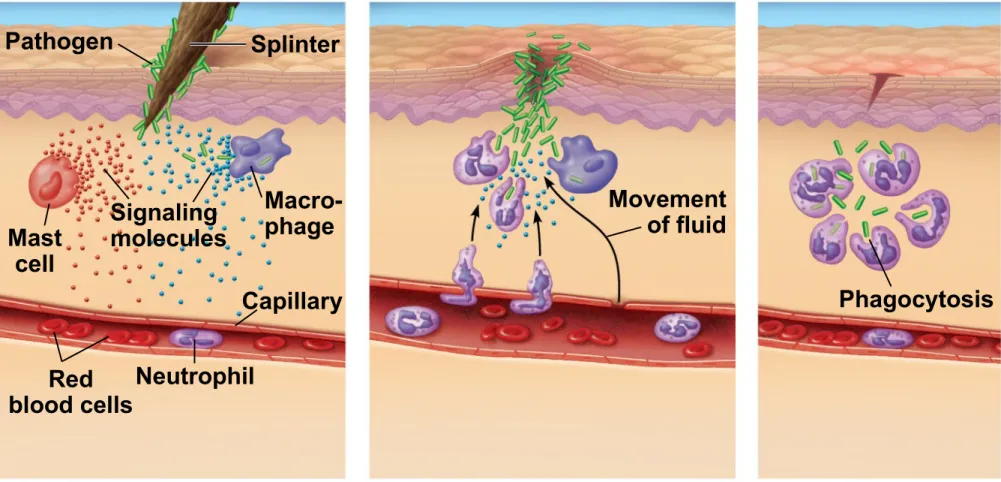
• The inflammatory response, such as pain and
swelling, is brought about by molecules released upon injury of infection
• Mast cells, a type of connective tissue, release
histamine, which triggers blood vessels to dilate
and become more permeable
• Activated macrophages and neutrophils release
cytokines, signaling molecules that enhance the
immune response
• Pus, a fluid rich in white blood cells, dead pathogens, and cell debris from damaged tissues
Figure 43.8-3
Pathogen Splinter
Mast cell
Macro-phage
Capillary
Red blood cells
Neutrophil Signaling molecules
Movement of fluid
• Inflammation can be either local or systemic (throughout the body)
• Fever is a systemic inflammatory response triggered by pyrogens released by
macrophages and by toxins from pathogens
• Septic shock is a life-threatening condition caused by an overwhelming inflammatory response
Concept 43.2: In adaptive immunity,
receptors provide pathogen-specific
recognition
• The adaptive response relies on two types of
lymphocytes, or white blood cells
• Lymphocytes that mature in the thymus above the heart are called T cells, and those that
mature in bone marrow are called B cells
• Antigens are substances that can elicit a response from a B or T cell
• Exposure to the pathogen activates B and T cells with antigen receptors specific for parts of that pathogen
• The small accessible part of an antigen that binds to an antigen receptor is called an
epitope
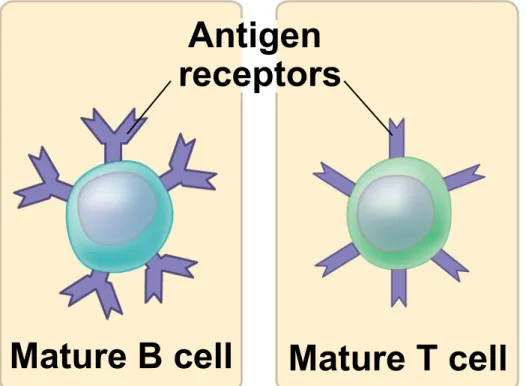
Figure 43.UN01
Antigen receptors
• B cells and T cells have receptor proteins that can bind to foreign molecules
• Each individual lymphocyte is specialized to recognize a specific type of molecule
Antigen Recognition by B Cells and
Antibodies
• Each B cell antigen receptor is a Y-shaped
molecule with two identical heavy chains and two identical light chains
• The constant regions of the chains vary little among B cells, whereas the variable regions differ greatly
• The variable regions provide antigen specificity
Cytoplasm of B cell Antigen-binding site B cell antigen receptor B cell Light chain Disulfide bridge Antigen-binding site Variable regions Constant regions Transmembrane region Heavy
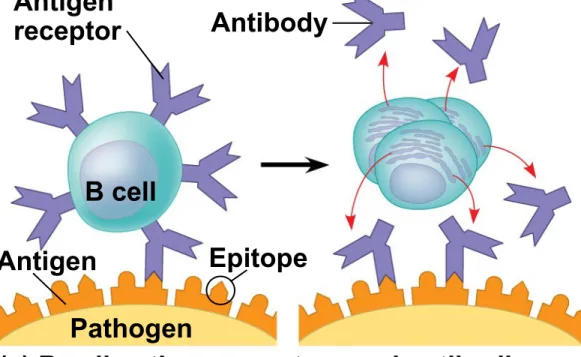
• Binding of a B cell antigen receptor to an antigen is an early step in B cell activation
• This gives rise to cells that secrete a soluble form of the protein called an antibody or
immunoglobulin (Ig)
• Secreted antibodies are similar to B cell
receptors but lack transmembrane regions that anchor receptors in the plasma membrane
Figure 43.10
Antibody Antigen
receptor
B cell
Antigen Epitope
Pathogen
(a) B cell antigen receptors and antibodies
Antibody C
Antibody B Antibody A
Antigen
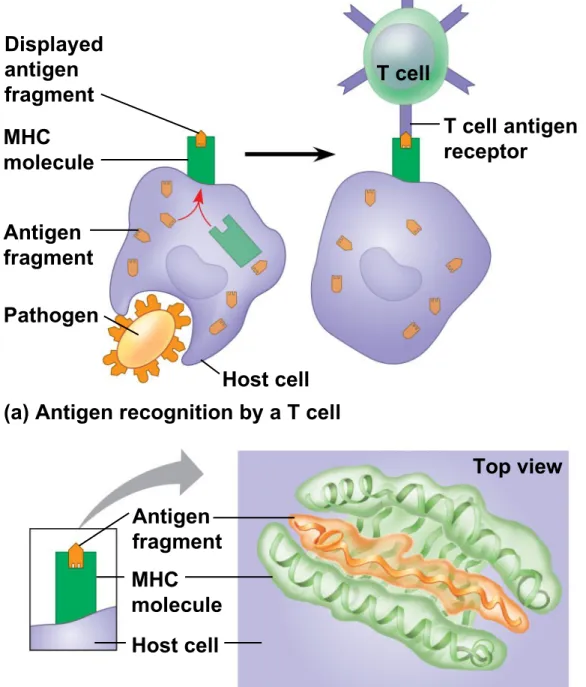
• T cells bind to antigen fragments displayed or presented on a host cell
• These antigen fragments are bound to cell-surface proteins called MHC molecules
• MHC (major histocompatibility complex)
molecules are host proteins that display the antigen fragments on the cell surface
• In infected cells, MHC molecules bind and
transport antigen fragments to the cell surface, a process called antigen presentation
• A T cell can then bind both the antigen fragment and the MHC molecule
• This interaction is necessary for the T cell to participate in the adaptive immune response
Figure 43.12 Displayed antigen fragment MHC molecule Antigen fragment Pathogen Host cell T cell
T cell antigen receptor
(a) Antigen recognition by a T cell
B Cell and T Cell Development
• The adaptive immune system has four major characteristics
– Diversity of lymphocytes and receptors
– Self-tolerance; lack of reactivity against an animal’s own molecules
– B and T cells proliferate after activation – Immunological memory
• Once activated, a B or T cell undergoes multiple cell divisions
• This proliferation of lymphocytes is called clonal selection
• Two types of clones are produced: short-lived activated effector cells that act immediately
against the antigen and long-lived memory cells
that can give rise to effector cells if the same antigen is encountered again
Antigen
Antigen receptor
Antibody
Plasma cells Memory cells
B cells that differ in antigen specificity
• Immunological memory is responsible for long-term protections against diseases, due to either a prior infection or vaccination
• The first exposure to a specific antigen represents the
primary immune response
• During this time, selected B and T cells give rise to their effector forms
• In the secondary immune response, memory cells facilitate a faster, more efficient response
© 2011 Pearson Education, Inc.
Animation: Role of B Cells
Primary immune response to antigen A produces
antibodies to A.
Secondary immune response to
antigen A produces antibodies to A; primary immune response to antigen B produces antibodies to B.
Exposure
to antigen A Exposure to antigens A and B Time (days) A n ti b o d y co n ce n tr a ti o n (a rb it ra ry u n it s ) 104 103 102 101 100
0 7 14 21 28 35 42 49 56
Antibodies to A
Antibodies to B
Concept 43.3: Adaptive immunity defends
against infection of body fluids and body
cells
• Acquired immunity has two branches: the
humoral immune response and the cell-mediated immune response
• In the humoral immune response antibodies
help neutralize or eliminate toxins and pathogens in the blood and lymph
• In the cell-mediated immune response
specialized T cells destroy affected host cells
Helper T Cells: A Response to Nearly
All Antigens
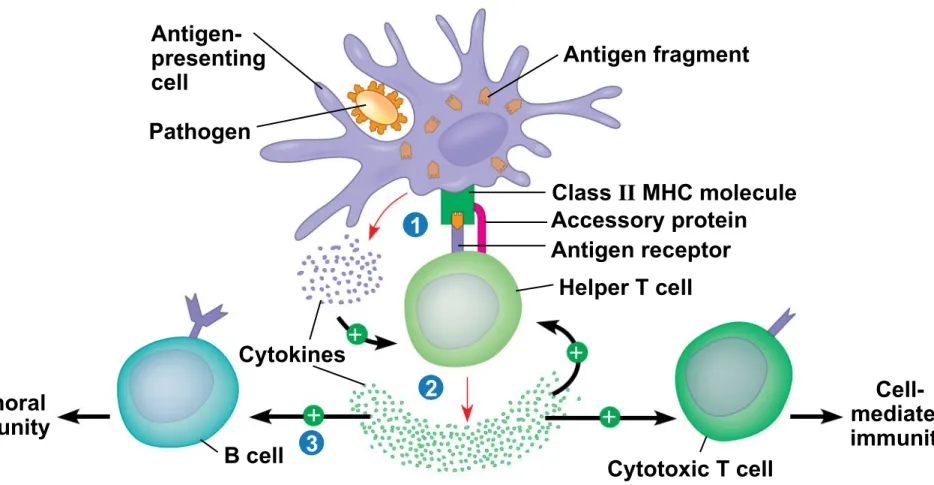
• A type of T cell called a helper T cell triggers both the humoral and cell-mediated immune responses
• Signals from helper T cells initiate production of antibodies that neutralize pathogens and
activate T cells that kill infected cells
• Antigen-presenting cells have class I and
class II MHC molecules on their surfaces
• Class II MHC molecules are the basis upon which antigen-presenting cells are recognized
• Antigen receptors on the surface of helper T cells bind to the antigen and the class II MHC molecule; then signals are exchanged
between the two cells
• The helper T cell is activated, proliferates, and forms a clone of helper T cells, which then
activate the appropriate B cells
© 2011 Pearson Education, Inc.
Figure 43.16 Antigen-presenting cell Pathogen Antigen fragment
Class II MHC molecule Accessory protein Antigen receptor
Helper T cell
Cytokines Humoral immunity Cell-mediated immunity
B cell 3 Cytotoxic T cell
Cytotoxic T Cells: A Response to Infected
Cells
• Cytotoxic T cells are the effector cells in the cell-mediated immune response
• Cytotoxic T cells recognize fragments of foreign proteins produced by infected cells and possess an accessory protein that binds to class I MHC molecules
• The activated cytotoxic T cell secretes proteins that disrupt the membranes of target cells and trigger apoptosis
© 2011 Pearson Education, Inc.
Figure 43.17-3
Cytotoxic T cell
3
1 2
Accessory protein
B Cells and Antibodies: A Response to
Extracellular Pathogens
• The humoral response is characterized by secretion of antibodies by B cells
Activation of B Cells
• Activation of the humoral immune response involves B cells and helper T cells as well as proteins on the surface of pathogens
• In response to cytokines from helper T cells and an antigen, a B cell proliferates and
differentiates into memory B cells and antibody- secreting effector cells called plasma cells
Figure 43.18-3 Pathogen 3 1 2 Antigen-presenting cell Antigen fragment
Class II MHC molecule Antigen receptor Accessory protein
Helper T cell
B cell
Cytokines
Activated helper T cell
Memory B cells
Plasma cells
Secreted antibodies
Antibody Function
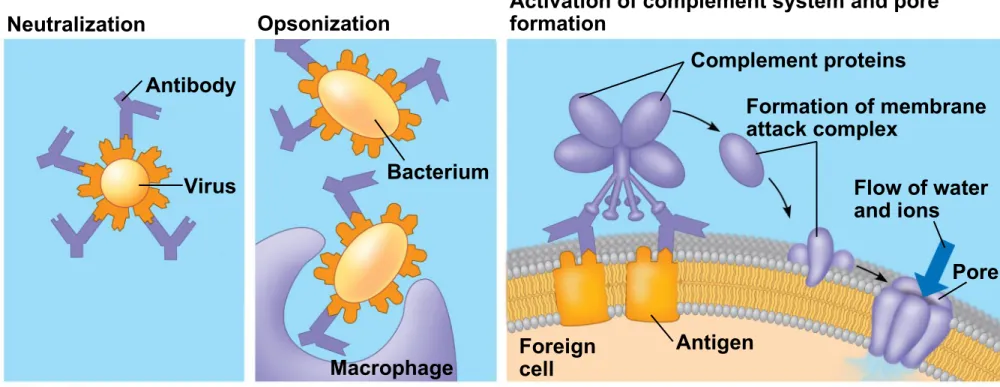
• Antibodies do not kill pathogens; instead they mark pathogens for destruction
• In neutralization, antibodies bind to viral
surface proteins preventing infection of a host cell
• Antibodies may also bind to toxins in body fluids and prevent them from entering body cells
• In opsonization, antibodies bind to antigens on bacteria creating a target for macrophages or neutrophils, triggering phagocytosis
• Antigen-antibody complexes may bind to a
complement protein—which triggers a cascade of complement protein activation
• Ultimately a membrane attack complex forms a pore in the membrane of the foreign cell,
leading to its lysis
Figure 43.19
Opsonization Neutralization
Antibody
Virus Bacterium
Macrophage
Activation of complement system and pore formation
Complement proteins
Formation of membrane attack complex
Flow of water and ions
Pore
Antigen Foreign
• B cells can express five different forms (or classes) of immunoglobulin (Ig) with similar antigen-binding specificity but different heavy chain C regions
– IgD: Membrane bound
– IgM: First soluble class produced
– IgG: Second soluble class; most abundant – IgA and IgE: Remaining soluble classes
• Both the humoral and cell-mediated responses can include primary and secondary immune
response
• Memory cells enable the secondary response
© 2011 Pearson Education, Inc.
Active and Passive Immunization
• Active immunity develops naturally when
memory cells form clones in response to an infection
• It can also develop following immunization, also called vaccination
• In immunization, a nonpathogenic form of a
microbe or part of a microbe elicits an immune response to an immunological memory
• Passive immunity provides immediate, short-term protection
• It is conferred naturally when IgG crosses the placenta from mother to fetus or when IgA
passes from mother to infant in breast milk
• It can be conferred artificially by injecting antibodies into a nonimmune person
Humoral (antibody-mediated) immune response Cell-mediated immune response
Antigen (1st exposure)
Engulfed by
Antigen-presenting cell
Helper T cell
Memory helper T cells
Antigen (2nd exposure) B cell
Plasma cells
Secreted antibodies
Defend against extracellular pathogens
Memory B cells cytotoxic T cellsMemory cytotoxic T cellsActive
Defend against intracellular pathogens and cancer
Cytotoxic T cell Key
Stimulates Gives rise to
Blood Groups
• Antigens on red blood cells determine whether a person has blood type A (A antigen), B (B
antigen), AB (both A and B antigens), or O (neither antigen)
• Antibodies to nonself blood types exist in the body
• Transfusion with incompatible blood leads to destruction of the transfused cells
• Recipient-donor combinations can be fatal or safe
Tissue and Organ Transplants
• MHC molecules are different among genetically nonidentical individuals
• Differences in MHC molecules stimulate
rejection of tissue grafts and organ transplants
• Chances of successful transplantation increase if donor and recipient MHC tissue types are well matched
• Immunosuppressive drugs facilitate transplantation
• Lymphocytes in bone marrow transplants may cause the donor tissue to reject the recipient
Concept 43.4: Disruptions in immune system
function can elicit or exacerbate disease
•
Some pathogens have evolved to diminish
the effectiveness of host immune responses
Exaggerated, Self-Directed, and Diminished
Immune Responses
• If the delicate balance of the immune system is disrupted, effects range from minor to sometimes fatal
Allergies
• Allergies are exaggerated (hypersensitive) responses to antigens called allergens
• In localized allergies such as hay fever, IgE antibodies produced after first exposure to an allergen attach to receptors on mast cells
• The next time the allergen enters the body, it binds to mast cell–associated IgE molecules
• Mast cells release histamine and other
mediators that cause vascular changes leading to typical allergy symptoms
• An acute allergic response can lead to
anaphylactic shock, a life-threatening reaction, within seconds of allergen exposure
Autoimmune Diseases
• In individuals with autoimmune diseases, the immune system loses tolerance for self and
turns against certain molecules of the body
• Autoimmune diseases include systemic lupus erythematosus, rheumatoid arthritis, insulin-dependent diabetes mellitus, and multiple sclerosis
Exertion, Stress, and the Immune System
• Moderate exercise improves immune system function
• Psychological stress has been shown to disrupt immune system regulation by altering the
interactions of the hormonal, nervous, and immune systems
• Sufficient rest is also important for immunity
Immunodeficiency Diseases
• Inborn immunodeficiency results from hereditary or developmental defects that
prevent proper functioning of innate, humoral, and/or cell-mediated defenses
• Acquired immunodeficiency develops later in life and results from exposure to chemical and biological agents
• Acquired immunodeficiency syndrome
(AIDS) is caused by a virus
Evolutionary Adaptations of Pathogens
That Underlie Immune System Avoidance
• Pathogens have evolved mechanisms to thwart immune responses
Antigenic Variation
• Through antigenic variation, some pathogens are able to change epitope expression and prevent recognition
• The human influenza virus mutates rapidly, and new flu vaccines must be made each year
• Human viruses occasionally exchange genes with the viruses of domesticated animals
• This poses a danger as human immune systems are unable to recognize the new viral strain