Glenn Fowler
[email protected]
Abstract
Many programming languages rely on abstractions to speed the implementation or to share common components with other languages. For example, some C++ compilers produce C as an intermediate step [ATT89], some PROLOG compilers produce WAM (Warren Abstract Machine) code [Warr83], and some C, C++, and FORTRAN compilers generate intermediate code for common back ends that do optimization and machine code generation. Abstractions allow complex language constructs to be implemented once and well.
So why an abstraction for make? The concept behind make is simple, but the abundance of incompatible implementations (make[Feld79],augmented make[SV84],build[EP84],nmake[Fowl85][Fowl90],mk[Hume87], SunPro make [Palk87], gnumake [SM89], parallel make [Baal88], POSIX make [POSI93], Microsoft NMAKE [MICR90],imake[DuBo93],4.4 bsdmake[BSD93]) makes it difficult to determine the exact semantics for a given makefile. Although makefiles specify the files undermake’scontrol, it is only the makeexecution that reveals the actions to be taken. Traditionally this is where make programming support has been weak. The usual dynamic output, a shell command trace, reveals little about the relationships that triggered them.
Themake abstract machineencompasses the static and dynamic nature ofmake. It has a simple instruction set that has been used to abstract botholdmake(System V, BSD, GNU) andnmake. makeabstractions form the basis for makefile conversion tools, makefile porting, regression testing, and makefile analysis.
1 Background
MAM (make abstract machine) was born of necessity. I use nmake to control all my software. This poses no problem for personal work on my home platform, but makes porting and shipping to incompatible platforms a headache. Originally I maintained two sets of makefiles: nmake for local use and oldmake for porting. This duplication was particularly annoying during the early stages of software development when makefiles would change many times in a single day. To make matters worse, no amount of care could keep the makefiles from diverging. The only acceptable solution was to single source the makefile information and generate the makefiles as needed.
At the same time there was considerable pressure from new nmake users to produce a program that converted oldmake makefiles tonmake. So a version of System V makewas modified in a similar manner tonmake and a
nmake convert-to-oldmake
oldmake convert-to-nmake
nmake-abstraction oldmake-makefile
oldmake-abstraction nmake-makefile
separate generator was coded:
The prospect of adding more formats and converters to handlemk,gnumake, etc., made clear the need for a common abstraction.
2 Themakemodel
Unlike COMMON LISP, there probably won’t ever be a common make; there are just too many variants. The differences are especially evident in makefile syntax and dynamic execution. Conditional makefiles, variable expansion syntax, dependency graph generation and traversal, shell interface, and concurrent target updates are typical divergence points. But the static semantics are a different story. Strip away the bells and whistles and syntactic goo and allmakesbecome strikingly similar: execute a minimal (minimalis the ultimate goal) set of shell actions, in the correct order, to bring files up to date.
From a static viewpointmakemanipulates two entities: rules and variables. Rules are the nodes in the dependency graph and their names usually associate one-to-one with file names. A dependency arc from rule A to ruleB is asserted as:
A : B
and reads: ifBis newer thanAthenAis out of date. Anactionmay label a dependency arc:
A : B
action
and reads: ifAis out of date then executeactionto bringAup to date.
Variables are used to parameterize actions and to avoid duplication in rule assertions. They can be assigned: variable= value
and expanded:
$(variable)
make also supports pattern metarules. These are special rules that allow some assertions to be omitted. For example, the assertion:
main.o : main.c cc -c main.c
3 The MAM Language
MAM provides a simple, concise notation for describing makeentities (variables, rules, actions) and relationships (dependencies). The language has both a static and dynamic nature. Static MAM specifies the complete make dependency graph; this can be used by makefile display and conversion programs. Dynamic MAM tracesmakeas it executes; this can be used formakeregression testing or for communicatingmakeactions to other tools, either in real time or as a logging technique.
At this point it may seem that MAM is shaping up to be just anothermake, but there is an important difference: MAM does not define themakealgorithm. Although it specifies the dependency graph, it does not specify ‘‘out of date’’ or under what circumstances the actions are executed. The intent is not to replacemakebut rather to provide a common language that communicates ‘‘make’’ to other programs.
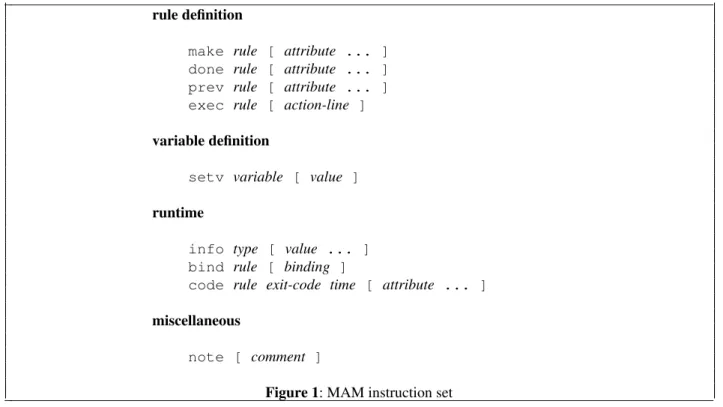
MAM syntax is akin to assembly: a sequence of instructions, one per line, read from top to bottom. The complete instruction set is listed in Figure 1. The rule and variable definition instructions support static makefile descriptions whereas the runtime instructions provide dynamic information asmakeexecutes.
rule definition
make rule [ attribute ... ] done rule [ attribute ... ] prev rule [ attribute ... ] exec rule [ action-line ]
variable definition
setv variable [ value ]
runtime
info type [ value ... ] bind rule [ binding ]
code rule exit-code time [ attribute ... ]
miscellaneous
note [ comment ]
Figure 1: MAM instruction set
_ ______________________________________________________________________________________________
_ ______________________________________________________________________________________________
A detailed description follows.
makerule[attribute... ]
donerule[attribute... ]
Amake/donepair defines the target rule namedrule. Nestedmake/donepairs define the dependencies: the enclosingruleis the parent and the enclosedrulesare the prerequisites. The optionalattributesclassify the rule or dependency relationship (oldermakesmay not emit any attributes):
archive An archive rule binds to a file that contains information on other files. archive
usually marks libraries controlled by thearcommand.
generated Marks rules that are generated by a shell action.
implicit Marks the current rule as an implicit prerequisite of the enclosing parent rule. An implicit prerequisite can make the parent rule out of date without triggering the parent action. Implicit prerequisites usually correspond to #include prerequisites. For example, if x.o is generated from x.c, x.c is generated from x.y, andx.c includesx.h, thenx.h is an implicit prerequisite ofx.c. Touchingx.hdoes not makex.cout of date but it does make
x.oout of date. Implicit prerequisites are currently generated only bynmake.
joint Marks one of a group of rules that are built by a single shell action.
metarule A metarulerule provides predefinedmakeinformation; its action and prerequisite actions are not executed, but are instead used to hold additional information. metarule is provided as an extension; no tools currently use it.
state Marks state variable rules.
virtual A virtual rule is not associated with any file. Some makes may optimize file system operations based on this.
prevrule[attribute... ]
Used to reference rules that have already been defined by make/done.
execrule[action-line]
Appendsaction-lineto the shell action forrule. Therulename-names the rule in the currentmake/done
nesting. execis not emitted until all prerequisite rules forrulehave been defined.
setvvariable[value]
Assignsvaluetovariable. Asetvis required for each variable referenced in the mamfile, even if its value is null, and it must occur before the first reference of the variable. This allows an analysis program to determine all variables used in the makefile and the proper assignment order.
infotype[value]
Theinfoinstruction is a catch-all formakeexecution environment information:
info mamMM/DD/YY[generator]
This is always the first instruction. It identifies the MAM version (YYYY-MM-DD) and optional version information on the program that generated the mamfile (generator).
info starttime
Shows themakestart time in seconds since the epoch.
info pwdpath
Shows the current working directory path.
info viewview
Shows the current view information if either viewpathing or union directories are present.
info finishtime code
Shows themakefinish time and exit code.
info error|warning|debug|panic|infomessage makemessages of varying severity.
bindrule time[binding]
coderule exit-code
This instruction reports the exit statusexit-codewhen the action forrulecompletes.
note[comment]
This is the comment instruction and is otherwise ignored.
To support multiple make processes in a dynamic MAM trace, an optional process id number may prefix each instruction:
12345 info start 6789 54321 info finish 6790 0 ...
4 MAM example
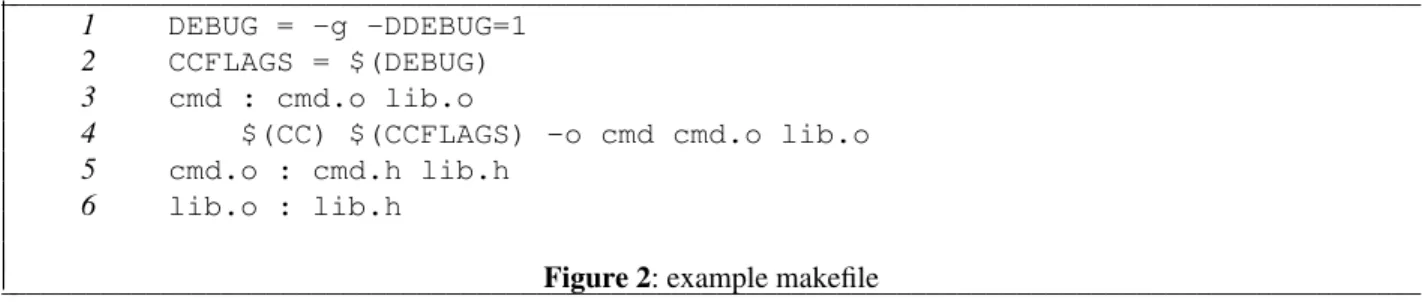
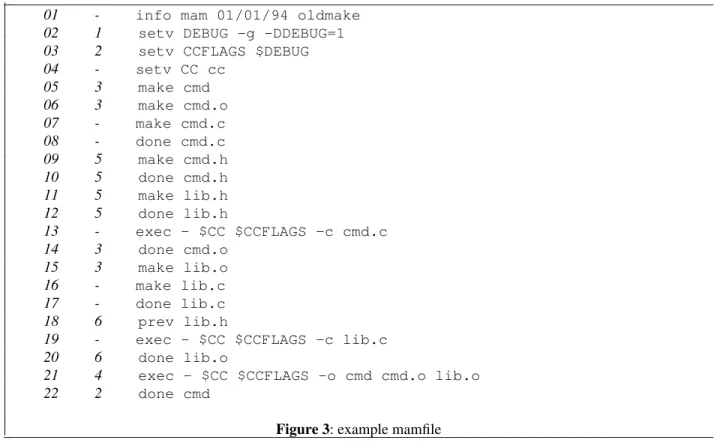
The makefile in Figure 2 will be used to illustrate MAM. The corresponding mamfile is listed in Figure 3, annotated with line numbers for easy reference. The first column contains mamfile line numbers and the second column contains line numbers from the makefile in Figure 2.
1 DEBUG = -g -DDEBUG=1
2 CCFLAGS = $(DEBUG)
3 cmd : cmd.o lib.o
4 $(CC) $(CCFLAGS) -o cmd cmd.o lib.o
5 cmd.o : cmd.h lib.h
6 lib.o : lib.h
Figure 2: example makefile
_ ______________________________________________________________________________________________
_ ______________________________________________________________________________________________
Theinfo maminstruction (line 01) identifies the file as a mamfile, lists the MAM version, and also identifies the program that generated the mamfile. Variables are defined using setv (lines 02,03,04). Lines 02 and 03 come directly from the makefile and line 04 is inferred from the predefined rules. execdefines the rule actions (lines 13,19,21), but is not emitted until after all prerequisite rules have been defined. The rule name-is shorthand for the rule name in the currentmake/donenesting (lines 13,19,21).
Makefile variable references are converted to shell syntax in the mamfile (lines 03,13,19,21). This provides a common target language for actions and also makes it possible to analyze makefiles using the shell. Variable references may occur in all instructions, and are commonly used to parameterizerulenames:
setv INSTALLROOT $HOME ....
make $INSTALLROOT/include/std.h
5 MAM analysis
From a human standpoint MAM is too verbose, but this is exactly what makes it an attractive input language for program analysis. The close connection between MAM andshellis also intentional; it allows most MAM analyzers to be written directly inshell. Also, the analysis scripts are short enough that a few are included in this paper. Rather than get bogged down in shell compatibility issues (and for brevity) the example scripts useksh93[BK94], which provides builtin arithmetic and associative arrays. For portability the scripts have also been written in V7 shell [Bour78], but the V7 scripts are much larger (up to 10 times) and noticeably slower, mainly because external commands must be used as a substitute forksh93features.
01 - info mam 01/01/94 oldmake
02 1 setv DEBUG -g -DDEBUG=1
03 2 setv CCFLAGS $DEBUG
04 - setv CC cc
05 3 make cmd
06 3 make cmd.o
07 - make cmd.c
08 - done cmd.c
09 5 make cmd.h
10 5 done cmd.h
11 5 make lib.h
12 5 done lib.h
13 - exec - $CC $CCFLAGS -c cmd.c
14 3 done cmd.o
15 3 make lib.o
16 - make lib.c
17 - done lib.c
18 6 prev lib.h
19 - exec - $CC $CCFLAGS -c lib.c
20 6 done lib.o
21 4 exec - $CC $CCFLAGS -o cmd cmd.o lib.o
22 2 done cmd
Figure 3: example mamfile
_ ______________________________________________________________________________________________
_ ______________________________________________________________________________________________
nmakesource was ported from 1985 to 1989. Given a mamfile, generating a bootstrap script is trivial: simply grab thesetvand execinstructions and convert to shell syntax:
setv variable [ value ]
converts to
variable="value"
and
exec rule [ action-line ]
converts to
action-line
The variable assignments and commands are in the correct order because, by definition, setv instructions are emitted before the first variable reference and exec instructions are not emitted until all prerequisite rules have been defined. The script,mamsh, is listed in Figure 4.
sed -n -e ’s/ˆsetv \([ˆ ]*\) \(.*\)/\1="${\1-\2}"/p’ -e ’s/ˆexec [ˆ ]* //p’
Figure 4:mamsh: convert MAM to shell script
_ ______________________________________________________________________________________________
_ ______________________________________________________________________________________________
DEBUG="-g -DDEBUG=1" CCFLAGS="$DEBUG" CC="cc"
$CC $CCFLAGS -c cmd.c $CC $CCFLAGS -c lib.c
$CC $CCFLAGS -o cmd cmd.o lib.o
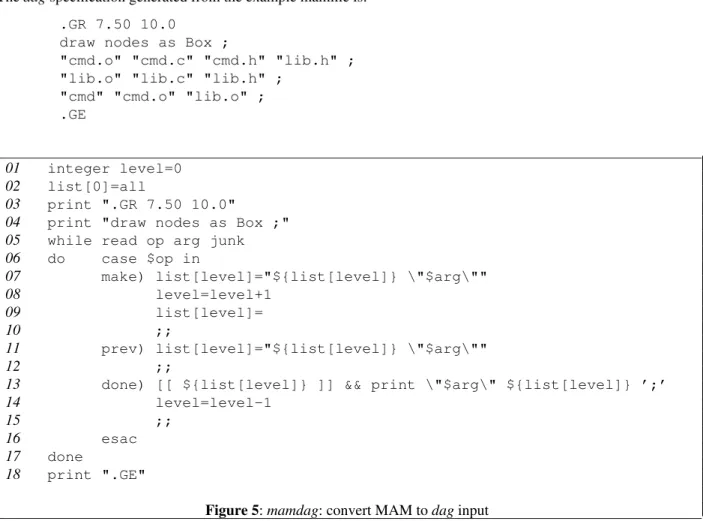
Generating a graphical representation of makefile dependencies is slightly more complicated. Figure 5 lists mamdag, a script that converts mamfile input into adag[GNV88] specification. daginput consists of a header, a trailer, and lists of the form "A" "B" "C" ... ;that reads: an edge connects nodeAto nodeB, nodeAtoC, etc. mamdag uses the make and prev instructions to build the prerequisite lists (lines 07,11) and the done
instruction to print the non-empty lists (line 13). It follows typical MAM script form:
• initialize (lines 01-04)
• check options and arguments (none in this example)
• read each mamfile line andcaseon each instruction (lines 05-17), wheremakeanddonecorrespond to push and pop operations (lines 07,13)
• clean up (line 18)
Thedagspecification generated from the example mamfile is:
.GR 7.50 10.0
draw nodes as Box ;
"cmd.o" "cmd.c" "cmd.h" "lib.h" ; "lib.o" "lib.c" "lib.h" ;
"cmd" "cmd.o" "lib.o" ; .GE
01 integer level=0
02 list[0]=all
03 print ".GR 7.50 10.0"
04 print "draw nodes as Box ;"
05 while read op arg junk
06 do case $op in
07 make) list[level]="${list[level]} \"$arg\""
08 level=level+1
09 list[level]=
10 ;;
11 prev) list[level]="${list[level]} \"$arg\""
12 ;;
13 done) [[ ${list[level]} ]] && print \"$arg\" ${list[level]} ’;’
14 level=level-1
15 ;;
16 esac
17 done
18 print ".GE"
Figure 5:mamdag: convert MAM todaginput
_ ______________________________________________________________________________________________
cmd.o
cmd.c
cmd.h
lib.h lib.o
lib.c cmd
The resultingdaglayout is:
Figure 6 listsmamexec, a script that implementsmakewith state using mamfiles rather than makefiles as input. A script similar to this (except written in ˜300 lines of V7 shell) is a major component of a software distribution system that has been used to shipkshandnmaketo a wide variety of systems and requires only a V7sh, a C compiler,ls, comm,sortandsed.
A common reaction tomamexec(especially to its V7 counterpart) is: Why would anyone wantmakein shell? The answer is portability:
• The V7mamexecworks the same on all UNIXsystem variants that support the shell. It has even been used to bootstrapkshandnmakeon Microsoft Windows NT† (MicrosoftNMAKEis completely different fromoldmake and AT&Tnmake).
• mamexecis small enough that it can be shipped along with the source to be built.
• mamexecavoidsmakeimplementation differences on recipient systems. Such differences are often difficult to debug, especially when no login is available.
• By operating from mamfiles, mamexec also avoids make implementation differences on the sending system. These are difficult to debug because features in the home environment are easy to take for granted. MAM inherently freezesmakefeatures into a common language.
• Unlike oldmake, mamexec handles actions with embedded shell here documents and multi-line case
statements.
To be fair,mamexecdoes not implement fullmakesemantics. It only has four options:
-A Accept current files as up to date.
-F Force all files to be out of date.
-fmamfile The input mamfile ismamfileinstead of the defaultMamfile.
-n Show actions but do not execute.
mamexecdoes not have target selection: all targets that are out of date are built (i.e., it cannot just makemain.o; adding this would cost about 10 lines). To its advantage, however, mamexec implements a state algorithm for testing ‘‘out of date.’’ Inoldmakea target is out of date if its modification time is older than the modification time of any of its prerequisites. In the state algorithm the modification time for each target is saved in a statefilejust beforemakeexits. A target is out of date if its current modification time is different from its state time (saved in the statefile)orif any of its prerequisites are out of date. The state algorithm detects changes that occur when old files
__________________
01 typeset beg="(set -ex;" end=") </dev/null" exec=eval mamfile=Mamfile
02 typeset -i accept=0 force=0 level=0
03 typeset -A list same
04 while getopts "AFf:[mamfile]n" opt
05 do case ${opt#${opt%?}} in
06 A) accept=1 ;;
07 F) force=1 ;;
08 f) mamfile=$OPTARG ;;
09 n) exec=print beg= end= ;;
10 esac
11 done
12 [[ $opt == "?" ]] && exit 1
13 ml=$mamfile.ml ms=$mamfile.ms
14 [[ $force == 0 && -f $ml && -f $ms ]] &&
15 for i in $(ls -ld $(<$ml) 2>/dev/null|sort|comm -12 $ms -|sed ’s/.* //’)
16 do same[$i]=1; done
17 while read -r op arg data
18 do case $op in
19 setv) eval val=’$’$arg
20 [[ $level != 0 || $val ]] && eval $arg=’$data </dev/null’
21 ;;
22 make) level=level+1
23 eval arg=$arg
24 [[ " $data " == *" metarule "* ]] && same[$arg]=1 && continue
25 name[level]=$arg cmds[level]= list[$arg]=1
26 ;;
27 prev) eval arg=$arg
28 [[ ! ${same[$arg]} ]] && same[${name[level]}]=
29 ;;
30 exec) [[ ! ${cmds[level]} ]] && cmds[level]=$data ||
31 cmds[level]=${cmds[level]}$’\n’$data
32 ;;
33 done) eval arg=$arg
34 [[ ! ${same[$arg]} ]] &&
35 { [[ ${cmds[level]} ]] &&
36 { $exec "$beg${cmds[level]}$end" || exit; }
37 same[${name[level-1]}]=; }
38 level=level-1
39 ;;
40 esac
41 done <$mamfile
42 [[ $accept == 1 || $exec == eval ]] &&
43 { print ${!list[@]} > $ml; ls -ld ${!list[@]} 2>/dev/null|sort > $ms; }
Figure 6:mamexec:makewith state
are restored, a situation thatoldmakecannot handle. This may happen whencpioor tararchives are read into the current source tree, but also happens more frequently under viewpathing (usingVPATHinoldmake,gnumake, and nmake, orvpath in nDFS[KK90] or union mounts in Plan 9 and 4.4 BSD) when top layer files are removed to expose older lower layer files. More importantly, the state algorithm allows an action to chose notto update its target file(s). Unlikeoldmake, the state algorithm will not trigger such actions the next time. This supports smart actions that may determine ‘‘out of date’’ by mechanisms more complex than modification time.
The mamexecsource is straightforward. Lines 01-13 initialize the local variables (lines 01-02), associative arrays (line 03), and options (lines 04-13). Lines 15-16 compare the current state with the previous state (if it exists).
same[rule]is1ifrule’scurrent modification time is the same as the statefile modification time (lsdetermines the time, commandsortdetermine entries that have not changed). A rule is out of date ifsame[rule]is null. The main loop (lines 17-38) collects prerequisites and actions and executes actions for out of date rules (line 33). Only builtin commands are executed in the main loop. setvassigns variable that have no previous value unless the
setvoccurs inside amake/donenesting (line 20). Lines 39-40 update the statefile before the script exits. The state consists of 2 files;mamfile.mlcontains the list of all rules andmamfile.mscontains the state time and name for all rules.
user sys user+sys gnumake 0.35 0.30 0.65 oldmake 0.43 1.08 1.51 mamexec 1.23 0.40 1.65 nmake 0.85 0.95 1.80
Figure 7: comparativemake –ntimes
_ ______________________________________________________________________________________________
_ ______________________________________________________________________________________________
Figure 7 is a table of user+sys times on an unloaded SPARC 2 for variousmake –ncommands running on a makefile (or mamfile) with 97 up to date rules and 223 action lines. Sincemamexecis a shell script and the othermakesare compiled programs one would assume thatmamexecwould perform poorly, but this is not the case. There are a few reasons for this: the mamfile parse is simple compared to makefiles, and all rule bindings are precomputed in the mamfile (i.e., metarules and file path searches have already been applied by the mamfile generator). nmake is slightly slower in this example because it computes the implicit prerequisites that have already been asserted in the mamfile andoldmakemakefiles, and the startup cost for this outweighs the small makefile size.
Makefile conversion, last mentioned in the introduction, hasn’t been forgotten. Original plans were to describe an 800 line, 5 year old C program that converts MAM to oldmakemakefiles, but after cleaning up themamdagand mamexec scripts for publication a mamold script precipitated out. Figure 8 lists mamold, a MAM to oldmake makefile converter.
Since it generatesoldmakemakefiles, mamoldmust differentiate between explicit (prereqs[rule]) and implicit (implicit[rule]) prerequisites for a given rule(lines 27-29). setv collects the variable names (line 23) so that the shell style variable references can be converted tomakestyle by theconvertfunction (lines 01-07). The assertions are emitted in mamfile order (lines 32,43-48), and the closurefunction emits the transitive closure of the explicit and implicit prerequisites.
Embedded newlines in actions have always been a problem foroldmakebecause it traditionally executes action lines one at a time, each in a separate shell. Some shell constructs, such as here documents and multiline case
statements, cannot appear inoldmakeactions. Somamolddoes not play as an important a role asmamexecin the software porting process.
6 Generating MAM
MAM deliberately mimics the makealgorithm, so adding MAM tomakeis a simple task. The makeanddone
01 function convert {
02 typeset buf=$*; typeset -i i
03 set -s -A variable ${variable[@]}
04 for (( i = ${#variable[@]} - 1; i >= 0; i-- ))
05 do buf=${buf//\$${variable[i]}/\$(${variable[i]})}; done
06 print -r -- "$buf"
07 }
08 function closure {
09 typeset i j
10 for i
11 do [[ " $list " == *" $i "* ]] && continue
12 list="$list $i"
13 for j in ${implicit[$i]}
14 do closure $j; done
15 done
16 }
17 typeset -A prereqs implicit action
18 typeset -i level=0 nvariables=0
19 typeset rule list order target variable
20 print "# # oldmake makefile generated by $0 # #"
21 while read -r op arg val
22 do case $op in
23 setv) variable[nvariables++]=$arg
24 convert "$arg = $val"
25 ;;
26 make|prev) rule=${target[level]}
27 [[ " $val " == *" implicit "* ]] &&
28 implicit[$rule]="${implicit[$rule]} $arg" ||
29 prereqs[$rule]="${prereqs[$rule]} $arg"
30 [[ $op == prev ]] && continue
31 target[++level]=$arg
32 [[ " $order " != *" $arg "* ]] && order="$order $arg"
33 ;;
34 exec) [[ $arg == - ]] && arg=${target[level]}
35 [[ ${action[$arg]} ]] &&
36 action[$arg]=${action[$arg]}$’\n’$’\t’$val ||
37 action[$arg]=$’\t’$val
38 ;;
39 done) level=level-1
40 ;;
41 esac
42 done
43 for rule in $order
44 do [[ ! ${prereqs[$rule]} && ! ${action[$rule]} ]] && continue
45 list=
46 closure ${prereqs[$rule]} && print && convert "$rule :$list"
47 [[ ${action[$rule]} ]] && convert "${action[$rule]}"
48 done
Figure 8:mamold: MAM tooldmakemakefile converter
oldmake. The exec instruction is just an intercept of action execution. Actions may be parameterized by first emittingsetvfor each parameter variable:
setv CC cc setv CCFLAGS ...
and then initializing themakevariable values to expand to their shell counterparts:
CC = $$CC
CFLAGS = $$CCFLAGS ...
The–Moption generates MAM innmake. –Mimplies–n(show actions but not execute) and–F(force all targets to be out of date); this ensures that all rules and actions are represented in the output MAM. A separate option,–o mamtrace=file, outputs runtime MAM infileasnmakeexecutes. –Mand-Fhave also been added to an internal version of System Voldmake. The normalmakearguments apply: if you want a mamfile of theinstalltarget then runmake -M install; if you want a mamfile of the default target then runmake -M.
7 MAM omissions
There is no MAM analogue for makefile conditionals:
# generic makefile conditional syntax if this is release x of system y with hardware z
command : x_y_z.c endif
Basically MAM describes makefiles relative to the current environment, just as the C preprocessing phase freezes
#ifand#ifdefconditionals and macro expansions for C programs. This is a drawbackifMAM is viewed as a replacement makefile language.
8 Conclusion
Although MAM started out to support makefile conversion, it has inspired the development of several different programs that aid makefile analysis, generate shell scripts for software porting, report software updates as make executes, and even replace a generous subset ofmakeitself. MAM is stable and has been used to port and analyze software within AT&T for over four years.
References
[ATT89]UNIX System V AT&T C++ Language System: Release 2.1 Release Notes, AT&T, Select Code 307-160, 1989.
[Ball88] Erik Ballbergen, Design and Implementation of Parallel Make, USENIX Computing Systems, 135-158, Spring 1988.
[BK89] Morris Bolsky and David G. Korn,The KornShell Command and Programming Language, Prentice Hall, 1989.
[BK94] Morris Bolsky and David G. Korn, a revised edition of [BK89], to be published.
[Bour78] S. R. Bourne, The UNIX Shell, AT&T Bell Laboratories Technical Journal, Vol. 57 No. 6 Part 2, pp. 1971-1990, July-August 1978.
[BSD93]4.4 BSD make, 4.4 BSD UNIX distribution.
[DuBo93] Paul DuBois,Software Portability with imake, O’Reilly and Associates, 1993.
[Feld79] S. I. Feldman, Make – A Program for Maintaining Computer Programs, Software – Practice and Experience, Vol. 9 No. 4, pp. 256-265, April 1979.
[Fowl85] G. S. Fowler, The Fourth Generation Make, USENIX Portland 1985 Summer Conference Proceedings, pp. 159-174, 1985.
[Fowl90] G. S. Fowler,A Case for make, Software – Practice and Experience, Vol. 20 No. S1, pp. 35-46, June 1990. [GNV88] E. R. Gansner, S. C. North and K. P. Vo, DAG - A Program That Draws Directed Graphs, Software –
Practice and Experience, Vol. 17, No. 1, pp. 1047-1062, 1988.
[Hume87] A. G. Hume, Mk: a successor to make, USENIX Phoenix 1987 Summer Conference Proceedings, pp. 445-457, 1987.
[KK90] D. G. Korn and E. Krell,A New Dimension for the Unix File System, Software – Practice and Experience, Vol. 20 No. S1, pp. 19-33, June 1990.
[MICR90]Microsoft C: Advanced Programming Techniques, Microsoft Corporation, pp. 103-132, 1990.
[Leff84] Samuel J. Leffler, Building 4.2BSD UNIX Systems with Config, UNIX System Manager’s Manual, University of California, Berkeley, July 1984.
[Palk87] R. Palkovic, SunPro: The Sun Programming Environment, M. Hall (ed.), A Sun Technical Report, Sun Microsystems, Inc., pp. 67-86, 1987.
[POSI93] IEEE Standard for Information Technology – Portable Operating System Interface (POSIX) – Part 2: Shell and Utilities (Volume 1), pp. 666-679, IEEE, 1993.
[SM89] R. M. Stallman and R. McGrath,GNU Make – A Program for Directing Recompilation, Edition 0.1 Beta, March 1989.
[SV84]Augmented Version of Make, UNIX System V – Release 2.0 Support Tools Guide, pp. 3.1-19, April 1984. [Wald84] Kim Walden,Automatic Generation of Make Dependencies, Software – Practice and Experience, Vol. 14
No. 6, pp. 575-585, June 1984.