TEKS
REVIEW
How were chemical and physical properties
used in the development of the periodic table?
As scientists learned how to isolate elements from compounds, the number of known elements increased rapidly in the early 1800s. Scientists looked for patterns and similarities in the properties of elements in order to classify the growing number of discovered elements. In 1869, two chemists—Dmitri Mendeleev from Russia and Lothar Meyer from Germany—independently published very similar classification systems. Mendeleev is often given more credit because he published his table first. Mendeleev knew that many of the known elements shared similar chemical and physical properties. In order to show the relationships among the known elements, Mendeleev organized the elements into a periodic table. The periodic table is an arrangement of elements in which the elements are separated into groups based on a set of repeating
properties. Mendeleev arranged the elements in his periodic table in order of increasing atomic mass. By using this organization, Mendeleev noticed that the physical and chemical properties repeated in a predictable pattern. For example, the melting points of lithium (Li), beryllium (Be), boron (B), and carbon (C) increased with increasing atomic mass. However, the melting point of the next element, nitrogen (N), dropped sharply. This same pattern was seen with the elements sodium (Na), magnesium (Mg), aluminum (Al), silicon (S), and phosphorus (P). The following table shows the pattern of rise and sudden drop in melting point.
Development of the Periodic Table
5A
TEKS 5A
Explain the use of chemical and physical properties in the historical development of the Periodic Table.
Vocabulary periodic table
Atomic Mass Melting Point (°C)
7 180.5
9 1278.0
11 2300.0
12 3550
14
–209.9
Element Li Be B C N
Atomic Mass Melting Point (°C)
23 97.7
24 650.0
27 660.3
28 1410.0
31 41.4
Element Na Mg Al Si P
TEKS 5A • Copyright © Pearson Education, Inc., or its affiliates. All Rights Reserved. 67
Figure 1 Melting Points of Certain Elements
Mendeleev noticed that occasionally, an element placed in a group according to its properties was slightly out of place according to atomic mass. For example, the atomic mass of tellurium (Te) is slightly greater than that of iodine (I), yet the properties of the two elements suggested that tellurium be placed before iodine, not after it. Mendeleev assumed that the measured atomic masses of these elements were not accurate and
maintained the order based on properties. Scientists soon learned that the atomic masses were correct. The problem was using atomic mass to organize the periodic table.
Though Mendeleev and Meyer’s tables were nearly identical, Mendeleev took his classification system one step further. He left several empty spaces in his table for which no known element existed at the time with properties matching others in the column. Mendeleev boldly predicted that new elements would be discovered with properties that would fit into these empty spaces. For example, he referred to one of these undiscovered elements as eka-aluminum and predicted that its properties would be similar to those of aluminum. In fact, in 1875 an element with the atomic mass and properties predicted by Mendeleev was discovered. This element was named gallium (Ga). Mendeleev also predicted the properties of the element germanium (Ge), which was discovered in 1886.
How does the modern periodic table differ
from the earlier table?
Years later, in the early 1900s, a scientist named Henry Moseley determined an atomic number for each known element. The atomic number is the
number of protons in an element. If the elements were ordered by atomic number, tellurium would come before iodine which made more sense. In the modern periodic table, elements are arranged in order of increasing atomic number.
The elements in the modern periodic table start with hydrogen (H) with an atomic number of 1 (one proton in the nucleus). The elements are
organized into seven rows called periods. Each period corresponds to a principal energy level. There are more elements in higher-numbered periods because there are more orbitals in higher energy levels.
The properties of the elements within a period change as you move across a period from left to right. However, the pattern of properties within a period repeats as you move from one period to the next. This pattern gives rise to the periodic law: When elements are arranged in order of increasing atomic number, there is a periodic repetition of these physical and chemical properties. The arrangement of the elements into periods has an important consequence. Elements that have similar chemical and physical properties end up in the same column (or group) in the periodic table. An example of the modern periodic table can be found in the Chemistry Reference
Materials at the end of this book.
Study Tip
Use the mnemonic “Very Good Hot Pies” to remember that the vertical columns in the Periodic Table are called groups, and the
horizontal rows are called periods.
TEKS 5A • Copyright © Pearson Education, Inc., or its affiliates. All Rights Reserved. 68
End-of-Course Assessment Review
1. Infer What can you infer about elements that are in the same group?
A They will have the same atomic mass.
B They will contain the same number of protons.
C They will display similar chemical and physical properties.
D They will emit X rays of similar frequency.
2. Think Critically Why did Mendeleev switch the order of some
elements in his periodic table?
A He determined that the atomic masses were incorrect.
B He decided that elements should be placed in order of atomic mass even if this meant placing elements with different properties in the same group.
C He decided that elements should be grouped based on properties even if this meant placing elements out of order by atomic mass.
D He determined that elements should be placed in order of increasing atomic number.
3. Identify The periods and groups on the periodic table are numbered.
For example, the element neon (Ne) is in period 2, group 18. Neon is an inert gas and therefore does not react readily with any other ele-ment. Which of the following elements is likely to have properties that are similar to those of neon?
A lithium (Li) in period 2, group 1
B boron (B) in period 2, group 13
C iron (Fe) in period 4, group 8
D krypton (Kr) in period 4, group 18
4. Explain How did Mendeleev’s organization of elements help him
predict the properties of elements that had not yet been discovered?
TEKS
TEKS 5A • Copyright © Pearson Education, Inc., or its affiliates. All Rights Reserved. 69
TEKS
REVIEW
What are the main chemical families
on the periodic table?
On the modern periodic table, elements are placed in order of atomic number and then into groups, or families, based on repeating, or periodic, properties. There are 18 families on the periodic table. The families are grouped into representative elements (groups 1, 2, and 13 through 18), transition elements (groups 3 through 12) and inner transition elements (actinides and lanthanides), as shown in Figure 1. Elements within each of these families share many physical and chemical properties.
What properties do alkali metals share?
Alkali metals make up Group 1 on the Periodic Table. The elements in this family are all metals and share metallic properties, such as a shiny luster, malleability, and high thermal and electric conductivity. Alkali metals are soft solids at room temperature and have low melting points and densities. Notably, all alkali metals are very reactive. For example, alkali metals react vigorously with water to produce hydrogen and a basic solution. Because they are so reactive, alkali metals are found in nature only within compounds and never as free elements. When atoms of alkali metals react, they usually lose one electron, resulting in an atom with a +1 oxidation state.
Chemical Families
in the Periodic Table
5B
TEKS 5B
Use the Periodic Table to identify and explain the properties of chemical families, including alkali metals, alkaline earth metals, halogens, noble gases, and
transition metals.
R
e
a
d
in
e
s
s
Figure 1 Chemical Families in the Periodic Table
Transition Metals Alkali Metals
Alkaline Earth Metals Halogens
Noble Gases
Vocabulary alkali metal
alkaline earth metal halogen
noble gas transition metal
TEKS 5B • Copyright © Pearson Education, Inc., or its affiliates. All Rights Reserved. 70
What properties do alkaline earth
metals share?
The alkaline earth metals make up Group 2 on the periodic table. The elements in this family are soft metals. Alkaline earth metals are also very reactive, although slightly less reactive than alkali metals. Except for beryllium (Be), they react with water to produce basic solutions. Most occur naturally only in compounds. When atoms of alkaline earth metals react, they usually lose two electrons, resulting in an atom with a +2 oxidation state.
What properties do halogens share?
The halogens make up Group 17 on the periodic table. All halogens are nonmetals and are generally poor conductors of heat and electricity. Unlike the alkali metals and alkaline earth metals, the halogens do not share a common state of matter. In fact, this is the only family on the periodic table to contain elements in all three states of matter. At room temperature, fluorine (F) and chlorine (Cl) are gases, bromine (Br) is a liquid, and iodine (I) and astatine (At) are solids. Halogens are very reactive and are rarely found in nature as free elements. In fact, fluorine is one of the most reactive elements and will even react with glass, a relatively inert material. The elemental form of a halogen is a diatomic molecule, such as F2, Cl2, and Br2. When halogen atoms react, they usually gain one electron, resulting in an atom with a −1 oxidation state.
What properties do the noble gases share?
Noble gases make up Group 18 on the periodic table. As the name suggests, all noble gases are gases at room temperature. They are also odorless and colorless. Unlike elements in Groups 1, 2, and 17, noble gases have a very low reactivity and exist as unbounded single atoms in nature. For this reason, noble gases were once called inert, meaning nonreactive. However, scientists have since synthesized noble gas compounds in the laboratory, demonstrating that noble gases are not completely inert.What properties do the transition
metals share?
Transition metals include elements in Groups 3 through 12 on the periodic table, although there is disagreement about including the elements zinc (Zn), cadmium (Cd), and mercury (Hg) because these elements do not exhibit some of the characteristics of other transition metals. Transition metals share metallic properties with elements in other families. Unlike elements in Groups 1 and 2 and Groups 13 through 18, transition metals can exist in several common oxidation states and are more likely to form metal complexes in which the charges are not balanced and there is an excess number of electrons. Tetrachloroferrate(III), FeCl4−, is one such complex. Although compounds containing transition metals are very common, transition metals also exist as free elements and, as a family, are not considered exceptionally reactive.
Study Tip
As you read about families in the Periodic Table, organize the information into a table that contains the family names in columns and row headers such as
Elements, State of Matter, Metal or
Nonmetal, and Reactivity.
TEKS 5B • Copyright © Pearson Education, Inc., or its affiliates. All Rights Reserved. 71
End-of-Course Assessment Review
1. Identify Which of the following groups contain elements that are
gaseous at room temperature?
A alkali metals and alkaline earth metals
B alkali metals and transition metals
C noble gases and transition metals
D noble gases and halogens
2. Classify When this element was discovered, it exhibited luster and malleability, and it reacted very vigorously with water. This element is never found as a free element in nature and always exists in a compound. To which group does this element most likely belong?
A alkali metals
B halogens
C noble gases
D transition metals
3. Identify Which sequence contains elements listed from most reactive
to least reactive?
A transition metals, noble gases, halogens
B transition metals, alkali metals, alkaline earth metals
C alkali metals, alkaline earth metals, noble gases
D alkaline earth metals, alkali metals, halogens
4. Predict Based on each family’s ability to either gain or lose electrons, predict what might happen if an element in Group 1 came into
contact with an element in Group 17.
5. Explain Why was the term inert gas once used to refer to noble gases and why is it no longer in common use?
TEKS
TEKS 5B • Copyright © Pearson Education, Inc., or its affiliates. All Rights Reserved. 72
TEKS
REVIEW
TEKS_TXT
R
E
a
d
in
E
S
S
Use the Periodic Table to identify and explain periodic trends, including atomic and ionic radii, electronegativity, and ionization energy.
R
E
a
d
in
E
S
S
5C
Trends in the Periodic Table
TEKS 5C
What periodic trends in atomic radii can be
identified in the periodic table?
The size of an atom is expressed as an atomic radius (plural, radii). The
atomic radius is one half the distance between the nuclei of two atoms of the same element when the atoms are joined. In general, atomic radii decrease from left to right across a period on the periodic table and
increase from top to bottom within a group, or family. As you move across a period in the periodic table, the number of protons in the atoms
increases, but the electrons remain in the same energy level. Therefore, outer-level electrons are pulled more strongly toward the nucleus from left to right across a period. This increasingly stronger pull results in a smaller radius from left to right across a period.
The principal quantum number, n, of the outer-level electrons increases by one from period to period. For example, for elements in period 1, n= 1. For elements in period 2, n= 2, and so on. As n increases down a family, the outer-level electrons have an average position that is farther from the nucleus. As a result, the atoms are larger.
What periodic trends in ionic radii can be
identified in the periodic table?
An ion is an atom or group of atoms that has a positive or negative charge. There are two types of ions—cations and anions. Cations are atoms that have lost one or more electrons and thus have a positive charge. Atoms that lose electrons become smaller. For example, the calcium ion, Ca2+, is
smaller than a calcium atom, Ca, because Ca2+ has two fewer electrons.
Anions are atoms that have gained one or more electrons and thus have a negative charge. Atoms that gain electrons are bigger. For example, a bromide ion, Br–, is larger than a bromine atom, Br, because Br– has one
more electron.
Cations and anions exhibit trends that are similar to those of their
parent atoms across periods and down families. From left to right across a period, the radii of cations and anions decrease because the number of protons in the nucleus increases. From top to bottom within a family, the radii of cations and anions increase because the principal quantum number, n, increases.
Vocabulary atomic radius ion
cation anion
electronegativity ionization energy
TEKS 5C • Copyright © Pearson Education, Inc., or its affiliates. All Rights Reserved. 73
Study Tip
Draw a rough outline of the periodic table leaving room for labels above and to the left of the table. For each trend that you study, draw a line above the table and on the left side, and use arrowheads to indicate the direction in which the trend increases. Label each arrow.
What periodic trends in electronegativity
can be identified in the periodic table?
Electronegativity is the ability of an atom to attract electrons when the atom is in a compound. The greater an atom’s electronegativity, the greater its ability to attract electrons. The number of protons in the nucleus and the principal quantum number influence the periodic trends for
electronegativity. Generally, the electronegativity increases from left to right across a period of the periodic table because the number of protons in the nucleus increases. Electronegativity generally decreases from top to bottom within a family because outer energy level electrons are farther from the nucleus.
What periodic trends in ionization energy
can be identified in the periodic table?
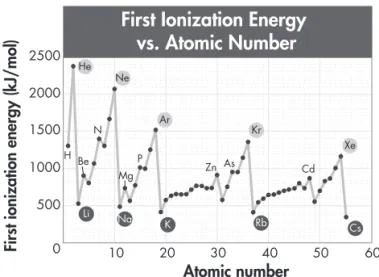
Ionization energy is the minimum energy required to remove an electron from an atom or ion. The energy required to remove the first electron from an atom is referred to as the first ionization energy. The greater an element’s ionization energy, the more difficult it is to remove an electron. Generally, ionization energy increases from left to right across a period and decreases from top to bottom within a family.
Ionization energy depends on the force of attraction the nucleus exerts on the electron. As with the other periodic trends, this attraction depends upon the number of protons in the nucleus and the distance of the electron from the nucleus. More protons exert more force, making electrons harder to remove. Therefore, from left to right across a period, ionization energy increases because the number of protons in the nucleus increases. Electrons that are closer to the nucleus are pulled more strongly toward the nucleus, making them harder to remove. Therefore, as atomic radii increase from top to bottom within a family, electrons that are farther from the nucleus are easier to remove. These trends can be seen in Figure 1 below.
Figure 1 Trends in
Ionization Energy 2500
2000 Fi rs t i on iz at io n en er gy (k J/ m ol ) 1500 1000 500
0 10 20 30
Atomic number40 50 60
He H Be N Ne Li Na Mg P
Zn As Cd
K Rb Cs
Kr
Xe Ar
First Ionization Energy
vs. Atomic Number
TEKS 5C • Copyright © Pearson Education, Inc., or its affiliates. All Rights Reserved. 74
End-of-Course Assessment Review
1. Identify Which of the following trends can be identified on the periodic table?
A Atomic radii increase from left to right across a period.
B Ionization energy increases from top to bottom within a family.
C Electronegativity decreases from left to right across a period.
D Ionic radii of cations decreases from left to right across a period.
2. Explain Which of the following correctly explains why the sizes of atoms decrease from left to right across a period?
A The principal quantum number increases.
B The number of electrons increases.
C The distance from the nucleus increases.
D The number of protons increases.
3. Explain An increase in principal quantum number explains which of
the following trends?
A The ionization energy decreases from top to bottom within a family.
B The ionization energy increases from left to right across a period.
C The electronegativity increases from left to right across a period.
D The atomic radius increases from left to right across a period.
4. Apply Concepts Use the table below to determine which of the
following relationships is correct.
A Li has a smaller atomic radii than C.
B Li+ has a larger atomic radii than Li.
C Rb has a smaller atomic radii than Li.
D Li has a larger atomic radii than Be.
5. Explain Why does an increase in the number of protons in the nucleus
of an atom increase the ionization energy of atoms within a period?
TEKS
Li C Rb Be
2 2 5 2
1A 4A 1A 2A
Selected Trends in the Periodic Table
Element Period Family
TEKS 5C • Copyright © Pearson Education, Inc., or its affiliates. All Rights Reserved. 75