Chapter 1
Chapter 1
Science and Marine Biology
Science and Marine Biology
Karleskint
Karleskint
Small
Small
Turner
Key Concepts
• Marine and terrestrial environments are
interrelated, interactive, and
interdependent.
• The ocean is an important source of food
and other resources for humans.
• Marine biology is the study of the sea’s
Key Concepts
• The history of marine biology is one of
changing perspectives that have shaped
the modern science and its applications.
Key Concepts
• It is important to study marine biology in
order to make informed decisions about
how the oceans and their resources
should be used and managed.
• Scientists use an organized approach
Scientific Method
• A body of techniques for:
– investigating phenomena – acquiring new knowledge
– or correcting and/or integrating previous knowledge.
• To be termed scientific, a method of inquiry
is commonly based on empirical or
measurable evidence
Why use the scientific method?
• Consistency and reliability
– Using the scientific method promotes dependable results.
• Two scientists doing the same experiment should obtain similar results.
• The same scientist repeating the same experiment should obtain similar results
– There is always some variability in organic systems
• If you get the exact same results, people will know you cheated!
Definitions
• Natural Law is FACT!
– There’s no denying it
• Hypothesis
– Testable explanation of observable phenomena
• Theory
– Same as hypothesis except it’s accepted by the scientific community (because it’s been tested!)
• Paradigm
What creates our weather
• Sun (#1)
– How much solar radiation is absorbed – Earth’s orbit
• Oceans
– Huge (71% of earth’s surface) – Water resists change in temp
• Specific heat capacity
Earth’s orbital cycles
• Precession – 23,000 years
– The axial tilt wobbles
• Axial tilt changes – 41,000 years
– 21.5 – 24.5
• Eccentricity - 100,000 years
– Elliptical to less elliptical
Importance of the Oceans
and Marine Organisms
• World ocean covers
nearly 71% of earth’s
surface
Importance of the Oceans
and Marine Organisms
• Marine Organisms:
– provide substantial part of human food supply - are used as subjects of
scientific study for many areas of research
Study of the Sea and Its Inhabitants
• Oceanography
– study of the oceans and their phenomena, such as waves, currents and tides
• Marine biology
– study of the living organisms that inhabit the
seas and their interactions with each other and their environment
Marine Biology: A History of
Changing Perspectives
• Early studies of marine organisms
- traced back to ancient Greeks and Romans
- Aristotle and the “ladder of life”, a scheme of classification
• Renewed interest in marine organisms
– voyage of the HMS Beagle and Charles
Darwin’s On the Origin of Species, theory on evolution through natural selection
How old is the earth?
• 4.6 Billion years!
– How do we know this?
• Radiometric dating
• K+/Ar dating is the most useful for this assessment
– How old is the universe?
• 13.8 billion years old
– How has the earth changed in that time? – Pangea
– Ice ages
– Non ice ages
Darwin was a marine biologist
• These are drawings from Darwin’s notes that he made while on the HMS Beagle.
Marine Biology: A History of
Changing Perspectives
• Beginnings of modern marine science
– Challenger expedition exploring world’s oceans
• 4,700 new species collected and described
• significance of plankton receives attention marine studies in the United States
• expeditions of Alexander Agassiz
• funding of the first marine biology laboratory: Anderson Summer School of Natural History,
predecessor of the Marine Biological Laboratory at Woods Hole
Alexander Agassiz
Marine Biology: A History of
Changing Perspectives
• Marine biology in the twentieth century
– Fridtjof Nansen’s Arctic expedition
– Sir Alistair Hardy’s Antarctic expedition – impact of human activities on marine
environment gains attention
• Marine biology today
– deep-sea submersibles
– discovering ties between terrestrial and marine environments
– information sharing via the Internet
Process of Science
• Hypothesis
– explanations that can be tested by experiments
Steps in the Scientific Method
• (Step 1) Making observations
• (Step 2) Use inductive reasoning to form a hypothesis • (Step 3) Use deductive reasoning to design
experiments
– Experimental variables:
• Independent variable • Dependent variable • control
• (Step 4) Gathering results • (Step 5) Draw conclusions
Steps in the Scientific Method
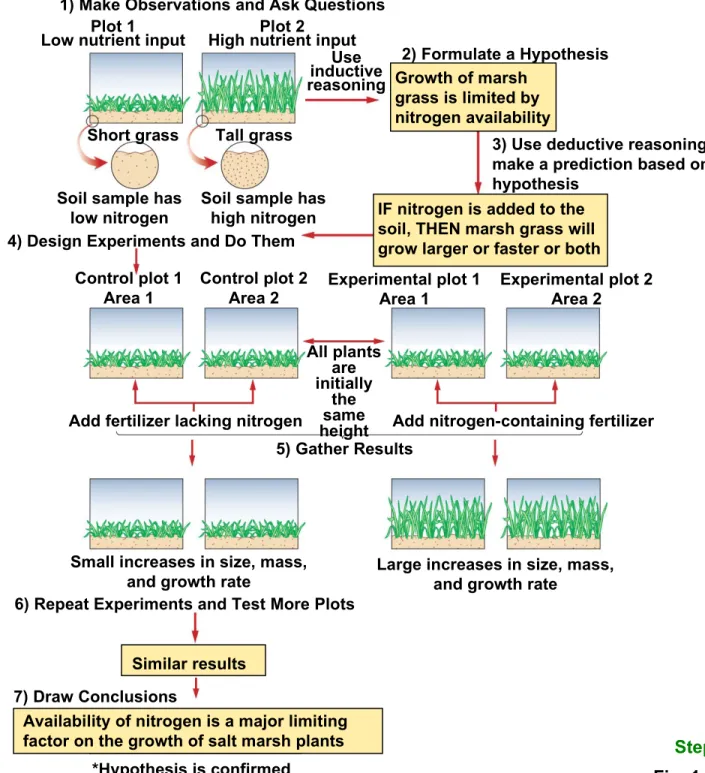
EXAMPLE:
• Plant growth in a salt marsh: a case study of the scientific method
– observation of growth patterns and analysis of soil samples
– experiment to test hypothesis
Availability of nitrogen is a major limiting factor on the growth of salt marsh plants
*Hypothesis is confirmed 7) Draw Conclusions
IF nitrogen is added to the soil, THEN marsh grass will grow larger or faster or both
3) Use deductive reasoning to make a prediction based on the hypothesis
Small increases in size, mass,
and growth rate Large increases in size, mass,and growth rate 5) Gather Results
Similar results
6) Repeat Experiments and Test More Plots Use inductive reasoning
2) Formulate a Hypothesis Growth of marsh
grass is limited by nitrogen availability Tall grass
Plot 1 Low nutrient input
Short grass Why do salt marsh plants in
some areas grow larger?
1) Make Observations and Ask Questions
Soil sample has high nitrogen Soil sample has
low nitrogen
Plot 2
High nutrient input
4) Design Experiments and Do Them
Add fertilizer lacking nitrogen
All plants are initially the same height
Experimental plot 2 Area 2
Add nitrogen-containing fertilizer Control plot 1
Area 1
Control plot 2
Area 2 Experimental plot 1Area 1
Fig. 1-11, p. 11
Process of Science
• Alternative methods of science
– experimentation is not always possible
– observational science – observation alone must be used to support or deny the
hypothesis
• “The science of Marine Biology”
– Introduction to Marine Biology 3rd edition
contains “Science of Marine Biology” features to illustrate the application of the scientific