^
Factor V Leiden
R.P.M. Lensen
1, F.R. Rosendaal
12'Department of Clinical Epidemiology, University Hospital Leiden, Leiden, The Netherlands
2Department of Haematology, University Hospital Leiden, Leiden, The Netherlands
Introduction
Venous thromboembolism is a major cause of morbidity and mortality with an incidence of about 1 per 1000 per year [1]. Predisposing factors can be either genetic or acquired. Acquired risk factors are surgery,
immobilisation, malignancy, oral contraceptives, pregnancy and puerperium [2].
Until 1993, a specific genetic defect could be identified in only 10-15% of affected subjects [3]. These defects included deficiencies of protein C, protein S and antithrombin [4], Protein C is an important inhibitor of the clotting system, which mactivates cofactors Va and Villa [5, 6]. Both these cofactors accelerate the production of thrombin which converts soluble fibnnogen into insolublefibrin.
Inherited resistance to activated protein C (APC resistance), first descnbed in 1993 by Dahlbäck [7] (see article by A. Hillarp and B. Dahlbäck, Vessels, this
issue), is the result of an abnormal factor V molecule, (FVR506Q, FV Leiden) which turned out to be the most common known cause of inherited thrombophilia [8-12].
Molecular genetics of Factor V Leiden
APC resistance is strongly associated with a single point mutation (1,691 G->-A transition) in exon 10 of the factor V gene (mapped to chromosome 1 (1q21-25)). This mutation predicts the replacement of Arg-506 (CGA) by Gin (CAA) in the factor V molecule which results in FVR506Q or pv Lejden (Rg -,) Νοη713||Υι Arg-506-Gly-507
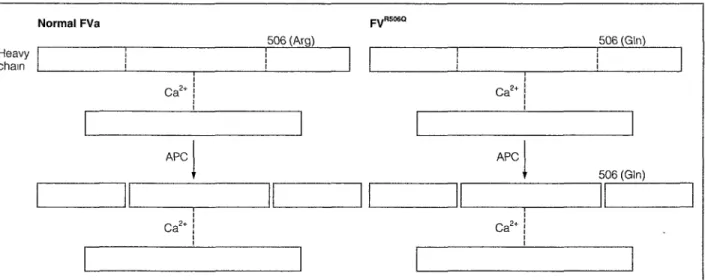
is one of the cleavage sites for APC, so replacement of Arg-506 results in an inadequate inactivation by APC (APC resistance) of the mutated Factor V molecule which causes an increased tendency to develop thrombosis [12]. This explains APC resistance in vitro, for the activated thromboplastin time (APTT) is affected by factor Va and the rate of its inactivation by APC. When APC is added to plasma, it leads to a
Prolongation of the APTT. In the presence of mutated factor V, this Prolongation of the APTT after
administration of APC is much reduced [7]. This is expressed äs the APC sensitivity ratio, i.e. the ratio of the APTTs before and after APC being added to the plasma.
Inherited APC resistance is an autosomal dominant trait [9, 10], This implies that on average, 50% of the
Normal FVa
Heavy chain
506 (Arg) 506 (Gin)
Ca2+
APC APC
506 (Gin)
Ca2* Ca2
Fig. 1: Model of factor Va and factor Va"5060, both composed of a heavy and a light chain. Cleavage at R506 will not occur in
FVa"5060 which results in a reduced inact/vation of the molecule APC = activated protein C. φ
l
ίϊ &·£ Säi ·'&! C&iE&öii »fei AM« l&toii, α tMi-ji Ä' £ SeSS ι'ι eä -fc ÄfrCiii
^
sibiings, children and parents of a heterozygous carrier of FV Leiden also carry the mutation, and will be APC resistant.
about 3% in unselected consecutive patients and 10-15% in selected symptomatic individuals from thrombophilia families [15-17]
Epidemiology of Factor V Leiden
In a case-control study of 474 unselected consecutive patients with a first deep venous thrombosis (Leiden Thrombophilia Study, LETS), 14 of the 474 healthy controls (3%) were heterozygous carriers of the FV Leiden mutation. This is about ten times the prevalence of protein C deficiency, protein S deficiency and antithrombin deficiency combined. Others have reported prevalences among healthy individuals ranging between 0 and 15%. This wide ränge can be explained to some extent by the mode of selection, but there can be little doubt that there are true racial and probably regional differences. The highest prevalence has been found in Caucasians in Europe and Northern America and the Iowest in Asia and Africa [13]. Within Europe, higher prevalences have been reported in Northern Europe than in Southern Europe with the exception of some clusters of FV Leiden in Greek Cypriots and Alsatians [14] (13.3% and 9.6%, respectively, of healthy controls) (Table l)
Among patients with venous thrombosis, the estimated prevalence of FV Leiden ranges from 20% of unselected patients from the LETS study to 50% of selected symptomatic individuals from families referred because of unexplained familial thrombophilia [9, 10]. Again, this far exceeds the prevalence of the other forms of inherited thrombophilia in patients with venous thrombosis. The prevalence of (heterozygous)
deficiencies of protein C, protein S and antithrombin is
Risk of venous thrombosis
The LETS case-control study, and other studies have demonstrated that, äs for protein C deficiency, heterozygous carriers of FV Leiden mutation have a seven- to 10-fold mcreased risk of venous thrombosis. The risk of thrombosis for homozygous carriers is increased by about 100-fold compared with non-carriers (Table II) [18]. Ridker et al. performed a cohort study and found an overall risk ratio of 2.7, which, after restriction to individuals of 60 years and older, increased to 7.0 [19].
Several studies demonstrate that the probability of being free of venous thrombosis in thrombophilia-families with FV Leiden was significantly reduced in carriers. At the age of 50 years, about 25% of the carriers had experienced at least one thrombotic event (compared with about 5% for 50-year-old non-carriers (Fig. 2)) [10, 20], Higher risks were found in
thrombophilia families with protein C deficiency; these families however, were included by more selective inclusion criteria [21].
This Variation in prevalence and risk demonstrates the role of the selection of individuals. Many studies have been performed using different inclusion criteria (e.g. patients with a young age of onset, with
experience of recurrences, with thrombotic events in the absence of main risk factors, with a positive family history, unselected consecutive patients etc.) yielding different kinds of Information. We recently compared the
Table I: Prevalence of FV"5060 among healthy'individuals.
Region Prevalence of FVn506Q among
healthy individuals (%)
Africa Asia Brazil
Northern Europe Southern Europe USA
0 0-1.1 2.0 3.4-7 9 0.6-2.9 6.0-7.6
Table II: FV"soe° and protein C deficiency in unselected
patients and controls [16,18, 22, 35].
Relative risk
Prevalence in controls Prevalence in patients Age of onset (years)
Protein C deficiency
>7.0 0.4% 3% 47
pyRSoeo
>7.0 5% 20% 43
§
100
80-2
60-•g 40H
S
o f
20-APC resistant
Ρ < 0.002
10 20 30 40 Age (years)
50 60
F/g. 2: Thrombosis-free survival in people with activated protein C (APC) resistance and normal relatives. Differences between affected and non-affected individuals were highly significant. (Reprinted with permission; NEJM 1994, 330: 517-22.).
thrombotic tendency of FV Leiden and protein C deficiency - defined äs the median age of the first thrombotic event - in unselected patients from the LETS
study and in selected family members of patients who were referred for thrombophilia work-up (Fig. 3). The
median age at the first thrombosis in the unselected
symptomatic carriers of FV Leiden from the LETS study was 43 years (ränge 16-69 years) and for unselected
protein C deficient patients 47 years (ränge 19-63 years). In thrombophilia families the median age of
onset for selected symptomatic relatives (no probandi) with FV Leiden was 29 years (ränge 15-74 years), and
for selected symptomatic relatives with protein C
deficiency 35 years (ränge 17-67 years) [22]. This suggests that the overall thrombotic risk is similar in
carriers of FV Leiden and carriers of protein C deficiency and that the median age of onset mainly
depends on the way patients are identified.
Combinations of gene defects, such äs FV Leiden
and protein C deficiency, FV Leiden and protein S
deficiency or FV Leiden and antithrombin deficiency, each result in a higher risk than for the single defect. In
families in which protein C deficiency and FV Leiden
cosegregated, the lifetime risk of thrombosis was 31% for carriers of only protein C deficiency, 13% for carriers
of only FV Leiden and 73% for those with the combined
defect [23]. In families with cosegregation of protein S
deficiency and FV Leiden, the lifetime risk of thrombosis was 19% for carriers of only protein S deficiency, 19%
for carriers of only FV Leiden and 72% for those with both defects [24]. Another study confirmed the high risk
for this combined defect [25]. In families in which antithrombin deficiency cosegregated with FV Leiden, lifetime risk of thrombosis was 50% for carriers of only
antithrombin deficiency, 20% for carriers of only FV
Leiden and 92% for those with both defects [26]. A synergistic gene-environmental effect has been
demonstrated for carrying FV Leiden and the use of oral contraceptives. Within the LETS study, 155
premeno-pausal female cases and 169 premenopremeno-pausal female controls were investigated. The risk of venous
thrombosis for users of oral contraceptives was increased four-fold while this risk among carriers of FV
Leiden was increased eight-fold. Compared with non-affected non-users, the relative risk of venous
thrombosis in carriers of FV Leiden who used oral contraceptives was increased 30-fold (relative risk: 34.7;
95% C.I., 7.8-154) [27]. This synergistic effect stood out
80
70-"ω" 60-Π3
S
50-Φ g
40-S
3°H
D)
<
20-
10-0
• Median age of onset
A B D
F/g. 3: Boxplot of age at the first venous thrombotic event according to genetic defect in the four main groups. It shows the ränge (horizontal lines at the end of the boxes) and median age of onset (horizontal lines inside the boxes). The upper and Iower boundaries are the 25th and 75th percentiles. Individuals with combined defects were excluded
A: unselected patients from the LETS case-control study with
pif RS06Q
B: unselected patients from the LETS case-control study with protein C deficiency.
C: selected patients from thrombophilia families with p|/B5ajo D: selected patients from thrombophilia families with protein
C deficiency
most clearly for so-called third generation oral
contraceptives - those contaming the progestogens desogestrel and gestodene [28]
Arterial thrombosis
Some studies have demonstrated an association between the presence of FV Leiden and coronary heart disease [29], though others have failed to show this
[30] This mconsistency may be the result of different
modes of selection of patients Regarding the high prevalence of the FV Leiden mutation and the high
prevalence of artenal thrombosis, it is important to assess a possible association between the two In 1994, Holm et al showed an association of myocardial
infarction and homozygosity of FV Leiden m two young women [31] In a population-based case-control study
in Seattle, 472 women (84 cases with a first myocardial infarction and 388 controls) were tested for the
presence of FV Leiden When adjusted for major myocardial nsk factors FV Leiden lead to a four-fold
increased nsk of myocardial infarction (95% C l , 1 2-121) [32] This suggests that FV Leiden is a nsk
factor for artenal disease m young women but not in (older) men
Pregnancy and foetal loss
FV Leiden strongly increases the nsk of venous
thrombosis in pregnancy In one study, 60% of women with thrombosis in pregnancy carned the FV Leiden
mutation [33] Carners of FV Leiden have an increased nsk of foetal loss (miscarnage or stillbirth) Preston et al
demonstrated that the nsk for stillbirth m pregnant
carners of FV Leiden was increased two-fold (95% C l , 0 5-7 7) (the odds ratio for miscarnages m carners was
0 9, 95% C l , 0 5 -1 5) [34]
Conclusion
Given the high prevalence of FV Leiden among healthy individuals (-5%) it is unlikely that APC resistance in
itself is sufficient to cause thrombosis [35] Important to
clmicians is the question of which prophylactic and
diagnostic measures are advisable for patients with FV
Leiden and their relatives, especially when they are exposed to other major nsk factors such äs surgery,
immobihsation, pregnancy or use of oral contraceptives Unfortunately very few data are available on which to
base such guidelmes [17] Most centres will avoid lifelong treatment with oral anticoagulants for
asymptomatic carners Treatment with anticoagulants
after a first venous thrombosis will usually be temporary but duration of this treatment may also depend on the
seventy of the thrombotic event, positive family history
and other mdividual factors In general, recurrence of a thrombotic event will result in lifelong therapy with
anticoagulants Surgery and immobilisation will, of course require adequate anticoagulant prophylaxis
Before APC resistance was described by Dahlback
m 1993, few patients were diagnosed with hereditary thrombophilia Considering the fact that the prevalence
of FV Leiden is at least 10-fold higher than the prevalence of other known genetic deficiencies
together, this affects many patients and new studies are needed to arrive at a rational clmical management
policy for these patients
References
1 Nordstrom M Lindblad B Bergqvist D Kjellstrom T A prospective study of the incidence of deep vein thrombosis within a defmed urban population J Intern Med 1992 232 155-60
2 Nachman RL Silverstem R Hypercoagulable states Ann Intern Med 1993 119 819-27
3 Zoller B Famihal thrombophilia Resistance to activated protein C and protein S deficienoy PhD Thesis University of Lund Malmo Sweden 1996 32 (Table 3)
4 Hirsh J Hüll R Raskob GE Epidemiology and pathogenesis of venous thrombosis J Am Coll Cardiol 1986 8 104B-13B 5 Esmon CT Protein C biochemistry physiology and clmical
imphcations Blood 1983 62 1155-8
6 Clouse LH Comp PC The regulation of hemostasis the protein C System NEJM 1986 314 1298-1304
7 Dahlback B Carlsson M Svensson PJ Familiai thrombophilia due to a previously unrecogmzed mechanism charactenzed by poor anticoagulant response to activated protein C prediction of a cofactor to activated protein C Proc Natl Acad Sei 1993 90 1004-8
8 Griffin JH Evatt B Wideman C Fernändez JA Anticoagulant protein C pathway defective in majonty of thrombophilia patients Blood 1993 82 1989-93
9 Koster T Rosendaal FR de Ronde H Briet E Vandenbroucke JP Bertina RM Venous thrombosis due to poor anticoagulant response to activated protein C Leiden Thrombophilia Study Lancet1993 342 1503-6
10 Svensson PJ Dahlback B Resistance to activated protein C äs a basis for venous thrombosis NEJM 1994 330 517-22
11 Bertina RM Koeleman RPC Koster T Rosendaal FR Dirven RJ de Ronde H van der Velden PA Reitsma PH Mutation in blood coagulation factor V associated with resistance to activated protein C Nature 1994 369 64-7
o o
g>
12 Dahlback B Inhented thrombophilia resistance to activated 25 protein C äs a pathogenic faotor of venous thromboembolism
Blood 1995, 85 607-14
13 Rees DC, Cox M, Clegg JB World distribution of Factor V Leiden 26 Lanoet1995, 346 1133-4
14 De Stefano V, Voso MT, Chiusolo P, Paciaroni K, BIZZI B, Leone G Prevalence of mutated Factor V Arg 506 to Gin m Italians Thromb Haemost1997, 77 216 27 15 Hei|boer H, Brandjes DPM, Buller HR, Sturk A, ten Cate JW
Deficiencies of coagulation-inhibiting and fibrinolytic proteins m outpatients with deep-vem thrombosis NEJM 1990, 323 1512-6 16 Koster T, Briet E, van der Meer FJM, Colly LP, Tnenekens PH, Poort 28
SR, Reitsma PH, Vandenbroucke JP Protein C deficiency in a controlled senes of unselected outpatients an infrequent but clear nsk faotor for venous thrombosis (Leiden thrombophilia study) Blood 1995, 85 2756-61
17 Lane DA, Mannucci PM, Bauer KA, Bertina RM, Bochkov NP, 29 Boulyjenkov V, Chandy M, Dahlbaok B, Gmter EK, Miletich JP,
Rosendaal FR, Seligsohn U Inhented thrombophilia Parts 1&2 Thromb Haemost 1996, 76 651-62 & 824-34
18 Rosendaal FR, Koster T, Vandenbroucke JP, Reitsma PH High risk of thrombosis m patients homozygous for factor V Leiden 30 (activated protein C resistance) Blood 1995, 85 1504-8
19 Ridker PM, Hennekens GH, Lindpamter K, Stampfer MJ, Eisenberg PR, Miletich JP Mutation m the gene coding for coagulation factor 31 V and the risk of myocardial infarction, stroke and venous
thrombosis in apparently healthy men NEJM 1995, 332 912-7
20 Zoller B, Svensson PJ, He X, Dahlback B Identification of the 32 same factor V gene mutation in 47 of 50 thrombosis-prone famihes with mherited resistance to activated protein C J Clm Invest 1994, 94 2521^1
21 Allaart CF, Poort SR, Rosendaal FR, Reitsma PH, Bertina RM, Briet E Increased nsk of venous thrombosis in carners of hereditary 33 protein C deficiency defect Lancet 1993, 341 134-8
22 Lensen R, Rosendaal RF, Koster T, Allaart CF, de Ronde H Vandenbroucke JP, Reitsma P, Bertina RM Apparent different
thrombotic tendency m patients with Factor V Leiden and Protein C 34 deficiency due to selection of patients Blood 1996, 88 4205-8
23 Koeleman BPC, Reitsma PH, Allaart CF, Bertina RM Activated
protein C resistance äs an additional risk factor for thrombosis in 35 protein C deficient families Blood 1994, 84 1031-5
24 Zoller B, Berntsdotter A, Garcia de Frutos P, Dahlback B Resistance to activated protein C äs an additional genetic risk factor in hereditary deficiency of protein S Blood 1995, 85 3518-23
Koeleman BPC, van Rumpf D, Hamulyäk K, Reitsma PH, Bertina RM Factor V Leiden An additional risk factor for thrombosis in protein S deficient families9 Thromb Haemost 1995, 74 580-3
van Boven HH, Reitsma PH, Rosendaal FR, Bayston TA, Chowdhury V, Bauer K, Scharrer l, Conard J, Lane DA Factor V Leiden (FV R506Q) in families with mherited antithrombin deficiency Thromb Haemost 1996, 75 417-21
Vandenbroucke JP, Koster T, Briet E, Reitsma PH, Bertina RM, Rosendaal FR Increased risk of venous thrombosis m oral-oontraceptive users who are carners of Factor V Leiden mutation
Lancet1994,344 1453-7
Bloemenkamp KWM, Rosendaal FR, Heimerhorst FM, Buller HR, Vandenbroucke JP Enhancement by Factor V Leiden mutation of nsk of deep-vem thrombosis associated with oral contraceptives contammg a third-generation progestogen Lancet 1995, 346
1593-6
Kontula K, Ylikorkala A, Miettmen H, Vuono A, Kauppmen-Makelm R, Hamalamen L, Palomäki H, Kaste M Arg506Gln Factor V mutation (Factor V Leiden) in patients with ischemic
cerebrovascular disease and survivors of myocardial infarction
Thromb Haemost 1995, 73 558-60
Ardissmo D, Peyvandi F, Merlmi PA, Colombi E, Mannucci PM Factor V (Arg506Gln) mutation m young survivors of myocardial infarction Thromb Haemost 1996, 75 701-2
Holm J, Zoller B, Svensson PJ, Berntorp E, Erhard! L, Dahlback B Myocardial infarction associated with homozygous resistance to activated protein C Lancet 1994, 344 952-3
Rosendaa! FR, Siscovick DS, Schwartz SM, Beverly RK, Psaty BM, Longstreth Jr WT, Raghunathan TE, Koepsell TD, Reitsma PH Factor V Leiden (resistance to activated protein C) mcreases the risk of myocardial infarction m young women Blood 1997 (m press)
Hellgren M, Svensson PJ, Dahlback B Resistance to activated protein C äs a basis for venous thromboembolism associated with pregnancy and oral contraceptives Am J Obstet Gynecol 1995,
173 210-3
Preston FE, Rosendaal FR, Walker ID, Briet E, Berntorp E Conard J, Fontcuberta J, Makns M, Manani G, et al Increased fetal loss in women with hentable thrombophilia Lancet 1996, 348 913-6 Miletich JP, Sherman L, Broze GJ Jr Absence of thrombosis m subjects with heterozygous protein C deficiency NEJM 1987, 317
991-6