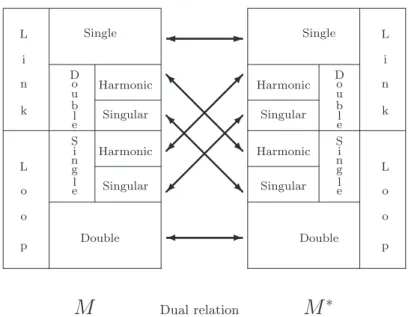
INTRODUCTORY MAP THEORY
Kapa & Omega, Glendale, AZ
USA
Yanpei LIU
Institute of Mathematics Beijing Jiaotong University Beijing 100044, P.R.China Email: [email protected]
Introductory Map Theory
Kapa & Omega, Glendale, AZ
USA
Books on Demand
ProQuest Information & Learning (University of Microfilm International) 300 N.Zeeb Road
P.O.Box 1346, Ann Arbor MI 48106-1346, USA
Tel:1-800-521-0600(Customer Service) http://wwwlib.umi.com/bod
Peer Reviewers:
L.F.Mao, Chinese Academy of Mathematics and System Science, P.R.China. J.L.Cai, Beijing Normal University, P.R.China.
H.Ren, East China Normal University, P.R.China. R.X.Hao, Beijing Jiaotong University, P.R.China.
Copyright 2010 by Kapa & Omega, Glendale, AZ and Yanpei Liu
Many books can be downloaded from the following Digital Library of Science:
http://www.gallup.unm.edu/∼smarandache/eBooks-otherformats.htm
Preface
Maps as a mathematical topic arose probably from the four color problem[Bir1, Ore1] and the more general map coloring problem[HiC1, Rin1, Liu11] in the mid of nineteenth century although maps as poly-hedra which go back to the Platonic age. I could not list references in detail on them because it is well known for a large range of readers and beyond the scope of this book. Here, I only intend to present a comprehensive theory of maps as a rigorous mathematical concept which has been developed mostly in the last half a century.
However, as described in the book[Liu15] maps can be seen as graphs in development from partition to permutation and as a basis extended to Smarandache geometry shown in [Mao3–4]. This is why maps are much concerned with abstraction in the present stage.
In the beginning, maps as polyhedra were as a topological, or ge-ometric object even with geographical consideration[Kem1]. The first formal definition of a map was done by Heffter from [Hef1] in the 19th century. However, it was not paid an attention by mathematicians until 1960 when Edmonds published a note in the AMS Notices with the dual form of Heffter’s in [Edm1,Liu3].
Although this concept was widely used in literature as [Liu1–2, Liu4–6, Rin1–3, Sta1–2, et al], its disadvantage for the nonorientable case involved does not bring with some convenience for clarifying some related mathematical thinking.
Since Tutte described the nonorientability in a new way [Tut1– 3], a number of authors begin to develop it in combinatorization of continuous objects as in [Lit1, Liu7–10, Vin1–2, et al].
However, the joint tree model of an embedding completed in recent years and initiated from the early articles at the end of seventies in the last century by the present author as shown in [Liu1–2] enables us to make the complication much simpler.
Because of the generality that an asymmetric object can always be seen with some local symmetry in certain extent, the concepts of graphs and maps are just put in such a rule. In fact, the former is corresponding to that a group of two elements sticks on an edge and the later is that a group of four elements sticks on an edge such that a graph without symmetry at all is in company with local symmetry. This treatment will bring more advantages for observing the structure of a graph. Of course, the later is with restriction of the former because of the later as a permutation and the former as a partition.
The joint tree representation of an embedding of a graph on two dimensional manifolds, particularly surfaces(compact 2-manifolds without boundary in our case), is described in Chapter I for simplifying a number of results old and new.
This book contains the following chapters in company with re-lated subjects.
In Chapter I, the embedding of a graph on surfaces are much concerned because they are motivated to building up the theory of abstract maps related with Smarandache geometry.
The second chapter is for the formal definition of abstract maps. One can see that this matter is a natural generalization of graph em-bedding on surfaces.
The third chapter is on the duality not only for maps themselves but also for operations on maps from one surface to another. One can see how the duality is naturally deduced from the abstract maps described in the second chapter.
The fourth chapter is on the orientability. One can see how the orientability is formally designed as a combinatorial invariant. The fifth chapter concentrates on the classification of orientable maps. The sixth chapter is for the classification of nonorientable maps.
Preface v how the procedure is simplified for these classifications.
The seventh chapter is on the isomorphisms of maps and pro-vides an efficient algorithm for the justification and recognition of the isomorphism of two maps, which has been shown to be useful for de-termining the automorphism group of a map in the eighth chapter. Moreover, it enables us to access an automorphism of a graph.
The ninth and the tenth chapters observe the number of distinct asymmetric maps with the size as a parameter. In the former, only one vertex maps are counted by favorite formulas and in the latter, general maps are counted from differential equations. More progresses about this kind of counting are referred to read the recent book[Liu7] and many further articles[Bax1, BeG1, CaL1–2, ReL1–3, etc].
The next chapter, Chapter XI, only presents some ideas for ac-cessing the symmetric census of maps and further, of graphs. This topic is being developed in some other directions[KwL1–2] and left as a subject written in the near future.
From Chapter XII through Chapter XV, extensions from basic theory are much concerned with further applications.
Chapter XII discusses in brief on genus polynomial of a graph and all its super maps rooted and unrooted on the basis of the joint tree model. Recent progresses on this aspect are referred to read the articles [Liu13–15, LiP1, WaL1–2, ZhL1–2, ZuL1, etc].
Chapter XIII is on the census of maps with vertex or face par-titions. Although such census involves with much complication and difficulty, because of the recent progress on a basic topic about trees via an elementary method firstly used by the author himself we are able to do a number of types of such census in very simple way. This chapter reflects on such aspects around.
Chapter XIV is on graphs that their super maps are particularly considered for asymmetrical and symmetrical census via their semi-automorphism and semi-automorphism groups or via embeddings of graphs given [Liu19, MaL1, MaT1, MaW1, etc].
well definedness has been done, almost all of them have not yet been solved up to now.
Three appendices are compliment to the context. One provides the clarification of the concepts of polyhedra, surfaces, embeddings, and maps and their relationship. The other two are for exhaustively calculating numerical results and listing all rooted and unrooted maps for small graphs with more calculating results compared with those appearing in [Liu14], [Liu17] and [Liu19].
From a large amount of materials, more than hundred observa-tions for beginners probably senior undergraduates, more than hun-dred exercises for mainly graduates of master degree and more than hundred research problems for mainly graduates of doctoral degree are carefully designed at the end of each chapter in adapting the needs of such a wide range of readers for mastering, extending and investigat-ing a number of ways to get further development on the basic theory of abstract maps.
Although I have been trying to design this book self contained as much as possible, some books such as [DiM1], [Mss1] and [GaJ1] might be helpful to those not familiar with basic knowledge of permutation groups, topology and computing complexity as background.
Since early nineties of the last century, a number of my former and present graduates were or are engaged with topics related to this book. Among them, I have to mention Dr. Ying Liu[LpL1], Dr. Yuan-qiu Huang[HuL1], Dr. Junliang Cai[CaL1–2], Dr. Deming Li[LiL1], Dr. Han Ren[ReL1–3], Dr. Rongxia Hao[HaC1, HaL1], Dr. Zhaox-iang Li[LiQ1–2], Dr. Linfan Mao[MaL1, MaT1, MaW1], Dr. Er-ling Wei[WiL1–2], Dr. Weili He[HeL1], Dr. Liangxia Wan[WaL1–2], Dr. Yichao Chen[CnL1, CnR1], Dr. Yan Xu[XuL1–2], Dr. Wen-zhong Liu[LwL1–2], Dr. Zeling Shao[ShL1], Dr. Yan Yang[YaL1–2], Dr. Guanghua Dong[DoL1], Ms. Ximei Zhao[ZhL1–2], Mr. Lifeng Li[LiP1], Ms. Huiyan Wang[WgL1], Ms. Zhao Chai[CiL1], Mr. Zi-long Zhu[ZuL1], et al for their successful work related to this book.
(Com-Preface vii binatorial and Computational Mathematics Research Center) of the Pohang University of Science and Technology in the summer of 2001. In that period, the intention of this book was established. Moreover, I should be also appreciated to the Natural Science Foundation of China for the research development reflected in this book under its Grants(60373030, 10571013, 10871021).
Preface . . . .iii
Chapter I Abstract Embeddings . . . .1
I.1 Graphs and networks . . . 1
I.2 Surfaces . . . 9
I.3 Embeddings . . . 16
I.4 Abstract representation . . . 22
I.5 Smarandache 2-manifolds with map geometry . . . 27
Activities on Chapter I . . . .32
I.6 Observations . . . 32
I.7 Exercises . . . 34
I.8 Researches. . . .37
Chapter II Abstract Maps . . . .41
II.1 Ground sets . . . 41
II.2 Basic permutations . . . 43
II.3 Conjugate axiom . . . 46
II.4 Transitive axiom . . . 49
II.5 Included angles . . . 55
Activities on Chapter II . . . .57
II.6 Observations. . . .57
II.7 Exercises . . . 58
II.8 Researches . . . 59
Chapter III Duality . . . .65
x Contents
III.2 Deletion of an edge . . . 72
III.3 Addition of an edge . . . 85
III.4 Basic transformation . . . 96
Activities on Chapter III . . . .98
III.5 Observations . . . 98
III.6 Exercises . . . 99
III.7 Researches . . . 101
Chapter IV Orientability . . . 103
IV.1 Orientation . . . 103
IV.2 Basic equivalence . . . 107
IV.3 Euler characteristic . . . 113
IV.4 Pattern examples . . . 116
Activities on Chapter IV . . . .119
IV.5 Observations. . . 119
IV.6 Exercises . . . 120
IV.7 Researches . . . 122
Chapter V Orientable Maps . . . .124
V.1 Butterflies . . . 124
V.2 Simplified butterflies . . . 126
V.3 Reduced rules . . . 130
V.4 Orientable principles. . . 134
V.5 Orientable genus. . . 137
Activities on Chapter V . . . .139
V.6 Observations . . . 139
V.7 Exercises . . . 140
V.8 Researches. . . .142
Chapter VI Nonorientable Maps . . . .145
VI.2 Simplified barflies . . . 149
VI.3 Nonorientable rules . . . 151
VI.4 Nonorientable principles . . . 156
VI.5 Nonorientable genus . . . 157
Activities on Chapter VI . . . .159
VI.5 Observations. . . 159
VI.6 Exercises . . . 160
VI.7 Researches . . . 162
Chapter VII Isomorphisms of Maps . . . .164
VII.1 Commutativity . . . 164
VII.2 Isomorphism theorem . . . 168
VII.3 Recognition . . . 172
VII.4 Justification . . . 177
VII.5 Pattern examples . . . 180
Activities on Chapter VII . . . .185
VII.6 Observations . . . 185
VII.7 Exercises . . . 186
VII.8 Researches . . . 188
Chapter VIII Asymmetrization . . . 190
VIII.1 Automorphisms . . . 190
VIII.2 Upper bound of group order. . . .193
VIII.3 Determination of the group . . . 196
VIII.4 Rootings . . . 201
Activities on Chapter VIII . . . .206
VIII.5 Observations . . . 206
VIII.6 Exercises. . . 207
xii Contents
Chapter IX Rooted Petal Bundles . . . .212
IX.1 Orientable petal bundles . . . 212
IX.2 Planar pedal bundles . . . 217
IX.3 Nonorientable pedal bundles . . . 220
IX.4 The number of pedal bundles . . . 226
Activities on Chapter IX . . . .230
IX.5 Observations. . . 230
IX.6 Exercises . . . 231
IX.7 Researches . . . 232
Chapter X Asymmetrized Maps . . . 235
X.1 Orientable equation. . . .235
X.2 Planar rooted maps. . . 243
X.3 Nonorientable equation . . . 250
X.4 Gross equation . . . 255
X.5 The number of rooted maps . . . 258
Activities on Chapter X . . . .261
X.6 Observations . . . 261
X.7 Exercises . . . 262
X.8 Researches. . . .265
Chapter XI Maps with Symmetry . . . .268
XI.1 Symmetric relation . . . 268
XI.2 An application . . . 270
XI.3 Symmetric principle . . . 272
XI.4 General examples . . . 274
Activities on Chapter XI . . . .278
XI.5 Observations. . . 278
XI.6 Exercises . . . 279
Chapter XII Genus Polynomials . . . .282
XII.1 Associate surfaces . . . 282
XII.2 Layer division of a surface . . . 285
XII.3 Handle polymomials . . . 289
XII.4 Crosscap polynomials . . . 290
Activities on Chapter XII . . . .292
XII.5 Observations . . . 292
XII.6 Exercises . . . 293
XII.7 Researches . . . 294
Chapter XIII Census with Partitions . . . .297
XIII.1 Planted trees . . . 297
XIII.2 Hamiltonian cubic maps . . . 305
XIII.3 Halin maps . . . 307
XIII.4 Biboundary inner rooted maps . . . 310
XIII.5 General maps . . . 315
XIII.6 Pan-flowers . . . 317
Activities on Chapter XIII . . . .323
XIII.7 Observations . . . 323
XIII.8 Exercises. . . 324
XIII.9 Researches . . . 325
Chapter XIV Super Maps of a Graph . . . .326
XIV.1 Semi-automorphisms on a graph . . . 326
XIV.2 Automorphisms on a graph . . . 329
XIV.3 Relationships . . . 332
XIV.4 Nonisomorphic super maps . . . 334
XIV.5 Via rooted super maps . . . 336
Activities on Chapter XIV . . . .341
xiv Contents
XIV.7 Exercises . . . 342
XIV.8 Researches . . . 334
Chapter XV Equations with Partitions . . . 345
XV.1 The meson functional . . . 345
XV.2 General maps on the sphere . . . 350
XV.3 Nonseparable maps on the sphere . . . 353
XV.4 Maps without cut-edge on furfaces . . . 357
XV.5 Eulerian maps on the sphere . . . 361
XV.6 Eulerian maps on surfaces. . . .365
Activities on Chapter XV . . . .370
XV.7 Observations . . . 370
XV.8 Exercises . . . 371
XV.9 Researches . . . 372
Appendix I Concepts of Polyhedra, Surfaces, Embeddings and Maps . . . 374
Ax.I.1 Polyhedra . . . 374
Ax.I.2 Surfaces . . . 377
Ax.I.3 Embeddings . . . 381
Ax.I.4 Maps . . . 384
Appendix II Table of Genus Polynomials for Embeddings and Maps of Small Size . . . 389
Ax.II.1 Triconnected cubic graphs . . . 389
Ax.II.2 Bouquets . . . 398
Ax.II.3 Wheels. . . 401
Ax.II.4 Link bundles . . . 403
Ax.II.5 Complete bipartite graphs. . . 405
Appendix III Atlas of Rooted and Unrooted Maps
for Small Graphs . . . 409
Ax.III.1 Bouquets Bm of size 4 ≥ m ≥ 1 . . . 409
Ax.III.2 Link bundles Lm of size 7 ≥m ≥3 . . . 415
Ax.III.3 Complete bipartite graphs Km,n,4≥ m, n ≥ 3 . . . 432
Ax.III.4 Wheels Wn of order 6≥ n≥ 4 . . . 437
Ax.III.5 Complete graphs Kn, 5 ≥n ≥ 4 . . . 447
Ax.III.6 Triconnected cubic graphs of size in [6,15] . . . 452
Bibliography . . . .472
Chapter I
Abstract Embeddings
• A graph is considered as a partition on the union of sets obtained from each element of a given set the binary groupB = {0,1}sticks on.
• A surface, i.e., a compact 2-manifold without boundary in topol-ogy, is seen as a polygon of even edges pairwise identified.
• An embedding of a graph on a surface is represented by a joint tree of the graph. A joint of a graph consists of a plane extended tree with labelled cotree semi-edges. Two semi-edges of a cotree edge has the same label as the cotree edge with a binary index. An extended tree is compounded of a spanning tree with cotree semi-edges.
• Combinatorial properties of an embedding in abstraction are par-ticularly discussed for the formal definition of a map.
I.1 Graphs and networks
LetX be a finite set. For any x∈ X, the binary groupB = {0,1}
sticks on x to obtain Bx = {x(0), x(1)}. x(0) and x(1) are called the
x(0) and x(1) are, respectively,initial and terminal ends of x. Let
X = X
x∈X
Bx, (1.1)
i.e., the disjoint union of all Bx, x ∈ X. X is called the ground set. A (directed) pregraph is a partition Par= {P1, P2, · · ·} of the
ground set X,i.e.,
X = X
i≥1
Pi. (1.2)
Bx (or hx(0), x(1)i), or simply denoted by x itself, x ∈ X, is called an (arc) edge and Pi, i ≥ 1, a node or vertex.
A (directed) pregraph is written as G = (V, E) where V =Par and
E = B(X) = {Bx|x ∈ X}
(= {hx(0), x(1)i|x∈ X}).
If X is a finite set, the (directed) pregraph is called finite; otherwise,
infinite. In this book, (directed) pregraphs are all finite.
If X = ∅, then the (directed) pregraph is said to be empty as well.
An edge (arc) is considered to have two semiedges each of them is incident with only one end (semiarcs with directions of one from the end and the other to the end). An edge (arc) is with two ends identified is called a selfloop (di-selfloop); otherwise, a link (di-link). If
t edges (arcs) have same ends (same direction) are called a multiedge (multiarc), or t-edge (t-arc).
Example 1.1 There are two directed pregraphs on X = {x},
i.e.,
Par1 = {{x(0)},{x(1)}};
Par2 = {{x(0), x(1)}}.
I.1 Graphs and networks 3
> x
+ x
Par1 Par2
Fig.1.1 Directed pregraphs of 1 edge
Further, pregraphs of size 2 are observed.
Example 1.2 On X = {x1, x2}, the 15 directed pregraphs are
as follows:
Par1 = {{x1(0)},{x1(1)},{x2(0)},{x2(1)}};
Par2 = {{x1(0), x1(1)},{x2(0)},{x2(1)}};
Par3 = {{x1(0), x2(0)},{x1(1)},{x2(1)}};
Par4 = {{x1(0), x2(1)},{x1(1)},{x2(0)}};
Par5 = {{x1(0)},{x1(1), x2(0)},{x2(1)}};
Par6 = {{x1(0)},{x1(1), x2(1)},{x2(0)}};
Par7 = {{x1(0)},{x1(1)},{x2(1), x2(0)}};
Par8 = {{x1(0), x1(1), x2(0)},{x2(1)}};
Par9 = {{x1(0), x1(1), x2(1)},{x2(0)}};
Par10 = {{x1(0), x2(0), x2(1)},{x1(1)}};
Par11 = {{x1(0)},{x1(1), x2(0), x2(1)}};
Par12 = {{x1(0), x1(1), x2(0), x2(1)}};
Par13 = {{x1(0), x1(1)},{x2(0), x2(1)}};
Par14 = {{x1(0), x2(0)},{x1(1), x2(1)}};
Par15 = {{x1(0), x2(1)},{x1(1), x2(0)}}.
Among the 15 directed pregraphs, Par3, Par4, Par5 and Par6
are 1 pregraph; Par8 and Par9 are 1 pregraph; Par10 and Par11 are 1
pregraph; Par14 and Par15 are 1 pregraph; and others are 1 pregraph
x1 x2
x1 x2 Mx
1 x2
Par1 Par2 Par3
/ M
x1 x2
N
x1 x2
/ N x1 x2
Par4 Par5 Par6
x1 x2
N
x1 x2
? x1 x2
Par7 Par8 Par9
M
x1 x2
N x1 x2
? x1 x2
Par10 Par11 Par12
?
x1 x2
-6
x1
x2
x1
x2
Par13 Par14 Par15
Fig.1.2 Directed pregraphs of 2 edges
Now, Par= {P1, P2,· · ·} and B are, respectively, seen as a
map-ping z 7→ Pi, z ∈ Pi, i ≥ 1 and a mapping z 7→ z¯, ¯z 6= z, {z,z¯} ∈
I.1 Graphs and networks 5
to be the mapping
(αβ)z = [
y∈βz
αy, z ∈ Z. (1.3)
Let Ψ{Par,B} be the semigroup generated by Par=Par(X) and B =
B(X). Since the mappings α =Par and B have the property that
y ∈ αz ⇔z ∈ αy, it can be checked that for any z, y ∈ B(X), what is determined by
∃γ ∈ Ψ{Par,B}, z ∈ γy
is an equivalence. If B(X) itself is a equivalent class, then the semi-group Ψ{Par,B} is calledtransitive onX = B(X). A (directed)pregraph
with Ψ{Par,B} transitive on X is called a (directed )graph .
A (directed)pregraphG = (V, E) that for any two vertices u, v ∈
V, there exists a sequence of edges e1, e2,· · ·, es for the two ends of ei,
i = 2,3,· · ·, s−1, are in common with those of respectiveei−1 andei+1
where u and v are, respectively, the other ends of e1 and es, is called
connected . Such a sequence of edges is called a trail between u and
v. A trail without edge repetition is a walk. A walk without vertex repetition is a path. A trail, walk, or path with u = v is, respectively, a travel, tour, or circuit.
Theorem 1.1 A (directed)pregraph is a (directed)graph if, and only if, it is connected.
Proof Necessity. Since Park = Par, k ≥ 1, and Bk = B, k ≥ 1,
by the transitivity, for any two elements y, z ∈ X, there exists γ such that z ∈ γy and there exists an integer n≥ 0 such that
γ = (BPar)nB = (BPar)· · ·(BPar)
| {z }
n
B, (1.4)
where BPar appears for n times. Therefore, the (directed)pregraph is connected.
Sufficiency. If a (directed)pregraph is connected, i.e., for any two elements x, y ∈ X, their incident vertices u, v ∈ V, have edges
and ei+1. Of course, u and v are, respectively, the ends of e1 and es.
Thus, y ∈ γz whereγ = (ParB)sB. This implies that the semigroup Ψ{Par,B} is transitive on X. Therefore, the (directed)pregraph is a
(directed)graph.
It is seen from the theorem that (directed) graphs here are, in fact, connected (directed) graphs in most textbooks. Because discon-nectedness is rarely necessary to consider, for convenience all graphs, embeddings and then maps in what follows are defined within con-nectedness in this book.
A network N is such a graph G = (V, E) with a real function
w(e) ∈ R, e ∈ E on E, and hence write N = (G;w). Usually, a network N is denoted by the graph G itself if no confusion occurs.
Finite recursion principle On a finite set A, choose a0 ∈ A
as the initial element at the 0th step. Assume ai is chosen at the ith,
i ≥ 0, step with a given rule. If not all elements available from ai are
not yet chosen, choose one of them as ai+1 at the i + 1st step by the
rule, then a chosen element will be encountered in finite steps unless all elements of A are chosen.
Finite restrict recursion principle On a finite setA, choose
a0 ∈ A as the initial element at the 0th step. Assume ai is chosen at
the ith, i ≥ 0, step with a given rule. If a0 is not available from ai,
choose one of elements available from ai as ai+1 at the i+ 1st step by
the rule, then a0 will be encountered in finite steps unless all elements
of A are chosen.
The two principles above are very useful in finite sets, graphs and networks, even in a wide range of combinatorial optimizations.
A G = (V, E) with V = V1 +V2 of both V1 and V2 independent, i.e., its vertex set is partitioned into two parts with each part having no pair of vertices adjacent, is called bipartite.
Theorem 1.2 A graph G = (V, E) is bipartite if, and only if,
G has no circuit with odd number of edges.
ini-I.1 Graphs and networks 7
tially chosen and then by the rule from the vertex just chosen to one of its adjacent vertices via an edge unused and then marked by used, according to the finite recursion principle, an even circuit (from bipar-tite), or no circuit at all, can be found. From the arbitrariness of v0
and the way going on, no circuit of G is with odd number of edges. Sufficiency. Since all circuits are even, start from marking an arbitrary vertex by 0 and then by the rule from a vertex marked by b ∈ B = {0,1} to mark all its adjacent vertices by b = 1 − b, according to the finite recursion principle the vertex set is partitioned into V0 = {v ∈ V| marked by 0} and V1 = {v ∈ V| marked by 1}. By
the rule, V0 and V1 are both independent and hence G is bipartite.
From this theorem, a graph without circuit is bipartite. In fact, from the transitivity, any graph without circuit is a tree.
On a pregraph, the number of elements incident to a vertex is called the degree of the vertex. A pregraph of all vertices with even degree is said to be even . If an even pregraph is a graph, then it is called a Euler graph.
Theorem 1.3 A pregraph G = (V, E) is even if, and only if, there exist circuits C1, C2,· · ·, Cn, on G such that
E = C1 +C2 +· · ·+Cn, (1.5)
where n is a nonnegative integer.
Proof Necessity. Since all the degrees of vertices on G are even, any pregraph obtained by deleting the edges of a circuit fromG is still even. From the finite recursion principle, there exist a nonnegative integer n and circuits C1, C2,· · ·, Cn, on G such that (1.5) is satisfied.
Sufficiency. Because a circuit contributes 2 to the degree of each of its incident vertices, (1.5) guarantees each of vertices on Ghas even
degree. Hence, G is even.
The set of circuits {Ci|1 ≤ i ≤ n} of G in (1.5) is called a
other is for G is a directed pregraph. Their forms and proofs are left for the reader.
Let N = (G;w) be a network where G = (V, E) and w(e) =
−w(e) ∈ Zn = {0,1,· · ·, n − 1}, i.e., mod n, n ≥ 1, integer group.
For examples, Z1 = {0}, Z2 = B = {0,1} etc. Suppose xv = −xv ∈
Zn, v ∈ V, are variables. Let us discuss the system of equations
xu+xv = w(e) (mod n), e = (u, v) ∈ E (1.6)
on Zn.
Theorem 1.4 System of equations(1.6) has a solution on Zn
if, and only if, there is no circuit C such that
X
e∈C
w(e) 6= 0 (mod n) (1.7)
on N.
Proof Necessity. Assume C is a circuit satisfying (1.7) on N. Because the restricted part of (1.6) on C has no solution, the whole system of equations (1.6) has to be no solution either. Therefore, N
has no such circuit. This is a contradiction to the assumption
Sufficiency. Letx0 = a ∈ Zn, start from v0 ∈ V reached. Assume
vi ∈ V reached and xi = ai at step i. Choose one of ei = (vi, vi+1) ∈ E
without used(otherwise, backward 1 step as the step i). Choose vi+1
reached and ei used with ai+1 = ai +w(ei) at step i + 1. If a circuit
as {e0, e1,· · ·, el}, ej = (vj, vj+1),0 ≤ j ≤ l, vl+1 = v0, occurs within a
permutation of indices, then from (1.7)
al+1 = al + w(el)
= al−1+ w(el−1) +w(el)
· · · ·
= a0 +
l
X
j=0
w(ej)
I.2 Surfaces 9
Because the system of equations obtained by deleting all the equations for all the edges on the circuit from (1.6) is equivalent to the original system of equations (1.6), in virtue of the finite recursion principle a
solution of (1.6) can always be extracted .
Whenn = 2, this theorem has a variety of applications. In [Liu5], some applications can be seen. Further, its extension on a nonAbelian group can also be done while the system of equations are not yet linear but quadratic.
I.2 Surfaces
In topology, a surface is a compact 2-dimensional manifold with-out boundary. In fact, it can be seen as what is obtained by identifying each pair of edges on a polygon of even edges pairwise.
For example, in Fig.1.3, two ends of each dot line are the same point. The left is a sphere, or the plane when the infinity is seen as a point. The right is the projective plane. From the symmetry of the sphere, a surface can also seen as a sphere cutting off a polygon with pairwise edges identified.
The two surfaces in Fig.1.3 are formed by a polygon of two edges pairwise as a.
R
a
a
I
R
a
a
Sphere(Plane) Projective plane
Surface closed curve axiom A closed curve on a surface has one of the two possibilities: one side and two sides.
A curve with two sides is called a double side curve ; otherwise, a
single side curve . As shown in Fig.1.3, any closed curve on a sphere is a double side curve(In fact, this is the Jordan curve axiom). However, it is different from the sphere for the projective plane. there are both a single(shown by a dot line) and a double side curve.
How do we justify whether a closed curve on a surface is of single side, or not?
In order to answer this question, the concept of contractibility of a curve has to be clarified. If a closed curve on a surface can be continuously contracted along one side into a point, then it is said to be contractible, or homotopic to 0.
6 6
-a
a
b b
6
-?
a
a
b
b
Torus Klein bottle
Fig.1.4 Torus and Klein bottle
It is seen that a single side curve is never homotopic to 0 and a double side curve is not always homotopic to 0. For example, in Fig.1.4, the left, i.e., the torus, each of the dot lines is of double side but not contractible. The right, i.e., the Klein bottle, all the dot lines are of single side , and hence, none of them is contractible.
A surface with all closed curves of double side is calledorientable; otherwise, nonorientable .
projec-I.2 Surfaces 11
tive plane is nonorientable. In Fig.1.4, the torus is orientable and the Klein bottle is nonorientable.
The maximum number of closed curves cutting along without destroying the continuity on a surface is called the pregenus of the surface.
In view of Jordan curve axiom, there is no such closed curve on the sphere. Thus, the pregenus of sphere is 0. On the projective plane, only one such curve is available (each of dot lines is such a closed curve in Fig.1.3) and hence the pregenus of projective plane is 1.
Similarly, the pregenera of torus and Klein bottle are both 2 as shown in Fig.1.4.
Theorem 1.5 The pregenus of an orientable surface is a non-negative even number.
A formal proof can not be done until Chapter 5. Based on this theorem, the genus of an orientable surface can be defined to be half its pregenus, called theorientable genus. The genus of a nonorientable surface, called nonorientable genus, is its pregenus itself.
The sphere is written as aa−1 where a−1 is with the opposite direction of a on the boundary of the polygon. Thus, the projective plane, torus and Klein bottle are, respectively, aa, aba−1b−1 and aabb. In general,
Op = p
Y
i=1
aibia−i 1b−i 1
= a1b1a−11b1−1a2b2a2−1b−21· · ·apbpa−p1b−p1
(1.8)
and
Qq = q
Y
i=1
aiai = a1a1a2a2· · ·aqaq (1.9)
denote, respectively, a surface of orientable genus p and a surface of nonorientable genus q. Of course, O0, Q1, O1 and Q2 are, respectively,
the sphere, projective plane, torus and Klein bottle.
nonori-entable surface. Thus, all Op, p ≥ 0, orientable and all Qq, q ≥ 1, are
nonorientable.
Forms (1.8) and (1.9) are said to be standard.
If theform of a surface is defined by its orientability and its genus, then the operations 1–3 and their inverses shown as in Fig.1.5–7, do not change the surface form.
... ...... ... ... ... ... ... ... ... ... ... ... ... ... ... ... ... ... .... .... .... .... .... .... .... .... .... . o A a a .... .... .... .... .... .... .... .... .... .... .... .... ...... ...... ...... ... ... ... ... ... A /
Fig.1.5 Operation 1: Aaa−1 ⇐⇒A
... ... ... ... ... ... ... ... ... ... ...... ... ... ... ... ... ... .... ... ... ... ... ... ... ... ... . ℄ i N j a a b b A B ... ... ... ... ... ... ... ... ... ... ... ... ... } R c c A B
Fig.1.6 Operation 2: AabBab ⇐⇒AcBc
... ... ... ... .... ... ...... ... ... ... ... ... ... ... ... ... ... ... ... ... ... .. ......
.......B
A R ℄ ... ... ... ... .... ... ...... ... ... ... ... ... ... ... ... ... ... ... ... ... ... .. ......
.......B
A
K R
℄
a
Fig.1.7 Operation 3: AB ⇐⇒(Aa)(a−1B)
In fact, what is determined under these operations is just a
topo-logical equivalence, denoted by ∼top.
I.2 Surfaces 13
to be empty as degenerate case in these operations.
The parentheses stand for cyclic order when more than one cyclic orders occur for distinguishing from one to another.
Relation 0 On a surface (A, B), if A is a surface itself then (A, B) = ((A)x(B)x−1) = ((A)(B)).
Relation 1 (AxByCx−1Dy−1) ∼top ((ADCB)(xyx−1y−1)).
Relation 2 (AxBx) ∼top ((AB−1)(xx)).
Relation 3 (Axxyzy−1z−1) ∼
top ((A)(xx)(yy)(zz)).
In the four relations,A, B, C, and D are permitted to be empty.
B−1 = b−s1· · ·b−31b−21b−11 is also called the inverse of B = b1b2b3· · ·bs,
s ≥ 1. Parentheses are always omitted when unnecessary to distin-guish cyclic or linear order.
On a surfaceS, the operation of cutting off a quadrangleaba−1b−1
and then identifying each pair of edges with the same letter is called a handle as shown in the left of Fig.1.8.
If the quadrangleaba−1b−1 is replaced by aa, then such an
oper-ation is called a crosscap as shown in the right of Fig.1.8.
-?
?
-a
a
b b
S
R Y
a
a
S
Handle Crosscap
Fig.1.8 Handle and crosscap
The following theorem shows the result of doing a handle on an orientable surface.
Proof Suppose S is the surface obtained, then
S ∼top
p
Y
i=1
aibia−i 1b−i 1xap+1bp+1a−p+11 b−p+11 x−1 ( Relation 0)
∼top
p
Y
i=1
aibia−i 1b−i 1xx−1ap+1bp+1a−p+11 b−p+11 (Relation 1)
∼top
p
Y
i=1
aibia−i 1b−i 1ap+1bp+1a−p+11 b−p+11 (Operation 1)
=
p+1
Y
i=1
aibia−i 1b−i 1.
This is the theorem.
In the above proof, x and x−1 are a line connecting the two boundaries to represent the surface as a polygon shown in Fig.1.8. This procedure can be seen as the degenerate case of operation 3.
In what follows, observe the result by doing a crosscap on an orientable surface.
Theorem 1.7 On an orientable surface of genusp,p ≥ 0, what is obtained by doing a crosscap is nonorientable with its genus 2p+ 1.
Proof Suppose N is the surface obtained, then
N ∼top
p
Y
i=1
aibia−i 1b−i 1xaax−1 (Relation 0)
∼top
p
Y
i=1
aibia−i 1bi−1xx−1c1c1 (Relation 2)
∼top
p
Y
i=2
aibia−i 1b−i 1xx−1c1c1c2c2c3c3 (Relation 3)
∼top 2p+1
Y
i=1
I.2 Surfaces 15
This is the theorem.
By doing a handle on a nonorientable surface, 2 more genus should be added with the same nonorientability.
Theorem 1.8 On a nonorientable surface, what is obtained by doing a handle is nonorientable with its genus 2 added.
Proof Suppose N is the obtained surface, then
N ∼top
q
Y
i=1
aiaixaba−1b−1x−1 (Relation 0)
∼top
q
Y
i=1
aiaixx−1aba−1b−1 (Relation 1)
∼top
q
Y
i=1
aiaiaba−1b−1 (Operation 1)
∼top
q+2
Y
i=1
cici. (Relation 3).
This is the theorem.
By doing a crosscap on a nonorientable surface, 1 more genus produced with the same nonorientability
Proof Suppose N is the obtained surface, then
N ∼top
q
Y
i=1
aiaixaax−1 (Relation 0)
∼top
q
Y
i=1
aiaixx−1aa (Relation 2)
∼top
q
Y
i=1
aiaiaa (Operation 1)
∼top
q+1
Y
i=1
aiai. (Relation 3).
This is the theorem.
I.3 Embedding
Let G = (V, E), V = {v1, v2,· · ·, vn}, be a graph. A point in the
3-dimensional space is represented by a real number t as the parame-ter, e.g., (x, y, z) = (t, t2, t3). Write the vertices as
vi = (xi, yi, zi) = (ti, t2i, t3i)
such that ti 6= tj, i 6= j, 1≤ i, j ≤ n, and an edge as
(u, v) = u+λv, 1≤ λ ≤1,
i.e., the straight line segment between u and v. Because for any four vertices vi, vj, vl and vk,
det
xi −xj xi −xl xi−xk
yi −yj yi −yl yi −yk
zi −zj zi −zl zi −zk
!
= det
ti −tj ti −tl ti−tk
t2i −t2j t2i −t2l t2i −t2k t3i −t3j t3i −t3l t3i −t3k
I.3 Embedding 17
= (ti −tj)(ti −tl)(ti −tk)(tk −tl)(tk −tj)(tj −tl) 6= 0, i.e., the four
points are not coplanar, any two edges in G has no intersection inner point.
A representation of a graph on a space with vertices as points and edges as curves pairwise no intersection inner point is called an
embedding of the graph in the space. If all edges are straight line segments in an embedding, then it is called a straight line embedding. Thus, any graph has a straight line embedding in the 3-dimensional space. Similarly, A surface embedding of graph G is a continuous injection µG of an embedding of G on the 3-dimensional space to a surface S such that each connected component of S−µG is homotopic to 0. The connected component is called a face of the embedding. In early books, a surface embedding is also called a cellular embedding. Because only a surface embedding is concerned with in what follows, an embedding is always meant a surface embedding if not necessary to specify.
A graph without circuit is called a tree. A spanning tree of a graph is such a subgraph that is a tree with the same order as the graph. Usually, a spanning tree of a graph is in short called a tree on the graph. For a tree on a graph, the numbers of edges on the tree and not on the tree are only dependent on the order of the graph. They are, respectively, called the rank and the corank of the graph. The corank is also called the Betti number, or cyclic number by some authors.
The following procedure can be used for finding an embedding on a surface.
First, given a cyclic order of all semiedges at each vertex of G, called a rotation. Find a tree(spanning, of course) T on G and distin-guish all the edges not on T by letters. Then, replace each edge not of T by two articulate edges with the same letter.
a surface in correspondence with a choice of indices on each pair of the same letter. For convenience, ˜G with a choice of indices of pair in the same letter is called a joint tree of G.
Theorem 1.10 A graphG = (V, E) can always embedded into a surface of orientable genus at most ⌊β/2⌋, or of nonorientable genus at most β, where β is the Betti number of G.
Proof It is seen that any joint tree of G is an embedding of G
on the surface determined by its associate polygon. From (1.8) for the orientable case, the surface has its genus at most ⌊2β/4⌋= ⌊β/2⌋. From (1.9) for the nonorientable case, the surface has its genus at most
2β/2 = β.
In Fig.1.9, graph Gand one of its joint tree are shown. Here, the spanning tree T is represented by edges without letter. a, b and c are edges not on T. Because the polygon is
abcacb ∼top c−1b−1cbaa (Relation 2)
∼top aabbcc (Theorem 1.7),
the joint tree is, in fact, an embedding ofG on a nonorientable surface of genus 3.
a
b c
a a
b
b
c
c
G G˜
Fig.1.9 Graph and its joint tree
I.3 Embedding 19
by letters. Different indices of the two semiedges of an edge stand for from one side of the edge to the other on a face boundary in an embedding.
Theorem 1.11 A tree can only be embedded on the sphere. Any graphG except tree can be embedded on a nonorientable surface. Any graph G can always be embedded on an orientable surface. Let
nO(G) be the number of distinct embeddings on orientable surfaces,
then the number of embeddings on all surfaces is
2β(G)nO(G), nO(G) =
Y
i≥2
((i−1)!)ni, (1.10)
where β(G) is the Betti number and ni is the number of vertices of
degree i in G.
Proof On a surface of genus not 0, only a graph with at least a circuit is possible to have an embedding. Because a tree has no circuit, it can only embedded on the sphere. Because a graph not a tree has at least one circuit, from Theorem 1.10 the second and the third statements are true. Since distinct planar embeddings of a joint tree of G with the indices of each letter different correspond to distinct embeddings of G on orientable surfaces and the number of distinct planar embeddings of joint trees is
nO(G) =
Y
i≥2
((i−1)!)ni.
Further, since the indices of letters on the β(G) edges has 2β(G) of choices for a given orientable embedding and among them only one choice corresponds to an orientable embedding, the fourth statement
is true.
For an embedding µ(G) of G on a surface, let ν(µG), ǫ(µG) and
φ(µG) are, respectively, its vertex number, or order, edge number, or
size and face number, or coorder.
Theorem 1.12 For a surfaceS, all embeddingsµ(G) of a graph
on S and independent of G. Further,
Eul(µG) =
2−2p, p ≥0,
when S has orientable genus p; 2−q, q ≥ 1,
when S has nonorientable genus q.
(1.11)
Proof For an embedding µ(G) on S, if it has at least 2 faces, then by connectedness it has 2 faces with a common edge. From the finite recursion principle, by the inverse of Operation 3 an embedding
µ(G1) of G1 on S with only 1 face on S is found. It is easy to check
that Eul(µG) =Eul(µG1). Similarly, by the inverse of Operation 2 an
embedding µ(G0) of G0 on S with only 1 vertex is found. It is also
easy to check that Eul(µG) =Eul(µG′). Further, by Operation 1 and Relations 1–3, it is seen that Eul(µG0) =Eul(Op), p ≥ 0; or Eul(Qq),
q ≥ 1 according as S is an orientable surface in (1.8); or not in (1.9). From the arbitrariness of G, the first statement is proved.
By calculating the order, size and coorder of Op, p ≥ 0; or Qq,
q ≥ 1, (1.11) is soon obtained. So, the second statement is proved. According to this theorem, for an embedding µ(G) of graph G, Eul(µG) is called its Euler characteristic, or of the surface it is on. Further, g(µG) is the genus of the surface µ(G) is on.
If a graph G is with the minimum length of circuits σ, then from Theorem 1.12 the genus γ(G) of an orientable surface G can be embedded on satisfies the inequality
1− ν(G)−ǫ(1−
2
σ)
2 ≤γ(G) ≤ ⌊
β
2⌋ (1.12)
and the genus ˜γ(G) of a nonorientable surface G can be embedded on satisfies the inequality
2−(ν(G)−ǫ(1− 2
σ)) ≤ γ˜(G) ≤ β. (1.13)
I.3 Embedding 21
fact, a graph is up-embeddable on nonorientable, or orientable sur-faces according as it has an embedding with only 1 face, or at most 2 faces.
Theorem 1.13 All graphs but trees are up-embeddable on nonorientable surfaces.
Further, if a graph has an embedding of nonorientable genus l
and an embedding of nonorientable genus k, l < k, then for any i,
l < i < k, it has an embedding of nonorientable genus i.
Proof For an arbitrary embedding of a graph G on a nonori-entable surface, letT be its corresponding joint tree. From the nonori-entability, the associate 2β(G)-gonP has at least 1 letter with different indices(or same power of its two occurrences!). If P = Qq, q = β(G),
then the embedding is an up-embedding in its own right. Otherwise, by Relation 2, or Relation 3 if necessary, whenever s−1s or stst oc-curs, it is, respectively, replaced by ss or sts−1t. In virtue of no letter
missed in the procedure, from the finite recursion principle, P′ = Qq,
q = β(G), is obtained. This is the first statement.
From the arbitrariness of starting embedding in the procedure of proving the first statement by only using Relation 2 instead of Relation 3 (AststB ∼top Ass−1Btt by Relation 2), because the genus
of the surface is increased 1 by 1, the the second statement is true.
I.4 Abstract representation
Let G = (V, X), V = {v1, v2,· · ·, vn},
X = {x1, x2,· · ·, xm} ⊆ V{×}V = {{u, v}|∀u, v ∈ V},
be a graph. For an embedding µ(G) of G on a surface, each edge has not only two ends as in G but also two sides. Let α be the operation from one side to the other and β be the operation from one end to the other. From the symmetry between the two ends and between the two sides,
α2 = β2 = 1 (1.14)
where 1 is the identity. By considering that the result from one side to the other and then to the other end and the result from one end to the other and then to the other side are the same, i.e.,
βα = αβ. (1.15)
Further, it can be seen thatK = {1, α, β, γ},γ = αβ, is a group, called the Klein group where
(αβ)2 = (αβ)(αβ) = (αβα)β
= (ααβ)β = (αα)(ββ) = 1. (1.16)
Thus, an edge x ∈ X of G in an embedding µ(G) of G becomes
Kx= {x, αx, βx, γx}, as shown in Fig.1.10.
x βx
αx αβx
Fig.1.10 An edge sticking onK
In fact, let
X =
m
X
i=1
I.4 Abstract representation 23
where summation stands for the disjoint union, thenα andβ can both be seen as a permutation on X, i.e.,
α =
m
Y
i=1
(xi, αxi)(βxi, γxi), β = m
Y
i=1
(xi, βxi)(αxi, γxi).
The vertex x is on deals with the rotation as
{(x,Px,P2x,· · ·),(αx, αP−1x, αP−2x,· · ·)}, (1.18) as shown in Fig.1.11(when its degree is 4).
-x αx βx αβx
P2x
αP2x
βP2x
αβP2x
66 ??
Px αPx βPx αβP2x
??
66
P3x
αP3x
βP3x
αβP3x
v
Fig.1.11 The rotation at a vertex
It is seen thatP is also a permutation on X. The set of elements in each cycle of this permutation is called an orbit of an element in the cycle. For example, the orbit of element x under permutation P is denoted by (x)P. From (1.18),
(x)P\(αx)P = ∅, x∈ X. (1.19) The two cycles at a vertex in an embedding have a relation as
(αx,Pαx,P2αx,· · ·) =(αx, αP−1x, αP−2x,· · ·) =α(x,P−1x,P−2x,· · ·).
(1.20)
For convenience, one of the two cycles is chosen to represent the vertex,
i.e.,
or
(αx, αP−1x, αP−2x,· · ·).
Theorem 1.14 αP = P−1α.
Proof By multiplying the two sides of (1.20) by α from the left and then comparing the second terms on the two sides,
αPα = P−1.
By multiplying its two sides by α from the right, the theorem is soon
obtained.
Sinceα andβ are both permutations on X, γ = αβ and P∗ = Pγ are permutations on X as well. Let
(x,P∗x,P∗2x,· · ·)
be the cycle of P∗ involving x. From the symmetry between βx and
x, the cycle of P∗ involving βx is
(βx,P∗βx,P∗2βx,· · ·)
which has the same number of elements as that involving x does. Because P∗(βx) = Pαβ(βx) = Pαx and from Theorem 1.14
Pαx = αP−1x= αγ(γP−1)x
= αγP∗−1x
= βP∗−1x,
we have
P∗(βx) = βP∗−1x. (1.21)
Furthermore, because P∗2(βx) = P∗(P∗(βx)) and from (1.21)
P∗(P∗(βx)) =P∗(βP∗−1x),
by (1.21) for P∗−1x instead of x, we have
I.4 Abstract representation 25
On the basis of the finite restrict recursion principle, a cycle is found. Therefore,
(βx,P∗βx,P∗2βx,· · ·) = β(x,P∗−1x,P∗−2x,· · ·). (1.22) This implies
(x)P∗
\
(βx)P∗ = ∅, (1.23)
for x ∈ X.
Theorem 1.15 βP∗ = P∗−1β.
Proof A direct result of (1.22).
Based on (1.22), it is seen that the face involving x of the em-bedding represented by P is
{(x,P∗x,P∗2x,· · ·),(βx,P∗−1βx,P∗−2βx,· · ·)}. (1.24) Similarly to vertices, based on (1.22) and (1.23), the face can be represented by one of the two cycles in (1.24).
Example 1.3 Let G = K4, i.e. , the complete set of order 4.
Given its rotation
{(x, y, z),(βz, l, γw),(γl, u, βy),(βx, w, γu)},
as shown in Fig 1.12. Its two faces are (x, βu, βl, γz) and (y, αu, αw, αl, γy, z, βw, γx).
-w x
?
y
R
z
I
u
l v4
v1
v2
v3
Thus, it is an embedding of K4 on the torus
O1 = (ABA−1B−1)
as shown in Fig.1.13.
w
A A
αx
6
y6B
B
R
αz
I
αu
αl v4
v1
v2
v3
Fig.1.13 Embedding determined by rotation
Further, another rotation of K4 is chosen for getting another
embedding of K4.
Example 1.4(Continuous to Example 1.3) Another embedding of K4 is shown as in Fig.1.14. Its rotation is
{(x, y, z),(βz, l, γw),(u, γy, γl),(βx, w, γu)}.
Its two faces are
(x, βu, βl, γz) and
(αx, w, βz, αy, αu, αw, αl, βy).
This is an embedding of K4 on the Klein bottle
I.5 Smarandache2-manifolds with map geometry 27 as shown in Fig.1.14.
w
A A
αx
6
y6B
B
?
βy
R
αz
I
αu
αl v4
v1
v2
v3
Fig.1.14 Embedding distinguished by rotation
Such an idea is preferable to deal with combinatorial maps via algebraic but neither geometric nor topological approaches.
I.5 Smarandache 2-manifolds with map geometry
Smarandache system The embedding of a graph on surface enables one to construct finitely Smarandache 2-manifolds, i.e., map geometries on surfaces.
A rule in a mathematical system (Σ;R) is said to be Smaran-dachely denied if it behaves in at least two different ways within the same set Σ, i.e., validated and invalided, or only invalided but in mul-tiple distinct ways.
A Smarandache system (Σ;R) is a mathematical system which has at least one Smarandachely denied rule in R (see [Mao4] for de-tails). Particularly, if (Σ;R) is nothing but a metric space (M;ρ), then such a Smarandache system is called a Smarandache geometry, seeing references [Mao1]–[Mao4] and [Sma1]–[Sma2].
line passes through A will turn 30o degree to the upper and passes
through B will turn 30o degree to the down such as those shown in Fig.1.15. Then each line passing through A in F1 will intersect with
l, lines passing through B in F2 will not intersect with l and there is
only one line passing through other points does not intersect with l.
-A B l 30o 30o 30o 30o . . . . . . . . . . . . . . . . . . . . . . . . . ... ... ... . . . . . . . . . . . . . . . . . . . . . . . . . . . . . . . . . . . . . . . . . . . . . . . . . . . . . . . . F1 F2 Fig.1.15
Then such a geometry space R2 with queer points A and B is
a Smarandache geometry since the axiom given a line and a point
exterior this line, there is one line parallel to this line is now replaced by none line, one line and infinite lines.
A more general way for constructing Smarandache geometries
is by Smarandache multi-spaces ([Mao3]). For an integer m ≥ 2, let
(Σ1;R1), (Σ2;R2), · · ·, (Σm;Rm) be mmathematical systems different
two by two. A Smarandache multi-space is a pair (Σ;e Re) with
e
Σ =
m
[
i=1
Σi, and Re =
m
[
i=1 Ri.
Such a multi-space naturally induce a graph structure with
V(G) = {Σ1,Σ2,· · ·,Σm},
E(G) = { (Σi,Σj) | ΣiTΣj 6= ∅,1≤ i, j ≤m}.
Example 1.16([Mao5]) Letnbe an integer,Z1 = ({0,1,2,· · ·, n−
1},+) an additive group (modn) and P = (0,1,2,· · ·, n−1) a
permu-tation. For any integer i,0 ≤i ≤ n−1, define
Zi+1 = Pi(Z1)
I.5 Smarandache2-manifolds with map geometry 29 denotes the binary operation +i : (Pi(k), Pi(l)) → Pi(m). Then we
know that
n
[
i=1
Zi;O
!
withO = {+i, 0 ≤i ≤ n−1}is a Smarandache multi-space underlying
a graph Kn, where Zi = Z1 for integers 1 ≤i ≤n.
Map geometry A nice model on Smarandache geometries, namely s-manifolds on the plane was found by Iseri in [Ise1] defined as follows, which is in fact a case of map geometry.
An s-manifold is any collection C(T, n) of these equilateral trian-gular disks Ti,1≤ i ≤ n satisfying the following conditions:
(i) each edge e is the identification of at most two edges ei, ej in
two distinct triangular disks Ti, Tj,1≤ i, j ≤n and i 6= j;
(ii) each vertex v is the identification of one vertex in each of five, six or seven distinct triangular disks.
These vertices are classified by the number of the disks around them. A vertex around five, six or seven triangular disks is called an
elliptic vertex, an Euclidean vertex or a hyperbolic vertex, respectively.
*
j
A A
O
L1
*
*
P
L2
6
3
B
B
Q
Q
L3
(a) (b) (c)
Fig.1.16
In a plane, an elliptic vertex O, a Euclidean vertex P and a
hyperbolic vertex Q and an s-line L1, L2 or L3 passes through points
O, P or Q are shown in Fig.1.16(a),(b),(c), respectively.
The map geometry is gotten by endowing an angular function
on surfaces following, which was first introduced in [Mao2].
Map geometry without boundary Let M be a combinato-rial map on a surface S with each vertex valency≥3 and µ :V(M) →
[0,4π), i.e., endow each vertexu, u ∈ V(M) with a real numberµ(u),0< µ(u) < ρM4π(u). The pair(M, µ) is called a map geometry without bound-ary, µ(u) an angle factor on u and orientable or non-orientable if M
is orientable or not.
Map geometry with boundary Let (M, µ) be a map geom-etry without boundary, faces f1, f2,· · ·, fl ∈ F(M),1 ≤ l ≤ φ(M) −
1. If S(M) \ {f1, f2,· · ·, fl} is connected, then (M, µ)−l = (S(M) \
{f1, f2,· · ·, fl}, µ)is called a map geometry with boundaryf1, f2,· · ·, fl,
and orientable or not if (M, µ) is orientable or not, where S(M) de-notes the underlying surface of M.
u
u
u
ρM(u)µ(u)<2π ρM(u)µ(u) = 2π ρM(u)µ(u)>2π
Fig.1.17
Certainly, a vertex u ∈ V (M) with ρM(u)µ(u) < 2π, = 2π or
> 2π can be also realized in a Euclidean space R3, such as those
shown in Fig.1.17.
A point u in a map geometry (M, µ) is said to be elliptic,
Eu-clideanorhyperbolicifρM(u)µ(u) < 2π,ρM(u)µ(u) = 2π orρM(u)µ(u) >
2π. If µ(u) = 60o, we find these elliptic, Euclidean or hyperbolic
ver-tices are just the same in Iseri’s model, which means that these s
-manifolds are a special map geometry. If a line passes through a point
u, it must has an angle ρM(u)µ(u)
2 with the entering ray and equal to
180o only when u is Euclidean. For convenience, we always assume
I.5 Smarandache2-manifolds with map geometry 31 results.
Theorem 1.16 LetM be an embedding on a locally orientable surface with|M| ≥ 3 andρM(u) ≥3 for∀u ∈ V(M). Then there exists
an angle factorµ : V(M) →[0,4π) such that (M, µ) is a Smarandache geometry by denial the axiom (E5) with axioms (E5) for Euclidean, (L5) for hyperbolic and (R5) for elliptic.
Theorem 1.17 LetM be an embedding on a locally orientable surface with order≥3, vertex valency≥3 and a face f ∈ F(M). Then there is an angle factor µ : V(M) → [0,4π) such that (M, µ)−1 is a Smarandache geometry by denial the axiom (E5) with axioms (E5) for Euclidean, (L5) for hyperbolic and (R5) for elliptic.
A complete proof of Theorems 1.16–1.17 can be found in refer-ences in [Mao2–4]. It should be noted that the map geometry with boundary is in fact a generalization of Klein model for hyperbolic geometry, which uses a boundary circle and lines are straight line seg-ment in this circle, such as those shown in Fig.1.18.
L1
L2
L3
I.6 Observations
O1.1 Let X be a finite set and B be a binary set. Is {Bx|x ∈
X} a pregraph or a graph? If unnecessary, what condition does a pregraph, or a graph satisfy?
O1.2 Let X be a finite set, B be a binary set and
X = X
x∈X
Bx.
For a permutation ψ on X such that ψ2 = 1, is {{x, ψx}|x ∈ X} a graph? If unnecessary, when is it a graph?
O1.3 How many orientable, or nonorientable surfaces can a hexagon represent? List all of them.
O1.4 How many orientable, or nonorientable surfaces can a 2k -gon represent? How to List them all.
O1.5 In [Liu1], an embedding of a graph G on the nonori-entable surface of genus β(G) is constructed in a way from a specific tree on G. Now, how to get such an embedding from any tree on G.
O1.6 Suppose G has an embedding on an orientable surface of genus k. If k is not the maximum genus of G, how to find an embedding of G on an orientable surface of genus k + 1.
O1.7 Any embedding of a graph G = (V, X) is a permutation on {1, α, β, αβ}X = X as shown by (1.17). However, α, β and γ = αβ
I.6 Observations 33
O1.8 If permutation P on X is an embedding of a graph, to show that for any x ∈ X, there does not exist an integer m such that
αx = Pmx.
O1.9 If permutation P on X is an embedding of a graph, to show
PαP = α.
O1.10 Observe that permutation β as P satisfies both O1.8 and O1.9. However, permutation α as P satisfies O1.9 but not O1.8.
O1.11 Let S be a set of permutations on X and ΨS be the
group generated by S. If for any x, y ∈ X, there exists a ψ ∈ ΨS such
that x= ψy, then the group ΨS is said to be transitive on X. Observe
that if permutation P on X is an embedding of a graph, then group ΨI, I = {P, α, β}, is transitive on X.
An embedding of a graph G = (V, E) can be combinatorially represented by a rotation system σ(V) on the vertex set V of G and a function on the edge set as λ : E −→ B, B = {0,1}, denoted by
Gσ(λ).
In order to determine the faces of an embedding, an immersion of the graph and a rule should be established.
Animmersion of a graph is such a representation of the graph in the plane that vertices injects into the plane on an imaged circle and edges are straight line segments between their two ends.
Travel and traverse rule From a point on one side of an edge, travel as long as on the same side until at the middle of a edge with
λ = 1, then traverse to the other side.
O1.12 By the TT-rule(i.e., the travel and traverse rule) on an immersion, the initial side the starting point is on can always be encountered to get a travel as a set of edges met on the way.
On a graph G = (V, E), a subset of edges C ⊆ E that V has a 2-partition V = V1 +V2 with the property:
C = {(u, v) ∈ E|u ∈ V1, v ∈ V2} (1.25)
is called a cocycle of G.
O1.14 For an immersion Gσ(λ) of graph G = (V, E), the
em-bedding of Gdetermined by Gσ(λ) is orientable if, and only if, the set
{e|∀e ∈ E,≤(e) = 1} is a cocycle of G.
I.7 Exercises
E1.1 For a graph G, prove that G has no odd circuit(a circuit with odd number of edges) if, and only if, for a tree on G, G has no odd fundamental circuit.
E1.2 Prove that a graph G = (V, E) has no odd fundamental circuit if, and only if, E itself is a cocycle.
Let Γ be a nonAbelian group. The identity is denoted by 1. Write Γ0 = {ξ|ξ2 = 1, ξ ∈ Γ}, i.e., the set of all elements of order 2.
For a pregraph G = (V, E), let xv ∈ Γ0, v ∈ V, be variables on the
vertex set V and w(e) ∈ Γ0, e ∈ E be a weight function on the edge
set E. On the network N = (G;w), its incidence equation is
xuxv = w(e), e ∈ E. (1.26)
E1.3 Prove that if the incidence equation has a solution, then it has at least |Γ0|, i.e. , the number of elements in Γ0, solutions.
E1.4 Prove that the incidence equation has a solution if, and only if, G has no circuit C such that
w(C) = Y
e∈C
w(e) 6= 1.
I.7 Exercises 35
has
|Γ0|σ(G)
solutions.
E1.6 For an orientable surface, provide a procedure for deter-mining its orientable genus and then estimate an upper bound of the operations necessary.
E1.7 For a nonorientable surface, provide a procedure for de-termining its nonorientable genus and then estimate an upper bound of the number of operations necessarily used.
E1.8 Let Gbe a graph of order 2 with all its edges selfloops but only one. Prove that G is not up-embeddable on orientable surfaces if, and only if, each vertex is incident with odd number of selfloops.
E1.9 According to the orientable and nonorientable genera, list all embeddings of K4, the complete graph of order 4.
A graph is called i-separable if it has i, i ≥ 1, vertices such that it is not connected anymore when the i vertices with their incident edges are deleted. A set ofi vertices separable without a proper subset separable for a graph is called an i-cut of the graph. A graph which has an i-cut without (i−1)-cut is said to be i-connected.
E1.10 Prove that if a 3-connected graph G is planar (embed-dable on the sphere), then it has exact 2 embeddings on the sphere.
For a planar graph G = (V, E), and u, v ∈ V, if G has the form as
G =
(
G1
[
G2, (u, v) ∈ E; G1
[
G2 − {(u, v)}, (u, v) 6∈ E
(1.27)
and
G1
\
G2 = (u, v) (1.28)
such that G1 and G2 are both with at least 2 edges, then {u, v} is
called a splitting pair of G, and G1 and G2, its splitting block. If a
E1.11 Prove the following three statements.
(i) Let A and B be two standard splitting blocks of a splitting pair, then they are no edge in common;
(ii) For a splitting pair of a 2-connected planar graphG= (V, E), the standard splitting block decomposition of the edge set E, i.e.,
E = E1
[
E2
[
· · ·[Es
such that Ei ∩ Ej = ∅, 1 ≤ i 6= j ≤ s, and the induced subgraphs of
Ei, 1 ≤ i ≤s, are all standard splitting blocks of the splitting pair, is
unique.
(iii) Let bi be the number of standard splitting blocks of the
ith splitting pair, i = 1,2,· · ·, m, m be the number of splitting pairs, then the number of embeddings of a 2-connected planar graph on the sphere is
2b1+b2+···+bm
m
Y
i=1
(bi −1)!.
For a graph G, let Π(G) be the set of rotation systems of inner vertices on a joint tree and ωπ(i), π ∈ Π, be the boundary polygon
with its β(G) pairs of letters whose indices are determined by a binary numberi withβ(G) digits by the rule: the two indices of the lth letter are same or different according as the lth digit of i is 0 or 1. Define
ξ(ωπ(i)) =
⌊Xβ(2G)⌋
k=−β(G)
akxk (1.29)
where x is an undeterminate and
ak =
1, if ωπ(i) ∼top Ok, or Q−k;
0, otherwise. (1.30)
Now, let
Ωπ = {ωπ(i)| 0 ≤ i ≤ 2β(G)−1} (1.31)
and
ξ(Ωπ) =
2β(G) −1
X
i=0
I.8 Researches 37
E1.12 Prove that the coefficient of xk in
ξ(G) = X
π∈Π(G)
ξ(Ωπ)
is the number of embeddings of G on the surface of relative genus k,
−β(G) ≤k ≤ ⌊β(2G)⌋.
A graph of order 2 without selfloop is called a link bundle.
E1.13 Let Lm be the link bundle of size m ≥ 1. Determine
ξ(Lm).
A graph of order 1 is also called a bouquet, or a loop bundle.
E1.14 Let Bm be a bouquet of size m, m ≥ 1. Determine
ξ(Bm).
A graph of order 2 is called a bipole. Of course, a link bundle is a bipole which has no selfloop.
E1.15 Let Pm be a bipole of size m, m ≥ 1. Determine ξ(Pm).
I.8 Researches
The set(repetition at most twice of elements permitted) of edges appearing on a travel can be shown to have a partition of each subset forming still a subtravel except probably the travel itself. Such a partition is called adecompositionof a travel into subtravels. However, it is not yet known if any travel can be decomposed into tours except only the case that its induced graph has a cut-edge.
R1.1 Prove, or disprove, the conjecture that a travel with at most twice occurrences of an edge in a graph has a decomposition into tours if, and only if, the induced subgraph of the travel is without cut-edge.
Because a circuit is restricted from a tour by no repetition of a vertex, the following conjecture would look stronger the last one.
most twice occurrences of an edge in a graph has a decomposition into circuits if, and only if, the induced subgraph of the travel is without cut-edge.
However, it can be shown from Theorem 1.3 that any tour has a decomposition into circuits. The above two conjectures are, in fact, equivalent. Because a cut-edge is never on a circuit, the necessity is always true. A travel with three occurrences of an edge permitted does not have a decomposition into circuits in general. For example, on the graph determined by Par= {{x(0), y(0)},{x(1), y(1)}}, the travel
xx−1xy−1 where x = hx(0), x(1)i and y = hy(0), y(1)i has no circuit decomposition.
Furthermore, the two conjectures are apparently right when the graph is planar because each face boundary of its planar embedding is generally a tour whenever without cut-edge.
R1.3 For a given graph G and an integer p, p ≥ 0, find the number np(G) of embeddings of G on the orientable surface of genus
p.
The aim is at the genus distribution of embeddings of G on ori-entable surfaces, i.e., the polynomial
PO(G) =
⌊σ/2⌋
X
p=0
np(G)xp,
where σ is the Betti number of G.
For p = 0, n0(G) can be done based on [Liu6]. If G is planar,
O1.11 provides the result for 2-connected case. Others can also be derived. As to justify if a graph is planar, a theory can be seen from Chapters 3,5 and 7 in [Liu5].
Generally speaking, not easy to get the complete answer in a short period of time. However, the following approach would be avail-able to access this problem. Choose a special type of graphs, for instance, a wheel(a circuit Cn all of whose vertices are adjacent to an
I.8 Researches 39
except for all articulate vertices forming the vertex set of the circuit) and so forth.
Of course, the technique and theoretical results in 1.3 can be employed to calculate the number of distinct embeddings of a graph by hand and by computer.
R1.4 Orientable single peak conjecture. The coefficients of the polynomial in R1.3 are of single peak , i.e., they are from increase to decrease as p runs from 0 to ⌊σ/2⌋(≥ 3), np(G).
The purpose here is to prove, or disprove the conjecture not nec-essary to get all np(G), 0≤ p ≤ ⌊σ/2⌋(≥3).
R1.5 Determine the number of distinct embeddings, which have one, or two faces, of a graph on orientable surfaces.
R1.6 For a given graphGand an integerq, q ≥1, find the num-ber ˜nq(G) of distinct embeddings on nonorientable surfaces of genus
q.
The aim is at the genus polynomial of embeddings ofGon nonori-entable surfaces:
PN(G) = σ
X
q=1
˜
nq(G)xq,
where σ is the Betti number of G.
Some pre-investigations for G is that a wheel, or a generalized Halin graph can firstly be done.
R1.7 For a graphG, justify if it is embeddable on the projective plane, and then determine ˜n1(G) according to the connectivity of G.
R1.8For a graph embeddable on the projective plane, determine how many sets of circuits such that for each, all of its circuits are essential if, and only if, one of them is essential in an embedding of G
on the projective plane.
R1.9 Nonorientable single peak conjecture. The coefficients of the polynomial in R1.6 are of single peak in the interval [o, σ] where