Post Diploma Degree Program
Student Handbook
Bachelor of Science in Nursing
2014 - 2015
STUDENTS ARE REQUIRED TO ACCESS THE "News And
Events" SECTION ON THE DAPHNE COCKWELL SCHOOL
OF NURSING WEB PAGE AND BLACKBOARD SITES ON A
REGULAR BASIS (E.G. WEEKLY BASIS) AND ARE RESPONSIBLE
FOR BEING AWARE OF EVERYTHING THAT IS ON THOSE
SITES.
www.ryerson.ca/nursing www.myryerson.ca
IT IS EXPECTED THAT ALL STUDENTS, FACULTY, AND STAFF IN THE
SCHOOL
OF
NURSING
WILL
CONDUCT
THEMSELVES
IN
A
PROFESSIONAL AND COLLEGIAL MANNER, IN ACCORDANCE WITH THE
CIVILITY POLICY OF THE UNIVERSITY.
www.ryerson.ca/about/vpadministration/ assets/pdf/3-A-Guide-to-Civility.pdf
.
HARASSMENT OF ANY KIND, INCLUDING BY ELECTRONIC MAIL, IS NOT
ACCEPTABLE AND WILL BE SUBJECT TO REPORTING, AS PER THE
UNIVERSITY POLICY
.
The information in this Handbook is specific to the Daphne Cockwell School
of Nursing. Students are also required to adhere to the policies and
procedures of the University. Information about these policies and
procedures is available in the University Calendar and RYESAC Student
Guide.
Contributors to Handbook Elaine Santa Mina
Diane Pirner Don Rose Sherry Espin
Daphne Cockwell School of Nursing 350 Victoria Street Toronto, Ontario M5B 2K3 (416) 979-5300 (416) 979-5332 (fax)
www.ryerson.ca/nursing
2014-2015
TABLE OF CONTENTS
NURSING EDUCATION AT RYERSON UNIVERSITY ... 5
VISION AND MISSION ... 5
HISTORICAL PERSPECTIVE OF THE POST DIPLOMA DEGREE PROGRAM ... 5
CURRICULUM OVERVIEW ... 9
TEACHING-LEARNING BELIEFS AND PRINCIPLES ... 11
NURSING PRACTICE ... 12
COLLEGE OF NURSES OF ONTARIO CERTIFICATE OF REGISTRATION. WORKSTUDY OPTION FOR NURSING PRACTICE COURSES ... 14
PRACTICE PLACEMENT PROCESS ... 16
PREPARATION FOR PLACEMENT ... 17
NURSING PRACTICE COURSE EXPECTATIONS ... 18
COMPONENTS OF NURSING PRACTICE: COURSE EXPECTATIONS ... 20
1. NURSING PRACTICE CONFERENCES ... 20
2. LEARNING PLAN ... 20
3. REFLECTIVE PRACTICE ... 20
NURSING PRACTICE POLICIES ... 22
RESPONSIBILITY AND ACCOUNTABILITY FOR NURSING PRACTICE ... 22 PROFESSIONAL APPEARANCE AND DRESS CODE ... 22 ACCOMPANYING CLIENTS ... 22 VENAPUNCTURE ... 23 MEDICATION ADMINISTRATION ... 23 LATEX ALLERGIES ... 23 ACCOUNTABILITY ... 23
ACADEMIC POLICIES AND PROTOCOLS ... 26 GUIDELINES FOR SCHOLARLY WORK ... 26 DUPLICATE PAPERS ... 30 GRADING ... ... 31
NEGOTIATING EXTENSIONS AND LATE ASSIGNMENT PENALTIES ... 35
COURSE MANAGEMENT ... 35
REQUEST FOR SECOND READER/CALCULATION ERROR ... 35
ABSENCE FOR TESTS & EXAMS ... 36 SUPPLEMENTAL EXAMS ... 36 GRADE POSTING ... 36 ACADEMIC PROMOTION ... 37Promotion Policy Variances... 37
STUDENT CONFIDENTIAL FILES ... 37 ACADEMIC APPEALS ... 38
STUDENT CODE OF NON-ACADEMIC CONDUCT ... 38
PROFESSIONAL CONDUCT GUIDELINES FOR POST DIPLOMA DEGREE PROGRAM NURSING STUDENTS ... ... 38 GENERAL POLICIES ... 40 TRANSFER CREDITS ... 40 LETTERS OF PERMISSION ... 40 REFERENCE REQUESTS... 40 TRANSCRIPTS ... 41
RESEARCH ... 41
SCHOOL COUNCIL ... ... 42
STUDENT NURSING ORGANIZATIONS ... 44
RNAO PROVINCIAL NURSING STUDENT INTEREST GROUP (PNSIG) ... 44
The RYERSON NURSING COURSE UNION ... 44
CANADIAN NURSING STUDENTS’ ASSOCIATION (CNSA) ... 45
3 RESOURCES AT RYERSON ... 45
FACULTY PERSONNEL ... ... 48 INSTRUCTORS (SESSIONAL AND PART-TIME)... 51 COLLABORATIVE CENTRAL PLACEMENT OFFICE ... 52
CONTACT PERSONNEL ... 52
DAPHNE COCKWELL SCHOOL OF NURSING COMMITTEES ... 53
TABLES
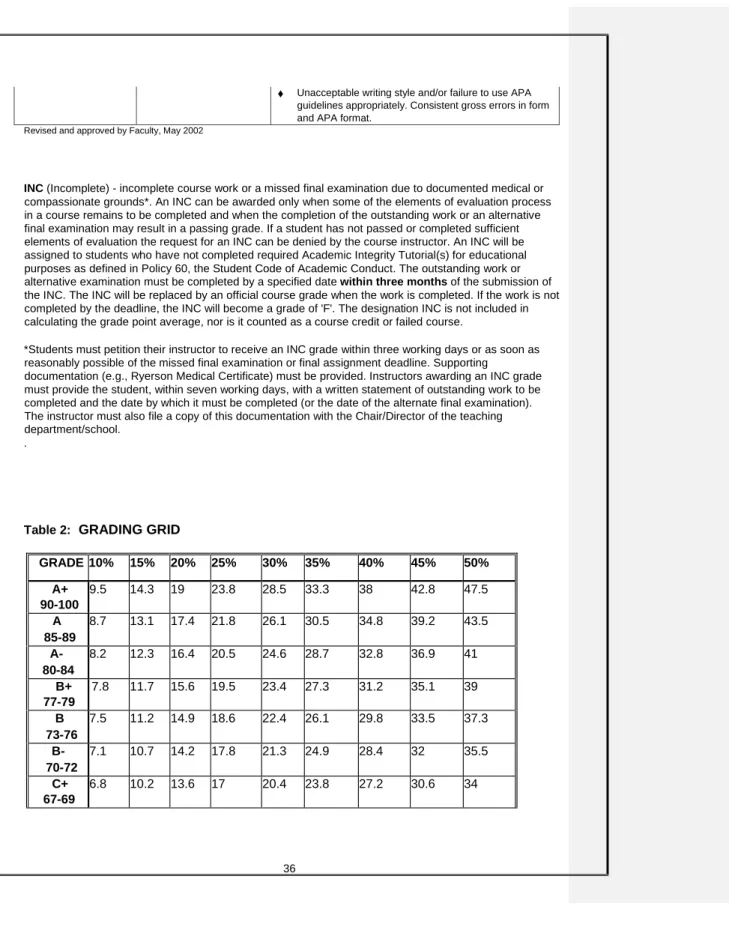
1. Guidelines for Grading Assignments ……… 28 2. Grading Grid ………. 30
APPENDICES
A Post Diploma Degree Curriculum ………. 53 B Nursing Practice Performance Appraisal ………. 54 C College of Nurses of Ontario Standards of Professional Practice ………. 58 D Freedom of Information and Protection of Privacy Act (FIPPA)………..80
NURSING EDUCATION AT RYERSON UNIVERSITY
VISION AND MISSION
Vision. By leading post diploma degree baccalaureate nursing education in Ontario for diploma prepared Registered Nurses, Bridging Program Registered Practical Nurses, and Bridging Program Internationally Educated Nurses, we lead the development and advancement of knowledge and research for nursing practice and nursing education.
Mission. We are committed to preparing nursing leaders who are highly competent, knowledgeable a nd who play an integral role in shaping our health care future. We are committed to building upon our reputation for excellence by creating and delivering innovative, accessible baccalaureate nursing, and advanced practice education. We support an environment that respects differences, encourages inquiry, promotes the discovery of the human lived experience, and champions social justice. We engage in the scholarship of teaching, discovery, integration, and application to further excellence in nursing pract ice, education and leadership.
RECENT NAMING
The University named its School of Nursing in honour of Daphne Cockwell, recognizing her family’s ongoing support for Ryerson and its Master Plan development. Jack Cockwell, Group Chairman of Brookfield Asset Management, is a Member of the Ryerson University Board of Governors. His family has made lifetime contributions of $11.5 million to the University, including a recent gift of $5 million directed to the School of Nursing.
The Daphne Cockwell School of Nursing is named after Mr. Cockwell’s mother, who started her career as a nurse. This is Canada’s first university nursing school to be named for a nurse. Daphne Cockwell trained as a nurse in East London, South Africa in the 1930s, and later worked as a volunteer with veterans returning from the Second World War.
Jack Cockwell was re-appointed to the Ryerson Board of Governors in 2005 and was appointed Vice Chair from 2006-07, having previously served on the Board from 1995 to 2001. He serves in a voluntary capacity for a number of community organizations including as a Governor of the Royal Ontario Museum, and a Directors of the C.D. Howe Institute and Waterfront Toronto Corporation. He also chaired the Building Fundraising Committee for The G. Raymond Chang School of Continuing Education at Ryerson University.
HISTORICAL PERSPECTIVE OF THE POST DIPLOMA DEGREE
PROGRAM
In 1964, Ryerson became the first post-secondary general education institution in Canada to offer a diploma nursing program. Based on recommendations from the Rowles' (1963) study (as cited in Allen & Reidy, 1971), the program was developed to demonstrate the feasibility of offering a nursing program in a general education setting, as opposed to the typical hospital setting.
The success of this program proved Ryerson's ability to provide unique and innovative nursing education. The program was also the subject of an ongoing evaluation study (Allen & Reidy, 1971) that reinforced Rowles' (1963) original recommendations, but paved the way for changes in the nursing educational system. When the provincial government transferred responsibility for nursing diploma programs to the Ministry of Colleges and Universities in 1973, the Schools of Nursing from The Wellesley Hospita l,
Women's College Hospital and the Hospital for Sick Children joined Ryerson's nursing school. The amalgamated school offered a diploma nursing program curriculum until 1988.
In January 1980, the Bachelor of Applied Arts (Nursing) program for registered nurses was approved and implemented. This program was designed to enable diploma graduates to develop an analytical approach to nursing practice and expand their knowledge and understanding of the profession and the health care system. In 1983, the program was expanded to admit students on a part-time basis.
The Post Diploma Degree Program currently has over seven hundred students. Part -time students and non-program nurses can access most courses at over twenty regional access centres, through partnership with The G. Raymond Chang School of Continuing Education. We offer flexibility to nurses considering baccalaureate education through a variety of degree completion schedules. Currently, the Post Diploma Degree Program team is involved in pilot projects to evaluate the success of admitting to the program graduates from selected approved full time and part time bridging programs for internationally educated registered nurses and 2-year diploma prepared registered practical nurses. The bridging students are admitted to the respective full time and part time programs only during the evaluation phase.
All graduates earn the degree designation Bachelor of Science in Nursing (BScN.). The Daphne Cockwell School of Nursing is a member of the Canadian Association of Schools of Nursing (CASN), and is one of a selected group of university Schools of Nursing to receive accreditation.
The Daphne Cockwell School of Nursing is part of the Faculty of Community Services at Ryerson. This Faculty includes Child and Youth Care, Occupational and Public Health, Nutrition, Early Childhood Education, Social Work, Urban and Regional Planning, Midwifery, and Disabilities Studies. Theory and applied learning experiences are a hallmark of nursing education at Ryerson. C lassroom courses are continually reinforced through nursing practice placement, field trips, outside projects, and actual experience in the professional community. Humanities and social sciences are included in all programs to give students a better understanding of the social and cultural environment in which they will function, both as professionals and as educated citizens. The Daphne Cockwell School of Nursing strives to offer our students a plethora of learning opportunities: in the classroom; in prac tice settings; within the school itself, and beyond. The learning-teaching environment is supported through the use of various methodologies such as traditional large group lectures, simulations, problem based learning, small group study, self-directed instruction, and computer supported learning.
To recognize excellence in research, practice and scholarly activities, the Daphne Cockwell School of Nursing has joined Lambda Pi At-Large Chapter of Sigma Theta Tau International. The School has approximately 700 members including faculty, alumni, students and other community leaders. Not only does the Society position the school in the international community, it gives students greater access to conferences and increased opportunities to meet the nursing lead ers in the area of research, practice and academia. Undergraduate students are required to have completed 1/2 of the nursing curriculum, have approximately a 3.67 GPA and be situated in the upper 20% of their cohort.
Ryerson is committed to providing continuing education opportunities that reflect real needs. Each year, the University continues to develop new programs and expand its services to meet the changing requirements of the community. Today, there are over 450 subject areas offered that provide students choice in credit and professional development courses, management seminars, courses leading to professional certification, more than 45 certificate programs, and part-time degree studies.
Reference
Allen, M., & Reidy, M.(1971). Learning to nurse: The first five years of the Ryerson nursing program. Toronto: Registered Nurses Association of Ontario.
PHILOSOPHY OF THE DAPHNE COCKWELL SCHOOL OF NURSING
The purpose of the program is to educate nurses to work with persons and communities of diverse backgrounds, ages, degrees of health/illness and in a variety of contexts. Therefore, it is important that it have philosophical foundation that addresses the unique way in which experiences inform our practice. Through their participation in the learning process as students, graduates will become active participants in the provision of care and achievement of health for all.
Optimal nursing care is advanced by using philosophical underpinnings and multiple methods of inquiry to address complex and diverse nursing questions. Within the empirical paradigm, for example, controlled trials are crucial in the establishment of effective interventions and best practices. Empiricism encompasses an array of research approaches ranging from randomized controlled trials to phenomenological studies. The constructivist paradigm, on the other hand, enables nurses to make professional judgments that incorporate expert opinion and sensitivity to unique individuals within particular family and cultural contexts. Different inquiry methods are adopted by nurses according to the work to be accomplished. Interdisciplinary research is a continuing challenge for the nursing profession during the 21st Century because it serves to maximize the benefits of complementary health care services and resources.
Phenomenology:
A central tenet of phenomenology is understanding the meaning of lived experience. Within the curriculum, phenomenology is actualized through the nurse-client relationship with the primary focus being on the exploration of the meaning of clients’ experiences of health and healing.
Critical Social Theory:
Integral to critical social theory is a commitment to penetrate the world of objective appearances in order to expose the underlying social relationships that are often concealed. Within the curriculum, critical social theory addresses the unequal social, economic and power relations that often exist within health care and society (adapted from the University of Victoria Collaborative Nursing Program).
The beliefs that underpin the nursing program are based on Phenomenology and Critical Social Theory and together they resonate with Ryerson University’s Mission to advance “applied knowledge and research to addressed societal need”. These beliefs provide the normative basis of the program:
1. The nurse understands health, well-being and quality of life from the client’s perspective. 2. The nurse affirms that every human being deserves equal concern, respect and consideration
and therefore challenges systems that oppress the health status of some people while privileging others.
In order to realize these normative beliefs, nurses pursue evidence through data-gathering processes that are used to inform professional nursing practice. However, the means of actualizing these beliefs remains broad and varied, ranging from works of art to scientific trials. The aims of this philosophy are to assist students to acquire the knowledge, skills and dispositions needed to enhance the health of the people in the global community, as well as to promote a progressive, dynamic and inclusive learning community for students, faculty and staff.
With these philosophical approaches underlying the foundation of the curriculum, five Program Threads have been identified. These threads will serve to organize the content of the curriculum and will be reflected in all years of the program in varying degrees of depth.
With this philosophy underlying the nursing program, the metaparadigm of the discipline can be described as follows:
Nursing
Nursing is a humanitarian and caring profession, guided by ethical and legal standards. It is viewed as a systematic, theory-based process, with its own body of knowledge, consisting of both independent and collaborative roles. Its members are held accountable for their professional competence and for the advocacy of clients, peers and the discipline itself. Nursing is a social force within the total context of the health care system. As a practice discipline, nursing requires its members to have a strong professional identity, be politically informed and involved, and advance public policy that improves the health of individuals and society. Nursing acknowledges that political activities, consumerism and changing health/illness patterns influence health care policy and health care delivery patterns. The professional recognizes the value of innovative multidisciplinary relationships as an effective approach to health care.
Nursing is both a science and an art. The science of nursing examines the relationships among person, health and environment. The art of nursing is embedded in the caring relationship between nurse and client. Nurses work in partnership with clients, learning from them the personal meanings of their health situations. Client-specific situations and meanings direct the selection of a theoretical base to guide nursing practice with the goal being a fostering of client well being. The art and science of nursing develop through, and are informed by, the dynamic interaction of theory, practice, education and research.
Health
Health is a concept that has multiple meanings. It is related to quality of life, is individually defined and is in dynamic interaction with the environment. Individuals, families, groups, communities and society share responsibility for health. The major principles of primary health care: health promotion, accessibility, public participation, appropriate use of technology and multi-disciplinary collaboration, are seen as fundamental in achieving health for all.
Person/Individual
Person is viewed as an individual, a family, group or community. Persons have their own subjective experiences of the world, the freedom to choose values, and to develop potential and aspirations that give meaning to living and reflect well-being.
Environment
Environment is the context within which an individual exists. It is integral with the person, comprehensive and unique.
PROGRAM THEMES
• Primary Health Care/Health Promotion Primary Health Care encompasses a philosophy of care as well as the services provided. Incorporation of all aspects of the care necessary to achieve health for all, with appropriate nursing implications will be a focus for each year.
• Reflective Practice/Critical ThinkingCentral to all aspects of a nurse’s practice are the skills of reflection and critical thinking. These will be central elements in the student’s way of learning as well as an outcome for all graduates.
• Meaningful Relationships/Caring/Communication The nurse-patient relationship is one of understanding of the other, communicating effectively, and emphasizing the meaning of the experience from the patient’s perspective. Only through caring meaningful relationships with self and others can this be achieved.
• Political/Social Justice Knowledge of the political, social and economic context of health care is essential to the current study of the nursing profession. Awareness and understanding of the roles of the nurse in social and political arenas is a requirement of the graduate.
• Personal/Professional Development Students are self-directed learners in the pursuit of knowledge for personal and professional purposes. Personal perceptions and meaning making as they relate to self and others are encouraged throughout the curriculum.
POST DIPLOMA DEGREE PROGRAM LEARNING
Program Outcomes guide the development and delivery of theory and practice courses. The development of the philosophy and program outcomes reflects the position statement of baccalaureate education of the Council of Ontario University Programs in Nursing (COUPN) and the College of Nurses of Ontario, Standards of Practice for Nursing.
• Student progress is monitored to reflect learning in relation to the Professional Standards as defined by the College of Nurses of Ontario, 2002.
• Student performance is appraised in accordance with the practice outlined within each standard at a level appropriate to the stage of the program.
• Students demonstrate knowledge, skills, attitudes and judgment congruent with expectations within classroom and nursing practice.
Program outcomes:
1. Demonstrates caring as it relates to self and others. 2. Determines meaning and significance in patient encounters.
3. Establishes meaningful connections with clients to facilitate therapeutic interactions. 4. Collaborates with clients and colleagues to ensure consistent, safe, effective care.
5. Uses personal knowledge and theory from nursing and related disciplines to determine an appropriate course of nursing actions.
6. Demonstrates reflective, critical, and analytical thinking to inform a creative and flexible nursing practice.
7. Appraises research studies and critically utilizes the findings as a basis for nursing practice. 8. Evaluates gaps in nursing knowledge and appropriate solutions to address them. Considers research
possibilities, and participates in research activities where appropriate.
9. Analyses health and practice issues within the social/economic, political/global environment. 10. Practices nursing in a skilful, therapeutic, socially inclusive, and culturally sensitive manner. 11. Provides leadership within his/her own practice to facilitate clients’ and colleagues’ desired outcomes. 12. Interprets population health principles to plan, implement, and evaluate health promotion and disease
prevention programs.
13. Works within the context of a multidisciplinary health care team to apply primary health care principles.
14. Participates in developing and implementing strategies for the improvement of the health environment through the use of the political process and the principles of social justice and equity, within an individual/community/global context.
15. Practices nursing within legal, ethical and professional guidelines; behavior is consistent with academic integrity and social responsibility.
16. Is an active participant in his/her personal and professional development.
17. Demonstrates the ability to communicate information, arguments, and analyses accurately and reliably, orally and in writing to a range of audiences.
CURRICULUM OVERVIEW
The Post Diploma Degree Program curriculum, 4 semesters full-time, consists of the equivalent of 19, one-semester courses. The following concepts are organizing themes throughout the program: diversity, health promotion and population health, developmental stages, reflective practice/critical thinking, research, meaningful or caring relationships, communication, leadership, political and social justice, ethics, and personal and professional development. The courses are sequenced so that students can apply acquired knowledge in a logical fashion.
The nursing courses in semester one (Nursing: Current Issues and Future Perspectives, Nursing: The Evolution of Theoretical Knowledge, and Nursing: Health Assessment) establish the context for post diploma baccalaureate level nursing education and professional practice. Nursing: Research Design, Measurement Applications courses emphasize that nursing is a research-based practice discipline and provide students with the necessary knowledge and skills to understand and apply the research process throughout the program.
During the second semester, students focus on health and health related concepts, reinforced by an epidemiology course that provides an understanding of risk factors related to the development and prevention of illness. The Nursing: The Community Nursing and the Nursing: Epidemiology, Major Health Problems courses are situated together in the second semester because of their complementarities. Theory and practice related to nursing leadership within the health care system is addressed this semester.
Semester three provides the opportunity for students to apply theory as it relates to specific nursing organizations. The Nursing: Concepts in Contemporary Nursing Practice course enhances the students’ ability to examine major issues related to individual clients and their families within the nursing practice context. The first practice course (Nursing: Nursing Practice I) allows students to apply this knowledge within a practice setting of their choice.
During semester four, the nursing elective course and a second nursing practice II course (Nursing: Nursing Practice II) allow students to focus on a selected client population and acquire in-depth knowledge of that population.
The nursing practice experiences are designed to reflect the philosophical beliefs of the curriculum and are levelled, based on the focus and progression of the students through the curriculum. Planned nursing practice experiences focus on applying accumulated program theory. For example, Nursing Practice I (NCL700) is a third semester course that places an emphasis on critical thinking, self-reflection, utilization of research findings and the application of concepts from leadership and change. Nursing Practice II (NCL800) is a fourth semester course that places an emphasis on the multiplicity of nursing roles in hospital and community settings. The intent of the second nursing practice course is to expand the student’s perspective of nursing practice through the use of critical social theory and their lived experience as a reflective practitioner. Students have the opportunity to develop increased depth and breadth of knowledge and skill application to the care of particular populations guided by career plans and goals identified during their Leadership Course (NUR831). In addition, personal learning goals are enlightened by discussion of nursing knowledge, issues of practice, health assessment, community nursing, epidemiology, nursing research, contemporary nursing concepts in practice, and organizational contexts of practice that are introduced, and discussed during their curriculum courses.
Learning experiences and teaching methodology foster the growth of the student as a professional nurse. We believe the professional nurse is critically reflective and an active agent for change within nursing, health care, and society at large. Nursing practice learning opportunities are enhanced through learning/teaching relationships with expert practitioners. Teaching methodology includes: experiential, emancipatory, reflective, collaborative, situation-based inquiry, and integrative practice.
Professionally Related Electives and Upper Level Liberal Studies have been incorporated in accordance with program balance guidelines suggested by Ryerson University.
MODES OF DELIVERY
A variety of teaching methodologies are utilized within this curriculum. In addition to didactic presentations, students are taught through use of situation based learning methods, such as case studies that use small group learning formats, and distributive learning modes. Critique and inquiry are enhanced through use of debates and group/individual presentations, with strong emphasis on the students’ self-evaluation and reflection of their learning. Another interactive and situation-based learning method utilized is the seminar discussion format that aims to enhance the in-depth discussion of a variety of nursing issues. Nursing practice and laboratory work develop psychomotor and communication skills necessary to graduate.
Nursing calendar course descriptions can be found in the Ryerson University Calendar and at www.ryerson.ca/ce/nursing.
TEACHING-LEARNING BELIEFS AND PRINCIPLES
Learning is an interactive, lifelong process, which involves the development of the learner as a person. Nursing students are adult learners who are accountable for their own learning and learn in collaboration with faculty. Multiple teaching/learning approaches facilitate the student’s progression toward becoming lifelong independent nurse practitioners.
Learning comes from those interactions in personal and social situations that have continuity and connection to a person’s unique experience in life. Learning also occurs in educative experiences where positive growth in personal, moral, ethical, aesthetic and professional aspects of life develops.
Learning is facilitated by a caring collaborative student-teacher relationship based on mutual trust and respect. Both bring diverse capabilities and experiences to the learning environment that are valued as enhancing learning. The learning environment reflects evolving equality through the fostering of interactive relationships, established through the development of trust, self-awareness, and dialogue. Strong collaborative relationships between nursing education and nursing practice also foster a rich learning environment.
The teaching/learning process is integral to providing a climate conducive to the development of intellectual pursuits. A supportive and challenging learning environment contributes to the development of a reflective nursing practitioner, who is capable of creative and critical thought, sound problem solving, and ethical decision-making.
Faculty involvement in scholarly activity and professional development is viewed as an important factor in enhancing the teaching/learning environment and maintaining teaching expertise. Scholarly activity includes nursing practice, research, publication and community involvement. The educational preparation and professional expertise of faculty members enrich the learning environment.
The Daphne Cockwell School of Nursing is a
scent free zone.
Due to the number of allergies, students are asked
NOT
to wear any
scented product to the school or in any nursing practice area.
NURSING PRACTICE
PRACTICE REQUIREMENT RECORD (PRR) POLICY
In accordance with the Ryerson, Centennial, George Brown Collaborative Nursing Degree Program, the Post Diploma Degree Program, the NP Program and the Masters of Nursing Degree Program protocol on current completion of the PRR prior to nursing students entering their assigned clinical/practice placement, all nursing students enrolled in practice courses must have their PRR cleared and stamped by the Central Placement Office (CPO) prior to the date of their first clinical/practice experience. Students are required to present their cleared and stamped PRR to their Clinical Instructor (CI) on the first clinical/practice day or to their Faculty Advisor (FA) at orientation. All required elements of the PRR must be met before the PRR will be cleared and stamped. When a student’s PRR is incomplete (i.e. one or more missing elements), the following steps are to be taken:
1. The CPO will provide Practice Course Lead Faculty and the Associate Director/Program Director/Program Coordinator, the names of students whose PRR forms are not cleared and stamped by the following timelines:
Year 1 (Collaborative) – prior to the end of the fall semester (before exams) Year 2, 3, 4 (Collaborative) – by the last week of August
Post Diploma, NP, MN Programs – 2 weeks prior to the start of Clinical/Practice
The Practice Course Lead Faculty must contact the student immediately, advising that they are denied admittance to the clinical/practice placement and that the missed clinical/practice time may jeopardize success in the course.
2. When the student’s PRR is cleared and stamped, the CPO will notify the Practice Course Lead Faculty immediately so that no clinical/practice placement time is lost unnecessarily.
3. Following a progression meeting with the Associate Director/Program Director/Program Coordinator, students who do not have their PRR cleared and stamped by the end of Week 2 of the semester will be withdrawn from the course.
Rationale:
The requirement for students to assume responsibility and accountability for current completion of their PRR at the beginning of each term in their Nursing program is clearly defined in all relevant documents and correspondences with the students. However, some students still remain outstanding with their PRR’s. Under our affiliation agreements with External (Agency) Placement Partners, we are obligated to ensure that Ryerson University students enter their clinical/practice placements with required
documentation, and that all of the required elements have been met. It is acknowledged that students’ failure to have their PRR cleared and stamped jeopardizes client safety and our clinical/practice partner affiliation agreements. In fairness to our partners, their clients, and other students, consistent application of this policy is expected.
PREREQUISITES FOR NURSING PRACTICE PLACEMENT
1. College of Nurses of Ontario
Students who are enrolled in the Post Diploma Degree Program are required to provide evidence of a current Ontario Certificate of Registration, in good standing, or Academic Pathway Certificate from Centennial College or an approved bridging program, and an RPN Registration, in good standing. If a student experiences any change in her/his RN or RPN status with the CNO, including but not limited to: restrictions, suspensions, cancellations, and being under investigation with the College of Nurses. Failure to do so will result in removal from the Program. CNO status changes must be reported to the Associate Director of the Post Diploma Degree Program, as soon as they occur. If a change in status occurs during a placement, the student cannot return to placement until given approval by the Associate Director.
Students who fail to meet the above requirements will not be permitted to begin their nursing practice courses and will be subject to concomitant academic penalties.
2. Health Policy
The following requirements are guided by concern for the optimal functioning of the student, the maintenance of optimal health of clients, government regulations for health care workers/students in health settings, and the policies of nursing practice placement agencies.
3. Policy and Acknowledgement of Student Responsibilities
Completion of the Practice Requirement Records is the responsibility of the student and is required in order to enter practice settings. Our placement partners have the right to refuse students who do not
meet the requirements outlined in the Practice Requirement Records documents (available on the CPO website at www.ryerson.ca/cpo). Placement agencies may, at any time, request to see proof of your immunizations, TB step 2 skin test, mask fit test certificate, CPR level HCP, vulnerable sector screen police check, and CNO license (if applicable).
With regard to mask fit testing:
• Attend a mask fit test clinic and provide evidence of a mask fit test certificate, which includes type and size.
• All nursing students must be clean-shaven in order to be fitted so that the mask attains a proper seal.
• At any time during clinical placements, if students are required to wear their Certified Safety Respirator Mask, at that time they must remove any facial hair.
Failure to comply with practice requirements will jeopardize a student’s progress in the program.
4. Influenza Immunization
The influenza immunization is not mandatory, however, students who do not obtain influenza immunization may encounter challenges with clinical placement. Some placement partners may mandate that students receive influenza immunization and may require students to provide evidence of immunization. In the event of an outbreak, any student without the vaccination may be denied access to the placement facility, thereby, jeopardizing successful completion of their clinical course. The influenza vaccine is available free of charge from Ryerson Health Services in the Fall. If a student fails to provide documentation it will be assumed that the student has chosen not to be vaccinated for personal reasons.
5. Cardiopulmonary Resuscitation Certification (CPR)
All students are required to maintain current CPR – level HCP certification for the duration of their studies. . Certification must be renewed annually.
6. Vulnerable Sector Screen and Police Checks
In compliance with requests from nursing placement partners, all students in the Post Diploma Nursing Degree Program are required to have completed these checks annually. These reference checks are done to protect clients in the nursing practice setting and meet the requirements of nursing practice partners.
All students are required to complete a yearly vulnerable sector screen police check. If you reside in the city of Toronto, you must complete the consent forms that are available in the CPO. Please note that police checks filed in Toronto can take 10-12 weeks or longer, therefore your form should be filed well in advance of your placement. If you live in other municipalities, please go to your local police services. A clear police check is required every year in order to attend practice.
If your police check is positive you may be required to disclose this information to your assigned nursing practice agencies through arrangements made by the Central Placement Office. This will be required for every nursing practice placement until your police record has been cleared. In the event of a positive police check, the placement facility has the final decision whether or not to accept the student for placement.
7. Workplace/Education Placement Agreement – Postsecondary (WEPA Information) The Ministry of Training, Colleges and Universities (MTCU) provides students with insurance coverage in the event of an accident while attending clinical placement.
In the event of a student accident or injury, requiring more than first aid, the student must submit the appropriate paperwork to the Workplace Safety and Insurance Board within seven working days from
the incident. Students must retrieve the appropriate forms and follow the instructions outlined on the CPO website at www.ryerson.ca/cpo/students/injury-incident.html
8. All nursing students, in order to practice nursing, must be an active participant in the education of providing care to all genders, including male, female, and transgender. Students who are unable to provide such care will jeopardize their progress in the program.
9. All nursing students who are currently on WSIB, and/ or sick leave from their employer must notify the Post Diploma Practice Placement Coordinator located in the Central Placement Office (CPO) well in advance to starting the placement and register with the Access Centre for Students with Disabilities.
10. Students who are in the process of completing C/NCL700 Nursing Practice I and/or C/NCL800 Nursing Practice II are not permitted to be absent (i.e. vacation) during the respective course.
For more information please go to www.ryerson.ca/cpo
WORKSTUDY OPTION FOR NURSING PRACTICE COURSES
Purpose: To offer diploma-prepared RN (RN) students with a multipurpose nursing practice course opportunity for the courses NCL 700 and/or NCL 800.
NOTE: IF A STUDENT RECEIVES A GRADE OF C- OR LESS IN A WORKSTUDY PRACTICE COURSE EITEHR NCL 700 OR 800, THEN THE REPEATED NCL 700 OR 800 MUST BE A PRACTICE PLACEMENT
Work: Means paid employment, which has been arranged by the students.
Strategy: Diploma prepared RN students who are currently employed in a nursing role at their work place will independently complete a learning plan. Successful completion of the work-study option will meet the requirements of a Post Diploma Degree nursing practice course. Role of the Employee/Student:
The primary role is that of a (paid) employee with performance expectations and responsibilities. The employee/student will report to the agency supervisor on all work related issues. The employee/student will implement a learning plan that takes into account opportunities in the role and workplace that are mutually beneficial and do not conflict with job performance. The student will submit evidences to faculty in a timely way. Students are responsible for demonstrating the ability to apply theory from the program in nursing practice. Submitted evidences will be evaluated relative to program theory. Students must meet with their faculty advisor during the semester to review their progress. Details about expectations are found in the course syllabus.
Role of the Faculty Advisor:
Faculty will be available to employees/students regarding the learning plan and outcomes. Consultation and evaluation of the learning outcomes or evidences will be done by faculty on an on-going basis. Students and faculty may negotiate modes of communication that are mutually acceptable, including attendance at scheduled group meetings.
Note: Failure to submit course assignments on prescribed due dates as outlined in the course syllabus or as negotiated with faculty will result in a fail grade and may result in withdrawal from the course.
Role of the Workplace:
Workplaces will have the opportunity, but not the obligation, to facilitate an employee's ability to meet learning objectives. They will provide the faculty with a current evaluation of the employee, if possible, and submit a letter indicating that the student is an employee who met the required number of work hours. It is the student's responsibility to obtain this documentation and submit to the faculty.
Student Criteria:
To be eligible for consideration for the Work Study option, students must meet the following criteria:
o successful completion of all pre-requisite course work and a cumulative GPA of >2.0 (check the University calendar for pre-requisites);
o employment in a workplace that meets established criteria (see below); o demonstrated ability to work independently; o demonstrated ability to achieve course objectives.
Workplace Criteria:
To be eligible to support the Work Study option, the workplace must meet the following criteria:
o job description or objectives for employment work available;
o on-site in-services or continuing education available for the employee/student; o
opportunities for mentoring relationships available for the employee/student;
o willingness to provide a written performance appraisal or evaluation upon completion of the work term;
o opportunities for client contact, problem solving, and participation in a health team in a nursing capacity;
o practice opportunities for motor and intellectual skills, professional judgement and decision-making;
o time frame of employment to be at least equivalent to nursing practice course hours (208 hours).
Potential Learning Activities:
o Within the scope of nursing practice for the employee/student role, examples of potential learning activities could be:
o client-centered teaching plans, their implementation and evaluation; o peer teaching plans, their implementation and evaluation;
o development of continuous quality improvement, tools/plans/programs in collaboration with others; o conducting a case conference or participating in nursing or multidisciplinary rounds;
o participation in clinical nursing research;
o participation in professionally or clinically relevant organizations.
o precepting new staff or nursing students
For more detailed information go to www.ryerson.ca/nursing ; to clinical information, then Frequently Asked Questions (Work Study).
Students may not arrange their own placements. Please be advised that all practice placements for the Post Diploma Degree Program must be organized though the Central Placement Office at Ryerson University. The Central Placement Office has pre-existing relationships and agreements with partners (agencies/hospitals) throughout Ontario for practice placements. Our partners will only accept students for placements that are arranged by their placement offices directly with the Central Placement Office All institutions have formal methods of negotiating placements and an official representative from the Central Placement Office will contact the agency using the mutually agreed upon protocols. Students are encouraged to share information/ideas regarding potential new placements with their faculty advisors and the Central Placement Office.
Students are required to complete the Practice Information Record form every year of their studies. Specific information and deadlines will be made available during the fall term. For more information go to www.ryerson.ca/cpo The information on this form is collected under the authority of the Ryerson University Act and is needed to confirm a practice placement. The information will be used in connection with placement negotiations and communication with placement agencies. Any concerns regarding the collection, use and disclosure of this information by the Daphne Cockwell School of Nursing are to be directed to the Post Diploma Degree, Practice Placement Coordinator, Ryerson University, POD 477, 350 Victoria Street, Toronto M5B 2K3, 416 979-5000 extension 2769.
Decisions regarding nursing practice experiences are based on the following: • Congruence with program outcomes and year curriculum themes
• Commitment to the ongoing educational preparation of nursing professionals • Placement Availability
• Availability of preceptors • Geographical location
• Inclusion of research findings in nursing practice • Grade Point Average
• Interviews and Faculty consultations • Past practice experiences
• Please note: Geographical preferences are considered when assigning placements; however, due to circumstances beyond the control of the Central Placement Office, there is no guarantee.
Placements are not always available in each location due to geographical preferences, placement availability, past practice experiences and curriculum requirements. Community partners (hospitals and agencies) consider many factors before deciding to accept a student for placement. Not all hospitals and agencies accept students every year. They may also limit the number of students accepted based on organizational changes and structures.
Nursing Practice Placement schedule will include a variety of shifts and days of the week (days, evenings nights and week-ends). Any student attending nursing practice placement activities outside of their assigned schedule must notify their faculty prior to attending the activity. Although practice days are indicated on individual timetables – this is for scheduling purposes only and it is expected that students will be as flexible in planning their nursing practice time to follow assigned preceptor schedules – provided that scheduled classes are not being missed. It is anticipated that students and their preceptors negotiate nursing practice time for optimal learning experiences. Normally, practice placements are scheduled for all shifts 15 hrs/wk, every Thursday, Friday and some weekends to follow preceptor’s schedule.
PREPARATION FOR PLACEMENT
INTERVIEWS
At times, students may be required to attend an interview prior to the placement accepting the student for the term. Student grades and evaluative feedback (including practice course mid-term and final evaluations) are part of the student’s academic record and are considered “Confidential” under university policy. However, students should be prepared to discuss their strengths and areas they wish to develop. If asked for evaluation information during the interview, the student may feel comfortable responding along these lines:
“While university policy maintains the confidentiality of my course evaluations, I would be pleased to identify my strengths and talk about my developmental areas I would like to focus on during my placement.”
Arranging an Interview
If contacted by the placement coordinator with a request for an interview students are required to: • Contact the agency whose name you have been given within two working days
• Identify yourself as a Post Diploma Degree Program nursing students and provide your name, phone number, your program year, and the purpose of your call (eg. “nursing practice placement”)
• Arrange a mutually agreeable date and time • On completion of your interview, notify your placement coordinator
Preparing for an Interview
Interviews with individuals representing your tentative placement should be managed as a professional interview and you should take with you a copy of:
• Personal learning goals (based on year curriculum theme and self assesses areas for nursing practice development)
• Typed, on letter quality paper, a one page resume of your nursing practice experience as well as related employment and volunteer experiences
• Be prepared to discuss your rationale for the selection of this placement
• Be prepared to discuss the pertinent sections of the Post Diploma Degree Nursing Degree program curriculum.
• Consult with your placement coordinator or other faculty for assistance as necessary Placement Interviews & Placement Orientation
Students who do not attend the required placement interviews and who do not attend orientation may not be accepted by that agency and may jeopardize any other placement in that course. Orientation to an agency will normally have precedence over class. Should there be a timetable conflict, your professor should be notified of your nursing practice orientation priority. Students who do not attend orientation to practice setting will not be allowed to begin their practice experience.
Student grades and evaluative feedback (including practice course mid-term and final evaluations) are part of the student’s academic record and are considered “Confidential” under university policy. Students are not expected to provide this type of evaluation information to agency personal during an interview. However, students should be prepared to discuss their strengths and areas they wish to develop. If asked for evaluation information during the interview, the student may feel comfortable responding along these lines:
“While university policy maintains the confidentiality of my course evaluations, I would be pleased to identify my strength and talk about developmental areas I would like to focus on during my placement”.
NURSING PRACTICE COURSE EXPECTATIONS
These guidelines provide an overview of expectations for students, faculty, and preceptors (if placement option selected) in relation to nursing practice.
ORIENTATION
Students are required to obtain the following information during orientation:
• the name of your faculty advisor/teacher, location of office, office hours, telephone number, e-mail address, course description, methods for performance review, and the scheduled nursing practice hours for the course, times of conferences;
• the full name of your preceptor, her phone number, both at work and at home (if she wishes to provide you with this), her email address;
• interpretations of program outcomes for the course and related College of Nurses competencies; • relevant Ryerson and agency policies;
• must have a Ryerson Matrix account for use with Blackboard discussions; • emergency protocols including fire, safety, and CPR;
• roles and responsibilities of various health care workers; • available human and physical resources;
• care delivery and documentation protocols;
• relevant knowledge and skills related to the specific population.
NURSING PRACTICE ROLES
Student Practice role includes:
• acquiring a name tag at the Ryerson Bookstore; • being professionally responsible;
• orienting self to the practice environment; • creating and supporting a healing environment; • focusing on quality of life from the client's perspective;
• acquiring psychomotor skills as per policy and procedure of the health care faculty; • critiquing the quality and integration of health sciences in the setting/community population; • negotiating with the client the role and time spent in the situation;
• negotiating with the preceptor the nursing practice hours – the student is expected to be flexible; • providing comprehensive, individualized care;
• using intuitive and critical analysis abilities to continually enhance practice. Student Learner role includes:
• applying knowledge/ theory to practice;
• building on one's own experience, personal knowledge and wisdom; • contributing to and supporting the learning of others;
• developing critical thinking skills using the reflective process; • capitalizing on learning opportunities in the settings;
• developing personal learning plans related to Program Outcomes and placement goals/ outcomes;
• developing professional relationships with the faculty advisor and the preceptor; • generating questions and hunches in the search of excellence in nursing; • integrating theory/ knowledge and practice during nursing practice conferences; • partnering with peers to co-construct nursing expertise;
• working interdependently with others;
• submitting required evidence of nursing practice learning.
Faculty Advisor role
• providing sufficient information during orientation to facilitate student preparation for the nursing practice setting;
• assisting students to develop strategies to enter the nursing practice setting in a professional manner;
• discussing the preceptor role with other nursing practice setting staff;
• advocating for students to promote their freedom of expression and freedom from discrimination; • building on one's own experience, personal knowledge and wisdom;
• dialoguing with students to assist them in building on their strengths and addressing their practice limitations;
• generating questions and hunches in search of excellence in nursing and teaching/learning; • monitoring and mediating interactions and concerns between staff and students;
• promoting professional growth of self, students, and colleagues;
• providing ongoing clarification of performance expectations and competencies of students with staff, preceptors, and colleagues;
• supervising the provision of safe care; • discussing student progress with students;
• consult agency staff, preceptors about the appropriateness of learning plans and student practice; • integrating agency staff, preceptor, and student reviews into the mid course and final reviews; • informing the preceptor of events of professional interest in the Daphne Cockwell School of
Nursing;
• being available to agency staff and preceptors for support and discussion in the fulfilment of their role e.g. incorporating new teaching methodologies, adapting methods of feedback.
Preceptor role (applies to placement students only):
The Preceptor role focuses on augmenting the student’s understanding and learning about nursing practice in a particular setting and includes:
• promoting orientation to the practice setting; • negotiating mutual role expectations;
• assisting the student to tailor the learning plan so that it is relevant and feasible within the nursing context of the setting;
• collaborating with the student 's faculty advisor about progress throughout the semester; • assisting students to access resources and relevant experiences;
• mentoring students to help increase their competence and confidence;
• sharing verbal and written feedback with both the student and the faculty advisor; • contributing (in writing where possible) information for the student's final appraisal;
• immediately reporting concerns about unsafe nursing practice to both the student and the faculty advisor.
The role does not involve marking the evidences that the students complete as part of their learning plans or assigning of final grades.
Preceptors are assigned or volunteer to work with students. A preceptor provides individualized teaching, as well as acting as role model, resource person, and facilitator. Two elements distinguish the preceptor/student relationship from the traditional faculty/student relationship. First, the preceptor/student ratio is small, usually one to one. Secondly, the student works only in the preceptor's area of nursing practice expertise. The preceptor must also integrate this additional responsibility for the student with her/his other roles/professional responsibilities.
Ultimately, the preceptor has a positive outcome on the student's adjustment to the profession. The Daphne Cockwell School of Nursing at Ryerson believes that the preceptor approach is one of the most effective ways to prepare students to function and to feel more satisfied in their roles as practising professionals upon graduation.
COMPONENTS OF NURSING PRACTICE: COURSE EXPECTATIONS
1.
NURSING PRACTICE CONFERENCES
Note: Nursing Practice Conferences are an integral part of nursing practice courses. There will be in person and online conferences during the semester.
Responsibilities and accountability for nursing practice conferences/ seminars. All students will be expected to:
• attend all nursing practice conferences (either face-to-face or web-based); • raise thoughtful and thought-provoking questions;
• expand on issues raised by peers;
• seek clarification of ideas from others in a positive manner; • support group members with a constructive approach; • share new information with groups;
• contributes positively to the emotional climate of the group; • prepare for all conferences in order to be an effective participant; • show sensitivity to ideas expressed by peers;
• be involved in Blackboard internet group discussions (web-based).
2.
LEARNING PLAN
Adult learning theory states that adults learn what is relevant to them, what builds on experience and prior learning, and that teachers are coaches and facilitators. Learning plans enable students to make choices and decisions that individualize learning and promote self-direction. Learning plans are explicit, written agreements between students, faculty and preceptor/nursing practice advisor which outline the learner’s objectives, resources/strategies, evidences of achievement, target date and criteria for evaluation. Learning plans allow students to integrate their learning needs with program outcomes. Plans can be modified or renegotiated as circumstances dictate. Refer to program and course outcomes as well as the draft competencies from the College of Nurses when developing your Learning Plan. See Daphne Cockwell School of Nursing webpage for a sample learning plan.
3.
REFLECTIVE PRACTICE
In addition to the development of reflective thinking, students apply the central tenets from both phenomenology and critical social theory to develop their critical reflective practice skills. As Davies (1995) indicates:
By its grounding in self-responsibility for learning, reflection on practice has the capacity to encourage inquiry and autonomy in seeking information that is necessary for practice. (pg. 168)
Reflective practice incorporates the processes of critical thinking and critical reflectivity. These processes require that the practitioner consciously and deliberately recognize and vigorously critique the assumptions, values, and beliefs that guide his/her practice (Mezirow, 1990). It is through these processes of self-inquiry and discovery that the practitioner acknowledges the perceptions that filter his/her experiences; identifies intellectual and behavioral patterns; and makes explicit the biases that constrain his/her practice perspectives (Brookfield, 1998); thus creating the opportunity to transform his/her practice.
Brookfield, S. (1998). Critically reflective practice. Journal of Continuing Education in the Health Professions, 18(4), 197-206.
Davies, E. (1995). Reflective practice: A focus for caring. Journal of Nursing Education, 34(4), 167-174 Mezirow, J. (1990). How critical reflection triggers transformative learning.
In J. Mezirow and
Associates,
Fostering critical reflection in Adulthood
(pp. 1-20). San Francisco, CA:
Jossey-Bass.
Reflective practice is a key component of the College of Nurses of Ontario's Quality Assurance Program. Engaging in reflective practice is the core difference between whether a person repeats the same experience several times, becoming proficient at one behavior, or learns from experience in such a way that thinking or feelings are changed (Brokenshire, 1998).
The college uses the acronym LEARN to guide the process; however, since this activity is conducted within an academic program and one of the program expectations is integration, synthesis, and application of concepts and theory, we have revised the College guidelines to reflect this process. Critical thinking is an integral part of the process.
Each reflective practice entry must contain 5 areas… Look back, Elaborate and describe, Analyze the outcomes, Revise the approach, and New perspective. The last 4 areas are included in your written reflective practice entries. Entries should be at least 6 pages long and written as close to the situation as possible.
1. Look back at a recent meaningful nursing practice situation.
2. Elaborate and describe:
• What happened during the event? (what did you see, hear?) • Who was involved?
• Where and when did it happen? • How did you feel?
• How do you think others felt? 3. Analyze the outcomes:
• Select the key issue(s)/heart of the matter of this situation
Consider what you know from nursing and related courses, what you need to know and where you might find the information.
• Complete the literature review on the key issue (where possible research studies relevant to nursing should be included).
• Critique the literature.
• Compare and contrast the situation with what you have learned, incorporating and citing significant findings from the literature. Include a reference list and a copy of each article used with your submission.
• Question values, assumptions and the nature of systems impacting on individuals.
4. Revise your approach. Based on your analysis:
• Decide what ought to be preserved, how and why • Decide what ought to be changed, how and why
This might involve asking others for ideas to manage a similar situation or to identify a personal learning need. With your new learning, you may decide to try a new approach, learn more about the subject or decide that you handled the situation well.
5. New Perspective
• Recommendations for learning or actions in a similar situation.
Reference
Brokenshire, A. (1998). Toward reflective practice: Learning from experience. Registered Nurse 10 (5), 7-8. College of Nurses of Ontario (1997). Quality assurance program. Toronto: Author.
NURSING PRACTICE POLICIES
RESPONSIBILITY AND ACCOUNTABILITY FOR NURSING PRACTICE
The student shall:
• learn or review the knowledge, skills, theory and judgement necessary for safe nursing practice • practice prior to assuming that responsibility for client care.
• be prepared to discuss the basis of practice with the teacher or preceptor, including learning plan. • know (and operate) under the policies and procedures of the agency and Ryerson.
• submit required evidence of nursing practice learning.
• document and report in accordance with professional and agency standards
• maintain confidentiality (e.g. discussing clients only in appropriate places and with appropriate people).
PROFESSIONAL APPEARANCE AND DRESS CODE
All students are expected to maintain a professional appearance when attending any nursing practice setting. Where there are specific uniform policies, you are expected to follow those; where there are not policies, then dress professionally (in most cases that does not include jeans or track pants). Unique considerations that are specific to individual nursing practice settings will be discussed in nursing practice groups. If you are not appropriately attired or unkempt, the faculty or the agency representative may refuse your admission to the unit or agency.
PERSONAL HEALTH INFORMATION PRIVACY ACT, 2004
Available at: www.health.gov.on.ca/english/providers/legislation/priv_legislation/priv_legislation.html
Students must review the PHIPA legislation each semester prior to entering practice. The review is intended as a supportive document to ensure safe, effective and ethical care for the clients and their families in the practice setting.
Some reminders for practice:
1. Students must not remove any documents from the agency with identifying or personal information about clients. This includes (but is not limited to) client names, initials, room numbers, birth dates or health card numbers.
2. Students must not give out any identifying information over the phone, unless the client has approved disclosure.