Evolving Remote Laboratory Architectures to
Leverage Emerging Internet Technologies
David Lowe, Senior Member IEEE, Steve Murray, Euan Lindsay, and Dikai Liu
Abstract— There is growing research into, and development of, the use of the internet to support remote access by students to physical laboratory infrastructure. These remote laboratories can, under appropriate circumstances, support or even replace traditional (proximal) laboratories, provide additional or improved access at reduced cost, and encourage inter-institutional sharing of expensive resources. Effective design of remote laboratories requires attention to the design of both the pedagogy and the technical infrastructure, as well as how these elements interact. In this paper we consider the architectures of remote laboratories, the shortcomings of existing implementations, and we argue that emerging internet technologies can assist in overcoming these shortcomings. We also consider the opportunities which these technologies provide in moving beyond both existing remote laboratories and existing proximal laboratories, to create opportunities which were not previously possible. Index Terms— C.0.e System architectures, integration and modeling, N.1.d Virtual labs, N.6 Devices for learning.
—————————— ——————————
1 I
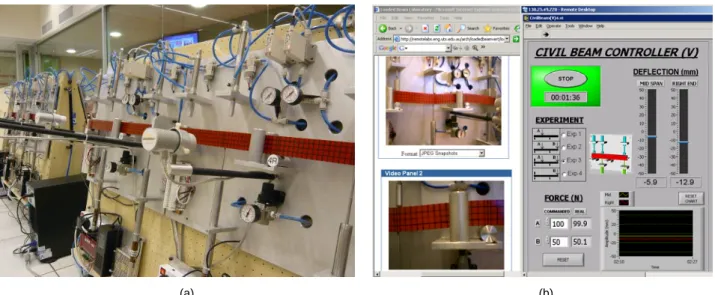
NTRODUCTIONABORATORY work has long been identified as an important element of undergraduate degree courses in many disciplines, especially engineering and the applied sciences [1] [2]. With the increasing availability of advanced telecommunications infrastructure and asso-ciated access to internet-based applications, there has been a recent increase in the development of remote la-boratories [3]. The facilities typically provide internet-based access for students to monitor and/or control phys-ical laboratory equipment which is located remotely from the student. Current implementations vary in sophistica-tion, ranging from the simple ability to monitor output data from a single piece of equipment, through to systems which provide queuing and automated allocation of stu-dents to one of a set of multiple laboratory rigs with com-plex video/audio/data monitoring and control. As an illustration, Figure 1 shows the remote laboratory facility in the Faculty of Engineering at the University of Tech-nology, Sydney. This facility currently supports 6 differ-ent experimdiffer-ents, with multiple sets of equipmdiffer-ent for each experiment. Access occurs through the internet using a combination of a web interface and a remote desktop connecting to an experiment server, and is managed through an arbitrator system which either allocates equipment to students, or places the student in a queue if all equipment is currently in use.
There are several motivating factors supporting the use or remote laboratories, including cost, security, reliability, flexibility and convenience [4]. The earlier era of remote laboratory development saw most effort directed at tech-nical development – preoccupations included experi-menting with technologies for real-time audio and video streaming in an effort to overcome bandwidth limitations whilst ensuring service quality, and dealing successfully with the arbitration of multiple simultaneous connections to shared online laboratory apparatus and equipment.
To a significant extent, many of these issues have been successfully overcome. Continuous, reliable and high quality services have been maintained for much of the past decade [4] [5]. This progress has resulted in a shift in the focus of development effort away from technical re-finement. Recent trends have focused upon enriching the nature of the student interaction (for example, including support for student collaboration and student-teacher interaction). In parallel there have been moves towards developing a clearer understanding of the peda-gogic aspects related to conducting laboratory work re-motely and indeed a more reflective consideration of the laboratory learning context in general (both conventional laboratories where students are proximal to the equip-ment they're using as well as remote laboratories) and the place of experiment simulation [6]. This change in focus however has meant that we have not yet adequately con-sidered the complex inter-relationship between the stu-dent interaction, learning outcome, and technological constraints and opportunities. Most particularly, the ra-pidly evolving suite of internet technologies provides increasing opportunities to address issues which were previously unacknowledged or ignored. For example, Web 2.0 technologies potentially enable a much richer student engagement, collaboration, support and reflection to occur when remotely interacting with laboratory expe-riments. Similarly, it may be possible to use technologies xxxx-xxxx/0x/$xx.00 © 200x IEEE
————————————————
• D. Lowe is with the Centre for Real-Time Information Networks at the University of Technology, Sydney, Australia
E-mail: [email protected]
• S. Murray is with the Centre for Real-Time Information Networks at the University of Technology, Sydney, Australia
E-mail: [email protected]
• E. Lindsay is with Curtin University of Technology, Perth, Australia E-mail: [email protected]
• D. Liu is the University of Technology, Sydney in Australia. E-mail: [email protected]
Manuscript received (insert date of submission if desired). Please note that all acknowledgments should be placed at the end of the paper, before the bibliography.
such as AJAX to simplify architectures, provide a more integrated and responsive environment, and hence im-prove the nature of the student experience. Further afield, the impending explosion in networked sensor and actua-tor devices which link the real-world and the virtual world will provide an opportunity to move student expe-rimentation out of the laboratory altogether and into the real-world.
In section 2 we discuss related work and the current situation with regard to remote laboratories. In section 3 we look at contemporary architectures using two exam-ples to illustrate current approaches. In section 4 we dis-cuss the way in which these systems typically utilize in-ternet technologies, the constraints which this imposes, how this influences the nature of the laboratory expe-rience, and the implications of future trends in internet technologies.
2 R
ELATEDW
ORKA standpoint advocating that all undergraduate practical experimentation should (or even could) be carried out remotely would be difficult to defend and is not the objec-tive here. Rather, the evaluation of existing implementa-tions has demonstrated that, when used in the right con-text, remote laboratories can provide significant advan-tages over conventional proximal laboratories [3] [6] [7]. Whilst there is not yet any significant research data on remote laboratory cost comparisons, anecdotal evidence indicates that operating costs can be significantly reduced. This is in part due to the equipment and apparatus being held in a physically secure environment with tightly con-strained access that limits either intentional or uninten-tional misuse. This reduction in attrition and “wear and tear” on the equipment, an entrenched characteristic of proximal laboratories, means that more elaborate, expen-sive and/or delicate experiments can be constructed. This in turn makes possible student exposure to systems that might not have otherwise been afforded them. The result is that when viewed on a macro scale, more rather than
less experimentation by students becomes possible. Addi-tionally, the convenience and flexibility of being able to complete laboratory experiments remotely tends to fit well within the complex lifestyle of the contemporary undergraduate student – it is as welcome amongst the student body which is comprised of full-time or part-time “on campus” students as it is with those that are distance-mode. A final advantage which remote laboratories offer is that they present a capability of inter-institutional shar-ing of laboratory infrastructure and resources [5]. The potential benefits to students are enormous and pro-found, but it requires a global view if it is to be realised.
Having accepted that there are considerable “logistic-al” benefits of remote laboratories – flexibility, cost, re-source sharing – attention needs to be given to the impact that a change to remote laboratories has on student learn-ing outcomes. It is clear that the environment in which learning takes place, whether online or face to face, in-volves a complex array of factors that influence learner satisfaction and achievement [8]. These factors include the relationships between the user and the technology, the instructor and students, and the relationships among the students [9]. This is of particular relevance when consi-dering the evolution of the internet to incorporate increas-ing support for interactivity and social collaboration.
As a part of the adoption process of remote laborato-ries into engineering curricula, various authors have made attempts to determine an appropriate list of “quali-ty indicators” for the online laboratory experience. This has been approached primarily from two perspectives, the first being relative to the expectations of students (e.g. [10] [11]); and the latter being driven by course or subject content. These include the level and speed of interaction, clear articulation of expectations, timeliness of feedback, and access. In highlighting such factors and relating them to the remote access mode, it is important to note that implicit to this discussion is how these factors are influ-enced by the nature of internet technologies. From a broader perspective, simply referring to the literature to
(a) (b)
Fig. 1. UTS Remote Laboratory Facility (http://remotelabs.eng.uts.edu.au). (a) Physical equipment; (b) Student interface to the Beam Def-lection Experiment.
one hand, there is the proposition that there is no signifi-cant difference between the educational outcomes from students who performed an experiment remotely, versus those who carried out the experiment proximal to the equipment and apparatus [12]. The alternate view how-ever argues that students’ performances on different cri-teria can vary depending upon the form of access used and that indeed some outcomes appear to be enhanced by non-proximal access modes, whilst others seem to be de-graded [6] [13].
So, having recognized that the nature of the learning outcomes arising from laboratory experiences has a com-plex relationship with the characteristics of the interaction modality, it is worth considering the way in which the technologies which are used affect the nature of the inte-raction. From this point we can then consider the most appropriate way to leverage emerging technologies.
3 R
EMOTEL
ABORATORYA
RCHITECTURESA design challenge in the practical development of a re-mote laboratory is to identify an architecture which can provide appropriate access to the remote hardware. In the simplest form, the remote laboratory may be a single ex-periment, with a custom-built web-based interface which may optionally include reporting of measurement data and audio/visual feedback. A more sophisticated facility may involve multiple sets of equipment, multiple expe-riments and many users. To illustrate the challenges pre-sented by the design of remote laboratory systems, we will consider the architecture of two contemporary sys-tems: the UTS remote laboratory facility (shown previous-ly in Figure 1) and the MIT iLabs.
Within the UTS remote laboratory [14], there are cur-rently six collections of significantly different experimen-tal equipment [4] [15] [16]:
• Microcontroller design (12 x Embedded Operating System Experiments);
• Beam Deflection (10 x Beam Behaviour Experi-ments);
• Automation (5 x PLC Experiments);
• Dynamics and Control (3 x Coupled Water-Tanks Experiments);
• Programmable Hardware design (5 x FPGA Expe-riments);
• Structures Design (3 x shaker-table platform expe-riments).
The UTS architecture was developed to provide flex-ibility and extensflex-ibility, as well as the ability to manage multiple sets of equipment. A key aim was to ensure that all experiments can be accessed from any networked
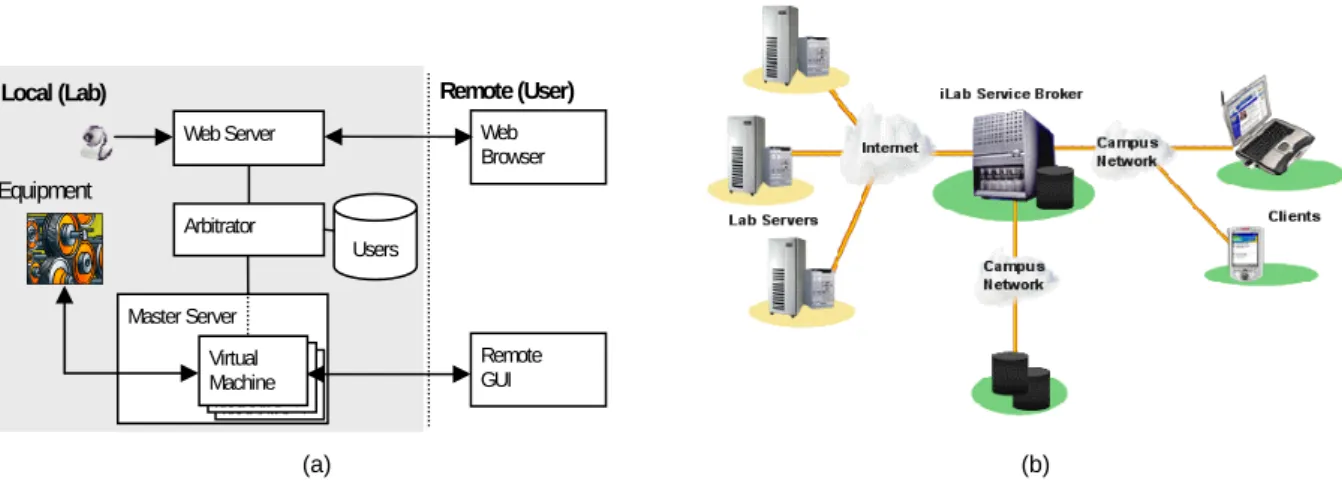
including control applications, onto the remote computer (since students may be accessing the laboratory from computers on which they have limited user permissions). The resultant architecture is shown in Figure 2a. A remote user logs-in through a web browser (with authentication managed by an arbitrator) and requests access to a set of equipment. The arbitrator allocates apparatus to students from the pool of unused devices, queuing allocation re-quests when necessary. The student is then provided, through the Web interface, audio/visual monitoring of the equipment. In order to support control of the equip-ment (and the differing user interfaces associated with the control applications), the arbitrator boots a Windows vir-tual machine on a master server (using VMware) and as-sociates this virtual machine with the relevant equipment. The student creates a remote desktop connection to this virtual machine, runs the control application, and con-trols the equipment. The control application is therefore running on the master server (not on the remote user’s computer) but with the user-interface being presented on the remote machine. Figure 1b shows the resultant hybrid interface. When a session of use is completed by a stu-dent, the arbitrator reclaims the apparatus, re-initialises it, and returns the device to the free pool. This architecture means that the only software required on the client side is a Web browser and a remote desktop client.
Contrasting with the UTS architecture is the more dis-tributed architecture used for the MIT iLabs (see figure 2b). Here, the equipment is managed by Lab servers, and authentication and access is moderated by a service bro-ker. There are two forms of experiment in this configura-tion: batched and interactive. With batched experiments, the student interacts indirectly with an experiment through a client on their remote machine, which passes the student-configured experimental parameters to the service broker, which in turn communicates to a laborato-ry server which executes the experiment. Ultimately the results are returned to the client once complete. In this form of experiment there is no interaction between the client and the experiment whilst it is executing. Students receive results only on completion of the experiment (in-deed they need not even remain logged-in whilst the ex-periment request is queued or executing). Conversely, interactive experiments allow direct communication be-tween a student’s client and the laboratory server. The architecture incorporates a modified Interactive Service Broker (ISB) which provides a scheduling feature and (at the appropriate time) establishes communications be-tween the student-side client and the Laboratory server.
Whilst there are many other architectures which have also been adopted in supporting remote laboratories, they typically are either simpler than the above (e.g. a single downloaded client application communicating with a single experiment) or share similar characteristics to ei-ther or both of the above examples.
4 U
TILISATIONO
FT
ECHNOLOGYA
NDE
DUCATIONALI
MPLICATIONSExisting remote laboratory systems utilize the internet in diverse ways. In considering this it is useful to return to the core relationships which exist during student labora-tory experimentation. As discussed previously, this in-cludes the relationships between the student and the equipment, between students, and between the instructor and students [9].
4.1 Supporting The Student-Equipment Relationship
At the core of the interaction between a single student and remote equipment is consideration of the way in which a student engages with that equipment. There are two primary dimensions to this interaction: the extent of the live interactivity, and the richness of the representa-tion of the experimental reality which is exposed to the student.
In terms of live interactivity, the iLabs architecture il-lustrated support for different ends of this spectrum. In batch mode, students submitted their experimental para-meters and the experiment request was then queued to be carried out remotely and asynchronously. This form of interaction places relatively low demands on the technol-ogy - bandwidth is generally not an issue (there is no re-quirement for live monitoring) and there is no direct inte-raction between the student and experiment. Conversely, interactive experiments involve live synchronous interac-tion with the experiment. Where the monitoring involves video and/or audio, this implies streaming of the media and adaptation of the system to varying bandwidth. In the case of the UTS remote laboratories, this is addressed through providing the student with a choice of media access: streamed video in various formats and
auto-refreshed image snapshots. One of the key issues in stu-dent monitoring of the experiment involves how experi-ment events are handled. When monitoring occurs through a Web browser, the inherent “pull” model of the Web (i.e. interactions are initiated by the client) means that creative approaches have been developed for passing information from the experiment server to the user with minimal latency. The simplest approach is to use auto-matic web page refreshes – but this tends to be somewhat cumbersome. An alternative is to use separate client ap-plications which establish a continuous communication with the experiment. This solution however requires the installation of user-side applications, which may not al-ways be feasible. The emergence of AJAX technologies has provided an alternative to these approaches, whereby finer-grained data updates within the web view of the experiment can be achieved.
The second element of the user-experiment interaction relates to the perceived “reality” of the experiment. Pre-vious research [17] has considered the significance of ex-perimental verisimilitude and how this affects student engagement. In particular, it has been shown that stu-dents’ perception of whether the experiment is “real” or a simulation can affect their willingness to accept the expe-rimental results as valid and hence affects the learning outcomes. Interestingly, the requirement for experimental verisimilitude varies during the student engagement. Lindsay et al [17] [18] refer to the concepts of “establish-ment reality” (i.e. the initial establish“establish-ment of the students’ acceptance of the reality of the experiment) and “main-tenance reality” (i.e. maintaining the students’ acceptance of the experimental reality). This has implications for the nature of the experimental interface and how technology might be used in constructing it. For example, we have anecdotally noted that inclusion of video information showing the broader context of the experiment within the laboratory can significantly affect the establishment reali-ty. An interesting comment came from a student who noted that it wasn’t until he overheard several technical staff members talking near the equipment, that he rea-lized the equipment was real rather than a simulation (despite the quality of the streaming video which was included in the interface).
(a) (b)
Fig. 2. Typical Remote Laboratory Architectures: (a) UTS Remote Laboratory Facility; (b) iLabs Architecture (from http://icampus.mit.edu/iLabs/architecture/) Local (Lab) Master Server Arbitrator Virtual Machines Users Web Browser Remote GUI Virtual Machines Virtual Machine Equipment Remote (User) Web Server
ship in more detail, student survey data was collected from the students who used the UTS remote PLC labora-tory and the remote water-level control laboralabora-tory during 2006 [19]. Students were asked to respond to a series of questions on a 10 point Likert scale – including two that related to the student-equipment relationship: Question 4: Didn’t you feel a degree of isolation between the physical system and you? And Question 6: While you were using the remote PLC lab, did you feel like you were operating real equipment? The survey results [19] show that aver-age agreement values of 5.4 or higher for Question 4 and 6.8 or higher for Question 6, indicating that students did feel a degree of isolation from the physical equipment, but in general they believe they are using real equipment. The survey also indicated that the student-equipment relationship is affected by many factors such as the nature of the video and audio feedback.
4.2 Supporting The Student-Student Relationship
It has long been accepted that peer collaboration can play a major role in affecting student learning outcomes. Also, the majority of conventional (proximal) laboratory exer-cises are group based (though admittedly this may often have been for logistical rather than pedagogic reasons). Despite this, the vast majority of current remote laborato-ries provide limited support for student collaboration, and largely remain one-to-one connections between stu-dent and equipment. One form of support which is often provided (including in the UTS facilities) is a simple dis-cussion board used separately from the experiment to facilitate student discussion and communication. The student survey described previously [19] included the question: Do you think the UTSOnline discussion board helps in solving your problems while you are using the remote labs? The results gave average agreement values of 6.6 and 4.8 over two semesters, indicating an ambiva-lent reaction to this mechanism - a conclusion supported by the student comments. This indicates that more effec-tive approaches or tools are required to support enhanced student-student relationships.
In terms of “live” (i.e. during experiment) collabora-tion, where this does occur it is typically through remote co-location of the students rather than through technolo-gical support. If we are to provide support for student-student collaboration where the student-students are also remote from each other then several issues emerge. The first is the creation of a shared experience which can form the basis for a common learning context. Issues arise such as: how do we provide each student with access to a com-mon view of the experiment? Who has control of the ex-periment and how can this be managed? How aware of other students (both within their own group and in other parallel groups) can each student be? Where the imple-mentation has used a stand-alone client, this can be a dif-ficult issue to address, though again recent technological developments can assist in addressing this. As an illustra-tive example, the UTS remote laboratory architecture re-moved the need for student-side installation of control applications by running the control application in a
vir-Whilst an elegant solution, this does mean that we are using applications which are not designed for shared access, and the virtual machine on which is runs does not support multiple simultaneous log-ins. A solution cur-rently being developed is to use a separate proxy to access the control application, and this proxy provides shared access (as well as managing who has control) us-ing AJAX techniques to update the users view. Another approach being considered is the integration of real in-strumentation into environments such as Second Life (http://www.secondlife.com/, and see work by IBM in [20]). Whilst this is yet to result in mainstream remote laboratory implementations, it does hint at the possibili-ties for creating rich shared laboratory experiences.
In terms of student communication (text chat, audio and video connections, and shared workspaces), there has been significant development of technology in these areas, and there are now numerous toolkits which facili-tate integration of these functionalities into both web-based and stand-alone applications. However, a key is-sue which should be considered in the design of solutions is the role not only of intentional communication (i.e. where two or more students consciously initiate commu-nication – a focus of most existing development) but also the role of incidental and serendipitous communications. Much of the learning context for students in conventional proximal labs involves incidental interactions with stu-dents in their own laboratory groups, as well as other groups in the same laboratory. Being able to “eavesdrop” on related conversations, notice the issues confronting other students, and overhear the questions they are ask-ing the instructor, can all play a role in assistask-ing the learn-ing process. Given this, it is important to consider how emerging internet technologies can be used to support exposing this broader context to students. Partly, this is a design issue – being able to construct interfaces which expose peripheral activities, but it is also a technological issue – in terms of how this rich set of information can be structured and presented to users without it being dis-tracting. Certainly virtual reality worlds such as Second Life can be used to provide a rich context and their feasi-bility is improving as the understanding of linking real-time data into these environments develops.
4.3 Supporting The Student-Instructor Relationship
A similar issue to the above is the relationship between students and instructors. To a large extent the utilization of technology will be the same as for student-student in-teractions, with the difference largely being in the system design, and control over the level of information which can be accessed. Typically we would want to support both student-initiated interactions (“Please, I need some assistance with…”) and instructor-initiated interactions (“You seem to be having trouble with X – can I suggest that …”). This latter form of interaction implies that we need to provide rich information to the instructor so that they can identify when students might be struggling with a laboratory exercise. Some of this might be supported by allowing warning flags to be established (e.g. has the
amount of time taken to perform a certain experimental stage exceeded some threshold; has some control parame-ter been set outside some acceptable range), but it might also be effective to provide alerts based on overall level of, or imbalances in, student-student communication, semantic analysis of any text chats, or other forms of rich data mining.
4.4 Future Trends
Most of the above discussion has focused on what is cur-rently feasible in terms of constructing laboratories which are accessed across the internet. There are a number of trends in the development of internet technologies which are likely to play a role in the ongoing evolution of re-mote laboratories. Whilst crystal-ball gazing can be fraught with danger, we will nevertheless briefly discuss possible impacts of these trends, arguably from a reason-ably conservative viewpoint.
Improved bandwidth availability: As available net-work bandwidth increases, it will become progressively more feasible for students interacting with remote labora-tories to have higher fidelity and resolution audio and video, and a richer collection of media streams. This will pertain not only to the experiment, but to interactions with other students and instructors, and will hence facili-tate improved quality of both interaction and contextuali-zation of the experiment.
Improved sensors and actuators: As the quality of sen-sors and actuators improves, and costs drops, the extent to which students can understand aspects of the experi-mental environment, and control that environment will increase. Consider, for example, the beam deflection ex-periment shown in Figure 1. In the current implementa-tion of this experiment the camera posiimplementa-tions, orientaimplementa-tions and zoom levels are fixed, as are the locations of the actu-ators which are used to place a load on the beam. The experiment would (possibly) be enhanced if the students were able to move, rotate and zoom the cameras, and change the position of the actuator.
Improvements in interaction technology: Whilst AJAX technologies have provided an improved ability to create highly interactive environments, it is expected that future developments in this area will extend these capabilities. For example, AJAX is inherently based on client-initiated events, which proves to be a significant limitation with remote laboratories, where much of the event stream ori-ginates on an experiment server. Emerging technologies and architectures which provide server-side content push (or HTTP streaming), such as Comet, can address this limitation and improve the quality of the data presented to the student. Similarly, changes to HTML (particularly the introduction of HTML5) are likely to facilitate richer interfaces – particularly in terms of inherent support for rich media.
Linking real-world equipment: Possibly the most sub-stantial impact on remote laboratories will come not from specific internet technologies, but rather from the way the internet is used. It is becoming increasingly straightfor-ward to connect real world devices into the internet, both in terms of specific equipment and appliances, but also at
a finer level of granularity through network-enabled sen-sors and actuators. Whilst these devices are often in-stalled to support specific applications, they provide a rich data source and control mechanisms that link the real and virtual worlds. This in turn can potentially be used to support much richer experiment experiences. While (real physical) laboratories have often been used because they provide a controlled environment, equally they have also been used because they simplify the logistics of providing access to “real environments” by students. In many cases, it would be more desirable for students to be exposed to real-world environments, and this is only not achieved because of the logistical difficulties. The combination of the internet and networked sensors and actuators can change this. Consider, as a simple example, a thermody-namics laboratory where students monitor the changing temperature profile of a heated steel block, and compare their measurements to those predicted by heat conduction theory. Compare this to an online experiment where stu-dents have direct access to live temperature measure-ments on steel castings in a foundry (which could poten-tially by anywhere in the world). Apart from being a more realistic context, it reduces the need to establish specific laboratories in those cases where a student-controlled environment is not essential. In essence, these technologies (networked sensors and actuators, and dis-tributed access via the internet) provide an opportunity to move at least some experimentation out of the laboratory and into the real world.
5 C
ONCLUSIONSWhen used appropriately, remote laboratories can pro-vide significant benefits over some proximal laboratories. For these benefits to be realised, consideration must be given to the complex interplay between desired educa-tional outcomes, pedagogical design, and the nature of the technology supporting the laboratory. In this paper we have discussed current technological and architectural issues with remote laboratories, how these relate to the factors which affect student learning, and how these la-boratories may evolve in light of future technology de-velopments.
A
CKNOWLEDGMENTSSupport for this publication has been provided by The Australian Learning and Teaching Council Ltd (ALTC), an initiative of the Australian Government Department of Education, Employment and Workplace Relations. The views expressed in this publication do not necessarily reflect the views of the ALTC.
R
EFERENCES[1] L. D. Feisel, G. D. Peterson, O. Arnas, L. Carter, A. Rosa, and W. Worek, "Learning objectives for engineering education laborato-ries," in Frontiers in Education, 2002. FIE 2002. 32nd Annual Confe-rence, 2002, vol. 2, pp. F1D-1.
dergraduate Engineering Education," Journal of Engineering Edu-cation, vol. 94, pp. 121-130, 2005.
[3] J. E. Corter, J. V. Nickerson, S. K. Esche, C. Chassapis, S. Im, and J. Ma, "Constructing Reality: A Study of Remote, Hands-on and Simulated Laboratories," ACM Transactions on Computer-Human Interaction, vol. 14, 2007.
[4] S. J. Murray and V. L. Lasky, "A Remotely Accessible Embed-ded Systems Laboratory," in Tools for Teaching Computer Net-working and Hardware Concepts, Sarkar, Ed. Hershey: Informa-tion Science Publishing, 2006, pp. 284-302.
[5] Massachusetts Institute of Technology. (2008). MIT iCampus:
iLabs. [Online]. Available:
http://icampus.mit.edu/iLabs/default.aspx.
[6] E. D. Lindsay and M. C. Good, "Effects of laboratory access modes upon learning outcomes," Education, IEEE Transactions on, vol. 48, pp. 619-631, 2005.
[7] J. E. Corter, J. V. Nickerson, S. K. Esche, and C. Chassapis, "Re-mote Versus Hands-On Labs: A Comparative Study," in 34th ASEE/ IEEE Frontiers in Education Conference, Savannah, GA, 2005.
[8] D. S. Stein and C. E. Wanstreet, "Role of social presence, choice of online or face-to-face group format, and satisfaction with perceived knowledge gained in a distance learning environ-ment," in Midwest Research-to-Practice Conference in Adult, Con-tinuing, and Community Education, Colombus, OH, 2003, pp. 193-198.
[9] W. J. Gibbs, "Implementing on-line learning environments,"
Journal of Computing in Higher Education, vol. 10, pp. 16-37, 1998. [10] Y. Amigud, G. Archer, J. Smith, M. Szymanski, and B. Servatius,
"Assessing the quality of web-enabled laboratories in under-graduate education," in IEEE Frontiers in Education, Boston, MA, 2002, vol. 2, pp. 3-12.
[11] M. S. Cohen and T. J. Ellis, "Developing criteria for an on-line learning environment: From the student and faculty perspec-tives," ASEE Journal of Engineering Education, vol. 93, pp. 161-168, 2004.
[12] P. K. Imbrie and S. Raghaven, "A remote e-laboratory for stu-dent investigation, manipulation and learning.," in 35th ASEE/IEEE Frontiers in Education Conference, Indianapolis, IN, 2005, p. F3J.
[13] S. K. Taradi, M. Taradi, K. Radic, and N. Pokrajac, "Blending problem-based learning with Web technology positively im-pacts student learning outcomes in acid-base physiology," Ad-vanced Physiology Education, vol. 29, pp. 35-39, 2005.
[14] S. Murray, D. Lowe, E. Lindsay, V. Lasky, and D. Liu, "Expe-riences with a Hybrid Architecture for Remote Laboratories," in
FiE 2008: The 38th Annual Frontiers in Education Conference, Sara-toga Springs, USA, 2008.
[15] V. L. Lasky, D. K. Liu, S. J. Murray, and K. K. L. Choy, "A re-mote PLC system for e-Learning," in 4th ASEE/AaeE Global Col-loquium in Engineering Education, Sydney, Australia, 2005. [16] D. G. McLntyre, D. K. Liu, V. L. Lasky, and S. J. Murray, "A
Remote Water-Level Rig Laboratory for e-Learning," in
ITHET'06, 7th International Conference on Information Technology Based Higher Education and Training., Sydney, Australia, 2006, pp. 77-81.
[17] E. Lindsay, S. Murray, D. Liu, D. Lowe, and C. Bright, "Estab-lishment reality vs maintenance reality: how real is real
Society for Engineering Education, Aalborg, Denmark, 2008. [18] E. Lindsay, S. Murray, D. Liu, D. Lowe, and C. Bright,
"Estab-lishment reality vs maintenance reality: how real is real enough?," European Journal of Engineering Education, (In Press). [19] E. Lindsay, D. Liu, S. Murray, and D. Lowe, "Remote
laborato-ries in Engineering Education: Trends in Students’ Perceptions," in AaeE 2007: Eighteenth Annual Conference of the Australasian As-sociation for Engineering Education, Melbourne, Australia, 2007, p. (electronic publication).
[20] H. Mason, in Second Life Education Workshop, Chicago, IL, 2007. Prof. David Lowe B.E. (hons), PhD, GradCert (Higher Educ.), SMIEEE, MACM. David is the Director of the Centre for Real-Time Information Networks in the Faculty of Engineering and IT at the University of Technology, Sydney. He has active research interests in the areas of Web development and technologies, and software engineering. In particular he focuses on real-time control in the web environment, and remote laboratories. He has published widely in these areas, including over 100 papers and three books (most re-cently Web Engineering: A Practitioner’s Approach, McGraw-Hill, co-authored with Roger Pressman). He is also on numerous Web con-ference committees and journal editorial boards (including as a Managing Editor of the Journal of Web Engineering). He was the recipient of the Australasian Association for Engineering Education 2001 McGraw Hill New Engineering Educator Award.
Steve Murray is a member of the Centre for Real-time Information Networks at the University of Technology, Sydney and is also Aca-demic Coordinator of the UTS:Engineering Remote Laboratory Pro-gramme. His professional background includes computer systems development in industry in Australia and the UK. He joined the UTS in 1993 and has directed all of his efforts since, to the teaching and learning programs within the faculty. As well as developing and deli-vering a great number of undergraduate coursework subjects and modules, he has authored and co-authored several articles and one book chapter on topics related to remotely accessible laboratories. He is a member of the editorial board of the International Journal of Emerging Technologies in Learning, and was the team leader of a group which was honoured with a UTS Teaching Award in 2005 for work in this area and received a 2006 Carrick citation for work on remote laboratories.
Euan Lindsay is a Senior Lecturer and the Discipline Leader for Mechatronic Engineering at Curtin University of Technology, in Perth, Western Australia. His research interests include engineering edu-cation, telecontrol (particularly internet-based telecontrol), artificial neural networks, and rehabilitative technologies for people with sensing impairments. He completed a PhD in the field of Engineer-ing Education at the University of Melbourne, Australia, in 2005. He is currently the Vice President of the Australasian Association for Engineering Education, and co-edits the Australasian Journal of Engineering Education. He was the recipient of a 2007 Carrick Award for Australian University Teaching. In 2005 he was named as one of the 30 Most Inspirational Young Engineers in Australia. Dikai Liu is an Associate Professor in Mechanical and Mechatronic Engineering at the Faculty of Engineering and Information Technolo-gy, University of TechnoloTechnolo-gy, Sydney. He has expertise in intelligent mechatronic systems. His research interests in engineering educa-tion include remote laboratory development, strategies for deploying remote laboratories in teaching, and the effect of remote laboratories on teaching and student learning outcomes. He was a key member of a group which was honoured with a UTS Teaching Award in 2005 for work in this area and received a 2006 Carrick Australian Award for University Teaching _Citation for Outstanding Contributions to Student Learning.