Cost of debt
consistent
with the NGR and NGL
Dr. Tom Hird
Table of Contents
Executive summary ... 1
A benchmark debt management strategy must be defined ... 1
The ERA’s methodology does not define a feasible debt management strategy ... 1
Features of an efficient debt management strategy ... 2
Use of RBA estimates is the best method to estimate the cost of debt ... 4
1 Introduction ... 6
2 Defining a debt management strategy consistent with the NGR and NGL ... 8
2.1 Two steps in arriving at an estimate of the cost of debt ... 8
2.2 Rule 87(3): the allowed rate of return objective ... 9
2.3 Rule 87(5)... 12
2.4 Rule 87(8) to Rule 87(10) ... 13
2.5 The national gas objective and the revenue and pricing principles ... 14
3 Assessment of the ERA methodology against the NGR and NGL ... 16
3.1 The ERA’s methodology ... 16
3.2 Term of debt issuance ... 17
3.3 Annual update to the DRP ... 21
3.4 How does the ERA justify a non-replicable allowance? ... 24
4 The efficient benchmark debt management strategy ... 31
4.1 Transition arrangements ... 33
4.2 An ‘on the day’ estimate without transition ... 37
5 Term of the risk free rate used in the cost of equity estimate ... 38
5.1 There is no theoretically correct term for the risk free rate in the CAPM ... 38
5.3 Internal consistency requires the MRP and risk free rate to be estimated
consistently ... 39
5.4 Conclusion... 40
6 Best estimates of current and historical yields on 10 year BBB debt ... 41
6.1 Methodologies to estimate yields on 10 year BBB debt ... 42
6.2 Potential amendments to the RBA yield estimate on 10 year BBB debt ... 50
6.3 Arriving at a 10 year historical average estimate ... 54
7 Summary of conclusions ... 55
7.1 Question 1... 55
7.2 Question 2 ... 55
7.3 Question 3 ... 56
7.4 Question 4 ... 56
Appendix A Letter to the AER on debt term ... 57
Appendix B Modigliani Miller and efficient financing strategy ... 58
B.1 Finance theory ... 58
B.2 Modigliani-Miller with perfect financial markets ... 58
B.3 Modigliani-Miller financial markets with frictions ... 59
B.4 Special role of insolvency/bankruptcy costs ... 60
Appendix C Addressing other claims made by the ERA regarding debt term 63 C.1 The cost of debt is determined by the maturity at issuance – not the remaining maturity ... 63
C.2 Incorrect interpretation of Lally advice ... 65
C.3 Can a debt management strategy be reconciled to the ERA approach? ... 67
C.4 What other justifications for the ERA’s approach to DRP term might exist? ...68
C.5 The ‘NPV=0’ principle ... 73
D.1 Interest rate swaps as a component of the benchmark efficient debt
management strategy ... 75
D.2 Inconsistency with a financing strategy that uses interest rate swaps ... 76
Appendix E Further discussion of the ERA’s economic efficiency analysis 82 E.1 The ERA’s belief that creating risk is necessary to promote economic efficiency ... 82
E.2 Other statements by the ERA on economic efficiency ... 83
Appendix F Mismatch risk and benchmark credit rating ... 89
Appendix G Criteria for adopting a benchmark efficient debt management strategy ... 92
G.1 Criteria a benchmark efficient debt management strategy must satisfy ... 92
G.2 Consistency of these criteria with the NGR and NGL... 97
G.3 Proposed benchmark efficient debt management strategy ... 99
Appendix H Benchmark credit rating ... 108
H.1 AER credit rating analysis ... 108
List of Figures
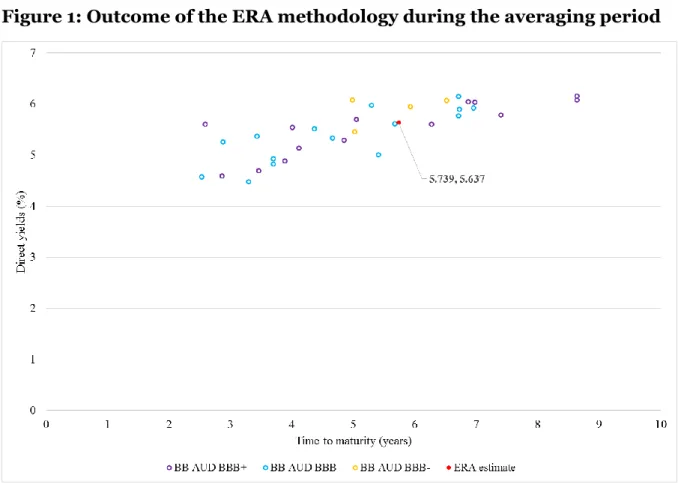
Figure 1: Outcome of the ERA methodology during the averaging period ... 43
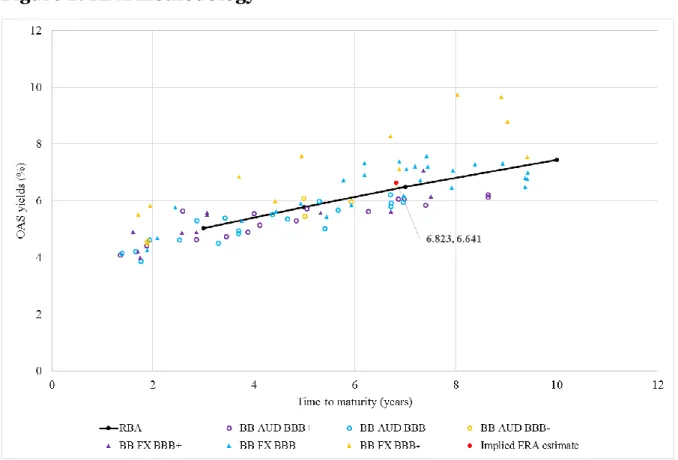
Figure 2: RBA methodology ... 46
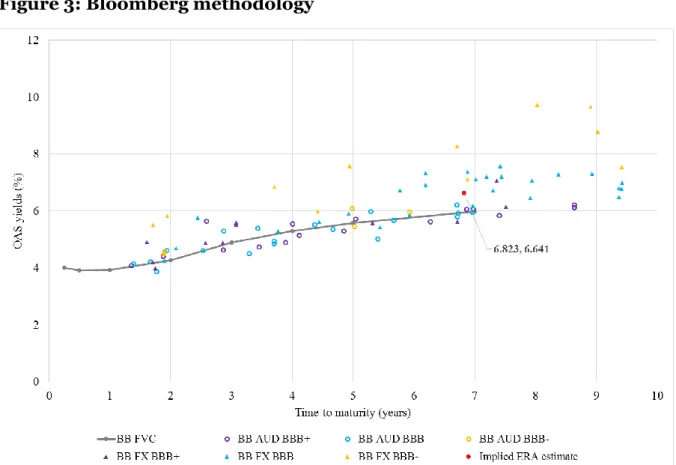
Figure 3: Bloomberg methodology ... 47
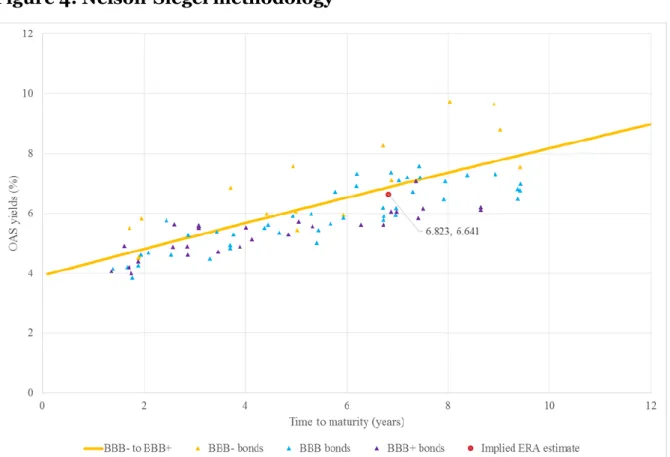
Figure 4: Nelson-Siegel methodology ... 49
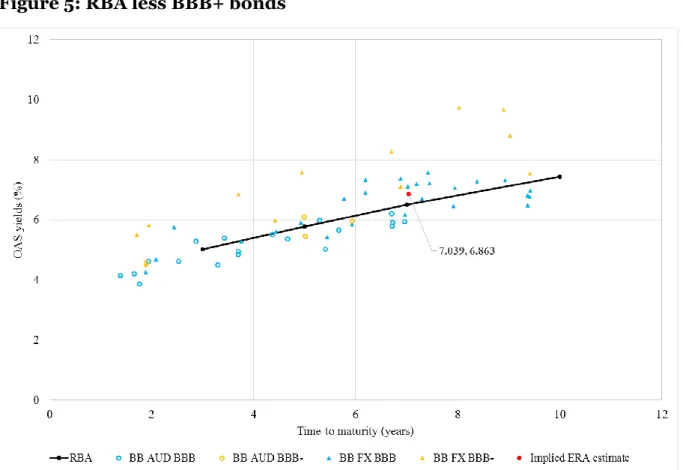
Figure 5: RBA less BBB+ bonds ... 51
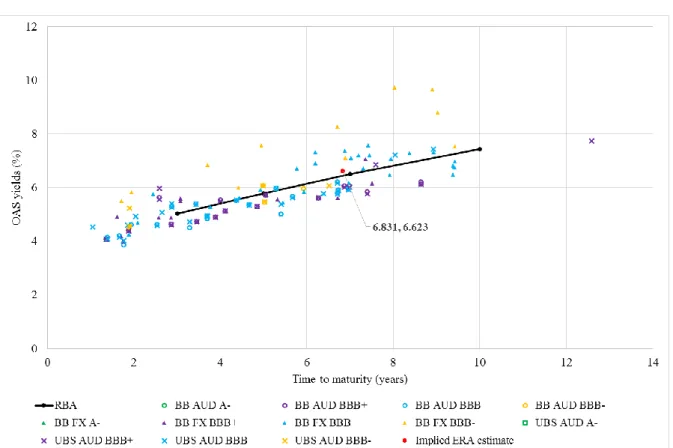
Figure 6: RBA sample including UBS data ... 52
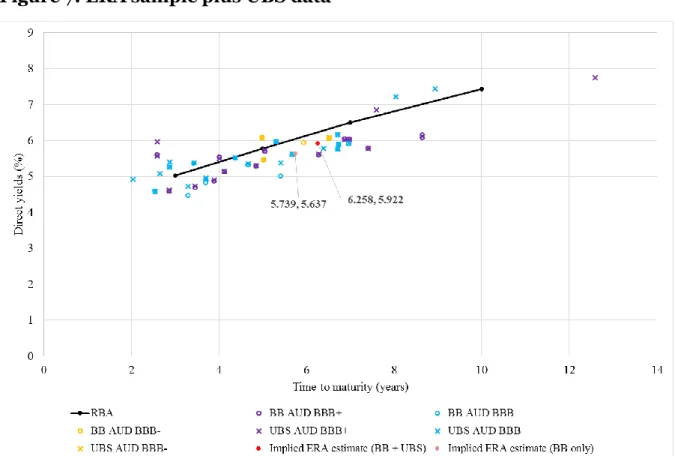
Figure 7: ERA sample plus UBS data ... 53
Figure 8: RBA estimate of average DRP yield curve January 2005 to January 2014 ... 72
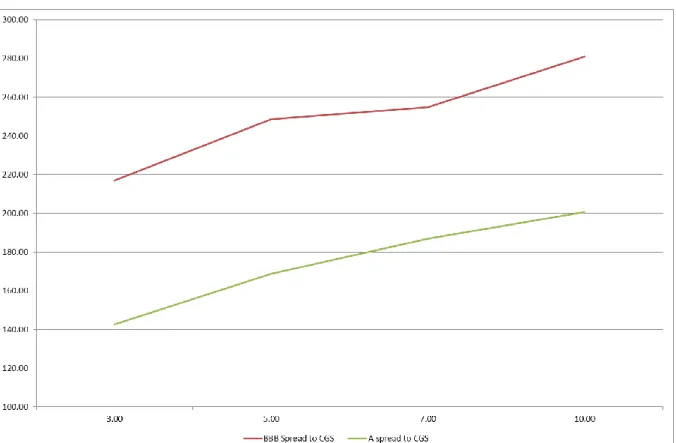
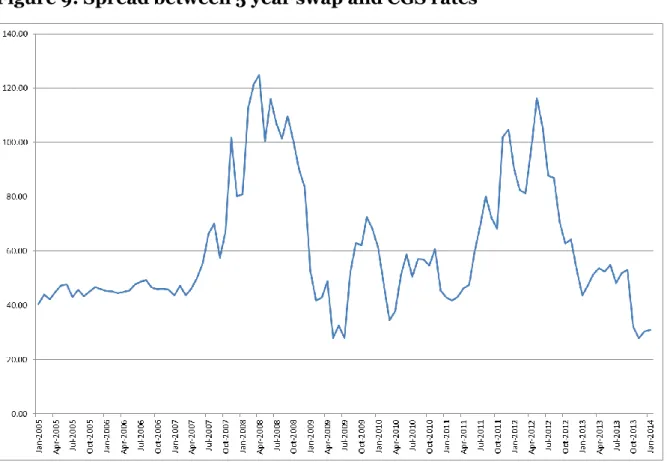
Figure 9: Spread between 5 year swap and CGS rates ... 79
Figure 10: Reproduction of Figure 3 Appendix 3 of the ERA’s explanatory statement ... 101
Figure 11: Sydney Airport debt maturity profile – as at 30 June 2012 ... 102
Figure 12: Transurban debt maturity profile – as at 30 June 2011 ... 103
Figure 13: Bloomberg and CBA Spectrum fair value yields ... 104
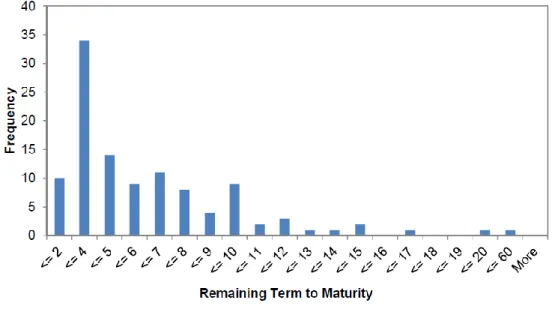
List of Tables
Table 1: Median credit rating of AER’s sample ... 109 Table 2: Median credit rating 2002 – 2013 for AER sample ... 110
Executive summary
1. Rule 87(3) of NGR defines the allowed rate of return objective as:
The allowed rate of return objective is that the rate of return for a service provider is to be commensurate with the efficient financing costs of a benchmark efficient entity with a similar degree of risk as that which applies to the service provider in respect of the provision of reference services (the allowed rate of return objective).
A benchmark debt management strategy must be defined
2. In my view, the requirements of Rule 87(3) and Rule 87 more generally suggest the need for a regulator to undertake two distinct steps when estimating the return on debt (cost of debt) for a ‘benchmark efficient entity’ (or any other entity):
Step 1: define a financing strategy for a “benchmark efficient entity with a similar degree of risk as that which applies to the service provider in respect of the provision of reference services”; then
Step2: estimate the “efficient financing costs” of implementing that strategy. 3. Step 1 is a necessary step given that, before we attempt to measure the cost of
something, we must define what that ‘something’ is. In this case, the ‘something’ in question is the benchmark efficient debt management strategy that the benchmark efficient entity referred to in Rule 87(3) would undertake.
The ERA’s methodology does not define a feasible debt
management strategy
4. The ERA’s methodology for setting the cost of debt does not comply with Rule 87(3) because the ERA never defines the debt management strategy that, if followed, would give rise to a cost of debt consistent with that calculated under its methodology. Indeed, there is no debt management strategy (efficient or otherwise) that would give rise to a cost of debt consistent with the ERA’s methodology. 5. This is true even if the ERA’s bond yield approach resulted in a perfectly accurate
estimate of the prevailing cost of issuing debt for the benchmark efficient entity. The reason is that the ERA methodology of fixing the risk free rate equal to the 5 year CGS yield and then, each year of the regulatory period, annually updating the DRP based on the spread between BBB debt and CGS yields prevailing at that time, results in a value for the return on debt that it is impossible to emulate under any debt management strategy. That is, the cost of debt calculation undertaken by the
ERA is not replicable by a benchmark efficient business – either in practice or in theory.
6. In addition to this problem, I consider that the ERA’s bond yield approach will not result in a reliable estimate of the prevailing (or historic) efficient cost of debt for a benchmark efficient entity. This is, in part, because the ERA methodology does not have regard to all of the available data. Equally critically, the cost of debt estimated under this approach is not for any defined maturity level – but varies based on the vagaries of the bonds in the ERA’s sample. A defined maturity of debt issuance is a critical element of any benchmark efficient debt management strategy. Having a cost of debt based on an indeterminate term of debt maturity is a further reason why the ERA’s methodology does not conform with Rule 87(3) and is not replicable. 7. The ERA accepts that its methodology does not set an allowance that is based on the
costs of a specific debt management strategy. This reflects the ERA’s interpretation that the NGR and NGL require it to set a cost of debt allowance that promotes economic efficiency and the ERA belief that the promotion of efficiency requires the regulator to deliberately set the cost of debt allowance in a manner that is not replicable (a replicable allowance is based on the costs of a debt management strategy that is actually implementable). Its reasoning is that a replicable methodology would afford regulated businesses an opportunity to lower costs (by aligning their debt costs with the allowance) that unregulated businesses do not have, and that this would be inefficient.
8. In my view, the ERA’s economic basis for its interpretation of the NGR and NGL is not sound. The ERA’s analysis sets up a tension between:
setting a replicable cost of debt allowance; and
promoting economic efficiency.
9. On this basis, the ERA explicitly rejects adopting a replicable allowance that reflects the efficient business practices of a benchmark efficient firm in favour of a cost of debt allowance that it believes will promote economic efficiency (widely defined). 10. However, the ERA’s analysis of what promotes economic efficiency is flawed. When
this is recognised the perceived tension between setting a replicable allowance (consistent with Rule 87) and promoting economic efficiency disappears. In fact, setting the allowance based on the costs of a replicable debt management strategy of a benchmark efficient entity would actually promote economic efficiency – not the reverse.
Features of an efficient debt management strategy
issuance of around 10 years. This is the observed practice of both Australian and foreign utilities. It is reasonable to assume that this near uniformly followed practice is efficient – otherwise businesses would not adopt this practice.
12. The AER, operating under the same Rules as the ERA, has adopted a 10 year term as part of the benchmark efficient debt management strategy. A 10 year or greater term has also been adopted by UK and US energy regulators. Similarly, other domestic regulators of non-energy businesses such as IPART and the QCA have also adopted a 10 year term.
13. By contrast, the weighted average maturity underpinning the ERA’s weighted average term is only 5.7 years when the ERA methodology is applied to the ATCO nominated period 22 October and 18 November 2013. Given an upward sloping yield curve, estimating the cost of debt at a 5.7year maturity will materially underestimate the cost of a benchmark efficient debt management strategy (which involves the issuance of debt with an average maturity of around 10 years). This is true whether the cost of debt is estimated based on prevailing market conditions or on an historical average basis.
14. The AER, operating under the same Rules as the ERA, has adopted a 10 year trailing average of the cost of debt as the basis for setting the regulatory allowance. Also Ofgem in the UK uses a 10 year trailing average of 10 year debt costs, as do US regulators. In the US the time horizon of the trailing average reflects the actual issuance of a regulated business (often extending out to 20 years). Of domestic non-energy regulators, IPART also has regard to a 10 year trailing average – although IPART has regard to a prevailing estimate of the cost of 10 year debt. 15. Consistent with the practice of regulated businesses, I consider that setting a cost of
debt allowance based on a 10 year trailing average of interest rates on 10 year debt will promote the allowed rate of return objective and the NGR and NGL more broadly. This approach would result in a stable cost of debt allowance that was simple and low cost to replicate. The stability of a trailing average allowance would be in customers’ and businesses’ mutual interests – consistent with submissions to both the AER and the ERA from both sets of stakeholders.
16. However, this involves a material departure from the previous regulatory practice (under the previous Rules) of resetting the cost of debt at the beginning of the regulatory period based on then prevailing conditions in debt markets. Businesses have the (imperfect) ability to use options and derivative products to manage the risk created by past practice of regular resetting of the cost of debt based purely on prevailing conditions. Once in place, these elements of a debt management strategy take time to unwind.
17. To the extent that a business has managed its debt portfolio on the basis that the previous regulatory practice would continue then it may be appropriate for the allowance for that business to transition over time to a 10 year trailing average. This
could be achieved via a transition mechanism as proposed by the AER (which gradually transitions the allowance every year over 10 years) or a mechanism that sets an “on the day” allowance for the entirety of the next regulatory period but introduces a full or partial trailing average at the beginning of the subsequent regulatory period.
18. The best estimate of the credit rating for a regulated energy business with a 60% gearing issuing 10 year debt is BBB or below. A BBB credit rating is consistent with recently observed credit ratings for Australian regulated utilities and the modelling of credit metrics from specific regulatory decisions (regulatory decisions where the cost of equity allowance was set based on an equity beta of 0.8 rather than the ERA’s new range of 0.5 to 0.7). The credit rating for a business issuing shorter term debt or with a less generous cost of equity allowance will be below BBB.
Use of RBA estimates is the best method to estimate the cost
of debt
19. Whatever benchmark efficient debt management strategy that is adopted, it will be necessary to estimate the cost of issuing BBB debt. In my view, the best methodology for arriving at this estimate is likely to rely on estimates of the yield on BBB corporate debt at a 10 year maturity as published by the RBA.
20. The ERA finalised its Rate of Return Guidelines prior to the RBA commencing publication of these estimates. Therefore, the RBA’s estimates reflect new information that was not available to, or considered by, the ERA in its Rate of Return Guidelines.
21. The RBA’s core methodology is transparent and well documented, and has been proposed by IPART as the basis for estimating the cost of 10 year BBB debt. It is similar to the ERA’s bond yield methodology in many respects, but it makes considerable improvements in broadening the sample of relevant data collected, and in how this is transformed into estimates of yields at different maturities. 22. In particular, the RBA publishes an estimate of the cost of BBB rated debt at 10
years to maturity, while the ERA methodology is not capable of this.
23. The RBA methodology, like the ERA methodology, restricts its sample to bond yields available from Bloomberg. However, the RBA includes in its sample bonds issued by Australian companies in foreign currencies. Given that almost half of the value of bonds issued by Australian energy utilities is denominated in a foreign currency, a benchmark efficient debt management strategy should similarly account forth issuance of foreign currency bonds. Moreover, including these bonds adds significantly to the observations of long maturity bonds – the maturity of interest for infrastructure issuers.
24. It is also relevant to note that the RBA estimates are consistent with the results of Nelson Siegel curve fitting techniques applied to wide samples of bonds, and are also consistent with the yields on long dated domestic currency bonds as estimated by UBS (bonds for which the Bloomberg database does not report yields). Finally, I note that the RBA estimation technique is transparent and well documented.
1
Introduction
25. My name is Tom Hird, and I have a Ph.D. in Economics from Monash University and over 20 years’ experience as a professional economist.
26. I have been engaged by ATCO Gas to prepare an expert report which provides:
a. An assessment of the ERA’s approach to estimating the return on debt set out in the Rate of Return Guidelines, including: A critique of the ERA’s reasoning for adopting a 5 year term for the risk free rate (cost of debt and cost of equity), and an analysis of the ERA’s proposed bond yield approach to the debt risk premium and the proposal to update the DRP annually.
b. My opinion on whether the ERA’s proposed approach to the return on debt would results in the best estimate of the return on debt that contributes to the achievement of the allowed rate of return objective and meets the requirements of Rule 87.
c. My opinion on whether the return on debt estimate using the ERA approach would produce a result consistent with the achievement of the NGP and the RPP.
d. If I find that the ERA’s approach does not meet the requirements set out in points (ii) and (iii) above, a suggestion of an alternative method for estimating the cost of debt which should be used to produce the best estimate possible in the circumstances which complies with Rule 87, and report on the estimate this method produces.
27. The full terms of reference that I have been provided with by ATCO is provided at Appendix I to this report.
28. The remainder of this report is structured as follows:
Section 2 discusses defining a debt management strategy consistent with the NGR and NGL. That is, it provides my interpretation of the relevant economic content of the legal context.
Section 3 provides an assessment of the ERA methodology against the NGR and NGL. In this chapter I demonstrate that the ERA’s methodology for arriving at an estimate of the cost of debt is inconsistent with the requirements of the NGR and the NGL.
Section 4 discusses efficient benchmark debt management strategies. I conclude that any benchmark efficient debt management strategy consistent with the NGR and NGL needs to be based on a staggered issuance of debt with a term of issuance of 10 years.
Section 5describes why I believe that a 10 year term is also appropriate for the risk free rate used in the CAPM.
Section 6 outlines the best estimates of current and historical yields on 10 year BBB debt. In this chapter I provide analysis which demonstrates that, over the 20 day averaging period between 22 October and 18 November 2013, the RBA methodology to estimating current and historical yields on 10 year BBB debt represents an improvement on the ERA methodology.
Section 7summarises my response to the questions put to me in my terms of reference.
29. I acknowledge that I have read, understood and complied with the Federal Court of Australia’s Practice Note CM 7, “Expert Witnesses in Proceedings in the Federal Court of Australia”. I have made all inquiries that I believe are desirable and appropriate to answer the questions put to me. No matters of significance that I regard as relevant have to my knowledge been withheld. I have been provided with a copy of the Federal Court of Australia’s Guidelines for Expert Witnesses in Proceeding in the Federal Court of Australia, and confirm that this report has been prepared in accordance with those Guidelines.
30. I have been assisted in the preparation of this report by Daniel Young and Johanna Hansson in CEG’s Sydney office. However, the opinions set out in this report are my own.
Thomas Nicholas Hird 14 March 2014
2
Defining a debt management strategy
consistent with the NGR and NGL
31. The relevant legal context for setting a cost of debt allowance under the NGR and the NGL is summarised in my terms of reference. This section provides my interpretation of the relevant economic content of that legal context.
32. In particular, I review Rules 87(3) (the allowed rate of return objective), 87(5) and 87(8)-(10), as directed within my term of reference. I also consider the National Gas Objective (NGO) and the revenue and pricing principles (RPP).
33. Based on the legislative context I consider that, in order to be consistent with the NGR and NGL, the cost of debt allowance must be:
replicable in the sense that it is based on a well-defined debt management strategy;
based on a debt management strategy which is efficient in the sense that it reflects a prudent strategy that minimises the expected (risk adjusted) costs of financing. In order to achieve this, the benchmark strategy should be based, as far as possible, on observed behaviour of regulated businesses (where it can be assumed that regulated business have an incentive to behave efficiently); and
estimated based on the best available data.
2.1
Two steps in arriving at an estimate of the cost of debt
34. In my view, there are two distinct steps involved in estimating the return on debt (cost of debt) for any entity – including a ‘benchmark efficient entity’. The basis for this conclusion is a common-sense belief that, before one can embark on an estimation process, one must define what it is that is being estimated. To define what is being estimated, it is necessary to:
define a financing strategy for a “benchmark efficient entity with a similar degree of risk as that which applies to the service provider in respect of the provision of reference services”; and
estimate the “efficient financing costs” of implementing that strategy. 35. The second step cannot proceed without the first step.
36. Examples of elements of a benchmark efficient debt management strategy that may need to be defined in the first step include:
the term structure of the debt issued;
the timing of debt issuance;
the market into which debt is issued;
the type of debt issued (e.g., callable vs non-callable debt);
the extent to which derivative contracts, such as swap contracts, are used to manage the debt portfolio; and
the perceived riskiness of the debt issued (e.g., proxied by a benchmark efficient credit rating). This needs to be consistent with the rest of the benchmark efficient debt management policy (e.g., higher assumed gearing should be associated with, other things equal, a lower credit rating).
37. Once a benchmark efficient debt management strategy is defined, the next step is to estimate the financing costs associated with that strategy. This step requires collection and analysis of financial market price/yield information relevant to determining the costs incurred in implementing the benchmark efficient financing strategy at the relevant times. This step focuses on data collection, interpretation and manipulation, to arrive at an estimate of the costs of implementing the benchmark efficient strategy defined in the first step. Relevant decisions that must be made are:
whether and how to use third party estimates of the yields on broad categories of corporate debt. This might include Bloomberg and RBA published estimates of the yields on bonds of particular maturities/credit ratings;
whether and how to use third party estimates of the yield on specific debt instruments (e.g., a specific bond issued company “X”, another bond issued by company “Y”, etc.); and
what sources for these data should be used and what, if any, differential weighting should be applied to the data sources.
2.2
Rule 87(3): the allowed rate of return objective
38. Rule 87(3) states:
The allowed rate of return objective is that the rate of return for a service provider is to be commensurate with the efficient financing costs of a benchmark efficient entity with a similar degree of risk as that which applies to the service provider in respect of the provision of reference services (the allowed rate of return objective).
it is possible to define a “benchmark efficient entity with a similar degree of risk as that which applies to the service provider in respect of the provision of reference services”;
“efficient financing costs” for that entity can be estimated; and
the service provider should receive compensation that is “commensurate” with this.
40. In the context of setting the allowed cost of debt, I consider that this requires:
a benchmark efficient debt financing strategy to be defined;
the costs of efficiently implementing that strategy to be estimated; and
compensation commensurate with this to be provided to the service provider. 41. In my view, the definition of a benchmark efficient financing strategy must be such
that it would be possible for a benchmark efficient entity to undertake that strategy. This does not necessarily mean that a specific regulated entity must actually or potentially be able to implement that strategy, nor that it must be the most efficient strategy for that entity. However, it must be conceivable that this strategy would be efficient for a benchmark entity facing the same risks.
42. By way of example, if it is not possible to issue 100 year debt, or it is known to be prohibitively expensive to attempt to do so, then issuing 100 year debt should not be included in the definition of a benchmark efficient debt financing strategy. To do so would be to attempt to arrive at a cost estimate that is associated with doing something that is impossible/inefficient. Similarly, if it is impossible to trade certain derivative contracts, or if it is known to be prohibitively costly to do so, then the trading of such derivative contracts should not be included in the definition of benchmark efficient debt financing strategy.
43. The AEMC Final Rule Determination suggests that the AEMC envisaged its Rule change would require that the regulator clearly define a benchmark debt financing strategy and then estimate the costs of implementing that strategy.
While the Commission considers that allowing the regulator to estimate the return on debt component of the rate of return using a broad range of methods represents an improvement to the current approach, it is a separate issue from that of benchmark specification and measurement. A historical trailing average approach still requires the regulator to define a benchmark and use appropriate data sources to measure it. Arguably, it is even more important that the benchmark is defined very clearly and can be measured,
because it needs to be estimated periodically in the future.1[Emphasis added.]
Similarly, the AEMC clearly envisaged that the definition of an efficient benchmark entity would include a definition of that benchmark entity’s efficient debt financing strategy.
The first factor in the rule requires the regulator to have regard to the characteristics of a benchmark service provider and how this influences assumptions about its efficient debt management strategy.2
2.2.1 Definition of “efficient” as used in 87(3)
44. It is also necessary to define what is meant by the term “efficient” in the two places it is used in Rule 87(3). In my view, the correct interpretation is that the benchmark entity must engage in a financing strategy that gives rise to the lowest expected
finance costs for an “entity with a similar degree of risk as that which applies to the service provider in respect of the provision of reference services”.
45. In this context it is important to make two observations. First, Rule 87(3) is defined at the level of the weighted average rate of return on debt and equity. Thus, a financing strategy that results in the lowest expected cost of debt need not be efficient if undertaking that strategy raises the cost of equity by a more than offsetting amount. That is, if undertaking that strategy results in a higher weighted average rate of return on debt and equity than could otherwise be expected to be achieved.
46. Second, financing strategies are designed without perfect knowledge of the future. This means that different financing strategies will give rise to different costs in different market circumstances. When I define an efficient financing strategy as one that gives rise to the lowest expected finance costs, I do not mean that it always gives rise to the lowest actual financing costs. Rather, I mean that it is a finance strategy that prudently takes into account future uncertainties and seeks to minimise the (actuarially weighted) expected financing costs under all possible future states of the world.
47. By way of illustration, a generally upward sloping yield curve for corporate debt suggests that issuing very short term debt (e.g., 3 month debt) might minimise interest costs in most circumstances (i.e., this strategy might be “most likely” to achieve cost minimisation given the range of future possible states of the
1 AEMC, National Gas Amendment (Price and Revenue Regulation of Gas Services) Rule 2012, p. 90
world).3However, this strategy would involve refinancing 100% of debt every 3 months. Any future disruption to financial markets could have potentially disastrous consequences for an entity’s debt and equity investors if the firm finds itself unable to refinance its debt.4 Consequently, even if there is only a small probability of this occurring, the actuarially expected costs of financing solely with 3 month debt might be higher than the actuarially expected costs of funding using long term debt. Thus, even though short term funding might be ‘most likely’ to achieve cost minimisation, it still has a higher actuarially expected costs than long term debt funding because it magnifies investors’ exposure to low probability but high cost events/risks.
2.3
Rule 87(5)
48. Rule 87(5)(a) has clear application to both steps, requiring that regard be had to all relevant evidence both when defining a financing strategy and when estimating the cost of that strategy.
49. Rule 87(5)(b) and Rule 87(5)(c) require regard be had to the desirability of internal consistency between the estimates of the return on debt and return on equity. I consider that, amongst other things, this means that the definition of the benchmark efficient debt financing strategy should have regard to the debt management strategies of the companies used to infer an estimate of the benchmark efficient cost of equity funding.
50. This is because the risks faced by equity holders in an entity depend on the debt financing strategy undertaken by that entity. Therefore, if the cost of equity is estimated based on observed equity risks for a sample of firms then, ideally, the cost of debt estimate should have regard to the debt financing strategies of the same sample of firms.
51. Consider again the illustration used in the previous section. A firm that relies solely on 3 month debt instruments will face very high refinancing risk. This will tend to raise the observed equity beta and cost of equity for that firm – raising the
3 This is actually a doubtful proposition. The corporate yield curve is generally upward sloping at least in
part because short term debt issued by a corporation is less risky than long term debt because it matures first. Consequently, a short term lender is less worried about default because they know the business has locked in funding from other debt providers that it does not need to repay in the short term. If all debt is short term debt then this advantage disappears – and we would expect the cost of short term debt to rise.
4 For example, debt investors are defaulted on and equity investors have their rights usurped by debt
investors in bankruptcy proceedings. In the process, part of the intrinsic value of the firm is destroyed due to constraints on its ability operate without funds and in the midst of legal disputes between
sensitivity of its stock price to variation in the perceived liquidity of financial markets.
52. It would be a mistake to use this heightened cost of equity without recognising that it results from a specific debt financing strategy. That is, there is the potential to overestimate the efficient overall average rate of return by adopting this heightened cost of equity in conjunction with a more prudent assumed debt financing strategy (one that would not be associated with the observed heightened cost of equity). The opposite is also true. If the firms used to benchmark the cost of equity engage in prudent debt management practices which lowers their equity risks, then it would be inappropriate to combine a cost of equity estimated from these benchmarks with a cost of debt estimate based on a less prudent strategy (such as very short term borrowing).
2.4
Rule 87(8) to Rule 87(10)
53. Rule 87(8) states that the return on debt should be estimated to contribute to the achievement of 87(3) (the allowed rate of return objective).
54. Rule 87(9) makes clear that the regulator can update the return on debt each year of the access arrangement period.
55. Rule 87(10) is relevant to the first step of the estimation process (i.e., defining a benchmark efficient debt management strategy). Specifically, Rule 87(10) makes clear that, subject to it promoting the allowed rate of return objective and without limitation, the benchmark efficient financing strategy defined in the first step can be based on:
(a) the return that would be required by debt investors in a benchmark efficient entity if it raised debt at the time or shortly before the time when the AER's decision on the access arrangement for that access arrangement period is made;
(b) the average return that would have been required by debt investors in a benchmark efficient entity if it raised debt over an historical period prior to the commencement of a regulatory year in the access arrangement period; or
(c) some combination of the returns referred to in subrules (a) and (b).
56. I believe that it is relevant that both 87(a) and 87(b) refer to the return that would be required by debt investors if the benchmark efficient entity raised its debt in a particular way. This is consistent with my view that it is necessary to define a benchmark efficient debt financing strategy before proceeding to estimate the costs of that strategy.
2.5
The national gas objective and the revenue and pricing
principles
57. The national gas objective (NGO) and the revenue and pricing principles (RPP) in the NGL apply more broadly than to just the cost of debt and equity funding. However, in my view, the requirements set out in the NGL are consistent with my interpretation that the NGR requires an estimate of the allowed return on debt to be based on an estimate of the cost of following a benchmark efficient debt financing strategy.
58. In my view, if the allowance for the return on debt is based on a benchmark financing strategy consistent with what a benchmark efficient entity would undertake, then the regulated entity will:
have appropriate incentives to invest and maintain its assets in a manner that promotes the national gas objective;
have “a reasonable opportunity to recover at least the efficient costs the service provider incurs in providing reference services” - consistent with (2)(a) of the revenue and pricing principles;
be provided with effective incentives in order to promote economic efficiency – consistent with (3) of the revenue and pricing principles;
have tariffs that allow for a return commensurate with the regulatory and commercial risks involved in providing the reference service – consistent with (5) of the revenue and pricing principles; and
have appropriate incentives to invest in the network - consistent with (6) of the revenue and pricing principles.
59. Similarly, setting tariffs to reflect the cost of debt associated with a benchmark efficient debt financing strategy is consistent with promoting efficient utilisation of gas networks by customers. In fact, in my view, achieving the allowed rate of return objective is an important foundation for achieving the national gas objective and the revenue and pricing principles.
60. Only if the cost of debt allowance is set consistent with a well-defined benchmark efficient debt management strategy can a business attempt to replicate that strategy such that its own efficient costs are commensurate with the allowance. If a business cannot do this because the cost of debt allowance is not based on well-defined debt management strategy, then a gap between the allowed and achievable cost of debt can be created. The effect of this gap can be to:
weaken incentives to invest and maintain its assets in a manner that fails to promote the national gas objective;
deny “a reasonable opportunity to recover at least the efficient costs the service provider incurs in providing reference services” - inconsistent with (2)(a) of the revenue and pricing principles;
weaken incentives for efficient investment and thereby fail to promote economic efficiency – inconsistent with (3) of the revenue and pricing principles;
result in tariffs that do not allow for a return commensurate with the regulatory and commercial risks involved in providing the reference service – inconsistent with (5) of the revenue and pricing principles; and
fail to provide appropriate incentives to invest in the network - inconsistent with (6) of the revenue and pricing principles.
3
Assessment of the ERA methodology
against the NGR and NGL
61. In my view the ERA’s methodology for arriving at an estimate of the cost of debt is inconsistent with the requirements of the NGR and the NGL. A key reason for this conclusion is that the ERA has not attempted to adopt an estimation methodology that is derived from, or otherwise consistent with, a well-defined debt management strategy. As a result, the methodology is incapable of giving rise to an allowance that is commensurate with the efficient debt financing costs of a benchmark efficient entity with a similar degree of risk as that which applies to the service provider in respect of the provision of reference services.
62. In addition to this overarching flaw, there are aspects of the ERA’s methodology that are, in my view, clearly inconsistent with a benchmark efficient debt management strategy. In particular:
a. Any benchmark efficient debt management strategy should be based on the issuance of 10 year or longer debt – consistent with actual practice of regulated energy businesses both domestically and internationally. By contrast, the ERA sets an allowance for the cost of debt based on an undefined term of debt issuance (which is part of the reason that that it is not replicable). However, based on recent application of its methodology, the implicit term of debt issuance is a little over 5 years.
b. The ERA resets the allowed DRP on the entire debt portfolio annually. In order to replicate this cost, a benchmark efficient entity would need to be reissuing 100% of its debt every year. While this is theoretically possible, it would require the entity to issue 1 year debt. This is inconsistent with both efficient practice (10 years) and inconsistent with the ERA’s own implicit practice (indeterminate but currently a little over 5 years).
3.1
The ERA’s methodology
63. The ERA’s rate of return guidelines sets the allowance for the cost of debt in each year of the regulatory period based on:
an estimate of the yield on 5 year CGS over a 40 day period just prior to the beginning of the regulatory period; plus
an estimate of the debt risk premium (DRP) prevailing at the beginning of each regulatory year arrived at using the ERA’s ‘bond yield’ approach (based on a weighted average of observed DRPs for a particular sample of BBB- to BBB+ rated corporate bonds).
64. This approach to can only be consistent with the allowed rate of return objective if the resulting estimate of the cost of debt is “commensurate with the efficient financing costs of a benchmark efficient entity with a similar degree of risk as that which applies to the service provider in respect of the provision of reference services”.
65. Except by accident, this will not be the case unless there exists a benchmark efficient debt financing strategy that would give rise to a cost of debt consistent with these calculations. However, as I discuss in the next sections, there is no feasible debt financing strategy that will give rise to such a cost of debt consistent with the ERA’s calculation procedure. Certainly, there is no such efficient debt management strategy.
3.2
Term of debt issuance
66. An important element of any debt financing strategy that must be established is the term of the debt that the entity issues under the benchmark financing strategy.
3.2.1 What do regulated energy businesses do
67. The ERA surveys evidence provided by CEG and PwC to the effect that the average tenor of debt at the time of issuance by infrastructure businesses, including Australian regulated energy businesses, is in excess of 10 years.5I have further confirmed this with subsequent analysis of audited non-publicly available information sourced from ENA members. Based on these data I estimated a simple and weighted average term of debt at issuance of 10.9 years and 10.5 years respectively. My letter to the AER detailing this analysis is provided at Appendix A. 68. The AER, relying on the same data presented by me, adopts an estimate of 8.7 year
term at issuance – although this is achieved by including the wholly Singapore Government owned business SPIAA and treating callable debt ‘as if’ it matures at the first call date.6For the reasons outlined in my letter, I do not consider that these are appropriate adjustments to make when estimating the benchmark term of debt issuance for a benchmark efficient entity. In any event, the AER adopts a 10 year term as the relevant benchmark.
69. The same pattern of long term debt issuance is observed for US and UK regulated energy businesses.7In the context of a report for the ENA, I estimated a weighted average term of debt at issuance of 18.2 years across a sample of 86 regulated US
5 See Appendix 3 to the ERA Explanatory Statement to the Rate of Return Guidelines, p.35.
6 See AER, Explanatory Statement to the Rate of Return Guidelines, p. 142.
energy businesses. The weighted average term to maturity at issuance for the businesses within the sample with the highest proportion of regulated assets is even higher, at 19.4 years. In the same report, I demonstrated that the weighted average term of debt at issuance for UK regulated energy businesses is 19.1 years.8
70. Further to this, the ERA performs its own analysis and confirms the finding that regulated businesses issue 10 year debt.9
3.2.2 Why do regulated energy businesses issue long term debt?
71. The near universal practice of regulated energy businesses issuing long term debt provides strong evidence that this practice is efficient. That is, this practice tends to lower the overall risk adjusted finance costs of a regulated energy business. If this was not the case then we would not observe such a tendency in the data.
72. Moreover, the fact that we do observe this strong tendency in the data means that issuing short term debt must be expected to raise risk adjusted finance costs. This conclusion is grounded in one of the fundamental principles of modern finance theory, namely, the Modigliani-Miller Theorem.
73. This theorem states that in perfectly liquid and frictionless markets, the way in which a firm finances itself has no impact on the cost of capital – it just shifts risk around to different investors. However, in the real world, capital markets are less than perfect, and the fact that we see some dominant financing strategies must reflect an attempt by firms to minimise transaction costs and risks that arise from market imperfections. This is discussed further in Appendix B and Appendix G to this report, where I also discuss the role of long term debt issuance in minimising refinance risk – the existence of which is a form of “market imperfection”. However, the principle is intuitively simple and flows from the proposition that businesses have an incentive to adopt an efficient debt finance strategy. If we observe that businesses overwhelmingly issue long term debt, then it should be assumed that it is efficient to so.
3.2.3 What does this mean for the regulatory benchmark?
74. Given that there is no dispute that the observed term of debt issued by regulated businesses is around 10 years, I consider that this should form the basis of a benchmark efficient debt finance strategy that the ERA should attempt to estimate the cost of.
8 CEG, Debt strategies of utility businesses, A report for the ENA, p.30
3.2.4 What is the ERA’s implied term at issuance?
75. The ERA’s implicit estimate of the term of debt issued is, by contrast, defined by the average maturity of the bonds in its sample used to implement the ‘bond yield’ approach. The average term of debt will vary depending on the bonds that are in the sample, and the weights applied to them will tend to be around half of the average maturity that those bonds had at the time of issuance. That is, the remaining life of bonds in the ERA sample will tend to be half of the maturity of those bonds at the time that they were issued.
76. Strict application of the ERA bond yield methodology from the 22 October 2013 to the 18 November 2013 results in a weighted average remaining maturity of bonds of 5.7 years. This is around half of the 10 year plus maturity at issue that we actually observe for regulated utilities.
77. Moreover, because the term of debt will vary from year to year depending on the vagaries of maturities of the bonds in the ERA sample, this makes it impossible for an entity to have a debt management strategy consistent with the ERA benchmark. That is, if the average term of the bonds in the ERA sample is 5 years in one regulatory year and 6 years in the next then it will not be possible for a regulated business to have a portfolio of debt that has a term at issuance that matches the ERA’s implicit term in both years – even assuming it could predict what that would be in advance (which it could not). This is discussed further in Appendix C.
3.2.5 What reason does the ERA give for not adopting a 10 year debt issuance
78. The ERA acknowledges the difference between the maturity at issue of regulated utilities (10+ years) and the weighted average maturity of the bonds used to estimate its DRP. However, the ERA argues at length that it is not the maturity of a bond at the time of issuance that is relevant, but rather the maturity of the bond at the current time.10
The Authority considers that it is the average remaining term to maturity that determines the debt profile of a firm at a given time. That is, the yield required to service a firm’s cost of debt is a function of the remaining term to maturity, and not the term to maturity at issuance. [emphasis added]
79. This view is expressed in multiple places in the Explanatory Statement (see Appendix C for details). In summary, the ERA states that:
regulated utilities issue 10 year debt; but
because this debt is issued gradually through time, the average remaining maturity of a bond is only a little over 5 years; and
the yields that a business has to pay to service its debt are determined by the remaining term to maturity and not the term to maturity at issuance.
80. The ERA and I are in broad agreement on the first two points. However, I strongly disagree with the ERA’s view summarised in the third point above. This position is incorrect. Once a bond is issued, its coupon (or its trading margin (equivalent to the DRP) if it is a floating rate bond) is fixed and the issuer is legally obliged to pay that amount for the life of the bond. The price, and therefore the yield, of the bond in secondary markets may vary but this has no impact on the legal obligations of the issuer. It is quite true that, given an upward sloping yield curve and holding other things equal, the yield on secondary bonds will tend to fall as their remaining maturity falls. However, this has no effect on the obligations of the issuer – which are set at the time of issuance. (I provide a worked example in appendix C.1 illustrating the difference between the coupon paid on a bond (which is set at the time of issue) and the yield on the same bond in secondary markets.)
81. This is recognised by the AER in its Rate of Return Guidelines where it correctly states:
For the purposes of estimating debt yield compensation we consider that it is appropriate to consider:
…
Term at issuance rather than term to maturity. Term at issuance reflects the premium associated with the original term length. An issuer must pay this premium irrespective of the premium at a subsequent point in time, as reflected by the term to maturity.11
82. In contrast, the ERA’s conclusion that “the yield required to service a firm’s cost of debt is a function of the remaining term to maturity, and not the term to maturity at issuance” is incorrect. Consequently, the basis for the ERA not adopting a 10 year term falls away.
83. In Appendix C, I also review statements by the ERA to the effect that its approach is consistent with advice from Associate Professor Lally and other possible claims in support of the ERA’s term assumption. I find that these claims are also incorrect and rest on the same fundamental error described above.
3.3
Annual update to the DRP
84. The ERA justifies basing the cost of debt allowance on the 5 year CGS rate at the beginning of the regulatory period on the basis that derivative contracts (interest rate swaps) make it possible for a regulated business to issue staggered debt but to hedge its base interest rates to the levels that prevail at the beginning of the regulatory period using interest rate swaps:12
The on-the-day approach has been criticised on the grounds that it somehow does not allow firms to establish a debt portfolio with maturities that are staggered over time in order to avoid ‘refinancing risk’ (staggering is also known as debt laddering).Hence, stakeholders have argued that the approach is not replicable. The Authority considers that this view is incorrect.
The Authority notes that this lack of replicability is predicated on the idea that the firm is unable to hedge its existing portfolio of staggered debt to reflect exactly the return on debt estimated through the on-the-day approach. The implied view is that the regulated firm must issue all of its debt in the averaging period, just prior to the regulatory period.
However, the Authority considers that regulated firms may issue debt at any time, and may hedge the risk free rate by undertaking interest rate swaps, in order to convert to the rate that reflects the prevailing on-the-day rate adopted as the regulatory return on debt.
The Authority has not been presented with concrete evidence of impediments to hedging the risk free rate, through the use of interest rate swaps.
85. This is discussed in more detail in Appendix D where I also describe why I do not consider that such an interest rate swap strategy is efficient. However, even if one did believe that this was efficient, the ERA and its advisers clearly accept that it is not possible to alter the profile of DRP costs in the same way as base interest costs.
There are limited instruments for any firm seeking to hedge the debt risk premium.13
86. The ERA’s adviser, Chairmont Consulting, states the issue more plainly:
DRP cannot be hedged. The regulatory cost of debt calculation must recognise that DRP cannot be effectively hedged because of the lack of liquid derivatives.14
12 ERA, Explanatory Statement for the Rate of Return Guidelines, December 2013, pp.67-68.
87. In simple terms this means that the DRP on an entity’s portfolio of debt will reflect the historical average DRP that existed at the time each bond in the portfolio was issued. Unlike the base level of interest rates, exposure to which can be altered via entering into interest rate swaps, it is not possible to alter the level of firm specific risk premium that a business pays.
88. The inability to hedge the DRP means that, under any financing strategy, the DRP that is incurred when a bond is issued is fixed until the maturity of that bond. In other words, there is no way for an entity (efficient benchmark entity or the actual service provider) to implement a benchmark efficient debt management strategy that would have the DRP on pre-existing debt reset every year at prevailing DRP rates.
89. The ERA makes the following inexplicable statement in relation to the lack of hedging options for the DRP and its proposed annual updating of the DRP:
The debt risk premium will be derived from the yield to maturity of an observed sample of bonds issued by comparator firms with similar credit ratings as the regulated entity (see Chapter 8 – Benchmark credit rating and Chapter 9 – Debt risk premium). The debt risk premium will be updated annually in recognition that it is difficult for firms to manage risk related to changes in this component of debt, given the lack of hedging instruments.15[Emphasis added.]
90. I do not understand why the ERA considers that updating the DRP annually helps an entity manage the difference between their actual cost of debt (based on an historical average DRP) and the ERA’s allowance. As described above, the DRP paid by a business on its debt issue is fixed for the term of the debt. Updating the allowance to reflect a different prevailing DRP every year does not assist the business align its actual cost of debt with the ERA’s allowance in the same year. 91. By way of illustration, let the 10 year historical average DRP on 10 year debt be 3%.
However, let the prevailing DRP on 10 year debt be 1%. The actual DRP being paid by a benchmark efficient entity issuing staggered debt would be 3% at the beginning of the year but the ERA DRP allowance would be just 1% - this would be 1.9%16 lower than efficiently incurred DRP on average over that year.
92. Clearly, the use of a historical average DRP estimate will result in an allowance more commensurate with this assumed debt management strategy. A DRP estimated in this way would be relatively stable through time, better reflecting the
14 Chairmont Consulting, Cost of Debt Comparative Analysis, p. 27
15 ERA, Explanatory Statement for the Rate of Return Guidelines, December 2013, p.53
actual impact of changes in prevailing DRP on an entity’s interest costs. By contrast, the ERA’s proposed annual updating ‘turbo charges’ volatility in the cost of debt allowances making it more likely not less that the allowance will significantly differ from actual debt costs.
93. The ERA’s Guidelines explicitly include a 2.5bp allowance for the cost of hedging using interest rate swaps:
In addition, the Authority recognises that there is a cost involved with hedging. The Authority considers that an annual swap allowance of 2.5 basis points should be provided to firms on the whole of the debt portfolio to compensate for the cost of conducting hedging for the exposure to movements in the risk free rate. The hedging cost allowance would also be added to the return on debt.17
94. However, the DRP is not estimated consistent with the implementation of this strategy (i.e., on a historical average basis). Rather, the antithesis of this, annual updating of the entire DRP allowance, is proposed.
95. The only circumstance in which an entity could align the DRP it pays with the ERA’s proposed annual update to the DRP is if the entity relies solely on one year maturity debt (i.e., rolls over 100% of its debt each year). That is, implicitly, the ERA’s implied benchmark efficient debt management strategy could be described as follows:
the benchmark efficient entity finances itself solely with 1 year bonds refinanced at the beginning of each regulatory year; and
the entity enters into swap contracts to lengthen the base rate exposure for its portfolio from 1 to 5 years (reset at the beginning of each regulatory period). 96. In this case the DRP that the entity faces would be reset every year. However, the
credit rating for this entity would need to be consistent with this financing strategy. This credit rating would certainly not be investment grade due to the extreme reliance on short term debt issues. As noted by Kanangra:18
Rating agencies do not stipulate the debt amount for the capital structure for an issuer. Neither do they counsel issuers on the most appropriate markets for raising debt, nor the term of the debt. However rating agencies are looking for issuers to be conservative in their approach to the debt markets.
Factors which the rating agencies seek in highly rated users are:
17 ERA, Explanatory Statement for the Rate of Return Guidelines, December 2013, para.
A company with a spread of maturities to its debt, such that only a small proportion of its debt matures within each year;
Refinance of maturing debt within 6-9 months of its maturity. Early refinancing obviates the risk of the issuer not being able to refinance a tranche of debt if there is a market disturbance when the debt is maturing; and
Access to liquid funds.
Neither rating agency has published rules concerning debt maturity or refinance Neither are direct ratings drivers, but both contribute to a well-managed company and go towards stronger ratings.
Liquidity is however a significant consideration for rating agencies. The rating agencies take the approach that a company cannot be investment grade without adequate liquidity. In order to be IG an issuer must not only satisfy the long term metrics but must also have acceptable liquidity. Both agencies measure liquidity by calculating the ratio of the assured cash sources over the next 12-24 months to the cash uses over the same time period. In each opinion each agency has a section on liquidity, in which it describes the sources and uses of cash for the next 12-18 months.
97. In short, having 100% of debt refinanced every year would not provide “a spread of maturities to its debt, such that only a small proportion of its debt matures within each year” and would create a cash requirement (including the cash necessary to repay all debtors for 60% of the value of thereby) that massively exceeded the assured cash sources over the same period. It would also be inconsistent with the formal debt management strategies adhered to by regulated utilities that require no more than 15% to 25% of debt can fall due in a given year.19
3.4
How does the ERA justify a non-replicable allowance?
3.4.1 The ERA allowance is not replicable98. The ERA’s cost of debt allowance is not replicable by an efficiently financed benchmark entity because it is not based on the costs of a defined debt management strategy. As discussed in the previous sections, it is based on:
an indeterminate term of debt issuance (one that is currently 5.7 years based on the bonds in the ERA sample – well below the efficient term of debt issuance based on actual business practice); and
annual updating of the DRP when the actual DRP for any entity will reflect the historical average DRP.
99. In addition, as discussed in Appendix D the ERA’s adoption of a 5 year Commonwealth Government Security (CGS) rates as the base interest rate (and measurement of the DRP relative to CGS rates) is also internally inconsistent with its assumed use of interest rate swaps to reset the base interest rates. That is, if it is assumed that base interest rates are reset using interest rate swaps then the calculation of the cost of debt should reference swap rates not CGS rates – as Chairmont consulting also advised the ERA.
3.4.2 The ERA’s rationale for its position
100. The ERA understands that its methodology is not based on a well-defined benchmark efficient debt management strategy. The basis for this is that the ERA interprets the NGR and the NGL as requiring it to set a cost of debt that maximises “economic efficiency” broadly defined. The ERA’s analysis leads it to the conclusion that, in order to do this, it should annually reset prices consumers face based on prevailing conditions in debt markets at that time.
101. The ERA does not reach this conclusion because it believes that refinancing 100% of debt every year is an efficient debt management strategy for a benchmark efficient entity. Rather, it is because it believes that setting prices on this basis will give the entity and consumers economically efficient investment and consumption signals. 102. The decision framework that the ERA establishes for itself is described by the
following introduction to Appendix 3 – which puts forward ‘economic efficiency’ as the first of three key evaluation dimensions.
i) economic efficiency – does the proposed approach lead to efficient financing costs and economic efficiency; in particular, is it:
1. an approach which retains incentives for the regulated firm to adopt efficient financing practices; and
2. a good predictor for the actual cost of debt in the regulatory years, thereby providing effective incentives in order to promote economic efficiency;
103. It is notable that, in setting out these criteria, the ERA does not include providing compensation to a service provider that is commensurate with the efficient financing costs of a benchmark efficient entity as an objective. That is, the ERA does not include the allowed rate of return objective as an objective. Rather, it states its objective as retaining incentives for the regulated firm to adopt efficient financing practices. I do not view these as the same thing.
104. Consistent with the ERA’s stated evaluation criteria, its ultimate rationale for its methodology is based on its belief that, in order to promote economic efficiency, it is desirable that the cost of debt allowance in each year reflects the prevailing cost of newly issued debt at that time. The ERA accepts that it is not possible for any entity (be that a benchmark efficient entity or the regulated service provider) to arrange its debt financing strategy so that its debt financing costs are equal to the allowance that the ERA provides.
105. The ERA describes the difference between the allowance that it would provide and the cost of debt that an entity (including a benchmark efficient entity) would incur as ‘mismatch timing risk’:
The Authority notes that the practice of staggering debt may increase ‘mismatch timing risk’. As noted above, mismatch timing risk, also known as interest rate risk, derives from having revenue based on an assumption of the cost of debt that differs from the cost of debt that the firm actually incurs.20
106. By not setting the cost of debt allowance based on the cost of specific debt management strategy that an entity could follow the ERA creates ‘mismatch timing risk’. However, the ERA believes that this is a virtue of its approach because non-regulated firms are exposed to ‘mismatch timing risk’. The ERA argues that were it to adopt a methodology that had the potential to allow regulated firms (even in theory) to eliminate ‘mismatch timing risk’ then this would lower their funding costs relative to unregulated firms; an outcome which the ERA considers would lead to a reduction in economic efficiency.
The regulated firm’s debt risk premium, under a trailing average approach, would also likely reduce, as lenders would account for the lower risk of future mismatch timing risk and related risks, such as default risk. However, to the extent that this opportunity is not available to other unregulated firms in the economy, such an approach would create a type of financial subsidy to the regulated firm. This creates an economic distortion and an associated reduction in economic efficiency.21
107. The belief that the ERA should aim to align the level of ‘mismatch timing risk’ faced by service providers with the level of ‘mismatch timing risk’ faced by an unregulated firm is stated in several places in its explanatory statement. I detail further relevant quotes in Appendix E.
3.4.3 Critique of ERA rationale
108. In my view the ERA’s rationale for choosing to create ‘mismatch risk’ is fundamentally flawed and cannot be justified under the NGR and NGL. I consider that the ERA has misinterpreted the economic content of the NGR and NGL. 109. The ERA interprets its objective when setting the allowance for the cost of debt as
being to promote economic efficiency – interpreted broadly so as to include productive, allocative and dynamic efficiency. This includes sending appropriate signals to customers to consume regulated and unregulated services across the economy.
110. By contrast, Rule 87(3) sets out the allowed rate of return objective as follows:
The allowed rate of return objective is that the rate of return for a service provider is to be commensurate with the efficient financing costs of a benchmark efficient entity with a similar degree of risk as that which applies to the service provider in respect of the provision of reference services (the allowed rate of return objective).
111. There are two references to ‘efficient’ in Rule 87(3). However, in my view these clearly related to the efficient costs that would be incurred by a benchmark efficient entity. The word “cost” in this context is critical. Rule 87(3) attempts to align the regulatory allowance provided with the costs of a benchmark entity. The use of the adjective efficient does not fundamentally change this meaning. It simply makes clear that the costs in question are efficiently incurred by an efficiently structured entity. In this context, the term ‘efficient’ could reasonably be interpreted as connoting ‘prudency’ or ‘cost minimisation’.
112. The ERA’s rationale for its cost of debt methodology involves a deliberate and explicit departure from this objective. The ERA does not start from the assumption that it must allow a cost of debt commensurate with an efficient debt financing strategy that an efficient benchmark entity would undertake. Rather, the ERA starts from the assumption that it must set the cost of debt allowance in order to promote economic efficiency. The ERA’s interpretation of economic efficiency is very broad as reflected in the below statement.
Further, the Authority considers that economic efficiency cannot be considered in terms of a single firm or a single group of consumers. Such a partial approach may be efficient in isolation, but still leave net efficiency gains once the full general equilibrium considerations are considered. The Authority is required to achieve efficient outcomes for the long term interests of consumers of natural gas. Those consumers of natural gas are engaged with the broader economy. Hence their long term interests take into account that engagement with the broader economy. This requires efficient pricing of gas transmission and distribution network services,