Table of contents
Product description ... 3
Type remarks... 3
Features ... 3
Applications... 3
Connections... 4
System information ... 6
Description... 6
Audio performance data ... 6
Hardware Architecture ... 7
Digital audio input... 7
Controllers ... 7
Clip limiter ... 7
Product overview... 8
Hardware part ... 8
Software installation ... 9
Control panel ... 9
Filter design...10
Graph Area...11
Filter Definition Area ...11
Settings Window...11
Work flow ...11
Measurement ...11
Designing filters...13
Download ...14
Firmware update ...14
Safety precautions...15
Instructions For Installation...15
Recommended Operating Conditions for the SMPS...16
General Performance data for the SMPS ...16
Mains selection ...17
Product description
Type remarks
Firmware version 1.2 (July 2011)
Features
2x UcD400OEM amplifier Switch mode power supply Balanced audio in
Balanced audio through loop Two channel active filtering Fully user-configurable filters Firmware update by USB
DSP supply voltage dependant clip limiter Digital version with AES/EBU input
Applications
This module can be used for the following setups: Active 2-channel system
Active power sub-woofer
And with 2 modules it is also possible to set up a 3-channel system with one module for the separate Subwoofer, and a second module for the top in a 2-channel system.
Use onlyonlyonlyonly a version 1.4 or higher of the Hypex Filter Design program! In earlier versions the PSC is not yet implemented.
The first time the PSC2.400 is used all biquads are zero, so there are no filters installed
When you switch to Bridged mode please be sure to connect your speakers like described in this manual
Do note that the Firmware update differs to the AS2.100 firmware update.
After updating the firmware please use the combining PC software downloaded from our website, www.hypexshop.com
Connections
Figure 1
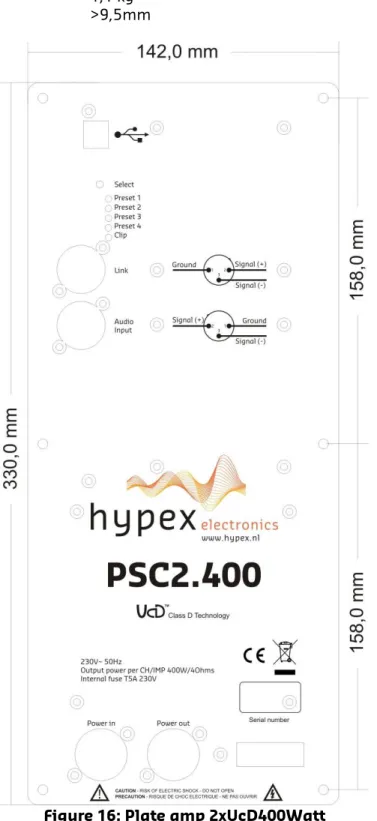
Overview of the connections on the front of the PSC2.400
Function
1 USB input
2 Select button
3 Preset LED’s
4 Clip detect LED
5 Analogue Link
6 Analogue Audio Input
10 Power input
11 Power output
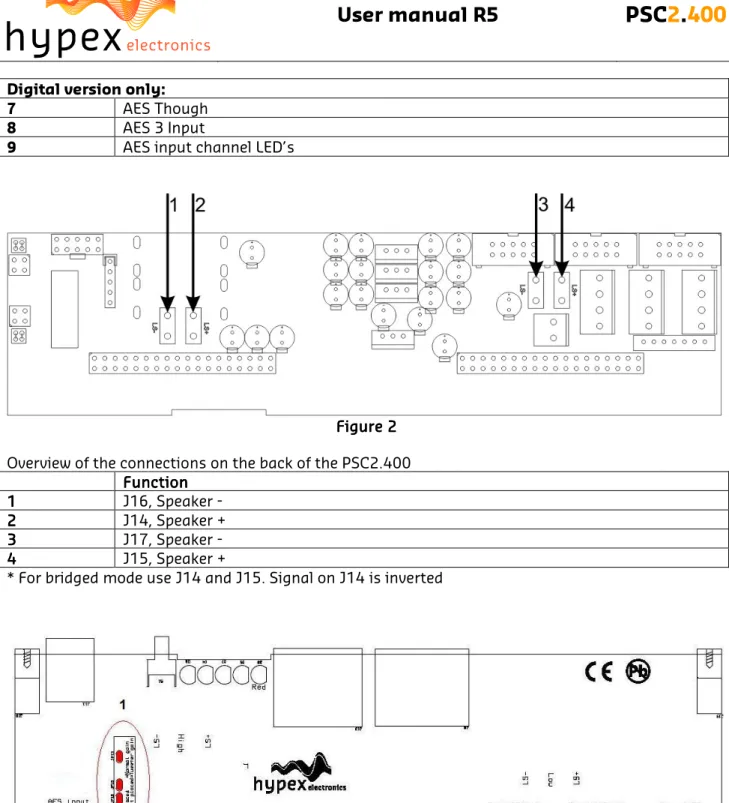
Digital version only:
7 AES Though
8 AES 3 Input
9 AES input channel LED’s
Figure Figure Figure Figure 222 2 Overview of the connections on the back of the PSC2.400
Function FunctionFunction Function 1 11 1 J16, Speaker - 2 22 2 J14, Speaker + 3 33 3 J17, Speaker - 4 44 4 J15, Speaker +
* For bridged mode use J14 and J15. Signal on J14 is inverted
Figure Figure Figure Figure 333 3 Function FunctionFunction Function
Jumpers placed is normal function 1
11 1
Jumpers not placed lowers High channel gain with 10dB, this must be corrected in Hypex Filter Designer under Tools>Options *
System information
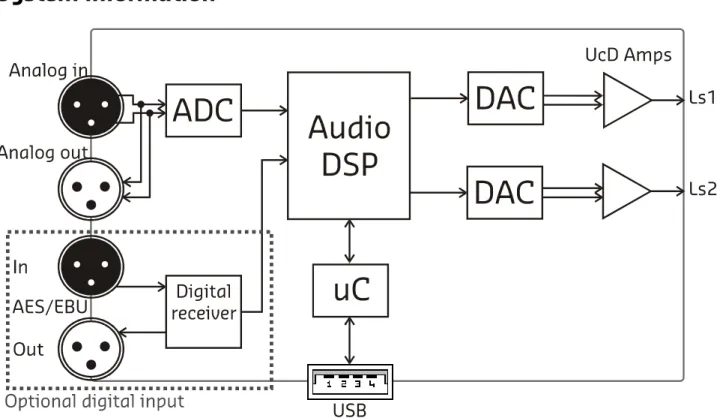
Figure 4: Block diagram
Two-channel active amplifier with DSP filter control.
Description
The PSC2 is a plate amp for use in powered speaker systems. As an active speaker controller, a PSC2 can form the basis of a powerful active two-way monitor.
Figure 4 shows the audio path of the PSC2. The module has two 400Watt UcD modules implemented and is also available with a digital audio input AES/EBU, called the PSC2.400d version. The supply voltage is provided by a Switched Mode Power Supply (SMPS400) module, also a module from Hypex Electronics.
A PC controls the PSC2 through the USB port. This connection is used to upload the configuration and filter settings. It will also be possible to update the firmware through USB.
Audio performance data
MBW=20kHz, unless otherwise noted. All filters set to unity. Noise levels unweighted.
Item ItemItem
Item SymbolSymbolSymbolSymbol MinMinMinMin Typ TypTypTyp MaxMaxMaxMax UnitUnit UnitUnit NotesNotesNotesNotes
Input level Vin +18 dBu Vin max
LS1 400* W Into 4 Ohms Output level LS2 400* W Into 4 Ohms 101 dB ADC Signal/Noise SNR 107 dB DAC
Total harmonic distor-tion+Noise
THD+N -90 dB Without UcD400
DSP sampling rate Fs 48 kHz
Delay per channel 0 0 15000 us Set in software
con-rates 192 verted to 48kHz
Gain +16 dB volume at 0dB
Analogue Latency 1,12 ms
AES Latency 3,58 ms
* Note: Total power for the PSC2.400 is limited to 500Watts total
Hardware Architecture
The standard version of the PSC2.400 has an analogue balanced audio input. This analogue signal is converted to digital, processed by the DSP and then converted back to analogue. A microcontroller controls the DSP and communicates with the PC and can set the presets. An unbalanced source may also be applied, this signal is divided over the two input DAC’s to get better performance.
Digital audio input
The digital version of the PSC2.400d comes with an AES/EBU digital audio input. Incoming AES/EBU is linked through directly to the output and send to the DSP through an asynchronous sample rate converter (ASRC) for jitter removal. The ASRC chip scans its input for whichever signal is active. When the module is set to “Auto input select”, in the control panel on the computer, the input source is automatically switched to digital when present. If the digital audio is stopped the source will be switched back to analogue.
Controllers
The PSC2.400 can only be controlled through USB. When the module is powered on it will automati-cally start up with the last settings. All setting, like volume and preset, are stored after a change is made.
Clip limiter
The PSC2.400 has a build in clip protection. The module measures the supply voltage and uses this value for the limiter. Figure 5 shows the response graph of the limiter.
The hold time is fixed to 100ms and the decay is set to 100dB/s.
Figure 5
When the limiter for either channel is active the Clip led will be lit.
Thermal protection
All modules fitted with Hardware ‘PSC2 V2’ or later, delivered since November 2010, have a build-in thermal protection. This protection lowers the output gain 1 dB per degree starting at plate tempera-ture of 70 degrees Celsius. The outputs will be completely muted when the temperatempera-ture rises over 90 degrees.
Product overview
Before you can use the PSC2.400(d) in your particular setup, you first have to set the right settings. This is done by pc software, called Hypex DSP filter design.
Please do not connect any speakers to your system yet!
Hardware part
The PSC2.400 can be used in 2 ways, as a 2-channel setup or as a one 2-channel bridged version for more power. This is selected in software.
The module can store up to 4 presets. A preset holds the complete filter-settings of both channels. By this the user is able to make different system settings for its speakers, for example for different rooms and setups. All of the presets are empty from factory setup, therefore the filters must be downloaded first. See section “examples”.
* note that for bridged mode both LS+ connections must be used, see section
Connections for more information
Software installation
System requirements:
• Pentium class or higher
• 64MB RAM
• USB1.0 or higher
Tested on Windows XP and Vista
All files are compressed in the setup.zip file. This zip file contains 1 DLL file for communication and an .EXE file, which represents the Hypex DSP filter design program.
1. Unzip the setup.zip file on your hard disk
2. Open the “Hypex DSP filter design.EXE” by double clicking the file
Control panel
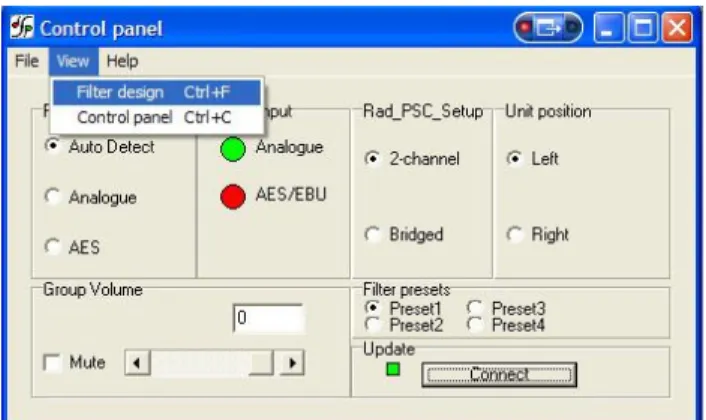
Now the program is ready for use. You will see the following window, called the control panel.
When the program is running connect your module to your pc by the USB cable. Windows will auto-matically detect and install the HID-device. When the installation is done the connected the connec-tion light will turn green. You can also manually make a connecconnec-tion by the “connect” button, on the bottom right of the control panel.
Now you may adapt the settings of the module real time through USB. On the left side in the control panel you see the Force input and active input groups. This shows you the settings of the audio in-puts and lets you control these inin-puts (only for digital version).
Audio can be provided analogue and digital. The selection of any of these inputs can be automatic, “auto detect”. This means that when any of the inputs is presented there will be switched to this channel automatically. This is done by setting the analogue input as the standard source. During analogue in the other two inputs are scanned for any valid signal. The first channel that contains any valid audio is selected and becomes the new input source. But if you put in the USB cable but you want to use the analogue input you can force the analogue input to be used. This can be done for both inputs.
When the module selects one of the inputs this is shown by the active input lights.
Under the Setup select part the system setup can be selected. There can be chosen between:
2-channel Bridged
Master on the left Master on the left Master on the right Master on the right
* The channel assignment in analogue mode makes no difference because there is only one input channel
bar to a desired position or by typing the value in the volume field, the value is send when pressed “enter”.
When the presets are installed they may be selected, the module will switch to the selected preset. The presets can be filled in the “Filter design” section.
Filter design
When you want to make some filters for your module they can be designed in the “Filter design”. Under view there can be switched between the control panel and the filter design window.
The following pages will give you a
widespread instruction of the possibilities of the program.
Figure 9 Figure 8
Graph Area
The magnitude tab shows the imported driver responses, filters, individual biquads, individual fil-tered driver responses and the sum.
Colour Function
Blue, thin Measured woofer response Green, thin Measured midrange response Red. thin Measured tweeter response Blue, thick Filtered woofer response Green, thick Filtered midrange response Red, thick Filtered tweeter response
Light blue, thick Response of filter, selected channel only Orange, thick Response of selected biquad
Black, thick Sum response
Having all of these on at the same time quickly produces an intractable mess so these graphs can be separately enabled or disabled in the filter definition area.
The impulse or step tabs show the time domain response of the imported drivers and the sum re-sponse, and are used to demarcate the anechoic portion.
Filter Definition Area
The two channel tabs, labelled Tweeter and Woofer are functionally identical. The top left frame is used to import response files. The “select” button opens a file. The “show” checkbox turns display of the measured graph on or off. The Common Settings box controls global gain (for each channel), delay, and the visibility of plots.
The amplified channels have up to 12 biquads, selected using the “Biquad Section” radio buttons in the middle. To the right is a settings area specific to the type of function selected. Unused biquads are set to unity.
The selected biquad is edited by selecting a function and setting relevant parameters.
Settings Window
Figure 10
The settings window is under File > Settings… Measurement sampling rate sets the sample rate used in the imported response files (typically 48kHz). Processor sampling rate is that of the Hypex DSP hardware. Note that this setting does not control the sampling rate of the hardware. Rather, it in-forms the filter design application of what that sampling rate is. In short, leave this at 46,875kHz. The select button opens a file dialogue box witch is not used in this application.
Work flow Measurement
truncation can be done later on the filter design program.
Measuring using an external amplifier
A separate amplifier may also be used for measuring the drivers, provided the amplifier’s output impedance is as low as the DSP unit’s.
Importing response data
Select the tab for the channel you want to import and click “select”. The filter designer expects the impulse response measurement as a text file with one sample per line.
There is no restriction on the absolute gain of the impulse response data. The only thing that mat-ters is that the absolute gain be the same for all three measurements. The filter designer computes a gain offset based on all loaded responses to centre them collectively on the vertical scale.
Truncating response data
Switch to the impulse or step response graph.
Figure 11
The first echo is apparent at 5ms. Zoom in until you see only the anechoic portion of the impulse response. Dragging the mouse, left-button down, from left to right marks a zoom area. Dragging from right to left zooms out. Dragging with the right button down pans the plot left and right.
Figure 12
Click “truncate”. Anything currently outside the display is drawn in grey and not processed. You will notice that in the frequency graph a portion of the low-frequency response is also drawn in grey. This is to remind the user that insufficient information is available to make *any* correction below
this frequency. A way of obtaining quasi anechoic low-frequency measurements is making close-up measurements. Working with such measurements requires a good deal of interpretation but it is doable.
Important: Avoid making any corrections for which no anechoic data is available. If reflections are included, they are guaranteed to dominate the measurement at low frequencies, and you will end up making corrections for circumstances that are highly specific to the room in which the measurement was made. Power-response data can only be made in a proper echo chamber or preferably, by collat-ing a large number of anechoic off-axis measurements. A reverberant measurement in a normal live room just won’t do.
The steps of loading and truncating data can be repeated at any time. This can be particularly prac-tical when combining close-up and far-field measurements during the filter design phase. The win-dow in Figure 12 shows the result of this. The small knot of corrections made around 70Hz is based on close-up data first loaded separately. The LF section of the test mule is quite smooth apart from one internal standing wave.
Designing filters
Biquad function Parameters Use
Unity - Section is not used
LPF1 Cut-off frequency (always -3dB) First order lowpass LPF2 Cut-off frequency (asymptotically)
Q
Second order lowpass. A Q of 0.71 corre-sponds to butterworth. 0.5 correcorre-sponds to LR2. Two identical sections with a Q of 0.71 form an LR4 filter.
HPF1 Cut-off frequency (always -3dB) First order highpass HPF2 Cut-off frequency (asymptotically)
Q
Second order highpass. A Q of 0.71 cor-responds to butterworth. 0.5 corre-sponds to LR2. Two identical sections with a Q of 0.71 form an LR4 filter. Shelf1 Centre Frequency (halfway point)
Gain Direction
First order shelf. Useful for baffle-step correction
Shelf2
Centre Frequency (halfway point) Gain
Q
Direction
Second order shelf. Useful for correcting internal cabinet resonances and for the midband peak/dip combo of most mid-woofer speakers.
Asymmetric Shelf Pole frequency and Q Zero frequency and Q
Equalising the bottom end of closed-box woofers with large magnets
Boost/Cut Centre frequency Q
gain
Dip/peak filter. For peaks, Q is defined by the poles. For dips, Q is defined by the zeros. Thus the same filter with op-posite gains will cancel.
The first step is equalising the magnitude responses of the drivers flat over their entire useable fre-quency range.
The weapons of choice are shelving filters, and boost/cut sections. A sharp peak followed by an equally sharp dip can be corrected using a second-order shelving filter with a high Q.
Exercise care when deciding what to correct. When correcting for diffraction errors, do not exceed a Q of 3 lest the cure be worse than the ailment. Errors that are caused inside the driver, or internal cabi-net resonances that emanate through the same diaphragm, may be corrected ruthlessly – provided the measurement has sufficient resolution to pin them down.
As a rule of thumb, sharp dips are diffraction artefacts while sharp peaks are caused by the drivers themselves. Exceptions are room resonances (if the response is not correctly truncated) and diffrac-tions on repetitive patterns.
higher frequency drivers with respect to lower-frequency ones is a powerful alternative to using asymmetric slopes and yields substantially improved coherence through the crossover region.
Download
Under download the user can press “load DSP” to download its designed filters to the module, but only for the current used preset!
Firmware update
Every module has the ability to update its firmware, when Hypex provides a new firmware version. The firmware can be simply updated by USB, the same for master and slave module. Under option “download” you can find “Firmware update”. When this option is selected the user can select the new firmware file. This is a complete hex file provided by Hypex, no adapts can and may be made by the user! After you selected the file you will enter the bootloader, the device will reconnect and shows version 99.99 in the status bar. Now you need to select the file again to load the new firmware into the module.
After the file is selected the update begins.
DO NOT DISCONNECT THE MODULE AT THIS POINT!
When the progress bar is filled the update is completed.
On a CRC error the update is automatically restarted, after three errors the update is aborted.
Note NoteNote
Note that the new firmware does not have any filters installed, so the filters must be reloaded with the correct values.
Safety precautions
The PSC2.400 is supplied with a switched mode power supply. The following chapter explains the safety precautions which have to be made for these kinds of products.
The SMPS400 operates at mains voltage and carries hazardous voltages at accessible parts. These parts may never be exposed to inadvertent touch. Observe extreme care during installation and never touch any part of the unit while it is connected to the mains. Disconnect the unit from the mains and allow all capacitors to discharge for 10 minutes before handling it.
This product has no serviceable parts other than the on-board fuse. Replace the fuse only with the same type and rating (250V T5AL).
All parts enclosed by the dotted line below carry hazardous voltages. This includes parts on the top and the bot-tom of the board. When the SMPS400 is mounted in a tight space there needs to be at least 6mm clearance or a layer of insulation with a minimum thick-ness of 0.5mm between the top of the transformer and the housing.
Standard the SMPS400 is supplied with 10mm spacers to mount the SMPS onto the chassis. This creates the mandatory 6mm clearance from the bottom side of the PCB to the chassis without the need for additional insulat-ing material.
Instructions For Installation
Warning: : : : To reduce the risk of fire or electric shock, do not ex-pose this apparatus to rain or moisture.
Warning: Disconnect the unit from the mains and allow all ca-pacitors to discharge for 10 minutes before handling it.
Warning: Please follow the mounting guidelines. 1. Do not build the module on a conductive surface.
2. Keep at least 60mm between the module front plate and the back of the enclosure, see Figure 14.
3. Do not lead any single insulated speaker-cable below the indi-cated line in Figure 14. With double insulated cable you are al-lowed to lead the cables below this line.
Figure 13
on the board. Parts that are not highlighted in red (picture above) may carry voltages in ex-cess of 140VDC!
1. Read these instructions.
2. Keep these instructions.
3. Heed all warnings.
4. Follow all instructions.
5. Do not use this apparatus near water.
6. Protect the power cord from being walked on or pinched particularly at plugs, convenience recep-tacles, and the point where they exit from the application.
7. Only use attachments/accessories specified or approved by the manufacturer.
8. Unplug this apparatus during lightning storms or when unused for long periods of time.
9. Refer all servicing to qualified service personnel. Servicing is required when the apparatus has been damaged in any way, liquid has been spilled or objects have fallen into the apparatus, the ap-paratus has been exposed to rain or moisture, does not operate normally or has been dropped.
10. Don’t run any cables across the top or the bottom of the SMPS400. Apply fixtures to cables to ensure that this is not compromised.
11. Observe a minimum distance of 6mm maintain clearance with all possible conducting parts (housing etc.). All parts enclosed by the dotted line below carry hazardous voltages. This includes parts on the top and the bottom of the board.
12. Natural convection should not be impeded by covering the SMPS400 (apart from the end applica-tions housing).
Recommended Operating Conditions for the SMPS
Item Symbol Min Typ Max Unit Notes
High Line Input Voltage VB 180 230 264 Vac
Low Line Input Voltage VB,FP 90 115 132 Vac
Line Input Frequency f 47 63 Hz
General Performance data for the SMPS
Item Symbol Min Typ Max Unit Notes
Max Output Power PR 600 - - W See Note 1
Max Audio Output Power @ 20Hz into amplifier load
PRALF 400 - - W See Note 2
Switching frequency FSW 80 100 120 kHz
Maximum power consumption Pmax 800 W See Note 3
Note 1 Note 1Note 1
Note 1: Output Power delivered to a resistive dummy load (generally the only specification supplied by other SMPS manufacturers).
Note 2: Note 2: Note 2:
Note 2: An audio amplifier actually draws twice the RMS power from the power supply. At high fre-quencies the secondary storage output caps are capable to provide this power. At very low frequen-cies however the SMPS is responsible for delivering this peak power to the amplifier.
Note Note Note
Mains selection
The PSC2.400 is factory set to operate at a mains voltage of 230Volt. The user is able to change this setting to 115Volt. Instructions must be followed!
Before changing the mains settings disconnect the unit from the mains and allow all ca-pacitors to discharge for 10 minutes before handling it.
Update the front plate with the updated information by checking the 115V or 230V setting.
J1: Mains Voltage Input Selection. Connector type: JST-B2P-VH
Pin Function
1,2 Not Connected = 230Vac Mains; Connected = 115Vac Mains
Technical data
Supply voltage 230Volt AC/50Hz +/- 10% (switch able to 115Volt 60Hz)
Dimensions 142mmx330mmx55mm (WxHxD)
Plate thickness 2,5mm
Weight 1,1 kg
Clearance >9,5mm
Revision PCB Version Description Date
R0 PSC2 V0.1 - Initial Draft. 21-04-2009
R1 PSC2 V0.2 - Hard- and software part added 06-10-2009
R2 PSC2 V1 - Pinout description added - Clip limiter added
23-06-2010 R3 PSC2 V1 - Safety instructions added
- Installation instructions added - Mains selection added
29-06-2010
R4 PSC2 V2 - Explain button functions on digital version added - Temperature protection added
18-11-2010