This may be the author’s version of a work that was submitted/accepted for publication in the following source:
Bredillet, Christophe (2004)
Beyond the positivist mirror: Towards a Project Management ’Gnosis’. In Artto, K (Ed.) Proceedings of the 6th Biannual International Research Network on Organising by Projects (IRNOP) Research Conference. International Research Network on Organising by Projects (IRNOP), Fin-land, pp. 1-25.
This file was downloaded from: https://eprints.qut.edu.au/49502/
c
Copyright 2004 IRNOP VI Conference
This work is covered by copyright. Unless the document is being made available under a Creative Commons Licence, you must assume that re-use is limited to personal use and that permission from the copyright owner must be obtained for all other uses. If the docu-ment is available under a Creative Commons License (or other specified license) then refer to the Licence for details of permitted re-use. It is a condition of access that users recog-nise and abide by the legal requirements associated with these rights. If you believe that this work infringes copyright please provide details by email to [email protected]
Notice:Please note that this document may not be the Version of Record (i.e. published version) of the work. Author manuscript versions (as Sub-mitted for peer review or as Accepted for publication after peer review) can be identified by an absence of publisher branding and/or typeset appear-ance. If there is any doubt, please refer to the published source.
B
E Y O N D T H E P O S I T I V I S T M I R R O R:
T
O W A R D S AP
R O J E C TM
A N A G E M E N T' G
N O S I S'
1Christophe N. Bredillet
ISGI - Groupe ESC Lille, Euralille – France
Abstract
This paper aims to clarify the foundations of the discipline of project management (PM). Historically, PM has evolved from a conceptual approach based on a positivist paradigm. The author questions the appropriateness of such foundations for the kind of project management which claims to deal with complex problems. To answer this question, a brief history of project management emphasizes key concepts useful to the discussion. Comprehensive definitions of knowledge, competencies, performance and knowledge management are reviewed to provide a better understanding of the project environment in terms of its present positivist epistemological position. This paper explores the tensions and paradoxes encountered in PM practice, when set within the boundaries of a normative approach; it also highlights the polysemic nature of PM, for which an extended framework is proposed. Dialectic, qualitative and interpretative aspects of PM are presented alongside its quantitative body of Knowledge. The author finally introduces an innovative overview of project management, set in the greater context of the learning organization. Implications and applications of this perspective are discussed and lead to the presentation of the MAP meta-method, a systemic practical approach.
Keywords: epistemology, knowledge management, organisational learning, learning organisation, project management, praxeology, project team, meta method
This paper aims to clarify the foundations of the discipline of project management, or at least elucidate what these foundations could be.
Having been involved in project management education, research and practice for the last twenty years, the author testifies about how the world, i.e. organizations, universities, students and professional bodies, see project management as a set of methods, techniques, tools, interacting with others fields – general management, engineering, construction, information systems, etc. – bringing some effective ways of dealing with various sets of problems – from launching a new satellite to product development through to organizational change.
In order to improve and to provide a better understanding/knowledge of the field and related practice, it has been necessary to widen and deepen the competencies involved in PM, guided by the overall assumption that better project management leads to more efficient and effective use of resources, development of people and at the end to a better World. The problem outlined in this paper is that historically, the tools, techniques and methods of PM have involved a conceptual approach, based on a specific paradigm, which was mostly, a positivist one. We need to question whether this is the appropriate paradigm for the kind of project management which claims to be able to deal with complex problems that do not have clear or straightforward solutions.
The argument highlighted here is that the apparent lack of foundations, leading, perhaps, to theoretical error, underpinning the application of techniques and tools, the lack of a clear
1
Gnosis: Esoteric knowledge of spiritual truth held by the ancient Gnostics to be essential to salvation
epistemological position in most of the research to date, the lack of a clear paradigm in most of the literature, seem to have become a real barrier to effective understanding and communication of the true nature of project management, leading to nonsense, to a dynamic of fad, where hype, advocacy of one's own practice is the rule, reinforced by a lack of critical thinking by the practitioners, who complacently accept seemingly reasonable answers, even if they lead to major failures2. It has been convenient, and lucrative to reinforce accepted belief systems, built on many centuries of thinking based on the positivist paradigm. Positivism has led, in some cases, to over-simplification – one problem equals one solution – and in many cases has obviated against recognition of the complexity and of the relativity of the world. The place of project management within most universities and in the research field shows that it is not yet considered a discrete discipline. At most universities it is treated as a sub-discipline of Construction, Engineering, IT or Business faculties. At the same time it is claimed to be a trans-functional discipline. This position contributes to reinforcing the positivist paradigm that pervades its teaching, research and practice.
The argument presented in this paper rests on the observation that Project Management needs to be a complex discipline because it aims to deal with complex reality! A useful analogy can be found in mathematics, since Ashby (1958) and the law of requisite variety it is well known that to control a complex system with 'n' dimensions (such as projects), you need an 'n+1' dimensional system (Project Management). Paradoxically, Project Management needs at the same time to be simple, as far as its principles are concerned forwarding another useful analogy from the world of physics: “like white light is transformed into multiple colours through a prism, project management applications may be seen as coming from some general principles”.
Indeed, Project Management in action (praxis) justifies the fact that a better understanding of the very nature of project management (beyond the positivist mirror) involves Project Management 'Gnosis'.
Project management needs to integrate both Quality and Quantity; To Be and to Have. Project management is a process of naming, of revelation, of creation. These issues draw upon the dialectic and post-modern paradigms that challenge the construction of our reality through our use of different language and the fundamental contradictions of our discourse. (Schwandt 1998)
Thus, it is the purpose here to defend the proposition that project management
has a raison d'être in itself, and should be a discrete discipline as its language testifies to the construction of a “different identity”;
is both a discipline and an art as it draws upon the interpretative paradigm to make sense and understand the organizational phenomena in its environment (Alvesson and Skolberg 2000)
and to propose a new framework for the very nature of project management.
Within the limited space of this research paper, emphasis is put on the link between projects, knowledge and learning and the dynamic generation of project wisdom through project praxis.
The first part of the presentation focuses on linking knowledge and competencies in project management and points to the irreversibility created by praxis at project level.
The second part of this discussion outlines the conceptual limits and difficulties historically encountered by PM in a traditional positivist framework.
2
15% of ERP, SCM… projects have been considered to be successful in USA in 1999, for a total of 250 Billions of US$ spent… (APICS survey – CPIM journal n° 46 – 17/07/2000) Long live to SAP projects!!!
The third part of the paper introduces the areas of Knowledge and Knowing as key issues in order to propose a larger organizational learning framework for PM.
Last, but not least the author proposes a systemic approach to PM via its integrated relationship in praxis and presents the MAP meta method as a useful means of enhancing the greater application of such a framework at practitioner level.
Knowledge, Competencies and Performance in Project
Management
Management of/by projects
For the past forty years project management has become a well-accepted way to manage organizations. The field of project management has evolved from operational research techniques and tools to a discipline of management (Cleland 1994, Bredillet 1999). Many authors emphasize this evolution in the way of managing projects: "this book traces the
development of the discipline of project management" (Morris 1997, p. i). Project management
becomes the way to implement corporate strategy (Turner 1993, Frame 1994) and to manage a company: "… value is added by systematically implementing new projects - projects of all types,
across the organization" (Dinsmore 1999, ix). Management of Projects, the way to manage
projects within the same organization (Morris 1997), and Management by Projects, projects as a way to organize the whole organization (Gareis 1990, Dinsmore 1999), are both good examples of that tendency. Projects are a form of organization that positions a company in relation to its environment. As projects are the vectors of the strategy (Grundy 1998), project management is a way to deal with the characteristics of the whole environment: complexity (Arcade 1998), change (Voropajev 1998), globalization, time, competitiveness (Hauc 1998). Thus, through project management, strategic management becomes the management of irreversibility (Declerck et al. 1997), concentrating on the ecosystem’s project/organization/context, operation/ organization/ context and their integrative management (Declerck et al. 1983).
Competencies, competitive advantage and Value(s)
Projects, as strategic processes, modify the conditions of the firm in its environment. Through them, resources and competencies are mobilized to create competitive advantage and other sources of value. As resources are easily shared by many organizations, the organization’s competencies are its most important relevant driver. Thus, through the organization’s processes or projects, past action is actualized as experience; present action reveals and proves competencies; future action generates and tries out new competencies (Lorino and Tarondeau 1998). Competencies (both individual and organizational) are at the source of competitive advantage and the creation of value.
The link with performance
The underlying assumption of recent research is that increased competency in project managers, teams, or organizations (maturity), leads to efficiency in performance and a more effective project performance, thus, a more successful overall organization (Crawford 1998, PMI® Project Manager Competency Development Framework 2002). Such research, and indeed the development of professional certification programs in general, seem to contradict former findings. For example, Pinto and Prescott (1988) concluded that the 'personnel factor', even if designated in theoretical literature as a crucial factor in project efficiency, is a marginal variable for project success at any of the four project life cycle phases considered (for a criticism of their findings, see Belout 1998). A working paper (Turner 1998) shows the positive influence of the project managers' competencies on value of shares of a company. Other important variables affecting performance have been investigated, such as the
maturity of the organization (in terms of dealing with projects). Further, maturity has been shown to be a determinant factor in learning. The OPM3 programme (PMI® Standards Committee), and other papers (for example: Remy 1997, Saures 1998, and Fincher et al. 1997) explore the relationship between maturity of several organizations and success in their projects.
Project Management as a Knowledge Field
Let us assume that Project Management is a knowledge field in order to examine:
"a knowledge field is the space occupied by the whole of the people who claim to produce knowledge in this field and this space is also a system of relationships between these people competing to gain control over the definition of the conditions and the rules of production of knowledge" (Audet 1986)
The following examples can be given to project management in respect to Audet’s definition: The relationships between established professional bodies (PMI®, IPMA – International Project Management Association, PMCC – Project Management Professional Certification Center (Japan)…);
The wish to create global standards;
The fact that PMI® is actively supporting research to establish a theory of project management, demonstrate project management value for executive, achieve corporate strategy through successful projects, to quote but a few;
The evolution of bodies of knowledge (PMBOK® Guide, APM BOK, P2M…), of the themes of papers and books, from techniques to psycho-sociology of temporary groups through knowledge creation and organisational learning.
Project management as a Knowledge field would be in the pre-paradigmatic phase defined by Kuhn (1970). It is actually the place of a revolution, inaugurated by a sense of growth, still restricted to a limited portion of the project management community, because the existing positivist paradigm has ceased to function adequately to explain and understand its phenomena.
Knowledge and Competence
Knowledge is needed to develop competence. Two main views of competence development may be considered.
One traditional view is that it involves applying a body of knowledge to known situations in order to produce rational solutions to problems. This area of knowledge will be referred to as the 'have' or 'quantitative' perspective in this paper. However, in a rapidly changing world and information-based society practitioners and organizations increasingly need to respond intelligently to unknown situations and go beyond established knowledge to create unique interpretations and outcomes (Schön 1971, Ackoff 1974, Toffler 1980, 1990, Reich 1991) This second area of Knowledge will be referred to as the 'be' or 'quality' perspective.
Because of the implications of these combined dimensions of knowledge, professional development can no longer be reduced to transmitting existing knowledge and developing a predefined range of competences on the basis of the “one problem equals to one solution” model. Instead, practitioners need to be able to construct and reconstruct the body of knowledge according to the demands and needs of their ongoing practice (Schön 1987). Hence, project management is witnessing a systemic and dynamic development of project managers’ competencies (For a review of the link between knowledge, personal and performance-based dimensions of competence see Crawford 1998). In the process, alternative approaches are created and span far beyond traditional models of knowledge production
and use. Reflecting, questioning and creating processes have gained formal status in the workplace.
In order to develop a sound theoretical basis for project management, the very nature of Projects needs to be examined and such fundamental questions as: “What is a Project?” are yet to be explored. Further, the legitimate epistemological foundations of Project Management as a knowledge field remains to be argued.
An alternate epistemological approach for PM
The concept of Project
The concept of Project is generally approached by listing its intrinsic characteristics (Leroy 1994). The following three definitions demonstrate the range of different perspectives in the definitions of project and the polysemic nature of the project concept (Boutinet 1996).
Instrumental perspective:
"a project is a temporary endeavour undertaken to create a unique product or service" (PMBOK® Guide 2000)
Cognitive perspective:
"an endeavour in which human, material and financial resources are organized in a novel way, to undertake a unique scope of work, of given specification, within constraints of cost and time, so as to achieve beneficial change defined by quantitative and qualitative objectives." (Turner 1993).
Political perspective:
"a project is a whole of actions limited in time and space, inserted in, and in interaction with a politico-socio-economic environment, aimed at and tended towards a goal progressively redefined by the dialectic between the thought (the project plan) and the reality" (Declerck et al. 1983, 1997).
The polysemic nature of the project concept, as demonstrated in the previous definitions, is at the source of two underlying visions which have evolved with the development of Project Management (see the history of Project Management in Leroy 1994).
On the one hand, the development of Project Management was constantly marked by the constitution of codes of practice evolving according to two plans:
The people plan, stretching from the cathedral builders to NASA with its 100 rules of 'the good' project manager. Different historical phases were marked by the process of certification that was connected (in many cases) to an 'initiation rite' in which theoretical knowledge alone was not sufficient and was reinforced by recognition of peers and of practice;
The process of management plan concerned with the trajectory of projects in the organization, that lead to the appearance of standards, with either descriptive or prescriptive features. The underlying vision being a positivist3 one according to which experiences and practice lead to
3
philosophical doctrine that denies any validity to speculation or metaphysics. Sometimes associated with empiricism, positivism maintains that metaphysical questions are unanswerable and that the only knowledge is scientific knowledge. The basic tenets of positivism are contained in an implicit form in the works of Francis Bacon, George Berkeley, and David Hume, but the term is specifically applied to the system of Auguste Comte, who developed the coherent doctrine. In addition to being a dominant theme of 19th-century philosophy, positivism has greatly influenced various trends of contemporary thought. Logical positivism is often considered a direct outgrowth of 19th-century positivism. (source: Encyclopedia.com)
standards and rules, standards and rules lead to theories, which lead to paradigms and are used as the basis for codes of practice and bodies of knowledge.
On the other hand, through projects, Man builds Reality and, as highlighted by Declerck et al. (1997), the management of projects through deployment of these projects within the ecosystem project/firm/context implies a systemic vision, "an 'intelligent' action, 'ingenium'4, this mental faculty which makes possible to connect in a fast, suitable and happy way separate things"
(Giambattista Vico,1708 IN Lemoigne,1995). Thus, the evolution in project management and/or management by projects (Giard et al. 1993) and its structuring characteristics suggest a constructivist vision the roots of which can be found in Piaget’s Cognitive Constructivism and Vygotsky’s Social Constructivism.
Tensions and paradoxes in Project Management
These two visions appear to be consubstantial with the concept of management of projects underlining the "tensions and paradoxes in project management."
Boutinet (1997) shows that the figure of the project can now constitute a suitable reference in the management of organizations, as through them, it is possible to create and to innovate by using several parameters which they organize in a paradoxical way. The positive effect of such a vision prevents project management from a totalitarian 'technicist' project approach and over- simplification of the project environment.
Current organizations in the mobility of our post-industrial culture resort readily to the figure of the project as a model of management. This recourse seems suitable insofar as we move in complex and fluctuating environments which confront us to create and innovate while always resorting to a plurality of parameters. Result-driven reasoning is located at the unidimensional level and reasoning in terms of projects, must take into account multidimensional thought .
Indeed, this paradox, deliberately integrates an unconventional thought process, founded on non-traditional logic, that of the “unexpected” or “fuzzy” and more particularly that of “uncertainty”. This way of thinking is completely congruent with our time of post-modernity marked by the advent of the post-industrial culture. We have indeed left the universe of certainty to enter that of fluidities and paradoxes. The currently dominant reign of communication networks predisposes us to seize the diversities and contrasts of the environment. The project embodies this paradoxical reality since it exists only for a limited time-span. To speak about the non-traditional paradox of logic is to take a stand in opposition to traditional formal logic which was dominant until the end of the industrial era. This traditional logic was concerned with coherence and haunted by the principle of non-contradiction as well as a discipline of the mind that lead to controlled sets of steps. At times, this preoccupation for logic was responsible for artificially giving reality desired intelligibility.
4
INGENIUM: "For the ingenium was given to human to understand, i.e. to make" G Vico Thus characterized it since 1708 the "Method of the studies of our time", method or rather advance - these ways which we build while going - what restores the vast contemporary project of a New Reform of Understanding. Deploying all faculties of the human reason, the ingenium - this " strange faculty of the human mind which allows him to co-join", i.e. to give direction to its experiments of the "world of the life" – makes us understandable of these multiple interactions between knowledge and action, between including/understanding and making, which we recognize in our behaviors within the human societies. With collective resignation to which still too often invite us scientific knowledge sacrilizing reductionism and deductivism, "sciences of ingenium" oppose the attractive capacity of the human mind to co-join, to understand and invent by forming projects, with this "stubborn person rigour" to which already testified Léonard de Vinci.
The increasing complexity in our environment has decreased opportunities to use traditional logic and added relevance to the paradox that enables us to think through the 'fuzzy', uncertain and even the strangeness of our intentions (i.e. the heuristic framework of our projects).
These considerations on the different perspectives embodied in the concept of Projects, on the "polysemic" nature of the concept and consequentially on the underlying positivist and constructivist visions consubstantial to the concept of Management of Projects and its paradoxical and non-traditional logic force us to consider alternate epistemological positions for project management.
An epistemological perspective for project management
Since the writings of Polanyi (1958), it is now possible to explore an alternate epistemological perspective both to positivism and to constructivism that better fits program management as defined in this paper (integrating both classical scientific aspects and 'fuzzy' or symbolic aspects).
A 'reality' can be explained according to a specific point of view and can also be considered as the symbol of higher order (Guénon 1986). A more general reality (for example a 2-dimensional form) can be seen as the projection on a plan of a n-2-dimensional figure. The 'demiurgic' characteristic of project management involves seeing this field as an open space, without 'having' (Have) but rather with a raison d'être (Be), because of the construction of “Real” by projects. This could be considered a fundamental explanation of the pre-paradigmatic nature of this field (Kuhn 1970): the dominant paradigm, source of well established theory(ies) is NOT to find, the deep nature of Project Management implies this paradox of being built on moving paradigms reflecting the diversity of the Creation process by Itself.
The field of knowledge of project management is composed of a quantitative aspect (Have), dependent upon the positivist paradigm in which people have few degrees of freedom as witnessed in operational research in network optimisation, cost engineering, statistical methods, bodies of knowledge, application of standards, best practices, and code of ethics. A second aspect of the field of knowledge of project management is qualitative (Be) and dependent upon the constructivist paradigm in which people have many degrees of freedom such as in organisational design, learning, knowledge management, change management, systemic approaches, contextualisation of the life-cycle, and meta-rules.
Combinations and permutations of these components can create new “links” and joint ventures as in the creation and evolution of standards seen from the Theory of Convention (social construct) and their application (positivism).
The former considerations of this text forward a vision for project management that is one of an integral function, the knowledge field consisting of differential elements, each of them well defined (ie. cost control, scheduling, communication, quality, information system, temporary group…). When considered as a whole, the function becomes a transition to the limit. In the light of this analogy to mathematics, the result of such an integral is both quantitatively and qualitatively more than the sum of its parts. In other words, it can be called a system effect: parts A, B and C forming a system S in which the components keep some of their properties and potential performances, lose others and develop some entirely new performances (Legay 1996).
From this point of view of the conceptual field of management of projects, can best be described in the following terms:
"inseparability of knowledge and its representation understood in their distinguishable activity, the intentional experience of the knowing subject and the groping construction of
the subject representing knowledge, this undoubtedly constituting the strong assumption on which are defined teachable knowledge today, both scientific and ordinary" (Lemoigne 1995) Project Management as a knowledge field can further be seen as both an Art and a Science, in their dialectic AND integrative dimensions.
The 'critical-rationalist' and 'interactionist' approach of Popper (1947) broadens the discussion to two epistemological approaches:
the Positivist epistemology (materialist – quantitative – Have): "the relation of Science to Art may be summed up in a brief expression: from Science comes Prevision, from Prevision comes action". (Comte 1896, p 43. )
the Constructivist epistemology (immaterialist – qualitative – Be), with two hypotheses of reference as underlined by Lemoigne (1995):
the phenomenological hypothesis in which the cognitive interaction between the object or the phenomenon to be known and the subject knowing who forms both the knowledge of the object (in 'organising the world') and a mode of development of knowledge ('self-organising intelligence').
the teleological hypothesis in which the intentionality or the finality of the knowing subject, according to its decisive role in the construction of knowledge (phenomenological hypothesis), must be taken into account.
Most of the research in organizational learning, learning organizations, knowledge management, and knowledge-creating organizations is based on a traditional understanding of the nature of knowledge. We could name this understanding the 'positivist epistemology' perspective since it treats knowledge as something people have. This perspective does not reflect the knowing found in individual and team practice, Knowing as an 'intelligent' action, 'ingenium', as stated by Lemoigne (1995). The 'positivist epistemology' tends to promote explicit over tacit knowledge (see below), and individual knowledge over team or organizational knowledge.
A more integrative epistemological approach for project management broadens the basic consideration that organizations will be better understood if explicit, tacit, individual and team/organizational knowledge are treated as four distinct forms of knowledge (each doing work the others cannot), and if knowledge and knowing (intelligent action) are seen as inseparable and mutually enabling. Thus knowledge may be seen as a “knowing-input”, and knowing as an aspect of our interaction with the social and physical world. Hopefully, the dynamic interaction of knowledge and knowing can generate new knowledge and new ways of knowing.
Knowledge and Knowing
Knowledge Management (KM), key issues to Organizational Learning
KM offers a unique concept considered by many in industry as simultaneously progressive yet soft and difficult in application; one may suggest that this is primarily because of the intangible elements of knowledge. However, the increased topicality – if not to say pervasiveness – of the term through the writings of such well-known and recognized authors as Drucker (1993), Wheatley (2001), De Geus (1997), and Senge et al. (1999), strongly suggest that KM is becoming accepted as a credible concept.
Although the study of knowledge dates back at least to Plato and Aristotle, entertaining the management of knowledge throughout a corporation first gained visibility with Polanyi in 1958. O'Dell and Grayson (1998) state that "Polanyi's work served as a basis for the
much-acclaimed knowledge management theories and books by the Japanese organizational learning guru, Ikujiro Nonaka" (p.3).
Polanyi (1958) presented knowledge as something that can have intrinsic value placed on it; he also outlined two types of knowledge: tacit and explicit. Nonaka (1991) confirmed Polanyi's two types of knowledge and introduced the larger concept of 'the knowledge-creating company' (p.22). This author further proposed that organizations were more similar to living organisms than machines. This insightful biological analogy created a logical link between knowledge and organizations and was responsible for the shift of paradigm towards the people within the organization as knowledge contributors. The focus was on knowledge sharing and knowledge transfer. The average life span of major corporations being forty to fifty years, roughly half that of humans, the need for development of KM was seen as one potential avenue to expand life expectancy and, in so doing , improve their overall health.
Prior to Nonaka's (1991) research, Westerners (predominantly in the United States) viewed an organization as "a machine for information processing. According to this view, the only useful knowledge is formal and systematic-hard data, codified procedures, universal principles." (p. 23) Wheatley (2001) maintains that even today the Japanese approach to the field of KM is different from that of Westerners. She explains that, in the West, organizations still focus on explicit knowledge while Japanese counterparts exploit predominantly the area of tacit knowledge ('BE'). For instance, Davenport and Prusak (1997) focus on knowledge acquisition, providing a market perspective in organizational knowledge creation ('HAVE'). Peng and Akutsu (2001) propose that "there are two fundamentally different mentalities for dealing with new knowledge: linear thinking and dialectical thinking" (Peng and Akutsu 2001, p. 107). Linear thinking is defined "as distaste for ambiguity and contradiction and preference for consistency and certainty" (Peng and Akutsu 2001, p. 108). They differentiate dialectical thinking in 'synthesizing dialectical thinking', aiming at identifying contradiction and resolving it by means of synthesis or integration, from 'compromising dialectical thinking', focusing on tolerating contradiction. These authors conclude that mentality is a major factor in understanding how people behave in front of new knowledge. Their research points to the fact that the Japanese are more dialectical than the Americans (United States).
Knowledge and Knowledge Management
Part of the interest in the possible value of corporate knowledge comes from the information age and the realization that knowledge (and its sharing) is the fundamental element behind an organization's activities. This is not to say that information is knowledge. Deming (1993) accurately states "to put it another way, information, no matter how complete and speedy, is not
knowledge" (p. 106). Once information is embodied in time and gets a temporal value it then
becomes knowledge. Unfortunately, many experts and laymen alike, treat knowledge as some sort of higher-level information: extended, synthetic, advanced, tacit, complex, etc., but, still as information. Although information is an enhanced form of data, knowledge is not an enhanced form of information. It is quite clear, even on an intuitive level, that knowledge is not and cannot be the same thing as information, not even a form of information. It cannot be handled as information, does not have the same uses, and will resist any simplistic and expedient methodological transfers from information systems to 'knowledge systems'. Having information is not the same as knowing: not every reader of a cookbook is a great chef. It is therefore very important to define knowledge in a distinct, appealing and operational way. Simply calling complex forms of information 'knowledge' will not lead to knowledge, even if repeated for years. 'Knowledge' of information can be demonstrated through a statement, recall or display. Knowledge itself can only be demonstrated through action as Knowledge is demonstrated in purposeful coordination of action (Intelligent action, 'ingenium').
Knowledge Management is "the art of creating value from an organization's Intangible Assets" (Sveiby 1999). With Sveiby (2001) we can define Knowledge Management by looking at what people in this field are doing: "Both among KM-researchers and consultants and KM-users there
Track 1: Management of Information
Researchers and practitioners in this field tend to have their education in computer and/or information science (Hayes-Roth et al. 1983) and are involved in the construction of information management systems, AI, reengineering, groupware etc. Knowledge involves Objects that can be identified and handled in information systems. This track is new and is growing very fast at the moment, assisted by new developments in IT;
Track 2: Management of People
Researchers and practitioners in this field tend to have their education in epistemology, philosophy (Kuhn 1970), psychology, sociology (Polanyi 1958, 1966) or business / management / economics (Silberston 1967) and are primarily involved in assessing, changing and improving human individual skills and/or behaviour. Knowledge involves Processes, a complex set of dynamic skills, know-how etc, that is constantly changing. They are traditionally involved in learning and in managing these competencies individually – like psychologists – or on an organizational level – like philosophers, sociologists or organizational theorists. This track is very old, and has not demonstrated fast growth in the last decade.
Level 1: Individual Perspective
The focus in research and practice is on the individual (AI specialists, psychologists) Level 2: Organizational Perspective
The focus in research and practice is on the organization (reengineering, organization theorists, etc.) (Sveiby 2001).
Crossing these two dimensions, we can capture one essential issue: "There are paradigmatic
differences in our understanding of what knowledge is" (Sveiby 2001). The researchers and
practitioners in the 'Knowledge = Object' track tend to rely on concepts from Information Theory in their understanding of Knowledge. The researchers and practitioners in the 'Knowledge = Process' track tend to take their concepts from philosophy, psychology or sociology".
Knowledge Management key concepts
Tacit vs. Explicit KnowledgeThis idea finds its origin in Polanyi (1966), but has been applied to business and knowledge management by Nonaka et al. (1995). It suggests that there are two types of knowledge: tacit (embedded in the human brain and not easily expressed) and explicit (easily codified and accessible) (Brooking 1999). Both types of knowledge are important, but Western organizations have focused largely on managing explicit knowledge.
Codification vs. Personalization
This distinction is related to the tacit vs. explicit concept. It involves an organization's primary approach to knowledge transfer (Hansen et. al., 1999). Organizations using codification approaches rely primarily on repositories of explicit knowledge ('have'). Personalization approaches imply that the primary mode of knowledge transfer is the direct interaction among people ('be'). Both are necessary in most organizations, but alternating the focus from one approach to the other (at any given time within a specific organization) may be appropriate.
Knowledge Processes
Knowledge processing may be seen as a social system that can be found in the value chain of an organization. Two sides should be considered: 1. the “demand-side” involving knowledge production also called first generation KM; 2. the “supply-side” involving
knowledge integration named second generation KM (Knowledge Management Consortium International (KMCI) Knowledge Life Cycle – Mc Elroy 2002).
Knowledge Markets
This concept focuses on the interest that individuals have in holding onto the knowledge they possess. In order to part with it, they will expect something in exchange (Davenport and Prusak 1997). Any organization is a knowledge market in which knowledge is exchanged for other things of value (money, respect, promotions, or other knowledge).
Communities of Practice
This idea grew with the 'organizational learning' movement and states that knowledge flows best through networks of people who may not be in the same part of the organization, but have the same work interests (Brown and Duguid 1991, Wenger 1998, Wenger et al. 2002). Some organizations have attempted to formalize these communities, although theorists argue that they should emerge in a self-organizing fashion without any relationship to formal organizational structures: "learning happens, design or not" (Wenger 1998, p. 225).
Intangible Assets
Many observers have recently pointed out that formal accounting systems do not measure the valuable knowledge, intellectual capital, and other 'intangible' assets of a corporation (Sveiby 1997). Some analysts have even argued that accounting systems should change to incorporate intangible assets and that knowledge capital should be reflected on the balance sheet. However, the esoteric and subjective nature of knowledge makes it impossible to assign a fixed and permanent value to knowledge. Intangible assets have however always been integrated in strategic analysis as a source of competitive advantage.
Knowledge Management in action
Since KM is a relatively new philosophy, Davenport (1999) argues that it is "not yet tied to
strategy and performance in practice" (p. 2-1). The use of the term 'knowledge' in business
strategy is rampant; however, Davenport (1999) believes that only a very small number of companies use a knowledge strategy as part of their business strategy.
Several authors have provided principles that facilitate the implementation of KM. Among them some are offering a humanistic perspective such as in Wheatley's (2001) six principles that facilitate KM and are a testimonial of Nonaka's original principle of an organization being analogous to an organism. De Geus (1997) also comes within the scope of the humanistic trend by not using the terms "learning organization" and providing explorations of a 'living company'. With an 'information technology' perspective Zack (1999) discusses the management of codified (explicit) knowledge and the use of four primary resources to manage knowledge: "repositories of explicit knowledge, refineries for accumulating, refining,
managing and distributing knowledge, organization roles to execute and manage the refining process, and information technologies to support the repositories and processes" (p. 47).
As stated by the many examples provided above, information technology does not inevitably lead to knowledge creation. Augier and Morten (1999) state "technologies manifest themselves
as representers of knowledge" (p. 253). Huang, Lee, and Wang (1999) show that "technology and systems, however, are used as facilitators in the production, storage, and use of organizational knowledge" (p. 4). Wiig (1999) outlines sixteen building blocks that should be considered for
the introduction of KM (p. 3-6): obtain management buy-in, survey and map the knowledge landscape, plan the knowledge strategy, create and define knowledge-related alternatives and potential initiatives, portray benefit expectations for knowledge management initiatives, set knowledge management priorities, determine key knowledge requirements, acquire key knowledge, create integrated knowledge transfer programmes, transform, distribute and apply knowledge assets, establish and update KM infrastructure, manage knowledge assets,
construct incentive programmes, coordinate KM activities and functions enterprise-wide, facilitate knowledge-focused management, monitor knowledge management.
In short, Wheatley (2001) provides principles for the facilitation of KM, Zack (1999) provides the primary resources to manage codified knowledge, and one can refer to Wiig (1999) who provides the thought process necessary to build upon (in sequential order) for a successful KM program.
Clearly the field of KM is extensive, complex and still in its pre paradigmatic stage (Kuhn 1970) though with significant application.
Organizational Learning
The first publications on organizational learning (OL) appeared in the 60s (Cangelosi and Dill 1965), but research on learning organizations principally gained impetus with the publication of The Fifth Discipline by Peter Senge (1990a) and the special edition on organizational learning in Organization Science (1991). A overview of the development of the field can be found in Dierkes et al.’s "Handbook for Organizational Learning & Knowledge" (2001) pp. 926-927.
The concept of the 'learning organization' or 'learning by organizations' has actually been taken from the psychological concept of 'individual learning' (Weick 1991). Almost all definitions of organizational learning are based on this analogy.
One can differentiate normative and descriptive definitions. The normative definition refers to some requirements that an organization must satisfy in order to be known as a learning organization (Garvin 1993, Hayes et al. 1988, Bomers 1989, Senge 1990a). Various other authors propose a more descriptive definition (Kim 1993, Levinthal and March 1993). Kim argues that all organizations learn, whether consciously or not. Some organizations try to encourage learning; others abandon such efforts and, in doing so, develop habits that finally reduce their learning capability.
However, in both situations there are, in one way or another, learning processes taking place.
Individual and organizational learning
Many authors emphasize the paradoxical nature of the relationship between individual and organizational learning (Argyris and Schön 1978, Huber 1991, Bomers 1989). One can observe that an organization consists of individuals, and individual learning is consequently a necessary condition of organizational learning. In contrast, the organization is capable of learning independently of each single individual but not independently of all individuals (Argyris and Schön 1978).
An organization learns through its individual members and is thus directly or indirectly influenced by individual learning. Therefore, it is not surprising that most theories about learning organizations are based primarily on observations of learning individuals, particularly in experimental situations (Sterman 1989, Huber 1991, Kim 1993).
Hedberg (1981) makes a comparison between the brains of individuals and organizations as information processing systems. Organizations have cognitive systems and memories, through which certain modes of behaviour, mental models, norms and values are retained. For that reason, organizations are not only influenced by individual learning processes, but organizations influence the learning of individual members and store that which has been learned. This may take the form of manuals, procedures, symbols, rituals and myths. Though the individual is the only entity able of learning, he must be seen as part of a larger learning system in which individual knowledge is exchanged and transformed.
Single loop and double loop learning
Most authors refer to two kinds of learning processes: single loop and double loop learning (Argyris and Schön 1978, Bomers 1989, Duncan and Weiss 1979, Fiol and Lyles 1985, Pedler et al. 1991).
Single loop learning involves processes in which errors are tracked down and corrected within
the existing set of rules and norms. According to Fiol and Lyles (1985), single loop learning is the result of repetition and routine. Examples of the result of these sorts of learning processes are successful programs and decision-making rules (Cyert and March 1963). These are particularly important in situations in which the organization controls its environment (Duncan and Weiss 1979). The main characteristics of single loop learning can be described as based on repetition, routine and within existing structures. It mainly concentrates on a specific activity or direct effect, within a simple context. The expected results may be change of behaviour or performance level, and problem solving capacity.
Double loop learning, in contrast, involves changes in the fundamental rules and norms
underlying action and behaviour (Argyris and Schön 1978). Double loop learning generally has long-term effects with consequences for the whole organization. Crisis situations often provide opportunities for double loop learning. Argyris and Schön (1978) defined double loop learning as a process in which errors are tracked down and corrected with the result that underlying norms, ideas and objectives become the objects of discussion and, where necessary, change.
To summarize, the main characteristics of double loop learning can be described as based on cognitive processes and understanding the non-routine, and aim at changing rules and structures. This occurs within a complex context. The results are changes of mental frameworks, development of frames of reference and interpretation on the basis of which decisions can be made and enhances the development of new myths, stories and cultures.
Different approaches to organizational learning
Organizational learning may be seen under many different perspectives. For instance, the "Handbook of Organizational Learning & Knowledge" from Dierkes et al. (2001) proposes seven perspectives in its part I: "Insights from major social disciplines" (psychological, sociological, management science, economic theories, anthropology, political science and historic). Easterby-Smith (1997) describes six academic perspectives which have made significant contributions to understanding organizational learning (psychology & OD, management science, strategy, production management, sociology, and cultural anthropology). Argyris (1999) in his introduction for the evolving field of organizational learning suggests the following 'subfields': sociotechnical systems, organizational strategy, production, economic development, systems dynamic, human resources, and organizational culture.
Further the above considerations, one can propose four different approaches to organizational learning: contingency theory, psychology, information theory, and system dynamics (Romme and Dillen 1997). As such, these approaches seem to constitute the main alternative frameworks for approaching organizational learning, each of which is presented as an “ideal type”, although in practice there is some overlap.
Contingency and psychological theories have to some extent been integrated in more recent publications to the information theory (Walsh and Ungson 1991, Huber 1991) and to system dynamics (Senge 1990a, Kim 1993).
In general, the literature on this subject is still of strongly theoretical nature providing a broad analytical framework for describing and understanding organizational learning. An integrative framework with interesting practical implications has been developed in the field of system dynamics and tools and methods have stemmed mainly from training and consultancy practice.
From Knowledge Management and Organizational Learning to Learning
Organization
The focus now shifts to the applied area of organizational learning, which is the learning organization (LO) in which KM and OL are intimately linked.A common ground for these related concepts can be found in such statements as: "Knowledge development constitutes
learning" (Weick 1991 p.122) However convenient this closeness may be, similarities between
Knowledge Management (KM) and Organizational Learning (OL) begin with ambiguity of definition. Garvin (2000) provides no less than seven definitions of learning organizations to subsequently synthesize various definitions into one broad enough to serve as a template of what a learning organization is:
"A learning organization is an organization skilled at creating, acquiring, interpreting, transferring, and retaining knowledge, and at purposefully modifying its behaviour to reflect new knowledge and insights" (p. 11).
Using the systems theory, Senge (Senge 1990b, Senge et al. 1999) provides a few guidelines towards achieving a learning organization. In fact, the open environment needed to facilitate KM is the same environment that facilitates organizational learning. "Knowledge management
is not a stand alone process. It is closely bound up with the inputs of organizational learning and strategy that govern its nature and scope" (Rastogi 2000, p. 45).
The information era has generated the need to focus on knowledge workers vs. blue-collar labour and the new knowledge workers’ success is increasingly dependant of the working environment. Thus, the learning organization’s need to facilitate KM. KM and OL reflect the collective focus of minds towards meeting common interactive organizational objectives and, given the research provided on KM, they become inextricably linked to learning organizational development. The title, and the subjects, of Dierkes et al. "Handbook for Organizational Learning & Knowledge" (2001) provide a good example. To further illustrate the interconnections that exist between KM and learning organizations, Kofman, Senge, Kanter, and Handy (1995) state that "the learning organization is built upon an assumption of
competence that is supported by four characteristics: curiosity, forgiveness, trust, and togetherness"
(p. 47). These characteristics are also those providing the proper environment for the process to share explicit and tacit knowledge.
Learning Organization models
As previously described, a typology of learning organizations has been proposed in Easterby-Smith (1997) and Dierkes et al. (2001, p. 930) have identified three main learning models: 1 - "…based on feedback loops between the organization and its environment", 2 -
"…portrayed learning in term of steps or phases", and 3 - the spiral model (Nonaka and
Takeuchi 1995, Nonaka, Toyama, and Byosiere, in Dierkes et al. 2001, pp. 491-517).
Another interesting model is that of Boisot as it adds new dimensions to previous models being grounded in an information perspective and Complexity science, a set of theories describing how complex adaptive systems work (Boisot 1998). Here (p. 34), knowledge assets emerge as a result of a two-step process, constituting the two distinct phases of the evolutionary production function:
creating knowledge ("process of extracting information from data")
applying knowledge ("testing the insights created in a variety of situations that allow for the gradual accumulation of experiential data").
Boisot further defines an Information space (I-Space) according to three dimensions: codification (information codifieduncodified), abstraction (abstract/concrete), and diffusion (diffused/undiffused). The creation and diffusion of new knowledge occurs in a particular sequence (Social Learning Cycle – SLC, p. 59): scanning, problem-solving, abstraction, diffusion, absorption, impacting. Two distinct theories of learning, although not mutually
exclusive, are introduced as part of the identification of two distinct strategic orientations dealing with the paradox of value (i.e. "maximising the utility of knowledge assets compromises
their scarcity, and maximising their scarcity make it difficult to develop and exploit their utility", p.
90). Boisot clarifies that in neoclassical learning (N-Learning) knowledge is considered cumulative. Learning becomes a stabilizing process. This approach may lead to excessive inertia and fossilization of the knowledge assets. In Schumpeterian learning (S-Learning), change is the natural order of things. Abstraction and codification are incomplete.
"Knowledge may be progressive in the sense that successive approximation may give a better grasp of the underlying structures of reality, but it is not necessarily cumulative" (p. 99). S-Learning is more
complex than N-Learning integrating both certainties and uncertainties, and requires an 'edge of chaos' culture (p. 116).
Knowledge Management and Organizational Learning are thus linked in a systemic way through action and the quest of developing Learning Organizations. The diversity of epistemologies, scientific fields, theories, perspectives and resulting models (not mutually exclusive) exemplify the plurality of approaches.
A systemic and integrated Approach for PM
The purpose, here, is to explore the specificity of the project environment in view of the Learning Organization perspective. This paper will present the results of research grounded in the writings of the founders of the CIMAP Research Centre (Groupe ESC Lille) Decleck et al. (1983, 1997) These authors have attempted to integrate the former gnoseological (on the nature of knowledge and learning) hypothesis and elaborate a model derived from its conceptual development.
Methodology
One of the key understandings in project management is that learning and practice are integrated ('Ingenium'). In order to facilitate this praxis a meta-method built both upon Research and Experience (Science and Art…) has been developed through time.
The underlying methodology of this meta-method is mainly based on observation-action research and longitudinal case studies from education systems and programmes in Project Management over the past twenty years. The underlying paradigm is that of co evolution between the subject/actor/researcher/student and his/her environment. This involves inseparability between the subject and the object in this observation-action process. This observation-action is related to an epistemo-praxeologic cognition (praxeology: an alteration as it takes is root in praxis) through an observational chain (epistemological subjectivity), a decision chain (pragmatical subjectivity) and an effect chain (praxeological subjectivity). This epistemo-praxeologic cognition calls upon both partial subjectivity AND partial objectivity and, thus, is congruent to our previous alternate epistemological position.
Project situations vs. operation situations
Every organization acts according to two fundamental modes
Operational mode, aiming at the exploitation of competitive advantage and current position on
the market and providing profits and renewal or increase of resources
Entrepreneurial mode, or project mode, focusing on the research of new position and new
competitive advantage, consuming money and resources.
To ensure their sustainability and development, all organizations need to combine both modes. (Declerk in Ansoff et al. 1976)
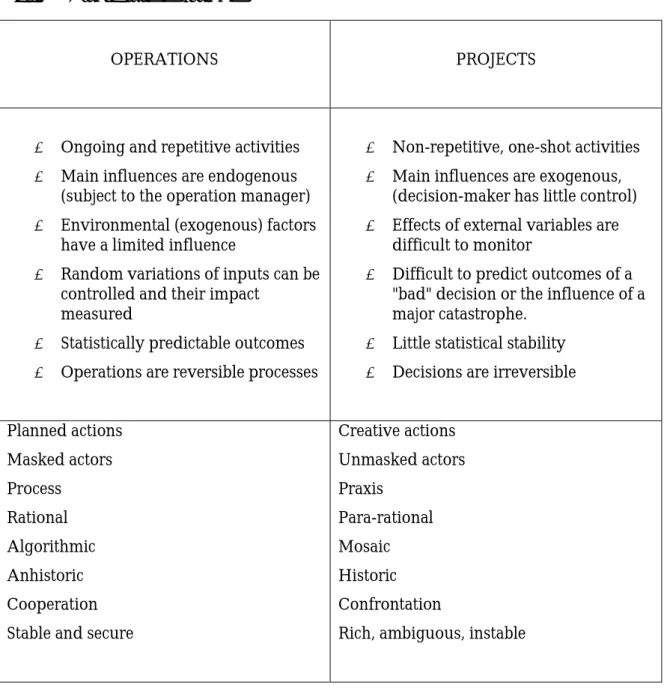
Thus, the necessity of two types of activities that lead to the dichotomy “operations / projects”. Table 1 emphasizes the main characteristics of these activities although, in reality, there may be considerable overlap between them.
Table 1: Operations vs. Projects
OPERATIONS PROJECTS
- Ongoing and repetitive activities
- Main influences are endogenous (subject to the operation manager)
- Environmental (exogenous) factors have a limited influence
- Random variations of inputs can be controlled and their impact
measured
- Statistically predictable outcomes
- Operations are reversible processes
- Non-repetitive, one-shot activities
- Main influences are exogenous, (decision-maker has little control)
- Effects of external variables are difficult to monitor
- Difficult to predict outcomes of a "bad" decision or the influence of a major catastrophe.
- Little statistical stability
- Decisions are irreversible
Planned actions Masked actors Process
Rational Algorithmic Anhistoric Cooperation Stable and secure
Creative actions Unmasked actors Praxis
Para-rational Mosaic Historic Confrontation
Rich, ambiguous, instable
Organizations and the environment
An ecosystem is defined as "the complex of a community of organisms and its environment
(biotope) functioning as an ecological unit" (Merriam Webster dictionary). Here the biotope is
the environment including the context sub-system that is defined following pertinence criteria by decision makers and/or project managers. Environment and context exist only in their dialectical relationship with an organization (operation or project). Perturbations, shocks and macro destabilizations arise within the environment.
Referring to knowing as an 'intelligent' action, and learning as knowledge development, projects involve praxis, which becomes an action oriented to meet a goal that is context and environment specific. Understanding such a dynamic relationship between information, knowledge, learning and acting leads to a systemic perspective.
Considering the dynamic aspect of the ecosystem project/context three propositions can be made:
a project starts with a simulation then continues with series of dissimulations; a project is a place for spontaneous generation of positive feedbacks;
a project is a dialectic “complexification/decomplexification”.
The whole dynamic of the ecosystem and the information generated can be represented as follows (Exhibit 1):
Exhibit 1: Morphogenesis of ecosystem and information flows
With this in mind, it is possible to look at the characteristics of a project team, in charge of project activities, but to some extent, of "operations" activities as well through the looking glass of a learning organization.
Knowing and learning in the Project Team
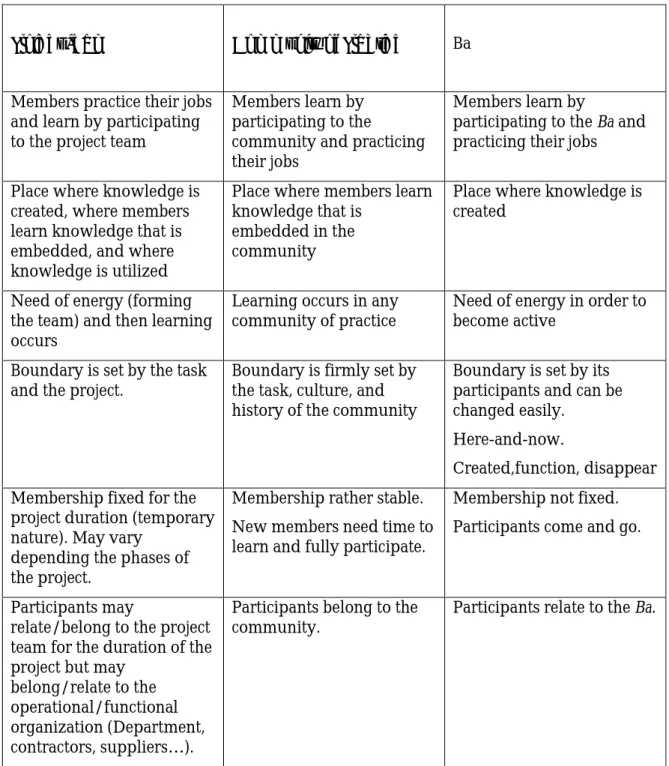
Wenger and Snyder (2000, p. 142) draw a comparison between several forms of team organizations: community of practice, formal work group, informal network and project team. To this it seems important to add the concept of Ba, latform for the knowledge creation process (Nonaka, Toyama, and Byosiere in Dierkes, Berhoin Antal, Child, and Nonaka 2001, pp. 491-517). There are some fundamentals differences between project team, community of practice, and Ba. They are summarized Table 2.
Table 2: Putting in perspective project team, community of practice, and Ba
Project Team Community of Practice Ba
Members practice their jobs and learn by participating to the project team
Members learn by participating to the
community and practicing their jobs
Members learn by
participating to the Ba and practicing their jobs
Place where knowledge is created, where members learn knowledge that is embedded, and where knowledge is utilized
Place where members learn knowledge that is
embedded in the community
Place where knowledge is created
Need of energy (forming the team) and then learning occurs
Learning occurs in any community of practice
Need of energy in order to become active
Boundary is set by the task and the project.
Boundary is firmly set by the task, culture, and history of the community
Boundary is set by its participants and can be changed easily.
Here-and-now.
Created,function, disappear Membership fixed for the
project duration (temporary nature). May vary
depending the phases of the project.
Membership rather stable. New members need time to learn and fully participate.
Membership not fixed. Participants come and go.
Participants may
relate/belong to the project team for the duration of the project but may
belong/relate to the operational/functional organization (Department, contractors, suppliers…).
Participants belong to the community.
Participants relate to the Ba.
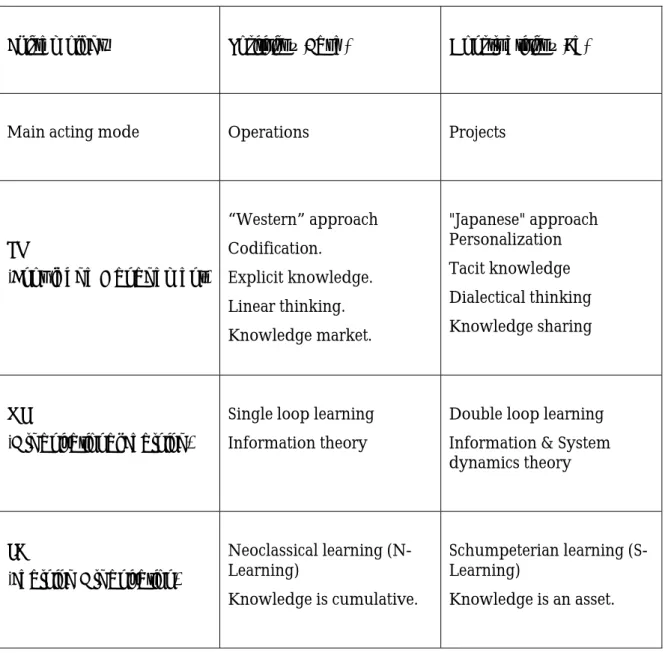
To understand the specificity created by the project environment and project team as far as learning is concerned let us synthesize some of the key perspectives. (Table 3)
Table 3: Synthesis of two perspectives regarding KM, OL and Learning Organizations
Epistemology Positivist – 'Have' Constructivist – 'Be'
Main acting mode Operations Projects
KM
(Knowledge Management)
“Western” approach Codification.
Explicit knowledge. Linear thinking. Knowledge market.
"Japanese" approach Personalization Tacit knowledge Dialectical thinking Knowledge sharing
OL
(Organizational Learning)
Single loop learning Information theory
Double loop learning Information & System dynamics theory
LO
(Learning Organization)
Neoclassical learning (N-Learning)
Knowledge is cumulative.
Schumpeterian learning (S-Learning)
Knowledge is an asset.
With Table 3, it is clear that projects, through the way the project team acts (praxis), are a privileged place for learning. Project-based learning needs to integrate the two perspectives ('Have' & 'Be' or 'operations' & 'projects') for them to blend creative or exploratory learning and application or exploitative learning (Boisot 1998, p. 116). With the need for efficiency and effectiveness, a project team acts as a temporary structure, generating first information and creating knowledge (adding complexity) with many degrees of freedom, and then applying it (reduction of complexity) in the former stage of a project. The level of knowledge being created will be dependant on the nature of the project/organization/environment system. Some projects require little creativity, while others require a great deal.
The notion of knowledge management is fascinating within projects precisely because all new project teams must solve a unique conundrum: to what degree is the information/knowledge available to complete the project based on past experience (replicable historical processes). and to what degree must all knowledge and learning be acquired or 'emergent' as a result of the unique nature of the project tasks.
Consequences at knowledge management level are twofold:
Focusing on the 'Have' side creates a need for some form of knowledge – guidance, best practice, standards, etc. – at the individual, team and organizational levels. The
developments of professional certification programs, as well as maturity models, are important for this aspect to develop. Such standards are mainly social constructs, developed to facilitate communication and trust among those who are adopting them. The evolution is in line with previous user experiences and new developments or practices thus preventing fossilisation (Bredillet 2002).
On the 'Be' side fosters the need for more creative competence (e.g. some professional certifications are incorporating personal characteristics), flexible frameworks (e.g. use of meta rules), and organizational structures that enable the sharing of experience.
Acting and Learning through a Meta method
Rather than focusing on the different aspects of knowledge enablement as in Krogh, Ichijo, and Nonaka (2000, p. 5) who provide five knowledge enablers as a means to develop the power of tacit knowledge, the focus will be put on the introduction of an integrative Meta method. This 'method of methods' is grounded on the previous development and is the fruit of the CIMAP research works. By its alternate epistemology this method focuses on generic aspects (simplicity) enabling contextualisation/situational use (complexity).
Project Management generic theories, concepts, methods and tools are in need of a specific framework enabling the contextualisation of their use in the project ecosystem. Furthermore, they also need a specific framework enabling their contextualisation according to the specific dynamic of a project trajectory or life-cycle phase. The MAP meta-method created by Declerck et al. (1983, 1997) facilitates the praxis and double contextualisation (environment and dynamic of the project trajectory).
MAP is a process of analysis, solving and decision of macro and micro socio-economic problems (dissipative structure, see Exhibit 1). It is founded on the constitution of an office of strategic decisions – the Map room – and on the dynamic interaction between analysts and decision makers. MAP may be seen as a place of 'social practice' (Brown and Duguid 2001) and a place providing the individuals and teams with 'representations' (Weick 1995, Weick and Roberts 1993).
The MAP Method has the following objectives and characteristics: Resolution of the ill-structured problems.
The banal experience of whoever has worked on entrepreneurial decision-making is to note that the great difficulty is not to discover solutions but, on the contrary, to better formulate the 'statements' of the problems, posed initially in vague terms, sometimes ambiguous or contradictory. MAP Method comprises an iterative process leading to increasingly precise formulations and allowing the analyses that prepare for the decision, the implementation and the control of the project.
Common language for a team working on a project.
The MAP Method is conceived for teamwork. This method is essential for the two following reasons. First, teamwork supports the creativity: the controversies, the variety of ideas caused by the complementarities between members of the group generating logical reasoning, accompanied by the phenomena of associations. Second, the dynamics of the dialogue between the analysts and the decision makers limits the dangers of excesses of technocracy or subjectivity.
Overall perception of a project.
The MAP Method leads to visual and synthetic representations of complementary aspects of projects. The map room gathering the whole of these representations plunges the analysts and the decision makers into an environment of information that leads them to an overall perception – the psychologists say "gestaltist" – of the project. It is important that this contributes to a vision that translates into an intimate knowledge of the project. The MAP
Method makes it possible to exceed the simple analytical evaluation of each aspect of a project and prepares a global, participative and multi-criterion judgement.
Piloting the process of the management of the project.
From the fuzzy, ambiguous, contradictory awareness of an idea of project until the immersion in an institutionalised operation, the project describes a complex trajectory throughout which Method MAP applies. In particular, the management of the studies and the definitions of the alternative scenarios for the project considered are dealt with by the method. Thus it is possible to avoid what one too frequently observes: a lack of adapted method that introduces an implicit skew into final decisions. The MAP Method aims to make management of the project a process where thought and action interact, not a linear course of a study from the hands of analysts and specialists directly to the decision makers.
Crossroads of quantitative and psycho-sociological techniques.
MAP was born from the will to associate in a coherent method all three quantitative, qualitative and psycho-sociological approaches. The concept of model – a necessary representation through which management takes on the real world – has operational existence only thanks to the control of the quantitative techniques (system analyses, PERT, simulation, data processing, etc.). These techniques, however, form part of a really creative process only insofar as they serve the reflection and the action of a team. Therefore MAP largely calls upon the psycho-sociological techniques, such quiet group methods, techniques of creativity, groups of confrontation, etc