Vanadium Contribution to the Surface
Modification of Titanium Silicalite for
Conversion of Benzene to Phenol
Mulyatun1 and Didik Prasetyoko2
AbstractVanadium oxide supported on the surface of titanium silicalite was investigated in benzene hydroxylation to determine its activity as heterogeneous catalyst. Effect of vanadium loading on structure and activity of titanium silicalite was investigated. On the basis of X-ray diffraction and infrared spectroscopy techniques, it was found that the titanium structure was remained on the modified catalyst. The catalytic activity of the modified catalyst was observed to be higher than that of parent catalyst.
Keywordstitanium silicalite, vanadium oxide, hydroxylation, benzene
AbstrakAktivitas vanadium oksida yang berada pada permukaan titanium silikalit sebagai katalis heterogen telah diteliti pada hidroksilasi benzena. Pengaruh loading vanadium terhadap struktur dan aktivitas titanium silikalit telah dipelajari. Berdasarkan teknik difraksi sinar-X dan spektroskopi inframerah, ditemukan bahwa titanium pada katalis yang telah dimodifikasi tidak mengalami perubahan struktur. Aktivitas katalitik dari katalis yang telah dimodifikasi diamati lebih tinggi dibandingkan dengan katalis induk.
Kata Kuncititanium silikalit, vanadium oksida, hidroksilasi, benzena
I.INTRODUCTION6
henol is an important intermediate compound for the synthesis of petrochemicals, agrochemicals, and plastics. Nowadays approximately 95 % of phenol production was produced by cumene process consisting of three main reaction steps (alkylation of benzene with propylene to cumene, oxidation of cumene to cumene hydroperoxide and decomposition to phenol and acetone) [1]. The advantage of the cumene process is that it takes two inexpensive starting materials, benzene and propylene and converts them into two high value useful products, phenol and acetone, using air. Despite its great success, the cumene process has some disadvantages such as the production of an explosive intermediate (cumene hydroperoxide), it has a high environmental impact, and it uses a corrosive catalyst. It is multi-step process, which makes it difficult to achieve high phenol yields in relation to benzene used and which leads to a high capital investment. It requires the uses of aggressive media (dilute sulphuric acid at 60-70oC) and has a high acetone production as a co-product which results in an over supply in the market [2]. This situation encouraged scientists to develop other methods for producing phenol from benzene, preferably via a single-step and free of co-products reaction, which thus would be economically favorable.
The direct hydroxylation of benzene to phenol is an attractive alternative to phenol production for economically and environmentally reason [3]. One of the alternative routes to produce phenol which has more
Mulyatun is with Department of Chemical Education, Faculty of Education, Institut Agama Islam Negeri Walisongo, Semarang, Indonesia.
Didik Prasetyoko is with Department of Chemistry, FMIPA, Institut Teknologi Sepuluh Nopember, Surabaya, 60111, Indonesia. E-mail: [email protected].
advantages is through benzene hydroxylation reaction using H2O2 as oxidant agent and Titanium Silicalite-1 (TS-1) as catalyst. TS-1 is known to be an excellent catalyst for hydroxylation of benzene with selectivity to phenol reach 97% [4]. TS-1 catalyst has high catalytic activity and selectivity in oxidation reaction of aromatic compounds with H2O2 which important for commercial industries [5]. However, the reaction rate of benzene hydroxylation tends to be low [6]. It is because TS-1 has hydrophobic nature [5], and as the result H2O2 adsorp-tion which has hydrophilic nature towards active sites of TS-1 is also become slower.
Meanwhile, in the hydroxylation reaction, it is well known that the interaction between titanium and oxidizing agents (H2O2) to form titanium-peroxo species as intermediate species from reaction between H2O2 and TS-1 catalyst [7-9], should occur before the reaction with benzene to produce phenol. The rate of the formation of titanium-peroxo depends on the rate of H2O2 reach to active site in TS-1. One of the ways to increase benzene hydroxylation reaction rate with TS-1 catalyst is by making TS-1 become more hydrophilic, and the reaction rate of benzene hydroxylation will be much faster, and it’s catalytic activity and selectivity higher than TS-1. Hydrophilic improvement of catalyst can be carried out by addition of metal oxide which leads to increasing of acidity properties. The metal oxide in TS-1 catalyst which act as acid site capable to increase catalyst hydrophilicity, so that reactant adsorption in catalyst becomes faster [10,11]. In previous research done by Indrayani [12], MoO3/TS-1 catalysts have showed improvement of hydrophilicity along with the increasing of MoO3 content in MoO3/TS-1 catalyst. The improvement of hydrophilic character of MoO3/TS-1 catalyst is also accompanied with the improvement of its catalytic activity. In this research, TS-1 catalyst was
modified by addition of metal oxide V2O5 on the surface of TS-1 catalyst. The existence of V2O5 on the TS-1 surface was observed to make this catalyst (V2O5/TS-1) has higher hydrophilic character as compared to TS-1.
II. METHOD A. Samples Preparation
TS-1 catalyst samples were prepared according to a procedure described earlier by Taramasso et al. [13]. Tetraethyl orthosilicates, TEOS (Merck, 98%) containing 0.3145 mol of silicon was placed into a Teflon beaker and vigorously stirred. Tetraethyl orthotitanate, TEOT (Merck, 95%) containing 0.0032 mol of titanium in isopropyl alcohol was carefully added drop-wise into this TEOS. The beaker was covered with parafilm to avoid hydrolysis by air. The reactants were mixed homogeneously for 30 minute at room temperature. Then the mixture was cooled to about 0oC. The solution of tetrapropylammonium hydroxide, TPAOH (Merck, 20% TPAOH in water), which was used as template, was also cooled to 0oC. After a few minutes, TPAOH containing 0.1287 mol of TPAOH was added drop-wise slowly into the mixture of TEOS and TEOT. At first, one should wait a few minutes after addition of a few drops of TPAOH solution before more TPAOH solution is added, to avoid precipitation. Stirring and cooling were continued during this process. When the addition of TPAOH was completed, the mixture was heated in the temperature range of 80-90oC for about 4 hour in order for the hydrolysis of TEOS and TEOT to take place. Distilled water was added to increase the volume of the mixture to about 127 mL, after which a clear gel was obtained. The gel was transferred into a 150 mL autoclave and heated at 175oC under static condition. The material was recovered after 4 days of hydrothermal crystallization by centrifugation and washing with excess distilled water. A white powder was obtained after drying in air at 100oC overnight [13].
The V2O5/TS-1 catalysts were prepared by impregnation of TS-1 with an aqueous solution containing sufficient amount of ammonium metha-vanadate (NH4VO3), to yield materials with loading in the ranges of 0.5 – 4 wt% of V2O5. The suspension was heated at 80oC for 3 h under stirring condition, followed by evaporation of water, draining at 110oC for 24 h, and calcination at 500oC for 5 h [14]. The samples were denoted by their weight percentage of V2O5 on TS-1. B. Characterizations
The structure of catalyst TS-1 and V2O5/TS-1 was determined using X-ray powder diffraction (XRD) and infrared spectroscopy technique. X-ray powder diffraction (XRD) patterns were collected using the Ni-filtered Cu-Kα radiation (λ = 1.5406 Å) as the diffracted monochromatic beam at 40 kV and 40 mA. The pattern was scanned in the 2 ranges from 5o to 50o at a step size 0.010o and step time 1s. Infrared spectra of the catalyst TS-1 and V2O5/TS-1 samples were collected on a Shimadzu Fourier Transform Infrared, with scans 20 s by KBr pellet method. The Infrared spectra were recorded in the region of 1400 – 400 cm-1. The acidity of samples
was determined by infrared spectroscopy technique using pyridine as probe molecule. The water of the sample (10-12 mg) was locked in the cell equipped and evacuated at 400oC under nitrogen flow for 4 h, continued by adsorption of pyridine at room temperature. After evacuation at 150oC for 3 h, infrared spectra of the sample were recorded at room temperature in the region of 1400 - 1700 cm-1 using Shimadzu Fourier Transform Infrared (FTIR). The catalysts hydrophilicity is analyzed by catalyst sample powder dispersion method at water phase and organic phase mixture (water and xylene). A mixture of xylene and water, which do not mix each other, is employed to test the hydrophobic characteristics of the samples. xylene and water of the same volume are added into a test tube to form a stable phase interface. TS-1 and V2O5/TS-1 catalyst samples are, respectively, dispersed in the xylene–water system and stirred. After the mixture has stabilized, the hydrophobic characteristics can be qualitatively evaluated by inspecting the state of the floating/sinking of samples at the interface [15].
C. Catalytic Activity
The catalyst performance was tested in the hydroxylation of benzene using aqueous H2O2 (30%) as oxidant. The reaction mixture containing benzene (1 g ), H2O2 (1.32 mL), and acetoneitrile (5 g) as solvent was placed in a round bottom flask equipped with a condenser. The catalyst ( 0.15 g TS-1 based) was then added to the mixture. The reaction was carried out in an oil bath under stirring at 70oC. The products of the reaction were analyzed by a Agilent gas chromatograph using an HP 5 non polar column with FID detector.
III. RESULTS AND DISCUSSION
However, the peak intensities of the V2O5/TS-1 samples decrease with the increase of V2O5 loading, due to the increase concentration of the V2O5 on the surface of the TS-1. It is suggested that V2O5 could be located on the surface of TS-1 or covering the surface of TS-1. The crystallinity of V2O5/TS-1 catalysts (based on the highest diffraction line of TS-1) are summarized in Table 1.
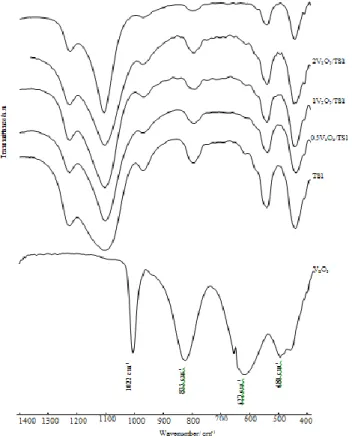
The infrared spectra of the samples are shown in Figure 2. Vanadium (V) oxide crystal exhibits four strong absorption bands at around 1022, 835, 627 and 480 cm-1. The band at 1022 cm-1 could be assigned to (V = O)3+ double bond stretching mode. The bands at 835 and 480 cm-1 are due to the asymmetric stretching mode and the rotation mode of V–O–V vibrations, respectively [18].
Catalyst samples of TS-1 and V2O5/TS-1 shows absorption band at around 1100, 800, and 450 cm-1, which is vibration mode of SiO4 or AlO4 tetrahedral. Absorption band at around 1100 cm-1 is asymmetrical vibration mode of Si-O-Si, and absorption band at around 800 cm-1 is its symmetrical vibration mode. Absorption band around 1230 and 547 cm-1 is characteristic for tetrahedral structure in framework zeolite MFI [19]. Absorption band at around 970 cm-1 is characteristic of TS-1 which is vibration mode of stretching Si-O from unit [SiO4] which tied at atom Ti4+ with tetrahedral coordination in TS-1 framework. Absorption band at this wavenumber is an evidence that titanium atom has already stayed inside the structure of catalyst framework [20]. No additional band after impregnation of V2O5 on the TS-1 can be observed. This finding shows that impregnation of V2O5 has not affected the MFI structure of TS-1 significantly.
The acidity of V2O5/TS-1 catalyst samples was investigated by infrared spectroscopy using pyridine as the probe molecule. Figure 3 shows the infrared spectra of the samples at various V2O5 loadings after evacuation at 150oC under vacuum for 3 h. TS-1 catalyst sample shows peaks at around 1490 and 1445 cm-1. The peak at around 1445 cm-1 is assigned to Lewis acid sites, suggesting that TS-1 possesses only Lewis acid. Similar finding has been reported by Drago et al. [19]. Meanwhile, all V2O5/TS-1 samples show peaks at around 1546, 1490, and 1445 cm-1. The small peak at around 1546 cm-1 and the strong peak at around 1445 cm-1 indicate that all samples contain both Brønsted and Lewis acid sites. The calculated amount of Lewis and Brønsted acid sites in the TS-1 and V2O5/TS-1 catalyst samples is tabulated in Table 2, calculated according to the equation method introduced by Emeis [21]. The impregnation of V2O5 in TS-1 results in the existence of interaction between V2O5 and hydroxyl group at solid surface of TS-1, and gives acid sites to solid itself. The existence of acid sites can enhanced hydrophilicity of TS-1 catalyst, which can be carried out by addition of metal oxide to catalysts. Table 2 also shows the area of the peak at around 1490 cm-1 that can be assigned to total amount of acid sites (Brønsted and Lewis). The table shows that the area increases as V2O5 loading increases up to 4 wt%. In this study, it is suggested that the coordinately bonding of vanadium species with hydroxyl groups on the surface of TS-1 can be correlated with
Brønsted acid sites. According to Table 2, reported that the increasing of the acid site both Lewis and Brønsted are accompanied with the increasing of metal oxide V2O5 content at TS-1 catalyst.
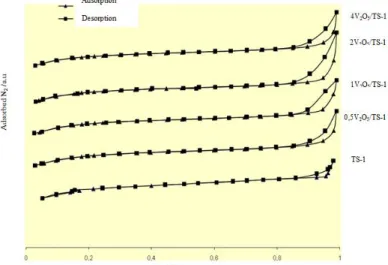
The specific surface area of TS-1 and V2O5/TS-1 catalyst samples was meansured based on the Brunauer-Emmett-Teller (BET) isotherm using nitrogen adsorption. Figure 4 illustrates the N2 adsorption / desorption isotherm of TS-1 and V2O5 / TS-1 catalyst samples. The isotherm of TS-1 and V2O5 / TS-1 catalyst samples exhibits a sharp transition in adsorption branch followed by a linear section with a very gentle slope, which indicates its microporous structure. The hysteresis loop at high P/P0 (0.9–1.0) can be attributed to the interparticle spaces formed by the nanometer sized particles. Surface area progressively decreases with increasing V2O5 concentration. Table 3 shows the surface area of the catalyst samples. Similar finding have been reported by Li et al. [21], which reported that specific surface area of TS-1 catalyst is approximately 310-463 m2/g.
The results of hydrophobic tests are shown in Table 4. TS-1 and V2O5/TS-1 catalyst samples seem to show similar behavior during the hydrophilicity test. It indicates that the addition of metal oxide V2O5 on TS-1 surface doesn’t give too much effect in TS-1 catalyst properties, which is partially hydrophobic. The criterion of partially hydrophobic samples is samples float on the phase interface, after mixing for a long time, some particles still float on the phase interface.
Nevertheless, the addition of metal oxide V2O5 on TS-1 surface resulted higher hydrophilicity of V2O5/TS-1 catalysts than that of TS-1 catalyst. Table 4 shows that the higher V2O5 loading in TS-1 catalyst results in the faster sinks of V2O5/TS-1 catalysts into water. It proved that the increasing of the catalyst hydrophilicity character is accompanied with the increasing of metal oxide V2O5 content at TS-1 catalyst.
B. Catalytic Activity
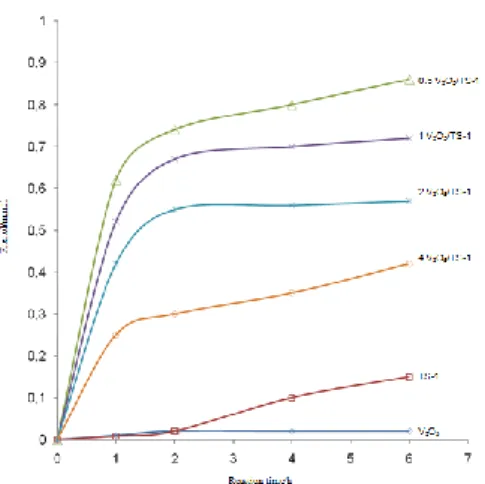
The catalytic activity of the V2O5, TS-1, and V2O5/TS-1 catalysts were tested in the hydroxylation of benzene using H2O2 as oxidant and acetoneitrile as solvent at 70oC. The main product of the reaction was phenol. Figure 6 shows the graph of the rate of formation of phenol versus reaction time in the hydroxylation of benzene using acetoneitrile as solvent.
All of samples show activity towards the the hydroxy-lation of benzene. Compared to V2O5/TS-1 catalysts, sample TS-1 shows the lowest rate of the formation of phenol. Therefore, the high rate of phenol formation observed in the reaction mixture catalyzed by samples V2O5/TS-1 may be due to the presence of V2O5 in the catalysts. However, the yield of phenol decreased as V2O5 loading increased in all reaction time.
initial stage, and then further increased gradually with the reaction time up to 6 h. The high rate of the formation of phenol observed in the initial stage of reaction time on V2O5/TS-1 catalysts can be explained in term of the hydrophilicity of the catalysts. Generally, in the catalytic reaction by heterogeneous catalysts, the first step of the reaction involve adsorption of the substrate on the surface of the catalysts to form intermediate, followed by reaction in the catalyst, and finally desorption of the product from the catalyst. In this reaction, the benzene is a non-polar molecule, while H2O2 a polar molecule. Therefore, benzene will be adsorbed immediately at the catalyst with high hydrophobicity. Sample TS-1 has higher hydrophobic properties than V2O5/TS-1. Consequently, when catalyst TS-1 is added into the solution of phenol and H2O2, the adsorption of phenol on the TS-1 is faster than that of H2O2. Meanwhile, it is known that in the benzene hydroxylation, the active sites are peroxo-titanium complex which is formed by interaction of titanium species of TS-1 with hydrogen peroxide. Therefore, it is expected that the faster interaction of H2O2 with titanium in the TS-1 result the faster formation of peroxo-titanium species. As a result, the formation of phenol was found to be increased. Based on these finding, it is concluded that the high rate of the formation of phenol observed on V2O5/TS-1 catalysts may due to the higher hydrophilicity of these catalysts as compare with sample TS-1.
Figure 4 shows the dependence of the TOF (mol oxide/mol titanium/h) on the amount of V2O5 loading in V2O5/ TS-1 for the hydroxylation of benzene with aqueous H2O2 at 700C for 6 h. All V2O5/TS-1 catalysts showed higher TOF than the parent TS-1. Among the V2O5/TS-1 catalysts, it is found that the TOF decreased sharply with an increasing amount of V2O5 loading. This finding suggests that the capability of substrate to access the peroxo-titanium active sites inside the pore of TS-1 is easier at lower amount of V2O5 loading. The pore opening of TS-1 is blocked by vanadium oxide at the high amount of V2O5 loading. Meanwhile, the higher activity observed in the sample with lower V2O5 loading indicated that only small amount of V2O5 is needed to increase the hydrophilicity of TS-1 to form peroxo-titanium species. Similar findings have been reported by Prasetyoko et al. [11], which reported that the yield of 1,2-epoxyoctane from 1-octene epoxidation decreased as WO3 loading in TS-1 increased higher that 7 wt% due to the blocking pores of TS-1 by tungsten oxide WO3 at the high amount of WO3 loading in TS-1.
IV. CONCLUSION
Impregnation of vanadium oxides (V2O5) onto titanium silicalite (TS-1) was studied. The XRD data showed that after incorporation of vanadium oxides, the MFI structure of TS-1 still remained. Bronsted acid sites have been generated in the V2O5/TS-1 catalysts. It was suggested that the Brønsted acid sites were formed due to formation of Si–O–V bond in the V2O5/TS-1 catalysts. The increasing of the acid sites both Lewis and Bronsted acids are accompanied with the increasing of metal oxide V2O5 content at TS-1 catalyst. Catalyst hydrophilicity
character increases successively from TS-1, 0,5V2O5 / TS-1, 1V2O5 / TS-1, 2V2O5 / TS-1, and 4V2O5 / TS-1. In the hydroxylation of benzene with aqueous H2O2 in acetoneitrile as a solvent, the V2O5 / TS-1 catalysts showed higher activity than the unloaded TS-1 due to higher hydrophylicity of the V2O5 / TS-1 catalysts.
ACKNOWLEDGEMENT
We gratefully acknowledge funding from the Directorate General of Higher Education, Indonesia, under Hibah Kompetensi and The Academy of Sciences for the Developing World (TWAS) Research Grant.
REFERENCES
[1] G. Tanarungsun, W. Kiatkittipong, P. Praserthdam, H. Yamada, T. Tagawa, and S. Assabumrungrat, “Hydroxylation of benzene to phenol on Fe/TiO2 catalysts loaded with different types of second
metal”, Catalysis Communications, Vol. 9, pp. 1886-1890, 2008. [2] M. H. Sayyar, and R. J. Wakeman, “Comparing Two New Routes
for. Benzene Hydroxylation”, Chemical engineering research and design, Vol. 86, pp. 517-526, 2008.
[3] J. Chen, S. Gao, and J. Xu, “Direct hydroxylation of benzena to phenol over a new vanadium-substituted phosphomolybdate as a solid catalyst”, Catalysis communications, Vol. 9, pp. 728-733, 2008.
[4] X. Gao and J. Xu, “A new application of clay-supported vanadium oxide catalyst to selective hydroxylation of benzena to phenol”, Applied clay science, Vol. 33, pp. 1-6, 2006.
[5] X. Liu, X. Wang, X. Guo, and G. Li, “Effect of solvent on the propylene epoxidation over TS-1 catalyst”, Catalysis today, Vols. 93-95, pp. 505-509, 2004.
[6] A. Bhaumik, P. Mukherjee, and R. Kumar, “Triphase catalysis over titanium-silicate molecular sieves under solvent-free conditions”, Journal of Catalysis, Vol. 178, pp. 101-107, 1998. [7] F. Bonino, A. Damin, G. Ricchiardi, M. Ricci, G. Spano`,
D’Aloisio, R. A. Zecchina, C. Lamberti, C. Prestipino, and S. Bordiga, “Ti-peroxo species in the TS-1/H2O2/H2O system”,
Journal of Physical Chemistry B, Vol. 108, pp. 3573-3583, 2004. [8] Y. Liu, X. Ma, S. Wang, and J. Gong, “The nature of surface
acidity and reactivity of MoO3/SiO2 and MoO3/TiO2-SiO2 for
transesterification of dimethyl oxalate with phenol”, Applied catalysis B: environmental, Vol. 77, pp. 125-134, 2007.
[9] G. N. Vayssilov and R.A. Van Santen, “Catalytic activity of titanium silicates – a DFT study”, Journal of Catalysis, Vol. 175, pp. 170-174, 1998.
[10] H. Nur, D. Prasetyoko, Z. Ramli, and S. Endud, “Sulfation: a simple methode to enhance the catalytic activity of TS-1 in epoxidation of 1-octene with aqueous hydogen peroxide”, Catalysis communications, Vol. 5, pp. 725-728, 2004.
[11] D. Prasetyoko, Z. Ramli, S. Endud, and H. Nur, “Enhancement of catalytic activity of titanosilicalite-1-sulfated zirconia combination towards epoxidation of 1-octene with aqueous hydrogen peroxide”, Reaction kinetics catalysis letter, Vol. 86, pp. 83-89, 2005. [12] S. Indrayani, “Aktivitas katalitik MoO3/TS-1 pada reaksi
hidroksilasi fenol menggunakan H2O2”, Thesis M. Si, Institut
Teknologi Sepuluh Nopember, 2008.
[13] M. Taramasso, G. Perego, and B. Notari, “Preparation of porou crystalline synthetic material comprised of silicon and titanium oxides”,US Patents 4,410,501, 1983.
[14] S. Shylesh, T. Radhika, S. K. Rani, and S. Sugunan, “Synthesis, characterization and catalytic activity of Nd2O3 supported V2O5
catalysts”, Journal of Molecular Catalysis A: Chemical, Vol. 236, pp. 253–259, 2005.
[15] Z. Wang, T. Wang, Z. Wang, and Y. Jin,”Organic modification of ultrafine particles using carbon-dioxide as the solvent”, Journal of Powder Technolog, Vol. 139, pp. 148-155, 2004.
[16] Y.G. Li, Y.M. Lee, and J.F. Porter, “The Synthesis and Caracterization of. Titanium Silicalite-1”, Kluwer Academic Publishers, pp. 0022-2461, 2002.
[18] Q. Sun, D. Fang, S. Wang, J. Shen, and A. Auroux, Applied catalysis A, Vol. 327, pp. 218-225, 2007.
[19] R.S. Drago, S.C. Dias, J.M. McGilvray, and A.L.M.L. Mateus, “Acidity and hydrophobicity of TS-1”, Journal of Physical Chemistry, Vol. 102, pp. 1508-1514, 1998.
[20] G. Li, X. Wang, X. Guo, S. Liu, Q. Zhao, X. Bao, and L. Lin, “Titanium species in titanium silicate TS-1 prepared by
hydrothermal method”, Materials chemistry and physics, Vol. 71, pp. 195-201, 2001.
[21] C.A. Emeis, “Determination of integrated molar extinction coefficients for infrared absorption of pyridine adsorbed on solid acid catalysts”, Journal of Catalysis, Vol. 141, pp. 347-354, 1993.
Figure 1. X-ray diffraction pattern of the V2O5, TS-1, and XV2O5/TS-1 (X = 0.5, 1 - 2, and 4) catalyst samples
Figure 3. Infrared spectra of the TS-1 and X V2O5/TS-1 (X = 0.5, 1 - 2, and 4) catalyst samples after evacuation at 400oC in the nitrogen flow,
followed by pyridine adsorption at room temperature and desorption at 150oC for 3 h
Figure 4. N2 adsorption–desorption isotherms of the calcined TS-1 and X V2O5/TS-1 (X = 0.5, 1 - 2, and 4) catalyst samples
TS1 1445 cm-1
1490 cm-1
In
te
n
si
ty
/
a
.u
.
0.5V2O5/TS1
1V2O5/TS1
2V2O5/TS1
4V2O5/TS1
17 00 .0
16 50
160 0
1550 150 0
145 0
140 0 Wavenumber/cm-1
Figure 5. The formation of phenol from benzene hydroxylation using aqueous H2O2 at 700 C catalyzed by TS-1 and V2O5 / TS-1
Figure 6. Dependence of TOF (mol phenol per mol Ti, per hour at 6 hrs of reaction time) on the V2O5 content for hydroxylation benzene with
aqueous hydrogen peroxide at 700C in acetoneitrile
TABLE 1.
CRYSTALLINITY OF THE TS-1 AND XV2O5/TS-1(X=0.5,1-2, AND 4)CATALYST SAMPLES
TABLE 2.
AMOUNT OF LEWIS AND BRØNSTED ACID SITES (MMOL/G) OF THE TS-1 AND XV2O5/TS-1(X=0.5,1-2, AND 4)CATALYST SAMPLES
Samples
Acid site, mmol/g
Ratio B/L
Peak Area at 1490, cm-1 Bronsted (B) Lewis (L)
TS-1 0,5V2O5/TS-1
1V2O5/TS-1
2V2O5/TS-1
4V2O5/TS-1
- 0.319 0.619 0.901 1.061
0.965 1.453 1.581 1.239 0.974
0 0.220 0.392 0.727 1.089
4.612 6.350 6.554 7.815 9.159
TABLE 3.
AVERAGE SURFACE AREA OF THE TS-1 AND XV2O5/TS-1(X=0.5,1-2, AND 4)CATALYST SAMPLES
Samples BET Surface Area (m2/g)
TS-1 394.88
0,5V2O5/TS-1 393.81
1V2O5/TS-1 391.27
2V2O5/TS-1 387.32
4V2O5/TS-1 348.13
TABLE 4.
HYDROPHOBICITY CHARACTER OF THE TS-1 AND XV2O5/TS-1(X=0.5,1-2, AND 4)CATALYST SAMPLES
Samples Index Character Time to sink into the water (s) TS-1
0,5V2O5/TS-1
1V2O5/TS-1
2V2O5/TS-1
4V2O5/TS-1
5 5 5 5 5
Hydrophobic Partial Hydrophobic Partial Hydrophobic Partial Hydrophobic Partial Hydrophobic Partial
72 63 54 35 24 Samples Intensity at around
2θ = 23.00o, Cps
Relative Crystallinity (%)
phase
TS-1 0.5V2O5/TS-1
1V2O5/TS-1
2V2O5/TS-1
4V2O5/TS-1
2871 2852 2786 2504 2366
100 99.34 97.04 87.22 82.41