Introduction
In the European Union, work-related stress is a major occupational health problem, second only to lower back pain. The 2000 Third European survey on working conditions identified work-related stress in about one in four European workers, i.e. in about 40 million people.
It has been shown that job stress has a remarkable impact on the health of workers, being related to depression, anxiety, nervousness, fatigue and cardiac diseases [1]. In the United Kingdom 10% of working people affected by job-related diseases suffer from stress and depression [2].
Stress can negatively influence work organization, creativity and competitiveness and it may be responsible for the loss of productivity, healthcare consumption and absenteeism. The loss of working days caused by absence due to stress for EU workers is pertinent with more than a quarter of absenteeism from work, for periods of two or more weeks, being related to job stress [3] and between 50% and 60% of total working days lost being linked to work related stress. The economic impact for the member states in 1999 was estimated to be about €20 billion. In the same
year, the costs for absenteeism in Sweden were about €450 million, about 10% of the total cost for work related disease. The United Nations International Labor Organization estimated the cost of lost productivity resulting from work absenteeism at US $200 billion a year for the United States alone [4]. Any worker can be affected by work related stress, with no regards to job type or position and organization size.
According to the definition of the European Agency for Safety and Health at Work, stress originates from an excess of demands from the working environment or from a lack of the worker’s ability to face and control it [5-6]. This definition focuses on the working origin of stress, consisting in a “pattern of emotional, cognitive, behavioural and physiological reactions to adverse and noxious aspects of work
organisation, work content and work
environment” [4,7].
Stressful working environments are recognised as a workplace hazard and policies are being introduced to improve psychosocial working conditions in many countries [8]. In order to manage and prevent work-related stress it is
Evaluating the effect of stress management programmes at the work-site on
absenteeism reduction: a systematic review
Gianfranco Damiani
1, Bruno Federico
2, Luigi Pinnarelli
3, Annalisa Sammarco
1, Walter Ricciardi
11
Dipartimento di Sanità Pubblica, Università Cattolica del Sacro Cuore, Largo F. Vito 1, Roma, Italia; 2Cattedra di Igiene e Scienze Motorie, Università di Cassino, Italia; 3Direzione sanitaria Azienda ACO San Filippo Neri, Roma, Italia
Correspondence to: Gianfranco Damiani, Dipartimento di Sanità Pubblica, Università Cattolica del Sacro Cuore, Largo F. Vito 1, Roma, Italia. E –mail: [email protected]
Abstract
Background: In the European Union, work-related stress affects about one in four workers, and it may be responsible for the loss of productivity, healthcare consumption and absenteeism. The objective of our study was to estimate whether stress programmes aimed at managing and preventing work-related stress reduced the rate of absenteeism.
Methods: We searched electronic databases for relevant articles assisted by hand searching for references. We included studies that had an experimental or quasi-experimental design, describing an intervention focused either on the work organisation or on workers’ characteristics as well as reporting a measure of absenteeism.
Results: The search identified 2520 articles: among these, nine met our inclusion criteria. Stress management programmes reduced absenteeism shortly after the intervention however in the long term there was no evidence to support this.
Conclusion: Future studies should evaluate stress management programmes that consist of repeated interventions over longer periods of time, focusing on effectiveness and relative costs.
possible to act either on the work organization, by reducing the causes of stress, or on workers’ characteristics, by improving their ability to face stressful situations [9-10]. It has been suggested that a potential benefit for employers who manage to improve psychosocial working conditions is reduced levels of absenteeism due to sickness [7,10]. Previous reviews have evaluated the effectiveness of different programmes aimed at managing job stress on the basis of qualitative analyses [11]. In 2001, Van der Klink et al. carried out a quantitative meta-analysis to determine the effectiveness of stress-reducing interventions [12], showing that cognitive-behavioural and relaxation interventions were more effective than organizational ones; in addition, some outcome measures (psychological responses and resource, quality of work, anxiety and depressive symptoms) showed a larger improvement than others. With regards to loss of work days, this systematic review found that the interventions were not effective in reducing absenteeism.
However, this review considered very few studies that measured variation in absenteeism rates, so it is not clear whether stress management programmes have an effect on sickness absence. Therefore, we aimed to estimate through a systematic review whether health programmes aimed at managing and preventing work-related stress reduced the rate of absenteeism.
Methods
Search strategy
Electronic databases were searched for relevant
articles (MEDLINE, NIOSHTIC, COCHRANE
LIBRARY, EMBASE), using different search strategies and using a combination of the following terms:job stress, work stress, worksite stress, stress management, worksite stressor, work related stress, distress at work, stress therapy, stress reduction, occupational stress, absenteeism, sickness leave and stress absence.
In addition, in order to integrate the results, we carried out a hand search of references. A further analysis of grey literature was conducted looking for unpublished studies about work-related stress in generic search engines (google, vivisimo) but the search did not produce any experimental studies of good quality.
The search covered studies published between January 1982 and December 2005.
Study selection
We decided to include studies with an experimental or a quasi-experimental design, describing interventions focused either on the
work organization or on workers’ characteristics, which reported a comparison with a reference or control group and used absenteeism as one of the outcome measures.
Quality assessment
The methodology of each study was assessed independently by two authors (L.P., A.S.) according to a score based on a 10-points scale, consisting of 5 potential sources of bias, adapting the items according to our topic [13,14]. Disagreements were resolved with a third epidemiologist (G.D.) or by consensus.The cut-off value for including an article in our systematic review was 6/10.
Data extraction and analysis
We reported relevant data from each article in an ad hoc data sheet, containing data about author, year of publication, country, type of intervention, type of working population, size of control and intervention group, duration of intervention, duration of follow-up, measure of absenteeism used and the comparison of absenteeism between the two groups (Table 1).
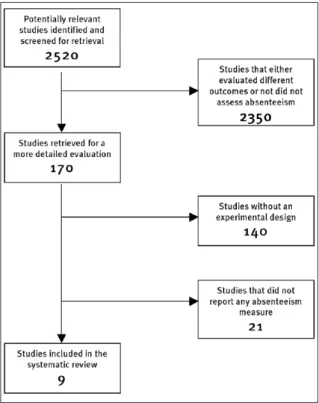
Figure 1 represents the flow chart for the inclusion of studies in the systematic review. The combined searches resulted in a total of 2520 potentially relevant studies identified by abstract and title. Out of these studies, 2511 were excluded because either they considered different
outcomes or because they did not assess absenteeism measures or because they were observational studies. The remaining nine studies (Table 1) met the selection criteria and were included in the systematic review. No study received a score below 6/10 (mean score: 8.2, range: 6-10).
Results
Table 1 reports the characteristics of the nine selected trials, which reported different absenteeism measures and follow-up of different lengths. Four studies [15-18] reported results limited to a follow-up period of six months at the most, while other studies had follow-up ranging from 12 to 36 months. Three studies compared more than one programme with a reference group [19—21], whereas in the remaining studies only one intervention was evaluated.
Studies that reported a short (i.e. six months at most) follow-up showed contrasting results for the rate of absenteeism. In Munz’s study a higher average reduction in absenteeism was present in the intervention group (24%) compared to the control group (7%). This study assessed absenteeism reduction 3 months after the intervention [15].
Results provided by Jackson’s study showed that absence frequency after 3 and 6 months of follow-up was similar between control and intervention groups, suggesting that the stress management programme was not effective. The results are reported as means and standard deviations (SD) of days of illness. At the pre-test,
C=1 (SD=0.9), while the mean for the
intervention group (I) was 1.1 (SD=1.2); at three months C=1.2 (SD=1.0), I=1.1 (SD=1.1) and at six months, C= 0.7 (SD=0.8), I=0.9 (SD=1.0). In this study the number of participants differed substantially between the pre-test and the following post-tests [16].
Toivanen analysed the effect of a stress programme that lasted only 3 weeks. The results show that sickness absenteeism during the intervention and follow-up period were equivalent between the intervention and the control group [17].
The study by Peters et al. had a follow-up of three months and evaluated the effects of a worksite stress management programme; results showed that there were no significant changes in absenteeism reduction from pre-treatment to post-treatment, but the authors did not provide any quantitative data to support it [18].
Again, studies that considered a longer follow-up period did not produce clear-cut results.
Rahe reported results in terms of days of illness over the 12 months of follow-up. Workers of two different workplaces were enrolled in a full intervention (FI), a partial intervention (PI) or a wait-list control (C). Results showed a slight reduction in absenteeism for illness between FI, PI and C: the median (range) of days of illness was 5.0 (0-180) for FI, 6.0 (0-362) for PI and 7.0 (0-50) for C among computer industry employees.Values among city government participants were 5.5 (0-73) for FI, 6.0 (0-182) for PI and 10.0 (0-180) for C [19].
Eriksen reported that there was no significant effect of interventions on self reported sick leave both the short (3 months) and long term (12 months). The study compared three different interventions programmes, consisting of physical exercise (PE), integrated health programme (IHP) and a stress management test (SMT) with a control group (C). At three months, the following results in terms of mean and confidence intervals of days of sick leave were reported: C=1.70 (0.97-2.22) PE=0.65 (0.21-1.10), IHP=1.43 (0.72-2.15), SMT=1.27 (0.55-2.00). At one year means and confidence intervals were: C=2.04 (1.01-3.07), PE=2.31 (0.89-3.74), IHP=1.23 (0.24-2.23), SMT=2.56 (1.11-4.00) [20].
In a 12-month stress programme intervention, Kawakami shows a reduction in absenteeism, calculated in days of sick leave, although it was not significant. The proportion of participants who had 1-5 days of sick leave in one year was 52% in the treatment group before the intervention, 61% at the end of the stress programme and 34% one year later.The reference group values were 53% before the intervention, 37% at the end of the stress programme and 37 % one year later [22].
The findings provided by Maes shows that before the intervention the percentage of absenteeism in the experimental group was 15.8%, as compared with the 14.3% in the control group.At the end of the programme, absenteeism in the intervention group had decreased to 7.7% (vs. 9.5% in the control group). Thus, there was a decrease in absenteeism of 8.1% in the experimental group and a decrease of 4.8% in the control one, suggesting that the stress programme was clearly effective [23].
Discussion
Our systematic review shows a great variability in the effectiveness of stress management programmes on absenteeism rates. Indeed, some studies showed an effect, whereas other studies did not. In the short-run, the interventions with a longer duration, like those carried out by Murphy, Kawakami and Maes, were associated with a greater effectiveness. The results are still contrasting, because of the heterogeneity of both the interventions and the study characteristics.
The variability of results may also derive from the different programmes carried out in the studies (individual, relaxation, organizational) that have a different impact on absenteeism outcome. A relevant factor contributing to the variability in programme effectiveness was the duration of the intervention. Thus, in order to decrease
absenteeism, it may be necessary that
interventions aimed at managing work-related stress in the workplace are sustained for a long and continuous period. For example the impact of adverse working conditions on physical illness may become more apparent over a long period of time [7]. Furthermore, a stress management programme aimed at reducing absenteeism, may be most useful as an adjunct to interventions aimed at organizational change, for example increased participation in decision making or improved worker autonomy [21]. It is also known that continuous and more extensive intervention is required to produce permanent and broader effects, particularly for interventions at the individual level [23].
The selected studies show some limits in relation to: lack of random allocation (Munz), selection of participants (Jackson), subjects lost to follow-up (Kawakami) but in particular studies were heterogeneous for lengths of follow-up.
It is important to underline that the positive effect on absenteeism reduction in most of the studies, may be partly due to the Hawthorne effect on worker’s behaviours, altered because they knew that they were being studied.
Because of the heterogeneity of the outcomes presented in these studies, our results lack a quantitative analysis focused on a comparable measure of absenteeism.
Nevertheless, the findings of our study represent a first original attempt to perform a systematic evaluation on the effectiveness of stress management programmes in terms of absenteeism reduction.
We suggest that future studies devoted to deepening our preliminary results should focus on different stress management programmes, repeated more times (for example two times every year), taking into consideration the varying effectiveness of these programmes over time.
Future research could also focus on the economic evaluation of stress management programmes in work settings, with particular attention being paid to the possible cost reduction linked to the decrease in absenteeism in order to also promote organizational productivity.
References
1) Cox T, Rial-González E, Griffiths A. Research on Work-related Stress. Luxembourg: European Agency for Safety and Health at Work, 2000.
2) Davies NV,Teasdale P.The costs to the British Economics of work accidents and work-related ill health. London: Health and Safety Executive 1994.
3) Dupré D.‘Work-related health problems in the EU 1998–99’. Bruxelles: Eurostat, 2001.
4) Anderzén I, Anrnetz B.The Impact of a Prospective Survey-Base Workplace Intervention Program on Employee Health, Biologic Stress Markers, and Organizational Productivity. J Occup Environ Med. 2005;47:671–82.
5) European Commission. Guidance on work-related stress – Spice of life or kiss of death? Luxembourg: Office for Official Publications of the European Communities, 2002.
6) European Agency for Safety and Health at Work. How to Tackle Psychosocial Issues and Reduce Work-related Stress. Luxembourg: European Agency for Safety and Health at Work, 2002.
7) Marmot MG, Head J, Kivimäki M, et al. Influence of change in psychosocial work characteristics on sickness absence: the Whitehall II study.J Epidemiol Community Health 2006;60:55-61. 8) Ok Park K, Wilson MG, Sun Lee M. Effects of social support at work on depression and organizational productivity. Am J Health Behav 2004;25:444-455.
9) Melchior M, Niedhammer I, Berkman LF et al. Do psychosocial work factors and social relations exert independent effects on sickness absence? A six year prospective study of the GAZEL cohort. J Epidemiol Community Health 2003;57;285-93.
10) Vahtera J, Kivimäki M, Pentti J et al. Effect of change in the psychosocial work environment on sickness absence: a seven year follow up of initially healthy employees. J Epidemiol Community Health 2000;54:484–93.
11) Van der Hek H, Plomp HN. Occupational stress management programmes: a practical overview of published effect studies. Occup Med 1997;47:133-41.
12) Van der Klink JJL, Blonk RWB, Schene AH, et al.The Benefits of Interventions for Work-Related Stress. Am J Pub Health 2001;91:270-6.
14) Haynes RB, Walker C. Computer-Aided Quality Assurance. Arch Intern Med 1987;147:1297-301.
15) Munz DC, Kohler J, Geenberg C. Effectiveness of a comprehensive worksite stress management program: combining organizational and individual interventions. Int J Stress Manag 2001;8:49-62.
16) Jackson SE. Partecipation in Decision Making as Strategy for Reducing Job-Related Strain. J Appl Psychol 1983;68:3-19. 17) Toivanen H, Helin P, Hanninen O. Impact of Regular Relaxation Training and Psychosocial Working Factors on Neck-Shoulder Tension and Absenteeism in Hospital Cleaners. J Occup Med 1993;35:1123-30.
18) Peters KK, Carlson JG. Worksite stress management with high risk maintenance workers: a controlled study. Int J Stress Manag 1999; 6:21-44.
19) Rahe RH,Taylor C, Robbins et al.A novel stress and coping workplace program reduces illness and healthcare utilization. Psychosomatic Medicine 2002; 64:278-86.
20) Eriksen HR, Ihlebaek C, Mikkelsen A et al. Improving subjective health at the worksite: a randomized controlled trial of stress management training, physical exercise and an integrated health programme. Occup Med 2002;52(7):383-91. 21) Murphy L, Sorenson S. Employee behaviours before and after stress management. J Organiz Behavior 1988;9:173-82. 22) Kawakami N, Shunichi A, Kawashima M, et al. Effects of work-related stress reduction on depressive symptoms among Japanese blue-collar workers. Scand J Work Environ Health 1997;23:54-9.