Distributed Channel and Power Level Selection in
VANET Based on SINR using Game Model
Selo Sulistyo
1and Sahirul Alam
11
Department of Electrical Engineering and Information Technology, Faculty of Engineering, Universitas Gadjah Mada, Indonesia
Abstract: This paper proposes a scheme of channel selection and transmission power adjustment in Vehicular Ad hoc Network (VANET) using game theoretic approach. The paradigm of VANET enables groups of vehicles to establish a mesh-like communication network. However, the mobility of vehicle, highly dynamic network environment, and the shared-spectrum concept used in VANET pose some challenges such as interferences that can decrease the quality of signal. Channel selection and transmit power adjustment are aimed to obtain the higher signal to interference and noise ratio (SINR). In this paper, game theory is implemented to model the channel and power level selection in VANET. Each vehicle represents the player and the combination of channel and power level represents the strategy used by the player to obtain the utility i.e. the SINR. Strategy selection is arranged distributive to each player using Regret Matching Learning (RML) algorithm. Each vehicle evaluates current utility obtained by selecting a strategy to define the probability of that strategy to be selected in the next power update. However, RML has a shortcoming for using assumption that hard to be implemented in real VANET environment. Therefore, modification of RML devised for this application is also proposed. The simulation model of channel and power level selection is build to evaluate the performance of the proposed scheme. The results of simulation show the improvement of VANET performance in term of SINR and throughput from the proposed scheme.
Keywords: vehicular ad hoc network, signal to interference and noise ratio, game theory, regret matching learning.
1.
Introduction
The concept of Vehicular Ad hoc Network (VANET) enables vehicles equipped with wireless communication device to establish connection with other surrounding vehicles. The vehicle to vehicle (V2V) connections build a self-configured network that has dynamic topology following the mobility of vehicles. This emerging concept of network can be useful for broadcasting information of upcoming traffic to vehicles, thus the drivers can make better decision that probably can prevent the accident, avoid traffic jam, or plan the route efficiently. Information related with road condition become more prominent in some geographical area with harsh environment such as in arctic winter condition [1]. The snow storms can disturb the visibility of the road and often lead into serial car accidents. According to [2], VANET applications are not limited to safety and transport efficiency, but can be applied for information or entertainment purposes which indicate the promising potential of VANET. Therefore, a lot of attention has been gained in the researches of VANET.
In spite of the potential, VANET has some technical challenges mainly due to the high mobility of the nodes [3]. Other challenge seriously affecting the quality of vehicle communication is the interference. Clustering was one of the proposed approaches to mitigate the interference. In this
approach, cluster size and range can influence the network performance. Therefore, adaptive clustering technique based on vehicle density is proposed such as in [4]. However, by increasing the number of vehicles such as in urban environment with high density scenario, the demand of improving the network capacity has spurred the utilization of spectrum sharing. A vehicle can transmit the signal through a channel which is also used by other vehicles. Spectrum sharing raises the interference especially if the vehicles using the same channel are close each other. Interference level is also depended on the power level of interferer vehicle. The higher transmit power of the interferer vehicle, the higher the interference received by the victim vehicle. Although high transmit power normally can result the better signal quality at the receiver vehicle, but it is socially inappropriate since it can interfere and decrease the signal quality of other vehicles. Therefore, channel selection and power adjustment for the transmitter vehicles must be arranged properly to reduce the interference. This paper proposes channel selection and power adjustment in VANET using game model and regret matching learning (RML) for strategy selection to improve the average SINR of vehicles in the network.
The organization of this paper is as follows. Section 2 presents the previous works that related with this paper and the main contribution expected to be given by this paper. Section 3 presents the model of system which is built and used in this paper. Section 4 proposes the game model for channel and power level selection in VANET and the proposed RML for strategy selection. Section 5 presents the simulation results and the evaluation of the proposed scheme and section 6 discloses the conclusion of the paper.
2.
Related Works
probability and handoff latency. In [9], analytic hierarchy process (AHP) and multi-criteria decision analysis (MCDA) are implemented in the proposed service channel (SCH) allocation and scheduling scheme. SCH allocation is coordinated by the RSU using message identification where messages are identified as safety or control function. In [10], semi-Markov decision process (SMDP) is used to model channel allocation in VANET which can adaptively allocate the proper number of channels to the users so that the system reward can be maximized. In [11], learning automata is implemented in the proposed node speed based channel reservation scheme in VANET with the purpose to improve system performance i.e. dropped calls percentage and handoff latency. Transmission power control is used frequently to minimize the power consumption along with routing protocol such as in [12] which proposes multipath routing protocol to obtain energy saving for cognitive radio ad hoc networks. However in VANET, power consumption is not the real problem due to the supply of power from vehicles battery. Power control in VANET is more intended to adjust the transmission range and manage the interference level. Some papers that present power control in VANET are as follows. Delay bounded dynamic interactive power control for VANET is proposed in [13]. The adjustment of vehicle transmit power is based on the probe messages that exchanged periodically with the surrounding vehicles. In [14], power control to improve VANET performance is jointly proposed with contention window size adjustment. Transmission power is adjusted adaptively based on the node density. Meanwhile the size of contention window is adjusted according to the instantaneous collision rate. Another transmission power control in VANET which is based on the node density is proposed in [15] with aim to improve the reception rate. In [16], vehicle transmit power control is performed based on the connectivity and several factors such as the trends of relative position and the duration of latest packet received. Therefore, the transmit power control is expected to reduce the collision rate. In [17], space and channel reservation utilize the transmit power control and adaptive carrier sensing range to improve the network throughput, increase the number of transmission that can be held concurrently and the efficiency of transmission power. Those improvements are aimed by controlling the transmission power and carrier sensing range adaptively. In [18], the purpose of power control is to manage the cluster range since the transmission power has direct implication to the transmission range. Cluster range adjustment is expected to prevent some clusters which highly overlapping and thus channel allocation can be managed efficiently. In [19], transmission power control scheme based on the interference received by the receiver node is proposed namely Ostrich. However in ostrich, the node that operating transmission requires certain level of interference that can be tolerated and the neighboring nodes are prevented to initiate transmission at the same time if the nodes inflict the interference higher than the tolerated value. In [20], power control is also used to adjust the transmission range with the purpose to reduce beacon collision. Moreover, the update scheme to lower the delay time is also proposed.
In this paper, channel selection and transmit power
adjustment are jointly performed using game theory. In these recent years, game theory takes a major part in the study related with optimization in LTE such as reviewed in [21]. Thus, game theory is also expected to give significant contributions in VANET. Game theoretic approach for implementation in VANET has been presented in several papers as follows. In [22], non-cooperative game theory was implemented in distributed congestion control through power level adjustment of basic safety message. The proposed algorithm aims to improve the fairness and bandwidth usage. In [23], game theoretic approach is used in mobile networks data offloading through vehicular network and Wi-Fi AP. Data offloading is managed using information i.e. the calculated utility of the nearby vehicle node and APs. In [24], non-cooperative game theory is exploited to propose a scheme for cloud resource allocation to solve problem related with the limited communication time between vehicles and RSU. In [25], non-cooperative game theory is used in transmission power control algorithm with aim to improve the performance of network-wide communication in VANET with interference limitation and inter-node feedback signaling channels limitation. The proposed power control algorithm uses common self-incentive convex payoff function as consideration to select strategies that leads to Nash equilibrium. In [26], game theoretic approach is used in wireless networks, channel and data rate selection in heterogeneous wireless environment for VANET, aiming to obtain the higher throughput for the vehicles.
In the game theoretic approach, the algorithm is directed to converge to the equilibrium point. However in VANET, the environment and network topology are rapidly changed even before the equilibrium is reached by the algorithm. Nevertheless an algorithm to guide the game in order to converge to the better solution is required. In this paper, regret matching learning (RML) algorithm is used to guide the player in strategy selection. RML is a learning algorithm that uses the concept of regret from selecting a strategy [27]. The regret value is then utilized to determine the probability of a strategy to be selected in the next time. RML has been used in [28] to distributively mitigate the interference in two-tier wireless networks which is modeled using game theoretic approach.
The main contributions and advantages of the scheme proposed in this paper are as follows:
1. The proposed scheme models the channel and power level selection in VANET using game theoretic approach. Although using the distributive manner, the proposed scheme aims to improve SINR of vehicles in the system globally.
2. The modification of RML for implementation in channel and power level selection is also proposed. The modification is devised to tackle the shortcoming of RML algorithm which is usually bypassed using assumption.
3. The proposed scheme works in physical layer. As the VANET environment is very dynamic and the network topology can change rapidly, the scheme that works in physical layer is expected to perform faster and use less resource than scheme that works in higher layer.
3.1 VANET environment
The vehicular networking observed in this work is in a 2 kilometers of urban road with the high density scenario. The road is unidirectional flow and consists of 3 lanes. Each road lane has 3 meters of width. Communication device is installed on each vehicle and thus one vehicle can establish a vehicle to vehicle (V2V) connection with another vehicle. However, in this system model, each vehicle is arranged a connection with the nearest vehicle. Vehicle transmission observed in this work is uplink side. Thus, the signal to interference and noise ratio (SINR) of a vehicle calculated in this work is based on the signal transmitted by that vehicle to the receiver vehicle. In uplink transmission, there is possibility that a vehicle acts as the receiver of several vehicles as illustrated in Figure 1. Actually, the receiver vehicle receives not only the signals from the respective transmitters, but also the signals from other vehicles. Those signals from other vehicles are considered as interference if the channel used by those other vehicles is same with the channel used by the respective transmitter of receiver vehicle. Moreover, the transmitter vehicles of the same receiver can interfere each other if the channel used is also same. Therefore, channel selection is important to manage the interference along with the power control. Since power control implies the transmission range, hence the shared channel occupation can be implemented without causing interference provided that the vehicles using the same channel are out of the transmission range each other. The details of channel and power level used in this system model are presented in section IIIA.
In this system model, each vehicle moves at different speed. For simplicity, vehicles are not allowed to change the lane. Thus, if a vehicle moves faster than the neighbor vehicle in front of it, than the vehicle will slow down and match the speed of that neighbor vehicle. This simplicity is helpful and acceptable for simulation in short time. As each vehicle in the network moves at different speed, the topology of network naturally changes. Transmitter vehicle can maintain the connection with a receiver as long as that receiver is the nearest vehicle from the transmitter vehicle. If a new neighbor vehicle is found by the transmitter and the distance of new neighbor vehicle is closer than the current receiver vehicle, the transmitter vehicle will change the connection so that the new neighbor vehicle becomes the receiver.
Figure 1. Vehicle to vehicle transmission 3.2 Signal propagation model
Vehicular networking has the characteristics of wireless communication. As described in [29], the main characteristics of wireless channel that also prevail in vehicular networking are path loss, signal fading, delay spread, and angular spread. However, path loss and fading have the strongest influence toward the quality of signal.
Therefore this system model focuses on path loss and fading in evaluating the SINR of vehicles. Path loss defines the attenuation of signal related with the distance traveled by the signal from transmitter to receiver. Fading is the variation or fluctuation of signal level at the receiver due to multipath propagation. The work in [30] has presented the parameters values for path loss and fading based on extensive channel measurement under several scenarios. Using parameters values in [30] for urban environment with high density scenario, channel gain (G) related with path loss and fading (in 700 MHz band) is given by
(1)
where is the distance traveled by the signal from transmitter to vehicle and is the fading which is modeled as random process. Hence, fading is represented as random number with zero mean normal distribution and standard deviation . Based on channel gain given in (1), the signal level (S) received at the receiver if the transmitter uses the transmit power p is calculated as
(2)
The unwanted signal received by the receiver that decrease the quality of transmission between transmitter and receiver is addressed as interference. The power level of interference is calculated in the same way as calculating signal power at receiver. Since the interference occurs if the unwanted signals are transmitted at the same channel as the desired signal, then interference is calculated as follows
(3)
Note that the transmission measurement considered in this work is uplink side. Thus in (3), interference received at receiver vehicle i due to the usage of channel by transmitter vehicle j is the sum of interference from n other transmitter vehicles. Transmitter n is considered as interferer if transmitter n uses the same channel as transmitter j ( ) and hence is equal 1. Meanwhile, if
transmitter n uses different channel than vehicle j, than
is equal 0.
Another factor decreasing the quality of signal is the noise. In this system, the noise is modeled as white noise whose the intensity is same in all frequencies. A signal transmitted through a channel with bandwidth B Hz receives some amount of noise which is given by
(4)
where is the intensity of the noise in dBm/Hz. Based on the value of signal, interference, and noise in watt, the value of SINR in decibel is calculated as follows.
(5)
The rate of data or throughput (C) can be calculated from the SINR value according to Shannon-Hartley theorem as given by
4.
Proposed Method
4.1 Game model for channel and power level selection in VANET
Channel selection and power level adjustment in VANET can be modeled using strategic non-cooperational game theory. All vehicles in the network represent the players. The selected channel and power level represent the strategy currently used by vehicle j and denoted as Sj. The number of channel used in the network is 50 which represent the consecutive subcarriers in frequency domain (as in OFDMA concept) and each channel has 180 kHz of bandwidth and 20 kHz for guard interval. The transmission power is divided into 11 levels from -20 dB to 0 dB with 2 dB interval. Since the purpose of channel selection and power level adjustment is to obtain the higher SINR, thus the SINR value as in (5) is considered as the utility obtained by the vehicle j (Uj) while using the strategy Sj. The game model for channel and power level selection in VANET is based those three components and thus can be defined as
(7)
Each vehicle is given chance to select a strategy with interval 1 ms. The vehicle can try to select a new strategy to find better utility or remain to use current strategy. In this system, a strategy is selected by a vehicle with probability as given by
(8)
where denotes the probility that vehicle j selects strategy . The number of strategies available to be selected by a vehicle is N which is equal with the number of combinations between channel and transmission power level. A vehicle will select one from N strategies , where 1 n N. Although each vehicle is given chance to select a strategy every 1 millisecond, however if the SINR obtained by the vehicle has reached the required value, then the vehicle is not allowed to change the strategy. Later, the vehicle can change strategy if the SINR value drops below the required value. This restriction is demanded to reduce the alteration in the network that is too frequent and thus can help other vehicles to improve their SINR values which are still below the target.
Channel and power level selection in this model is considered as distributed control as each vehicle can select its own channel and power level to transmit signal to the receiver. The advantage of this model is that the strategy selection is only based on the utility obtained by the vehicle at the previous time. The higher utility obtained by a vehicle due to the usage of a strategy, then the higher probability that the strategy is selected. Based on this idea, the strategy selection utilizes a learning algorithm that is described later.
4.2 Regret matching learning for strategy selection
Regret Matching Learning (RML) is a learning algorithm related with decision making where the utility obtained due to selecting a strategy is evaluated by comparing with the utility if other strategy is selected. If other strategy actually can give better utility, then the current strategy selection
causes regret REG. However, this algorithm requires the information about utility value of other strategies at the same time to calculate the regret. In reality, it is not feasible since a measurement or computation time is needed, whereas the topology or network condition can change anytime. In some researches, this obstacle is often bypassed using assumption that the utilities of other strategies can be obtained e.g. by solving offline.
In this research, regret calculation is proposed using the SINR difference with the targeted value. Each vehicle j can set the value of SINR that want to be achieved, then the regret is calculated based on the difference of targeted SINR with the current SINR obtained for using current strategy as given by
(9)
where
(10)
denotes the difference of vehicle j targeted
utility ( ) with the utility for using strategy n . denotes the strategy profile of other
players than player j. The value of REG is always positive as written in (8). It implies that vehicle j regrets selecting strategy if the utility obtained for using strategy is below the targeted utility. Meanwhile, if the utility is above the targeted value, than the vehicle does not regret or the value of REG is equal 0.
Later, the value of regret will determine the probability of strategy n to be selected in the next time as follows
5.
Simulations
5.1 Simulation setup
The model of system that was built as in section II is used for simulation of channel and power level selection in VANET. The model was built in C++ program and for the purpose of VANET simulation, discrete-event simulation scenario was used with time resolution 1 ms. Every 1 ms, the position of vehicles in the network was updated. This setting is related with the game model that each vehicle is given chance to change the strategy every 1 ms. The fading effect ( ) in communication channel as in (1) was regenerated every 1 s. As fading has rather significant effect in channel gain so that affecting the SINR value, thus the probability of selecting each strategy in game model ( ) is reinitialized again every 1 s. This is also intended to anticipate the possibility that some strategies that previously not selected yet and have low
but actually have better utility.
One simulation set of channel and power level selection in VANET was performed for 30 s duration. In one set of simulation, the number of vehicles was defined and fixed during the simulation. Thus, if a vehicle moves outside the observed road, a new vehicle is deployed from other side of the road. To observe the performance of the proposed method related with vehicle density in the network, simulations using different number of vehicles were performed i.e. using 100, 150, and 200 vehicles. In these simulations, the targeted SINR value for all vehicles was 30 dB. Furthermore, the details of parameters used in simulations are given in Table 1. At initial time of simulation, the speed of each vehicle was defined randomly within minimum and maximum value and then defined by the acceleration. The probability of selecting a strategy in game model was also defined randomly at initial time of simulation.
Table 1. Simulation Parameters of Channel and Power Selection in VANET
Parameter Value
Length of road 2000 m
Number of road lanes 3 Width of one road lane 3 m
Number of vehicles 100, 150, and 200 Vehicle minimum speed 10 m/s
Vehicle maximum speed 20 m/s Vehicle maximum acceleration 4 m/s2 Duration of acceleration 5 s System bandwidth 10 MHz Carrier frequency 700 MHz Number of channels 50 Channel (subcarrier) bandwidth 180 kHz
Antenna gain 0 dB
Noise density -174 dBm/Hz Fading standard deviation 4.57 dB Transmit power minimum, maximum -20 dB, 0 dB
5.2 Simulation results and performance evaluation
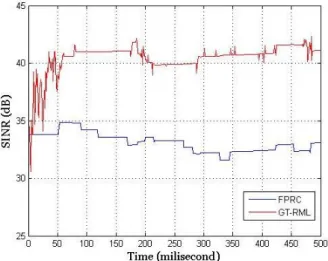
The convergence of utility (SINR) during the first 500 ms of simulation using 100 vehicles is shown in Fig. 2. The proposed method is channel and power selection using Game
Theory and Regret Matching Learning (GT-RML). For reference of performance evaluation, fixed power and random channel selection (FPRC) scheme is performed concurrently. At the early time of simulation, the SINR of GT-RML fluctuates very much. It implies that the vehicles perform several strategy trials based on the initial probability value at the beginning of simulation. Then, after several trials, some vehicles find the proper strategy that can provide the targeted utility. Thus fewer vehicles change the strategy and the SINR value becomes steadier. However, as mentioned before, the real convergence point cannot be reached since the network condition changes frequently. The most frequent change is the vehicle position which is updated every 1 ms and the less frequent is the fading in channel gain which is regenerated every 1 s. Therefore, even FPRC scheme does not show the constant value but has small fluctuation.
Figure 2. Convergence of SINR at beginning of simulation
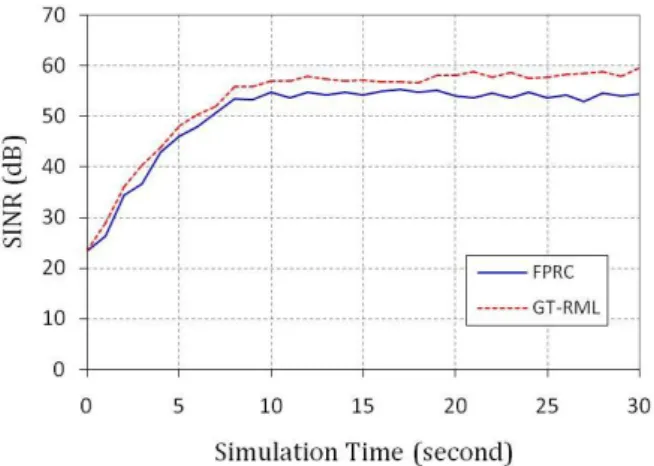
Figure 3. Average of vehicle SINR in simulation using 100 vehicles
throughput of vehicle as in (6) is proportional to SINR. The result of simulation using 100 vehicles related with the vehicles throughput is presented in Fig. 6. Based on the CDF graph in Fig. 6, GT-RML can obtain the better throughput than FPRC scheme.
Figure 4. Average of vehicle SINR in simulation using 150 vehicles
Figure 5. Average of vehicle SINR in simulation using 200 vehicles
Figure 6. CDF of vehicle througput from simulation using 100 vehicles
6.
Conclusions
In this paper, channel and transmission power level selection in VANET are modeled as strategic game. Each vehicle in the network represents the player and the combination of
channel and power level selection represents the strategy that will be selected and used by the player. Strategy selection is aimed to obtain the higher utility i.e. the SINR of vehicle. To achieve the higher utility, Regret Matching Learning (RML) is proposed for strategy selection. RML in this paper is modified to be more feasible with the real environment of VANET. The proposed game model with RML (GT-RML) can select channel and power level distributive for each vehicle using the previous experience. Based on the simulation result the proposed GT-RML can achieve better SINR and throughput compared to the conventional scheme.
7.
Acknowledgement
This research was funded and supported by Ministry of Research, Technology, and Higher Education, Indonesia under the PUPT grant (751/UN1-P.III/LT/DIT-LIT/2016) year of 2016-2019.
References
[1] T. Sukuvaara, K. Mäenpää, R. Ylitalo, H. Konttaniemi, J. Petäjäjärvi, J. Veskoniemi, and M. Autioniemi, “Vehicular Networking Road Weather Information System Tailored for Arctic Winter Conditions,” International Journal of Communication Networks and Information Security (IJCNIS), vol. 7, no. 1, pp. 60–68, 2015.
[2] H. Hartenstein and K. P. Laberteaux, “A Tutorial Survey on Vehicular Ad Hoc Networks,” IEEE Communications Magazine, vol. 46, no. 6, pp. 164–171, 2008.
[3] G. Karagiannis, O. Altintas, E. Ekici, G. Heijenk, B. Jarupan, K. Lin, and T. Weil, “Vehicular Networking : A Survey and Tutorial on Requirements, Architectures, Challenges, Standards and Solutions,” IEEE Communications Surveys and Tutorials, vol. 13, no. 4, pp. 584–616, 2011.
[4] A. Ram and M. K. Mishra, “Mobility Adaptive Density Connected Clustering Approach in Vehicular Ad Hoc Networks,” International Journal of Communication Networks and Information Security (IJCNIS), vol. 9, no. 2, pp. 222–229, 2017.
[5] N. Cheng, N. Lu, K. Liu, X. Wang, and F. Liu, “A Prioritized Resource Scheduling Scheme for Throughput-sensitive Applications in VANET,” 2010 6th International Conference on Wireless Communications Networking and Mobile Computing (WiCOM), pp. 1–4, 2010.
[6] P. Fazio, F. De Rango, C. Sottile, C. Calafate, and U. P. De Valencia, “A New Channel Assignment Scheme for Interference-Aware Routing in Vehicular Networks,” 2011 IEEE 73rd Vehicular Technology Conference (VTC Spring), pp. 1–5, 2011.
[7] R. S. Tomar and S. Verma, “RSU Centric Channel Allocation in Vehicular Ad-Hoc Networks,” 2010 Sixth International conference on Wireless Communication and Sensor Networks, pp. 1–6, 2010.
[8] V. Saritha and V. M. Viswanatham, “Approach for channel reservation and allocation to improve quality of service in vehicular communications,” IET Networks, vol. 3, no. 2, pp. 150–159, 2014.
[9] J. Wang, Y. Ji, X. Wang, and F. Liu, “RSU-coordinated Multi-channel MAC with Multi-criteria Channel Allocation,” 2012 International Conference on Connected Vehicles and Expo (ICCVE), pp. 60–65, 2012.
[10] Y. Yao, K. Zhang, and X. Zhou, “A Flexible Multi-Channel Coordination MAC Protocol for Vehicular Ad Hoc Networks,” IEEE Communications Letters, vol. 21, no. 6, pp. 1305–1308, 2017.
[12] S. M. Kamruzzaman, X. Fernando, and M. Jaseemuddin, “Energy Aware Multipath Routing Protocol for Cognitive Radio Ad Hoc Networks,” International Journal of Communication Networks and Information Security (IJCNIS), vol. 8, no. 3, pp. 187–196, 2016.
[13] C. Chigan and J. Li, “A Delay-Bounded Dynamic Interactive Power Control Algorithm for VANETs,” 2007 IEEE International Conference on Communications, pp. 5849– 5855, 2007.
[14] D. B. Rawat, D. C. Popescu, G. Yan, and S. Olariu, “Enhancing VANET Performance by Joint Adaptation of Transmission Power and Contention Window Size,” IEEE Transaction on Parallel and Distributed Systems, vol. 22, no. 9, pp. 1528–1535, 2011.
[15] P. Haghani and Y. Hu, “Power Control for Fair Dynamic Channel Reservation in VANETs,” 2012 9th Annual IEEE Communications Society Conference on Sensor, Mesh and Ad Hoc Communications and Networks (SECON), pp. 659– 667, 2012.
[16] J. Tian and C. Lv, “Connectivity Based Transmit Power Control in VANET,” 2012 8th International Wireless Communications and Mobile Computing Conference (IWCMC), pp. 505–509, 2012.
[17] Y. Yuan, B. Li, and Z. Yan, “A Cooperative Channel Reservation MAC Protocol with Adaptive Power Control and Carrier Sensing,” 2012 International Conference on Connected Vehicles and Expo (ICCVE), pp. 114–119, 2012. [18] C. Wang and G.-J. Yu, “Power Control and Channel
Assignment Mechanisms for Cluster-based Multichannel Vehicular Ad-hoc Networks,” 2013 12th IEEE International Conference on Trust, Security and Privacy in Computing and Communications, pp. 1762–1767, 2013.
[19] L. Zhang, Y. Cui, B. Jin, and K. Li, “Ostrich : An Optimistic Distributed Power Control Scheme for VANETs,” 2014 IEEE Wireless Communications and Networking Conference (WCNC), pp. 2184–2189, 2014.
[20] B. Kim, H. Song, and H. S. Lee, “Bi-Beacon : Two-Level Power Control for Enhancing Beacon Performance in Vehicular Ad Hoc Networks,” 2014 International Conference on Connected Vehicles and Expo (ICCVE), pp. 1000–1001, 2014.
[21] S. Oulaourf, A. Haidine, A. Aqqal, and H. Ouahmane, “Review on Radio Resource Allocation Optimization in LTE / LTE-Advanced using Game Theory,” International Journal of Communication Networks and Information Security (IJCNIS), vol. 9, no. 1, pp. 117–156, 2017.
[22] F. Goudarzi and H. S. Al-Raweshidy, “Distributed Transmit Power Control for Beacons in VANET,” Proceedings of the 3rd International Conference on Vehicle Technology and Intelligent Transport Systems (VEHITS 2017), pp. 181–187, 2017.
[23] A. Dua, N. Kumar, and S. Bawa, “Game theoretic approach for real-time data dissemination and offloading in vehicular ad hoc networks,” Journal of Real-Time Image Processing, vol. 13, no. 3, pp. 627–644, 2017.
[24] J. Tao, Z. Zhang, F. Feng, J. He, and Y. Xu, “Non-cooperative Resource Allocation Scheme for Data Access in VANET Cloud Environment,” 2015 Third International Conference on Advanced Cloud and Big Data, pp. 190–196, 2015.
[25] O. Yu and E. Saric, “Feedback-Free Non-Cooperative Power Control Game for Vehicular Ad Hoc Networks,” 2014 IEEE 80th Vehicular Technology Conference (VTC2014-Fall), pp. 1–5, 2014.
[26] D. B. Rawat, B. B. Bista, and G. Yan, “CoR-VANETs : Game Theoretic Approach for Channel and Rate Selection in Cognitive Radio VANETs,” 2012 Seventh International Conference on Broadband, Wireless Computing, Communication and Applications, pp. 94–99, 2012.
[27] G. Bacci, S. Lasaulce, W. Saad, and L. Sanguinetti, “Game Theory for Networks: A tutorial on game-theoretic tools for
emerging signal processing applications,” IEEE Signal Processing Magazine, vol. 33, no. 1, pp. 94–119, 2016. [28] P. Sroka and A. Kliks, “Distributed Interference Mitigation in
Two-Tier Wireless Networks Using Correlated Equilibrium and Regret-Matching Learning,” 2014 European Conference on Networks and Communications (EuCNC), pp. 1–5, 2014. [29] C. F. Mecklenbräuker, J. Karedal, A. Paier, T. Zemen, and N.
Czink, “Vehicular Channel Characterization and Its Implications for Wireless System Design and Performance,” Proceedings of the IEEE, vol. 99, no. 7, pp. 1189–1212, 2011. [30] H. Fernández, L. Rubio, V. M. Rodrigo-Peñarrocha, and J. Reig, “Path Loss Characterization for Vehicular Communications at 700 MHz and 5.9 GHz Under LOS and NLOS Conditions,” IEEE Antennas and Wireless Propagation Letters, vol. 13, pp. 931–934, 2014.