Performance Evaluation of LTE Random Access
Procedure under Distributed Location Data Mining
for Road Traffic Monitoring
Ruki Harwahyu, Misbahuddin, Riri Fitri Sari
Department of Electrical Engineering, Faculty of Engineering, Universitas Indonesia, Indonesia
Abstract: The widely-used cellular system, such as LTE, has a
large potential to serve vehicle-related connectivity which is one of the potential IoT market in the near future. However, the connection-oriented nature of LTE Random Access procedure remains the challenge. The RA procedure in LTE is prone to be overloaded with simultaneous access request from large number of mobile users. This overload condition is likely to happen due to synchronized location reporting for road traffic monitoring in Intelligent Transportation System (ITS). This work studies the performance of RA procedure under overload condition in term of probability of successful report delivery and average report delivery delay. Subsequently, two proposals are made to increase the performance: report time spreading and truncated binary exponential decrease backoff mechanism. The two proposals are evaluated and compared with the existing configuration of LTE RA procedure. Our simulation results show that both proposals can increase the probability of successful report delivery and obtain fairly low average report delivery delay, which is necessary for accurate location reporting and road traffic monitoring system.
Keywords: Random Access, LTE, 4G, RACH, Backoff, Location
service
1.
Introduction
In developing countries, transportation in big cities often becomes an urgent problem which needs to be solved. Unreliable and uncomfortable public transportation triggers more private vehicles usage which increases road density and pollution. Intelligent Transportation System (ITS) is one of the technologies to promote a more reliable and sustainable transportation infrastructure. It deals with transportation problem such as road traffic monitoring.
Many losses happen in road congestion. For the commuters, their time is wasted for such idling activity twice a day (i.e. go to and back from work) and usually it is hard to be productive during the traffic jam. Stress accumulation and other psychological problems can emerge as well. Furthermore, in dense traffic, a fossil-fuelled engine cannot reach their efficient state in comparison with the distance. The emission produces pollution which is undeniably dangerous for human and environment.
Road traffic monitoring is conducted to provide real-time vehicle density information on the roads. The information is expected to be used for road traffic engineering by the authority, statistics for transportation infrastructure development and city space planning, or simply just for navigation for the commuters.
Recently the wireless market is globally evolving to 4G LTE [1]. Although some prominent options for 5G are already discussed, it will be standardized in 2020. In 4G cellular network, location information is essential for wide variety of applications. For telecommunication operators, it has become
one of the valuable capabilities to monetize their network resource. Backed with a widely-deployed infrastructure of cellular network, LTE is considered as a promising technology to support ITS market [2] compared to the other alternative technologies such as IEEE 802.11p [3], and may replace 3G networks which sometimes serves as the support for IEEE 802.11p [4]. In term of coverage and infrastructure, with addition for IoT services in Release 13 [5], it is also superior than other wireless sensor networks such as ZigBee, WiFi, Bluetooth, and UWB [6].
Communication entities in ITS such as the connected vehicles (referred as “vehicles” herein since all vehicles are assumed to be connected) and the Road-Side Units (RSUs) can be regarded as machines as they work without or with less human intervention. In LTE, its generated data traffics can be considered as machine-type communication (MTC). Since LTE network is used mainly for human-to-human services and may also be used for other MTC services, the communication resource for ITS service is normally limited. LTE uses Random Access (RA) procedure to allocate the communication resource toward the mobile users. It has been used up to LTE release 13, and potentially no major change until LTE release 15 which is scheduled to be completed at September 2018. Due to the limited availability of the resource, there is an overload condition when the number of contended resource is much lower than number of mobile users demanding the resource. RA procedure is the first step which is impacted by this overload condition. It decides which mobile users to grant the resource by means of contention. This condition degrades the performance of the system and decreases the resource utilization. Additionally, it may also disturb neighboring cells [7].
Driven by the aforementioned drawbacks, this work studies the performance of the RA aspect of LTE network which is impacted by the road traffic monitoring service in ITS environment. Subsequently, this work presents two solutions. Firstly, a method to spread the location reporting time to limit the load in RA procedure is proposed. Secondly, an exponential-decrease backoff algorithm is also proposed. The proposed methods are then evaluated by computer simulation.
The problem arises when the road traffic is congested, causing large number of vehicle stays within a cell. Due to limited resource, the performance of RA procedure is compromised, leading to compromised performance of road traffic monitoring service.
This work evaluates the effect of traffic congestion to the probability of successful report delivery and average report delivery delay, and proposes the best method to minimize collision. The rest of this paper is organized as follow. Section 2 briefly introduces LTE RA procedure and provides quick overview of existing works on alleviating RA procedure in overload condition. Section 3 discusses the positioning mechanisms assumed in this work and the proposal of spreading the report time. Section 4 shows the evaluation result and its discussion. Section 5 presents the conclusion.
2.
LTE’s RA Procedure and Location Service
2.1 Random Access (RA) Procedure in LTE
The RA Procedure is one of the initial signaling steps in LTE network. RA procedure is important for two reasons: (a) to achieve uplink (UL) synchronization between mobile user and base station and (b) to obtain the resource for RRC Connection Request. In downlink, synchronization is achieved by special signal which is always broadcasted periodically. However in uplink, the same approach is not efficient since the communication may be initiated by particular mobile user. In this case, the synchronization is conducted only by this single mobile user, not involving the others, and as necessary, not all the time.
LTE provides contention-based and contention-free RA procedure. The contention-based RA Procedure is performed for initial access from RRC_IDLE, RRC Connection Re-establishment, and upon uplink data arrival during RRC_CONNECTED. The contention-free RA procedure is performed upon handover, downlink data arrival, and positioning and obtaining timing advance alignment [9]. This work focuses on contention-based RA procedure since the location reporting is assumed to be done in uplink from RRC_IDLE mode.
The contention-based RA procedures consist of 4 hand-shake steps. The first step is RA preamble transmission, which is transmitted by mobile station toward the base station. RA preamble is transmitted a special time slot which is referred as RA opportunity (RAO) herein. In each RAO, base station provides a number of preambles. Each contending mobile station must randomly choose and transmit one of the preambles. Collision happens when more than one mobile station transmit the same preamble at the same RAO. This collision is detected at the later steps by the involved mobile stations.
The second step is RA Response (RAR) transmission, which is broadcasted by base station at a specified time after the RAO. Mobile stations search for its preamble ID at the broadcasted RAR. If the preamble ID is found, it moves to the next step. If the preamble ID is not found, it checks its preamble transmission counter. If the counter has reached the preamble transmission limit, it declares a failed access and cannot send the current data. If the counter is still below the limit, it conducts a uniform backoff and retransmit preamble at the immediate RAO after backoff. The ID of transmitted preamble may not be included in RAR due to undetected or
too low preamble transmission power, or due to limitation of RAR payload.
The third step is the transmission of RRC connection request (or referred as Msg3). Msg3 from each mobile station is transmitted in an uplink resource which is specified in RAR for each preamble ID. When more than one mobile station transmit the same preamble ID in an RAO and get acknowledged in RAR, these mobile stations transmit their Msg3 at the same resource and collide. Collided Msg3 will not be ACK-ed and the colliding mobile stations realize the collision after a timeout. They will retransmit the preamble if the preamble transmission limit has not been exceeded, or declare a failed access otherwise. Mobile stations which receive ACK for its Msg3 proceeds to the next step.
The last step is the transmission of RRC connection establishment (or referred as Msg4) from base station to each ACK-ed mobile station. This step is pretty straight forward and has very low failed probability since it uses dedicated resource that has been allocated for Msg3.
2.2 Location Service in LTE
According to TS 36.305 [10], location service methods applicable for LTE comprises (i) cell coverage based positioning methods, (ii) Assisted Global Navigation Satellite System (A-GNSS) based positioning methods, (iii) Downlink Observed Time Difference Of Arrival (OTDOA), and (iv) Uplink-Time Difference of Arrival (UTDOA). LTE also support the usage of single or hybrid implementation of the above methods.
Cell coverage based positioning method uses cell ID and enhanced cell ID. Cell ID (CID)-based method estimates mobile station’s position with the knowledge of geographical coordinates of its serving base station. Enhanced Cell ID (E-CID) positioning uses additional radio-related measurements to improve the estimation. It has small impact to the mobile station and the network, works both outdoor and indoor, supports near real-time operation and has small network traffic overhead. However the 50-1000 m accuracy achieved by this method is very low.
Assisted Global Navigation Satellite System (A-GNSS)-based positioning method uses satellite navigation systems that provide autonomous geo-spatial positioning with global or regional coverage. GNSS includes GPS, Galileo, GLONASS, WAAS, EGNOS, MSAS, and GAGAN, Quasi-Zenith Satellite System (QZSS), and BeiDou Navigation Satellite System (BDS). A-GNSS methods rely on signaling between mobile station’s GNSS receivers and a continuously operating GNSS reference receiver network, which has clear sky visibility of the same GNSS constellation as the assisted mobile stations. This method has high accuracy of 5-20 m while having no impact to the network and small impact to the mobile station to process the received data. However the receiver may consumes high power and can only work properly with at least 4 satellites within a line of sight (outdoor and wide sky view).
around 50-300 m with acceptable support indoor. The operation may be mobile-station dependent and needs to be triggered by the network.
Uplink time difference-of-arrival (UTDOA) estimates mobile station’s position based on timing measurements of uplink radio signals taken at different Location Measurement Units (LMUs) which can resides in one or more base station, along with knowledge of the geographical coordinates of the LMUs. The time required for a signal transmitted by a mobile station to reach a LMU is proportional to the length of its transmission path to the LMU. A set of LMUs is tasked to sample the mobile station’s signal at the same time. This method has no impact to mobile station but places large impact to the base stations. The accuracy is 50-300 m and indoor support is acceptable. The operation is fully defined in the network [1] [10].
3.
Related Works
To the best of our knowledge, not many works study the performance of LTE network to support vehicular services, especially for the overloaded access caused by ITS location-based application. Nonetheless, several overload control mechanisms has been presented. The prominent mechanisms and are summarized in 3GPP specification [11].
The first mechanism is called access class barring (ACB), which divides mobile users into several groups. Each group is denoted as a separated access barring class. Upon synchronization, base station broadcast a barring factor to each class. This factor defines the probability of the mobile user to initiate the RA procedure. When a mobile user has an uplink data to be transmitted, it waits until the access period, and draws a random number. If this number is less or equal to the barring factor, it may initiate the RA procedure. Otherwise, it has to wait until the next access period and draws a new random number. Hence, ACB can decrease number of users who conduct RA procedure at the same time. Additionally, it may also prioritize one or more access classes by assigning higher barring factor compared to the other access classes. However, this may lead to unbounded access delay.
Separating RA preamble pool is also proposed to control the load of RA procedure. It works by separating mobile users into classes and assign different preamble pool to each class. Base station can allocate different number of preamble in each pool. With this method, each access class has independent collision domain and will not affect each other’s performance. One or more classes can also be prioritized by allocating more preambles for them. The improvement with dynamic preamble pool allocation has also been studied [12], which dynamically adjust the number of preamble for a class based on their estimated number of accessing mobile users. However, the total number of preamble in the system is limited. Hence, dividing them into groups means each group may have even smaller number of preamble.
Group paging is also proposed to alleviate the overload access in LTE RA procedure. Group paging triggers different group of mobile users in different time, which noticeably decreases the load of RA procedure for a group [13]. However, longer access delay is expected when there are more groups within the cell. An improvement of group paging called consecutive paging is proposed in [14]. Consecutive paging can increase the access success probability for a group even with limited number of
preamble. This is done by allowing failed mobile users to retry their RA procedure in the subsequent paging occasion which has less contending users, i.e. higher chance to be successful. However, it increases the access delay to be even longer than the original group paging.
Another improvement of group paging with pre-backoff is proposed in [15]. Pre-backoff enforces backoff for the first attempt which happens at the first access immediately after the group paging message is received. By distributing the users in wider time interval it aims to decrease the contention severity in each access period. Although it may increase the throughput of the RA procedure, this method also introduces additional delay.
4.
Proposed Model
This work studies the performance of an LTE cell which is flooded by M number of vehicles conducting RA procedure to send its location report for road traffic monitoring system. As discussed previously, this study is important since LTE is a promising technology to support vehicular services, but its RA procedure may act as a bottleneck in overload condition. Hence, this work only focuses on very high load condition, which is represented by massive access of mobile users running a location reporting application. In the later part of this section, two proposed methods are presented, which has simpler approach than those of existing methods to achieve higher access success probability and acceptable access delay.
A congested road with slow vehicle movement is assumed such that the reporting frequency is made lower. This long-enough time intervals between reports keep the mobile station in idle state. Hence, each vehicle needs to conduct the contention-based RA procedure to be able to report its location. Subsequently, the access requests are observed as a one-shot arrival system.
The location information is assumed to be obtained via hybrid implementation of the method discussed in Section 2.B, and the data needs to be transmitted in U-plane once every T seconds. The implementation of hybrid method can achieve near real-time operation and accurate location estimation. Notice that the congested road increases the number of the reporting vehicles and subsequently increases the load of RA procedure.
The base station provides R preambles in each RAO. Preamble transmission can be conducted up to NPTmax times.
Backoff indicator which defines the backoff window to be used for each retransmission is set to B.
Figure 1. Comparison of group paging (a), consecutive group paging (b) and report-time spreading (c)
The first proposal in this paper is to implement report-time spreading to spread the location reporting time. A comparison of this method with group paging [13] and consecutive group paging [14] is illustrated in Figure 1. In one-shot arrival system, all reporting mobile users generate its report simultaneously due to a synchronized timer. Hence, each mobile user starts its preamble transmission at the same time. With limited number of available preamble, there are a lot of collision happens. With our first proposed mechanism, the reporting time of each mobile user is randomized. When the reporting timer occurs, each mobile user does not directly start the RA procedure. Instead, it chooses a random number between 0 and W. An additional timer is then set to the chosen number. When this timer reaches zero, the mobile user starts its RA procedure.
The second proposal in this paper is to implement exponential-decrease backoff window. Backoff is conducted each time the mobile user’s preamble transmission is failed. With a synchronized arrival, the contentions in the earlier attempts are heavier. Hence, it is more reasonable to implement larger backoff window in early retransmission attempts then decrease it at the next attempt, since at the later attempts, the number of contending mobile users tends to decrease.
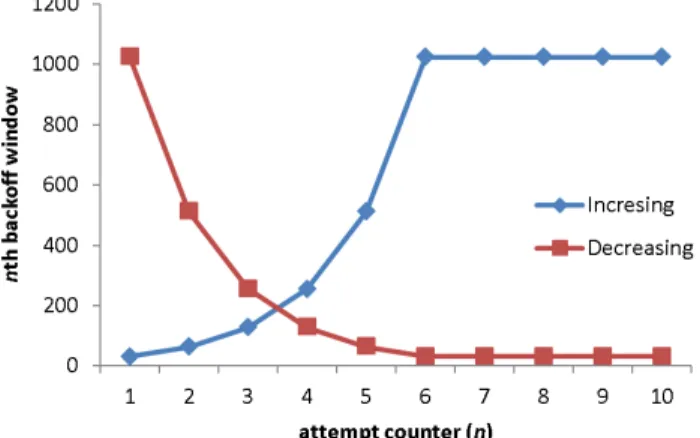
To be precise, the second proposal is to implement a truncated binary exponential decreasing backoff. It is binary since the decreasing factor is of power of 2. It is truncated since the decrease shall be stopped at the minimum backoff window value. In the default LTE RA procedure, the backoff window takes a constant value of B in every transmission attempt. In this mechanism, the backoff window for nth transmission attempt, Bn, must be calculated as
max max in mi
2 2 m n
, if
2 2
, otherwise. n n
n
B B
B B
B
− −
≥
=
(1)
where Bmin and Bmax denote the minimum and maximum
backoff window. Notice that the backoff is firstly conducted for the 2nd transmission attempt, since the first transmission attempt is not a retransmission. The comparison of backoff window for each retransmission between conventional truncated binary exponential backoff (blue) and our proposed truncated binary exponential-decrease backoff (red) is shown in Figure 2.
Figure 2. Comparison of conventional exponential backoff (blue) and our proposed exponential-decrease backoff (red)
5.
Evaluation and Result
A custom-made event-triggered computer simulation is conducted to evaluate the system with and without the proposed distributed-time reporting. The evaluation is conducted under various number of vehicles. The preamble collision probability (PC), probability of successful report
delivery (PS), average report delivery delay (D), and resource
utilization (U) are assessed. PC is evaluated as number of
collided preamble divided by total number of preamble allocated during access interval. PS is calculated as the
number of vehicles which can successfully finish the RA procedure and obtain the uplink resource divided by the total number of vehicles. D is calculated as the sum of RA delay for the vehicle who successfully obtains uplink resource divided by the number of vehicles which can successfully finish the RA procedure and obtain the uplink resource. U is calculated as the ratio between number of successful user and total number of resource allocated during the access interval.
The two methods proposed in this paper are evaluated separately. Firstly, report-time spreading is evaluated. Secondly, the exponential decrease backoff mechanism is evaluated.
5.1. Report-Time Spreading
Table 1. Values used for this simulation
Symbol Meaning Value(s)
M Number of vehicles 50, 100,… 500
R
Number of preambles per RAO for road traffic monitoring service
15
NPTmax Preamble transmission limit 10
B Backoff window 20 ms
W Spreading window for the
proposed method
0, 25, 50, 100 ms
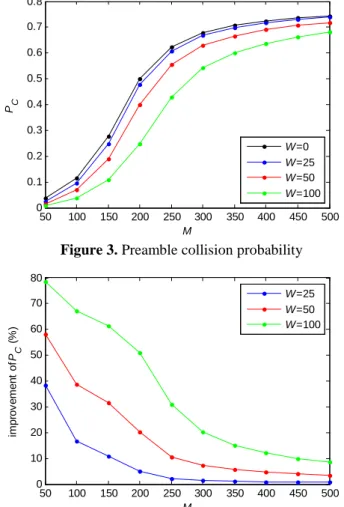
The result of the preamble collision probability, PC, is shown
in Figure 3. This figure clearly demonstrates that higher M triggers higher PC, which happens for all cases. Meanwhile,
increasing the size of spreading window decreases the PC.
This implies that when the reporting time is spread, the contention severity of RA procedure can be lowered.
Additionally, Figure 4 is provided to show the reduction of PC obtained by the three cases with non-zero spreading
window compared to the baseline. In this figure, we can observe that the ability of the system with larger W to decrease collision is gradually reduced when M grows to the larger value. In this case, to further reduce the collision, larger W is required.
Figure 3. Preamble collision probability
Figure 4. Reduction of preamble collision probability
The result of the probability of successful report delivery, PS,
is shown in Figure 5. This figure clearly demonstrates that higher M triggers lower PS. This applies for all cases.
Meanwhile, increasing the size of spreading window may increase the PS in higher M. This implies that when the
reporting time is spread, the contention severity of RA procedure can be lowered, and thus increases the number of vehicles which can successfully obtain an uplink resource for location report delivery.
Additionally, Figure 6 is provided to show the improvement obtained by the three cases compared to the baseline. In this figure, we can observe that even when W = 100 ms, the improvement eventually decreases as M grows, which can be found when M > 350. This denotes that the spreading of reporting time is not enough to completely overcome the overload problem.
Figure 5. Probability of the successful report delivery
Figure 6. Improvement of the probability of successful report delivery
The improvement of PS by the report-time spreading may,
theoretically, come with the cost of increasing the report delay, D. Figure 7 shows the result of D. From this figure, we can observe that for all evaluated M values, the delay difference is not significant among the four cases, except for the smaller M, such as M = 50 and 100 where the case with W = 100 obtain the highest delay compared to the other three cases.
In smaller value of M, the load on RA procedure is not too high. This is shown in Figure 5 that in smaller value of M, e.g. M = 50 and 100, the baseline case can obtain PS of
100%. Hence, the proposed distributed-time reporting is actually not required and when implemented, it adds unnecessary delay.
In larger value of M, the load on RA procedure is higher. Hence, the proposed distributed-time reporting can decrease the load of RA and increases the PS. However, some vehicles
with delayed report caused the average delay to become slightly higher.
As an addition, Figure 8 is provided to show the delay reduction obtained by the three cases with non-zero spreading window compared to the baseline (the case with zero spreading window). In Figure 8, we can observe that spreading the report time when the number of report is not too high is contra-productive as it will add unnecessary delay. Meanwhile, spreading the report time when the number of report is high is beneficial as it increases the PS,
although it cannot really decreases the D. 50 100 150 200 250 300 350 400 450 500
0 0.1 0.2 0.3 0.4 0.5 0.6 0.7 0.8
M
PC
W=0 W=25 W=50 W=100
50 100 150 200 250 300 350 400 450 500 0
10 20 30 40 50 60 70 80
M
im
p
ro
v
e
m
e
n
t
o
f P
C
(
%
)
W=25 W=50 W=100
50 100 150 200 250 300 350 400 450 500
0 0.2 0.4 0.6 0.8 1
M
PS
W=0 W=25 W=50
W=100
50 100 150 200 250 300 350 400 450 500
0 20 40 60 80 100 120 140
M
im
p
ro
v
e
m
e
n
t
o
f
o
f P
S
(
%
)
Figure 7. Average report delivery delay
Figure 8. Improvement of the average report delivery delay
The delay may impact the location reporting system as the location of the vehicles is changing over time. Hence, a value of spreading window should be tested (e.g. simulated) to know the maximum delay it obtains. Assuming the maximum ground speed of the vehicle is V and the target accuracy if the traffic monitoring system is A, the following constrain should be satisfied:
+ + < (2)
where T denotes the interval between each location report. With the proposed distributed-time reporting, the report is sent from each vehicle not exactly once every T seconds, since it may be delayed up to W seconds. With additional delay of RA procedure of D, all components of the delay must not exceed the time required by the vehicle to travel further than the targeted accuracy of the system.
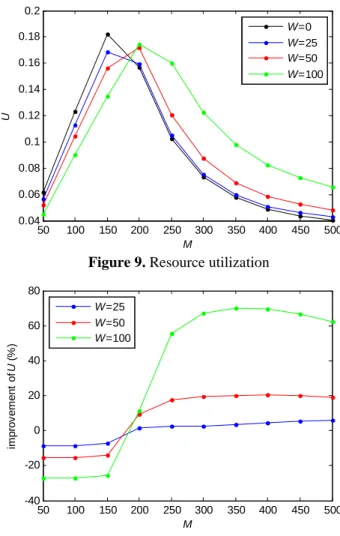
The result of resource utilization, U, is shown in Figure 9. Notice that higher resource utilization indicates better resource efficiency, i.e. more successful user can be achieved with less resource. As seen from this figure, when 50 ≤ M ≤
150, cases with smaller W achieve higher U. However, this condition immediately reversed when M > 150. In these range, cases with higher W achieve higher U.
Additionally, Figure 10 is provided to show the improvement obtained by the three cases compared to the baseline. In this figure, cases with W > 0 obtain negative improvement when 50 ≤ M ≤ 150 since they are worse than the baseline. As M increases to become larger than 150, the higher W the higher improvement it obtains.
Figure 9. Resource utilization
Figure 10. Improvement of resource utilization
5.2. Exponential-decrease Backoff
To evaluate the system with our proposed truncated binary exponential-decrease backoff mechanism, we simulate four cases with different backoff mechanism. The first case is our proposed backoff mechanism with Bmin = 8 ms and Bmax =
128 ms. In the result figures, this case is depicted with black line. The second case is a conventional truncated binary exponential increase backoff mechanism with Bmin = 8 ms
and Bmax = 128 ms. This case is depicted with blue line in the
result figures. The third case is a uniform backoff mechanism with constant backoff window B = 8 ms, which is depicted with red line in result figures. The fourth case is also a uniform backoff mechanism but with backoff window B = 64 ms. The four cases are summarized in Table 2.
Table 2. Cases compared in this simulation
Case Bmin Bmax B
Proposed 8 ms 128 ms -
Exponential increase 8 ms 128 ms -
Uniform - - 8 ms
Uniform - - 64 ms
To be able to observe the effect of the settings, the cases are evaluated under M of 100, 200,… 1000. Similar to the evaluation in Section 4.1, the RA procedure parameters defined in Table 6.2.2.1.1 in 3GPP TR 37.868 [11] and processing latency specified in Table B.1.1.1-1 in 3GPP TR 36.912 [16] are used. Due to space limitation, the simulation result of this proposed method only shows result of preamble collision probability, probability of successful report deliver, average report delivery delay, and resource utilization.
50 100 150 200 250 300 350 400 450 500
50 100 150 200 250
M
D
(
m
s
)
W=0
W=25 W=50 W=100
50 100 150 200 250 300 350 400 450 500
-60 -50 -40 -30 -20 -10 0 10
M
R
e
d
u
c
ti
o
n
o
f
D
(
%
)
W=25 W=50 W=100
50 100 150 200 250 300 350 400 450 500
0.04 0.06 0.08 0.1 0.12 0.14 0.16 0.18 0.2
M
U
W=0 W=25 W=50 W=100
50 100 150 200 250 300 350 400 450 500
-40 -20 0 20 40 60 80
M
im
p
ro
v
e
m
e
n
t
o
f U
(
%
)
Meanwhile, reduction of preamble collision probability, improvement of probability of successful report delivery, improvement of the average report delivery delay, and improvement of resource utilization are not shown.
The result for preamble collision probability, PC, is shown in
Figure 11. This figure demonstrates that in general higher M triggers higher PC, which happens for all cases. Meanwhile,
case with uniform backoff with B = 8ms obtains the higher PC since the collision in each RAO is not really resolved and
is propagated to the next RAOs. In this condition, a lot of mobile users which contend and collide at an RAO choose the same backoff timer, causing them to contend again in the same RAO. Hence, the preambles in each RAO are mostly wasted for collision. Case with uniform backoff with B = 64ms obtains low PC since collided mobile users have more
choice for their retransmission time. Hence, in the next RAOs, number of collided user is gradually decreased, leading to low PC. Case with exponential increase backoff
yields the lowest PC since the backoff window eventually
grows until a number which is good enough to spread the retransmission time from the collided mobile users. Meanwhile, our proposed backoff algorithm yields intermediate PC. It means that with our proposed backoff
algorithm, the contention severity is not as high as the case with uniform backoff and B = 8ms, and not as low as the case with exponential backoff. Indeed, this proposal aims to achieve adequate successful rate with reasonable delay, which can be shown in the subsequent figures.
Figure 11. Preamble collision probability
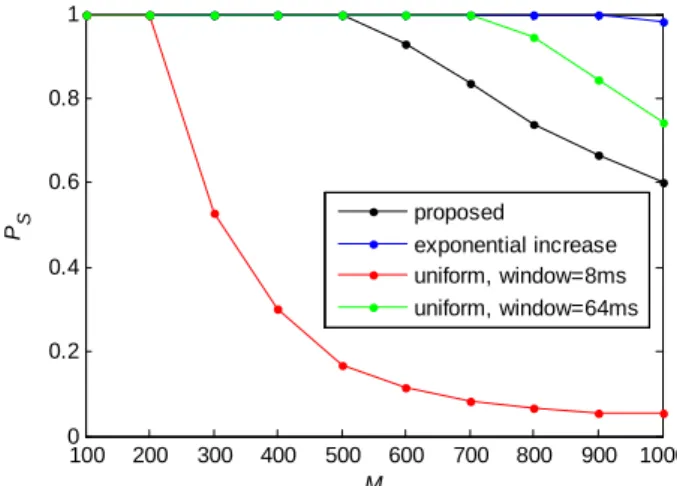
The result for probability of successful report delivery, PS, is
shown in Figure 12. From this figure, we learn that our proposed backoff mechanism do yields higher PS than the
third case, i.e the case of uniform backoff with B = 8 ms. However, the proposed backoff mechanism does not yields higher PS compared to the exponential-increase backoff
mechanism and the uniform backoff window with B = 64 ms. In our proposed backoff mechanism, the backoff window in the next retrial is smaller or equal than the previous backoff window. This setting is optimum when the trend of the collision is decreasing, which is commonly happens in synchronized access applications. In fact, its performance can be improved by allocating higher Bmin or Bmax.
Figure 12. Probability of successful report delivery
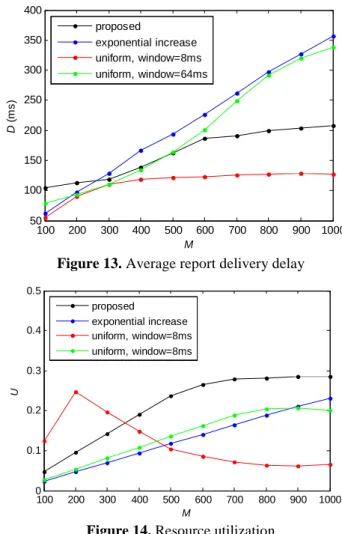
The result for the average report delivery delay, D, is shown in Figure 13. In this figure, case with uniform backoff with B = 8ms yields the lowest D. This is due to its small backoff window, which is clearly not enough to spread the retransmission time of the collided mobile users. Cases with exponential increase backoff and uniform backoff with B = 64ms has higher D in higher M. It clearly indicates that in general the backoff window used to spread the retransmission time is larger.
Remember that the severity of contention during preamble transmission is affected by number of mobile users which transmit preamble at an RAO and the number of available preamble in that RAO. Since the number of mobile users which needs to finish RA procedure and the number of available preamble is fixed, the approach taken by our proposed backoff mechanisms is to decrease the number of mobile users which transmit preamble in an RAO. Backoff mechanisms limit the number of transmitting mobile users in an RAO and delay some of the mobile users to the later RAOs. Hence, the larger the backoff window, the more mobile users are delayed. It decreases the contention in an RAO, but it also increase the average delay.
Our porposed backoff mechanism does not obtain the best result in term of PS since it also aims to yield lower D. As
can be seen in Fig. 6, our proposed backoff mechanism yields lower D in higher M compared to the second and the fourth cases, i.e. the cases that obtain higher PS in Fig. 5.
Hence, our proposal can be used to obtain reasonably higher PS with reasonably short D. Furthermore, the setting of Bmin
and Bmax can also be tuned even further to obtain the
expected values of PS and D for the required accuracy of the
location reporting service.
The result for the resource utilization, U, is shown in Figure 14. In this figure, we can observe that our proposed backoff algorithm obtain the best resource utilization in higher M, i.e when M > 300. This wraps up the above elaboration of why our proposed backoff algorithm does not obtain the best result in Figures 11, 12 and 13. This shows that allocating smaller backoff window for the next retrial is better to conserve resource but still achieving moderate PS and with
acceptable delay. 100 200 300 400 500 600 700 800 900 1000
0 0.2 0.4 0.6 0.8 1
M
PC
proposed
exponential increase uniform, window=8ms uniform, window=64ms
100 200 300 400 500 600 700 800 900 1000
0 0.2 0.4 0.6 0.8 1
M
PS
proposed
Figure 13. Average report delivery delay
100 200 300 400 500 600 700 800 900 1000 0
0.1 0.2 0.3 0.4 0.5
M
U
proposed
exponential increase uniform, window=8ms uniform, window=8ms
Figure 14. Resource utilization
6.
Conclusion
This work studies the performance of LTE RA procedure in serving location reporting for road traffic monitoring service. Abundant access request which is generated by the connected vehicles during heavy road congestion may overload the RA procedure and greatly decrease the performance of the network. The proposed distributed-time reporting can relieve the overloaded condition of RA procedure. When applied to an overloaded RA procedure, the larger the spreading window, the higher the probability of successful report delivery. Larger spreading window may also increase the report delay. When applied to RA procedure which is not overloaded, larger spreading window may cause unnecessary delay. A truncated binary exponential decrease delay mechanism is also proposed. The study shows that the proposed mechanism can yield reasonably higher probability of successful report delivery with reasonably lower average report delivery delay for larger number of mobile users. By combining the two proposals and setting them properly, operator can optimize their existing resource to support higher successful access rate and/or lower access delay according to the requirement of the location reporting application.
References
[1] S. Cherian, "A Premier on location Technologies in LTE Networks," Insight Nokia, insight.nokia.com/primer-location-technologies-lte-networks, 2012.
[2] Z. H. Mir, F. Filali, "LTE and IEEE 802.11p for vehicular networking: a performance evaluation," EURASIP Journal on
Wireless Communications and Networking, Wol. 2014, No. 89, pp. 1-15, 2014.
[3] G. Araniti et al, "LTE for vehicular networking: a survey," IEEE Communications Magazine, Vol. 51, No. 5, pp. 148-157, 2013.
[4] T. Sukuvaara et al, "Vehicular Networking Road Weather Information System Tailored for Arctic Winter Conditions," International Journal of Communication Networks and Information Security (IJCNIS), Vol. 7, Bo. 1, pp. 60-68, 2015.
[5] 3GPP TS 36.321, "Technical Specification Group Radio Access Network; Evolved Universal Terrestrial Radio Access (E-UTRA); Medium Access Control (MAC) protocol specification," v.13.2.0, June 2016.
[6] K. Ayub, V. Zagurskis, "Technology Implications of UWB on Wireless Sensor Network-A detailed Survey," International Journal of Communication Networks and Information Security (IJCNIS), Vol. 7, No. 3, pp. 147-161, 2015.
[7] A. Hameed, A. Oudah, "On The Impact of User Payload on Deployment Requirements of LTE Networks," WSEAS Transactions on Communications, Vol. 13, pp. 348-354, 2014.
[8] 3GPP TS 23.271, "Functional stage 2 description of Location Services (LCS)", v.13.0.0, September 2015.
[9] 3GPP TS 36.300, "Evolved Universal Terrestrial Radio Access (E-UTRA) and Evolved Universal Terrestrial Radio Access Network (E-UTRAN); Overall description; Stage 2," v.13.3.0, April 2016.
[10]3GPP TS 36.305, "Stage 2 functional specification of User Equipment (UE) positioning in E-UTRAN," v.13.0.0, Dec. 2015.
[11]3GPP TR 37.868, "RAN improvements for machine-type communication," v.11.0.0, Sep. 2011.
[12]F. M. Al-Taee et al, "A Dynamic Resource Allocation Scheme for Group Paging in LTE-Advanced Networks," IEEE Internet of Things Journal, Vol. 2, No. 5, 2015.
[13]C. H. Wei et al, "Performance analysis of group paging for machine-type communications in LTE networks," IEEE Transaction on Vehicular Technology, Vol 66, No. 7, pp. 3371-3382, 2013.
[14]R. Harwahyu et al, "Consecutive group paging for LTE networks supporting machine-type communications services," IEEE PIMRC, London, pp. 1619-1623, 2013. [15]R. Harwahyu et al, "Analysis of group paging with
pre-backoff," EURASIP Journal on Wireless Communications and Networking, Vol 2015, No. 1, pp. 1-9, 2015.
[16]3GPP TR 36.912, "Feasibility study for further advancements for E-UTRA (LTE-Advanced)," v.13.0.0, Jan. 2016.
100 200 300 400 500 600 700 800 900 1000
50 100 150 200 250 300 350 400
M
D
(
m
s
)
proposed