
The vertical distribution of marine macroplankton. XI. Further observations on diurnal changes
18
0
0
Full text
(2) 768. F. S. RUSSELL.. diagrams for the many species (Figs. 1 to 7, pp. 776 and 782) and as a Table setting out the complete catches of all organisms (Table I, pp. 783 and 784). COMPARISON OF RESULTS OF FOUR SERIES OF COLLECTIONS.. It is now possible to compare the results of the four series of collections and on pages 771 to 775 are given in summary form the types of behaviour shown by the mote important species on the four nights in question, namely July 15-16th, 1924, June 17-18th, and 18--19th, 1925, and June 3-4th, 1926. It must be realised that for most species we are dealing with a mixed population, composed of individuals of different ages and perhaps sexes; this point has been emphasised in a recent publication (4) in which the behaviour of Sagitta of different sizes is studied. It must also be borne in mind that, in the method of collecting, the catches from the different depths have not been made simultaneously (see 2, pp. 81 and 82). We cannot hope, therefore, to attempt to draw conclusions on the fundamental factors controlling the behaviour of the animals. The time has now come when a number of simultaneous collections must be made in rapid succession during the hours of changing light intensity at dusk and dawn, and attention must be given to the behaviour of each stage of development of the species caught. Nevertheless these four series of collections have given us a very good picture of how the larger plankton animals behave as a whole throughout the twenty-four hours in June and July in the waters off Plymouth. After a careful study of the available data it is evident that whatever be the physical and chemical conditions of the environment that control the behaviour of the animals and provide the necessary stimuli, there are two factors inherent in the animals themselves which are largely responsible for the type of distribution shown by any species during the night, namely :1. The depth at which the animal has been living during the previous daylight. 2. The speed at which the animal is capable of swimming upwards. In the report on the first night's ob'servations in 1924 (1, p. 779) the types of behaviour shown by the different species were grouped under the following four headings :1. Those that definitely migrated to the surface at night from the deeper layers in which they dwelt by day, showing a very large increase in numbers on the surface with a corresponding decrease in the deeper layers..
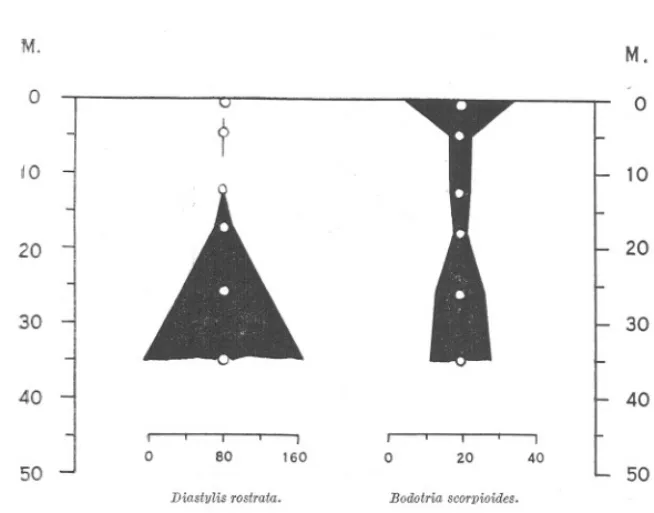
(3) VERTICAL. DISTRIBUTION. OF MACROPLANKTON.. 769. 2. Those that did not show a definite migration to the surface at night, but merely extended their distribution into the surface layers, which they avoided by day. In this case a diminution in numbers . was shown at the region of maximum intensity in the daytime, so that the distribution from surface to deeper layers was more or less uniform. 3. Those forms whose daytime. distribution altered little or not at all at night. 4. Those that showed a movement upwards from the bottom, appearing in large numbers at night at a level about 10 fathoms from the bottom. Actually it seems probable now that these groups cannot be separated, but that one merges into the other and a complete gradation can be obtained in the different types of behaviour, depending largely on the depths at which the animals are living in the daylight and the rates at which they can swim upward. In the present paper the figures giving the diagrams of vertical distribution for the different species (Figs. 1-7, pp. 776 and 782) have been arranged in order to give more or less a complete gradation from a species such as Leuckartiara (=Turris) which migrates rapidly to the surface at dusk, to Mysids and other bottom-living animals which have time only to reach the layers up to 20 metres belowthe surface. Good examples also are given showing how in one group of animals differences in activity willproduce different behaviour at night. The diagram in Figure 6, for instance, shows that Mysids, chiefly Leptomysis gracilis, do not apparently have time during the night to migrate in numbers above 20 metres, whereas Anchialus agilis, as its name implies, is able rapidly to migrate right to the surface in considerable numbers (Fig. 5). A comparison of these figures with Figures 5 and 6 in the previous publication (1) shows that in 1924 these two species of Mysids showed exactly the same difference in their behaviour, the diagrams for the same species being almost identical. Figure 7, p. 782, shows the behaviour of two Cumacean species* at night; Diastylis rostmta, like Leptomysis, did not appear in numbers above 20 metres, but Bodotria scorpioides, like Anchialus, migrated right to the surface. It is interesting to record as on a previous occasion (1, p. 797) that many of the Diastylis taken above the bottom at night were females. The young swimming crabs also were able to mount right to the surface in the dark, whereas the young of Pandalina brevirostris,like Leptomysis, could not migrate in numbers above * I am greatly indebted to Dr. W. T. CaIman, F.R.S., and Dr. Isabella Gordon for the identification of these two species as D. laevis Norman (=D. TOs/rata(Goodsir) in " Plymouth Marine Fauna") and Bodo/ria (= Ouma) scorpioides (Montagu) (=0. edwardsi of Sars', "Crustacea of Norway"). B. 8cOl"pioidcsis recorded for the first time at Plymouth..
(4) 770. F. S. RUSSELL.. the 20-metre level. Many other examples can also be seen, such as Themisto gracilipes as opposed to bottom amphipods. It is possible even that some species, e.g. perhaps Bougainvillea and Steenstrupia, which show no marked change in their distribution during the night hours, are prevented from doing so by their inability to swim quickly. A study of pages 771-775, in which the results for the three years are compared, shows that for a great number of species almost identical types of behaviour were shown for all three years. For other species differences were shown, the animals behaving differently in one year from the other two. In no case did a species behave in a different manner in all three years. It is noteworthy that the majority of species showing the same type of behaviour in all three years were those which lived deep down or very near the bottom in the daytime, and whose depth is limited by that of the bottom. For animals of this class power of movement may be said to be almost more of a conditioning factor in their type of distribution at night than such factors as light intensity. For animals living nearer the surface, however, daylight may control the ultimate night distribution more, in that it affects the daytime distribution of the animals, which are not so limited in the depths to which they descend as are those which normally live very near the bottom. It is therefore more likely that differences in behaviour will be shown by those animals living nearer the surface in the daytime (see 4, p. 404). Differences in vertical distribution due to season also may affect the behaviour of the animals; Tomopteris, for instance, in June lives very near the bottom in the daytime and its diurnal behaviour consequently appears very different from that shown in July when they are well up in the water during daylight. At the same time the different animals are not all quite consistent in their behaviour. For instance, it has been shown that Sagitta in 1925 (4, p. 404) was living very near the bottom in the daytime, possibly being forced down by strong light owing to the clearness of the water, whereas in 1924 and 1926 Sagitta was well up in the water in the daytime. There is no evidence, however, that some of the other animals were affected to so marked a degree. Such phenomena can only be understood when we have far more observations carried out in greater detail. A comparison of the four nights shows also that more of the deep-living animals reached the layers up to the surface in the nights in June, 1925,than they did on either of the nights in July, 1924, or June, 1926. It seems possible that owing to the scarcity of plankton animals on the nights in 1925 their passage upward was less impeded by obstructing animals. The presence of other animals in large numbers must in itself cause modification of the behaviour to be expected of an animal in perfectly uninhabited water. Both avoiding reactions and feeding reactions must.
(5) VERTICAL. DISTRIBUTION. OF MACRO PLANKTON. .. 771. tend to divert an animal from its pure responses to physical and chemical environmental stimuli. SUMMARY OF OBSERVATIONS ON FOUR NIGHTS.. Steenstrupia nutans. * 1924. "No marked vertical movements at night" : numbers rather low. 1925. First night-numbers rather low. Second night: "in the dark there had been a decided movement into the layers above 20 metres" : did not extend in numbers much above 12 m. 1926. No marked vertical movement at night; water at dawn.. slightly higher in. Leuc7cartiara octona.t 1924. "By 9 p.m. the majority were caught above a depth of 10 metres, and at midnight they were taken in greatest numbers right at the surface." 1925. "On both nights-but more markedly on the first-there seems to have been an active migration to the surface itself at dusk, followed by a downward movement at night in the dark and a further upward migration at dawn." 1926. Although the numbers rather point to encountering horizontal swarms there was a marked migration to surface at dusk, followed by a descent in the dark and a further upward migration at dawn. The medusffiremained high in the water the following day. Obelia sp. 1924. "It cannot be said that there was any marked movement towards the surface at night." 1925. "The catches of Obelia were very small, and appear to indicate little. 1926.. .. ntirelyabsent at night: no indication of movementat dusk.. Phialidiu ,~o-ordinated sp. 1924.. movement." "showed no signs of being affected by changes in lig t intensity." 1925. 'There appear to be definite indications of an upward movement n the part of these medusffiat night." 1926. 0 very marked movement at night shown. Oosmetirapilosella. 1924. "it would seem that here is shown a definite migration to the surface at night." Numbers rather low: present at surface at dusk.. l. 1925. On both nights were evenly distributed from su~face downwards in the dark: no movement at dusk. 1926. Same as 1925. * All specific names used are those adopted 1931. Previously recorded as S. rubra.. in the Plymouth Marine Fauna, 2nd edition. l' = Turris pileata in previous papers..
(6) 772. F. S. RUSSELL.. Saphenia gracilis. 1924. "Present at the surface both at 9 p.m. and at midnight, and absent from there at other times." Numbers low. 1925. " the impression gained is that in its diurnal behaviour Saphenia resembled Cosmetira, except that in the daytime it went possibly deeper. " 1926. Resembled Cosmetira in its behaviour, except fewer at surface itself. Tomopteris helgolandica. 1924. Present in numbers right at the surface at dusk and at night, but they were already high in the water in the daytime" when the region of maximum abundance was at about 20 metres. 1925. On both nights Tomopteris appeared in numbers on the upper layers at dark and dawn, being probably very near the bottom in the daylight. 1926. Very similar behaviour to 1925, the majority probably living very near the bottom in the daytime. Sagitta sp. These have been dealt with separately in another publication (4), the populations having been divided up into different size groups. There was, however, a very definite difference in the behaviour in 1925 from that shown in 1924 and in 1926. This would seem to be explained by the fact that in the daytime in 1925 the Sagitta were almost on the bottom, whereas in the other two years they were well up in the water layers in daylight. Calanus jinmarchicus. 1924. A definite migration to the surface at dusk, followed by an even distribution from the surface downwards in the dark. 1925. "By dusk there had been a marked upward movement in the water. . . . In the dark they were mostly distributed between the surface and 25 metres. The movements. . . were not as marked on the second night as on the first." 1926. Adult females: Slight upward movement at dusk followed by fairly even distribution from surface downwards in the dark. Larger concentration at 5 metres at dawn. Adult males: Being lower in the water in daytime than the females hardly any had reached the surface by dusk, and the majority were still deep in the water at night. Candacia armata. 1924. Definite migration to the surface at dusk, followed by fairly even distribution at night. 1925. Definite migration to the surface in the dark, but not at dusk, as the majority were living very deep down in the daytime. 1926. Same as 1925..
(7) VERTICAL. DISTRIBUTION. OF MACRO PLANKTON. .. ,773. Mysids: Mostly Leptomysis gracilis. 1924. Appeared in larger numbers at night, but majority did not rise above 20 metres. 1925. Similar behaviour to 1924 but rather more taken in surface layers. 1926. Behaviour same as in 1924. Anchialus agilis. 1924. "Unlike the other Mysids, which never rose much above 20 metres from the bottom, this form exhibited a very sudden migration towards midnight right to the surface." 1925. Similar to 1924 though fewer at surface and more evenly distributed. 1926. Behaviour same as in 1924. Cumaceans. Showed the same type of behaviour in all three years, appearing only in upper layers at night. It was noticeable that the Diastylis species, probably D. rostrata, were not caught in numbers above 20 m. at night, but that Bodotria sp. were able to reach the surface (see page 769). Themisto gracilipes.* 1924. "A marked migration to the surface at midnight." 1925. Very rare. 1926. Same behaviour as 1924. Apherusa sp. 1924. "Exhibited no marked movement at night." 1925. Marked movement on both nights, being evenly distributed from surface downwards. 1926. Probably same behaviour as 1925, though numbers at night rather low. Bottom Amphipods showed same type of behaviour in all three years. appearing in upper layers at night only. Pandalid larva? 1924. "Did not. . . show any marked change. . . . There is perhaps a slight tendency to rise at midnight, but the larvffi never appeared in numbers in the surface layers." 1925. There was a definite indication of an extension into the upper layers at night. 1926. Rather similar behaviour as in 1924. Crangonid larva?and post-larva? 1924. Appeared in upper layers at night, but were still most abundant below 20 metres. 1925. Same as 1924. but larger numbers extending to surface. 1926. Same as 1925. Phyllosoma larva? 1924. Marked movement right to surface by dusk: but entirely absent at night. * Parathemisto oblivia in "Plymouth. Marine Fauna.".
(8) 774. F. S. RUSSELL.. 1925. Same as 1924: still present throughout upper water layers at night. 1926. Same as 1925. Galatheidlarva3. 1924. "At dusk and at midnight they tended to become more evenly distributed from the upper layers downwards, but were at no time very abundant on the surface." 1925. Upper layers filled up right to the surface at night. 1926. Same as 1925 but not so marked, as they were living higher in the water in the daytime. Galatheidpost-larva3. 1924. Appeared in numbers at night in upper layers, but still most abundant below 20 metres. 1925. In ilUmbers right to surface itself at night. 1926. In numbers right to surface itself at night. Porcellana zoeas. 1924. "had spread out by 9.30 p.m. into all layers, and were still distributed in this manner at midnight." 1925. "The midnight behaviour on these two nights was apparently very unco-ordinated, but may possibly have been upset by the presence of swarms." 1926. Same as 1924, but more massed in upper layers in dark. Porcellana post-larva3. 1926. Similar behaviour to that of Galatheid post-Iarvre, but rather slower going down at dawn. Upogebia larva3. 1924. "By 9 p.m. they were present in all layers from the surface to 30 metres. At midnight by far the majority were taken on the surface." 1925. "By dusk they were extending their distribution up to between 10 and 15 m., and in the dark they were most abundant actually at the surface." On second night" the surface itself was not fully populated as on the previous night." 1926. By dusk many had already reached surface, and at night biggest catch was just below the surface at 4 metres. Pagurid larva3. 1924. "There was a very slight rise at midnight, but no increase in numbers at the surface." 1925. A very marked movement, the surface layers being filled from the surface downwards at night. 1926. Definite extension into surface layers at night. Pagurid glaucothoe. 1924. "At midnight they were taken on the surface, but in greatest numbers at 20 and 30 metres." 1925. "In the dark they moved up into the upper water layers as far as the surface itself, though the largest catches were still below 25 m." 1926. Same behaviour as 1924..
(9) VERTICAL. DISTRIBUTION. OF MACROPLANKTON.. 775. Crab zoeas (mostly Portunids). 1924. "Extending into the upper layers and surface at dusk and midnight." 1925. "A considerable increase in numbers in the layers above 15 to 20 m. on both nights, an increase which was pronounced also at the surface itself." 1926. Same as 1924. Crab megawpas (mostly Portunids). 1924. "At midnight. . . appeared on the surface in large numbers, being distributed from top to bottom." 1925. A marked movement to the surface in the dark on both nights. 1926. A marked movement to the surface in the dark. Although at the surface in the daylight they were mostly below 10 to 15 metres at dusk. SUMMARY. 1. Details are given of the results of a series of hauls with the 2-metre stramin ring-trawl fished at six different depths in daylight, at dusk, in the dark, at dawn and again in daylight on June 3rd-4th, 1926. 2. A comparison is given of the results obtained on the four nights July 15-16th, 1924; June 17-18-19th, 1925, and June 3rd-4th, 1926. 3. The importance is stressed of the effects .on the type of behaviour shown by any animal produced by the depth at which.it is living in the daylight and the speed at which it can swim upwards. REFERENCES. 1. RUSSELL,F. S. The Vertical Distribution of Marine Macroplankton. An Observation on Diurnal Changes. Journ. Mar. BioI. Assoc., N.S., Vol. XIII, No.4, p. 769, 1925. 2. -.. The Vertical Distribution of Marine Macroplankton. VI. Further Observations on Diurnal Changes. Ibid. Vol. XV, No.1, p. 81, 1928.. 3.. -.. The Vertical Distribution of Marine Macroplankton. VIII. Further Observations on the Diurnal Behaviour of the Pelagic Young of Teleostean Fishes in the Plymouth Area. Ibid. Vol. XV, No.3; p. 829, 1928.. 4.. -.. The Vertical Distribution of Marine MacropJankton. X. Notes on the Behaviour of Sagitta in the Plymouth Area. Ibid. Vol. XVII, No.2, p. 39], 1931..
(10) M.. DAYLiGHT. DARK. DUSK. 2.20-. 7.24. 4.11 P.M.. DAWN. 10.28P.M.-. -. 9.13 P.M.. 2.24. 4.17. 12.31 A.M.. A.M.. DAYLiGHT. 7.29-. M.. 9.29 A.M.. 0. 0. 10. 10. 20. 20. 30. 30 NUMBERS.. 40. 'I. I. 0. 50. I. 3000 6000. c::=:J. ~. 0. CRAB. -. MEGALOPAS. .. I2ZZZZZI c::::J. 40 50 0. 10. 10. 20. 20. 30. 30 PERCENTAGE.. 40. r. T 20. 0. -. 1 40. 50. 0. c::::J. ~. 40 LEUCKARTIARA. OCTONA.. IZZZZZZI c=:r 50 0. 10. 10. 20. 20. 30 40. 30 PERCENTAGE.. r 0. I 20. 40. 1 40. CALANUS. -. 50 ~ 0. FINMARCHICUS. . ~~ 50. IZZZm. C=:J 0. 10. 10. 20. 20. 30 40 50. 30 NUMBERS.. r 0. T 500. 1 1000. 40 UPOGEBIA. LARVAE. 50. FIG. I.-The vertical distribution of Crab megalopas (mostly Portunids), Leuckartiara octona (=Turris), Calanusfinmarchicus adult females, and Upogebia larvre at the times shown on June 3rd--4th, 1926. The plain, cross-hatched, black, and shaded rectangles represent" daylight," dusk," " dark," and" dawn" respectively. The white spots and black circles indicate the average depths at which hauls were taken..
(11) DUSK. DA YLiGHT. M.. 2.20-. DARK. 4.11 P. M.. DAWN. 10.28 P.M.-. .7.24 9.13 P.M. 12.31 A.M. DA YLiGHT. 417. M. 7.29 -. 2.24 -. 9.29 A.M.. A.M.. 0. 0. 10. 10. 20. 20. 30. 30 NUMBERS.. 40. r 0. 40. T 2000. -. 4000. 50. c=J. 0. ~. PORCELLANA. ZOEAS.. 50 fZZZZ2J. c:=J. 0. 10. 10. 20. 20. 30. 30 NUMBERS.. 40. 40 7000. 14.000. 50. 0. c=::J. ~. -. CRAB. ZOEAS . 50. iLZZZZI. c=::J 0. 10. 10. 20. 20. 30. 30 NUMBERS.. 40. r. ~ 3000. 0. 6000. 50. c=::J. ~. 0. -. GALA THEID. 40 LARVAE . 50. CLZ2Z2J. c=::J. 0. 10. 10. 20. 20. 30. 30 NUMBERS.. 40. r a. 50. 1 500. I 1000. 40 PANDALID. LARVAE. 50. vertical distribution of Porcellana zoeas, Crab zoeas (mostly Portunids), FIG. 2.-The Galatheid larvffi, and Pandalid larvffi, at the times shown on June 3rd-4th, 1926. The plain, cross-hatched, black, and shaded rectangles represent" daylight," "dusk," " dark," and" dawn" respectively. The white spots and black circles indicate the average depths at which hauls were taken. NEW SERIES.-VOL.. XVII.. No.3.. OCTOBER, 1931.. L.
(12) DA YUGHT. M.. 2.20.. DUSK. DARK. DAWN. 7.24-. 10.28P.M.-. Z.Z4 -. 7.(.9-. 4.17 A.M.. 9.29 A.III.. 9.13 P M.. 4.11 P.M.. 12.31 A.M.. DA YUGHT. 0. 0 10. 20 30 40. 1. 10 20 30. -. PERCENTAGE.. r 0. r 20. CALANUS. 1 40. 50. r:==J. tiZZZZ:Zl. 0 0. FINMARCHICUS. 60'. 30. t. 20 30 NUMBERS.. r 0. 20. 1 40. 50. c=:J. ~. 0. 20 30 40. t. -. LARVAE .. PHYLLOSOMA. 40 50. c=:J. ~. 0 10 20 30. NUMBERS.. , ,. 0. 100. 40 1 200. 50 0. 0 10. 40. 10. 40 50. c=J. IZZZm. 10 20. M,. c=J. ~. -. CRANGONID. LARVAE.. 50 I2Z2ZZZJ. c=:=J 0. 10. 10. 20. 20. 30. 30. 40 -. a. 50. 40. NUMBERS.. r. T 400. 1 800. PAGURID. LARVAE.. 50. FIG, 3.-The vertical distribution of Galanu8 finmarchicus adult males, Phyllosoma. larva3, Crangonid larva3, and Pagurid larva3 at the times shown on June 3rd-4th, 1926. The plain, cross-hatched, black, and shaded rectangles represent" daylight," " dusk," " dark," and" dawn" respectively. The white spots and black circles indicate thl' average depths at which hauls Werl' taken..
(13) . 4.11 P. M.. 0 10 20 30 40. 7.24 -. 10.28 P.M.-. 9.13 P.M. 12.31 A.M.. 2.20-. DAYLIGHT. DAWN. DARK. DUSK. DAYLIGHT. M.. 4.17. 9.29 A.M.. A.M.. 0 10 20 30 PERCENTAGE.. ~ 0. 10. 20. 50. c::::::J 0. -. COSMETIRA. PILOSELLA. ,. ~ r. T'I 2Q. c::::::J. 40. ~. 0 0. c:::::J. 20. 1. -. SP.. 50 kZ?ZZ2J. .. 10. ~. c::::::J a. 0. 9. 10. 0. 20. ~. NUMBERS.. r 0. 50. BOUGAINVILLIA. 0. 0. 30 40. 200. ~. 0. 0 10. 50. 40. [===:J 0. ~ 100. 0. 40 50. IilZ2Z2I. NUMBERS.. r. 30. GRACILIS.. !. !. 40. 30. -. SAPHENIA. 0. 10. 20. !. NUMBERS.. 50. 20. 10. 0. 0. 30. 0. 0. 40. 20. 40 50. 10. 30. .. [===:J. IilZ2Z2I. 0. 20. M-. 7.29 -. 2.24 -. I 30. 1 60. STEENSTRUPIA. 30. NUTANS 40. 50. FIG. 4.-The vertical distribution of Oosmetirapilosella,Saphenia gracilis,Bougainvillea sp., and Steenstrupia nutans at the times shown on June 3rd-4th, 1926. The plain, cross-hatched, black, and shaded rectangles represent" daylight," " dusk," " dark," and" dawn" respectively. The white spots and black circles indicate the average depths at which hauls were taken..
(14) DAYLIGHT. M.. 2.20 4.11 P.M.. DAWN. DARK. DUSK. 10.28P.M.-. 7.24 -. 1231 A.M.. 9..13 P. M.. DAYLIGHT. 2.24 -. M.. 7.29 -. 4.17 A.M.. 9.29 A.M.. 0. 0. 10. 10. 20. 20. 30 , 40. I 0. 50 0 10. I. I. 30. 60. c:=:J. IXZZm. u. v 0. j. 20 -I 30 -!. t. 1 NUMBERS. I ' I ' I 100 200 0. 40 -! 50. . -. NUMBERS.. -1. I. u 0. a. a. ,: J. 20. 0. 0 0. 0. 30. 40 50. -j. a. 0. NUMBERS. -i. I 0. I. u. I 50. ,:. u 0 0. 0. 0. 20. 0 0. 0. 30. -I. 40 -I 50. I. 0. 0. I 0. I. I 100. c=:::J 0. wz.zLJ. NUMBERS. ' I I 20 40. FIG. 5.-The vertical distribution of Portunids, and Anchialu8 agilis at cross-hatched, black, and shaded and" dawn" respectively. The depths at which hauls were taken.. c:=:J u 0. !. T. I. 1:. I-. 20. .... T. I- 30. ARMATA.. I- 40 50. c=:::J v. u. 0. a. 0. 0. [. 1:. I- 20. 0. I- 30 0. I-- 40. PORTUNIDS. YOUNG. -. [. 0. CAN DACIA. y. 0. 30. I- 40 HELGOLANDICA. 50. TOMOPTERIS. -. c::=J u. I. i. I. c=:::J IZZllZ2J u. u. 0. 0. , 0. ANCHIALUS. 0. 0. 50. [1: I--20. 0. I- 30 0. I- 40 AGILIS I. 50. Tomopteris helgolandica, Candacia armata, Young the times shown on June 3rd-4th, 1926. The plain, rectangles represent" daylight," "dusk," "dark," white spots and black circles indicate the average.
(15) M.. DAYLiGHT. DUSK. 2.20 -. 7.24 9.13 P.M.. 4.11 P. M.. DARK 10.28 P.M.12.31 A.M.. DAYLiGHT. DAWN. 2.24-. 7.29-. M. 9.29 A.M.. 4.17 A.M.. 0. 0 0. 10. 0. 0. 10. 0. 20. 20. 1. !. 30. -. NUMBERS.. 40. r. T 300. 0. 1 600. 50 ~. c::=:::J 0. 0. i. 1. 30. -. NUMBERS.. r 0. T 20. 1 40. c=J. ~. 0 0 0. 0. 40 PAGURID. GLAUCOTHOE.. 50. c=::r. t'ZL7ZZZLJ. 0. 0. 0. 0. 0. 0. 0. 0. j. 0. 0. 30. 50. c=J. IlllZZZJ. 20. 50. 20. SP.. 10. 40. 10. 40 MYSID. 0. 20 30. 0. 0. NUMBERS.. 40. r 0. T 100. -'T. 10 20. 0. 0. 0. 0. 0. 0. 30. 0. 0. 0. ~ NUMBERS.. 40 50. r 0. 20 30 40. SP.. 50. ~. c:::=:J. 10. 0. CUMACEA. 1 200. 0. 0. 50 0. 30. 0. 0. 10. I. T 1 50 100. u 9. IZZZm. c:::=:J 0. u 0. 0. 0. 0. 10. 9. 0 0. 20. 1. 0. PANDALINA. 30 40. YOUNG. 50. FIG. 6.-The vertical distribution of Mysids (chiefly Leptomysis gracilis), Pagurid glaucothoe, Cumacea, and young Pandalina brevirostris at the times shown on June 3rd4th, 1926. The plain, cross-hatched, black, and shaded rectangles represent" daylight," "dusk," "dark," and" dawn" respectively. The white spots and black circles indicate the average depths at which hauls were taken..
(16) M.. M.. 0. 0 ?. /0. 10. 20. 20. 30. 30. 40. 40 0. 80. 160. 0. 20. 40. 50. 50 Diastylis. FIG.. 7.-The. vertical. rostrata.. distribution. Bodotria. of Diastylis. sCOTPioides.. rostrata (left) and Bodotria. scorp,:oides. (right) in the dark on June 3rd-4th, 1926. The white spots and black circles indicate the average depths at which hauls were taken. The scales give the actual numbers caught.. NOTES. ON TABLE 1. SERIES 1.. Leuckartiara octona. At surface and 4.25 m. in first daylight series these were all small medusre; the larger Illedusre being in the deeper layers. Torrwpteris helgolandica froin surface, 4.25 and 10.75 m., were all in a damaged state. Nyctiphanes. Series one-all juvenile. Mysids were very small stages. SERIES 2. Crab zoeas. Surface and 4.4 m. Mostly very small specimens. Galatheid 1. Surface, small. Porcellana zoea. Surface, small. Pandalid 1. 4.4 m. Very small. Crangonid 1. 4.4 m. Very small. Hyperiid at surface = H. alba. Nyctiphanes. All juvenile. SERIES 3. Leuckariiara octona. Surface. Small. 4.6 m. Half small. 12.3 m. Most small. U m. Small. rest=some small. Young Portunids. Thirty.eight examined at 25.9 Ill. by R. Palmer= all P. depurator. Young crangons up to 15 mm.long. At 25.9 there were two and at 35 m. three Philoceras bispin08us in berry 12 and 15 mm. long. SERIES 5. Leuckartiara. octOM. Surface. to 10 m.. Many small:. larger. deeper..
(17) TABLE 1.. RING-TRAWL. JUNE. CATCHES.. 3RD-4TH,. 1926.. :>. "oi. w. . " "" '" "" ~. .,0. ~. .!:;. ~. .~ '". .;;:. s. ~. ~. "'. .,0. $. ~. oi S. oi ~ 0. "" "0". ". .. 0.. w. " .,0" ,~~ 0. "" 's., "" SP- S .~ '" "' .,0 "" "" .~ ~ ~ .,0 "' W "" " ;.a "'" ~ ,D '@ bO 0.. " "" ..0 '" "'. ". ~'". S. H 4.1 p.m. 3.44" 3.25" 3.3 " 2.42" 2.20". w w <11 q S. 4.3 2 3 10.8 3 - 27 6 18 26.6 33 1 29 4 31.5 28 2 60 2. 9.3 p.m. 8.46" 8.28" 8.9 " 7.48" 7.24... S. 4.4 9.3 1 19.7 25.3 1 30.3 35. 2i " w. 0. w. $ 's.,. "' "" :z 13. w 0 U. 0. w. ~" ,D 0. 35 2271 982 119. 50 4000 2700 810. s'". ;g ~ ;.a p.,. 90 320 790 2360 3710 1340. ,,.:. ="'" " "~ "". ". c::. 0... " "' "' .~ S'os ~ "' "' "" oj .~. -. "" P-. ;a ~ ~. ~. o. .. <)) oj. P"". "oj. ~""" ~ ~w ~w '" oj Pw w.,o bO "" ,~ -oj .,0" 'g ~ ~. ~. a ~ g "~ "oj ..00 .~ "" "" "" ~ "" "oj ""' S '5 0.."' '" " "" oj :>. ~ w. 6 12. U. -. 3 -. p.,. 12 13. p., 3 3 4 7 16 8. ~. .~. 0 E-<. eJ p.,. J3. 1 1 1 2. 1 1 4 12 36 8. <11. bO. oi 00 0 .,0. ". 00. ~. .,0 .bO. oj. "0. 00. 00. '" .g "Z "" " S. ~ q:::. -~ ~. oj. ". '" ". ;.a """ oj. s~. q::: 00. '". ~ oj. ~. ~ w. 'S .-~ 0. 00 ;::!. " ;.a. """ "'. s~. q::: w. '" ;::! oj. ~. 4 4 2. 40 92 1028 1117 3784 4090. w 13 49 92 83 167 120. U u 6 117 43 2,000 40,437 3,145 10,876 6,296 16,585 10,120 26,441 12,591. U. 107 1,338 1,908 1,405 2,938. 1 3 2. 513 677 392 288 755 745 1318 252 766 . 464 1530 550. 90 3,046 805 5,474 16,832 7,088 26,603 18,929 20,401 14,572 10,597 7,308. 1,344 1,771 5,610 5,628 1,457 365. w ;::!. "". E oj. ;g "" .,0. ". ~. oi .,0. " U. ;::! "' ~ U. 10 70 20 20. 10 20 60. 10 1 3 20 - 70 10 2102. 8 7 3 2 4. 183 271 373 83 118. 33 5 38 140 296 1249. 120 190 310 20 320 220 1520 3730. 4150. 1 1 1 4 42. 3 2 1 1 -. 1 6 19. 1 1 -. 2 6 7 9 13 12. 1 4 5 - 33 1 196 1 15. -. 11 17 14 11 76 52. 848 199 402 167 440 292. 30 380 840 550 910 1110. 1 29 35 15 13 18. 1 3 1 -. 2 -9 3 1 17 11 2 10 512 11 910-. 18 41 105 47 30 15. 1 1 2 3 2. 143 188 108 156 124 456. 287 452 412 264 317 604. 13,798 2,123 1,769 52,805 10,268 10,267 27,276 8,142 5,292 23,991 5,511 2,918 30 17,039 11,025 5,346 20 28,359 23,948 10,713 10. 80 120 160 50 60 80. 1 1 2. 10 49 18 11 8. 1 2 1. 25 18 40 27 12 3. 4 577 196 92 61. 8 2 17 6 1 2-. 1 9 17 35 13 9. 3 1 -. 257 454 1152 993 388 507. 93 116 338 207 172 72. 2,141 44,582 23,842 5,630 6,458 7,118. 22 939 1,608 1,125 1,436 2,149 20. 10 10 60 20 20. S. 4 10 21.8 9 25.7 21 34.3 72 1. 10 17 61. -. 123 156 223 120 149 43. 1 1 -. 117 347 852 1426 2428 2112. 13 244 107 194 272 808. 76 529 37,375 3,602 58,660 19,003 29,101 23,965 25,327 22,347 17,563 8,376. 4.7 a.m. S. 3.49" 4 3.29" 9.5 3 3.8 " 20.5 27 2.47" 24.4 35 2.24.. 36.3 13. 9 61 432 864. 1550 460 390. 20 60 220. - 1 402750 7 2310 17 720 3170 30 10 '100 120 980 1100. 3 9. 1 5 5 -. 2 3 3 1 4 4 9 13. 1 4 8. -. 7 4 8 13. 67 929 1,340 5,755 4,066 4,163. 25 4,053 4,957 3,994 1,986 1,081. -;-. -. .. <11 H 2 2- 20 2 100 1 ; - 50 - 140. 393. -. '0. "'. 3. 3 7 21 43. p.,. "'. 'S. "0 """ w 0.. .~ ""' ~ g ~ "0 s0 :;:! ..0 .-bO ;::!. -. 1. .£ en. .,0. "~ ~ oj. "". 3 31 43 63. 1. ~ ". " "' "' s. -. 12.21 a.m. S. 12.1" 4.6 11.36 p.m. 12.3 4 11.13" 17.2 1 10.51" 25.9 29 91 10.28" 35. 9.19a.m. 8.59" 8.38" 8.17" 7.52" 7.29". ". H 7 12 58 57 38 10. . w. ai ;::\. 01-. 60 200. 2 3 4 3 4 8. 1 3 2 1 2. -. 0. 0.. p.. "" oj w -'" .,0. "0 .~ ~ .8< 'EiJ ~. ~"t p.. ;::!"' :>. <11 IIi Z. ~ -. 3 5 4. 1 8 29 101. -. -. -. -126349 - 2 30 8 20 1 104 3 30 1 172 9 20 - 1106 16 30 1 705 16. - 2 -2014--5 - 100 2 10 2 - 60 1. 60 3 -. s w. "" 0 SZ ~ ~ ;::! gj w. 20 50 20 60 1 -. 1 2 1 2. -. -. -. -. 68 107 9 129 21. 8 11 63. -. 3 4 3 8. -. -. -. 7 1 3. 2 4 4 1 1. 72 77 47 83 75. -. 1. - 17 1 16 - 8. - - 1 - - 2 - - 7 - - 94 - - 48 - - 33.
(18) TABLE "'". ;3 ". ~ "'" ~ "'". '" !:: -. 0 ..... ~. '". . <!). S H. 4.1 p.m. 3.44" 3.25" 3.3 " 2.42" 2.20... '~. en. ,~ >-.. J, . <!) en. "0. .~ 0 's,. 0 ~ .~'". ~. ""'"'" en "0 t},~ 0 ~ A ~ S. 4.3 10.8 18 26.6 31.5. 9.3 p.m. 8.46" 8.28" 8.9 " 7.48" 7.24... S. 4.4 .9.,3 19.7 25.3 30,3. 12.21 a.m. 12.1 " 11.36 p.m. 11.13 " 10.51 " 10.28 ". S.. -. 4.7 a.m. 3.49" 3.29" 3.8 " 2.47" 2.24". J3.4 9.5 20'5 24.4 36.3. 9.19 a.m. 8.59" 8.38" 8,17" 7.52" 7.29... S. 4 10 21.8 25.7 34-3. 2 12. p.. ;"i '0. -. 1. 29. 6 5 3 13 16. 10 40 60 50. -. . 8J :.;;; :;; ;"i. ~". '" p.., 12 280 670 830 1180 680. :...... ~. ..0 en 0. p... ~ d. "'" i!5. ~. .~ <!)-;;; ,Q ". ". en. .;:::. B 0. 2 4 21. 4 3 1 2. 150 170 220 350. -. 10 270 1210 880 800. 90 1 210 40 7 780 60 5 1000 - 3 620 40 11 1470 - 21 1110. 30 90 - 120 - 200 2 280 4 380. 20 40 310 430 380 390. ffi :...... ~. .... <!) "0. ~ ~ " "" "" .;:: p.. " p.., U1 ~. "0. "0. 0. p..,. 2. - 140 - 60 - 70 - 20. 20. -. 4 18 1 II 2 12 15 15 47 II 116. 40 40 30 60 10 10 40 50 -. 1 2 3. 10 - 1200 - 1820 - 720 11 - 720 16 - 520 23. 1 13. 30 30 30. -. 80 40. -. 20. " S. en. .. 1. ---2050 70 30 2 1 40 16 1 5 2 20 29. -. ,~ ..... 8J. p.. ;Ei '" . p.. .... ~ S co .£ ~ ~ en " S 's<!) ..c1 iJ .£ "'" p.. 0 ..c1 E-< ~ ~. 1. -. 4.6 2 12.3 17-2 21 25.9 90 35 170. <!). -. -. J, "0 0. 9 9 25 5 10 3. ffi :...... ~ "0. '0: 0 co. en. ~" ~~. » co ..c1 " p.. 0. .E ~ gJ ;Ei C,) .... p.. co " 0. C,). 30 90 30 50 20 50 150 110 60. 5 II 4 5. 30 220 40 110. -. 240. 3. 170. 30 40 30 70. p..,. ffi :...... 82 :...... ffi :...... ~ "0. '01 ..c1 "'". " " "" "'" "0 ""0 ;"i " d ..... 3 4 19 3 8 5. 10 9 II 4 4 1. "en 0 " 's.. en. L-Contl:nned,. >< p.., 0. ~. ..0 en 0. p... "0 '01 ..c1 "'". " "' 0. en. ~. "<!). ..0 en 0. "". '" ". 0 N. ~ ~" .... 0 p..,. p... ~ ~" ..... 0 p..,. ;.s <!). . 8J :.~ ~. p.. p. p..,. 8J :...... ~. ". be 0. .; .0 :5 0. ". 0 p.., be. p..,. ><. '0:. "'" ..... J,. "OD "bO "" '" " 0. 0 N ,Q ".... C,). -. 10 6 12. 130 2670 5210 5420 6210. -. 40 180 1020 2360 2200 2280. 17 4 15. -. 12 46 56 21 19 10. 180 510 3240 5580 5770 3920. 10 10 10. 1820 1750 3130 2190 2200 2860. 20 50 90 180. 110 20560 70750 260 210 760 400 820 190 1220. 2 6 9 9 30 15. 1 34 18 42 44 55. 19 42 16 14 13 25. 2220 6900 4060 3270 5260 5070. 160 80 220 150 350 320. 1710 6180 3640 1540 2230 1910. 80 240 160 90 220 220. 160 230 1 137 760 900 7 82 170 420 5 42 170 420 9 40 150 1040 40 38 260 740 33 53. 19 17. 50 1120 2360 3390 4540 2410. -. 4 II 1 4 1. 40 210 140. 3020 2870 4140 1240. 380. -. 1190. -. 8 25 38 25. 60 - 1190 4630 - 7650 - 6820 660 160 1 8360 220 340 2 5300 20 3660 100 3660 20 2880 60 140 760 3 160 560 4 1820 100 1320 180. 2 26 16 24. 5 4 5 4. 5 7 30 2 2 80 15 1 220 14 2 160 9 9 20 8. -. -. -. 20. 1660 2960. J, "p... "0. " ~" 0 ~..... 50 1010 1010 1010 680 260 30 200 310 3 60 210 580 6. 1 5 6. ~ en. J,. J,. -. -. -. "<!). 0 d co. S. ,Q. ". .... C,). 1,160 4,200 16,080 8,980 7,870 7,840. 5490 530 2030 1820 2150 1490. 7,500 3,910 12,720 17,890 10,790 7,250. 150 90 650 6230 4010 3770. 9,260 25,700 14,850 10,340 12,140 8,280. 3370 4270 2210 1660 1240 1140. 980. 2800. 10 270 170 5,260 440 120 1420 290 1 2 10,940 2540 480 1580 440 8 4 7,030 1180 470 790 490 II 65 6,510 680 850 360 330 330 14 112 3,720 40 -. 3,310 17,570 16,920 10,360 5,120 3,040. 6080 2440 2180 1160 1620 1180. "p... 0 d co <!). S. en <!) +' en. ». .... 0 C,). -. 1 9 14 15 12 14. 3 5. ffi :...... ~. .... <!) :.0 ..... ". "'" <!) ..... 's.. en 0. '" ,S ". ..... " ;Ei. " S " rz1 ~. J,. ~. '0: "CO ..... 0 :3 0 E-<. 10 360 50 150 20. 6,992 8,037 70,822 49,906 59,425 68,297. 10 40 10 70 20 30 20 10 10. 16,037 16,104 53,058 88,375 65,361 50,695. 20 40 20 20 50 20 30 10 50 10 90. 36,993 121,301 70,083 95,680 61,717 86,515. 70 90 30 30 30 60 40 20 20 40. 8,167 57,449 50,964 35,818 32,515 25,038 12,039 80,823 121,238 81,570 69,679 42,156.
(19)
Figure


Related documents
Growth performance of jaraqui was better with 20% density of natural substrate, it being superior to the three densities of artificial substrate tested.. Values
CHILDREN: DENTAL CARIES AND A CONSIDERATION OF THE ROLE OF PEDIATRICS AND THE AMERICAN SOCIETY OF DENTISTRY FOR REPORT OF THE JOINT COMMITTEE OF THE AMERICAN ACADEMY
Assessing the Impact of Biodiversity Conservation in the Management of Maize Stalk Borer (Busseola f
Field experiments were conducted at Ebonyi State University Research Farm during 2009 and 2010 farming seasons to evaluate the effect of intercropping maize with
When the study variables in the recruited subjects were correlated with HOMA using Pearson correlation, showed a significant correlation with fasting blood sugar,
4 shows the effects of reaction temperature on the selectivity for DIPB isomers over MOR(206). The selectivity for 4,4’-DIPB remained almost constant at low and moderate
This paper discusses value allocation to stakeholder employees through adoption of social responsibility practices and the competitive differential in the Brazilian banking
Class II includes terrains with reduced limitations when used as arable land and they are soil with loam or sandy loam texture of the surface horizon, with average edaphic
Some of the enhanced oil recovery’s polymer solutions and their crude oil emulsions are subjected to different stages of storage, pumping, and pipeline transportations; therefore
