Karin Levinsen
Rikke Ørngreen
EJEL Editors
When considering learning processes and educational designs today, it is necessary to consider and
navigate from a double perspective which both adheres to society’s demands and to the technological
developments within learning. On the one hand Society’s demand for learning and the change of contexts
in which learning takes place influence the expectations from elearning technologies, but it is also the case
that technological development challenges human practices such as pedagogy, teacher and student roles,
and people’s conceptualization of learning and knowledge. Therefore innovation, development and
adaption from both sides of human-technology-interaction have become ongoing issues. The articles in this
issue take different approaches to explore this widening range of possibilities for elearning and offers
complementary views into the possibilities through technological experimental work with algorithms in the
laboratory, two studies of actual users in real learning settings and their encounter with technology and
learning, as well as a survey that compares students from different national and cultural backgrounds.
While the laboratory study has not yet reached the point of considering the use of real users, the empirical
work finds that both human and technological issues are of importance for further development of
elearning.
Sabitha, Mehrotra and Bansal take their point of departure with the claim that in order to achieve holistic
learning, knowledge enriched teaching skills are required, which can enhance and increase the thinking
skills of the learner to a higher level. Their research argues that present day Learning Management Systems
(LMS) do not meet this demand as their development and design primarily addresses ease of use, search
facilities, content and performance. According to the authors, knowledge should also be delivered along
with the domain information and in the paper they propose the idea of an enhanced Learning Object (LO)
called Knowledge Driven Learning Object (KDLO) aimed at delivering better learning to the user. According
to their experiment that tests developed algorithms, users queries for learning material in courses resulted
in KOs that are associated with relevant LOs. In the conclusion the authors point to the need to study other
approaches that justifies the need of the user.
Tarhini, Scott, Sharma and Abbasi finds that the use of Really Simple Syndication (RSS) offers a means for
university students to receive timely updates from virtual learning environments. However, a survey at a
university in the Lebanon shows that despite the assumed utility of RSS, only 21% of home students claim
to have ever used the technology. In order to investigate whether national culture could be an influence on
the intention to use RSS, the survey was therefore extended to British students in the UK and explored the
students’ attitude towards behavioral intention to use; attitude towards benefit; perceived usefulness; and
perceived ease of use. Although there were a higher percentage of users in the UK, the picture appeared
similar to that of the Lebanese students. The study also found significant differences between perceived
usefulness and perceived ease of use across the two contexts studied, and that it is not clear whether
educational technology that has been developed in one location will be perceived in a similar way in a
different location. Therefore future research should examine potential moderators which may influence
these variables and their relationships in other learning contexts.
Tarhini, Hassouna , Abbasi and Orozco points at the dilemma faced by higher educational technology and
engineering disciplines between resources and the focus on pedagogy and instructional designs that
emphasize peer instruction and rich formative feedback. They also point at the challenge to maintain
student engagement outside the traditional classroom environment and ensure that students receive
feedback in time to help them with ongoing assignments. The authors see that virtual learning platforms
and web feed syndication such as Rich Site Summaries (RSS) can help institutions to overcome such
challenges. However, an initial pilot at an institution in the Lebanon showed that only one fifth of students
used the facilities. In the current study the Technology Acceptance Model (TAM) was used to guide the
development of a scale to be used to investigate antecedents to the use of web feeds. The results revealed
adequate face, content, and construct validity. Thus RSS feeds in education were found to significantly
improve the content presented by the instructors to the e-learning user. However, perceived ease of use
was not a significant predictor of attitude towards use. This suggests that aspects of the model may lack
criteria validity in the Lebanese context. Consequently, it may be necessary to extend the scale to capture
cultural values and subjective norms. In the discussion the authors point at the limited scale of the study
and suggest that longitudinal studies be employed in future research along with the inclusion of diverse
theoretical models and diverse antecedents. According to the authors this will provide more insight into the
phenomena of adoption and usage of technology.
Mettiäinen aimed at studying nursing teachers’ and students’ attitudes to and experiences of using an
electronic assessment and feedback tool (eTaitava) in the supervision of clinical training, during a real
setting pilot project. Nursing teachers participated in interviews and a survey while students responded to
the survey. The study found that four-fifths of the students responded to teacher produced questions via
eTaitava almost daily and found the software easy to use. Based on the students’ and teachers’
experiences, the use of the electronic assessment and feedback tool showed that electronic assessment
and feedback can make it possible for teachers and students to promote learning during clinical training by
challenging students to reflect on their learning experiences. The findings of the pilot study were
encouraging, and indicate that the method is worth further development and will be potentially useful in
supervision in all fields of education. However, attention should be paid to the software features, such as
user-friendliness, in the introduction of the programme.
January 2015
Learning Object
Sai Sabitha
1, Deepti Mehrotra
2, and Abhay Bansal
2 1Reaserch Scholar, Amity University, Uttar Pradesh, India
2Amity University, Uttar Pradesh, India
[email protected]
[email protected]
[email protected]
Abstract: The most important dimension of learning is the content, and a Learning Management System (LMS) suffices this to a certain extent. The present day LMS are designed to primarily address issues like ease of use, search, content and performance. Many surveys had been conducted to identify the essential features required for the improvement of LMS, which includes flexibility and a user centric approach. These features can suffice the need of all learners, when they have different learning requirements. For a true learning, knowledge should also be delivered along with the domain information. There is a need to design an architecture for user centric Knowledge Driven Learning Management System (KDLM). Thus, for holistic learning, knowledge enriched teaching skills are required, which can enhance and increase the thinking skills of the learner to a higher level. The current LMS needs an improvement in the direction of knowledge discovery, exploration so that knowledge enriched learning can be provided to the learner. It can be based on knowledge engineering principles like ontology, semantic relationship between objects, cognitive approach and data mining techniques. In this paper, we are proposing an idea of an enhanced Learning Object (LO) called Knowledge Driven Learning Object (KDLO), which can be delivered to the user for better learning. We had used a data mining approach, classification to harness, exploit and classify these objects according to their metadata, thereby strengthening the content of objects delivered through the LMS.
Keywords: LMS; KMS; Learning Object; Knowledge Object; Classification; Decision Tree; Knowledge Driven Learning Objects; Knowledge Driven Learning Management System; e-Learning.
1.
Introduction
At the beginning of 2001, the major issues that e-Learning communities were facing are resource sharing, repurposing, and inter operation between different e-Learning systems. These issues led to the growth of two kinds of e-Learning systems, LMS and Learning Content Management System (LCMS).
LMS is a high-level strategic solution that handles all aspects of the Learning Process and a portal for collaborative learning (Greenberg 2002). LCMS is primarily used for management of Learning Contents. It has elements like an authoring and assembly tool for creating Learning Objects, a repository for storing them and a dynamic engine for delivering Learning Content to the learners. The development of LCMS can be considered as a great progress for e-Learning environment, where technology of creating and maintaining Learning Objects was standardized. Till, here the Learning Object is considered as a core concept of Learning Content and thus LMS were mainly informatics centric rather than knowledge centric.
According to Experts & Training Industry (2010), LMS also plays a pivotal role in all business domains. The current LMS and LCMS were developed basically for the delivery of study materials, but today there is a need to develop an environment that helps instructors and students in value added teaching/learning, with a focus on what students need to know. The LMS should also support a situation where the learner has some preferred Learning Style (Graf & Liu 2008). Definitely, there is a need of wider metadata so that learners can select the content as per his choice. These issues were resolved to an extent by developing an LMS based on web 2.0, which helps in collaborative learning and creation of dynamic digital repositories. These Learning Systems have built-in collaboration tools (Blogs, wiki), which provide a space for learners to interact, share and learn through mutual collaboration. Many of them also provide tools for interaction with instructors, mentors and peers via a discussion forum, chat and virtual communities.
Today the K-economy is the buzzword frequently used by the people from all the domain of business. This has shifted from product based economy to a knowledge-based economy resulting in an increased demand for the workers who are capable of higher-order thinking and reasoning in solving intricate and authenticate problem
Sai Sabitha, Deepti Mehrotra, and Abhay Bansal
in the workplace. All leading business organizations are now working on the principle of knowledge management where knowledge of its people is considered the most valuable resource of the organization. Knowledge Management (KM) is essentially about facilitating the processes by which knowledge is created, shared and used in organizations (Servin & De Brun 2005).
If we summarize the current need, it can be easily identified that there is a need to have a learner-centric environment in which the learner is not just a passive recipient of information but an active participant in knowledge acquisition. The major concern that remains in an e-Learning environment is how, to improve the process of knowledge acquisition. The role of an instructor or teacher needs to be modified such that knowledge together with domain information can be delivered to Learners.
Currently the science of learning is not only focusing on applications which transfers repeatable content, but applications which deliver the content in a new context and LMS in the future would have the ability to offer a richer content and a new learning experience for the user. This may help with retention of information and application of knowledge into work, leading to the development of new skills and deeper approach towards learning. Further, it increases the focus on understanding the content delivered rather than simply relying on memorization of the course material.
One way to generate knowledge is to design Knowledge Management System (KMS). Through these systems, small and relevant information about any domain is created. They are referred as knowledge nuggets in this paper. However, these knowledge nuggets are usually unstructured and hence cannot be a part of LMS directly. We need to convert these knowledge nuggets to structured objects called Knowledge Objects (KO) using an expert system. These KOs can also be used in a learning environment.
A classification technique, is adopted in this paper, which allows KOs to get associated with LOs. Thus, KOs are classified with different LOs and the resultants LOs can be considered as Knowledge Driven Learning Objects Through these KDLOs, the learners receive requisite Knowledge We had used decision tree algorithm for classifying the KOs with respect to LO. The basic idea of this research is to deliver a more valuable learning asset to the student and offer a right learning experience to each student in an e-Learning environment.
2.
Background
2.1
Learning objects
The Learning Objects (LO) are now considered as a fundamental element of a new conceptual model for content creation and distribution. They can be defined as a reusable chunk of data that can be used as a modular building block for e-Learning content. The various structures of LOs were discussed and proposed (Wagner 2002; Wiley
2002; SCORM 2005;
Heins & Himes 2006; Metros 2003). Reuse and repurpose of the LOs enables an LO to be used in different ways and in different programmes (Watson 2010; Collis & Strijker 2004; Gunn et al 2005; Polsani 2006). These objects stored in the Learning Object Repository (LOR) are fetched using metadata. There are many widely available metadata standards. (IMS 2006; Dublin core 2012; IEEE LTSC 2002;SCORM 2005
) Among these Instructional Management System (IMS) and Sharable Courseware Object Reference Model (SCORM) handles both metadata specification and content structure modelling.2.2
Learning management systems
LMS has been widely used in higher learning institutions as a mechanism to aid teaching and learning process. LMS provides an infrastructure and a platform through which learning content is delivered and managed (Balki 2010). The software tools of LMS have a variety of functions related to online and offline training, administration and performance management. It provides interaction between learner, instructors and content. The core modules of any LMS are student registration, course enrolment, course delivery, student performance tracking and student assessment. The LMS uses standardization in its construction and many organizations had developed regulations or recommendations about it.
2.3
Knowledge object
To extract knowledge in any organization tools and techniques of KMS is used. Knowledge Management (KM) is facilitating the processes by which knowledge is created (Tacit knowledge), shared and reused in organizations, so that an organization can obtain the greatest value from the knowledge available to it. The
Tacit Knowledge in a Knowledge Conversion Process can be considered as the content for Knowledge Object. Merrill (1999;2000) defines a Knowledge Object as:-
“A record of information that serves as a building block for a Knowledge Management System. It has a content, method of organizing a knowledge base (metadata), rules to identify and categorize Knowledge Components.”
According to Horton (2001):
“A Knowledge Object is a chunk of electronic content that can be accessed individually and that completely accomplishes a single goal.”
Knowledge Object contains elements, like goal, content and support metadata (summary, introduction, keywords, related knowledge object, security information). A KO also represents information that has been semantically conceptualised (Ruffner & Deibler 2008). Finding ability and reusability are two important features to be taken into consideration while creating a Knowledge Object. This finding ability can be achieved by a metadata and reusability by using a Knowledge Object in various learning contexts and with the advancement of IT technologies, it is possible to dynamically create and distribute the knowledge and make it as a part of the learning mechanism. The various techniques used in extraction of knowledge in an organization are Communities of Practice, Sharing Best Practices, Knowledge harvesting, Peer assists, Social network analysis, After Action Reviews (AAR), Storytelling (Servin &De Brun 2005).
An educational organization involves various learning processes and this information can be collected from course plan, lesson plan, assignments, quizzes, tutorials, seminar etc. This data is usually uploaded on the portal of the college or organization. Some explicit knowledge can be generated through the quantitative feedback from students/learner through feedback management system and result analysis. Some of the tacit knowledge extracted within an educational organisation is achieved through the collection and storage of research projects in project management system and the creation of new knowledge and extraction through innovation management system. These are various forms of knowledge nuggets within the organisation.
Today’s e-Learning environment consists of several components of web 2.0 applications such as wiki, web logs, social book and Really Simple Syndication (RSS) feeds. The aim of the wiki was to develop an easy to use KMS enabling effective and efficient online collaboration. They are also apt for preserving and organising knowledge. Web logs contain rather simple units of information, permitting a more agile management of information. Bookmarks relating to any kind of web resource are stored in databases and social book marking generates a comprehensive and thoroughly indexed collection of scholarly resources. (Blees & Rittberger 2009). These also can be chosen as sources of knowledge nuggets after evaluation from an expert panel.
3.
Proposed problem
3.1
Conversion of knowledge nuggets to knowledge object
The Knowledge Nuggets which are extracted from various systems need to be evaluated by an expert panel and get converted from an unstructured entity to a structured entity. This can be achieved by encoding it with a semantic relevant description of a particular object. Thus, adding a learning objective and requisite metadata these knowledge nuggets are converted to a KO which forms the building blocks of knowledge base, an integral part of the KMS. These conversions can be done through an expert system of KMS or by Ontology and are shown in Figure 1.
Figure 1 Conversion of knowledge nuggets to knowledge object.
Knowleg
e
Extractio
n
Exper
t
Panel
Knowledg e Nuggets
Expert System of
KMS (Objective
& MetaData
added)
Knowled ge Objects
Sai Sabitha, Deepti Mehrotra, and Abhay Bansal
3.2
Proposed Knowledge Driven LMS
An LMS is a static system with defined tools for all learners. They deliver the content framed by a teacher or contributor. Today a more responsive and personalized experience of learning is needed by the user. So ideally the material that the learner receives must be blended with core knowledge of that subject saved as a knowledge object in the knowledge base of KMS, permutation of content objects which are stored as LOs in LMS. The idea proposed here is to develop an enhanced LMS, which has LOs and can be combined with extracted KOs from KMS to form as KDLO (Knowledge Driven Learning Object which can be delivered to the learners. These learning contents, make an effective use of various distributed knowledge, which enriches learning experiences of the learner or we can say a Knowledge-pull occurs in a knowledge driven LMS, where, along with the learning content, the knowledge is pulled and the need of a particular learner can be fulfilled to a great extent. Formation of a KDLO can be achieved by natural language processing, artificial intelligence, ontology and data mining. Classification, a data mining technique is used for the formation of KDLO
3.3
Granularity
Granularity defined by IMS is, ‘the relative size of the resource’. According to IEEE, ‘It is an aggregate level or the functional size of the resource’. Granularity in the context of the LOs is often used to refer to the size of an object. Different scholars had discussed theoretical account of the aggregation level of a LO (Thompson & Yonekura 2005; Balatsoukas et al 2008; Wiley, Gibbons & Recker 2000). The term granularity refers to an object with the smallest level being a picture or a text and the largest being a set of courses. In a static e-Learning environment, a full course would be considered as grain size. However, in a dynamic LMS environment, we need a variety of objects so that more options can be delivered to the learner, and a semantic and cognitive approach can be used for identifying the most relevant object for the user. According to Hodgins (2002), a relevant object is one of the key strategies that determines how successful a LO is. A finer level of granularity ensures a greater potential to reuse of objects. Porter 2001, describes the notion of modules or modularity as “a key to provide flexibility for learners to use objects”. Designing learning as a modular concept in contrast to a course concept allows us to move from the ‘traditional course-building approach’ to that of ‘building-block concept’. In this paper, we had considered an environment where learners have a wider choice to select a LO for a particular subject and also there are a number of small KOs which can be attached to LO. The resultant KDLO also enhances the knowledge delivered with LO. However, for the sake of simplicity, relative size of a KDLO can be considered as one or two.
3.4
Proposed Model
Figure 2: Formation of KDLO
3.4.1
Model Description
The proposed model of KDLO is given in “Figure 2”. The model can be explained in the following steps.
1. Generation of LO and Metadata in LMS.
2. Extraction of Knowledge nuggets from the user through KMS and the conversion of nuggets into KO by adding a goal or an objective and Meta Data.
3. Convergence of LO and KO is done through Classification algorithm of data mining.
4.
The decision tree classification technique is used for getting the KDLO as shown in Figure 2.
Here, the Metadata of both LO and KO are considered for the classification algorithm.
5. For each LO we may have one or more associated KO which can be further considered as a part ofInstructional unit.
6. Based on the user need the relevant KDLO can be delivered.
3.5
Data Mining Technique:-Classification
The aim of data mining process is to extract implicit knowledge from large volumes of data sets and transform it into an understandable structure for further use. These techniques are being used in various domains including educational domain. Data mining contains several algorithms and techniques for finding interesting patterns from large data sets. These are classified into two categories, namely, supervised learning (classification) and unsupervised learning (clustering) (Tan et al 2006). The classification algorithms of data mining are decision tree, rule based classifier, naïve Bayes classifier and K-Nearest Neighbour
Classification is the task of learning a target function that maps each attribute set ‘x’ to one of the predefined class labels ‘y’. A Classification Model is useful for both descriptive and predictive modelling. A descriptive modelling can serve as an explanatory tool to distinguish between objects of different classes. In this approach, the metadata of the LMS has more attributes than that of KMS, thus the classification model can suitably be used to predict the class label of unknown records. Classification techniques are also most suitable for predicting or describing data with binary or nominal categories.
3.5.1
Need of Classification Technique –Decision Tree
We chose a Decision tree (Wu et al 2008) structure, which is self-explanatory as it can handle high dimensional data set (There are 63 attributes, which were identified by IEEE in the metadata standard of LMS). They are computationally inexpensive, and we can construct models quickly, even for a large data set (LMS and KMS are definitely a huge data set where the new LO and KO can be added as and when created or needed). As LMS and KMS may have redundant attributes, choice of decision trees is further justified as the presence of redundant attributes does not affect the accuracy of a tree. If an attribute is redundant with other, then one of the two attributes will not be used for splitting once the other attribute is chosen. Some other characteristics (Tan et al., 2006) which support our choice to select Decision Tree are:-
Decision tree induction is a non –parametric approach for building model. It does not require any prior assumptions regarding the type of probability distribution satisfied by the class attribute or other attributes.
Decision tree uses a heuristic based approach to guide their search in hypothesis space.
Classifying a test record is fast with a worst-case complexity O (w) where w is the maximum depth of the tree.
The decision tree is quite robust to noise when methods of over fitting are employed.
As a result of classification, one or two KO can be classified to LO. It is represented as Knowledge Driven Learning Object. A delivery engine will deliver the appropriate KDLO to the user based on his or her requirements.
3.5.2
Algorithmic approach of Decision Tree (Han et al 2006)
Input: The training samples D, samples, represented by discrete-valued attributes; the set of candidate attributes, attribute-list.
Output: A decision tree. 1)
C
reate a Node N2) If <Tuples in data set D belongs to the same class>
Sai Sabitha, Deepti Mehrotra, and Abhay Bansal
3) If <attribute list is empty >
then label the node with majority of class C and return N as the leaf Node 4) Apply Attribute selection Method (d, attribute) to find the best splitting criteria.
5) Label node N with splitting attribute and branches for the outcomes as ‘J’ (If Splitting criteria are discrete multi way split)
6) New attribute list = attribute list –splitting criteria
7) For Each outcome j of the splitting attribute, Let Dj Be the set of tuples satisfying outcome J. If Dj is empty
{then attach a leaf node with majority class in D to Node N} else If Dj be is not empty
{then generate decision tree (Dj, new attribute list) attach a node return by generate decision tree to N} end for.
Attribute selection Method (d, attribute ‘A’)
• An attribute selection measure like info gain or Gini index is applied to the attribute.
• If ‘A’ is a discrete value ( the outcome of the attribute A) for test node N then for having each known value of ‘A’ a branch is created.
• If ‘A’ is a continuous value (the outcome of the attribute ‘A’ has two possible values) for test node N Then the value of ‘A’ has a split point and two outcomes (A<=splitpoint) and (A>= spiltpont).
• If ‘A’ is a discrete value and a binary tree to be produced, then returns a splitting subset of ‘A’ which has two outcomes
• Return Splitting Criteria
4.
Experimental Setup
Dublin Core metadata contains 15 metadata attributes and IEEE Metadata standard has more than sixty attributes.
Dublin Core uses metadata like title, subject, contributor, date created, type. e.t.c and these attributes are considered for LOs.
KO can have metadata like title, author, date created, time, knowledge source, patent, knowledge type, knowledge objective.
In the data cleaning step, set of five common attributes has been identified based on entropy measure and are considered for both KO and LO.
They are an object id, title, author name, topic and sub topic.
A data set of the 100 Learning Object Metadata is considered during the training phase and a set of 15 of KOs are considered for the test phase.
Rapid Miner (RM) Tool is used for classification using decision tree. Following steps were performed:-
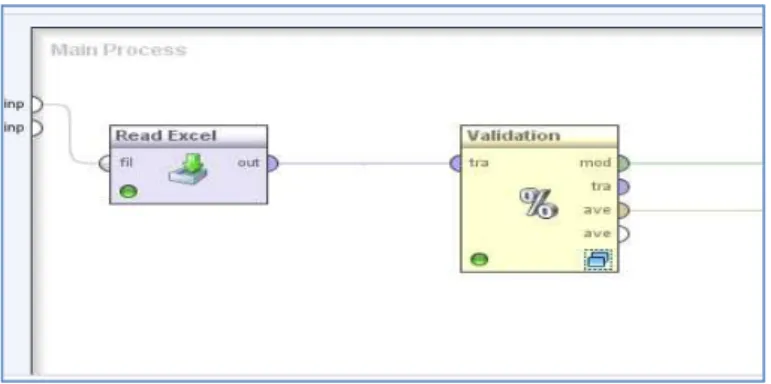
Step 1: LOs and KOs metadata are loaded into rapid miner as shown in Figure 3.
Figure 3: Loading of excel
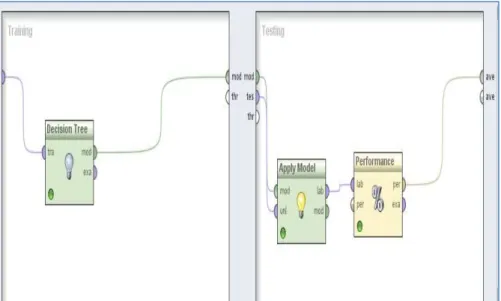
Step 2: A Simple Validation tool as shown in Figure 4 randomly splits up the example set into two parts, ie, training set and a testing set. The purpose of the training set is to create models, whereas the testing set is used to estimate the accuracy of the created model. Here cross-validation operator of RM is used. Cross-validation is a standard statistical method to estimate the generalization error of a predictive model. In the training phase, the cross-validation is built on the current training set.
Figure 4: Cross Validation Tool in Rapid miner
Step3 : A Decision tree operator of RapidMiner is used to classify nominal data on the training part as shown in Figure 5.
Step4: Apply Model operator is used in the testing part. Models obtained after the training part usually contain information about the data on which they had been trained on. This information can be used for predicting the value of a possibly unknown label (Refer Figure 5).
Step 5: Validation allows us to estimate the accuracy of our model and Rapid Miner provides a tool, Performance Operator.(Refer Figure 5)
Sai Sabitha, Deepti Mehrotra, and Abhay Bansal
Figure 5 Decision tree tool in Rapid miner
5.
Result & Analysis
As there are more than two categories for the attribute used as the class label, C4.5 algorithm is used for the classification. A gain ratio is evaluated to decide the splitting criteria of the variable. Here in the experiment the class label taken is ‘object id’, which has a number of categories. The formation of KDLO proposed in Figure 2 is achieved using the data set and the output is shown in Figure 6.The KO1 and KO3 are classified together with LO9 for the data as follows:-
Topic: Data Mining Theory. Sub Topic: Association.
5.1
Text View of DT
According to the “Text view” of Decision Tree shown in Figure 6, the KO1 & KO3 has been classified with LO9 based on Metadata attributes “topic” and “subtopic”.
For the given attributes, topic “dm theory” and subtopic “association” classifies a Learning Object (LO9) with KO1 and KO3. The output of KDLOs is further explained in “Figure 6a”.
Figure 6 Decision Tree in text view
Figure 6 a. KDLO delivered to a user
5.2
Graphical View of DT
Figure 7 shows the decision tree in a graphical form. The graph shows the attributes like title, topic, sub topic and author name form the nodes. The attribute “topic" has the highest entropy value and it is the root node. The object_id was chosen as the label, they are the leaf nodes.
Figure 7 Graphical view of Decision tree
5.3
Results of Performance Vector
In the testing phase, the accuracy of the decision tree is computed on the test data set as shown in Figure 8. The accuracy of a performance vector is 55%. (The arithmetic mean is ‘54.74%’ and ‘8.48%, is standard deviation).
Sai Sabitha, Deepti Mehrotra, and Abhay Bansal
Figure 8 Performance Vector.
6.
Conclusion and Future Scope
By converging KO with LO, during the routine learning a learner gets a bigger picture of the topic to learn. It is one way to reinforce the value in learning, which can build knowledge elements into training programmes. Here we integrate the static learning resource (LO) and dynamic knowledge (KO) during learning, thereby making the learning operations efficient, effective, flexible, high accessible, relevant (Hodgins 2002; Ochoa & Duval 2008) and collaborative. In the above experiment, we have shown one or two KOs classified with a LO. The Knowledge Driven LMS will deliver a LO that can be enriched with the knowledge. According to the experiment, when a user queries for a learning material under course –‘data mining’, and module-‘dm- theory’, the LO with id- ‘LO9’ is delivered by LMS. Along with it, KO1 and KO3 are also given. Thus, KDLO can be obtained and thereby it can strengthen the contents of objects delivered through the LMS.
We had used decision tree algorithm for classification of LO and KO. The result shows, the KOs getting associated with one of the most relevant LOs. The other classification algorithms like naive Bayes classifiers, k-nearest neighbour and artificial neural network can be used. Other approaches can be done by using clustering and followed by classification. The data mining techniques like clustering algorithms (K-mean, Density Based Scan) can also be used. Text mining techniques which may identify the similarity index between different documents will definitely give a more relevant result. These techniques may further refine the search but at the same time increase the computational cost. However, the need of reusability of KO (Ruffner &Deibler 2008) is very important and can be achieved if we associate the Knowledge Object with more relevant LOs. Relevant and reusable objects can be achieved using Fuzzy Clustering, where an object can belong to more than one cluster. Associating relevance and ranking to the learning objects (Sabitha et al. 2012) can improve the satisfaction level of the end user using the LMS. However the delivery engine can be further modified using the semantic and cognitive approach that justifies the need of the user.
References
Balatsoukas, P., Morris, A., & O'Brien, A. (2008). Learning Objects Update: Review and Critical Approach to Content Aggregation. Educational Technology & Society, 11(2), 119-130.
Balki, S. R.(2010) Learning Management System. Lambert Academic Publishing. USA.ISBN: 3838361687.
Blees, I., & Rittberger, M. (2009). Web 2.0 learning environment: concept, implementation, evaluation. E-Learning Papers, (15). ISSN 1887-1542
Collis, B., & Strijker, A. (2004). Technology and human issues in reusing learning objects. Journal of interactive media in education, 2004(1), Art-4.
Dublin Core Metadata Initiative (2012). Dublin Core Metadata Element Set, Version 1.1. DOI: 2012-06-14 Retrieved online 21-12-2011 from :http://dublincore.org/documents/dces/.
Expertus & Training Industry (2010). Survey Results: The Current and Future State of Learning Management Systems. Available at: http://www.trainingindustry.com/
Graf, S., & Liu, T. C. (2008, July). Identifying Learning Styles in Learning Management Systems by Using Indications from Students' Behaviour. In Advanced Learning Technologies, 2008. ICALT'08. Eighth IEEE International Conference on (pp. 482-486). IEEE.
Greenberg L (2002) LMS and LCMS: What's the Difference?. ASTD Source of e-learning copyright: learning circuits.
Gunn, C., Woodgate, S., & O’Grady, W. (2005). Repurposing learning objects: a sustainable alternative?. Research in Learning Technology, 13(3).
Han, J., Kamber, M., & Pei, J. (2006). Data mining, south east asia edition: Concepts and techniques. Morgan kaufmann Heins, T., & Himes, F. (2002). Creating learning objects with Macromedia Flash MX. Macromedia White Paper, April.
Hodgins, H. W. (2002). The future of learning objects.
Available at : http://dc.engconfintl.org/ cgi/viewcontent.cgi?article=1012&context=etechnologies Horton (2001). Designing Knowledge Objects. William Horton Consulting Inc. e-Learning by design, San Francisco.
IEEE LTSC (2002). Learning Technology Standards Committee (LTSC) IEEE Standard for Learning Object Metadata. 1484.12.1-2002. Available at :http://ltsc.ieee.org/wg12/.
IMS Global Learning Consortium (2006). IMS Metadata Best Practice Guide for IEEE 1484.12.1-2002 Standard for Learning Object Metadata. Version 1.3. Retrieved online 21-12-2011 from http://www.imsglobal.org/Metadata/mdv1 p3/imsmd_bestv1p3.html.
Merrill, M. D. (1999). Instructional transaction theory (ITT): Instructional design based on knowledge objects. Instructional design theories and models: A new paradigm of instructional theory, 2, 397-424.
Merrill, M. D. (2000). Knowledge objects and mental models. In Advanced Learning Technologies, 2000. IWALT 2000. Proceedings. International Workshop on (pp. 244-246). IEEE.
Metros, S.et. al. (2002-03). Learning Object ontology. NLII Learning Objects Working Group Available at http://people.cohums.ohiostate.edu/dagefoerde2/NLII_LO/ontology/ontology.htm.
Ochoa, X., & Duval, E. (2008). Relevance ranking metrics for learning objects. Learning Technologies, IEEE Transactions on, 1(1), 34-48.
Porter, M. D. (2001). Object Lessons from the Web: Implications for Instructional. The changing faces of virtual education, 47.
Polsani, P. R. (2006). Use and abuse of reusable learning objects. Journal of Digital information, 3(4).
Ruffner, J., & Deibler, N.,(2008). Knowledge Objects and Learning Objects: Birds of a Feather or Different Species Altogether Proceedings of the Inter service /Industry Training, Simulation & Education Conference (I/ITSEC), Orlando, FL. Sabitha, A. S., Mehrotra, D., & Bansal, A. (2012b). Quality metrics a quanta for retrieving learning object by clustering techniques. In Digital Information and Communication Technology and it's Applications (DICTAP), 2012 Second International Conference on (pp. 428-433). IEEE
Servin, G., & De Brun, C. (2005). ABC of knowledge management. NHS National Library for Health: Specialist Library. Available at: http://www.fao.org/fileadmin/user_upload/knowledge/docs/ABC_of_KM.pdf
SCORM (2005). Sharable Content Object Reference Model. Available at http://www.adlnet.org/scorm/index.cfm Tan, P. N., Steinbach, M., & Kumar, V. (2006). Introduction to data mining (Vol. 1). Boston: Pearson Addison Wesley. Thompson, K., & Yonekura, F. (2005). Practical guidelines for learning object granularity from one higher education setting.
Interdisciplinary Journal of E-Learning and Learning Objects, 1(1), 163-179.
Wagner, E. (2002). Steps to creating a content strategy for your organization. Best of the, 103. Available at: http: //www.elearningguild.com/ pdf/2/102902MGT-H. pdf
Watson, J. (2010). A Case Study: Developing Learning Objects with an Explicit Learning Design. Electronic Journal of e-Learning, 8(1), 41-50.Available online at : www.ejel.org
Wiley, D., (2002) "Connecting Learning Objects to Instructional Design Theory: A Definition, a Metaphor, and Taxonomy." The Instructional Use of Learning Objects (Bloomington, IN: Agency for Instructional Technology)
Available at: http:// reusability.org/read/chapters/wiley.doc
Wiley, D. A., Gibbons, A., & Recker, M. M. (2000). A reformulation of learning object granularity. Retrieved November, 23, 2003.
Wu, X., Kumar, V., Quinlan, J. R., Ghosh, J., Yang, Q., Motoda, H., & Steinberg, D. (2008).Top 10 algorithms in data mining. Knowledge and Information Systems, 14(1), 1-37.
Differences in Intention to Use Educational RSS Feeds Between
Lebanese and British Students: A Multi-Group Analysis Based on
the Technology Acceptance Model
Dr. Ali Tarhini
1, Dr. Michael James Scott
1, Dr. Sujeet Kumar Sharma
2and Dr. Muhammad
Sharif Abbasi
31
Department of Information System, Brunel University London, UK
2Department of Operations Management & Business Statistics, Sultan Qaboos University,
Oman
3
Department of Mathematics & Computer Science, Sindh University, Pakistan
[email protected]
[email protected]
[email protected]
[email protected]
Abstract: Really Simple Syndication (RSS) offers a means for university students to receive timely updates from virtual learning environments. However, despite its utility, only 21% of home students surveyed at a university in Lebanon claim to have ever used the technology. To investigate whether national culture could be an influence on intention to use RSS, the survey was extended to British students in the UK. Using the Technology Adoption Model (TAM) as a research framework, 437 students responded to a questionnaire containing four constructs: behavioural intention to use; attitude towards benefit; perceived usefulness; and perceived ease of use. Principle components analysis and structural equation modelling were used to explore the psychometric qualities and utility of TAM in both contexts. The results show that adoption was significantly higher, but also modest, in the British context at 36%. Configural and metric invariance were fully supported, while scalar and factorial invariance were partially supported. Further analysis shows significant differences between perceived usefulness and perceived ease of use across the two contexts studied. Therefore, it is recommended that faculty demonstrate to students how educational RSS feeds can be used effectively to increase awareness and emphasise usefulness in both contexts.
Keywords: cross-cultural; technology adoption model; developing countries; RSS; virtual learning environments; engagement
1.
Introduction
Throughout the last two decades, there has been a profound increase in the use of virtual learning environments, such as Blackboard and Moodle, in higher education institutions to support traditional classroom teaching (Dalal, 2014; Abbasi et al., 2011; Nerantzi, 2012; Padilla-Meléndez et al., 2013) as well as help students meet their educational goals (Clark and Mayer, 2011; Tshabalala et al, 2014). However, a lack of portability and pervasiveness in such systems can negatively influence peer interaction, resource acquirement, and content delivery (Cold, 2006; Lan and Sie, 2010; Ma, 2012). In response to these weaknesses, these web-based learning systems integrate Really Simple Syndication (RSS) to provides learners with a means to promptly receive updates using any Internet-enabled device (West et al., 2006). RSS is an XML format to syndicate and share content on the Web. It is employed for spreading frequently updated and personalized information among users subscribed to the source of content (Samper et al., 2008; Bouras et al., 2010; De La Torre-DíEz et al., 2013). Consequently, enabling learners to be informed about new educational resources in real time, which might include: new teaching materials; reading lists; topics for discussion; the release of feedback; or any other course-related announcements. This has been shown to enhance communication among peers (D’Souza, 2006) and help individuals track topics of conversation (Richardson, 2005). RSS has also been used to improve student research by providing access to updated compilations of relevant research references (Asmus et al., 2005; Liu, Liao and Pratt, 2009). Thus, RSS feeds present a means to provide portability and ubiquity to virtual learning environments in a way that facilitates the dissemination of new information and consequently has an impact on student collaboration.
ISSN 1479-4403 14 ©ACPIL
Reference this paper as: Tarhini A, Scott M, Sharma S and Abbasi M “Differences in Intention to Use Educational RSS Feeds Between Lebanese and British Students: A Multi-Group Analysis Based on the Technology Acceptance Model” The Electronic Journal of e-Learning Volume 13 Issue 1 2015, (pp14-29) available online at www.ejel.org
However, while RSS feeds are used successfully in many organizations, the use of RSS in educational contexts can be problematic because of students’ low level of technology adoption (Cold, 2006). Despite its utility and widespread deployment, a Lebanese institution has encountered a high level of resistance to this technology. So, despite having the potential to enhance learning through student interaction, a low level of acceptance has meant its benefits have not been fully realised (Tarhini, Hone and Liu, 2013c; Teo, 2009; Teo and Noyes, 2011; Sharma and Chandel, 2013). Additionally, previous research has shown that RSS-user adoption and acceptance is still below expected with 11 % among end users in 2008 and 2% in 2005 (Katz, 2008) .It is therefore important for practitioners and policy makers to better understand the acceptance of learning systems in the Lebanese context in order to increase usage, and thereby enhance the learning opportunities available to students in Lebanon. In particular, whether a national influence (culture, socio-economics, etc) influences students’ behavioural intention to use RSS feeds.
Various models and theories have been developed to investigate and understand and predict the acceptance of technology. Examples include: the Technology Acceptance Model (TAM) (Davis, 1989; Davis, Bagozzi and Warshaw, 1989); the Theory of Reasoned Action (TRA) (Ajzen and Fishbein, 1980; Fishbein and Ajzen, 1975); Innovation Diffusion Theory (IDT) (Rogers, 1995); the Theory of Planned Behaviour (TPB) (Ajzen, 1991); and the Unified Theory of Acceptance and Use Technology (UTAUT) (Venkatesh et al., 2003). This research employs TAM in order to understand and explain the relationship between individuals’ perceptions and behavioural intentions towards RSS. This is because TAM has: been widely used in similar information systems research (Yousafzai, Foxall and Pallister, 2007); has a parsimonious structure and acceptable explanatory power (Venkatesh and Bala, 2008; Chang, 2010; Tarhini, Hone and Liu, 2013a). Furthermore, the validity and reliability of TAM across a number of different technologies and usage contexts have been examined (Teo and Noyes, 2011; Park, 2009; Venkatesh and Davis, 2000).
A criticism of TAM is that it can be affected by biases in cross-cultural contexts and it may not be sufficient to explain the factors affecting the user adoption of new technology because important factors are likely to vary based on the technology, users and context (Straub, Keil and Brenner, 1997; McCoy, Everard and Jones, 2005; Teo, Luan and Sing, 2008; Tarhini el at., 2015a, b). For example, Straub et al. (1997) tested TAM across three different cultures, finding that TAM produces different explanatory power in behavioural intention between Japan and the United States (i.e only 1%), but similar power between the United States and Switzerland (i.e 10%). However, the argument that TAM doesn’t serve equally across cultures is inconsistent in the prior literature (McCoy et al., 2005; Zakour, 2004; Srite and Karahanna, 2006; Sharma et al., 2014). Of particular concern, in this case, is whether TAM is suitable for use in the Lebanese context and whether it can be used to compare Lebanon to other nations. This is because TAM has not been widely tested in a number of developing countries (Teo et al., 2008). Consequently, there is a gap in the literature, and so it is important to first test the appropriateness of TAM through exploring the psychometric properties of a research instrument to ensure measurement invariance, as well as adequate reliability and validity.
The authors hypothesise that national culture could affect technology adoption in Lebanon. As such, the study described in this article compares a sample of Lebanese students to a sample of students from a different country as a first step to explore potential differences. The United Kingdom was selected as an example of a typical developed country that could be used to conduct such a comparison. This country was chosen because, as shown below in Table 1, the United Kingdom and Lebanon represent nearly reverse positions on all of Hofstede’s (2005) cultural dimensions. In addition, there is a significant contrast in investment in educational technology as financial constraints in Lebanon tend to encourage more traditional styles of pedagogy (Baroud and Abouchedid, 2010).
Table 1: Cultural Differences between the United Kingdom and Lebanon (Hofstede, 2005)
Country Power Distance Masculinity Individualism Uncertainty Avoidance
Lebanon 80 53 38 68
United Kingdom 35 66 89 35
Consequently, this study extends the literature by applying TAM in the Lebanese context to examine differences that may affect the acceptance and adoption of RSS feeds among British and Lebanese students. The results of this study would be of interest to the research community since it explores the generalizability and validity of TAM in a new national context. Furthermore, it examines potential differences between national contexts that may influence students' use of RSS feeds. This will help policy makers and practitioners
Dr. Ali Tarhini, Dr. Michael James Scott, Dr. Sujeet Kumar Sharma et al
gain a deeper understanding of students’ acceptance of e-learning technology and consequently lead to enhancements in technology acceptance and learning.
1.1
The Technology Acceptance Model (TAM)
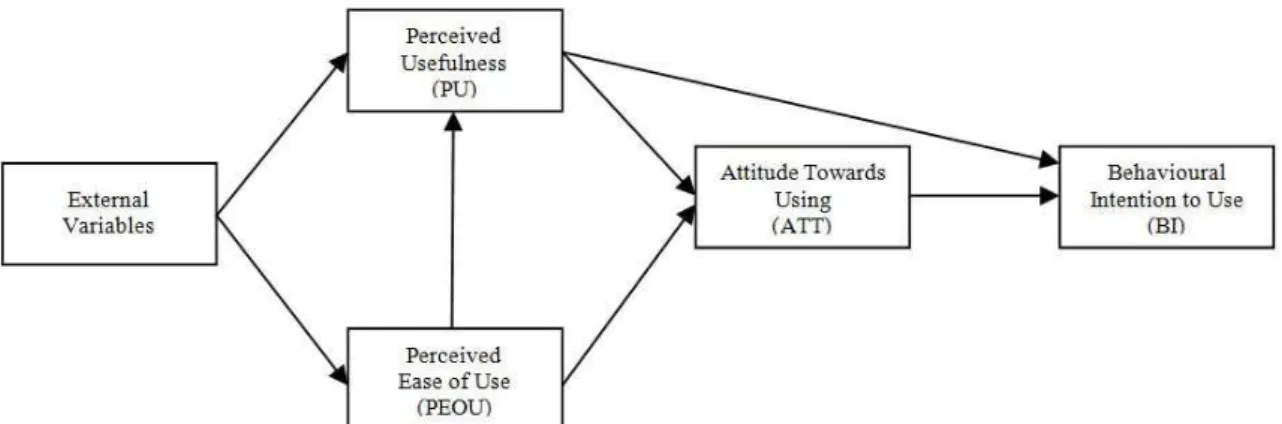
Davis (1989) developed the technology acceptance model (TAM) through the theoretical foundation for the Theory of Reasoned Action (TRA). TRA is a model pertaining to social psychology concerned with the specifics of intended behaviours (Ajzen and Fishbein, 1980). TRA posits that an individual’s behaviour and intent to behave is a function of that individual’s attitude toward the behaviour and their perspectives regarding the behaviour. Behavioural intention also is determined via subjective norms, as behaviour results as a function of all attitudes and beliefs (Masrom, 2007; Tarhini et al., 2014a). According to Davis (1989), the aim of TAM is “to provide an explanation of the determinants of computer acceptance that is general, capable of explaining user behaviour across a broad range of end-user computing technologies and user populations, while at the same time being both parsimonious and theoretically justified” (P.985). According to Venkatesh et al (2003), TAM presumes that behavioural intention (BI) is usually formed as a result of conscious decision making processes. This involves three key variables (see Figure 1): perceived usefulness (PU); perceived ease of use (PEOU); and attitude towards using (ATT) (Davis, 1989; Davis et al., 1989). The TAM postulates that PEOU and PU predict ATT, behavioural intention (BI) is predicted by the user’s attitude (ATT), and the actual use of the system is predicted by BI. Furthermore, the PEOU has a significant influence on PU.
Figure 1: The Technology Acceptance Model (Adapted from Venkatesh et al, 2003)
The main foundation of our research is based on TAM and drawing from previous literature that used TAM in an educational context in order to reflect the usage and acceptance of RSS in education. The overall conceptual model is illustrated above in Figure 1 and the sections which follow explain and justify each of the predicted relationships in light of previous findings from the literature.
1.2
Perceived Ease of Use (PEOU) and Perceived Usefulness (PU)
Perceived usefulness (PU) is a predictor that measures individuals’ beliefs regarding whether the use of a particular technology system will improve her or his performance (Davis et al., 1989). Perceived usefulness was used in this study to investigate students’ beliefs about obtaining benefits regarding the use of Blackboard’s system as well as to predict students’ beliefs of using RSS on the Blackboard system. The selection of this factor in the research model was due to the direct and significant influence on user’s attitude to use the technology and also behavioural intention to use the system, which comes from the previous studies (e.g., Teo et al., 2008, Hsu, 2014). Perceived ease of use (PEOU) is a predictor that measures an individual’s beliefs regarding the use of a particular technology system free of effort (Davis, 1989). The PEOU construct was selected in order to investigate students’ attitudes regarding using Blackboard’s system free of effort, as well as to predict students’ intentions of using RSS on the Blackboard system.
TAM posits that PEOU and PU predict the user’s attitude towards the system (ATT). As such, it is expected that users with high level of PU are more likely to have positive attitudes about using the technology. Similarly users with high level of PEOU are also expected to induce positive attitudes. Furthermore, according to Davis (1989), PU was found to mediate the effect of PEOU on attitude. In another words, PEOU indirectly has an impact on attitudes through PU.
1.3
Attitude Toward Using (ATT)
Attitude toward using (ATT) is a predictor that investigates individuals’ beliefs regarding using a particular technology. The casual relationship between PU, PEOU and ATT towards using the technology is supported considerable number of studies e.g. (Cheng, Lam and Yeung, 2006; Yu et al., 2005; Tarhini, Hone and Liu, 2013b). Furthermore, Gao (2005) indicated in his study ‘Educational Hypermedia’ that attitude toward using had a direct and significant effect on intention to use. More recently, Teo and Noyes (2014) claimed in their study that attitude toward using had a direct and significant effect on intention to use.
However, attitude toward using has varying degrees of effectiveness based on the field of study, sample, or techniques used for analysis. On the other hand, Masrom (2007), found in her study of ‘learning online’ that attitude toward using did not have a direct and significant effect on intention to use. There are differences in significant and insignificant effects of the intention to use based on the field or sample of the study. This is because the term ‘attitude’ can be interpreted quite broadly and could be directed towards many different facets of using a system, such as ‘attitude towards features’, ‘attitude towards purpose’ or ‘attitude towards benefit’; of which, the latter is the focus in this article.
1.4
Behavioural Intention (BI)
The presence of behavioural intention (BI) in the TAM is one of the major differences with TRA. Behavioural intention is considered to be an immediate antecedent of usage behaviour and gives an indication about an individuals’ readiness to perform a specific behaviour. In TAM, both PU and PEOU influence an individual’s intention to use the technology, which in turns influence the usage behaviour (Davis, 1989). There is significant supports in the literature for the relationship between PU, PEOU and ATT on behavioural intention (Venkatesh and Davis, 2000; Taylor and Todd, 1995b; Davis et al., 1989), particularly in the context of e-learning studies (Zhang, Zhao and Tan, 2008; Yi-Cheng et al., 2007; Park, 2009; Saeed and Abdinnour-Helm, 2008; Liu et al., 2010). It is worth noting, however, that actual usage (AU) of the system was excluded from this study because it was found to be challenging to track individual users based on the available server system logs. This is because RSS feeds are available without requiring a login, to facilitate ease of access. Thus, it was impossible to distinguish individual users, or even distinguish between individual mobile devices, with the data available. Therefore, it was deemed appropriate to only measure behavioural intention.
1.5
Aims of the Study
The overall aim of this study was to explore the appropriateness of applying TAM in the Lebanese context through investigating any potential differences between predictors of behavioural intention technology acceptance between British and Lebanese students. As such, the first five hypotheses are based on the relationships in TAM as shown below in Figure 1:
H1: Students' perceived ease of using RSS feeds (PEOU) will significantly influence the perceived usefulness of RSS feeds (PU) in both the Lebanese and British contexts, equally.
H2a: Students’ perceived usefulness of RSS feeds (PU) will significantly influence attitude towards the benefits of using RSS (ATT) in both the Lebanese and British contexts, equally.
H2b: Students’ perceived ease of using RSS feeds (PEOU) will significantly influence attitude towards the benefits of using RSS (ATT) in both the Lebanese and British contexts, equally.
H3a: Students’ perceived usefulness of RSS feeds (PU) will significantly influence intention to use RSS feeds available on Blackboard Learn (BI) in both the Lebanese and British contexts, equally.
H3b: Students’ attitude towards the benefits of using RSS (ATT) will significantly influence intention to use RSS feeds available on Blackboard Learn (BI) in both the Lebanese and British contexts, equally.
Further to these hypotheses, it follows that there may be differences between the Lebanese and British students due to external variables that influence PU and PEOU, as shown in Figure 1. Therefore, the following hypotheses are also examined:
H4a: The British students will report a higher perceived usefulness (PU) of RSS feeds, compared to the Lebanese students.
H4b: The British students will report a higher perceived ease of use (PEOU) for RSS feeds, compared to the Lebanese students.
Dr. Ali Tarhini, Dr. Michael James Scott, Dr. Sujeet Kumar Sharma et al
H4c: The British students will report a more positive attitude towards using (ATT) RSS feeds, compared to the Lebanese students.
H4d: The British students will report a higher behavioural intention (BI) to use RSS feeds, compared to the Lebanese students.
H5: There will be a greater proportion of British students using RSS, compared to Lebanese students.
2.
Methodology
Consistent with previous empirical research in technology acceptance e.g. (Venkatesh and Bala, 2008; Venkatesh et al., 2003) and similar work within the e-learning context e.g. (Zhang et al., 2008; Liaw, 2008; Cronjé, 2011), a quantitative approach was adopted. A 25-item questionnaire was administered to students at an institution in the United Kingdom and an institution in Lebanon, by a process of convenience sampling. The questionnaire contained at least five items for each of the proposed constructs in the TAM model (PU, PEOU, ATT and BI). These items were adapted for the context of using new RSS feeds that had been introduced within the virtual learning environment, Blackboard Learn. Data collected from this survey were analysed using principle components analysis (PCA) in SPSS 20.0.0 and structural equation modelling (SEM) using AMOS 18.0.1. The PCA technique was applied to cull the larger set of items down to a smaller, more parsimonious scale containing items that were likely to be invariant across the two samples, while also ensuring that the proposed factor structure was appropriate for the items included in the scale. The SEM technique was then applied to ensure that adequate construct validity was present in the data and to verify the level of measurement invariance those items achieved in more detail. As Straub (1997) points out, it is important that any hypothesised latent constructs are measured in an appropriate manner. Researchers must ensure that they are actually measuring what they believe to be measuring by ensuring that an appropriate level of construct validity is found. Hair et al (2010) show that if adequate face validity, convergent validity and discriminant validity are found, then together these present sufficient evidence for construct validity. That is, participants understand the meaning of every item in the scale (face validity), a set of items expected to measure a particular latent factor converge on that factor with strong factor loadings (convergent validity), and the extent to which constructs differ by not sharing variance can be established (discriminant validity). As the two samples are based on two two groups with distinct differences (such as culture), assumptions of measurement invariance need to first be verified. This is because, based on a review of the literature, Vandenberg and Lance (2000) emphasise that at least some configural, metric, scalar and factorial invariance should be established. Such tests of measurement and structural invariance generally fall into one of five questions about how participants interpret items in an instrument (Byrne, 2006): (1) do the items that comprise an instrument operate in a similar fashion across groups; (2) are the constructs and factor structure equivalent across groups; (3) is the causal structure of the constructs the same across groups; (4) are the means of the factor scores invariant across the two groups; and (5) does the factorial structure of an instrument replicate across different independent samples of the same population? Once such questions have been answered, researchers can have confidence that the meaning of responses to particular items in a scale do not differ significantly across multiple groups and are reliable within-groups. Thus, as recommended by Vandenberg and Lance (2000), tests were performed to ensure that the configuration of factors were the same across the two cultures (configural invariance), rating scales were interpreted similarly (metric invariance), the quantifiable meanings of the scales meant the same to participants from both cultures (scalar invariance), and factor variances are homogenous indicating the equality of relationships between the latent factors (factorial invariance).
Once invariance has been established in the measurement model, the structural model can be tested to examine the relationships between the constructs. The differences between the model structure in the Lebanese and British samples (H1 to H3) were compared using z-tests on the correlation coefficients between pairs of constructs. Estimated factor scores were then generated using the regression method of data imputation within AMOS. The resulting data from Lebanon and the UK were subsequently compared using independent sample t-tests in SPSS (H4). Additionally, the proportion of students reporting to have previously used RSS to support their studies were compared using a chi-squared difference test (H5).
2.1
Participants and Sampling
The participants in this study comprised of 202 British students attending a university in the United Kingdom and 235 Lebanese students attending a university in Lebanon. All participants were studying in an English-language setting. The institutions were purposively selected based on: offering similar courses, with both institutions predominantly running courses in engineering and technology; similar infrastructure, based on both institutions being founded in the 1900's and having similar levels of infrastructure development; and similar use of web-based learning environments, with both institutions making extensive use of Blackboard Learn and deploying versions of Blackboard that integrate RSS feeds at a similar time.
Table 2: Demographic Information of Participants
Country
Age Gender Education Use RSS Feeds
M SD Male Female Undergraduate Graduate Yes No Lebanon 22.6 4.4 121 114 102 133 51 184 United Kingdom 21.8 4.9 91 111 101 101 74 128
Differences t 1.688 2 1.804 2 1.900 2 11.859
p .072 p .179 p .168 p .001
Notes: M = mean; SD = standard deviation.
Details of the participants are shown above in Table 2. Due to ethical constraints based on defining a sampling frame based on nationality, the sample was collected using a self-selection method and should therefore be considered a convenience sample. The survey was conducted in-person across a period of 3-weeks by two researchers moving to multiple locations within each institution, namely the libraries, computer suites and study areas. No course credit or other rewards were given to participants in this study. Prior to completing the questionnaire, all participants were briefed on the purpose of the work, and their right to choose not to participate. On average, each participant took no more than 10 minutes to complete the questionnaire.
2.2
Instrument Presentation
The instrument was administered in English to all of the students who volunteered to participate. The questionnaire was first pre-tested for content and face validity in both settings. Apart from providing their demographic information, they responded to 25 items, adapted from the work of Davis (1989) and related works, including: perceived usefulness of the RSS feeds (PU) (5 items); perceived ease of using RSS feeds (PEOU) (6 items); attitude towards the benefits of using RSS (ATT) (8 items); and intention to use particular RSS feeds on Blackboard Learn (BI) (6 items). These items were measured using a 5-point Likert scale ranged from strongly disagree to strongly agree.
3.
Results
The results initially focus on how the research instrument was refined, based on the results of a principle components analysis and matrix independence tests using Fisher's method. Following this, the results of a series of measurement invariance tests based on structural equation modelling techniques are shown; determining whether the two samples can be meaningfully compared using the proposed model and associated instrument. Subsequently, a series of t-tests and z-tests test whether the data supports or does not support the hypotheses presented.
3.1
Instrument Development and Refinement
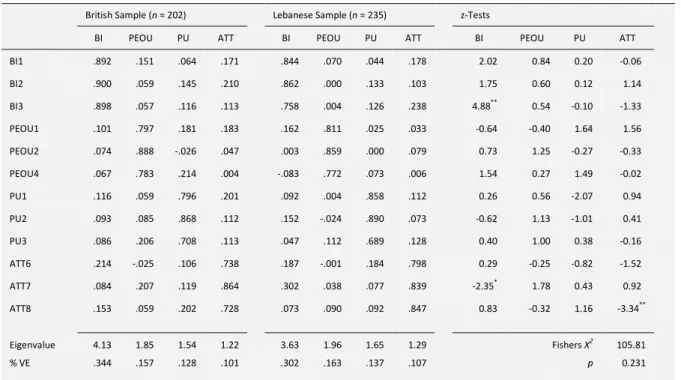
The instrument was refined based on a principle component analysis of the original 25 items included in the survey. Items with low loadings (< .4) on their theorised component, significant cross loadings (> .4 in a different component), and items belonging to undefined components were removed. An analysis using Fisher's method on these items showed that the two rotated component loading matrices (for Lebanon and the United Kingdom) were significantly different from each other (X2 = 303.79, df = 190, p < .001) and so items with significant z-scores were also removed, maintaining at least three items per factor, until an adequate solution was found (X2 = 105.81, df = 96, p = .231), as shown in Table 3. This refined scale contained 12 of the original 25 items, with a KMO of .763 and a significant Bartlett's indicating adequate factorability. Both Catell's scree plot criterion and Kaiser's eigenvvalue criterion indicated the 4 component solution, as hypothesised, were
Dr. Ali Tarhini, Dr. Michael James Scott, Dr. Sujeet Kumar Sharma et al
appropriate. The overall variance explained for the two models were 73% and 71%, for the British and Lebanese samples respectively.
Table 3: Principle Component Analysis and Fisher's Test of Independence
British Sample (n = 202) Lebanese Sample (n = 235) z-Tests
BI PEOU PU ATT BI PEOU PU ATT BI PEOU PU ATT BI1 .892 .151 .064 .171 .844 .070 .044 .178 2.02 0.84 0.20 -0.06 BI2 .900 .059 .145 .210 .862 .000 .133 .103 1.75 0.60 0.12 1.14 BI3 .898 .057 .116 .113 .758 .004 .126 .238 4.88** 0.54 -0.10 -1.33 PEOU1 .101 .797 .181 .183 .162 .811 .025 .033 -0.64 -0.40 1.64 1.56 PEOU2 .074 .888 -.026 .047 .003 .859 .000 .079 0.73 1.25 -0.27 -0.33 PEOU4 .067 .783 .214 .004 -.083 .772 .073 .006 1.54 0.27 1.49 -0.02 PU1 .116 .059 .796 .201 .092 .004 .858 .112 0.26 0.56 -2.07 0.94 PU2 .093 .085 .868 .112 .152 -.024 .890 .073 -0.62 1.13 -1.01 0.41 PU3 .086 .206 .708 .113 .047 .112 .689 .128 0.40 1.00 0.38 -0.16 ATT6 .214 -.025 .106 .738 .187 -.001 .184 .798 0.29 -0.25 -0.82 -1.52 ATT7 .084 .207 .119 .864 .302 .038 .077 .839 -2.35* 1.78 0.43 0.92 ATT8 .153 .059 .202 .728 .073 .090 .092 .847 0.83 -0.32 1.16 -3.34**
Eigenvalue 4.13 1.85 1.54 1.22 3.63 1.96 1.65 1.29 Fishers X2 105.81 % VE .344 .157 .128 .101 .302 .163 .137 .107 p 0.231
Notes: Factor loadings have been rotated using a varimax rotation with Kaiser normalization; %VE = percentage of variance extracted. *p < .05, **p < .01
Following this stage of item refinement, the following 12 items were included in subsequent analyses, as described below in Table 4.
Table 4: List of Constructs and Corresponding Items in Final Scale for Further Analysis Construct Item Description
Perceived Usefulness of RSS Feeds (PU)
PU1 I would like to be informed about any activities on Blackboard
PU2 I would like to receive updates on Blackboard as soon as published
PU3 I would like to receive course information daily
Perceived Ease of Using RSS Feeds (PEOU)
PEOU1 I find using RSS feeds on Blackboard Learn easy to use
PEOU2 I find it easy to check for information regarding my courses with RSS PEOU4 I find it easy to look up all recently uploaded materials using RSS
Attitude Towards Potential Benefit (ATT)
ATT6 I could improve my learning performance by receiving new information
ATT7 I could enhance my learning skills
ATT8 I could increase my interaction with Blackboard
Behavioural Intention to use RSS Feeds (BI)
BI1 I intend to receive information through the "course content" feed
BI2 I intend to receive information through the "announcement" feed
BI3 I intend to receive information through the "discussion" feed
The descriptive statistics presented below in Table 5 indicate a somewhat positive disposition towards RSS feeds. All means were greater than the midpoint (2.5) for both samples, ranging from 3.51 to 4.09. While the standard deviation (SD) values ranged from .685 to 1.113 for the Lebanese sample, indicating greater variability compared to .836 and .973 in the British sample, these values could still be considered a narrow spread around the mean. However, to ensure adequate multivariate normality in the sample, several cases were removed as outliers based on having a Mahalanobis distance greater than 35 from the centroid.