Experimental and Predicted Performance of the
BEI Mini-Linear Cooler
D.T. Kuo, A.S. Loc, and S.W.K. Yuan BEI Sensors and Systems Company Sylmar, CA 91342
ABSTRACT
BEI is a manufacturer of Stirling-cycle cryocoolers based on the concept of clearance seal, pneumatically driven displacer and linear drive motors. Several cooler models are available covering refrigeration requirements ranging from 150 mW to 5.0 Watts of cooling at 78 K. This paper describes a computer simulation model, herein referred to as Hybrid Refrigeration Model (HRM), that was developed for the design of BEI coolers. The BEI computer model uses a novel technique that greatly reduces computation time without compromise in accuracy.
The hybrid model is used at BEI for the design of both Stirling and Pulse-Tube refrigerators. The model is similar to a third order model described in the literature as the Stirling Refrigerator Performance Model (SRPM), that has been extensively validated against various Stirling and Pulse Tube designs from different manufacturers. Although very accurate in its prediction, the SRPM suffers a major shortcoming in its long run time. The Hybrid Refrigeration Model, on the other hand, uses a third order approach in calculating mass flows and pressure drops within the refrigerator while the losses are imposed using the second order analysis. This approach has provided an accurate tool for performance prediction with fast turnaround. An example of the use of this computer model is provided in this paper with the parameters of the BEI Mini-linear cooler. The performance of the cooler is discussed, in particular, the effects of the regenerator material, configuration and operating conditions.
INTRODUCTION
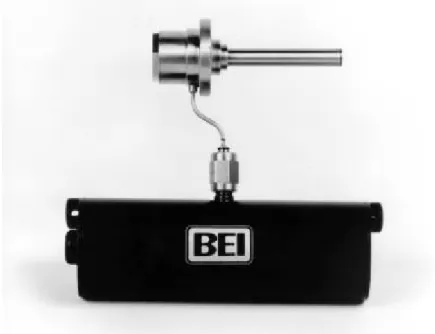
The external view of the BEI Mini-linear Cooler is shown in Figure 1. The cooler comprises of a compressor that is pneumatically coupled to its expander by way of a flexible transfer tube. The entire unit is very compact, with the compressor housing measured 4 inches in length and 1.365 inches in
diameter. The cooler can be viewed as having three distinct volumes to aid the understanding of its operation: 1) working volume, 2) crankcase volume, and 3) gas spring volume. The compressor functions as a pressure oscillator causing a rise and fall of the working volume pressure. As the working volume pressure approaches its peak value, this pressure pushes the displacer towards the warm end of the expander assembly. When the working pressure approaches its minimum point, the gas spring pushes the displacer toward the cold end.
The compressor generates the pressure oscillations from a pair of pistons driven in-line, and in opposite direction within a common cylinder. This configuration, known as “twin-opposed pistons,” provides a well-balanced machine with minimum vibration. The piston also functions as a bearing to support the weight of the moving mass.
Actuation force for each piston comes from a linear motor. This motor consists of a circumferentially wound coil assembly that is free to move in the axial direction within an annular air gap. A magnetic field is established with magnets and back-iron to focus the magnetic flux density in the radial direction across the air gap. The actuation force is the product of this flux density and the current flowing in the coil assembly.
Mechanical springs are used to maintain position of the coil assembly centered relative to the magnets. The springs are made stiff enough to minimize static deflections in 1-g gravitational field. Another important feature of the spring is the manner which it is used to achieve resonance for the spring-mass assembly to be equal to the drive frequency. Driving at resonance results in the best motor efficiency.
The expander has a displacer assembly with a moving regenerator. The regenerator consists of a matrix (porous medium) that absorbs heat from and releases heat to the working fluid as it passes through. The cold end of the regenerator is at cryogenic temperature and the warm end can get quite hot. Therefore, an efficient regenerator must also have low axial thermal conductivity.
Dynamic clearance seals are used in three places to separate the volumes. A seal on the piston separates the crankcase volume from the working volume in the compressor. In the expander, a seal on the plunger separates the working volume from the gas spring volume. The regenerator seal forces the working fluid to pass through the regenerator. This seal also functions as the bearing for the moving regenerator assembly.
Figure 1. An external view of the BEI Mini-linear Cooler.
Retention of the working fluid over extended period dictates the use of electron-beam welding and brazing techniques. However to facilitate assembly, two static metal seals are used: a conical seal at the joint between the compressor and the transfer line assembly, and a C-seal between the expander housing and the warm end-cap.
Computer Modeling
The modeling of cryocoolers ranges in degree of complexity and the resulted accuracy also varies accordingly. The First Order Analysis is an ideal cycle with no losses. By imposing losses on the ideal cycle, the Second Order is far more realistic. The Third Order Analysis, on the other hand, breaks down the cryocooler into a large number of nodes and the equations of conservation of energy, mass, and momentum are solved at each node until the solution converges. The number of nodes in each section depends on the value of the state variables. For examples, more nodes are required in the regenerator because of the large temperature difference and large pressure drop in the axial direction. Equation of states and empirical equations for pressure drop and heat transfer are also used. Among all the Third Order Models in the literature, only the Stirling Refrigerator Performance Model (SRPM) has been validated extensively against various refrigerators in the literature. They include the Lucas-Lockheed 60K unit1, the NASA/Philips Magnetic Bearing unit2, the Oxford refrigerators3, and the Astronomic Infrared Sounders (AIRS) units A, B, and C. A detailed description of the model can be found in Reference 4. SRPM was also found to give accurate prediction on the performance of Pulse Tube coolers (including a blind test, Ref. 5 and 6), and is very useful in the design of Stirling refrigerators7. The only shortcoming of the above model is long runtime.
At BEI, a new Hybrid Model has been developed. This model is third order in fluid dynamics and second order in heat transfer. The heat transfer in a third order model requires long runtime to converge because of the finite heat capacity, whereas the dynamics only take a few cycles to reach steady state. The Third Order Model is also known for its accuracy in predicting PV loops in both the compressor and the displacer (Reference 1). The compressor PV loop allows one to calculate the input power, where the expander PV loop gives the total gross refrigeration of the cooler. Knowing the gross refrigeration, the BEI model imposes the losses as in the Second Order approach. Losses incorporated include, regenerator loss, regenerator matrix conduction loss, static losses, gas conduction loss, pumping loss, shuttle loss, blow-by loss, radiation loss, and friction loss. Since the pressure drop loss is already accounted for in the expander PV loop, it is not considered separately. The resulted model does not give up much accuracy as compared to the Third Order Model, but has a much faster turn-around time. RESULTS AND DISCUSSION
The normal operating conditions of the BEI Mini-linear Cooler is listed in Table 1. Table 1. Normal operating conditions of the BEI Mini-linear Cooler.
Charge Pressure 400 PSIA
Frequency 60 Hz
Max. Displacer Stroke 0.1 inch
Max. Compressor Stroke 0.44 inch
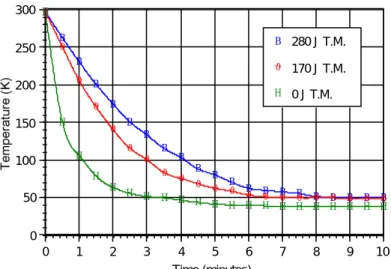
Figure 2 shows the cooldown characteristics of the cooler subject to various thermal masses (T.M.). Typical cooldown time to 80 K with a 250J thermal mass is around four minutes.
B B B B B B B B B B B B B B B B B B B B B J J J J J J J J J J J J J J J J J J J J J H H H H H H H H H H H H H H H H H H H H H 0 50 100 150 200 250 300 0 1 2 3 4 5 6 7 8 9 10 Time (minutes) B 280 J T.M. J 170 J T.M. H 0 J T.M.
Figure 2. Cooldown characteristics of the BEI Mini-linear Cooler.
The modeling of the BEI Mini-linear Stirling Cooler which has a pneumatically driven displacer is far more challenging than that of a cooler with a motor-driven displacer. In the latter case, the size of the PV loop in the expansion space (which represents the gross cooling) is set by the stroke of the displacer motor, the compressor pressure wave and the phase angle between the compressor and the displacer motors. With a pneumatically driven displacer, the expansion space PV loop is also a function
of the frictional force acting against the motion of the displacer. This friction term (f) was found in the present work to be a function of the compressor stroke (X), the coldtip temperature (TE), and the
ambient temperature (TA). f T X T E A ∝ 2 (1)
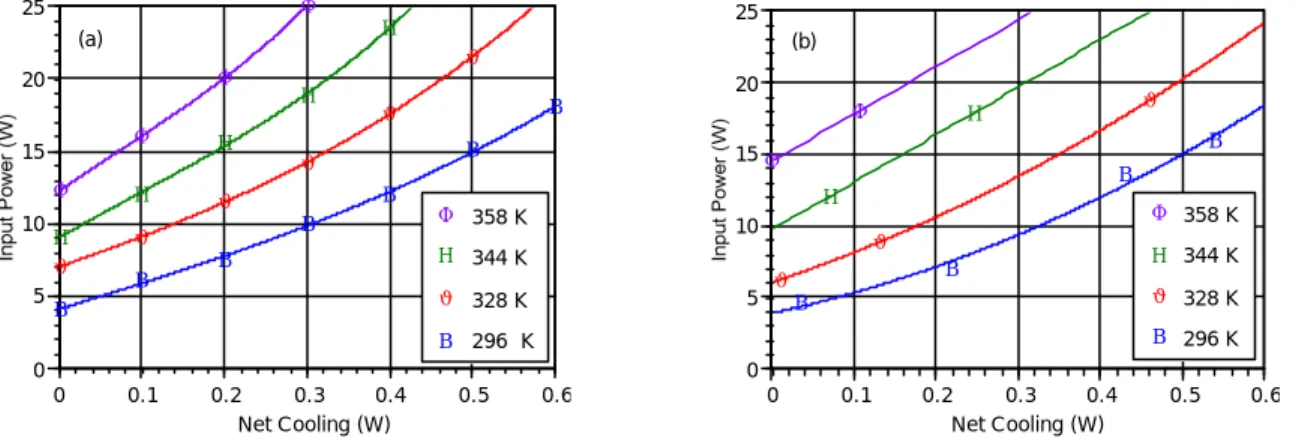
The performance of the BEI Mini-linear Cooler (with a one-inch transfer line) at various ambient temperatures as predicted by the Hybrid Computer Model (HCM) is compared to the experimental data in Figure 3. The ambient temperature ranges from room temperature to 358 K.
B B B B B B B J J J J J J H H H H H F F F F 0 5 10 15 20 25 0 0.1 0.2 0.3 0.4 0.5 0.6 Net Cooling (W) B 296 K J 328 K H 344 K F 358 K (a)
B B B B J J J H H F F 0 5 10 15 20 25 0 0.1 0.2 0.3 0.4 0.5 0.6 Net Cooling (W) B 296 K J 328 K H 344 K F 358 K (b)
Figure 3. Comparison of the experimental performance of the BEI Mini-linear Cooler to the prediction of the Hybrid Computer Model; a) experimental data, b) prediction.
B B B B B J J J 0 1 2 3 4 5 6 7 8 9 10 70 80 90 100 110 120 130 140 Coldtip Temperature (K) B Experiment J BEI Model
Figure 4. Input power (for 0.2 W refrigeration) as a function of coldtip temperature.
As the ambient temperature increases, the performance of the cooler degrades due to the limitation of heat rejection at the compressor and the increase of heat losses from the warm end of the coldfinger to the cold end. As a result, the input power required to produce the same cooling is higher at an elevated ambient temperature. By comparing Figures 3a and 3b, one can see that good agreement is found between the experimental data and HCM prediction.
Figure 4 depicts the input power of the Mini-linear Cooler (to produce 200 mW of cooling) as a function of the coldtip temperature. The input power increases exponentially as the coldtip temperature is decreased which is the characteristic of all Stirling coolers.
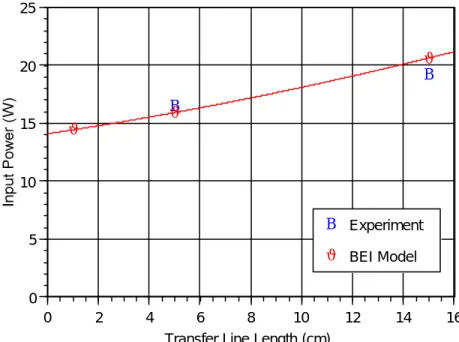
The effect of transfer-line length on the performance of the BEI Mini-linear Cooler is presented in Figure 5. A finite transfer-line length is required for most practical applications, which also acts as a buffer to isolate the coldtip interface from the vibration of the compressor. As the length of the transfer line increases, the dead volume in the system also increases accordingly. This results in a reduction of the pressure ratio, which in turn reduces the refrigeration power of the cooler. The prediction of the Hybrid Computer Model is also included in the figure. However, more experimental data is required to quantify the validation.
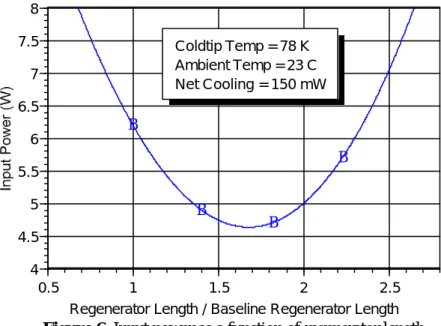
The HCM model is extremely useful for the design of mechanical coolers. Figure 6 shows the predicted input power of the cooler at 23 C ambient temperature, with a cooling load of 150 mW at 78 K as a function of regenerator length. A minimum input power is predicted by the model as too short a regenerator leads to large regenerator losses and too long a regenerator results in a large dead volume which translates into small pressure ratio and reduced cooling. The baseline length of the regenerator can be extended to enhance performance and this was verified experimentally.
BEI is in the process of developing an etched-foil regenerator to enhance the performance of the Stirling refrigerators and Pulse Tube coolers. The effect of using etched-foil regenerators and titanium coldfingers as predicted by the BEI Hybrid Computer Model is presented in Table 2. The pressure drop and heat transfer in the etched-foil regenerator is modeled as transport in parallel plates. By using a titanium coldfinger, the static conduction loss is reduced tremendously, resulting in a more efficient refrigerator (by 23%). The combination of enhanced heat transfer and reduced pressure drop in the etched-foil regenerator result in further improvement in performance (by 15%). It is noteworthy that one should be cautious in the application of etched-foil regenerators in pneumatically driven displacers, as the reduction in pressure drop across the regenerator might influence the dynamics of the displacer motion. B B J J J 0 5 10 15 20 25 0 2 4 6 8 10 12 14 16
Transfer Line Length (cm)
B Experiment J BEI Model
B B B B 4 4.5 5 5.5 6 6.5 7 7.5 8 0.5 1 1.5 2 2.5
Regenerator Length / Baseline Regenerator Length Coldtip Temp = 78 K
Ambient Temp = 23 C Net Cooling = 150 mW
Figure 6. Input power as a function of regenerator length. Table 2. Predicted performance of the BEI Mini-linear cooler.
Conditions Baseline Baseline + Titanium Coldfinger
Baseline + Titanium Coldfinger + Etched Foil
Regenerator Ambient Temperature 50 C 50 C 50 C Coldtip Temperature 73 K 73 K 73 K Refrigeration Load 150 mW 150 mW 150 mW Input Power 13 W 10.0 W 8.5 W CONCLUSIONS
The performance of the BEI Mini-linear Cooler is discussed in this paper along with the performance predicted by a Hybrid Computer Model. This model is third order in fluid dynamics and second order in heat transfer. Since the momentum equation converges much faster than the energy equation, the resulted model is fast with short turn-around time. With accurate predictions of the compressor PV-loop and the expander PV-PV-loop (gross refrigeration) from the third order approach, one can thus calculate the input power (from the compressor PV-loop) and the net cooling (by subtracting the second order losses from the expander PV-loop). Good agreement was found between the prediction and experimental data. The frictional force acting against the motion of a pneumatically driven displacer was found to be directly proportional to the ambient temperature and proportional to the square of compressor stroke over the coldtip temperature. The model is invaluable in optimizing the performance of Stirling refrigerators. BEI is in the process of constructing a hybrid computer model for Pulse Tube coolers.
REFERENCES
1) Yuan, S.W.K., Spradley, I.E., Yang, P.M., and Nast, T.C., “Computer Simulation Model for Lucas Stirling Refrigerators,” Cryogenics, vol. 32, (1992) p.143.
2) Yuan, S.W.K., and Spradley, I.E., “Validation of the Stirling Refrigerator Performance Model Against the Philips/NASA Magnetic Bearing Refrigerator,” Proc. 7th Int. Cryocooler Conf., vol. 1, Phillips Lab, USA (1993) p.280.
3) Yuan, S.W.K., Spradley,I.E., and Foster, W.G., “Validation of the Stirling Refrigerator Performance Model Against the Oxford Refrigerator,” Advances in Cryogenic Engineering, vol. 39, (1994) p.1359.
4) Yuan, S.W.K., and Spradley, I.E., “A Third Order Computer Model for Stirling Refrigerators,”
Advances in Cryogenic Engineering, vol. 37 (1992) p.1055.
5) Yuan, S.W.K., and Radebaugh, R., “A Blind Test on the Pulse Tube Refrigerator Model”, to be published in Advances in Cryogenic Engineering, 1996.
6) Yuan, S.W.K., “Validation of the Pulse Tube Refrigerator Model Against a Lockheed Built Pulse Tube Cooler”, to be published in Cryogenics, 1996.
7) Yuan, S.W.K., Naes, L.G. and Nast, T.C., “Prediction of Natural Frequency of the NASA 80 K Cooler by the Stirling Refrigerator Performance Model”, Cryogenics, vol. 34, No.5, (1994) p.383.