Washington University in St. Louis
Washington University Open Scholarship
All Computer Science and Engineering Research
Computer Science and Engineering
Report Number: WUCSE-2014-30
2014
CloudPowerCap: Integrating Power Budget and
Resource Management across a Virtualized Server
Cluster
Authors: Yong Fu, Anne Holler, and Chenyang Lu
In many datacenters, server racks are highly underutilized. Rack slots are left empty to keep the sum of the
server nameplate maximum power below the power provisioned to the rack. And the servers that are placed in
the rack cannot make full use of available rack power. The root cause of this rack underutilization is that the
server nameplate power is often much higher than can be reached in practice. To address rack
underutilization, server vendors are shipping support for per-host power caps, which provide a
server-enforced limit on the amount of power that the server can draw. Using this feature, datacenter operators can
set power caps on the hosts in the rack to ensure that the sum of those caps does not exceed the rack’s
provisioned power. While this approach improves rack utilization, it burdens the operator with managing the
rack power budget across the hosts and does not lend itself to flexible allocation of power to handle workload
usage spikes or to respond to changes in the amount of powered-on server capacity...
Read complete abstract
on page 2.
Follow this and additional works at:
http://openscholarship.wustl.edu/cse_research
Part of the
Computer Engineering Commons
, and the
Computer Sciences Commons
Department of Computer Science & Engineering- Washington University in St. Louis Campus Box 1045 - St. Louis, MO - 63130 - ph: (314) 935-6160.
Recommended Citation
Fu, Yong; Holler, Anne; and Lu, Chenyang, "CloudPowerCap: Integrating Power Budget and Resource Management across a Virtualized Server Cluster" Report Number: WUCSE-2014-30 (2014).All Computer Science and Engineering Research.
CloudPowerCap: Integrating Power Budget and Resource Management
across a Virtualized Server Cluster
Complete Abstract:
In many datacenters, server racks are highly underutilized. Rack slots are left empty to keep the sum of the
server nameplate maximum power below the power provisioned to the rack. And the servers that are placed in
the rack cannot make full use of available rack power. The root cause of this rack underutilization is that the
server nameplate power is often much higher than can be reached in practice. To address rack
underutilization, server vendors are shipping support for per-host power caps, which provide a
server-enforced limit on the amount of power that the server can draw. Using this feature, datacenter operators can
set power caps on the hosts in the rack to ensure that the sum of those caps does not exceed the rack’s
provisioned power. While this approach improves rack utilization, it burdens the operator with managing the
rack power budget across the hosts and does not lend itself to flexible allocation of power to handle workload
usage spikes or to respond to changes in the amount of powered-on server capacity in the rack. In this paper
we present CloudPowerCap, a practical and scalable solution for power budget management in a virtualized
environment. CloudPowerCap manages the power budget for a cluster of virtualized servers, dynamically
adjusting the per-host power caps for hosts in the cluster. Integrated with VMware Distributed Resource
Scheduler, CloudPowerCap can provide better use of power than per-host static settings, while respecting
virtual machine resource entitlements and constraints
Department of Computer Science & Engineering
2014-30
CloudPowerCap: Integrating Power Budget and Resource Management
across a Virtualized Server Cluster
Authors: Yong Fu, Anne Holler, Chenyang Lu
Abstract: In many data centers, server racks are highly underutilized. Rack slots are left empty to keep the sum of the server nameplate maximum power below the power provisioned to the rack, while the servers placed in the rack cannot make full use of available rack power. The root cause of this rack underutilization is that the server nameplate power is often much higher than can be reached in practice. To address rack underutilization, server vendors are shipping support for per-host power caps, which provide a server-enforced limit on the amount of power that the server can draw. Using this feature, datacenter operators can set power caps on the hosts in the rack to ensure that the sum of those caps does not exceed the rack's provisioned power. While this approach improves rack utilization, it burdens the operator with managing the power budget across the hosts and does not lend itself to flexible allocation of power to handle workload usage spikes or to respond to changes in the amount of powered-on server capacity. This paper presents CloudPowerCap, a practical and scalable solution for dynamic power budget management in a virtualized server cluster. Integrated with VMware
Distributed Resource Scheduler, CloudPowerCap can provide better use of power than per-host static settings, while respecting virtual machine resource entitlements and constraints.
CloudPowerCap: Integrating Power Budget and Resource Management
across a Virtualized Server Cluster
Yong Fu
Washington University in St. Louis
Anne Holler
VMware
Chenyang Lu
Washington University in St. Louis
Abstract
In many datacenters, server racks are highly underutilized. Rack slots are left empty to keep the sum of the server nameplate maximum power below the power provisioned to the rack. And the servers that are placed in the rack cannot make full use of available rack power. The root cause of this rack underutilization is that the server name-plate power is often much higher than can be reached in practice. To address rack underutilization, server ven-dors are shipping support for per-host power caps, which provide a server-enforced limit on the amount of power that the server can draw. Using this feature, datacenter operators can set power caps on the hosts in the rack to ensure that the sum of those caps does not exceed the rack’s provisioned power. While this approach improves rack utilization, it burdens the operator with managing the rack power budget across the hosts and does not lend itself to flexible allocation of power to handle workload usage spikes or to respond to changes in the amount of powered-on server capacity in the rack. In this paper we present CloudPowerCap, a practical and scalable solution for power budget management in a virtualized environ-ment. CloudPowerCap manages the power budget for a cluster of virtualized servers, dynamically adjusting the per-host power caps for hosts in the cluster. Integrated with VMware Distributed Resource Scheduler, Cloud-PowerCap can provide better use of power than per-host static settings, while respecting virtual machine resource entitlements and constraints.
1
Introduction
In many datacenters, server racks are as much as 40 per-cent underutilized [7]. Rack slots are intentionally left empty to keep the sum of the servers’ nameplate power below the power provisioned to the rack. And the servers that are placed in the rack cannot make full use of the rack’s provisioned power. The root cause of this rack un-derutilization is that a server’s peak power consumption is in practice often significantly lower than its nameplate power [6]. This server rack underutilization can incur substantial costs. In hosting facilities charging a fixed price per rack, which includes a power charge that as-sumes the rack’s provisioned power is fully consumed, paying a 40 percent overhead for rack underutilization is nontrivial. And in a private datacenter, the amortized cap-ital costs for the infrastructure to deliver both the racks’ provisioned power and the cooling capacity to handle the racks’ fully populated state comprises 18 percent of a
dat-acenter’s total monthly costs [10]. If that infrastructure is 40 percent underutilized, then 7 percent of the data center’s monthly costs are wasted for this reason.
Due to the significant cost of rack underutilization, major server vendors are now shipping support for per-host power caps, which provide a hardware or firmware-enforced limit on the amount of power that the server can draw [12, 5, 13]. These caps work by changing processor power states [11] or by using processor clock throttling, which is effective since the processor is the largest consumer of power in a server and its activity is highly correlated with the server’s dynamic power con-sumption [6, 12]. Using per-host power caps, data center operators can set the caps on the servers in the rack to en-sure that the sum of those caps does not exceed the rack’s provisioned power. While this approach improves rack utilization, it burdens the operator with manually man-aging the rack power budget allocated to each host in a rack. In addition, it does not lend itself to flexible allo-cation of power to handle workload spikes or to respond to the addition or removal of a rack’s powered-on server capacity.
Many datacenters use their racked servers to run virtual machines (VMs). Several research projects have investi-gated power cap management for virtualized infrastruc-ture [18, 16, 17, 14, 24, 4]. While this prior work has con-sidered some aspects of VM Quality-of-Service (QoS) in allocating the power budget, it has not explored operating in a coordinated fashion with a comprehensive resource management system for virtualized infrastructure. So-phisticated cloud resource management systems such as VMware Distributed Resource Scheduler (DRS) support admission-controlled resource reservations, resource en-titlements based fair-share scheduling, load-balancing to maintain resource headroom for demand bursts, and re-spect for constraints to handle user’s business rules [9]. The operation of virtualized infrastructure resource agement can be compromised if power cap budget man-agement is not tightly coordinated with it.
• Host power cap changes may cause the violation of VMs’ resource reservations, impacting end-users’ Service-Level Agreements (SLAs).
• Host power cap changes may interfere with the de-livery of VMs’ resource entitlements, impacting re-source fairness among VMs.
• Host power cap changes may lead to imbalanced re-source headroom across hosts, impacting peak per-formance and robustness in accommodating VM de-mand bursts.
• Power cap settings may limit the ability of the in-frastructure to respect constraints, impacting infras-tructure usability.
• For resource management systems supporting power proportionality via powering hosts off and on along with changing the level of VM consolidation, host power cap settings may cause the power budget to be inefficiently allocated to hosts, impacting the amount of powered-on computing capacity available for a given power budget.
This paper presents CloudPowerCap, an autonomic computing approach to power budget management in a virtualized environment. CloudPowerCap manages the power budget for a cluster of virtualized servers, dynami-cally adjusting the per-host power caps for servers in the cluster. It allocates the power budget in close coordina-tion with a cloud resource management system, operating in a manner consistent with the systems resource manage-ment constraints and goals. To facilitate interoperability between power cap and resource management, Cloud-PowerCap maps a servers power cap to its CPU capac-ity and coordinate with the resource management system through well defined interfaces and protocols. The inte-gration of power cap and resource management results in the following novel capabilities in cloud management.
• Constraint satisfaction via power cap realloca-tion:Dynamic power cap reallocation enhances the systems capability to satisfy VM constraints, includ-ing resource reservations and business rules.
• Power-cap-based entitlement balancing: Power cap redistribution provides an efficient mechanism to achieve entitlement balancing among servers to provide fairness in terms of robustness to accom-modate demand fluctuation. Power-cap- based enti-tlement balancing can reduce or eliminate the need for moving VMs for load balancing, reducing the associated VM migration overhead.
• Power cap redistribution for power manage-ment:CloudPowerCap can redistribute power caps among servers to handle server power-off/on state changes caused by dynamic power management. Power cap redistribution reallocates the power bud-get freed up by powered-off hosts, while reclaiming budget to power-on those hosts when needed. We have implemented and integrated CloudPowerCap with VMware Distributed Resource Scheduler (DRS). Evaluation based on an industrial cloud simulator demon-strated the efficacy of integrated power budget and re-source management in virtualized servers clusters.
2
Motivation
In this section, we motivate the problem CloudPowerCap is intended to solve. We first describe the power model
mapping a host’s power cap to its CPU capacity, which enables CloudPowerCap to integrate power cap manage-ment with resource managemanage-ment in a coordinated fash-ion. We next discuss some trade-offs in managing a rack power budget. After a brief introduction of the resource management model, we then provide several examples of the value of combining dynamic rack power budget management with a cloud resource management system.
2.1
CloudPowerCap Power Model
The power model adopted by CloudPowerCap maps the power cap of the host to the CPU capacity of the host, which is in turn managed by a resource management sys-tem directly. A host’s power consumptionPconsumed is
commonly estimated by its CPU utilizationU and the idlePidleand peakPpeakpower consumption of the host
via a linear function, which is validated by real-world workloads in previous measurements and analysis [15, 6],
Pconsumed=Pidle+ (Ppeak−Pidle)U. (1) The powerPidlerepresents the power consumption of the
host when the CPU is idle.Pidleintentionally includes the power consumption of the non-CPU components, such as spinning disk, since in enterprise datacenter shared stor-age is usually employed and their power draw does not vary significantly with utilization. The powerPpeak
repre-sents the power consumption of the host when the CPU is 100% utilized at its maximum CPU capacityCpeak, with
the CPU utilizationUexpressed as a fraction of the max-imum capacity.
We note that the power estimatePconsumedis an
upper-bound if a host power management technology such as dynamic voltage and frequency scaling (DVFS) is used. DVFS can deliver a percentage of maximum CPU ca-pacity at a lower power consumption, e.g., DVFS could deliver the equivalent of 50 percent utilization of a 2 GHz maximum capacity processor at lower power consump-tion by running the processor at 1 GHz with 100 percent utilization. ComputingPconsumedas an upper bound is
de-sirable for the resource management use case, to ensure sufficient power budget for worst case.
For a host power capPcapset belowPpeak, Equation (1)
can be used to solve for the lower-bound of the CPU capacityCcapped reachable at that power cap, i.e., the
host’s effective CPU capacity limit which we refer to as itspower-capped capacity. In this case, we rewrite Equation (1) as:
Pcap=Pidle+ (Ppeak−Pidle)(Ccapped/Cpeak). (2)
and then solve forCcappedas:
2.2
Managing a Rack Power Budget
To illustrate some trade-offs in managing a rack power budget, we consider the case of a rack with a budget of 8 KWatt, to be populated by a set of servers. Each server has 34.8 GHz CPU capacity comprising 12 CPUs, each running at 2.9 GHz, along with the other parameters shown in Table 1.
CPU Memory Nameplate Peak Idle
34.8 GHz 96 GB 400 W 320 W 160 W
Table 1: The configuration of the server in the rack.
Given the power model presented in the previous sec-tion and the servers in Table 1, the rack’s 8 KWatt power budget can accommodate various deployments includ-ing those shown in Table 2. Based on the 400 Watts nameplate power, only 20 servers can be placed in the rack. Instead setting each server’s power cap to its peak attainable power draw of 320 Watts allows 25 percent more servers to be placed in the rack. This choice maxi-mizes the amount of CPU capacity available for the rack power budget, since it best amortizes the overhead of the servers’ powered-on idle power consumption. However, if memory may sometimes become the more constrained resource, the memory made available by placing addi-tional servers in the rack may be critical. Setting each server’s power cap to (say) 250 Watts allows 32 hosts to be placed in the rack, significantly increasing the memory available for the given power budget. Note that the addi-tional hosts may also be desirable in use cases in which a constraint on the number of powered-on VMs per host has been set to limit the workload impact of a single host failure.
By dynamically managing the host power cap values, CloudPowerCap allows the kinds of trade-offs between CPU and memory capacity illustrated in Table 2 to be made at runtime according to the VMs’ needs.
Power Cap(W)Count
CPU Memory
Capa(GHz) Ratio Size(GB) Ratio
400 20 696 1.00 1920 1.00
320 25 870 1.25 2400 1.25
285 28 761 1.09 2688 1.40
250 32 626 0.90 3072 1.60
Table 2: Server deployments in a rack with 8 KWatt power budget with different power caps
2.3
Resource Management Model
The comprehensive resource management system with which CloudPowerCap is designed to interoperate
com-Host A Host B VM 1 VM 2 VM 3 CC CC Host A Host B VM 1 VM 3 VM 2 CC
(a)Enable VMs movement Host A Host B VM 2 VM 1 VM 3 CC CC Host A Host B VM 2 VM 3 VM 1 CC (b)Improve robustness Host A VM 1 Host B VM 2 VM 3 CC CC Host A VM 1 Host B VM 2 VM 3 CC
(c)Reduces overhead of entitlement balancing Host A VM 1 Host B VM 2 CC CC Host A VM 1 VM 2 Host B Stand-by
(d)Improves robustness after powering off a host Host A VM 1 VM 2 Host B Stand-by Host A VM 1 Host B VM 1 CC CC
(e)Balance robustness after powering on a host
Figure 1: Power cap distribution scenarios. Left-hand figures correspond to hosts status before dis-tribution; right-hand figures show hosts status after. Power-capped capacity is not shown when the power cap of the host equals its peak power. (CC: Power-capped capacity)
putes each VM’s entitled resources and handles the on-going location of VMs on hosts so that the VMs’ enti-tlements can be delivered while respecting constraints, providing resource headroom for demand bursts, and op-tionally reducing power consumption.
CloudPowerCap interoperates with support for the fol-lowing kinds of resource controls, used to express alloca-tion in terms ofguaranteed service-rateand/orrelative importance(assuming a mapping between service level and delivered resources).
• Reservation:A reservation specifies the minimum amount of CPU or memory resources guaranteed to a VM, even if the cluster is over-committed. This control is expressed in absolute units (e.g., MHz or MB).
• Limit: A limit specifies the upper bound of CPU or memory resources allocated to a VM, even if the cluster is under-committed. This control is also ex-pressed in absolute units.
• Shares:Shares specifyrelative importanceand rep-resent weights of resource allocation used if there is resource contention.
Each VM’s CPU and memory resource entitlement is computed according to its configuration and resource con-trol settings, along with an estimate of its CPU and mem-ory resourcedemand, a metric expressed in absolute units that estimates the amount of CPU and memory the VM would use to satisfy its workload if there were no con-tention. To clarify the CPUentitlementmodel, a VM’s entitlement indicates the amount of CPU capacity the VM deserves to be given by the hypervisor over time in a shared environment (assuming homogeneous hosts in the cluster). To illustrate, if a server has an CPU capacity of 4 GHz, it can (for example) accomodate 2 VMs, each with an entitlement of 2 GHz.
CloudPowerCap interoperates with the following kinds of operations to manage the ongoing location of VMs.
• VM Placement: VM placement involves initial placement of VMs for power-on and relocation of VMs for constraint correction to respect user-defined business rules. During initial placement, hy-pervisor hosts are selected to accomodate powering-on VMs. User-defined business rules restrict VMs’ locations on physical hosts.
• Entitlement Balancing: Entitlement balancing re-sponds to entitlement imbalance by migrating VMs between hosts to avoid potential bottlenecks and en-sure fairness on performance.
• Distributed Power Management: To optionally reduce power consumption, the VMs distributed across hosts may be consolidated on a subset of the hosts, with the vacated hosts powered-off. Powered-off hosts can subsequently be powered back on to handle workload increases.
A number of cloud resource management systems, includ-ing VMware Distributed Resource Scheduler (DRS), Mi-crosoft System Center, and Xenserver [27] provide such functionality, with proposals to include load balancing and power management in OpenStack as well [26, 1].
2.4
Powercap Distribution Examples
We use several scenarios to illustrate how CloudPower-Cap can redistribute host power caps to support cloud resource management, including enabling VM migration to correct constraint violations, providing spare resource headroom for robustness in handling bursts, and avoiding migrations during entitlement balancing. In these scenar-ios, we assume a simple example of a cluster with two hosts. Each host has an uncapped capacity of 2x3GHz (two CPUs, each with a 3GHz capacity) with a corre-sponding peak power consumption of 600W (values cho-sen for ease of precho-sentation).
Enforcing constraints:Host power caps should be re-distributed when VMs are placed initially or relocated, if necessary to allow constraints to be respected or con-straint violations to be corrected. For example, a cloud resource management system would move VM(s) from a host violating affinity constraints to a target host with sufficient capacity. However, in the case of static power cap management, this VM movement may not be feasible because of a mismatch between the VM reservations and the host capacity. As shown in Figure 1a, host A and B have the same power cap of 480 W, which corresponds to a power-capped capacity of 4.8 GHz. Host A runs two VMs, VM 1 with reservation 2.4 GHz and VM 2 with reservation 1.2 GHz. And host B runs only one 3 GHz reservation VM. When VM 2 needs to be colocated with VM 3 due to a new VM-VM affinity rule between the two VMs, no target host in the cluster has sufficient power-capped capacity to respect their combined reservations. However, if CloudPowerCap redistributes the power caps of host A and B as 3.6 GHz and 6 GHz respectively, then VM 2 can successfully be moved by the cloud resource management system to host B to resolve the rule viola-tion in the cluster. Note that host A’s capacity cannot be reduced below 3.6 GHz until VM 1’s migration to host B is complete or else the reservations on host A would be violated.
Enhancing robustness to demand bursts: Even when VM moves do not require changes in the host power caps, redistributing the power caps can still benefit the robustness of the hosts to handling VM demand bursts. For example, as shown in Figure 1b, suppose as in the previous example that VM 1 needs to move from host A to host B because of a rule. In this case, a cloud re-source management system can move VM 1 to host B while respecting the VMs’ reservations. However, after the migration of VM 1, theheadroombetween the power capped capacity and VMs’ reservations is only 0.6 GHz
on host B, compared with 2.4 GHz on host A. Hence, host B can only accommodate as high as a 15% work-load burst without hitting the power cap while host A can accommodate 100%, that is, host B is more likely to intro-duce a performance bottleneck than host A. To handle this imbalance of robustness between the two hosts, Cloud-PowerCap can redistribute the power caps of host A and B as 3.6 GHz and 6 GHz respectively. Now both hosts have essentially the same robustness in term ofheadroom
to accommodate workload bursts.
Reduce overhead of VM migration: Before entitle-ment balancing, power caps should be redistributed to reduce the need for VM migrations. Load balancing of the resources to which the VMs on a host are entitled is a core component of cloud resource management since it can avoid performance bottlenecks and improve system-wide throughput. However, some recommendations to migrate VMs for load balancing among hosts are unnec-essary, given that power caps can be redistributed to bal-anceworkload, as shown in Fig 1c. In this example, the VM on Host A has an entitlement of 1.8 GHz while the VMs on host B have a total entitlement of 3.6 GHz. The difference in entitlements between host A and B are high enough to trigger entitlement balancing, in which VM 3 is moved from host B to host A. After entitlement bal-ancing, host A and B have entitlements of 3 GHz and 2.4 GHz respectively, that is, the workloads of both hosts are more balanced. However, VM migration has an overhead cost and latency related to copying the VM’s CPU con-text and in-memory state between the hosts involved [19], whereas changing a host power cap involves issuing a simple baseboard management system command which completes in less than one millisecond [12]. CloudPow-erCap can perform the cheaper action of redistributing the power caps of hosts A and B, increasing host B’s power capped capacity to 6 GHz after decreasing host A’s power capped capacity to 3.6 GHz, which also results in more balanced entitlements for host A and B. In gen-eral, the redistribution of power caps before entitlement balancing, calledpowercap based entitlement balancing, can reduce or eliminate the overhead associated with VM migration for load balancing, while introducing no com-promise in the ability of the hosts involved to satisfy the VMs’ resource entitlements. We note that the goal of en-titlement balancing is notabsolutebalance of workload among hosts, which may not be possible or even worth-while given VM demand variability, but rather reducing the imbalance of hosts’ entitlements below a predefined threshold [9].
Adapting to host power on/off: Power caps should be redistributed when cloud resource management pow-ers on/off host(s) to improve cluster efficiency. A cloud resource management system detects when there is ongo-ing under-utilization of cluster host resources leadongo-ing to
power-inefficiencydue to the high host idle power
con-sumption, and it consolidates workloads onto fewer hosts and powers the excess hosts off. In the example shown in Figure 1d, host B can be powered off after VM 2 is migrated to host A. However, after host B is powered-off, it does not consume power and hence does not need its power cap. And the utilization of host A is increased due to migrated VM 2, which impacts the capacity head-roomof host A. Power cap redistribution after powering off host B can increase the power cap of host A to 6 GHz, allowing theheadroomof host A to increase to 3 GHz and hence increase system robustness and reduce the likelihood of resource throttling. Similarly, power-cap redistribution can improve robustness when resource management powers on hosts.
On the other hand, if there areoverloadedhosts in the cluster, cloud resource management powers on stand-by hosts to avoid performance bottlenecks as seen in Fig-ure 1e. Due to dynamic power cap management, active hosts can fully utilize the cluster power cap for robust-ness. So a host to be powered-on may not have enough power cap to run VMs migrated to it with suitable ro-bustness. CloudPowerCap can handle this issue by re-distributing the power cap among the active hosts and the host exiting standby appropriately. For example, as shown in Figure 1e, host B is powered on because of the high utilization of host A, and can only acquire 3.6 GHz power-capped capacity due to the limit of the cluster power budget. If VM 2 migrates to the host B to offload the heavy usage of host A, theheadroomof the host B will only be 1.2 GHz, contrasting to theheadroomof host A, which is 3.6 GHz. However, after power cap redistri-bution, the power caps of host A and B can be assigned to 4.8 GHz respectively, balancing the robustness of both hosts.
3
CloudPowerCap Design
In this section, we first present the design principles of CloudPowerCap. We then give an overview of the opera-tion of CloudPowerCap.
CloudPowerCap is designed to provide power budget management to existing resource management systems, in such a way as to support and reinforce such systems’ design and operation. Such resource management sys-tems are designed to satisfy VMs’ resource entitlements subject to a set of constraints, while providing balanced headroom for demand increases and, optionally, reduced power consumption. CloudPowerCap improves the op-eration of resource management systems, via power cap allocation targeted to their operation.
Existing resource management systems typically in-volve nontrivial complexity. Fundamentally reimplement-ing them to handle hosts of varyreimplement-ing capacity due to power caps would be difficult and the benefit of doing so is un-clear, given the coarse-grained scales at which cloud
re-source management systems operate. In CloudPowerCap, we take the practical approach of introducing power bud-get management as a separate manager that coordinates with an existing resource management system such that the existing system works on hosts offixedcapacity, with specific points at which that capacity may be modified by CloudPowerCap in accordance with the existing system’s operational phase. Our approach therefore enhances mod-ularity by separating power cap and resource manage-ment, while coordinating them effectively through well defined interfaces and protocols, as described below.
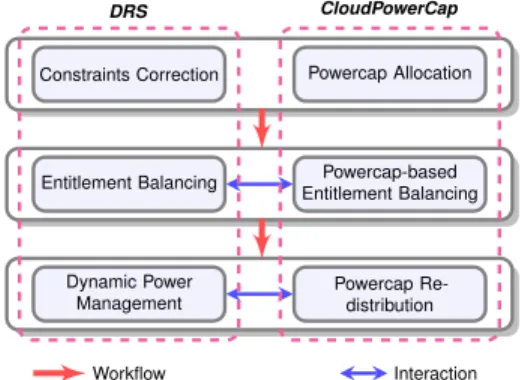
CloudPowerCap is designed to work with a cloud re-source management system with the attributes described in Section 2.3. Since the aim of CloudPowerCap is to enforce the cluster power budget while dynamically man-aging hosts’ power caps by closely coordinating with the cloud resource management system, CloudPowerCap consists of three components, as shown in Figure 2, cor-responding to the three major functions of the cloud re-source management system. The three components, cor-responding to main components in DRS, execute step by step and work on two-way interaction with components in DRS.
Constraints Correction Powercap Allocation
Entitlement Balancing Entitlement BalancingPowercap-based
Dynamic Power Management Powercap Re-distribution Interaction Workflow DRS CloudPowerCap
Figure 2: Structure and two-way interaction of CloudPowerCap working with DRS and DPM.
Powercap Allocation: During the powercap alloca-tion phase, potential resource management constraint cor-rection moves may require redistribution of host power caps. Because CloudPowerCap can redistribute the host power caps, the cloud resource management system is able to correct more constraint violations than would be possible with statically-set host power caps.
Powercap-based Entitlement Balancing: If the re-source management system detects entitlement imbal-ance over the user-set threshold, powercap based entitle-ment balancing first tries to reduce the imbalance, by re-distributing power caps without actually migrating VMs between hosts. This is valuable because redistributing power caps, which takes less than 1 millisecond [12], is cheaper than VM live migration in terms of overhead. VM live migration engenders CPU and memory overhead on both the source and target hosts to send the VM’s
vir-tual device state, to update its external device connections, to copy its memory one or more times to the target host while tracing the memory to detect any writes requiring recopy, and to make the final switchover [22]. While the migration cost may be transparent to the VMs if there is sufficient host headroom, reducing or avoiding the cost when possible increases efficiency. Powercap Balancing may not be able to fully address imbalance due to inher-ent physical host capacity limits. If powercap balancing cannot reduce the imbalance below the imbalance thresh-old, the resource management entitlement balancing can address the remaining imbalance by VM migration.
Powercap Redistribution: If the resource manage-ment system powers on a host to match a change in workload demands or other requirements, CloudPower-Cap performs a two-pass power cap redistribution. First it attempts to re-allocate sufficient power cap for that host to power-on. If that is successful and if the system se-lects the host in question after its power-on evaluation, then CloudPowerCap redistributes the cluster power cap across the updated hosts, to address any unfairness in the resulting power cap distribution. Similarly, if the system powers off a host, its powercap can be redistributed fairly to the remaining hosts after the host power-off operation.
4
CloudPowerCap Implementation
We implemented CloudPowerCap to work with the VMware Distributed Resource Scheduler (DRS) [20] along with its optional Distributed Power Management (DPM) [21] feature, though as we noted in Section 2.3, CloudPowerCap could also complement some other dis-tributed resource management systems for virtualiza-tion environments. In this secvirtualiza-tion, we first present an overview of DRS and then detail the design of each CloudPowerCap component and its interaction with its corresponding DRS component.
4.1
DRS Overview
VMware DRS performs resource management for a clus-ter of ESX hypervisor hosts. It implements the features outlined in Section 2.3. By default, DRS is invoked ev-ery five minutes. It evaluates the state of the cluster and considers recommendations to improve that state by ex-ecuting those recommendations in a what-if mode on an internal representation of the cluster. At the end of each invocation, DRS issues zero or more recommendations for execution on the actual cluster.
At the beginning of each DRS invocation, DRS runs a phase to generate recommendations to correct any cluster constraint violations by migrating VMs between hosts. Examples of such corrections include evacuating hosts that the user has requested to enter maintenance or standby mode and ensuring VMs respect user-defined
affinity and anti-affinity business rules. Constraint correc-tion aims to create aconstraint compliant snapshotof the cluster for further DRS processing.
DRS next performs entitlement balancing. DRS em-ploysnormalized entitlementas the load metric of each host. Denoted byNh,normalized entitlementis defined as the sum of the per-VM entitlementsEi for each VM
running on the hosth, divided by the capacity of the host,
Ch, i.e., Nh= ∑CEhi. DRS’s entitlement balancing
algo-rithm uses a greedy hill-climbing technique with the aim of minimizing the overall cluster entitlement imbalance (i.e., the standard deviation of the hosts’ normalized enti-tlements). DRS chooses as each successive move the one that reduces imbalance most, subject to a risk-cost-benefit filter on the move. The risk-cost-benefit filter considers workload stability risk and VM migration cost versus the increased balance benefit given the last 60 minutes of VM demand history. The move-selection step repeats until ei-ther the load imbalance is below a user-set threshold, no beneficial moves remain, or the number of moves gener-ated in the current pass hits a configurable limit based on an estimate of the number of moves that can be executed in five minutes.
DRS then optionally runs DPM, which opportunisti-cally saves power by dynamiopportunisti-cally right-sizing cluster ca-pacity to match recent workload demand, while respect-ing the cluster constraints and resource controls. DPM recommends evacuating and powering off host(s) if the cluster contains sufficient spare resources, and powering on host(s) if either resource demand increases appropri-ately or more resources are needed to meet cluster con-straints.
4.2
Powercap Allocation
Powercap Allocation redistributes power caps if needed to allow DRS to correct constraint violations. DRS’s abil-ity to correct constraint violations is impacted by host power caps, which can limit the available capacity on tar-get hosts. However, as shown in Fig 1a, by increasing the host power cap, the DRS algorithm can be more ef-fective in correcting constraint violations. Hence to aid DRS constraint correction, Powercap Allocation supports redistributing the cluster’s unreserved power budget, i.e., the amount of power not needed to support running VMs’ CPU and memory reservations. The unreserved power budget represents the maximum amount of power cap that can be redistributed to correct violations; insufficient unreserved power budget prevents the correction of con-straint violations.
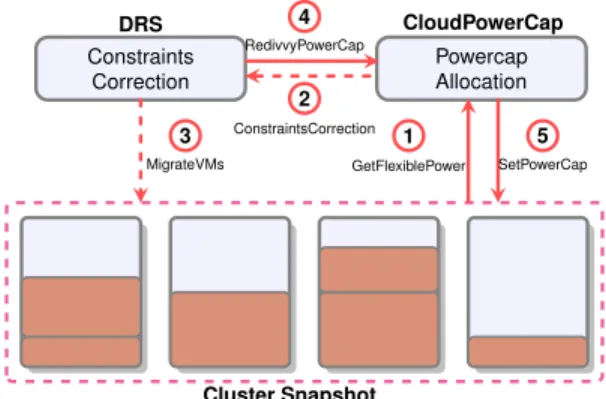
CloudPowerCap and DRS work in coordination, as shown in Figure 3, to enhance the system’s capability to correct constraints violations.
1) Powercap Allocation first callsGetFlexiblePowerto get flexiblePower, which is a special clone of the
Constraints Correction Powercap Allocation DRS CloudPowerCap Cluster Snapshot 1 GetFlexiblePower 2 ConstraintsCorrection 3 MigrateVMs 4 RedivvyPowerCap 5 SetPowerCap
Figure 3: Coordination between CloudPowerCap and DRS to correct constraints. Solid arrows indi-cate invocations of CloudPowerCap functions while dashed arrows indicate invocations of DRS functions.
current cluster snapshot in which each host’s host power cap is set to its reserved power cap, i.e., the minimum power cap needed to support the capacity corresponding to the reservations of the VMs cur-rently running on that host.
2) The flexiblePower is used as a parameter to call
ConstraintsCorrectionfunction in DRS, which rec-ommends VM migrations to enforce constraints and update hosts’ reserved power caps for the new VM placements after the recommended migrations. Then DRS generates an action plan for migrating VMs.
3) As a result of performing ConstraintsCorrection, DRS generates VM migration actions to correct con-straints. Note that when applying VMs migration actions on hosts in the cluster, dependencies are re-spected between these actions and any prerequisite power cap setting actions generated by CloudPower-Cap.
4) If some constraints are corrected by DRS, the power caps of source and target hosts may need to be reallo-cated to ensure fairness. For this case, RedivvyPow-erCapof CloudPowerCap is called to redistribute the power cap.
5) Finally Powercap Allocation generates actions to set the power cap of hosts in the cluster according to the results ofRedivvyPowerCap.
The key function in Powercap Allocation is Redivvy-PowerCap, in which the unreserved power budget is re-distributed after the operations for constraint violation correction. The inputs to this function are S (the current snapshot of the cluster) and updated snapshot F (after the constraint correction recommended by DRS). The ob-jective of RedivvyPowerCap is to distribute the cluster power budget according toproportional resource shar-ing [23] for maintaining fairness of unreserved power budget distribution across hosts after the constraint cor-rection. The actions to change host power cap on hosts
are also generated if the hosts need more power cap than those inSor less power cap without violating VM reser-vation. Note these sets of power cap changes are made appropriately dependent on the actions generated by DRS to correct the constraint violations.
Algorithm 1Powercap Allocation
S,F: cluster snapshots before and after constraints correc-tion;
Ci,S,Ci,F power cap of the hosthiinSandF;
1: functionREDIVVYPOWERCAP(S,F)
2: Cneeded←0,Cexcess←0
3: foreach hosthiin the clusterdo
4: if Ci,F>Ci,Sthen 5: SetPowerCap(hi,Ci,F) 6: Cneeded←Cneeded+ (Ci,F−Ci,S) 7: else 8: Cexcess←Cexcess+ (Ci,S−Ci,F) 9: end if 10: end for 11: ifCneeded>0then 12: r←Cneeded/Cexcess
13: foreach hosthiin the clusterdo
14: ifCi,F≤Ci,Sthen 15: Ci,F←Ci,F+r(Ci,S−Ci,F) Proportional sharing 16: SetPowerCap(hi,Ci,F) 17: end if 18: end for 19: end if 20: end function
4.3
Entitlement Balancing
Entitlement balancing is critical for systems managing distributed resources, to deliver resource entitlements and improve the responsiveness to bursts in resource de-mand, and is achieved by migrating VMs between hosts. For resource management systems like DRS without the concept of dynamic host capacity, entitlement balancing achieves both of these goals by reducing imbalance via migrating VMs between hosts. However, with dynamic power cap management, CloudPowerCap can alleviate imbalance by increasing the power caps of heavy loaded hosts while reducing the power caps of lightly loaded hosts rather than migrating VMs between those hosts as shown in Figure 1c. Considering the almost negligible overhead of power cap reconfiguration comparing to VM migration, Powercap-based Entitlement Balancing is pre-ferred to DRS entitlement balancing when the cluster is imbalanced. However, because power cap adjustment has a limited range of operation, Powercap-based Entitlement Balancing may not fully eliminate imbalance in the clus-ter. But the amount of VM migration involved in DRS entitlement balancing can be reduced significantly.
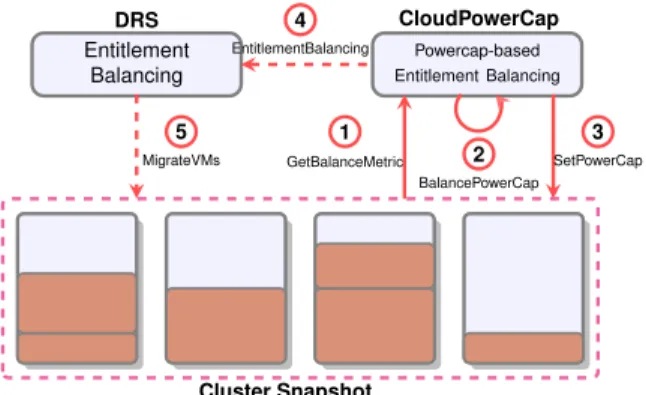
Entitlement Balancing Powercap-based Entitlement Balancing DRS CloudPowerCap Cluster Snapshot 1 GetBalanceMetric 2 BalancePowerCap 3 SetPowerCap 4 EntitlementBalancing 5 MigrateVMs
Figure 4: Work flow of Powercap-based Entitlement Balancing and its interaction with DRS entitlement balancing. Solid arrows indicate invocations of Cloud-PowerCap functions while dashed arrows indicate in-vocations of DRS functions.
The process of powercap based entitlement balancing and its interaction with DRS load balancing are shown in Figure 4.
1) To acquire the status of entitlement imbalance of the cluster, Powercap-based Entitlement Balancing first calculates the DRS imbalance metric for the cluster (i.e., the standard deviation of the hosts’ normalized entitlements).
2) Then Powercap-based Entitlement Balancing tries to reduce the entitlement imbalance among hosts by adjusting their power caps in accordance with their normalized entitlements.
3) If Powercap-based Entitlement Balancing is able to impact cluster imbalance, its host power cap redis-tribution actions are added to the recommendation list, with the host power cap reduction actions being prerequisites of the increase actions.
4) If Powercap-based Entitlement Balancing has not fully balanced the entitlement among the hosts, DRS entitlement balancing is invoked on the results of Powercap-based Entitlement Balancing to reduce en-titlement imbalance further.
5) DRS may generate actions to migrate VMs.
The sketch of the key function BalancePowerCapin Powercap-base Entitlement Balancing is shown in Algo-rithm 2, which was developed along the lines of progres-sive fillingto achieve max-min fairness [3]. The algo-rithm progressively increases the host power cap of the host(s) with highest normalized entitlement while pro-gressively reducing the host power cap of the host(s) with lowest normalized entitlement . This process is repeated until either the DRS imbalance metric crosses the balance threshold or any of the host(s) with highest normalized entitlement reach their peak capacity and hence further reduction in overall imbalance is limited by those hosts.
Algorithm 2Powercap-based Entitlement Balancing
S,F: cluster snapshot before and after Powercap Based Entitlement Balancing
h,l: hosts with highest and lowest normalized entitlement ˆ
Ci: peak capacity of the hosti
¯
Ci: capacity of the hosticorresponding to average
normal-ized entitlement of the cluster
1: functionBALANCEPOWERCAP(S)
2: F←S, pcBal←false
3: while Cluster is imbalanceddo
4: Choosehandlfrom the cluster
5: Cneeded←min(Cˆh,C¯h)−Ch
6: Cavail←Cl−C¯l
7: if Cneeded=0 orCavail=0then
8: break Then invoke DRS entitlement balancing
9: else
10: pcBal←true
11: end if
12: AddCavailtohand reduceCneededfroml
13: Recompute cluster balance metric onF
14: end while
15: ifpcBal = truethen
16: Set power cap of hosts according toF
17: end if
18: returnF
19: end function
4.4
Powercap Redistribution
Powercap Redistribution responds to DPM dynamically powering on/off hosts. When CPU or memory utilization becomes high, DPM recommends powering on hosts and redistributing the VMs across the hosts to reduce per-host load. Before the host is powered on, Powercap Redistri-bution ensures that sufficient power cap is assigned to the powering-on host. On the other hand, when both CPU and memory utilization are low for a sustained period, DPM may recommend consolidating VMs onto fewer hosts and powering off the remaining hosts to save en-ergy. In this case, Powercap Redistribution distributes the power caps of the powered-off hosts among the active hosts to increase their capacity.
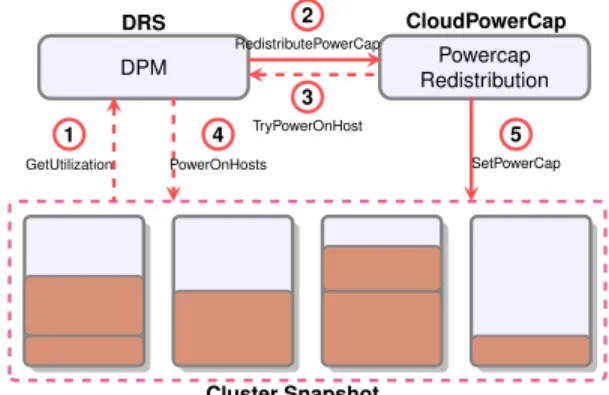
DPM RedistributionPowercap DRS CloudPowerCap Cluster Snapshot 1 GetUtilization 2 RedistributePowerCap 3 TryPowerOnHost 5 SetPowerCap 4 PowerOnHosts
Figure 5: Coordination between CloudPowerCap and DRS and DPM in response to power on/off hosts. Solid arrows indicate to invoke CloudPowerCap func-tions while dashed arrows indicate to invoke DRS functions.
The coordination between Powercap Redistribution and DPM when DPM attempts to power on a host is de-picted in Figure 5.
1) If there is sufficient unreserved cluster power budget to set the target host’s power cap to peak, the host obtains its peak host power cap from the unreserved cluster power budget and no power cap redistribu-tion is needed.
2) If the current unreserved cluster power budget is not sufficient, RedistributePowerCapis invoked to al-low the powering-on candidate host to acquire more power from those hosts with lower CPU utilization.
3) DPM decides whether to power on the candidate host given its updated power cap after redistribution and its ability to reduce host high utilization in the cluster.
4) If the host is chosen for power-on, the normal DPM function is invoked to generate the action plan for powering on the host.
5) If DPM decides to recommend the candidate power-on, any needed host power cap changes are recom-mended as prerequisites to the host power-on. The algorithm of redistributing power caps is straight-forward. To acquire sufficient power caps to power on a host, the hosts with lower utilization have their power caps reduced under the constraint of not causing those hosts to enter the high utilization range that would trigger DPM to power on another host.
When a host is being considered for powering-off, the portion of its host power cap currently above its utiliza-tion could be made available for redistribuutiliza-tion to other powered-on hosts whose host power caps are below peak, providing more target capacity for evacuating VMs.
4.5
Implementation Details
We implemented CloudPowerCap on top of VMware’s production version of DRS. Like DRS, CloudPowerCap is written in C++. The entire implementation of Cloud-PowerCap comprises less than 500 lines of C++ code, which demonstrates the advantage of instantiating power budget management as a separate module that coordi-nates with an existing resource manager through well-defined interfaces.
As described previously in this section, DRS operates on a snapshot of the VM and host inventory it is man-aging. The main change we made for DRS to interface with CloudPowerCap was to enhance the DRS method for determining a host’s CPU capacity to reflect the host’s current power cap setting in the snapshot. Other small changes were made to support the CloudPowerCap func-tionality, including specifying the power budget, intro-ducing a new action that DRS could issue for changing a host’s power cap, and providing support for testability.
During CloudPowerCap initialization, for each host, the mapping between its current power cap and its effec-tive capacity is established by the mechanisms described in Section 2.1. For a powered-on host, the power cap value should be in the range between the host’s idle and peak power. When computing power-capped capacity of a host based on the power model (3), it is important to ensure that the capacity reserved by the hypervisor on the host is fully respected. Hence, the power-capped capacity
Cmcappedmanaged by the resource management system,
i.e., managed capacity, is computed as:
Cmcapped=Ccapped−CH, (4)
where the power-capped raw capacity Ccapped is
com-puted using Equation (1) andCH is the capacity reserved
by the hypervisor.
The implementation of Powercap Allocation entailed updating corresponding DRS methods to understand that a host’s effective capacity available for constraint cor-rection could be increased using the unreserved power budget, and adding a powercap redivvy step optionally run at the end of the constraint correction step. Power-cap Balancing, which leverages elements of the powerPower-cap redivvying code, involved creating a new method to be called before the DRS balancing method. Powercap Re-distribution changed DPM functions to consider whether to turn on/off hosts based not only on utilization but also on the available power budget.
5
Evaluation
In this section, we evaluate CloudPowerCap in the DRS simulator under three interesting scenarios. The first ex-periment evaluates CloudPowerCap’s capability to rebal-ance normalized entitlement among hosts while avoiding the overhead of VM migration. The second experiment shows CloudPowerCap reallocates the power budget of a
powered-off host to allow hosts to handle demand bursts. The third experiment shows how CloudPowerCap allows CPU and memory capacity trade-offs to be made at run-time. This experiment includes a relatively large host inventory to show the capacity trade-offs at scale.
In these experiments, we compare CloudPowerCap against two baseline approaches of power cap manage-ment: StaticHighand Static. Both approaches assign equal power cap to each host in the cluster at the be-ginning and maintain those power caps throughout the experiment. StaticHighsets power cap of the host to its peak power, maximizing throughput of CPU intensive ap-plications. However for applications in which memory or storage become constrained resources, it can be ben-eficial to support more servers to provision more mem-ory and storage. Hence inStatic, the power cap of a host is intentionally set lower than the peak power of the host. Compared withStaticHigh, more servers may be placed withStaticto enhance the throughput of applica-tions with memory or storage as constrained resources. However both approaches lack the capability of flexible power cap allocation to respond to workload spikes and demand variation.
5.1
DRS Simulator
The DRS simulator [8] is used in developing and testing all DRS algorithm features. It provides a realistic execu-tion environment, while allowing much more flexibility and precision in specifying VM demand workloads and obtaining repeatable results than running on real hard-ware.
The DRS simulator simulates a cluster of ESX hosts and VMs. A host can be defined using parameters in-cluding number of physical cores, CPU capacity per core, total memory size, and power consumption at idle and peak. A VM can be defined in terms of number of con-figured virtual CPUs (vCPUs) and memory size. Each VM’s workload can be described by an arbitrary func-tion over time, with the simulator generating CPU and memory demand for that VM based on the specification. Given the input characteristics of ESX hosts and the VMs’ resource demands and specifications, the simula-tor mimics ESX CPU and memory schedulers, allocating resources to the VMs in a manner consistent with the be-havior of ESX hosts in a real DRS cluster. The simulator supports all the resource controls supported by the real ESX hosts. The simulator calculates VMs migration cost in accordance with several realistic factors, for example, VMs’ read/write memory access and the available I/O and network bandwidth. The simulator also models the ESX hypervisor CPU and memory overheads.
The simulator is able to estimate the power consump-tion of the ESX hosts based on the power model given in Equation (1) in Section 2.2. For this work, the
sim-ulator was updated to respect the CPU capacity impact associated with a host’s power cap.
5.2
Headroom Rebalancing
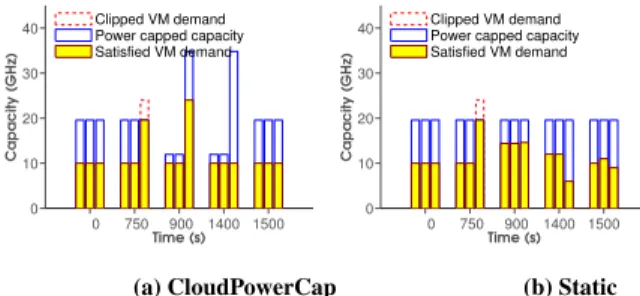
CloudPowerCap can reassign power caps to balance head-room for bursts, providing a quick response to workload imbalance due to VM demand changes. Such reassign-ment of power caps can improve robustness of the cluster and reduce or avoid the overhead of VM migration for load balancing. To evaluate impact of CloudPowerCap on headroom balancing, we perform an experiment in which 30 VMs, each with 1vCPU and 8GB memory, run on 3 hosts with the configuration shown in Table 1. Figures 6a and 6b plot the simulation results under CloudPowerCap and Static with a static power cap allocation of 250W per host, respectively. Initially, at time 0 seconds, the VMs are each executing similar workloads of 1 GHz CPU and 2 GB memory demand, and are evenly distributed across the hosts. At time 750 seconds, the VMs on one host spike to 2.4 GHz demand, thereby increasing the demand on that host above its power-capped capacity. When DRS is next invoked at time 900 seconds (running every 300 seconds by default), its goal is to rebalance the hosts’ normalized entitlements. Under the static power cap, DRS migrates the VMs to balance the normalized entitle-ments. In contrast, CloudPowerCap reassigns the hosts’ power caps to reduce the caps on the light-loaded hosts (to 215W) and increase them on the heavy-loaded host (to 320W). This addresses the host overutilization and imbalance without requiring vMotion latency and over-head, which is particularly important in this case, since the overhead further impacts the workloads running on the overutilized host. At time 1400 seconds, the 2.4 GHz VM demand spike ceases, and those VMs resume running at their original 1 GHz demand until the experiment ends at time 2100 seconds. Again, CloudPowerCap avoids the need for migrations by reassigning the host power caps to their original values. In contrast, Static performs two DRS entitlement balancing phases and migrates several VMs at time 900 seconds and 1500 seconds.
0 750 900 1400 1500 0 10 20 30 40 Capacity (GHz) Time (s) Clipped VM demand Power capped capacity Satisfied VM demand (a) CloudPowerCap 0 750 900 1400 1500 0 10 20 30 40 Capacity (GHz) Time (s) Clipped VM demand Power capped capacity Satisfied VM demand
(b) Static
Figure 6: Headroom balancing on a group of 3 hosts. Hosts are grouped at each event time.
CPU Payload Ratio vMotion
CPC 0.99 0
Static 0.89 7
StaticHigh 1.00 0
Table 3: CloudPowerCap (CPC) rebalancing without migration overhead
Table 3 compares the CPU payload delivered to the VMs under CloudPowerCap, Static using 250W static host power caps, as well as StaticHigh using the power caps equivalent to the peak capacity of the host. For Static, the vMotion CPU overhead has a significant over-all impact on the CPU payload delivered to the VMs be-cause the host is overutilized during the burst and the cycles needed for vMotion directly impact those avail-able for VM use. For CloudPowerCap, there is a rela-tively small impact to performance after the burst and be-fore DRS can run CloudPowerCap to reallocate the host power caps. The power cap setting operation itself can be executed by the host within 1 millisecond and introduces minor payload overhead.
5.3
Standby Host Power Reallocation
CloudPowerCap can reallocate standby hosts’ power cap to increase the capacity of powered-on hosts and thereby their efficiency and ability to handle bursts. To demon-strate this, we consider the same initial setup in terms of hosts and VMs as in the previous experiment. In this case, all VMs are running a similar workload of 1.2 GHz and 2 GB memory demand. At time 750 seconds, each VM’s demand reduces to 400 MHz, and when DRS is next in-voked at time 900 seconds, DPM recommends that the VMs be consolidated onto two hosts and that another host is powered-off. After the host has been evacuated and powered-off at time 1200 seconds, CloudPowerCap reas-signs its power cap to 0 and reallocates the rack power budget to the two remaining hosts, setting their power caps to 320W each. At time 1400 seconds, there is an un-expected spike. In the case of statically-assigned power caps, the host that was powered-off is powered back on to handle the spike, but in the CloudPowerCap case, the ad-ditional CPU capacity available on the 2 remaining hosts given their 320 W power caps is sufficient to handle this spike and the powered-off host is not needed.
CPU Payload Ratio vMotion Power Ratio
CPC 1.00 10 1.00
Static 0.98 19 1.36
StaticHigh 1.00 10 1.00
Table 4: CloudPowerCap (CPC) reallocating standby host power
to the VMs for CloudPowerCap, Static, and StaticHigh. In this case, a number of additional vMotions are needed for Static, but the overhead of these vMotions does not significantly impact the CPU payload, because there is plenty of headroom to accomodate this overhead. How-ever, Static consumes much more power than the other 2 cases, since powering the additional host back on and repopulating it consumes significant power. In contrast, CloudPowerCap is able to match the power efficiency of the baseline, by being able to use peak capacity of the powered-on hosts.
5.4
Flexible Resource Capacity
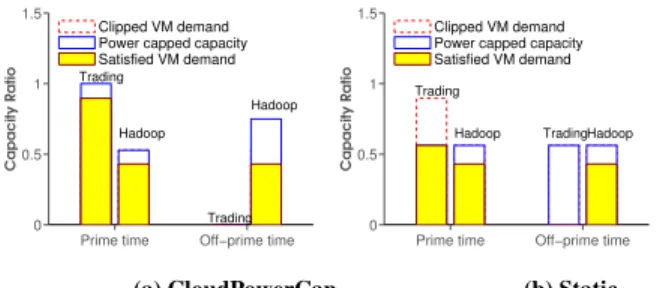
CloudPowerCap supports flexible use of power to allow trade-offs between resource capacities to be made dynam-ically. To illustrate such a trade-off at scale, we consider a cluster of hosts as described in Section 2.1. We model the situation in which the cluster is used to run both pro-duction trading VMs and propro-duction hadoop compute VMs. The trading VMs are configured with 2 vCPUs and 8 GB and they are idle half the day (off-prime time), and they run heavy workloads of 2x2.6 GHz and 7 GB demand the other half of the day (prime time). They access high-performance shared storage and hence are constrained to run on hosts with access to that storage, which is only mounted on 8 hosts in the cluster. The hadoop compute VMs are configured with 2 vCPUs and 16 GB and each runs a steady workload of 2x1.25 GHz and 14 GB demand. They access local storage and hence are constrained to run on their current hosts and cannot be migrated. During prime time, the 8 servers running the trading VMs do not receive tasks for the hadoop VMs running on those servers; this is accomplished via an elas-tic scheduling response to the reduced available resources [25]. Figure 7 shows the simulation results of the clus-ter under CloudPowerCap and the Static configuration of power caps.
Prime time Off−prime time 0 0.5 1 1.5 Capacity Ratio Trading Hadoop Trading Hadoop Clipped VM demand Power capped capacity Satisfied VM demand
(a) CloudPowerCap
Prime time Off−prime time 0 0.5 1 1.5 Capacity Ratio Trading Hadoop TradingHadoop Clipped VM demand Power capped capacity Satisfied VM demand
(b) Static
Figure 7: Trade-offs between dynamic resource ca-pacities. Trading indicates a group of servers run-ning production trading VMs while Hadoop repre-sents servers run production Hapdoop compute VMs.
Table 5 compares the CPU and memory payload de-livered for three scenarios, and shows the impact on the
trading VMs. The staticHigh scenario involves deploying 25 servers with power caps of 320 W, which immediately and fully supports the trading VMs prime time demand but limits the overall available memory and local disks in the cluster associated with the 25 servers. The Static scenario instead involves deploying 32 servers with each host power cap statically set to 250 Watts. This scenario allows more memory and local disks to be accessed, in-creasing the overall CPU and memory payload delivered because more hadoop work can be accomplished, but lim-its the peak CPU capacity of each host, meaning that the trading VMs run at only 62 percent of their prime time de-mand. With CloudPowerCap, the benefits to the hadoop workload of the static scenario are retained, but the power caps of the hosts running the trading VMs can be dynam-ically increased, allowing those VMs’ full prime time demand to be satisfied.
CPU Ratio Mem Ratio Trading Ratio
CPC 1.24 1.28 1.00
Static 1.21 1.28 0.62
StaticHigh 1.00 1.00 1.00
Table 5: CloudPowerCap (CPC) enabling flexible re-source capacity. Trading ratio indicates the ratio that production trading VMs demands in prime time are satisfied.
6
Related Work
Several research projects have considered power cap man-agement for virtualized infrastructure [18, 16, 14, 24, 17]. Among them, the research most related to our work is [17], in which authors proposed VPM tokens, an ab-straction of changeable weights, to support power bud-geting in virtualized environment. Like our work, VPM tokens enables shiftingpower budget slackwhich corre-sponds toheadroomin this paper, between hosts. How-ever the power cap management system based on VPM tokens are independent of resource management systems and may generate conflicting actions without coordina-tion mechanisms.
In contrast, interoperating with a cloud resource man-agement system like DRS also allows CloudPowerCap to support interesting additional features: 1) CloudPow-erCap accommodates consolidation of physical servers caused by dynamic power management while previous work assumed a fixed working server set, 2) CloudPower-Cap is able to handle and facilitate VM migration caused by correcting constraints imposed on physical servers and VMs, 3) CloudPowerCap can also deal with and enhance power cap management in the presence of load balancing. In most previous work, only part of these features are provided.
The authors of [18] describe managing performance and power management goals at server, enclosure, and data center level and propose handling the power cap hierarchically across multiple levels. Optimization and feedback control algorithms are employed to coordinate the power management and performance indices for en-tire clusters. In [24], the authors build a framework to coordinate power and performance via Model Predictive Control through DVFS (Dynamic Voltage and Frequency Scaling). To provide power cap management through the VMs management layer, [16] proposed throttling VM CPU usage to respect the power cap. In their approach, feedback control is also used to enforce the power cap while maintaining system performance. Similarly, the authors in [14] also discussed data center level power cap management by throttling VM resource allocation. Like [18], they also adopted a hierarchical approach to coordinate power cap and performance goals.
While all of these techniques attempt to manage both power and performance goals, their resource models for the performance goals are incomplete in various ways. For example, none of the techniques support guaranteed SLAs (reservations) and fair share scheduling (shares). Some build a feedback model needing application-level performance metrics acquired from cooperative clients, which is rare especially in public clouds [2].
7
Conclusion
Many modern data centers have underutilized racks. Server vendors have recently introduced support for per-host power caps, which provide a server-enforced limit on the amount of power that the server can draw, improv-ing rack utilization. However, this approach is tedious and inflexible because it needs involvement of human op-erators and does not adapt in accordance with workload variation. This paper presents CloudPowerCap to man-age a cluster power budget for a virtualized infrastructure. In coordination with resource management, CloudPow-erCap provides holistic and adaptive power budget man-agement framework to support service level agreements, fairness in spare power allocation, entitlement balancing and constraint enforcement.
References
[1] BELOGLAZOV, A.,ANDBUYYA, R. OpenStack Neat: A Frame-work for Dynamic Consolidation of Virtual Machines in Open-Stack Clouds - A Blueprint. Tech. rep., CLOUDS-TR-2012-4, The University of Melbourne, 2012.
[2] BEN-YEHUDA, O. A., BEN-YEHUDA, M., SCHUSTER, A.,
ANDTSAFRIR, D. The resource-as-a-service (RaaS) cloud. In
HotCloud’12(2012).
[3] BERTSEKAS, D., GALLAGER, R.,ANDHUMBLET, P. Data networks. Prentice-Hall, 1992.
[4] DAVIS, J., RIVOIRE, S.,ANDGOLDSZMIDT, M. Star-Cap: Clus-ter Power Management Using Software-Only Models. Tech. rep., MSR-TR-2012-107, Microsoft Research, 2012.
[5] DELLINC. Dell Energy Smart Management.
[6] FAN, X., WEBER, W.-D.,ANDBARROSO, L. A. Power pro-visioning for a warehouse-sized computer. SIGARCH Comput. Archit. News 35, 2 (June 2007), 13–23.
[7] GARTNERRESEARCH. Shrinking Data Centers: Your Next Data Center Will Be Smaller Than You Think.
[8] GULATI, A., HOLLER, A., JI, M., SHANMUGANATHAN, G.,
WALDSPURGER, C.,ANDZHU, X. VMware Distributed
Re-source Management: Design, Implementation, and Lessons Learned.VMware Technical Journal(Mar 2012).
[9] GULATI, A., SHANMUGANATHAN, G., HOLLER, A.,ANDAH
-MAD, I. Cloud-scale resource management: challenges and tech-niques. InHotCloud(2011).
[10] HAMILTON, J. Overall data center costs.
[11] HEWLETT-PACKARD, INTEL, MICROSOFT, PHOENIX, AND
TOSHIBA. Advanced Configuration and Power Interface
Spec-ification. Tech. rep., 2011.
[12] HP INC. HP Power Capping and HP Dynamic Power Capping for Proliant Servers.
[13] IBM INC. IBM Active Energy Manager.
[14] LIM, H., KANSAL, A.,ANDLIU, J. Power Budgeting for Virtu-alized Data Centers. InUSENIX ATC(2011).
[15] MINAS, L.,ANDELISON, B. The problem of power consumption in servers, 2009.http://software.intel.com. [16] NATHUJI, R., ENGLAND, P., SHARMA, P.,AND SINGH, A.
Feedback driven QoS-aware power budgeting for virtualized servers. InFeBID(2009).
[17] NATHUJI, R., SCHWAN, K., SOMANI, A.,ANDJOSHI, Y. VPM tokens: virtual machine-aware power budgeting in datacenters.
Cluster computing(2009).
[18] RAGHAVENDRA, R., RANGANATHAN, P., TALWAR, V., WANG, Z.,ANDZHU, X. No power struggles: Coordinated multi-level power management for the data center. InACM SIGARCH Com-puter Architecture News(2008), vol. 36, ACM, pp. 48–59. [19] STRUNK, A. Costs of Virtual Machine Live Migration: A Survey.
InIEEE Eighth World Congress on Services(2012).
[20] VMWARE, INC. Resource Management with VMware DRS, 2006.
[21] VMWARE, INC. VMware Distributed Power Management Con-cepts and Use, 2010.
[22] VMWARE, INC. VMware vSphere vMotion: Architecture, Per-formance, and Best Practices in VMware vSphere 5, 2011. [23] WALDSPURGER, C. A.,ANDWEIHL, W. E. Lottery
schedul-ing: flexible proportional-share resource management. InOSDI
(1994), USENIX Association.
[24] WANG, X.,ANDWANG, Y. Coordinating Power Control and Performance Management for Virtualized Server Clusters.IEEE Transactions on Parallel and Distributed Systems 22, 2 (Feb. 2011), 245–259.
[25] WHITE, T.Hadoop: The Definitive Guide. O’Reilly Media, 2009. [26] WUHIB, F., STADLER, R.,ANDLINDGREN, H. Dynamic re-source allocation with management objectives - Implementation for an OpenStack cloud. InCNSM(2012), IEEE.