Home energy labelling
Strategic Plan for Labelling of Part 9 Residential Buildings
in B.C.
Tom-Pierre Frappé-Sénéclauze • Ellen Pond • Alison Cretney The Pembina Institute
Disclaimer
This document is an independent report prepared exclusively as information for BC Hydro, with funding from the BC Real Estate Foundation..
The views and opinions expressed in this report are those of the author(s).
The information, statements, statistics and commentary (together the ‘information’) contained in this report have been prepared by the Pembina Institute from publicly available material and from discussions held with stakeholders. The Pembina Institute does not express an opinion as to the accuracy or completeness of the information provided, the assumptions made by the parties that provided the information or any conclusions reached by those parties.
The Pembina Institute has based this report on information received or obtained, on the basis that such information is accurate and, where it is represented to The Pembina Institute as such,
complete.
About the Pembina Institute
Leading Canada’s transition to a clean energy future.
The Pembina Institute is a national non-partisan think tank that advances clean energy solutions through research, education, consulting and advocacy. We have spent close to three decades working to reduce the environmental impacts of Canada’s energy production and use in several key areas:
• driving down energy demand by encouraging energy efficiency and transportation powered with cleaner energy sources;
• promoting pragmatic policy approaches for governments to avoid dangerous climate change, such as increasing the amount of renewable energy plugged into our electricity grids;
• and — recognizing that the transition to clean energy will include fossil fuels for some time — advocating for responsible development of Canada’s oilsands and shale gas resources.
For more information about the Pembina Institute, visit www.pembina.org. The Pembina Institute
610-55 Water Street Vancouver, B.C. Canada V6B 1A1 Phone: 604-874-8558
Acknowledgements
The Pembina Institute would like to acknowledge the generous financial and in-kind support of: • The Real Estate Foundation of B.C.
• BC Hydro
We would also like to thank all those that have provided comments during the stakeholder engagement phase of this project:
Chris Higgins, Vancouver Greg McCall, Vancouver Mike Vander North Vancouver Tim Ryce, North Vancouver
Ryan Schmidt, Township of Langley Allison Ashcroft, Victoria
Norm Connelly, New Westminster Robert Lawrence, Nanaimo
Winnie Yip, Port Moody Penny Marten, UBC
Brigid Reynolds, North Cowichan Mia Oldenburg, North Cowichan Rory Tooke, Surrey
Nat Gosman, MEM
Katherine Muncaster, MEM Zachary May, BSSB Rylan Nowell, MEM
Remi Charron, Home Owner Protection Jocelyn Yu, BC Hydro
Toby Lau, BC Hydro
Cynthia Curll, BC Hydro Beth Ringdahl, FortisBC Ned Georgy, FortisBC Robert Schuster, FortisBC
Peter Sundberg, City Green Solutions Ryan Coleman, EcoLighten
Peter Robinson, CEA Patricia Bell, CEA
Paul DaDalt, Quadra Homes Ron Rapp, Morningstar Homes Robert Deeks, RDC Fine Homes Gilbert Larocque, APEG
Maura Gatensby, AIBC Mark Sakai, GVHBA Vanessa Joehl, BCHBA Norma Miller, BCREA Damian Stathonikos, BCREA Harriet Permutt, GVREB Phil Moore, Re/Max, Burnaby Rob Grey, Re/Max, Nanaimo
Note that the Pembina Institute is the sole author of this strategic plan, and that the views expressed here do not necessarily represent the views of the stakeholders.
Special thanks to Katherine King (BC Hydro), Peter Sundberg (City Green Solutions), Erik Blair (Metro Vancouver) and Eve Hou (Metro Vancouver) for their input on this document.
Home Energy Labelling
Energy Efficient Buildings for B.C.
Contents
Executive summary ... 1 Introduction ... 8 Context ... 8 Timeliness ... 8 Scope ... 8 Structure ... 9 Definitions ... 10What is home energy labelling? ... 10
Comparative vs endorsement labels ... 11
Asset-based vs operational ratings ... 11
Validated vs unvalidated labels ... 12
Benefits ... 14
Key benefits of labelling ... 14
Summary of research on impacts of labelling — F.A.Q. ... 18
End goal & desired outcomes ... 24
End goal of labelling strategy ... 24
Desired outcomes ... 24
Policy tools ... 27
Levels of application: voluntary or required ... 27
Points of intervention ... 28
Reach ... 28
Agency responsible for regulation and/or implementation ... 29
Policy tool benefits and costs ... 32
Methodology ... 32
Results ... 32
Barriers and solutions ... 39
Key barriers to broad adoption of labelling and critical success factors ... 39
Success factors associated with specific policy tools ... 41
Recommended pathway ... 43
Appendix A. Summary of existing programs ... 46
Appendix B. Modelling assumptions and results ... 54
Appendix C. Does energy labelling affect the price of houses? ... 61
Appendix D. Elements of a ‘best in class’ energy labelling policy ... 63
Appendix E. Five possible pathways for labelling ... 64
List of Figures
Figure 1. Key benefits of asset-based comparative ratings, asset-based endorsement labels, and operational ratings ... 1Figure 2. Benefits and costs of labelling policy tools, by 2020 ... 4
Figure 3. Benefits and costs of labelling policy tools, by 2030 ... 5
Figure 4. New EnerGuide label ... 10
Figure 5. The five components of labelling ... 10
Figure 6. ‘Green’ or ‘best in class’ certification labels ... 11
Figure 7. Key benefits associated with the five components of home energy labelling ... 14
Figure 8. Key benefits of asset-based comparative ratings, asset-based ratings, and operational ratings ... 17
Figure 9. Labelling policy tools: level of application and reach ... 27
Figure 10. Segments of real estate market potentially captured by different policies ... 29
Figure 11. Labelling policy tools: past and current examples from B.C. and elsewhere in Canada ... 30
Figure 12. Benefits and costs of labelling policy tools, by 2020 ... 33
Figure 13. Benefits and costs of labelling policy tools, by 2030 ... 34
Figure 14. Logic model: phases and milestones along the recommended pathway ... 45
Figure 15. Pathways to desired outcomes and market transformation ... 65
List of Tables
Table 1. Medium-term outcomes, by target market segments ... 2Table 2. Four policy tools: cumulative costs of labelling, energy savings, and GHG reductions in
Metro Vancouver region by 2020. ... 35
Table 3. Four policy tools: cumulative costs of labelling, energy savings, and GHG reductions in Metro Vancouver region by 2030. ... 35
Table 4. Key barriers and critical success factors for broad adoption of home energy labelling 39 Table 5. Policy implementation: specific barriers and success factors ... 42
Table 6. Past and current home labelling programs in B.C. ... 46
Table 7. Existing mandatory energy labelling programs ... 52
Table 8. Total housing stock (PIE model output) ... 57
Executive summary
For energy efficiency to be valued, it must first be measured in a way that allows comparison. Home energy labelling makes energy performance ‘visible’ to consumers through validated and easy-to-understand energy labels. Once widely adopted, labelling allows energy efficiency to be considered in real estate decisions and improves the business case for energy efficiency
investments.
This strategic plan focuses on accelerating the uptake of EnerGuide labelling in B.C. Natural Resources Canada’s EnerGuide rating system (ERS) can assess new and existing homes,
including single-family homes, duplexes, rowhouses, townhouses, and low-rise apartments. It is an asset based system, meaning that the rating is derived from modelling of energy use after inspection of the home and/or review of schematics; unlike operational labels, it does not rely on consumption data. It applies to all levels of performance, unlike endorsement labels (eg
EnergyStar) which are used to identify ‘best in class’ homes. Figure 1 summarizes the respective benefits of asset-based, endorsement, and operational labels. While this strategy focuses on EnerGuide labelling, each of these tools has a potential role to play in accelerating market transformation for energy efficiency.
Figure 1. Key benefits of asset-based comparative ratings, asset-based endorsement labels, and operational ratings
Labelling system Primary benefits Secondary benefits
Comparative label, asset-based (e.g. EnerGuide)
Energy assessment
(validated rating and homeowner report)
Provides actionable information at key decision point (sale/purchase, renovation)
- prioritizes most effective EE measures by considering house as a system - face-to-face support
- increases number and depth of EE upgrades - (optional add on) energy coaching:
post-evaluation support
Supports Building Code compliance Increases household energy literacy
Public disclosure (label)
(in-house rating label, rating on MLS)
Real estate market can measure and price
home energy performance Facilitates marketing of high performance homes
Data reporting
(to government or utilities)
Assets database informs development of
building code and retrofit programs EE programs and incentives can be targeted to lowest performing homes
Endorsement label, asset-based (e.g. EnergyStar for homes)
Facilitates marketing of high performance homes
Mass benchmarking, consumption-based (e.g. o-power)
Engages occupants on energy behaviour (print or web-based)
EE programs and incentives can be targeted to lowest performing homes Increases household energy literacy Reaches large numbers of homeowners irrespective of sale or renovation plans
Executive summary
Market transformation for energy efficiency occurs when market participants change their behaviour, resulting in higher performing buildings being rewarded in the market, which leads to energy savings. 1
Transforming the market for residential energy efficiency would mean that home energy information is understood by customers, used by realtors, reflected in homebuilders’ decisions and appraisers’ valuations, and accessible to regulators for planning; and that all parties act upon that information. In other words, homeowners and stakeholders change their behaviour.
Broad awareness, availability, affordability, accessiblity and acceptability of home energy labelling information in the real estate industry enables this behaviour change, so that energy efficiency — and its health and comfort benefits — is valued in the residential real estate market. To reach this goal, information about energy efficiency must be made available, that is, a critical mass of houses must be labelled. Which labelling tool is best suited depends on the market segment considered. Table 1 summarizes the medium-term desired outcomes from a labelling strategy in B.C. for different market segments.
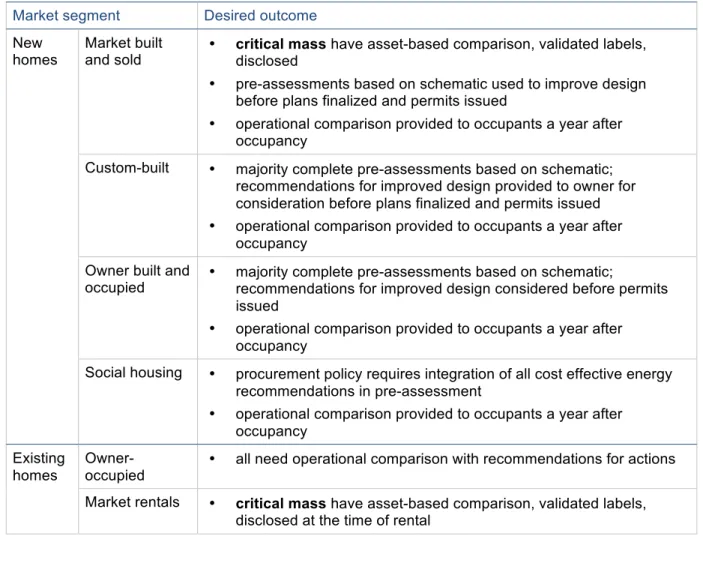
Table 1. Medium-term outcomes, by target market segments
Market segment Desired outcome
New homes
Market built
and sold • critical massdisclosed have asset-based comparison, validated labels,
• pre-assessments based on schematic used to improve design
before plans finalized and permits issued
• operational comparison provided to occupants a year after
occupancy
Custom-built • majority complete pre-assessments based on schematic;
recommendations for improved design provided to owner for consideration before plans finalized and permits issued
• operational comparison provided to occupants a year after
occupancy Owner built and
occupied • majority complete pre-assessments based on schematic; recommendations for improved design considered before permits issued
• operational comparison provided to occupants a year after
occupancy
Social housing • procurement policy requires integration of all cost effective energy recommendations in pre-assessment
• operational comparison provided to occupants a year after
occupancy Existing
homes
Owner-occupied •
all need operational comparison with recommendations for actions Market rentals • critical mass have asset-based comparison, validated labels,
disclosed at the time of rental
1International Partnership for Energy Efficiency Cooperation, Building Energy Rating Schemes: Assessing Issues
Executive summary
• operational comparison provided to occupants with
recommendations for actions
Social housing • procurement policy requires integration of all cost effective energy recommendations at time of renovation
• operational comparison provided to occupants with
recommendations for actions
Offered for sale • critical mass have asset-based comparison, validated labels, disclosed, with recommendations for actions
Renovated • all need asset-based and operational comparison with
recommendations for actions (for renos over a certain size) To be
demolished • exempt from labelling requirements
In addition, data reporting processes must be in place so that utilities, local governments, and other key actors have information on all market segments to enable customized program and policy design. Validated information would be preferred, but unvalidated information could be sufficient for early programs.
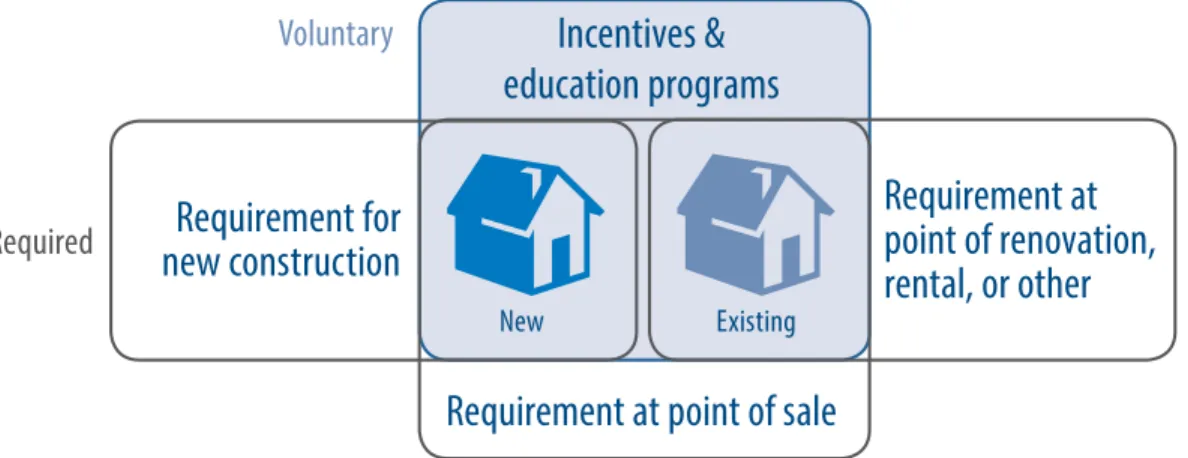
Based on a review of existing programs in B.C. and elsewhere, four key policy tools for accelerating uptake of home energy labelling have been identified: voluntary incentives and education, regulatory requirements for labelling of new construction, regulatory requirements at point of renovation, and regulatory requirements at point of sale. These policies can be
implemented by the provincial government or local governments. Local governments have the jurisdiction to require labelling as part of building permitting and inspections;2 however, B.C. communities do not have the power to require that homes reach a specific energy performance target above the building code, or that energy information be disclosed to third parties.
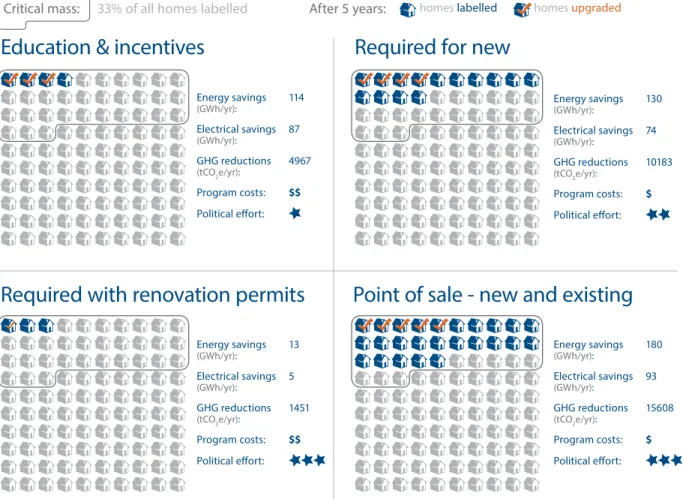
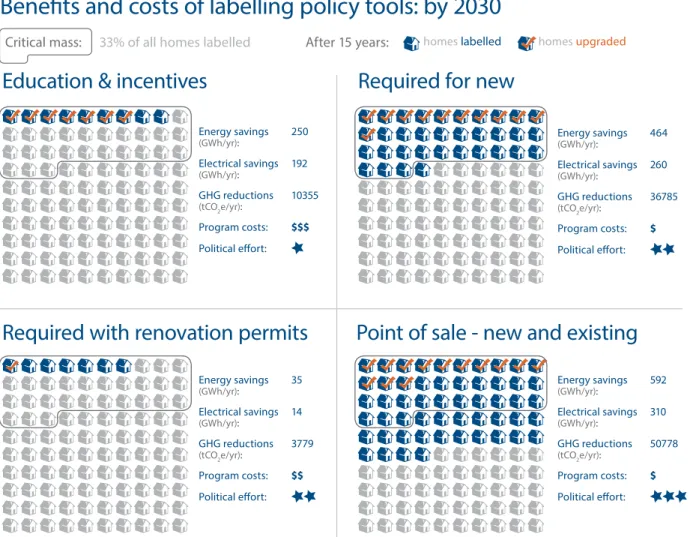
Figure 2 and Figure 3 summarize the impacts of applying such policies in the Metro Vancouver area.
Benefits are quantitatively estimated for the Metro Vancouver region using the BC Hydro PIE model. Benefits include: the number of homes rated; the number of homes upgraded as a result of the rating process; and the annual energy, electricity, and GHG reductions expected between now and 2030.
Program costs are qualitatively assessed, and represent costs incurred by the regulating jurisdiction and/or organization providing incentives.
Labelling costs: are quantitatively assessed based on labelling uptake. Home assessments currently cost approximately $300–350 for existing homes; some incentive programs require a $150 follow-up post-upgrade evaluation (blower door test). Labelling cost estimates are based on a total cost of $500 per assessment. New building assessment costs are higher, ranging from
2 Based on internal Pembina analysis, see T-P Frappé-Sénéclauze, B. Thibault and E. Pond, Energy Labelling for
New Homes: FAQs and Model Bylaw Amendments (Pembina Institute, 2014). http://www.pembina.org/pub/2523. Local governments are recommended to seek their own legal opinion.
Executive summary
$500 to $750 for an as-per-plan and as-built assessment.3 We do not distinguish here whether the cost is born by the homeowner or builder, or covered through program incentives. A full asset-based labelling program would also have reporting costs and administrative costs to maintain the assessment software, hardware and advisor network, as well as to analyze any reported results.
Figure 2. Benefits and costs of labelling policy tools, by 2020
3 Note that labelled homes are eligible for a $2000 incentive from BC Hydro and FortisBC if rated above EG80 (or Energy Star, as of April 2015), and a 10% mortgage insurance rebate from CHMC (worth $800–$1600
approximately) if rated 82 or higher.
Education & incentives
Required for new
Required with renovation permits
Point of sale - new and existing
Bene
fi
ts and costs of labelling policy tools: by 2020
homes upgraded
homes labelled
After 5 years: Critical mass: 33% of all homes labelled
Energy savings (GWh/yr): 13 Electrical savings (GWh/yr): 5 GHG reductions (tCO2e/yr): 1451 Program costs: $$ Political effort: Energy savings (GWh/yr): 114 Electrical savings (GWh/yr): 87 GHG reductions (tCO2e/yr): 4967 Program costs: $$ Political effort: Energy savings (GWh/yr): 130 Electrical savings (GWh/yr): 74 GHG reductions (tCO2e/yr): 10183 Program costs: $ Political effort: Energy savings (GWh/yr): 180 Electrical savings (GWh/yr): 93 GHG reductions (tCO2e/yr): 15608 Program costs: $ Political effort:
Executive summary
Figure 3. Benefits and costs of labelling policy tools, by 2030
Note that the modelling assumes programs begin in 2015.
Not suprisingly, market penetration is the greatest for a labelling requirement at point of sale, which cover the sale of both new houses and existing homes. A province-wide mandatory program has been previously signaled but not yet implemented: the government’s Energy
Efficient Buildings Strategy included an option to “Pursue policies for energy labelling of houses at time of transfer or sale”;4 a more recent, broader commitment was also included in the Pacific Coast Action Plan and reiterated by Minister Bennett.5
Incorporating labelling into the B.C. building code (or other provincial regulation), alongside setting energy performance targets such as maximum ACH or energy use intensity, could streamline compliance. Making compliance significantly simpler than the complex approach currently in place (as of December 2014) would likely be supported by local governments and
4 B.C. Ministry of Energy and Mines, Energy Efficient Buildings Strategy (2008), 15.
http://www.empr.gov.bc.ca/EEC/Strategy/EEBS/Pages/default.aspx
5 Bill Bennett, letter to the Green Building Leaders, March 27, 2014. Available at
http://www.pembina.org/docs/gbl/ministerbennett-response-mar14.pdf
Education & incentives
Required for new
Required with renovation permits
Point of sale - new and existing
Bene
fi
ts and costs of labelling policy tools: by 2030
homes upgraded
homes labelled
After 15 years: Critical mass: 33% of all homes labelled
Energy savings (GWh/yr): 35 Electrical savings (GWh/yr): 14 GHG reductions (tCO2e/yr): 3779 Program costs: $$ Political effort: Energy savings (GWh/yr): 250 Electrical savings (GWh/yr): 192 GHG reductions (tCO2e/yr): 10355 Program costs: $$$ Political effort: Energy savings (GWh/yr): 464 Electrical savings (GWh/yr): 260 GHG reductions (tCO2e/yr): 36785 Program costs: $ Political effort: Energy savings (GWh/yr): 592 Electrical savings (GWh/yr): 310 GHG reductions (tCO2e/yr): 50778 Program costs: $ Political effort:
Executive summary
possibly by builders as well. A 2014 UBCM resolution requesting that labelling be added to the Building Code was endorsed.
However, several market barriers would need to be addressed to reap maximal benefits from such a policy (Table 4). To address some of these barriers and prepare the ground for an
approach that would address both new and existing buildings, we recommend an implementation in three phases:
1. Continue incentives and education programs to prepare the ground and increase market demand for home energy performance services.
Multiple efforts are already underway for this phase: Township of Langley and
Whistler’s incentive programs, New West Energy Save program, Nanaimo realtor pilot program, various local Energy Diets, BC Hydro/Fortis New Home Program, BC Hydro online energy tracking tools, and other efforts by various stakeholders. Expanding the use of certified energy advisors (CEAs) to streamline permitting would also increase
awareness and uptake while reducing permit wait times. The launch of the new ERS should be seized as a key opportunity to educate stakeholders (builders, realtors, home inspectors, loaning agencies, assessors, etc).
Alongside these efforts to promote the use of EnerGuide, utilities and partners should develop and promote robust operational ratings. These operational ratings could be used to reach all homeowners, accessing market segments less likely to pursue asset-based labelling.
2. Once a critical mass of builders are familiar with ERS, require labelling for new constructions (and possibly major renovations).
Labelling could be required through a provincial regulation, or possibly through local permitting (e.g. generalized use of CEAs and EnerGuide labelling as a means for local governments to ensure compliance with energy efficiency). Significant gains have already been made to demonstrate both interest and feasibility. At the 2014 UBCM convention, delegates supported a stand-alone resolution calling on the province to consider a labelling requirement in the Building Code for new Part 9 construction. Similarly, the fact that labelling for new homes has been required in Vancouver since 2009, and adopted by most builders in the City of North Vancouver, shows that it is technically and politically doable, at least in metropolitan areas.6 Using the energy assessments to streamline code compliance, as initiated by the City of Vancouver, can lead to improved performance by new constructions and can benefit builders and local governments by reducing permit processing time.
3. Once a critical mass of real estate agents are familiar with ERS and an adequate home energy performance industry is established, extend the labelling requirement to existing buildings through a point of sale requirement implemented at the
provincial level.
6 Note however that these policies did not require disclosure of the rating on MLS. It is possible that the relatively low profile of the assessment results, while not helping market transformation, might have made it politically easier to advance these policies.
Executive summary
An adequate home energy performance industry must be established to ensure the industry can meet the demand for energy renovations), Similarly, there are efforts underway to lay the groundwork for all these.
Based on our research to date, this phased approach is the most likely to lead to wide adoption of labelling within a reasonable time frame, with the lowest pushback. Market and administrative systems have an opportunity to integrate labelling information first when dealing with new and reasonably efficient homes. Working first with builders before engaging home sellers at large also allows initial engagement to focus on a smaller group of stakeholders already accustomed to meeting permitting requirements.
Ideally, the requirement for new and point of sale labelling could be advanced directly at the provincial level. The best legislative home for such a regulation remains to be identified.
Working with local governments, preferably several within a region, to advance local bylaws (or permitting requirements) can help create a political window for action at the provincial level. Advancing labelling requirements with a few champion local governments provides a hub for innovation and prepares the market for a provincial regulation. Also, assessment requirements at time of renovation are currently best done at the local government level, since there is no
provincial retrofit code.
A variety of actions should be taken in the short term (next one to three years) to prepare the ground for a regulation and to advance market demand for home energy performance. These activities and their desired outcomes are presented in Figure 14.
Introduction
Context
In October 2013, the B.C. government committed to “transform the market for energy efficiency and lead the way to ‘net-zero’ buildings” as part of the Pacific Coast Action Plan on Climate and Energy. The Plan states that “energy efficiency is the lowest cost way to reduce greenhouse gas emissions while creating good local jobs.”7
In February 2014, Minister Bennett reaffirmed B.C.’s direction by stating that the provincial government plans to consider home energy labelling as part of operationalizing the Pacific Coast Action Plan. He referenced the Plan’s call for a “policy that ensures that energy efficiency is valued when buildings are bought and sold.”8
For energy efficiency to be valued, it must first be measured in a way that is comparable. Home energy labelling is one way to make energy performance ‘visible’ to consumers through
validated and easy-to-understand energy labels. Once widely adopted, labelling allows energy efficiency to be considered in real estate decisions and improves the business case for energy efficiency investments. Labelling can be a key tool in market transformation for energy efficiency in the residential sector.
Timeliness
This home energy labelling strategic plan dovetails with several other regional and national initiatives. Setting a strategic direction for labelling will support better integration and success across the following projects:
• NRCan will be rolling out the revised national EnerGuide Rating System in 2015. • Metro Vancouver has committed to the development of a regional labelling program. • The Regional District of Nanaimo and City of Nanaimo are developing realtor programs
and educational materials on labelling that should be replicable across the Province. • There are already a moderate number of energy efficient homes being built by skilled
builders across the province. A home energy labelling initiative would allow these builders to differentiate their homes from other non-energy efficient homes and would motivate private sector innovation and competition.
Scope
Geographic: This strategic plan has been developed for the province of B.C., with modelling and an implementation schedule specific to the Metro Vancouver region.
7 Pacific Coast Collaborative, Pacific Coast Action Plan on Climate and Energy (2013). http://www.pacificcoastcollaborative.org/Documents/Pacific Coast Climate Action Plan.pdf 8 Bill Bennett, letter to the Green Building Leaders.
Introduction
Building type: Home energy labelling under the EnerGuide system applies to low-rise
residential buildings (single-family through to three-storey apartments) covered by Part 9 in the Building Code. Larger multi-unit residential buildings (MURBs), covered under Part 3 on the Building Code, are not included in this plan.
Structure
The definitions section introduces various forms of home energy labelling, differentiating between asset-based and operational labels, comparative and endorsement labels, and validated and unvalidated approaches.
We then present the benefits of asset-based valiated labelling and summarize the literature on impacts of labelling as experienced in jurisdictions that have implemented labelling
requirements.
End goal and desired outcomes lays out the specific outcomes sought by energy labelling in the province of B.C. in the long, medium and short term. This section also explains the key
qualitative benefits of home energy labelling, including labelling’s role in market transformation for energy efficient residential buildings.
Next we investigate policy tools available for home energy labelling, distinguished by
voluntary/mandatory, reach and point of intervention. Four policy tools are explained, followed by a brief synopsis of where they are currently in use.
In benefits and costs, we provide a summary of our methodology, quantitative impacts and cost estimates, along with the political effort required to implement each of the policy tools.
We then turn to barriers and solutions for the desired outcomes, including success factors for for each policy tool.
Based on the impacts/costs and barriers/success factors analysis, we then lay out a
recommended pathway to reach broad adoption of labelling in B.C. in three phases: education and incentives, requirement for new homes, and requirement at point of sale. Specific steps that should be taken in the next one to three years to enable these policies and overcome barriers are discussed, and key milestones are identified.
Appendices include supporting material and a more detailed logic model of the pathways. Alongside this strategic plan, a stakeholder engagement summary present the key findings from discussion with over 40 stakeholders, which informed this plan. An implementation plan for the Metro Vancouver region was also produced. These documents are available upon request.
Definitions
What is home energy labelling?
As shown in Figure 5, home energy labelling programs and policies generally require five components: home energy assessments, comparison again peers or standard to produce a rating, validation by third party to issue labels or
certificates, data reporting to government, and public disclosure of results.
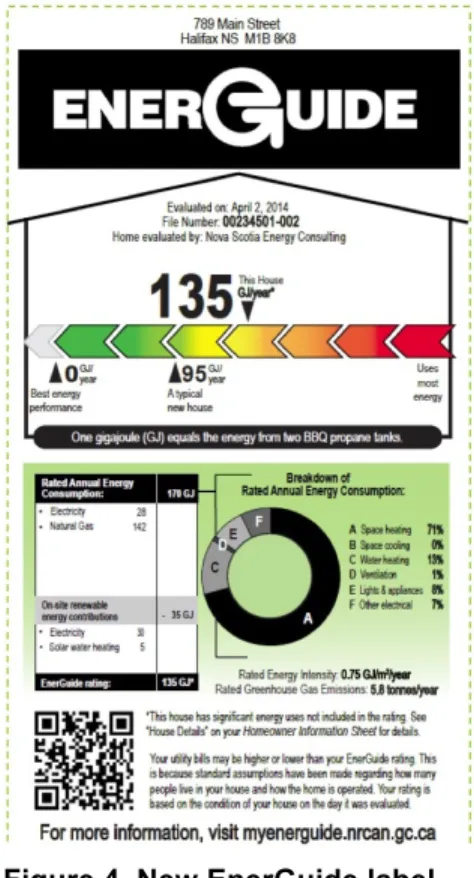
In Canada, residential energy assessments, ratings and validation services are provided by energy advisors certified by Natural Resources Canada. NRCan’s EnerGuide rating system (ERS) can assess new and existing homes, including single-family homes, duplexes, rowhouses, townhouses, and low-rise apartments. The rating is derived from modelling of energy use after inspection of the home and/or review of schematics; it does not rely on consumption data. A revised ERS will be rolled out across Canada in 2015, featuring improvements to the label and assessment methodology, with better reports for builders and
homeowners. Figure 4 is an example of the new label, with the home’s total energy use (GJ/year), energy intensity
Figure 4. New EnerGuide label
(GJ/m2/year) and breakdown of end uses (e.g. space heating).
EnerGuide Energy assessments provide builders and homeowners with reports that include the modelled energy performance of the home, the rating, and energy upgrade options.9
Data reporting occurs when energy advisors submit energy reports to NRCan; the data could also be provided to utilities, provincial and local governments to improve policy design and program delivery.
Public disclosure can be achieved by putting the rating sticker on the home’s electrical panel and providing the information on a public website such as MLS when the house is being sold. Public disclosure is not always required in existing labelling programs, although it is a key driver of market transformation.
Figure 5. The five components of labelling
9 For a more detailed description of the EnerGuide Rating System, see Appendix E in Energy Labelling for New
Homes.
Energy
Assessment
Labelling
Comparative
Rating
Third-Party
Validation
Reporting
Data
Disclosure
Public
EnerGuide evaluationDefinitions
Comparative vs endorsement labels
A comparative label (e.g. EnerGuide) provides information on a particular building’s ranking compared with similar buildings. An endorsement label distinguishes a certified building that fulfills a specific standard (e.g. Energy Star or Passive House) from non-certified buildings.10 The EnerGuide label is a ‘diagnostic’ home energy rating, as it rates the modelled performance of a home, verified with a blower door test. EnerGuide is different from “green” certification programs, such as Built Green, Passive House, R-2000, Energy Star for New Homes11, LivingBuilding, or LEED for Homes, which target high performance homes. Their associated endorsement labels serve to identify and market homes that meet higher environmental standards.
Green certification programs raise the visibility of home energy performance and can help create a market for high performing houses. However, all of the “green” certification programs are currently targeted for new homes. Thus, they are not useful tools to compare the energy performance of existing homes, which constitute the bulk of the building stock. To allow differentiation and valuation of energy performance between existing homes, a comparative labelling system such as EnerGuide is needed, and potentially a “green” or “best in class” label for existing homes.
Also, current “green” certification programs reach less than 20% of the new homes, leaving the remaining 80% of new homes with third-party validation tools, other than EnerGuide Labels.
Figure 6. ‘Green’ or ‘best in class’ certification labels
Because these labels only apply to high-performance homes, they can help to create a market for better houses, but they are not adequate for promoting energy efficiency across the full range of homes in the new and existing building stock.
Asset-based vs operational ratings
Two types of ratings can be used to assess the efficiency of buildings. Asset-based ratings, such as EnerGuide, use building inspections (or analysis of schematics and computer models) to evaluate how a building will perform under standard operation assumptions. Operational
10 International Energy Agency, Energy Performance Certification of Buildings, 2010, 15.
http://www.iea.org/publications/freepublications/publication/buildings_certification.pdf
11 NRCan Energy Star for Home, like EnerGuide, is produced by NRCan. There are two compliance options for new low-rise residential homes: a performance and a prescriptive path. The performance path requires energy modelling of the home, similarly to EnerGuide modelling; it can therefore generate both an EnerGuide and an Energy Star label. The prescriptive path requires a certain set of energy efficiency measures to be taken for the Energy Star label to be awarded. No ‘whole house’ assessment is conducted, and no EnerGuide rating or label is generated. Natural Resources Canada, “ENERGY STAR homes.” http://www.nrcan.gc.ca/energy/efficiency/housing/new-homes/5057
Definitions
ratings, such as Energy Star Portfolio Manager, use actual energy consumption data to compare the performance of buildings against each other.
Asset-based ratings can evaluate building efficiency independently from user behavior, allowing an apple-to-apple comparison between houses. Asset-based ratings are critical to enable real estate markets to compare the performance of houses and assign value to energy efficient features.
Operational ratings mix both building performance and current user behaviour. They are most useful for complex buildings, where building operation and maintenance offer significant opportunities for efficiency gains and for which an asset-based rating would be more costly to generate.
Residential operational ratings can be excellent tools for targeting energy efficiency marketing materials and engaging homeowner in behavior change campaigns,12 as the rating is highly dependent on occupancy and user behavior.
Options for operational rating
For Part 3 (complex) buildings, the EPA has developed a free online Benchmarking tool, Portfolio Manager, now adapted by NRCan for Canada.13 Building owners or managers import their energy use data and provide typical occupancy and building use. They can then see how their building performs compared to other buildings in the database with similar use and occupancy. This tool is available for low-rise residential homes and can produce weather-normalized energy use intensities. However, this tool does not provide Energy Star scores for residential buildings, as the statistical models have not yet been developed by NRCan or EPA.
For Part 9 residential homes, a comparative operational rating can be generated by analysis of utility bills given basic occupancy data. The occupancy data can be provided by the user, as is currently the case in the MyHydro profile tool offered by BC Hydro,14 or could be estimated based on census and property assessment data. Because user behavior varies widely from home to home, it is very difficult to assess the energy performance of the home itself through analysis of utility bills alone without occupancy and behavioral data.
Validated vs unvalidated labels
Both asset-based and operational labels can be based on self-reported information or validated by third parties. Ratings generated from self-reported data are usually cheaper, but validated ratings are more trusted. EnerGuide is an example of a validated rating, while Energy Star Portfolio Manager rating is generally unvalidated, as it is based on data submitted by the building owner/manager (although third-party validation of ESPM ratings are available).
12 See for example the tools offered by O-Power: http://www.opower.com/ 13 Natural Resources Canada, "ENERGY STAR Portfolio Manager."
http://www.nrcan.gc.ca/energy/efficiency/buildings/energy-benchmarking/3751
14https://www.bchydro.com/powersmart/residential/smart_meters___conservation.html ; note that this tool only covers electrical consumption; for a complete energy picture inclusion of both gas and electricity data would be needed.
Definitions
If the label is for self use (e.g. a building owner is trying to understand how efficient the building is for their own use), an unvalidated label may be sufficient. However, if the rating is to be used by a third party (e.g. a homebuyer, building assessor, or financial institution), a validated label would be preferable. Unvalidated ratings can be useful to engage building owners and occupants; validated labels allow other market agents to trust the information to inform pricing, loaning, and valuation. Both types of labels have their uses and value.
Benefits
Key benefits of labelling
Energy assessment, data reporting and public disclosure each provide specific, synergistic
benefits, depicted in Figure 7. The rationale for these benefits and supporting study results (when available) are discussed below. It should be noted that given the relative newness of labelling policies, studies assessing their impacts are limited. The policy context for these studies also varies greatly, and may differ from conditions in North America.
Figure 7. Key benefits associated with the five components of home energy labelling
Benefits of energy assessment 1. Increases energy literacy
2. Enables evaluation and tracking of energy performance
3. Improves depth and quality of upgrades by providing prioritized recommendations based on review of assets, face-to-face coaching, and access to incentives and programs:
• for existing homes: Certified energy advisors (CEAs) support homeowner decision making by suggesting renovations with the best energy and cost returns and
explaining incentive programs. This face-to-face interaction can increase uptake of incentive programs and help homeowners choose additional upgrades and/or more efficient technology.15 CEAs can also provide additional ‘energy coaching,’ which can further increase energy savings.16
• for new homes: CEAs can provide builders with timely feedback on energy efficient technologies and building techniques, an educational opportunity that can lead to improved design for current and future homes.17
15 Of the 96,816 homeowners reached by CEAs during the LiveSmart program (April 2007-October 2014) 77% followed through with retrofits, generating an average energy savings of 26% per household. (Based on Livesmart data provided by Rylan Nowell, 4 November 2014.)
16 An energy coaching pilot program conducted by CityGreen in 2013-2014 increased average energy savings by 24% for participants compared to non-participants. Peter Sundberg, Summary of Energy Coach Findings (2014), 1. 17 Mike Young, CEA-new homes, City Green Solutions, personal communication, June 24, 2014; and Monte Polsen, CEA-new homes, Red Door Energy Advisors, personal communication, June 20, 2014.
Energy
Assessment
Labelling
Comparative
Rating
Third-Party
Validation
Reporting
Data
Disclosure
Public
energy literacy, better upgrades, improved compliance
Key
Bene
fi
ts
catalyst for upgrades, information useable by market information trusted by market improved program design; market intelligence market valuation of EEBenefits 4. Improves code compliance:
• for new homes: The level of compliance with the energy efficiency elements of the building code for new construction in B.C. is currently unknown because for most homes, in most locations, energy efficiency requirements are not thoroughly inspected.
Energy assessments and blower door test results could act as a compliance pathway for energy performance targets in code, streamlining building officials’ inspections. CEAs can also support building inspectors by verifying energy efficiency measures outlined in a checklist; the City of Vancouver and the City of North Vancouver are exploring these avenues as a route to streamline code compliance under the new code requirements for energy performance (in force January 1, 2015 and December 19, 2014, respectively).
Benefits of comparison and ratings: 1. Catalyses energy saving actions
• for existing homes: by showing homeowners how their energy use (and therefore costs) compares with a standard and how it could be improved. When homeowners realise that there could be losing money by not pursuing upgrades and that they could save more money and/or have a healthier home by undertaking action, some
segments of the market may act, when opportunity arises (either behaviourally (e.g. turning off lights) or by undertaking upgrades).
• for new homes: by providing the builder with feedback and opportunity to improve design before house is built (if labelling includes an assessment based on schematic, as EnerGuide does) or for homes built in the future; provides information to properly price and market a home, and potentially to pursue “green” certification to achieve greater recognition and pricing.
2. Facilitates market valuation by providing easy-to-use house to house comparison
Benefits of third party validation
1. Facilitates market valuation by ensuring trustworthiness of information provided
Benefits of data reporting
1. Improves energy efficiency program design and delivery: By providing detailed and validated data on the new and existing building stock, energy assessment data enables government and utilities to better target incentive and education programs for builders and homeowners, and guide future code improvements.18
2. Improves home energy performance industry: The ERS data can provide invaluable market intelligence to the home energy performance industry to inform market opportunity, market penetration strategies and market development.
18 See, for example, the role played by benchmarking in Vancouver’s Building Retrofit Strategy. Benchmarking was used to identify high opportunity buildings, which will be targeted by high support programs maximize energy and GHGs returns. City of Vancouver, Energy Retrofit Strategy for Existing Buildings, Report to Council, June 2, 2014.
Benefits Benefits of public disclosure
1. Enables valuation and rewarding of energy efficiency: Disclosure of assessment information enables the market to incorporate energy efficiency as a consideration for pricing. Ultimately, this increases the value and saleability of energy efficient houses and thus strengthens the business case for energy efficiency (see below, market
transformation).
2. Improves energy literacy: Public disclosure of assessment information allows a wider range of market agents (realtors, builders, assessors, and homebuyers) to engage and act upon that information.
3. Meets consumer demand for energy performance information
Co-benefits
Labelling also has broader social benefits, which could be used to frame home energy labelling and labelling programs and policies. These include:
1. Improved health and comfort: Energy assessments diagnose heating system and envelope problems to improve comfort and indoor air quality and reduce the risk of mould.
2. Consumer protection: Energy labelling provides quantitative information on the expected performance of the largest single purchase most Canadians will make: their home. The blower door test can also act as a proxy test for the quality of construction, assessing components such as the vapour barrier that are not visible in the finished project.
3. Job creation: Labelling can stimulate local employment in the home energy performance and renovation sector. The total number of jobs (direct, indirect, and induced) for capital upgrades in multifamily buildings is estimated to be 13.41 per million dollar invested — significantly more than for a similar investment in energy infrastructure (5.32 per million dollar invested).19
Reducing energy bills also keeps dollars in the local economy. Because the energy sector generally has a lower jobs creation per investment ratio, shifting spending away from energy use also has a net employment creation effect. The net difference in jobs by shifting from energy spending to non-energy spending is estimated at 9.88 per million dollars invested.20
Over all, the Institute for Market Transformation estimates that a national building energy rating and disclosure policy in the U.S. would create more than 23,000 net new jobs in 2015 and more than 59,000 jobs in 2020.21
19 Andrew C. Burr et al., Analysis of Job Creation and Energy Cost Savings From Building Energy Rating and
Disclosure Policy (Institute for Market Transformation, 2012), Tables 5 and 6..
http://www.imt.org/resources/detail/analysis-of-job-creation-and-energy-cost-savings-from-building-energy-ratin 20 Ibid., Table 6.
21 Andrew C. Burr, Energy Disclosure & the New Frontier for American Jobs (Institute for Market Transformation, 2012). http://www.imt.org/resources/detail/energy-disclosure-the-new-frontier-for-american-jobs.
Benefits
Figure 8. Key benefits of asset-based comparative ratings, asset-based ratings, and operational ratings
Integration of energy efficiency pricing in real estate transaction will require broad uptake of asset-based descriptive labels, such as EnerGuide.
Labelling system Primary benefits Secondary benefits
Comparative label, asset-based
(e.g. EnerGuide)
Energy assessment
(Validated rating and homeowner report)
Actionable information provided at key decision point (sale/purchase, renovation)
- prioritizes most effective EE measures by considering house as a system
- face-to-face support
- increases number and depth of EE upgrades - (optional add on) energy coaching:
post-evaluation support
Support Building Code compliance Increase household energy literacy
Public disclosure (label)
(in-house rating label, rating on MLS)
Real estate market can measure and price
home energy performance Facilitate marketing of high performance homes
Data reporting
(to government or utilities)
Assets database informs development of
building code and retrofit programs Tailor EE programs and incentives to target least performing homes
Endorsement label, asset-based
(e.g. EnergyStar for homes) Facilitate marketing of high performance homes
Mass benchmarking, consumption-based
(e.g. o-power)
Engage occupants on energy behaviour (print or web-based)
Tailor EE programs and incentives to target least performing homes Increase household energy literacy Reach large numbers of homeowners irrespective of sale or renovation plans
Benefits
Summary of research on impacts of labelling — F.A.Q.
Is there consumer demand for home energy information?
Yes according to surveys, though some builder/realtor experience differs.
Despite the lack of information generally available to Canadians, surveys show homebuyers are interested in energy efficiency. According to a survey of over 1,600 Ontario homebuyers:22
• Nine out of ten homeowners consider energy efficiency important when purchasing a home.
• Almost 70% of homebuyers are willing to pay at least $5,000 more for an energy efficient home.
• Nine out of ten homebuyers say they will seek out an energy efficient home in the future. • The number one reason homebuyers did not choose energy efficient options is that they
were not offered by the builder.
Furthermore, a national survey conducted in 2013 on energy efficiencyestablished that nearly nine out of ten Canadians support a requirement that all new homes to be rated for energy efficiency.23
This contrasts with the experience of many builders on the ground. During stakeholder engagement, homebuilders and their organizations stated that homebuyers do not rank energy efficiency very high on their “wish list” as compared to other “lifestyle” items (e.g. granite counter tops). Very few customers are asking for energy efficient homes and builders must often educate customers about energy efficient features in a home. Some industry stakeholders noted that while energy efficiency taken in isolation might not be top of mind, other correlated factors are more significant to homebuyers, such as whether the home is built to code, is of quality construction, has good indoor air quality, does not have higher energy bills than another comparable home sold for the same price in the same neighbourhood, etc.
Does home energy labelling catalyze and accelerate energy upgrades?
Yes, when accompanied with recommendations for upgrades and supporting policies.
Denmark was one of the first country to mandate energy labelling. A 2008 study considered energy data from a wide range of single family home between 1999 and 2002. Comparing energy consumption before and after labelling of the home across this population did not show a
22 “4th annual EnerQuality survey shows importance of energy efficiency among homebuyers, despite recession,”
CNW Telbec, October 19, 2009. http://www.newswire.ca/fr/story/430055/4th-annual-enerquality-survey-shows-importance-of-energy-efficiency-among-home-buyers-despite-recession
23 Online survey conducted from February 13 to 26, 2013, with a nationally representative sample of 1584 adult Canadians, proportionate to region, age, gender and language (English and French); margin of error of +/- 2.5%, 19 times out of 20. The Gandalf Group, National Opinion Research for CEEA, April 12, 2013.
Benefits
significant energy reduction from the labelling alone.24 The study notes that this does not necessarily mean no efficiency gains were made, but that these gains could have been offset by an increase in indoor temperature, i.e. the ultimate outcome of the improvements might have been a welfare gain rather than an energy reduction.
In B.C., we see clear energy savings from home energy labelling as it was rolled out with incentive programs. Energy assessments have been a key component of the LiveSmart and EcoEnergy home retrofit programs. These combined policies have been very effective in driving energy savings:
• Of the 96,816 homes assessed in B.C. between April 2007 and October 2014, 77% followed through with retrofits.25
• Average energy savings from these upgrades is estimated at 26% per household. • Approximately half of these energy savings resulted from measures that homeowners
would have taken even if incentives were not offered (free riders); but 41% of
participants who had some upgrade plans before the assessment decided to undertake more upgrades than previously planned based on their conversations with the advisors and/or the recommendations in the energy assessment report.26
• Free ridership was low for draftproofing (< 15%), indicating that fewer participant households would have completed such air-tightness measures on their own in the absence of the program.27
• Energy retrofits inspired by the program but not reported in participation data (spillover) are estimated to have nearly doubled total energy savings. The net impact of the program, subtracting free riders and adding spillovers, is about 50% greater than gross energy savings reported.28
• In addition to energy savings, the LiveSmartBC Efficiency Incentive Program realized significant greenhouse gas emission reductions and provided stimulus for economic growth and job creation in communities across the province.29
In the U.K., the introduction of mandatory labelling has had a significant impact on retrofit decisions. A survey conducted in 2009, two years after requiring the issuance of Energy
Performance Certificates (EPC) at time of construction, sale, or rental, showed that the EPC was influencial in driving energy upgrades:
24 Vibeke Hansen Kjærbye, Does Energy Labelling on Residential Housing Cause Energy Savings? (AKF, Danish Institute of Governmental Research, 2008).
http://www.kora.dk/media/272155/udgivelser_2008_pdf_energy_labelling.pdf 25 Based on data provided by Rylan Nowell, MEM, November 3, 2014.
26 BC Hydro, Evaluation of the LiveSmart BC Efficiency Incentive Program F2009-F2011 (2012), 27. 27 Ibid., 28.
28 Free ridership was estimated at 44% of gross energy savings and spillover at 96% of gross energy savings (12% from renovation conducted by participants after the program, and 84% from renovations conducted by non-participants). The net energy savings from the program are therefore estimated at 151% of gross energy savings. Ibid., Appendix F.
29 While we are not aware of studies explicitly quantifying economic and job impacts of LiveSmart, anecdotal evidence and macroeconomic arguments show how energy conservation measures stimulate economic growth and employment; see for example Acadia Center, Energy Efficiency: Engine of Economic Growth in Canada (2014). http://acadiacenter.org/document/energy-efficiency-engine-of-economic-growth-in-canada/
Benefits
• 32% of the homebuyers who had read the energy certificate report carried out some of the recommended upgrades within months of buying.
• A further 9% intended to follow up on the recommendations in the near future.30
Despite these encouraging results, according to a three-year study conducted for the EU Commission, the overall impact of the EPC during home improvements is still relatively low compared to other factors: “the most important factors influencing people’s considerations [of home improvements] are the age and condition of their dwelling, comfort and financial issues. Finance plays a dual role: on the one hand, it can motivate people to invest in improved energy efficiency to save on energy cost in the long term or to increase the value of their property. Increasing energy efficiency and reducing energy bills are important factors according to about 40% of the survey respondents. On the other hand, finance can pose a big hampering factor if the necessary money to invest in home renovation is lacking.”31
A wider study from 10 EU countries stresses the importance of providing recommendations with the assessment, insisting that “only EPCs with recommendations can have an effect.”32Around 40% of homeowners in the U.K., Netherlands, Denmark and Germany who were aware of the recommendation report rated the EPC “very useful” or “useful” for providing information about the home improvements needed to reduce energy bills.33
The homeowner awareness of having received an EPC differed significantly per country. In England, Denmark and the Netherlands, 75-80% of the respondents indicated they had received an EPC. In Germany and Finland, this number dropped to about 40% and 20%, respectively.34 The study concludes that influence of the EPC over home improvements could be improved by providing information about renovation costs, energy cost savings, and where to go and whom to consult for further information and advice.35 In other words, the label’s impact can be amplified through bundling with the other components of a labelling program.
Alignment with retrofit incentives and financing options is also key to addressing financial barriers.
Does home energy labelling affect the price of houses?
Yes, reducing the need for incentives.
Experience in Europe and Australia demonstrates that once widely adopted, labelling can be an effective tool in rewarding performance (see Appendix C). Labelling’s market impact can be seen in real estate decisions, including home buying and renting, investment and valuation:
30 National Energy Services, Energy Performance Certificates: Seizing the Opportunity, Report 1 (2009), 3.
www.nesltd.co.uk/news/can-we-seize-opportunity
31 Julia Backhaus, Casper Tigchelaar and Marjolein de Best-Waldhober, Key Findings & Policy Recommendations
to Improve Effectiveness of Energy Performance Certificates & the Energy Performance of Buildings Directive
(2011), 4. www.ecn.nl/docs/library/report/2011/o11083.pdf 32 Ibid.
33 Ibid., 20. 34 Ibid., 14. 35 Ibid., 4.
Benefits
• “the analysis of property transactions and listings…. overwhelmingly points to energy efficiency being rewarded by the market,” with higher ratings commanding higher prices.36
• Office building benchmarking and rating has led to higher capital and higher income returns respectively.37
• Some real estate owners and managers are considering energy efficiency investments in terms of “better preserving their value going into the future in the face of changing demand and regulatory requirements.”38
• “Sustainability criteria [i.e. including energy certification schemes] are being incorporated into industry texts on valuation, such as RICS’ Red Book”39
Rewarding energy efficiency in the market reduces the need for incentives and should eliminate the need to subsidize energy assessments over the long-term.
Can home energy labelling improve the delivery of energy efficiency programs?
Yes, by providing better data.
Governments and utility companies have very limited access to occupancy, asset and whole house energy performance data on existing or new building stock. Utilities can access actual consumption data for whichever energy source they provide, but cannot share this information with other stakeholders (e.g. local governments) at a household level — which limits the
capacity of utilities to merge their datasets to complete the energy picture. Detailed information, such as occupancy profiles, home archetype characteristics (e.g. number of bedrooms), energy use intensity, estimated energy end uses, heating system, air tightness and levels of insulation, is also missing.
Better information on the performance of the existing and new building stock could lead to improved policy and program delivery by utilities and governments.
Here are a few examples:
• The City of Vancouver, which has required energy assessment for new homes since 2009, has used the assessment data collected to guide the development of energy efficiency requirements under the new building bylaw (VBBL 2014).40
• The City of Vancouver is planning to use benchmarking data as a means to identify and prioritize the least efficient Part 3 buildings. A key action of their retrofit strategy is to develop tools to identify least efficient Part 9 homes; mandatory labelling could be such a policy.41
36 Bio Intelligence Service for the European Commission. Energy Performance Certificates in Buildings and their
Impact on Transaction Prices and Rents in Selected EU Countries (2013), 12. 37Building Energy Rating Schemes, 53.
38Energy Performance Certificates in Buildings, 26.
39Building Energy Rating Schemes, 56. The Royal Institute for Chartered Surveyors “Red Book” refers to RICS Valuation – Professional Standards.
40 Mark Hartman, personal communication, May 7, 2012. 41Energy Retrofit Strategy for Existing Buildings, 10.
Benefits
• Denmark has compiled energy assessment data in a centralized database since it
introduced mandatory labelling at time of sale in 1997. This information has been used to assess the saving potentials and to develop policy actions for energy efficiency in the entire building stock. In-depth studies undertaken in 2004 and 2009 by the Danish Building Research Institute and Copenhagen Technical University have shown that a 30% potential energy savings in existing buildings could be realized over the next 15 years.42
• Various organizations, provincial governments, and local governments have used labelling data compiled by NRCan for program delivery or research purposes. Privacy issues can be addressed either by requesting homeowner to sign a data sharing agreement (as was the case for the LiveSmart program, for example) or by anonymizing the data (removing names and addresses).
Once a representative sample is available, data from energy assessments could also be used to form a pool against which one can compare the energy ratings of a given home. A database could be made available online to allow the public to get a distribution of ratings for a given location, price range, or vintage of houses — thus providing the market an easy way to benchmark performance along comparable homes.
In addition to improving government program delivery, the ERS data could be a useful source of intelligence to support the growth of the home energy improvement industry, providing
information on market opportunities, market penetration strategies and market development.
Could market transformation for energy efficiency in the residential building sector happen without home energy labelling?
No, not without massive investment in subsidies program.
Labelling is the key way to make energy performance visible, measurable and valued in the new residential building sector, and to accelerate improvement in the existing homes sector. In British Columbia, where there are virtually no whole home energy performance contractors, CEAs are currently the primary industry stakeholder providing homeowners with whole home energy improvement recommendations. Their third-party, validated assessments can be used by a range of market stakeholders to inform decisions on home energy upgrades and to place a value on the energy performance on a home.
Without market incentives to upgrade the existing building stock, energy efficiency across the residential building sector could be achieved in the long term through stock turnover and the adoption and enforcement of more and more stringent energy codes. Introducing an energy code for existing buildings can play an important role in accelerating this transition. However, the business and political case for these energy codes depend to a large extent on the evolution of market demand and building practices. Making energy performance visible to consumers is key to driving evolution of codes and standards, by improving the business case for these measures and providing ongoing data to assess the evolution of building practices. As described in the following text box, addressing the consumer awareness barrier and ensuring codes set objective-based targets is key to enabling the market to incorporate energy efficiency in a flexible manner.
Benefits
Vancouver introduced retrofit requirements for existing homes that are applying for renovation permits. A similar policy could potentially be introduced at the provincial level. However, a broader retrofit code for all homes would require much more detailed occupancy, asset and performance data, so policy would be targeted to specific types of homes.
Improved energy efficiency could also be achieved through higher energy prices and higher carbon taxes, although in B.C. the latter may simply lead to fuel switching to low-carbon electricity. And even with a cost imperative driving the demand for energy efficiency, a
disclosure scheme would likely be necessary for the market to respond appropriately to the price signal, as labelling provides the necessary data.
Developers and the role of regulatory targets in market transformation
This excerpt from a report on reducing thermal bridging describes a perspective commonly voiced by developers on the need for consumer awareness and code targets to justify energy efficiency features in buildings:
“What ultimately matters to developers is a level playing field and opportunities to choose the most effective method to comply with code while balancing factors that can affect the success of a project by a greater measure, (for example, suitable granite countertops or great views of the mountains). It is a hard decision to invest in improving the building envelope performance when any difference
between your building and a neighouring site in energy efficiency may not be easily recognized by consumers, especially when code does not require a design team to seriously consider thermal bridging. Code requirements that force major thermal bridges to be accounted for during design will be more effective in transforming the market than relying on the “fluid” analysis of cost benefits of new technologies. The market will naturally gravitate to cost-effective solutions within the margins of accepted practice.”43
43 Morrison Hershfield, Building Envelope Thermal Bridging Guide: Part 2: Energy Savings and Cost Benefit
Analysis (2014), 2-6. http://www.bchydro.com/content/dam/BCHydro/customer-portal/documents/power-smart/builders-developers/final-mh-bc-part-2-energy-and-cost-analysis.pdf
End goal & desired outcomes
End goal of labelling strategy
The end goal of a provincial labelling strategy is successful market transformation towards energy efficient new and existing homes. Market transformation for energy efficiency occurs when market participants change their behaviour, resulting in higher performing buildings being rewarded in the market, which leads to energy savings.44
Transforming the market for residential energy efficiency would mean that home energy information is understood by customers, used by realtors, reflected in homebuilders’ decisions and appraisers’ valuations, and accessible to regulators for planning; and that all parties act upon that information. In other words, homeowners and stakeholders change their behaviour.
Broad awareness, availability, affordability, accessiblity and acceptability of home energy labelling information in the real estate industry enables this behaviour change, so that energy efficiency — and its health and comfort benefits — is valued in the residential real estate market. This strategic plan therefore aims for broad adoption of labelling across the Part 9 residential housing stock. Broad adoption of labelling, alongside increased stakeholder capacity to understand and act on the information, will support market transformation for energy efficient homes in B.C.
Desired outcomes
This strategic plan pursues the following measurable outcomes to be delivered by home energy labelling programs and policies in B.C.:
Long-term outcome
Energy efficiency information is acted upon (e.g. more demand for new and existing energy efficient homes, accelerated rate of energy upgrades, etc.)
Medium-term outcomes, by target market segments Market segment Desired outcome
New homes
Market built
and sold • critical massdisclosed have asset-based comparison, validated labels,
• pre-assessments based on schematic used to improve design
before plans finalized and permits issued
• operational comparison provided to occupants a year after
occupancy
Custom-built • majority complete pre-assessments based on schematic;
recommendations for improved design provided to owner for consideration before plans finalized and permits issued