Complex engineering
objects construction using
Multi-D innovative
technology
Interregional Knowledge Management Workshop on Life Cycle Management of Design Basis Information —
Issues, Challenges, Approaches
28 October -1 November 2013, Vienna, Austria Alexey Agafonov, JSC “NIAEP”
In 2011 NIAEP celebrated 60-th anniversary More than 7000 employees
Projects in 14 countries worldwide
More than 20 NPP units on different stages of life cycle
NIAEP-ASE Integrated Company
Our Values
Established in 2012
Potential Market of NPP
Projects Abroad
Multi-D technology is an integrated innovative project
management system for a construction of complex
engineering objects based on a construction process
simulation using an intellectual 3D model
Multi-D technology includes:
• The unified schedule of E+P+C
• The schedule of loading of human resources, machines & mechanisms • The budget of expenses and the income integrated with the schedule • 3D model
• Multi-D model
• Weekly-daily tasks (with 4th level schedules)
• Control system of interaction of Customer-EPC(m) company - Contractors • Change and configuration management system
Multi-D Technology.
Definition
Global storage of UIM Change management Configuration management Data visualization Portal WDT Universal integrator of CAD Data AVEVA Bentley Systems Dassault Systemes INTERGRAP H CADx
Options of field engineering
V isua l m o d e lin g stu d io S e lf -se rv ice kiosks E q u ipm e n t bar co d in g Hum a n r e so u rce m a n a g e m e n t (R FID) E q u ipm e n t a rr iv a ls B u ild ing m o n ito ri n g (lase r sca n n ing ) D o cu m e n ts b a rcod in g Cha in of h e lp Change requests
Modeling and optimization of construction process
Labor
productivity norm database
Actual data feedback from a construction site Unified Information Model Repository Virtual building – Multi-D design Siemens
Multi-D technology.
Target architecture
From IAEA-TECDOC-1335 Configuration management in nuclear power plants
Configuration management (CM) The process of identifying and documenting the characteristics of a facility’s structures, systems and components (including computer systems and software), and of ensuring that changes to these characteristics are properly developed, assessed, approved, issued, implemented, verified, recorded and incorporated into the facility documentation.
CM equilibrium
Configuration
From IAEA-TECDOC-1651 Information Technology for Nuclear Power Plant Configuration Management
Configuration management (CM) The process of identifying and documenting the characteristics of a facility’s structures, systems and components (including computer systems and software), and of ensuring that changes to these characteristics are properly incorporated into the facility documentation.
in addition to the supporting facility configuration information programmes depicted in Figure 1, operational configuration, maintenance, and training information are also important components.
Configuration
Configuration
Management Principles
(3/4)
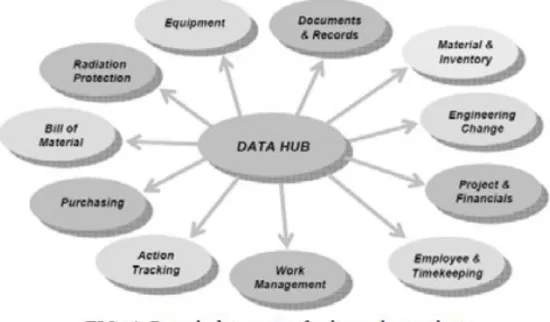
Figure 4 illustrates the concept of a data ‘hub’ (i.e. central data source). This hub is utilized to store data and establish key data relationships (such as equipment to documents) which are then utilized in CM and design basis process, as well as other related nuclear power plant processes. The data hub illustrates the primary elements of a CM solution, and the fact that key relationships must be established to connect these elements to each other in a useful manner.
From IAEA-TECDOC-1651 Information Technology for Nuclear Power Plant Configuration Management
9 “A properly designed and developed CM IT solution will have the following major attributes and positive effects of nuclear power plant management and operation:
⎯ single, unified data repository
⎯ temporal and cardinal links between plant data to create an nuclear power plant ‘content and change history’ and design basis repository
….”
“The CM IT solution, when complete, should meet the following general functional attributes in order to fully support the CM mission:
…
-CM is identified as the integrating methodology for creating, maintaining, publishing and recording the nuclear power plant design basis
-Core CM data repositories for the master equipment list, document control, design change, work management and materials management are in place”
Configuration
Management Principles
(4/4)
From IAEA-TECDOC-1651 Information Technology for Nuclear Power Plant Configuration Management
“An important objective of a configuration management programme is to ensure that accurate
information consistent with the physical and operational characteristics of the power plant is available in a timely manner for making safe, knowledgeable, and cost effective decisions with confidence.”
Asset Lifecycle Management Engineering Review and collision detection
Visual planning and simulation Work instructions Virtual training Multi Physics Simulation, Optimization
Digital Plant Asset Management Capital Project Management Construction Operation Maintenance Physics Simulation Analysis Safety Support Decommissioning Civil Design Equipment Design Fluidic Design Electrical Design Procurement
Planning
Unified IM*
Unified Information Model
…
…
…
* Should be based on open standards like ISO 15926 Unified Information Model Repository Uni v ersal i ntegrator of CAD data
CONSTRUCTION As-built documentation «As designed» baseline «As built» baseline «As developed» micro baselines Working documentation DESIGN
UIM Based Change and
Configuration Management
Technical project … OPERATION & MAINTAINCE DESIGN AS A PRACTICECAx
Repository
of UIM
Impact analysis using trace information to determine affected areas / disciplines Intersystem change workflow PDM PLM Other IT system Change request Change analysis by experts in affected areas/disciplines!
Change is required Updated NPP configurationUIM Based Change and
Unified Industry-Specific
Nomenclature Catalogue of NPP
Equipment and Materials
Equipment and materials classifier
more than 2000 types of products of all NPP systems
Database of suppliers and manufacturers
more than 630 companies
Design and technical documentation
more than 20 000 files
3D models
more than 20 000 unique 3D models
Price
for more than 56 000 cards of the equipment
Suppliers quality data
for more than 2500 units of equipment Based on DS ENOVIA
Construction simulation is done before entering the site
Multi-D project can be used to generate information for site work execution program and weekly-daily tasks for contractors
The history of required optimal labor norms for different construction operations
Provides tracking during along the whole life cycle of an equipment
Reduces the time of decision making thanks to coherence and
synchronization of equipment information during design, delivery, storages and installation
Improves the efficiency of warehouse management by reducing the
processing time
Procurement and Supply.
Equipment Barcoding
Simplify making operational decisions in the area of the number of workers at the construction site
Control of the number of workers on a construction site
Provides electronic timesheet
Human Resources Management
Using RFID Tags
Helps to define the amount of work by a visual analysis of the object
Serves pre-installation layout of equipment and materials (for open-top method) & other types of installation preparations
Allow to work with collisions between different disciplines identified during the construction
Supports operation & maintenance simulation & training
Portal - Monitoring and
Operational Management of
Capital Construction
Modules
Analytics Schedules Order and issue tracking
Cost management
Procurement management
Weekly-daily tasks
Archive of design and estimate documentation
Equipment arrivals
Storage facilities
Human Resources Management
3D model
3D model + spherical panorama
Web-cameras
Access to Information Systems
…
Available in the office and on site (self-service kiosks)
Multi-D Forum.
Life-cycle Management of complex
engineering objects
CONSTRUCTION DESIGN OPERATION2011
Nizhny Novgorod2012
Nizhny Novgorod2013
Moscow 21 countriesMore than 100 companies More than 500 participants 18 countries
More than 200 companies More than 650 participants 15 countries
More than 135 companies More than 350 participants
DECOMISSIONING