ISSN-L: 2501 - 1235 Available on-line at: www.oapub.org/edu
DOI: 10.46827/ejpe.v6i6.3226 Volume 6 │ Issue 6 │ 2020
BLENDED LEARNING IN BADMINTON TRAINING FOR
PROFESSIONALS: STUDENTS’ PERCEPTIONS
AND PERFORMANCE IMPACTS
Chau Vinh Huy1,
Nguyen The Luong1,
Nguyen Ngoc Vu2i
1HCMC University of Physical Education & Sports,
639 Nguyen Trai District 5, Ho Chi Minh city, 749000, Vietnam
2Hoa Sen University,
8 Nguyen Van Trang District 1, Ho Chi Minh city, 71000, Vietnam
Abstract:
As with other subject areas, badminton instruction for practitioners is experiencing a lot of changes under the impact of technology. Recently there has been the possibility of moving badminton training classes to the online platform but there is no consensus on its efficacy. This study is conducted to study the effects of blended learning activities on the perceptions and performance of students in physical education. Forty students in physical education are selected and divided into two groups: an experimental group, and a control group. All groups in face-to-face learning sessions have the same curriculum, course-book, equipment and teaching method. The questionnaire and interview data show that students in blended class sessions had positive perceptions of learning activities.
Keywords: blended learning, e-sports, online badminton, physical education
1. Introduction
Recently, the rapid development of broadband connection has given students plenty of opportunities to access quality online materials. In the area of badminton training for students of physical education this trend is also growing. The efficacy of blended learning as an effective mode of teaching and learning has caught the attention of many teachers, administrators and researchers in physical education. In addition to the potential benefits, this new learning pattern also creates challenges such as digital divide within a
classroom, access to learning tools, teaching methodology and learning styles that physical education research is trying to address. Through evaluating the feedback of students from the blended learning badminton for professional course at a Vietnam university, this paper aims to investigate the perceptions of students in physical education about the effectiveness of blended learning for badminton training.
2. Literature review
Since the emergence of online platforms used in higher education, different terms such as "hybrid instruction" or "integrated e-learning" have been used to describe blended learning in different ways. Researchers (Thorne, 2003; Garrison & Kanuka, 2004; Nguyen Ngoc Vu, 2016a) have defined mixed learning in a narrower sense as a mixture of online and offline learning.
For blended learning, Jochems, Merrienvoer & Koper (2004) used the word "integrated e-learning" and had a broader definition for this concept. They described it as the need for the effective implementation of e-learning in conjunction with more conventional methods to provide a variety of coherent measures at the pedagogical, institutional and technological levels. Despite this broader definition, it still places e -learning as a teaching and -learning add-on to conventional methods of -learning, as opposed to a learning overhaul.
According to Nguyen Ngoc Vu (2016b), blended learning is a controversial term at the moment. Some authors refer to this notion as something groundbreaking and others claim that many forms of technology integrated teaching can be called blended learning. However, most scholars have reached the agreement that the concept has come up a lot more recently because of the significance research has provided to computer-mediated teaching and learning.
can be used in blended learning. For example, real-time virtual or collaborative applications, web-based lessons, video contents, audio lectures embedded in the work-task environment. To support those learning activities, learning management systems like Moodle, Blackboard, WebCT or Canvas are often used. The arrival of new learning technologies such as podcasting, e-portfolios, social networking platforms, voice threads, virtual reality contents and mobile phones also make this form of learning more popular (Jochems, Merrienboer & Koper, 2004).
Blended learning can also be described as a learning program where many delivery modes were used to maximize program delivery's learning outcome and cost - effectiveness. It is the systematic integration of several complementary methods of providing information to enhance the growth of learning and skills. Despite different understandings, the consensus on blended learning is that this concept refers to the combination of the conventional face-to-face learning environment and e-learning technology to improve learning outcomes by applying various learning strategies and tools suitable for different learning styles. This form of learning facilitates learning outcomes by providing the best mix of different learning tools and strategies. From the perspective of pedagogy, blended learning strategies or methods could include flipped teaching, student-centered learning, and collaborative learning.
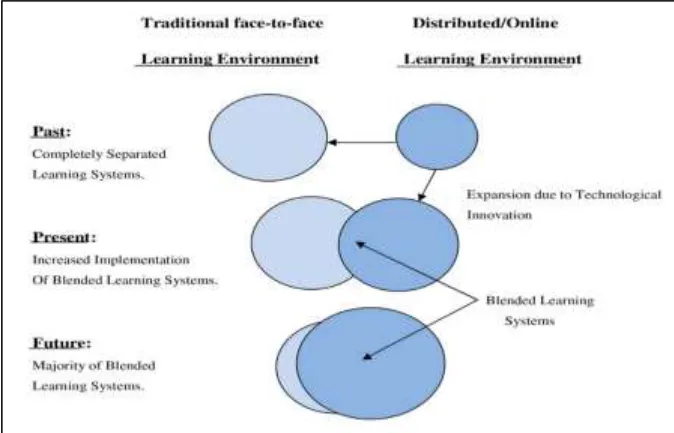
According to Nguyen Ngoc Vu (2016b), blended learning is part of the ongoing convergence between traditional learning and e-learning. On the one hand, there is the traditional face to face learning environment that has been used for centuries. On the other hand, distributed learning environments have started to grow and expand rapidly, as new technologies have expanded the possibilities for distributed communication and interaction. From previous blended learning definitions, it can be concluded that the blended learning program can include traditional lectures, virtual or online lessons, multimedia contents especially videos and audios, email systems, discussion forums, and a chat system as in the following figure.
3. Material and Methods
3.1 System description
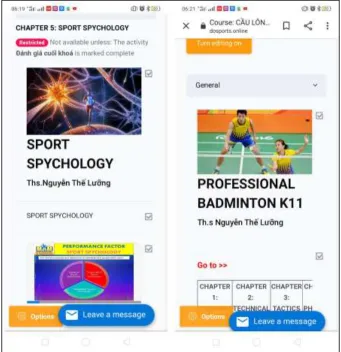
In this study, the classes under review use a Moodle-based learning management system. This system had intuitive interface for desktop screens so mobile devices, and it could identify the user device automatically to switch to the appropriate interface. With the same web link https://dosports.online/, both interfaces were open. The two systems used the same database, and learning activities on either platform could be carried out interchangeably.
Figure 2: Snapshots of the blended learning system on mobile interface (Source: https://dosports.online).
3.2 Participants
Table 1: Demographic information of the participants
Characteristics
Group
N
Gender Age
Male Female 18 19
Control 20
6 14 0 20
30% 70% 0% 100%
average age: 20
Experimental 20
5 15 0 20
25% 75% 0% 100%
average age: 20
3.3 Instruments 3.3.1 Questionnaire
The questionnaire covered 23 items divided into five sections: impact of blended learning activities on learning performance, communication and engagement in blended learning activities, general impressions of blended learning activities, enjoyment of conversation in blended learning activities, and perceptions of motivation in blended learning activities. After the posttest, the questionnaire was given to the students. Nevertheless, in order to avoid misunderstanding of the students, the questionnaire was given in Vietnamese to ensure that the concept was fully understood in each answer by the students. Vietnamese edition was therefore favored.
Table 2: The questionnaire structure
Questionnaire No of Items
Blended learning activities influence in training performance 5 Blended learning activities in collaboration and interaction 4 General perceptions of blended learning activities 4 Perceptions of enjoyment in discussion in blended learning activities 5 Perceptions of motivation in blended learning activities 5
Total 23
3.3.2 Interview
4. Results and Discussion
4.1 Questionnaire
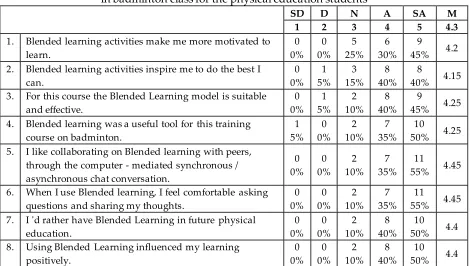
To be more explicit about learners' motivation of EG, the researcher gave out eight more questions. Data analysis for items 21-28 about the students' perceptions of motivation in Moodle activities was summarized and presented in Table 4.20.
Table 3: Perceptions of blended learning in badminton class for the physical education students
SD D N A SA M
1 2 3 4 5 4.3
1. Blended learning activities make me more motivated to learn. 0 0% 0 0% 5 25% 6 30% 9
45% 4.2 2. Blended learning activities inspire me to do the best I
can. 0 0% 1 5% 3 15% 8 40% 8
40% 4.15 3. For this course the Blended Learning model is suitable
and effective. 0 0% 1 5% 2 10% 8 40% 9
45% 4.25 4. Blended learning was a useful tool for this training
course on badminton.
1 5% 0 0% 2 10% 7 35% 10
50% 4.25 5. I like collaborating on Blended learning with peers,
through the computer - mediated synchronous / asynchronous chat conversation.
0 0% 0 0% 2 10% 7 35% 11
55% 4.45
6. When I use Blended learning, I feel comfortable asking questions and sharing my thoughts.
0 0% 0 0% 2 10% 7 35% 11
55% 4.45 7. I 'd rather have Blended Learning in future physical
education. 0 0% 0 0% 2 10% 8 40% 10
50% 4.4 8. Using Blended Learning influenced my learning
positively. 0 0% 0 0% 2 10% 8 40% 10
50% 4.4
4.2 Interview
Of the ten selected students, three (S4, S5, S8) had the same perception that Chat was their favorite activity as it was a very good communication tool that helped them to communicate well. "The chat activity module allows me to have synchronous conversations by real time. Thus, having a different interpretation of each other and the subject being discussed is helpful" one of the three students (S4) said. "I can develop my vocabulary as well as sentence structures when speaking. Also, through this wonderful experience I can learn much from my friends and my teacher" (S8).
Participants S2, S3 and S6 welcomed the service of the forum because it allowed them and the mentor to exchange ideas by posting comments. The instructor could choose to score forum posts, and allowing them to rate posts from other colleagues. "Thanks to comments received from my teacher and friends, my writing is considerably improved. I'm pleased as my writings are praised by them. As a result, my writing is getting better and better." (S6) However, the third popular activity was journal. S1 and S7 said journal was the one they enjoyed best. "I love online newspapers that are only read by the writers. This makes me feel comfortable. Many other people will not see my flaws, which allows me to be more optimistic" (S1). S7 said he was able to share his most private thoughts because the teacher was very polite and considerate.
By contrast, the other two students considered Workshop as a powerful peer-evaluation activity that they were especially interested in. "In many ways, the platform helps me. Because of the structured peer review environment, concentration on class participation, emphasis on communication skills and feedback provided from my peer editors, I should develop better skills" said S9. It is clear that a workshop will be set up to help students in online learning environments succeed.
10 respondents selected all four activities, which means students all want to interact with those exercises. This also demonstrates the effectiveness of the use of Moodle activities in improving the performance of students.
5. Conclusion
Conflict of interest statement
The authors declare that they have no conflict of interest.
References
Akkoyunlu, B., & Soylu, M. Y. (2008). A Study of Student's Perceptions in a Blended Learning Environment Based on Different Learning Styles. Educational Technology & Society, 11(1), 183-193.
Bleed, R. (2001). A Hybrid Campus for a New Millennium. Educause Review, 36(1), 5. Garrison, D. R., & Kanuka, H. (2004). Blended learning: Uncovering its transformative
potential in higher education. The Internet and Higher Education, 7(2), 95-105. Graham, C. R. (2006). Blended learning systems: definition, current trends, and future
directions. In Handbook of Blended Learning: Global Perspectives Local Designs, edited by C. J. Bonk and C. R. Graham, pp. 3–21. San Francisco, CA: Pfeiffer Publishing.
Harding, A., Kaczynski D., & Wood L. (2005). Evaluation of blended learning: Analysis of qualitative data. In Proceedings ofUniServe Science Blended Learning Symposium. 56–61.
Jochems, W., Merrienboer, J. V., & Koper, R. (2004). Integrated E-Learning: Implications for Pedagogy, Technology and Organization: Routledge.
Kukulska-Hulme, A. (2012). Language learning defined by time aConfnd place: A framework for next generation designs. Emerald Group Publishing Limited. Nguyen Ngoc Vu (2016a). Mobile learning in language teaching context of Vietnam: An
evaluation of students’ readiness. Journal of Science, HCMC University of Education.
No 7(85)/2016,16-27.
Nguyen Ngoc Vu (2016b). An investigation of Vietnamese students’ learning styles in
online language learning. Journal of Science, HCMC University of Education. No 1(79)/2016,25-34.
Rudestam, K. E., & Schoenholtz-Read, J. (2009). Handbook of online learning. Sage Publications.
Sharma, P. (2010). Blended learning. ELT Journal, 64(4), 456-458.
Taylor, J. A. and Newton, D. (2013). Beyond blended learning: A case study of institutional change at an Australian regional university. Internet and Higher Education, 18: 54-60.
Thorne, K. (2003). Blended learning: How to integrate online & traditional learning. VA: London and Sterling.
Troha, F. (2002). Bulletproof instructional Design: A model for blended le arning. USDLA Journal, 16(5).
Watson, J. (2008). Different types of blended learning. Retrieved on 1 Jan 2010 from:
https://sites.google.com/a/idahopd.org/blended-learning/different-types.
Creative Commons licensing terms