NIGERIANS AND GLOBALIZATION: COMPELLED ACCEPTANCE OF IMPORTED SECONDHAND COMMODITIES AS INDEX OF DECLINE IN HUMAN CONDITION IN A
MARGINAL ECONOMY
By
NDUKAEZE NWABUEZE , PhD, LL.B., BL Department of Sociology,
Faculty of Social Sciences University of Lagos, Lagos State, Nigeria. nwabueze 1955@ yahoo.com,
+234-803-350-7562
Abstract
It is canvassed that the beginning of the sharp drop in the quality of human conditions among Nigerian citizens, a decline that has continued unabated ever since, is traceable to that date in the history of the country when the citizens of all social classes, but especially the poorest of the poor, began to regard the use of second-hand commodities imported from the centres of international capitalism as preferred, legitimate and normative. That era, we observe, coincided with the date of introduction of the Structural Adjustment Programme (SAP) in 1986, one impact of which was exponential devaluation in the exchange rate of the local currency, the Naira which pushed up the prices of new imports beyond the affordable limit. It is submitted that the SAP is a policy strategy of neo-liberal predation. Trade liberalization which literally led to the dumping of all manner of second-hand goods in Nigeria is a principal manifestation of this policy of capitalist expansionism. Compelled acceptance of imported used commodities is explained by economic rationality in form of affordability not by an irrational economic preference for anything Western. The people, willy-nilly buy and use second-hand items and their use, by itself, amounts to lowering citizens’ standard of living. The paper debunks the theory that liberal reforms ameliorate the structural contradictions or the dwindling quality of living in an economy in the periphery of global capitalism. Further, it is observed that additional doses of liberal reform will only deepen the crisis of the domestic economy and worsen the already critical human conditions. A policy alternative around the notions of ‘globalization’ and social democracy is suggested to abate the rapidly declining quality of life.
Keywords: globalizations, marginal, economy, devaluation, commodities.
Introduction
In an article that appeared in Current Sociology in December 2005, Kiely set out to debunk the claim by some leading Western scholars and institutions (e.g. DFID, 2000; World Bank, 2002a; 2002b; IMF, 1997; Giddens, 2000; Wolf, 2001) that pro-globalization policies have led to reduction in global poverty and income inequality due to greater economic integration in the world economy. This intervention is aimed to further debunk this thesis by drawing illustrative empirical examples from the Nigerian experience. That claim is a sweeping generalization and an over claim as it does not represent the experience of most less developed countries (LCDs) including Nigeria that are servile and marginal players in the contemporary global economy. Debunking this thesis is desirable to forestall the danger of it gaining wide acceptance as established epistemological orthodoxy, which will be theoretically misleading, empirically inaccurate and counter-productive as the basis of future global economic policy. That conclusion is a parochial and distorted view of the effect of globalization from only one side of the many sides and innumerable faces of the world economy.
nations and hemispheres. Despite the remarkable improvement in the economic indices of the BRICS countries (Brazil, Russia, India, China and South Africa) whose economies are expanding rapidly and claiming higher proportions as global output of world trade, the disparity between the class of debtor nations and the class of creditor nations remains as it has been since colonial days. These countries have been coming together under the umbrella since 2009 to assert their interest of relevance in the world economy. The net importers and exporters of modern technology remain unchanged; the producer and consumer nations remain in their original positions; the pattern of flow of world trade and flow of foreign capital investment and the benefits accruing therefrom remain as in the old order. The direction of migration of highly skilled manpower remains from developing countries to the West. Those who dominate world information content and flow and who consequently also shape world opinion and those who merely follow remain as originally constituted. The five permanent members of the UN Security Council remain unchanged; those who control the UN, the World Bank and IMF are the same countries since 1945 and the newly ‘independent’ countries remain mere spectators. America has remained the unchangeable head of the World Bank since 1945. Instead of narrowing down, the income inequality between the North and the South has widened, deepened and become more inelastic. The social disadvantage of this inequality to those who live in the poorer countries is glaring. Health care is, for example, severely limited. Whereas the nine richest Western countries boast of one physician for every 242 to 539 inhabitants, in the eighteen poorest countries (and they are all in Africa) it is just one physician for every 3, 707 to 49, 118 inhabitants. Average life expectancy for males in those advanced countries stands at 73 years whereas it is below 50 years in the poorer countries. Average literacy rate in the rich countries is 99.1 percent as compared to 47 percent in those African countries (2005 Britannica Book of the Year). While Africa has only 14 percent of World population she carries a disproportionately global disease burden of 25 percent. Sub-Saharan Africa, Middle East, North Africa, Latin America and the Caribbean have the worst unemployment statistics in recent records. For example, in 1995 world unemployment figure was 6.0 percent. This rose slightly to 6.3 in 2004/2005 and fell back to 6.0 in 2006. In the same period, while the industrialized countries and Asia had figures generally below the world average, for Sub-Saharan Africa unemployment stood at 9.5 percent, in Latin America and the Caribbean 7.3 percent, while in the Middle East and North Africa unemployment averaged 13.2 percent. (Zenith Economic Quarterly Vol. 1 No. 5 Jan. 2006; 73) Indeed, the old world economic order is substantially unaltered with the cautious exception of some emerging markets in Asia, which though going through noticeable change have not significantly transformed the pre-globalization international economic disparities between the hemispheres.
The case of Nigeria in her fifty-three years of post-colonial statehood particularly, the citizens’compelled open acceptance of secondhand goods despite the country being the world’s seventh largest oil producer, is chosen to illustrate the fallacy of universal prosperity and the realities of worsening poverty and declining human condition for the second half of the world economy in spite of the official adoption of market-friendly and pro-globalization policies by the state.
perpetuated by British officials as far back as the early 20thcentury and handed down to their domestic successors at independence.
In addition to the embrace of second-hand goods we rely also on current statistical data on the state of the Nigerian economy especially the indicators of the living conditions of the citizens, their changing consumption patterns and life styles, inter alia, to refute the finding of increasing universal global prosperity. The rest of this paper is divided into seven sections each addressing, in an integrated manner, the separate strands of the major arguments as outlined above.
Nigeria: Indices of Decline in Human Conditions.
It is assured in this section that the conditions of living have progressively deteriorated for most Nigerians in spite of globalization, if not indeed due to globalization. The most graphic empirical evidence of this is the compelled mass acceptance of cheaper imported second-hand commodities. We shall return to that index later. But first let us examine the concrete presentation and interpretation of the statistical proof of the worsening living conditions that compel citizens to settle for ‘fairly used’ goods imported from the West as they could no longer afford new and more expensive commodities.
Nigeria presents an image of an economic and social paradox; until recently a heavily indebted state, over 60% of citizens living below poverty line but very rich ruling class. She is currently the seventh largest oil-producing country in the world. That should mean that it is potentially a wealthy country or that citizens should be well-off. But in reality that is not to be. For instance, in an overall performance rating in a global development and poverty table, Nigeria drifted down to 158thposition in 2005 from 151stin 2004 out of a total of 177 countries covered in the assessment (UNDP, 2005). Incredibly, in the immediate seven years before 2006, the price of crude oil, Nigeria’s main foreign exchange earner, climbed steadily high to a peak of US $72.00 per barrel in April, 2006. In 2010 the price had soared to over US $100 per barrel. Between 2004 and 2005, life expectancy in Nigeria declined from 51 to 43.4 (UNDP, 2005). Similarly, life expectancy at birth was 49 in 1990 but dropped to 45 in 2003 (World Bank, 2003). Extracts from World Bank: African Development Indicators, 2005 present an image of poverty-stricken nationals. For instance, between 1994 and 2002, 70 percent of Nigerians lived under US $1.00 a day that is, lived below poverty line. Between 1991 and 1999, the average family spent 67 percent of household income on food alone. The historical trend of poverty is striking. The Gross National Income (GNI) per capita annual average showed a downward trend (in US$) from 601 in 1975-84 through 275 in 1985-94 to 273 in 1995-2004. Contrary to the claim of the protagonists of globalization, not only are most Nigerians poor, the gap between the rich and the poor is widening. For example, from 1998-2002, it was estimated that the richest 20 percent controlled 55.7% of national wealth while the poorest 10 percent had 1.6% and the poorest 20% controlled 4.4% of national wealth. Poverty is notdetermined only by a person’s income but also by the cost of living because the prices of goods and services dictate what the real value of the income is or what that income can buy.
In a heavily import-dependent economy such as Nigeria, the movement of the exchange rate of the national currency is a pointer to well being because many consumables are imported. Shown below is the official exchange rate of the Naira, the national currency per US dollar between 1980 and 2006. It is as follows: 1980- 0.5; 1994- 22.0; 1995- 21.9; 1996-21.9; 1997- 21.9; 1998- 21.9; 1999- 92.3; 2000- 101.7; 2001-111.2; 2002-120.6; 2003- 129.2; 2006-132.05 (first quarter). In July 2011 the exchange rate further deteriorated to a US dollar to 154.
The rapidly deteriorating exchange rate during the years meant higher price of imports and fall in the real value and purchasing power of the local currency, the Naira. The annual average increase of the exchange rate in the period was as follows: 1975- 84- 0.6; 1985- 94- 9.8; 1995- 2004- 71.4.
An idea of what this index means for the purchasing power of the Naira over that period can be gleaned from the real effective exchange rate index with the year 2000 as base. It is as follows: 1980-420.9; 1994-145-8; 1995-123.6; 1996-152.9; 1997-175.5; 1998-192.5; 1999- 97.6; 2001- 111.0; 2002- 111.6; 2003-104.5.
annual average decrease in real exchange rate index is as follows: 1975-84-543.9; 1985- 94- 191.7; 1995-2004- 129.9.
The effect of the exchange rate and other internal economic variables on domestic prices is shown in the Consumer Price Index (2000 as base) in the 23 years as follows: 1980-1; 1994- 31; 1995- 54; 1996- 70; 1997- 76; 1998- 83; 1999- 87; 2001- 113; 2003- 145.
The impact of the inflationary trend on standard of living in an economy bedeviled with steep concentration of wealth in a few hands and in which for the second decade (1994- 2002) 70 percent of the population access less than a US dollar per day is obvious. In that period (2000- 2005) the price of petrol (and kerosene which is the main source of domestic cooking, heating and lighting fuel for urban as well as semi-urban dwellers) rose by over 300% from N22.00 in June, 2000 to N65.00 in August, 2005. Two other factors ensured that the astronomical rise in cost of living took a complete toll on the living condition of Nigerians. One was unemployment and the other is the policy of wage freeze from 1986 both of which reduced the number of those who operated above poverty line.
There are other indicators of miserable living conditions. In 1990, 39% of Nigerians had access to sanitation facilities. This proportion dropped to 38% in 2002. In March 2006 Water Aid Nigeria, an NGO in its Country Strategy Document, 2006- 2011 recorded that 81.5 million Nigerians had no access to adequate sanitation. Nigeria was ranked the fourth dirtiest country in the world behind India’s (772.4m), China’s (736.9m) and Indonesia’s (106.9m) which occupied first, second and third positions respectively (Daily Independent, March 23, 2006). And these are among the Asian ‘Tigers’ often quickly cited as examples of emerging markets, as illustrative examples of universal global prosperity. Nigeria’s maternal mortality ratio of between 704-1000 per 100,000 live births is one of the highest in the world. Infant mortality rose from 91 in 1990 to 105 per 1000 births in 1999. Less than 55% of the population has access to safe drinking water. HIV/AIDS national prevalence rate in 2005 was about 3.4% and poverty is a driving condition. Between 1991 and 1999, four preventable diseases, that is, malaria, diarrhea, respiratory infections and vaccine-preventable diseases accounted for over 90% of childhood morbidity and mortality. Housing conditions are very inadequate and access to modern healthcare remains a luxury. Electric power consumption in KWh per capita declined from 95.3 in 1993 to 68.5 in 2000 and 68.2 in 2002. In a nutshell, this is no cheering picture and Nigeria cannot be ranked among those that have benefited from pro-globalization policies which became official since 1986 (World Bank: Africa Development Indicators 2005). What these statistics portray is that living conditions are not getting better in Nigeria, they are rather deteriorating.
The comparative analysis of Nigerian poverty profile between 2004 and 2011 reveals a picture of worsening rather than improving condition.
Table 1, indicates a clear situation of rising poverty and declining human condition with over 61% of the population living on less than one dollar a day over the years.
Table 1: Profile of Poverty in Nigeria
2004 (%) 2010 (%) 2011 (%)
Estimated Population (Million)
126.3 163 168
Relative poverty 54.4 69 71.5
Absolute Poverty 54.7 60.9 61.9
Dollar per Day 62.8 61.2 62.8
Source: National Bureau of Statistics, Poverty Profile 2010 Report
Table 2: Relative Poverty–1980–2010 (%)
Year Non-Poor Moderately Poor Extremely Poor Moderately poor and Extremely Poor 1980
1985 1992 1996 2004 2010
72.8 53.7 57.3 34.4 43.3 31.0
21.0 34.2 28.9 36.3 32.4 30.3
6.2 12.1 13.9 29.3 22.0 38.7
27.2 46.3 42.8 65.6 55.4 69.0 Source: NBS Harmonized Nigeria Living Standard Survey, 2010
The Imported Second-hand Commodities Market
The Nigerian market, since 1986, has become the Western World’s dump site for used and discarded commodities. The trade is booming because there is demand for these items in the domestic market. The persisting demand is the local consumers’ mechanism for coping with the pressures of rapidly rising exchange rates and the resultant hyper inflation of the prices of imported new essential commodities. There is widespread acceptance without much choice across the country’s social and economic hierarchies of those cheap imported second-hand articles. Top civil servants, military generals, business executives, politicians, the rich, governments, embassies, celebrities, all buy items ranging from used cars, boats, aircraft, furniture, and electronics, spare parts, industrial machinery etc. How this situation has come to be, is one of the regrettable paradoxes of the continuing mal-articulation of the Nigerian economy from the world economic system. We say regrettable, because it is a compelled, painful mode of adapting to the economic fallout of globalization. Since the great Naira devaluation of 1986 at the onset of the Structural Adjustment Programme (SAP), Nigerians have sank deeper in economic misery faced with the reality of settling for second-hand commodities or live altogether without them as the prices of new items soared beyond the reach of even those in the high income brackets. Nigerians like nationals of other countries like to enjoy new products. So the growth in appetite for used items can no longer be explained by the usual craving for imported goods, but by what is affordable and available.
All over the length and breadth of the country, in urban and rural towns there are markets for used items. Indeed some traders (and this idea has been bought by some consumers) say that the imported used items are more durable and have greater utility value than new local products. They also theorize that the used ‘originals’ are better than the ‘fake’ new imports custom- ordered by profiteer Nigerian traders from factories mostly in Asia and the Middle East.
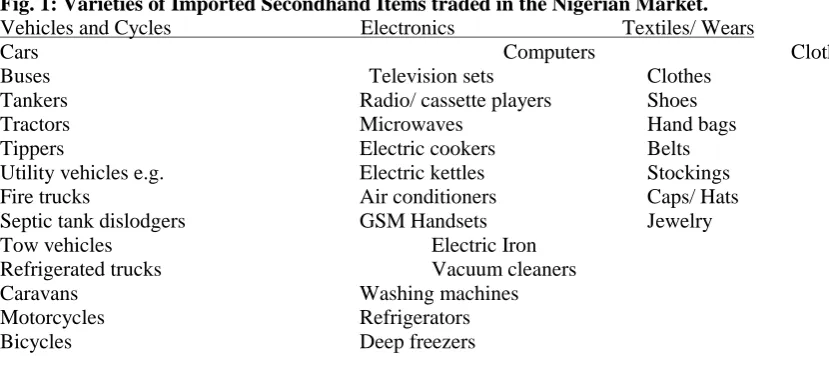
Everywhere one goes in the country, markets are awash with all manners of secondhand articles. The statistics of imports of used articles of trade in our situation are unreliable. Some of the items are contrabands and are therefore brought in by smugglers. We would therefore as an alternative draw a table of items tradable in this market to give an idea of the volume and variety of imports as an alternative to trade statistics.
Fig. 1: Varieties of Imported Secondhand Items traded in the Nigerian Market. Vehicles and Cycles Electronics Textiles/ Wears
Cars Computers Cloth
Buses Television sets Clothes
Tankers Radio/ cassette players Shoes
Tractors Microwaves Hand bags
Tippers Electric cookers Belts
Utility vehicles e.g. Electric kettles Stockings
Fire trucks Air conditioners Caps/ Hats
Septic tank dislodgers GSM Handsets Jewelry
Tow vehicles Electric Iron
Refrigerated trucks Vacuum cleaners
Caravans Washing machines
Motorcycles Refrigerators
Outboard engines Hair Dryers
Wheel chairs Sewing machines
Ships Clippers
Boats
Aircraft Producer Goods
School Materials Industrial machinery
Books Hospital equipment
Magazines Sports equipment
Stationery Office equipment
Pumping machines
Electricity generating plants, Tools boxes
It is asserted that the use of second-hand items in itself is an index of decline in living conditions. It could be argued that in the prevailing conditions the use of these commodities is a safeguard against total deterioration of human conditions. The ameliorating effect of second-hand goods is based on the idea that the alternative to them is to live without those items since new ones are unaffordable. That argument is oblivious of the history of emergence of this condition. As was shown earlier, there would have been no rational basis for any Nigerian to settle for used imported articles in 1980 or before 1986. That year, that is, in 1980, one Nigerian Naira exchanged for two US dollars. In that situation, new imports were cheaper and more affordable than local alternatives. Then, Nigerians used new cars, flew new aero-planes, and bought new bicycles, clothes, electronics e.t.c. just like nationals of other countries. That assertion, is therefore, based on the pre-1980 situation and the conditions of living of these people then. This observation is also supported by the geometric decline in the real effective exchange rate between 1980 and 2003 which fell from 420.9 to 104.5. The use of second-hand goods impacts on a people’s standard of living in more ways than one. First, there is a psychological impact. This is the ego deflation arising from using what another human being has done away with. Two, there is a question of national image, of national pride. Inferiority versus superiority complex exists between current buyers and former users. Three, used items are more expensive to maintain, they have shorter life span, they are less reliable, less predictable and less dependable. This is why sellers usually decline to issue any warranty on them. Users of used items, such as cars, spend more time and more resources mending faults and malfunctions. They are more risk-prone. In Nigeria, the Federal Road Safety Commission (FRSC) has waged a consistent campaign against the use of second-hand tyres which they say, is a major cause of road accidents. Government’s restriction of importation of air-conditioners, fridges and freezers is justified by those older technologies containing ozone layer-unfriendly substances. But they are shipped to the Third World any way from Europe, Asia and America.
In recent times, Nigeria had experienced fatal air crashes. One involving a local carrier on October 22, 2005 claimed all 117 passengers and crew. Less than two months later, on December 12, another airline was involved in a mishap in Port Harcourt another Nigerian city, claiming over 100 lives, this time with few survivors. In the October 22 case, the Aircraft was over 35 years and had passed through over five countries to get to Nigeria. So are most other aircraft flying in the local air space! Dana Air that went down on June 3, 2012 in Iju-Ishaga area of Lagos swept over 150 passengers, crew and ground victims to their untimely graves.
Features of the Nigerian Economy before and after the Structural Adjustment Programme
As has been asserted earlier, the Nigerian economy at present is a theatre of macroeconomic contradictions. It is the world’s seventh largest producer of oil but 70 percent of the citizens live on less than US $1 per day. As the price of this commodity rises in the world market, the human conditions of the citizens worsen. Nigeria imports over 60 per cent of refined petroleum products for local consumption even though it has four huge refineries which are hardly allowed to operate. The country is amassing huge external reserves but the real sectors in the domestic economy are in ruins; agriculture is tradition-bound, peasant-centred and technologically rudimentary; manufacturing firms are disappearing due to the policy of privatization and state divestment under a condition where the industrial and social infrastructure are a disincentive to private investment; the country until recently was heavily externally indebted, 70 percent of the citizens live below the official poverty line but less than 5 per cent of the population (majority of whom had occupied public office at one point or another beforehand) are stupendously rich. The hospitals and universities are starved of qualified doctors and academics but locally trained experts continue to leave in torrents to Western Europe and America where they form a significant proportion of the health and education personnel, producing excellent services in those places while equivalent institutions at home are collapsing. This is a case of the poor subsidizing the rich. The contradictions are legion.
These features are however not surprising. They are historically explainable. The Nigerian state and economy from about 1862, was progressively incorporated into the British Empire and thereby into the international capitalist system, albeit as a marginal player, as a dependent appendage. The duty assigned to it as is the case with all peripheral states is the continued reproduction and consolidation of the dependence of the Nigerian state on the centre. What is reproduced are the structural contradictions of dependent capitalism at the economic, political and socio-cultural levels, a few of which we have listed above. Unfortunately, the country after fifty-two years of political independence has not succeeded in breaking away from the core-satellite linkages of unequal and servile exchange. An implication of the overtly outward orientation of the economy is the sectoral and geographical disarticulation of the domestic economy. Under the hegemony of the IMF and the World Bank, the domestic ruling class is unable to summon the courage to dictate the terms and conditions under which the country participates in the global context. It is this situation that explains the wholesale adoption of market liberalization and rejection of strategic protectionism despite its tremendous advantages for technologically backward economies. Such issues as are identified above determine the features of the inherited economy and its course of teleguided existence, activities and results. The Nigerian economy before SAP was basically agro-based. Agriculture was the mainstay of the economy. It provided food, employment, raw materials and foreign exchange. In the first post-independence decade 1960-70, agriculture contributed to the GDP 62.9 percent, 54.4 percent and 47.94 percent in 1960, 1965 and 1970 respectively (Adejugbe, 2006: 30 ). Three items: groundnuts, cocoa and palm produce constituted the main cash crops and foreign exchange earners. The sector was however dominated by peasant farmers who relied on traditional knowhow. During this initial time, manufacturing and the extractive industries were less significant accounting for only 11.10 percent, 17.23 percent and 22. 40 percent of the GDP in 1960, 1965 and 1970 respectively (Adejugbe, 2006:30). Moreover, the manufacturing sector was and still is dominated by established multi-nationals. Initially, the approach of these companies was the importation of finished consumer goods from their home countries rather than strive to manufacture the products in the colony.
HIV/AIDS prevalence rate stood at 4.6, 4.6 and 4.1 in 2007 2009 and 2010 respectively. (NACA, NPPC). The experience of the economy over the years could safely be described as a trace of marginal performance, instability and human condition.
Thus in the second post-independence Development Plan period (1970-75), in addition to the expressed aim of transforming the agricultural sector, emphasis was placed on moving the economy away from agro-dependence. As a result, import-substitution industrialization and the indigenization of ownership and control of manufacturing companies and the service sectors were introduced into the repertoire of economic development strategies. Unfortunately, not much was achieved during the period. For a fact some Nigerians fronted for dubious foreign investors and thereby ostensibly secured ownership but lost control of the businesses to those foreign interests. This period also coincided with the onset of the oil boom and of reckless public spending. Oil became a major export product during this plan period. Many considered it more lucrative to import goods for sale in the domestic economy than to produce them at home. Imports comprised mainly of consumer goods and raw materials and the two constituted about 70 percent of total imports.
The transition from agro-based economy to oil-dependent economy promoted the dependence of the Nigerian economy on the global capitalist economy. For example, although the highest that agriculture contributed to the GDP in 1960 stood at 62.9%, while oil at its peak GDP contribution in 1980 was only 32.02%, oil constituted 70 percent of average government revenue and 85 percent of total export revenue in the economy between 1970 and 1988 (Iwayemi, 1995:69). With the rise in prominence of oil came the neglect of agriculture. This in turn led to human drift from the rural areas to the cities. A sharp drop in local food production occurred. What followed was a quantum leap in food importation which became inevitable. As the oil sector was foreign-dominated, the Nigerian economy became comparatively more vulnerable to the control and dictation of foreign economic and agricultural powers than was the situation when agriculture was the backbone of the economy. Unlike agriculture, very few Nigerians were engaged in the oil industry as the multinationals brought in as low as technicians from their home countries. Oil was drilled and exported crude without any plans initially to refine some quantity for export or to diversify or expand the industry to accommodate new opportunities. Although there was massive investment in social and industrial infrastructure such as ports, dams, roads, schools, hospitals and iron and steel plants during the Second and Third Plan periods, these investments could not be sustained due to the fragility of the real sectors and political instability. Corruption by those in public office, inflation, dumping of all manners of goods into the economy killed local initiative and enterprise. Consequently, between 1982 and 2002 manufactured value added as percentage of GDP remained low at an annual average of 7. 0 percent (CBN: Statistical Bulletin, Vol. 14 December, 2003).
liberalization policy by the current government does not appear to be changing the key indices of underdevelopment despite the orchestrated claims of remarkable recovery by the administration.
Nigeria’s Journey on the Road to Globalization
We share in this article the view of Adebayo Ninalowo that globalization is ‘obscured neo-imperialism’ (Ninalowo, 2005:1). This mode of conceptualization is concurrent with the view of globalization as a process, not an end state, not just a condition, because as a process it is still in progress changing its character and has the potential to present new vistas in future. Globalization is a euphemism for neo-liberal imperialism. It is the contemporary international policy frame for the consolidation of neo-liberal hegemony. Those definitions that obscure this imperialistic undertone, for example, those ‘common sense’ definitions (Van Der Bly, 2005: 877) simply trivialize the issue and obscure its intrinsic essence. Among such definitions are those that see it merely in terms of the shrinking of the world into a global village (McLuhan, 1968); or that relate it to the whole wide world, something universal (Oxford English Dictionary, online); or as homogenization of world cultures through sustained contact made possible by the current revolutions in technology of mass communication. The process is not ideologically neutral. It is about power, hegemony, vested interest and preservation of the existing unequal world order.
In this regard, its connection with the roots and origins of imperialism and the specific succeeding epochs in the history of development of underdevelopment cannot be ignored. Globalization is the late 20th century and early 21st century continuation (and outcome) of a historical process of capitalist conquest, expansionism and consolidation that began over six centuries ago with the first contact between Europeans and Nigerians along the coastal districts of the country.
The Role of the State under Globalization: Protectionism or liberalization?
It is a widely shared view that a key disadvantage of globalization is that the sovereign powers of states in the modern complex world as indexed by their diminished respective capacities for independent and autonomous action is remarkably encroached upon and eroded (Held 1995: 125). The loss of sovereignty stems from effects of bilateral and multilateral agreements and obligations arising from such agreements. In addition, supra-national organizations including organs of the United Nations especially the World Bank, IMF, WTO and other economic, social and intergovernmental platforms at least, by implication, impose restrictions on the freedom of individual member states to act. It is however the case that these restrictions do not apply equally to the rich and poor countries. The rich countries have substantial political clout to determine or influence international policy directions and this adds up to limited loss of sovereign powers by those states. This economic and political leverage in turn moderates the impact of international decisions on their domestic policies and on their peoples.
For the poorer countries, on the other hand, the implication of this imbalance of power and influence is their relative inability to cushion their citizens from the harsh effects of pro-globalization policies and actions from the world stage. This relative vulnerability is regrettable because some experts believe that different states have a duty to adapt international polices to their own economic, cultural and political systems and thereby evolve their own ‘policy styles’ (see Janicke and Welder, 1997; Richardson, 1987).In this regard, Smelser (2005; 104) submits that national governments are the agencies that have to cope with the consequences (for their domestic populations) of the vicissitudes of the world economy. But the poorer states are ill-equipped to defend their nationals.
As W. G. Friedmann stated in one of the clearest cautionary statements on international economic liberalization and deregulation:
The duty which the quest for human dignity thrusts upon states and which, it is feared, might not be attained by the free interplay of market forces alone, is made more imperative by neo-liberal pro-globalization policies, which in themselves advocate for ‘smaller government’ and the dominance of market forces. The apparent contradiction for globalization in this argument is removed by the difference in the ultimate essence of Friedmann’s imperative of state intervention which is hinged upon the need to protect human dignity including elimination of poverty and social inequality. Pro-globalization policy on the contrary, concentrates on unhindered ascendancy of market forces and the prosperity of the rich nations, not on promotion of universal human rights and dignity.
There is, however, abundant evidence in recent state policies in the West to justify the superiority of Friedmann over undiluted allowance of free market forces. The powerful nations that have the means continue to protect their national interests to the detriment of market liberalization goals in line with Friedmann, though they continue to sell the direct opposite of policy ideas to states in the dependent world. For instance, on February 2005, the German company E.ON proposed a takeover bid of US $34.5 billion to buy over Endesa, Spain’s energy and gas controlling company. The Government of Spain opposed the deal and in spite of anti-protectionism EU regulations failed to allow the take over on grounds of superior national interest. Similarly, in March 2006, the American Congress, citing overall national security interest, blocked the deal by which Dubai Ports (of United Arab Emirates) was to buy and manage six leading US Ports. In reference to the security concerns of the American people since the September 11 attack on the twin towers of the World Trade Centre in New York, the Congress disagreed with the Presidency that it was simply a safe business deal. Little attention was paid to the implications of the refusal on international free market regulations or on American\UAE business relations. A similar scenario played out when MITEL, an India Steel Company, wanted to take over ACELOR, a Luxembourg Steel firm for US $25 billion, but because ACELOR employed over 27,000 French nationals, the French President Jacque Chirac declared in a state visit to India that his country was an interested stakeholder in the business decision. The French government blocked the deal on account of national interest. Interestingly, this example was a protectionist move across the boundaries of two nations from France to Luxembourg.
In all of these accounts, market forces were subordinated to state or national interest. An irony of international economic decision making today is that while the West is moving towards greater state protectionist policies, they nonetheless encourage and even cajole underdeveloped countries to embrace liberalization policies of the most absurd and ridiculous proportions.
Globalization Theory, Poverty of the Other Half and the Invalidity of Theory
Is the thesis that pro-globalization policies have reduced poverty and inequality globally a valid theory? Does this theory apply to the predated/exploited economies of the South? As well, is it a valid assumption that the poor countries of the world that are still poor are those that have not sufficiently globalized? Is it true that globalization policies have so rearranged the structures of opportunity and access and redistributed world trade and resources as to ameliorate or mitigate the poor conditions of living prevalent in the other half of the world?
modernization and globalization as present day justifications of the continuing gap between the two spheres and a continuation of the old agenda of imperialism and ideological hegemony by the West. These three social facts are united in one purpose-the victory of capitalism. It is therefore pertinent to query the rationale provided by globalization protagonists for believing that its aims are at variance with its forebears. The rationalization that modern day neo-liberalism is a theory of restructured global symmetry rather than of asymmetry therefore deserves closer cross-examination.
To embark on this exercise the distinction made between ‘globalization theory’ and ‘theories of globalization’ by Rosenberg (2000:2) is a good point of entry. Kiely (2005; 907-910) endorses this distinction and berates the protagonist of globalization who does not see the necessity of drawing that distinction. He posits that it is not clear in current literature whether globalization is the cause or rather the outcome of the free-market forces, liberalized trade, open competition etc. In particular, Kiely further points out that the protagonists of globalization theory conflate these two clearly distinguishable views on globalization. He clarifies that while globalization theory accepts that globalization is the cause of the free market forces, free trade, liberalized finance and open competition and therefore of universal prosperity, followers of this view regard the state as an obstacle to perfect openness as it is to perfect market. It is to this school of thought that the World Bank, IMF, DFID and individuals like Giddens and Wolfe subscribe. From this perspective, globalization theory presents an image of itself as constituting a neo-liberal version of modernization theory. This is because of its sharing the characteristic shortcoming of a-historicity just the same way that modernization theory itself has regrettably been found to be. It also tends to view globalization and draws conclusions from its spatial rather than its political and social dimension. Kiely (2005) opines that this view of globalization as a determining variable has inevitably led globalization theorists into that complicity with neo-liberalism and modernization theory. This is in the sense that Giddens (2000) advanced this position further by submitting that globalization is not only inevitable but that it is desirable. He wrote:
.…contact with Western-dominated global economy represents the only opportunity for developing countries and that ultimately, development failure is only causedby failure to embrace this opportunity….
This constitutes the main shortcoming of globalization theory. If those ingredients commonly associated with globalization are believed to be caused by globalization, this whole mode of reasoning robs the ultimate historical moment of emergence of globalization of its rich historical antecedents. Globalization theory thereby denies the significance of social history and obscures understanding of globalization by denying the remote causes of this late 20th century interjection into the history of development of international capitalism. For example, if globalization theory contends that those correlates of globalization were caused by globalization itself, those protagonists deny the impact of some main events, the immediate factors in emergence of globalization. For example, Saverine Rugumamu identified two of these factors viz:
a. The prolonged crisis of the 1960s and 1970s in advanced capitalist economies and the systematic transformation from Fordist to flexible capitalist accumulation, the adoption of new technologies, increased pressures on firms to invest abroad, aggressive integration of global markets and above all, increased financial movements and speculation;
b. The collapse of the Soviet system, the end of the cold war and the disintegration of the planned economies of Eastern Europe (Rugumamu, 1999: 4).
correlates i.e. the enthronement of the free market, privatization and free competition. It was itself only a phase, albeit a decisive one in a continuing process of capitalist take-over of the global economy.
The theories of globalization, on the other hand, treat those ingredients of globalization as outcomes of globalization rather than it being their cause.
We agree with Kiely that globalization is the outcome rather than the cause of market forces and its accompanying economic principles. It is true that for several decades, western capitalism has persistently strove for enthronement of the supremacy of market forces, financial liberalization and diminution of effect of the state. These are the cumulative effect of the processes, as Kiely said, that are historically determined by specific agencies. As outcome, globalization cannot also be the cause of global prosperity due to greater integration of world economies, because both are results of an international agenda of western capitalism that has a history dating back over six centuries. Capitalism, the ideological context and precursor of globalization has never pretended to believe in social equality whether between nations or between classes of citizens, neither has it shown interest in transformatory empowerment of the poor, except as a palliative to ward off opposition against itself. It may have created more wealth but has done nothing to redistribute the heavy concentration of these resources in some countries. Therefore globalization cannot be the cause of the historical processes that have been on before its advent. As a keen observer of the international market remarked recently;
As would be expected, contemporary capitalist restructuring under globalization has led not only to creative processes of producing new technologies, more and better tradable goods and services and expanding the range of opportunities; it has also engendered inequalities and the alienation of increasing numbers of people the world over (Rugumamu, 1999: 4).
So the adoption by Giddens (2000) of globalization as a cure-all antidote to poverty in the other half (akin to what the Yoruba of Nigeria may refer to as gbogbo nise -a drug with potency for an infinite range of ailments) is empirically invalid, theoretically inconsistent and will lead to catastrophic global policy failure if it were to be adopted as the intellectual foundation of a new world development agenda. It poses as veiled ethnocentrism, ideological chauvinism and smacks of capitalist apology. Rugumamu’s (1999: 9-16) account of Africa’s marginalization from the world economy under globalization is a screaming index of the failure that debunks the theory of universal prosperity.
Capitalist economic restructuring may be characterized here as gbogbo nise deliberately because the idea serves a useful analogy of the impact of Structural Adjustment Programs (SAP). Charlatan drug hawkers in a bid to advertise their products to attract public patronage claim that these products can cure all known illnesses from headache, body pain, rheumatism, weak erection, stomach disorder, constipation, measles, diarrhea, insomnia, hypertension, malaria, HIV/AIDS etc. The people regard their advertisement as a laughable joke because no one drug can cure these ailments in infants, in children, in women, in the aged, in pregnant women, in all seasons and under all conditions. By the same token, the World Bank/IMF-sponsored Structural Adjustment Programs (SAP) package is administered in all underdeveloped countries, to all manners of economic problems oblivious of historical peculiarities, social attitudes or unique social and political structures and institutions. In decrying this situation Bade Onimode noted that
There is nothing Nigerian in the formulation of SAP, it is imposed for lending by The Bank and Fund and by 1991, some 34 African countries were implementing it under different names, such as Economic Recovery Programme in Ghana and Tanzania and Programme of Economic Recovery in Mozambique (Onimode, 1995: 51).
was implemented. Like the cure-all drugs, capitalist structural adjustment and globalization policy failed, lacking the advertised potency.
Globalization, Structural Adjustment Programme and Quality of Life of Nigerians
In Nigeria, the introduction of the SAP in July 1986 represented the official commencement of globalization policy which has continued up till the present through the ceaseless intrusion of the IMF and World Bank into the country’s public policy. The policy of the SAP however impacted adversely on human conditions contrary to its avowed objectives. This fact has been widely acknowledged by writers and observers of the Nigerian situation (See Ninalowo 2005; 13; Adejugbe, 2006; Ishola, 2004: 362-368). This effect did not come as a surprise to many analysts given the policy planks of the SAP. These are: trade liberalization, devaluation of the domestic currency, removal of government subsidies, reduction in government expenditure, increase in interest rate and wage freeze especially in the public sector. Others are divestment of government and its complement-privatization, rationalization of parastatals, deregulation and reorganization of the civil service. From the onset of the SAP, Nigerians in the different economic brackets and social strata saw the worst forms of poverty, deprivation, misery never before experienced in the history of the country. The effect of SAP on the people can be gleaned from the different policy elements.
Massive devaluation of the Naira which resulted from adoption of market determined flexible exchange rate shot up the exchange rate bringing in its wake high level inflation due to the high import content of locally consumed goods. For instance, the exchange rate moved up from about N 3.316 to the US dollar in 1986 to N 110.00 to a dollar in December 1999, which is close to 3, 566 per cent in depreciation in thirteen years of SAP (Shola 2004: 362). The same author captured the rate of inflation during this period which stood at 5.4 per cent in 1986 but rose steeply to 72.8 per cent in 1995, a rate which he emphasized, was never before experienced in the history of the country. One quick mode of adjusting to this reality by the consumers was to settle for cheaper second-hand goods which were not even affordable by many citizens. As we have shown earlier, the combined effect of inflation and the geometric rise in exchange rate was a fall in people’s real purchasing power.
Apart from loss of real purchasing power, the human condition was also struck down by the fall in earning power due to the equally massive unemployment in especially the public sector. This was the combined effect of trade liberalization, government divestment and rationalization of public sector organizations. For example, in 1997 alone, in eight months between January-August, eleven federal government employing organizations (Nigerian Television Authority, Nigerian Prisons Service, Nigerian National Petroleum Corporation, National Electric Power Authority, Federal Capital Development Authority, Ministry of Federal Capital Territory, Central Bank of Nigeria, National Orientation Agency, Nigerian Security Printing and Minting Company, University of Nigeria, Nsukka and University of Ilorin) retrenched, sacked, rationalized, dismissed or retired 15, 636 personnel (Nwabueze, 1997: 173). In that exercise, although the Central Bank retrenched only 782 staff, it was announced that the intention was to reduce its workforce from 10,000 to 7, 000, that is, by 3, 000 staff nation-wide. The story was not different in the private sector as we would demonstrate shortly.
effect of company closures on unemployment is direct and complementary to job losses in the public sector.
The SAP policy line that drove the final nail into the coffin of deplorable living conditions in Nigeria is that of wage freeze. In the late 1970s the military government had placed a lid on wage increases as a panacea for economic recovery. It took the 1981 general strike led by the Nigeria Labour Congress to usher in a minimum wage regime of N300.00 per month. But on 21 December 1984, direct reductions were effected on fringe benefits of public employees. This prepared the way and when SAP arrived in 1986 a complete wage freeze became official policy. The effect of the freeze on workers, those few who still retained their jobs is imaginable in the face of slashing of fringe benefits, high inflation, astronomical exchange rates and withdrawal of oil and other subsidies. On this matter trade unionist, Issa Aremu commented that:
To regulate wages, but allow profits and prices of goods to rise shows the partisan and class character of SAP (Aremu; 1990: 144)
There is little wonder then why the SAP era was one of grave industrial unrest. University lecturers, medical doctors, public sector airline pilots and the other members of the SAP-endangered and rapidly disappearing middle class joined in what was popularly termed ‘SAP riots’. Retired General Obasanjo (later to return as Nigeria’s elected president in 1999), criticized the SAP then for lacking a human face. It had the face of a monster, a dragon.
Another key policy plank of the SAP was government withdrawal of public utility and services subsidy especially the subsidy on petroleum products. During the budget speech of January 1986 government directed the removal of 80 per cent petroleum subsidy. By this time the government-motivated debate by the public on IMF conditionalities, for a choice between IMF/World Bank SAP and an autochthonous SAP was in progress. The immediate effect of this measure was the pushing up of general prices, particularly the cost of local transportation which jumped up by 100 per cent. This trend has continued till the present long after the official end of the SAP period. For example, in 1995, pump price of petrol was hiked by 1000 per cent from N3.50 to N11.50 per litre. This price hike had negative impact on real wage income on private savings and on government revenue and expenditure. It also had negative effect on the output of the real and service sectors of the economy. The progressive withdrawal of oil subsidy did not only continue after SAP, it became more frequent between 1999 and 2005. During that period, petroleum prices were raised five times. By 2005, the pump price of petrol had risen to N65.00 per litre. In January 2012 an unprecedented crisis engulfed the government of Goodluck Jonathan and organized labour over pump price of petrol. It settled at N97.00 per litre and has remained there. Further increase, however, is very imminent.
As if these effects were not enough, the reduction in government expenditure in essential services such as education, health and social infrastructure, public utilities like electricity, water, telephone led to a rapid decline in quality of services. Many professionals resigned or abandoned their jobs and emigrated. The universities were thrown into a hotbed of labour crisis. The hospitals were not spared. Up till today portable water is not accessible to a high percentage of the populace. Electricity remains epileptic and a main hindrance to national productivity.
In concluding this section it should be stressed that the failure of the SAP in Nigeria was a bad beginning for globalization, which is often assessed from the experiences of that era. The SAP did not only worsen the living conditions of Nigerians, it also enlarged the number of the poor and created wider income gap. It did not achieve the objective of economic restructuring for higher economic efficiency. Globalization polices have merely continued to thread the SAP way in content and impact. It is therefore difficult for those people who have gone through this experience ever to share the view that globalization creates universal global prosperity.
Conclusion
South. The illustration done with data drawn from Nigeria reveals that the persisting crises and contradictions of underdevelopment are indices of globalization’s negation of development and popular empowerment. The descent of Nigeria into a country whose citizens see nothing wrong in using industrial and household goods and personal effects already used and discarded by consumers in the West was traced to the mid-1980s when the World Bank and IMF-inspired SAP was introduced. As an economic ‘reform’ measure, the SAP was conceived as an antidote to the globally precipitated economic recession that swept dependent, oil-based Nigerian economy in its wake. The programme failed because there was nothing Nigerian in its logic and design but was a package imposed on the local economy with the active connivance of the unproductive local compradors and the pseudo-capitalist state at home. The unmitigated free fall of the exchange rate from that date shot up the general prices of new commodities, most of which were imported, beyond the reach of people even in the high income brackets. Nigerians, of different walks of life settled for secondhand goods. Life expectancies dropped, experts and professionals emigrated to Europe and America to avail themselves of the stronger currencies or to escape the dehumanizing effects of a rapidly declining real income regime. Meanwhile, industries shot down, hospitals and universities suffered both from underfunding and brain drain. Poverty deepened as the income gap between classes and groups widened.
On the discriminatory benefits of globalization, we observed that the distribution of the benefits were officially supposedly left to free market forces but in reality were teleguided and strongly regulated and controlled by Western governments and international capitalist institutions. These rather than market forces determine who gets what and how in the global market place. As to the role of internal forces in accounting for the loss of development momentum in dependent countries, we have argued that the reality on the ground in these economies is that there is no clear divide between the internal and external obstacles to economic growth. The logic of neo-colonialism means that the local ruling class and international capitalist interests are engaged in inseparable collaboration or collusion against the local populace and it is impossible to clearly separate blames. However, to blame internal forces and exonerate external issues is simply a ploy to save the face of capitalism and its organs and their failures in the Third World. Second, and perhaps more disturbing, is that it is calculated to turn attention away from the inescapable contribution of external forces in tackling the reproduction of dependency and marginalization. Globalization may have created more wealth universally but it has not devised the strategies of ensuring even distribution of the benefits. It has therefore not succeeded in reducing global poverty or elevated the condition in marginal economies such as Nigeria.
References
Adejugbe, M. O. A. 2006. “The Nigerian Derailed Industrialization; Causes,Consequences and Cures” Inaugural Lecture, March, University of Lagos Press, Lagos.
Adejugbe, M.O.A 2002. “Nigeria in the Globalization World: Optimism and Pessimism in Globalization and Sustainable Human Development in Nigeria” Unilag Sociological Review Special Issue Pp 42-55.
Aremu, Issa 1990. “The Structural Adjustment Programme and Nigerian Labour” in Olaniyan, R. O. and C. N. Nwoke (eds) Structural Adjustment in Nigeria: The Impact of SFEM on the Economy, Nigerian Institute of International Affairs. Lagos.
Asobie, A. 1993. “The Pauperization of the Nigerian Petty Bourgeoisie” in O. Nnoli (ed.) Dead-end to Nigerian Development, CODESRIA, Dakar, Senegal.
Deru, O. 1998. “Dumping, U.S. Firm Forced out Berec”The Guardian, February 16.
DFID 2000. Eliminating World Poverty: Making Globalization Work for the Poor, DFID ,London. Friedmann, W. G. 1971. The State and the Rule of Law in a Mixed Economy, Stevens, London. Giddens, A. 2000. Which Way for New Labour, Polity Press, Cambridge.
Held, D. 1995. Democracy and the Global Order: From the Modern State to Cosmopolitan Governance, Stanford University Press, Stanford, California.
IMF 1997. World Economic Outlook, May 1997- Globalization: Opportunities and Challenges, IMF, Washington, DC
Ishola, W. A. 2004. “Structural Adjustment and De-Industrialization in Nigeria: 1986-1999” in Adejugbe, M. O. A. (ed) Industrialization, Urbanization and Development in Nigeria 1950-1999, Concept Publication Ltd, Lagos.
Janicke, M and Weider, H. (eds) 1997. National Environmental Policies, Springer, Berlin.
Kiely, R. 2005. “Globalization and Poverty and the Poverty of Globalization Theory”,Current Sociology Vol. 53 No. 6, November.
Lawal, A. A. 2006 “Corruption in Nigeria: A Colonial Legacy” Inaugural Lecture, Wednesday, June 7, University of Lagos Press, Lagos.
McLuhan, M. 1968 War and Peace in the Global Village, Bantam, New York and London.
National Bureau of Statistics (2009) The Review of the Nigerian Economy, 2010, Lttp://
www.nigerianstat.gov.ng.
National Bureau of Statistics (2010) The Nigeria Poverty Profile 2010 Report NBS Press Briefing on Nigerian Poverty Profile 2010 Reporthttp://www.nigerianstat.gov.ng
Ninalowo, A. M. 2005. “Reflections on Mitigation of Legitimation Crisis: An Inquiry into Contradictions of Underdevelopment”, Mimeograph, African Centre for Economic Growth, Nairobi, Kenya Nwabueze, N 1997. “Nigeria: Relevancy and Union Survival in a hostile Political Economy” in
Adewunmi, Funmi (ed) Trade Unionism in Nigeria: Challenges for the 21st century, Freidrich
Ebert Foundation, Lagos.
Onimode, Bade “Economic Development and Policy in an Open Economy: The Nigerian Experience Since 1960” in Akin Iwayemi (ed) Macroeconomic Policy Issues in an Open Developing Economy: A Case Study of Nigeria, Ibadan, Nigeria. NCEMA.
Richardson, J. (ed) 1987. Policy Styles in Europe, London: Allen and Unwin.
Rugumamu, S. M. 1999. “Globalization, Liberalization and Africa’s Marginalization”, Occasional Paper Series Vol. 3 No. 1, AAPS, Harare.
Smelser, 2005. N. J .”Pressures for continuity in the context of Globalization”Current Sociology Vol 51 No. 2, March.
UNDP 2005. African Development Indicators.
Van Der Bly, M. C. E., 2005. “Globalization: A Triumph of Ambiguity”,Current Sociology, Vol 53, No. 6 November.
Wolf, M. 2001. “A Stepping Stone from Poverty”Financial Times, 19 December.