
© 2020 by the Serbian Biological Society How to cite this article: Wang X, Peng M, Wang Z, Yang Q, Peng S.Ultrasound- 211 microwave assisted extraction of flavonoid compounds from Eucommia ulmoides leaves and an evaluation of their antioxidant and antibacterial activities. Arch Biol Sci. 2020;72(2):211-21.
Ultrasound-microwave assisted extraction of flavonoid compounds from
Eucommia
ulmoides
leaves and an evaluation of their antioxidant and antibacterial activities
Xiang Wang1,2,3,4, Mi-Jun Peng4, Zhi-Hong Wang4, Qiu-Ling Yang4 and Sheng Peng1,*
1National and Local United Engineering Laboratory of Integrative Utilization Technology of Eucommia ulmoides, Key
Laboratory of Hunan Forest Products and Chemical Industry Engineering, Jishou University, Zhangjiajie, China
2Institute of Chemical Industry of Forest Products, CAF; National Engineering Lab for Biomass Chemical Utilization; Key
and Open Laboratory of Forest Chemical Engineering, SFA; Key Laboratory of Biomass Energy and Material, Nanjing, China
3Research Institute of Forestry New Technology, CAF, Beijing, China
4Guangdong Provincial Public Laboratory of Analysis and Testing Technology, Guangdong Institute of Analysis, Guangzhou,
China
*Corresponding author: [email protected]
Received: December 16, 2019; Revised: April 14, 2020; Accepted: April 14, 2020; Published online: April 21, 2020
Abstract: Ultrasound/microwave assisted extraction (UMAE) of flavonoid compounds from Eucommia ulmoides leaves was studied and the extraction conditions were optimized by the Plackett-Burman design (PBD) method combined with the Box-Behnken design (BBD). The antioxidant and antibacterial activities of the flavonoid extract were investigated. The results show that the optimal conditions were an ethanol concentration of 41%, microwave power of 178 W and an ultra-sound extraction time of 26 min. Under these conditions, the yield of the flavonoid compounds was 2.454%±0.230%, which was higher than that after direct solvent extraction, ultrasound extraction and microwave extraction. The results of in vitro
antioxidant assays showed that the flavonoid extract had scavenging capacity for DPPH, ABTS and hydroxyl radicals, with corresponding IC50 values of 30.76 mg/L, 21.09 mg/L, 248.4 mg/L, respectively. In addition, this extract exhibited strong antibacterial activity on Escherichia coli, Staphylococcus aureus and Salmonella typhimurium.
Keywords: Eucommia ulmoides leaves; flavonoids; ultrasound-microwave-assisted extraction; antioxidant activity; anti-bacterial activity
Abbreviations: ultrasound/microwave assisted extraction (UMAE); Plackett-Burman design (PBD); Box-Behnken design (BBD)
INTRODUCTION
E. ulmoides Oliver (called Du-zhong, Si-xian, Si-zhong,
etc.) is one of the oldest and precious restorative herbs traditionally used as medicine in China [1]. E. ulmo-ides leaves are rich in resources and easier to obtain than the bark. The active ingredients of the leaves are similar to those of the bark, and they include iridoids (aucubin), phenylpropanoids (chlorogenic acid), poly-saccharides and flavonoids (such as rutin, kaempferol and quercetin) [2]. This allows the leaves to be used as medicine instead of the bark. Modern research has revealed that various pharmacological properties of
E. ulmoides leaves were primarily attributable to these
compounds [3]. Also, E. ulmoides leaves are richer in flavonoid compounds than the bark [4]. The flavonoid compounds have various biological functions, such as anticancer and antihypertensive activities, and in prevention of neurodegenerative diseases [5]. Their free radical scavenging ability and antibacterial activity make them a desired resource of natural antioxidants and bactericides. Due to the harmfulness of chemically synthesized antioxidants (such as butylated hydroxy-toluene (BHT)), natural compounds replace synthesized antioxidants in food supplements [6].
extracts are used directly in food products and cosmet-ics. The reason for their limited application is because extracts do not produce as marked effects as pure com-pounds [7]. In fact, the extracts (for example, flavonoid compounds) are more cost-saving, easier to obtain and more efficacious when compared to pure compounds. In addition, higher doses of extracts that exhibit better antioxidant and antibacterial effects do not affect the sensory acceptability of food (flavors and odors).
The conventional extraction methods of flavonoid compounds from E. ulmoides leaves include solvent extraction and heating reflux extraction. However, both have some limitations and disadvantages, such as the high energy input, long extraction time and the use of a large number of different solvents. Moreover, the high heating temperature required for extraction may cause the degradation of flavonoid compounds [8]. To compensate for these deficiencies, novel technolo-gies have been devised for the extraction of bioactive compounds, including ultrasound and microwaves [9]. High-frequency microwaves and the cavitation effect of ultrasound vibration can damage the plant’s cell wall and membrane, increasing the release of bioactive com-ponents [10-13]. It was found that the separate use of cell-wall damage methods was less efficient than when the methods were used in combination. The UMAE system has emerged to meet the harsh demands of the extraction [14,15]. UMAE technology combines ultrasound vibration with open-ended microwaves. This system takes full advantage of the cavitation effect of ultrasound vibration and the high energy of microwaves to make up for the deficiencies of conventional extrac-tion methods. Not only does this system create milder extraction conditions, a lower energy requirement and simplified manipulation, but also it avoids the decom-position of active ingredients under high temperature [16]. Moreover, it has been reported that the extraction technology has a high efficiency of extraction [17,18]. Therefore, the combination of ultrasound and microwave techniques can have more advantages than the use of single extraction methods [16,19]. In previous studies, flavonoid compounds were extracted by a single extrac-tion method [20,21], and studies on UMAE have rarely been reported. Furthermore, no one has reported on the effect of UMAE on E. ulmoides leaves.
The PBD method, as an efficient test design method, can screen out significant factors with less test times
from various factors [22]. It greatly reduces the work-load of screening out significant factors influencing the extraction of flavonoid compounds. Based on PBD experiments, response surface methodology was used to obtain the optimum experimental conditions [23,24]. BBD, one of response surface design methods, is a powerful experimental design tool that has been used to optimize and elucidate the complicated functional relationships between factors and response values. Nowadays, the method is widely used in extraction, drug screening and other optimization processes due to its high accuracy and good predictability [25]. However, only a limited number of studies have reported on the extraction of flavonoid compounds from E. ulmoides
leaves by the combined use of PBD and BBD.
In this study, UMAE for the flavonoid-enriched extract from E. ulmoides leaves was investigated and the operational conditions were optimized by the PBD method combined with BBD. In addition, the result of UMAE was compared with the results of other sin-gle method extractions, such as ultrasound-assisted, microwave-assisted extraction and solvent extraction. The antioxidant and antibacterial activities of the flavonoid extract were also measured in multi-test systems in vitro. This aim of the study was to establish the optimal conditions of UMAE for the extraction of flavonoid components from E. ulmoides leaves, and to provide bioactivity information about the flavonoid extract of E. ulmoides leaves.
MATERIALS AND METHODS
Experimental materials
The E. ulmoides leaves were collected in August 2017
chemical agents were purchased from Macklin Bio-chemical Co., Ltd (Shanghai, China). Staphylococcus
aureus ATCC 29523, Escherichia coli ATCC 25922,
Salmonella typhimurium ATCC 14028 were provided
by the Microbiology Laboratory, Guangdong Institute of Analysis (Guangzhou, China).
Methods
An UMAE method for a flavonoid-enriched extract from E. ulmoides leaves was established by combin-ing the PBD method with BBD. The antioxidant and antibacterial activities of the flavonoid extract obtained by an optimal extraction procedure were also evalu-ated. The schematic representation of the processes involved in the whole experimental setup is presented in Supplementary Fig. S1.
Extraction of flavonoid compounds from E. ulmoides leaves
The leaves were dried to constant weight at 50°C and broken up in a disintegrator (DYF-1000C, Wenling Lina Machinery Co., Ltd, Wenling, China). The leaf powder was sieved through a mesh (0.3 mm) and stored at room temperature in dark plastic bags.
Three g of powdered E. ulmoides leaves were added to an Erlenmeyer flask with an ethanol solution and soaked at room temperature for 20 min. After swelling, it was extracted twice under the preset conditions by the UMAE system (Ultrasonic Microwave Reaction System, Nanjing Shunliu instruments Co., Ltd, Nanjing, China). An SL-SM200 Ultrasonic-Microwave Coopera-tive Extractor/Reactor was operated with ultrasound and microwave power of 1200 W at a frequency of 2450 MHz, as shown in Supplementary Fig. S2. The filtrates were combined in a 200-mL volumetric flask.
Quantitative analysis of flavonoid compounds
The yield of flavonoid compounds was estimated according to the method of Li et al. [26] with some modifications, and calculated using rutin as stand-ard. Briefly, 5 mg of rutin standard substance were dried to a constant weight at 105°C, and dissolved in 100 mL methanol. Then, 1.0, 2.0, 3.0, 4.0 and 5.0 mL of standard rutin solution were added to 10-mL
volumetric flasks and diluted with methanol. Absorb-ance was measured at 360 nm and the standard curve of rutin was obtained to calculate the concentration of the flavonoid compounds. The yield of the flavonoid compounds was expressed as flavonoid compounds equivalents in percentages of dry material.
The measurement of samples was as follows: 1 mL
of E. ulmoides leaf extract solution was added to an
evaporating dish with 1 g of preprocessed polyamide powder. The polyamide powder was volatilized with ethanol in a water bath; after adsorption it was trans-ferred to the chromatographic column. The system was eluted by benzene and methanol to obtained the pure flavonoid compound solution. The absorb-ance was measured at 360 nm against a blank sample (methanol). The yield of flavonoid compounds was calculated as follows:
Y(%)=Ae/Ap×100%
where Ae and Ap are the qualities of the flavonoid com-poundsand of the E. ulmoides leaf powder, respectively.
PBD
The following factors were used to evaluate the signifi-cance for the yield of flavonoid compounds: X1 ethanol concentration (35%, 55%); X2 solid-liquid ratio (1:15 g/mL, 1:25 g/mL); X3 microwave power (100 W, 200 W) and X4 microwave extraction time (140 s, 210 s); X5
ultrasound power (200 W, 400 W) and X6 ultrasound extraction time (20 min, 40 min). The experiment design included 12 runs of different combinations of independent variables coded as X1-X6 and conducted at high (+1) or low (-1) levels, as described in Sup-plementary Tables S1 and S2.
BBD
min, 30 min); 17 experiments were examined accord-ing to a three-variable-three-level BBD to optimize the extraction process and the yield of flavonoid com-pounds was regarded as the evaluation metric of the experiments. The factors and levels are presented in Supplementary Table S3, and the formulations and results of BBD are shown in Supplementary Table S4. Design-Expert (version 8.0.5) statistical software (Stat-Ease, Minneapolis, MN, USA) was applied to analyze the experiment data.
Antioxidant assays
DPPH free radical scavenging activity
The DPPH free radical scavenging activity was meas-ured according to the described method [27] with some modifications. The flavonoid extract solutions (20, 40, 60, 80, 100 mg/L), Vc (5, 10, 15, 20, 25 mg/L) and BHT (20, 40, 60, 80, 100 mg/L) were prepared before the test. Two mL of the DPPH solution (0.20 mmol/L) were commixed with 2 mL of the determinant solution (the blank solution was ethanol) in a water bath at 25°C in the dark. The absorbance of each mixture solution was determined three times at λ=517 nm after 30 min.
ABTS free radical scavenging activity
The ABTS free radical scavenging activity was meas-ured according to the described method [28] with some modifications. Working solutions of ABTS (7.40 mmol/L) and potassium persulfate (2.60 mmol/L) were mixed in the dark for 12 h to produce oxidized (ABTS■). The stock solution was then diluted with absolute ethanol to obtain an absorbance of 0.70±0.02 units at λ=734 nm. After that, 3.6 mL of the ABTS■ solution was mixed with 0.4 mL of the determinant solution (the blank solution was absolute ethanol), and with the flavonoid extract solution (10, 20, 30, 40, 50 mg/L), Vc (2, 4, 6, 8, 10 mg/L) and BHT (10, 20, 30, 40, 50 mg/L)) at room temperature. The absorbance of the mixtures was determined three times at λ= 734 nm after 6 min.
Hydroxyl radical free radical scavenging activity
The hydroxyl radical free radical scavenging activity was measured using the hydroxyl radical determination kit according to the described method [29] with some
modifications. The determinant solutions contained the flavonoid extract solution (100, 200, 300, 400, 500 mg/L), BHT (100, 200, 300, 400, 500 mg/L) and Vc (100, 200, 300, 400, 500 mg/L), respectively. The experiment was performed as per the manufacturer’s specification and the absorbance of each mixture was measured three times at λ=550 nm.
Calculation of clearance rate and IC50 value
The antioxidant ability was evaluated by the clearance rate and the IC50 values. A higher clearance rate reveals stronger antioxidant activity and vice versa. The clear-ance rate was determined as follows:
Y(%)=(1–A1/A0) ×100%
where A0, A1 are the absorbances of the blank sample and the test samples, respectively. The IC50 value de-noted the concentration of the antioxidant required for a 50% clearance rate. In the study, Origin 8.0 was used to fit the curve and to calculate the value of IC50.
Antibacterial assays
Preparation of bacterial suspension
Staphylococcus aureus, Escherichia coli and Salmonella
typhimurium strains were inoculated on nutrient
me-dium and incubated in aseptic conditions at 37°C for 24 h. A fraction of the activated bacteria was cultured in a shaker incubator at 37°C for 24 h. The concentra-tion of the bacteria was adjusted to 107-108 CFU/mL.
Determination of inhibition zone
Evaluation of minimum inhibitory concentration and minimum bactericidal concentration
The flavonoid extract was dissolved in 5% DMSO at a concentration of 100 g/L. Minimum inhibitory concentra-tions (MICs) and minimum bactericidal concentraconcentra-tions (MBCs) were obtained by the two-fold dilution method [30] with some modifications. The starting inoculum was 1.0×10⁶-1.0×10⁷ CFU/mL and the concentration of the flavonoid extract was tested in the range 0.04883 g/L-50 g/L. The MIC is the minimum concentration of the flavonoid extract solution required to prevent mi-croorganism growth. The MBC is the lowest flavonoid extract solution concentration, resulting in >99.9% reduction of the initial inoculum after 24 h incubation at 37 °C. All experiments were performed in triplicate.
RESULTS UMAE
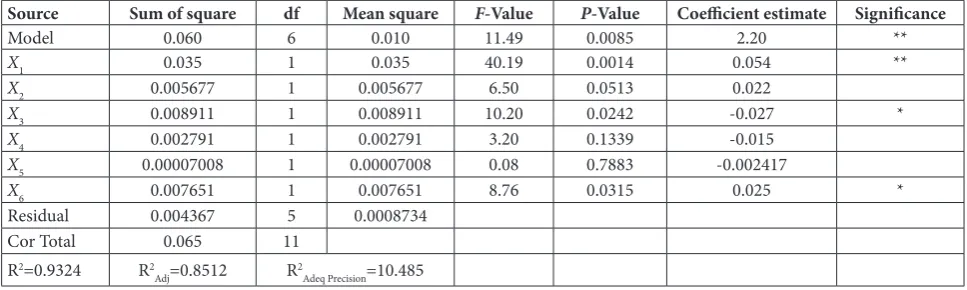
The effect of variables on the yield of flavonoid com-pounds was determined by conducting 12 experi-ments given by the PBD model (Table 1). P<0.05 was considered significant in results of analysis of variance (ANOVA). The determination coefficient (R2=0.9324) and the adjusted determination coefficient (R2
Adj= 0.8512) indicated a high degree of fit for the model. We found that the ethanol concentration (X1) had a highly significant effect on the yield of flavonoid compounds, while the microwave power (X3) and ultrasound extraction time (X6) had a significant ef-fect. The effects of solid-liquid ratio (X2), microwave
extraction time (X4) and ultrasound power (X5) were not significant on the yield. Therefore, the ethanol con-centration (X1), microwave power (X3) and ultrasound extraction time (X6) should be further optimized by BBD, and the remaining value brought to a low level (solid-liquid ratio 1:15 g/mL, microwave extraction time of 140 s and ultrasound power 200 W).
Optimization of UMAE
Multivariate regression analysis was performed on the results of the BBD to obtain a second order poly-nomial equation:
Y=2.440+0.052X1+0.033X3+0.039X6+0.032X1X3+0.0 43X1X6+0.0045X3X6-0.072X12-0.110X
32-0.066X62, where Y, X1, X3 and X6 represent the yield of the fla-vonoid compounds (%), the ethanol concentration, microwave power and ultrasound extraction time, respectively.
The statistical parameters obtained from ANOVA of the optimization model are shown in Table 2. The F -value of 76.55 and P<0.0001 indicated that the model is of great significance and could predict real experimental data. The R2=0.9899 and R2
Adj=0.9770 confirmed that the model was significant in the statistics. The pure error (P>0.05) indicated that the calculated values agree well with the experimental results. The signal-to-noise ratio was revealed by the “Adeq Precision”, and a ratio greater than 4 was acceptable [31]. Thus, the “Adeq Precision” value of 21.072 for the yield of flavonoid compounds demonstrated an adequate signal. In conclusion, the model was functional for the experiment.
Table 1. Variance analysis of PBD for the yield of flavonoid compounds.
Source Sum of square df Mean square F-Value P-Value Coefficient estimate Significance
Model 0.060 6 0.010 11.49 0.0085 2.20 **
X1 0.035 1 0.035 40.19 0.0014 0.054 **
X2 0.005677 1 0.005677 6.50 0.0513 0.022
X3 0.008911 1 0.008911 10.20 0.0242 -0.027 *
X4 0.002791 1 0.002791 3.20 0.1339 -0.015
X5 0.00007008 1 0.00007008 0.08 0.7883 -0.002417
X6 0.007651 1 0.007651 8.76 0.0315 0.025 *
Residual 0.004367 5 0.0008734
Cor Total 0.065 11
R2=0.9324 R2
Adj=0.8512 R2Adeq Precision=10.485
The P-value was applied to ascertain the significance of each coefficient and demonstrated the intensity of the interaction between each independent variable. It can be seen that the coefficients of X1, X3, X6, X1X3, X1X6, X12,
X32 and X
62 were highly significant (P<0.01). In addition,
X3X6 was not statistically significant (P>0.05). For the
X1X3 and X1X6 interaction, the value of P<0.01 indicated that the ethanol concentration was significantly related
to the microwave power and ultrasound ex-traction time.
The three-dimensional (3D) response surface plots and the contour plots were obtained by Design-Expert software, and are shown in Fig.1. Fig. 1A shows the inter-active effects of ethanol concentration and microwave power on the yield of flavonoid compounds, with the ultrasound extraction time (at zero level). The yield of flavonoid compounds first rose and then fell with in-creasing ethanol concentration from 35% to 45% and microwave power from 150 W to 200 W. The maximum yield was obtained when the ethanol concentration and microwave power were 41% and 180 W, respectively. Fig. 1B proved the interactive effects of the ultrasound extraction time and ethanol concentration on the yield of flavonoid compounds when keeping microwave power at zero level. The maximum yield of flavonoid compounds was obtained when the ethanol concentration was 41% and the ultrasound extraction time was 26 min. Fig. 1C revealed that the interactive effects between the ultrasound extraction time and microwave power presented non-significant effects.
Verification experiment
The optimal extraction parameters for obtaining the maximum yield of flavonoid compounds were as fol-lows: ethanol concentration 40.67%, microwave power 178.33 W, and an ultrasound extraction time of 25.67
Table 2. Analysis of variance and regression coefficients of the calculated surface quadratic model for the yield of flavonoid compounds.
Source Sum of square df squareMean F-Value P-Value Significance
Model 0.15 9 0.017 76.55 <0.0001 **
X1 0.022 1 0.022 98.91 <0.0001 **
X3 0.008581 1 0.008581 39.42 0.0004 **
X6 0.012 1 0.012 55.55 0.0001 **
X1X3 0.004096 1 0.004096 18.82 0.0034 **
X1X6 0.007310 1 0.007310 33.59 0.0007 **
X3X6 0.000081 1 0.000081 0.37 0.5611
X12 0.022 1 0.022 98.97 <0.0001 **
X32 0.047 1 0.047 216.44 <0.0001 **
X62 0.018 1 0.018 83.06 <0.0001 **
Residual 0.001524 7 0.0002177
Lack of fit 0.00009075 3 0.00003025 0.084 0.9650
Pure error 0.001433 4 0.0003582
Sum 0.15 16
R2=0.9899 R2
Adj=0.9770 R
2
Adeq Precision=21.072
Pred R2=0.9756
* represents P<0.05, **represents P<0.01; P<0.05 indicates that the factor has a significant effect, whereas P<0.01 indicates that the factor has a highly significant effect.
min. The predicted yield of flavonoid compounds was 2.456% by BBD. In view of the feasibility of the experiment, the optimal parameters were modified to an ethanol concentration of 41%, micro-wave power of 178 W, and an ultrasound extraction time of 26 min. Under the selected optimal conditions, the valid-ity of the model equation to predict the optimal response value was verified. The actual yield of flavonoid compounds was 2.454%, which almost coincided with the predicted yield (2.456%), as shown in Supplementary Table S5. There is a strong correlation between the actual results and
the predicted results, indicating the response surface model can better reflect the expected optimization.
Comparison of the effect on the flavonoid
compound yield of E. ulmoides leaves by different extraction methods
According to the optimal conditions of the previous results, ultrasound extraction [32], microwave assisted extraction [33], UMAE, and solvent extraction in the terms of yield offlavonoid compounds were com-pared. The yield of flavonoid compounds extracted by ultrasound-assisted extraction, microwave-assisted extraction, UMAE and solvent extraction were 2.041%, 1.731%, 2.454% and 1.568%, respectively. We found that the yield of flavonoid compounds extracted by UMAE was higher than those of the other three methods. Com-pared with the ultrasonic-assisted extraction method, the microwave-assisted extraction method and the solvent-extraction method, the yield obtained by UMAE was 20.24%, 41.77% and 56.51% higher, respectively.
Antioxidant activity analysis
DPPH free radical scavenging activity
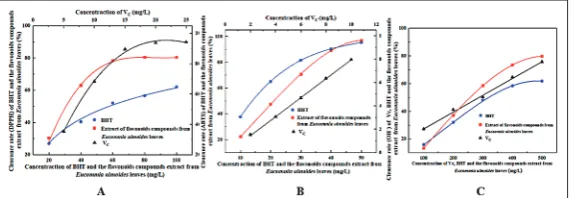
The pairing of the single electron of •DPPH occurred due to the presence of free radical scavengers, result-ing in a decrease of the maximum absorbance value at 517 nm. The lower absorbance demonstrates a better scavenging capacity. Fig. 2A shows the scav-enging capacity of the flavonoid extract, with BHT and Vc as positive controls. The scavenging rate of
•DPPH increased significantly with the increase in concentration in the range of measured concentra-tions. At the concentration of 100 mg/L, the clearance rate of the extract was 80.37%. The results demon-strated that the antioxidation efficiency of the extract (IC50=30.76 mg/L) for DPPH radical scavenging capac-ity was better than for BHT (IC50=55.33 mg/L), and worse than for Vc (IC50=6.914 mg/L).
ABTS free radical scavenging activity
The scavenging mechanism of the scavenging capacity for ABTS■ was as follows: with the presentence of oxi-dizing agents, the ABTS is oxidized to ABTS■; however, antioxidants could inhibit the production of ABTS■ [31]. As shown in Fig. 2B, the scavenging capacity for ABTS■ of the extract was significantly increased in a concentration-dependent manner in the range of meas-ured concentrations. At the concentration of 50 mg/L, the clearance rate of the flavonoid extract was 96.88%. We observed that the scavenging capacity of the fla-vonoid extract (IC50=21.09 mg/L) was worse than for BHT (IC50=13.74 mg/L) and Vc (IC50=6.349 mg/L).
Hydroxyl radical scavenging activity
The results of the scavenging capacity for the hydroxyl radical for the flavonoid extract are shown in Fig. 2C. The flavonoid extract exhibited good scavenging capacity at concentrations from 100 to 500 mg/L, and the scavenging capacity of the extract was increased at the tested concentration range. At the concentration of 500 mg/L, the clearance rate of the flavonoid extract was 79.67%. The IC50 of the flavonoid extract was 248.4
Fig. 2. Scavenging effects of the flavonoid extract from E. ulmoides leaves on DPPH radical, ABTS radical and OH radical. A – Effect of the flavonoid extract from E. ulmoides leaves on the removal of the DPPH radical. B – Effect of the flavonoid extract from E. ulmoides leaves on the removal of the ABTS radical.
mg/L, which was superior to BHT (IC50=306.5 mg/L) and Vc (IC50=294.4 mg/L).
Antibacterial test analysis
Determination of the inhibition zone
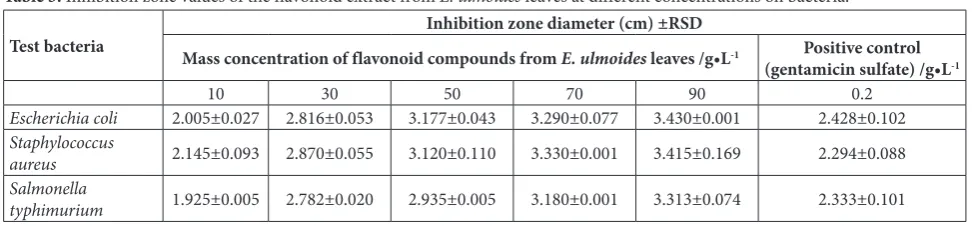
As shown in Fig. 3, the inhibition zone of the control was not detected in the negative group. At the same time, clear inhibition zones can be observed in the positive control group and the experimental group around the Oxford cup. The values of the inhibition zones are presented in Table 3. It can be seen that the flavonoid extract from E. ulmoides leaves exhibited potent antibacterial activity to positive and gram-negative bacteria. In addition, the antibacterial effect of the samples increased markedly in a concentration-dependent manner at the tested concentrations.
Determination of MIC and MBC
The MIC values of flavonoid extract against Escherichia
coli, Staphylococcusaureus, and Salmonella typhimurium
were 0.7813 g/L, 0.7813 g/L and 1.563 g/L, respectively. The MBC values were 1.563 g/L, 1.563 g/L, 3.125 g/L, respectively.
DISCUSSION
The traditional methods for flavonoid extraction are reflux and leaching extraction. These methods have many problems such as low extraction efficiency and high energy consumption [34]. The UMAE, as a com-plementary extraction method with both advantages of UAE and MAE, has recently received increasing attention [35], but only a few reports describe the application of UMAE methods in the extraction of flavonoids from E. ulmoides leaves. Moreover, factors affecting the yield of active ingredients increase as a result of the introduction of this extraction technique. For multi-factor and multi-level extractions, if orthogo-nal design or BBD is used to optimize the extraction conditions directly, the workload of experiments will be increased and precision will be reduced. Therefore, it is necessary to find possible solutions to reduce the experimental workload and improve yield. The PBD can screen out the factors that significantly affect the results through fewer experiments, thus greatly im-proving efficiency. In this study, UMAE was used to extract flavonoid compounds from E. ulmoides leaves in order to improve the yield. PBD combined with BBD was applied to optimize the extraction conditions. The results showed that the yield of flavonoid compounds by UMAE was higher than obtained by a single extrac-tion (such as ultrasonic-assisted, microwave-assisted and solvent extraction methods). The reason that the higher yield of flavonoid compounds was obtained by UMAE could partly be attributed to the mutually rein-forcing effects generated by ultrasound and microwaves [36]. The cavitation of ultrasound could break down
Fig. 3. Antibacterial activity of the flavonoid extract from E. ul-moides leaves. A – Antibacterial activity of the flavonoid extract from E. ulmoides leaves against E. coli. B – Antibacterial activity of the flavonoid extract from E. ulmoides leaves against S. aureus.
C – Antibacterial activity of the flavonoid extract from E. ulmoides
leaves against S. typhimurium. D – Negative control. E – Inhibition zone of the positive control (0.2 g/L). F – Inhibition zone of the flavonoid extract (90 g/L).
Table 3. Inhibition zone values of the flavonoid extract from E. ulmoides leaves at different concentrations on bacteria.
Test bacteria Mass concentration of flavonoid compounds from Inhibition zone diameter (cm) ±RSDE. ulmoides leaves /g•L-1 Positive control
(gentamicin sulfate) /g•L-1
10 30 50 70 90 0.2
Escherichia coli 2.005±0.027 2.816±0.053 3.177±0.043 3.290±0.077 3.430±0.001 2.428±0.102
Staphylococcus
aureus 2.145±0.093 2.870±0.055 3.120±0.110 3.330±0.001 3.415±0.169 2.294±0.088 Salmonella
the cytoarchitecture of E. ulmoides leaves and increase the release of flavonoid compounds. Simultaneously, this action imparted a larger contact area between the flavonoid compounds and the extraction solvent [37,38]. Auxiliary rapid heating by microwaves ruptured leaf tissue and released more compounds [39]. Similar results were reported when sequential UMAE was used for the extraction of pectin from pomelo peel [40]. The results proved that the combined extraction techniques had greater potential and a higher efficiency of 154.95% and a 31.39% improvement of yield. However, in their experimental design, the factors affecting the yield were not optimized, resulting in some of them having insignificant effects on the yield, which can increase workload and make the results less precise. Similarly, it was demonstrated that the yield of natural dye from sorghum husk via UMAE was 3.6-fold higher than the yield of 4.6% obtained by the conventional shaking method [41], however, in this study, the experimental conditions were optimized by several single factor experiments and the significance of these factors was not evaluated. These may result in lower accuracy of the experimental results, notably of the yield.
Excessive reactive oxygen/nitrogen species (ROS-RNS) production disturbs the antioxidant/pro-antiox-idant system and contributes to oxidative stress, which contributes towards development in humans of diabetes mellitus, neurodegenerative disorders, cardiovascular diseases, cancer, etc. [42,43], with studies pointing to a strong correlation between bioactive compounds and antioxidant activities [44,45]. Consequently, in this study the flavonoid extract was screened for antioxi-dant activities by different assays (•DPPH, ABTS■ and hydroxyl radicals). Our results revealed that the flavo-noid extract had a strong scavenging effect on •DPPH, ABTS■ and hydroxyl radicals, and that the scavenging rate was concentration-dependent. The antioxidant capacity of the flavonoid extract can be explained by the high number of active hydroxyl groups, which donate hydrogen for binding with the radical to terminate the free radical oxidation chain reaction [46,47]; these results were in accordance with those reported previ-ously [48]. We observed that the antioxidant activity increased significantly (P<0.05) with the increase of flavonoid concentration, which was in agreement with a previous report [49], however, it should be pointed out that our results for the scavenging capacity for •DPPH (IC50=30.76 mg/L) and hydroxyl radicals (IC50=248.4
mg/L) were better. The reason for this might be that more active ingredients, such as phenolic compounds, were extracted from E. ulmoides leaves through UMAE, resulting in increased scavenging capacity.
Plant extracts have shown considerable promise in a range of applications in industrial production, and several extracts due to their phytochemical constitu-ents possess antimicrobial activity. Moreover, plant extracts do not produce the numerous side effects that are frequently related with synthetic antimicrobials [50]. In this study, the flavonoid extract from E.
ul-moides leaves exhibited potent antibacterial activity to
gram-positive and gram-negative bacteria. A previous study showed similar results, with both bacteria and fungi being inhibited by the extract from E. ulmoides
leaves [51]. Moreover, the results of MIC and MBC
for Staphylococcus aureus and Salmonella typhimurium
indicated that the contained flavonoid exerted stronger antimicrobial effects on gram-positive bacterial than on gram-negative bacteria. This phenomenon was due to gram-positive bacteria being generally more sensitive to antibacterial agents than gram-negative bacteria [52], which may be because of the significant difference between the outer layers of gram-negative bacteria and gram-positive bacteria [53]. Surprisingly, the results of MIC and MBC for Escherichia coli (gram-negative bacteria) were the same as for Staphylococcus
aureus (gram-positive bacteria). The reason for this
inconsistency could be because other antibacterial compounds were also extracted via UMAE, includ-ing iridoids, phenylpropanoids, etc. Some of these compounds may display a better inhibitory effect on
Escherichia coli, however, the specific reason for this
needs further clarification.
CONCLUSIONS
DPPH, ABTS and hydroxyl radicals and an antibacte-rial effect against E. coli and S. aureus. The flavonoid extract of E. ulmoides leaves has considerable potential in the development of cosmetics and functional foods.
Funding: This work was supported by the National and Local United Engineering Laboratory of Integrative Utilization Technology of E. ulmoides (NLE201602&NLE201704), the National Natural Science Foundation of China (31660181), the Key Laboratory of Human Forest Products and Chemical Industry Engineering (LCHG1902), the Educational Commission of Hunan Province of China (19C1532) and the GDAS Project of Science and Technology Development (2019GDASYL-0502003).
Acknowledgements: Thanks to Mijun Peng and Sheng Peng for their guidance in the experiments.
Author contributions: Xiang Wang designed the project. Sheng Peng supervised the work and revised the manuscript. Xiang Wang carried out all the experiments and wrote the manuscript. Mi-jun Peng, Zhi-hong Wang, Qiu-ling Yang assisted in completing the work. All the authors read and approved the final manuscript.
Conflicts of interest disclosure: The authors declare no conflict of interest.
REFERENCES
1. Dai X, Huang Q, Zhou B, Gong Z, Liu Z, Shi S. Prepara-tive isolation and purification of seven main antioxidants from Eucommia ulmoides Oliv. (Du-zhong) leaves using HSCCC guided by DPPH-HPLC experiment. Food Chem. 2013;139(1-4):563-70.
2. Xu JK, Li MF, Sun RC. Identifying the impact of ultrasound-assisted extraction on polysaccharides and natural antioxi-dants from Eucommia ulmoides Oliver. Process Biochem. 2015;50(3):473-81.
3. Deyama T, Nishibe S, Nakazawa Y. Constituents and phar-macological effects of Eucommia and Siberian ginseng. Acta Pharmacol Sin. 2001;22(12):1057-70.
4. Zhong SJ, Yang X, Li J, Li Y, Li XS. Study on the Total Flavo-noids Content and Antioxidant Activity in Different Parts of
Eucommiae ulmoides. China Pharmacy. 2017;28(13):1787-90. 5. Greenway F, Liu Z, Yu Y, Gupta A. A clinical trial testing
the safety and efficacy of a standardized Eucommia ulmoides
Oliver bark extract to treat hypertension. Altern Med Rev. 2011;16(4):338-47.
6. Tuba A, İlhami G. Antioxidant and radical scavenging prop-erties of curcumin. Chem Biol Interact. 2008;174:27–37. 7. Parvathy KS, Negi PS, Srinivas P. Antioxidant, antimutagenic
and antibacterial activities of curcumin-β-diglucoside. Food Chem. 2008;115(1):265-71.
8. Rodríguez-Rojo S, Visentin A, Maestri D, Cocero M. Assisted extraction of rosemary antioxidants with green solvents. J Food Eng. 2012;109:98-103.
9. Mehmooda A, Ishaq M, Zhao L, Yaqoob S, Safdar B, Nadeeme M, Munir M, Wang C. Impact of ultrasound and conventional extraction techniques on bioactive compounds
and biological activities of blue butterfly pea flower (Clitoria ternatea L.). Ultrason Sonochem. 2019;51:12-9.
10. Aurore F, Xavier F, Matteo M, Francesco V, Giancarlo C, Farid C. Solvent-free microwave extraction of essential oil from aromatic herbs: from laboratory to pilot and industrial scale. Food Chem. 2014;150(5):193-8.
11. Sandrine PI, Christian G, Giancarlo C, Farid C. A com-parison of essential oil obtained from lavandin via different extraction processes: ultrasound, microwave, turbohydro-distillation, steam and hydrodistillation. J Chromatogra A. 2013;1305(24):41-7.
12. Cheung YC, Siu KC, Liu YS, Wu JY. Molecular properties and antioxidant activities of polysaccharide-protein com-plexes from selected mushrooms by ultrasound-assisted extraction. Process Biochem. 2012;47(5):892-5.
13. Ruciza JM, Slobodanka K, Eleonora W. Application of ultra-sound for enhanced extraction of prebiotic oligosaccharides from selected fruits and vegetables. Ultrason Sonochem. 2015;22(22):446-53.
14. Li Y, Zeng R, Lu Q, Wu S, Chen J. Ultrasound/microwave-assisted extraction and comparative analysis of bioactive/ toxic indole alkaloids in different medicinal parts of Gel-semium elegans Benth by ultra-high performance liquid chromatography with MS/MS. J Sep Sci. 2014;37(3):308-13. 15. Zhang L, Liu Z. Optimization and comparison of sound/microwave assisted extraction (UMAE) and ultra-sonic assisted extraction (UAE) of lycopene from tomatoes. Ultrason Sonochem. 2008;15(5):731-7.
16. Chen Y, Gu X, Huang SQ, Li J, Wang X, Tang J. Optimiza-tion of ultrasonic/microwave assisted extracOptimiza-tion (UMAE) of polysaccharides from Inonotus obliquus and evaluation of its anti-tumor activities. Int J Biol Macromol. 2010;46(4):429-35. 17. Bai F, Wang J, Guo J. Optimization for ultrasound-micro-wave assisted extraction of pectin from jujube waste using response surface methodology. Adv J Food Sci Technol.
2015;7(3):144-53.
18. Liu Z, Qiao L, Yang F, Gu H, Yang L. Brönsted acidic ionic liquid based ultrasound-microwave synergistic extraction of pectin from pomelo peels. Int J Biol Macromol. 2017;94(Pt A):309-18.
19. Rahmanian N, Jafari SM, Wani TA. Bioactive profile, dehydra-tion, extraction and application of the bioactive components of olive leaves. Trends Food Sci Tech. 2015;42(2):150-72. 20. Pan G, Yu G, Zhu C, Qiao J. Optimization of
ultrasound-assisted extraction (UAE) of flavonoids compounds (FC) from hawthorn seed (HS). Ultrason Sonochem. 2012;19(3):486-90. 21. Pinela J, Prieto MA, Carvalho AM, Barreiro MF, Oliveira
BPP, Barros L, Ferreira ICFR. Microwave-assisted extraction of phenolic acids and flavonoids and production of antioxi-dant ingredients from tomato: A nutraceutical-oriented opti-mization study. Sep Purif Technol. 2016;164:114-24. 22. Guo WQ, Meng ZH, Ren NQ. Optimization of key variables
for the enhanced production of hydrogen by Ethanoligenens harbinense W1 using response surface methodology. Int J Hydrogen Energ. 2011;36(10):5843-48.
24. Gharibzahedi SMT., Razavi S H, Mousavi M. Optimisation and kinetic studies on the production of intracellular can-thaxanthin in fed-batch cultures of Dietzia natronolimnaea HS-1. Qual Assur Saf Crop. 2015;7(5):757-67.
25. He QH, Gong ZJ, An M, Li GZ. Optimization of enzymatic extraction technology for algal oligosaccharide by response surface methodology. China Brewing. 2019;38(11):59-62. 26. Li YB, Yu JB, Wu SY, Zhi AP. Determination of total
flavo-noids in Brazil green propolis capsule. J Food Safety and Quality. 2015;(8):3060-3.
27. Frankel EN, Meyer AS. The problems of using one-dimen-sional methods to evaluate multifunctional food and bio-logical antioxidants. J Sci Food Agr. 2000; 80(13):1925–41. 28. Thaipong K, Boonprakob U, Crosby K. Comparison of
ABTS, DPPH, FRAP, and ORAC assays for estimating anti-oxidant activity from guava fruit extracts. J Food Compos Anal. 2012;19(6):669-75.
29. Huang XY, Li SL, Dang CZ, Song QY, Yang QX. Study on antioxidative activity and ingredient of extract from Toona Sinensis fruit. Seeds. 2011;30(7):79-82.
30. Fazeli MR, Amin G, Attari MMA, Ashtiani H, Jamalifar H, Samadi N. Antimicrobial activities of Iranian sumac and avishan-e shirazi (Zataria multiflora) against some food-borne bacteria. Food Control. 2007;18(6):646-9.
31. Zhang CW, Wang CZ, Fang C. Enzymolysis-based ultra-sound extraction and antioxidant activities of polypre-nol lipids from Ginkgo biloba leaves. Process Biochem. 2016;51(3):444-51.
32. Liu GP, Jiao FF. Study on the ultrasonic assisted extraction of total flavonoids from Eucommia ulmoides leaves. Food Ferment Ind. 2013;39(11):258-61.
33. Liu GP, Cui BJ, Sun JY, Gao XL. Microwave-assisted extrac-tion process of total flavonoids from Eucommia ulmoides
leaves. China Brewing. 2015;34(5):127-30.
34. Zhang G, He L, Hu M. Optimized ultrasonic-assisted extrac-tion of flavonoids from Prunella vulgaris L. and evaluaextrac-tion of antioxidant activities in vitro. Innov Food Sci Emerg Tech-nol. 2011;12:18-25.
35. Lu X, Zheng Z, Li H, Cao R, Zheng YF, Yue H, Xiao JB, Miao S, Zheng BD. Optimization of ultrasonic-microwave assisted extraction of oligosaccharides from lotus (Nelumbo nucifera, Gaertn.). Ind Crop Prod. 2017;107:546-57.
36. Alupului A, Călinescu I, Lavric V. Microwave extraction of active principles from medicinal plants. U P B Sci Bull Series B. 2012;74:129-42.
37. Gharibzahedi SMT. Ultrasound-mediated nettle oil nano-emulsions stabilized by purified jujube polysaccharide: Pro-cess optimization, microbial evaluation and physicochemical storage stability. J Mol Liq. 2017;234:240-8.
38. Moorthy IG, Maran JP, Muneeswari S, Naganyashree S, Shi-vamathi CS. Response surface optimization of ultrasound assisted extraction of pectin from pomegranate peel. Int J Biol Macromol. 2015;72:1323-8.
39. Prakash MJ, Sivakumar V, Thirugnanasambandham K, Sridhar R. Microwave assisted extraction of pectin from waste Citrullus lanatus fruit rinds. Carbohyd Polym. 2014;101:786-91. 40. Liew SQ, Ngoh GCH, Yusoff R, Teoh WH. Sequential
ultra-sound-microwave assisted acid extraction (UMAE) of pectin from pomelo peels. Int J Biol Macromol. 2016;93:426-35.
41. Wizi J, Wang L, Hou XL, Tao YY, Ma B, Yang YQ. Ultra-sound-microwave assisted extraction of natural colorants from sorghum husk with different solvents. Ind Crop Prod. 2018;120:203-13.
42. Wang ZJ. Xie JH, Kan LJ, Wang J, Shen MY, Li WJ, Nie SP, Xie MY. Sulfated polysaccharides from Cyclocarya paliurus
reduce H2O2-induced oxidative stress in RAW264.7 cells. Int J Biol Macromol. 2015;80:410-7.
43. Madian AG, Regnier FE. Proteomic identification of car-bonylated proteins and their oxidation sites. J Proteome Res. 2010;9:3766-80.
44. Ouyang H, Hou K, Peng WX, Liu ZL, Deng HP. Antioxidant and xanthine oxidase inhibitory activities of total polyphe-nols from onion. Saudi J Biol Sci. 2018;25:1509-13. 45. Hou MY, Hu WZ, Xiu ZL, Shi YS, Hao KX, Cao D, Guan YG,
Yin HL. Efficient enrichment of total flavonoids from Pteris ensiformis Burm. extracts by macroporous adsorption resins and in vitro evaluation of antioxidant and antiproliferative activities. J Chromatogr B. 2020;1138:121960.
46. Trouillas P, Marsal P, Siri D, Lazzaroni R, Duroux JL. A DFT study of the reactivity of OH groups in quercetin and taxifo-lin antioxidants: the specificity of the 3-OH site. Food Chem. 2006;97(4):679-88.
47. Tsimogiannis DI, Oreopoulou V. The contribution of flavo-noid C-ring on the DPPH free radical scavenging efficiency. A kinetic approach for the 3΄, 4΄-hydroxy substituted mem-bers. Innov Food Sci Emerg. 2006;7(1):140-6.
48. Hamed YS, Abdin M, Akhtar HMS, Chen D, Wan P, Chen G, Zeng X. Extraction, purification by macrospores resin and in vitro antioxidant activity of flavonoids from Moringa oliefera leaves. S Afr J Bot. 2019;124:270-9.
49. Li X, Liu T. Optimization of microwave-assisted extrac-tion of flavonoids from Eucommia ulmoides leaf and inves-tigation of their antioxidative effect. Sci-Tech Food Ind. 2013;34(04):243-8.
50. Wannissorn B, Jarikasem S, Siriwangchai T, Thubthimthed S. Antibacterial properties of essential oils from Thai medicinal plants. Fitoterapia. 2005;76:233-6.
51. Ji ZP, Su YQ. Study on antimicrobial activities of extracts from Eucommia ulmoides Oliv. leaves. Chem Ind Forest Prod. 2008;28(2):63-6.
52. Gill AO, Holley RA. Disruption of Escherichia coli, Listeria monocytogenes and Lactobacillus sakei cellular membranes
by plant oil aromatics. Int. J. Food Microbiol. 2006.;108:1-9. 53. Guo N, Zang YP, Cui Q, Gai QY, Jiao J, Wang W, Zu YG, Fu YJ. The preservative potential of Amomum tsaoko essential oil against E. coil, its antibacterial property and mode of action. Food Control. 2017;75:236-45.
Supplementary Material

![Bis{[μ bis(diphenylarsino)methane 1:2κ2As:As′]nonacarbonyl 1κ3C,2κ3C,3κ3C [tris(4 methoxyphenyl)arsine 3κAs] triangulo triruthenium(0)} dichloromethane solvate](data:image/gif;base64,R0lGODlhAQABAIAAAP///wAAACH5BAEAAAAALAAAAAABAAEAAAICRAEAOw==)