Journal of Electrical Engineering,
Electronics, Control and Computer Science – JEEECCS,
Volume 5, Issue 18, pages 11-18, 2019
Performance Analysis of Power Quality
Improvement for Standard IEEE 14-Bus based
FACTS Controller
Shazly A. Mohamed
Dep. of Electrical Engineering, Faculty of Engineering, South Valley University Qena, Egypt
E-mail: [email protected]
Abstract - FACTS systems can quickly influence the transmission line parameters like impedance, phase & voltage to supply fast controller of transmission or distribution response. This category of FACTS can be inserted to the transmission line in shunt, like static
compensator or STATCOM, series like series
compensator or SSSC and common such as, unified power controller or UPFC, and use the accessible energy from the system. FACTS have been inspected in power system area. There are numerous advantages in applied FACTS family such as system stability increase, loading
ability of transmission systems, power quality
enhancement and increase usage of low generation cost. When the fault occurs, more reactive power is demand from the system to achieve the fault and return the system to the stable condition.
Simulation results and discussion of the IEEE 14-bus system with/without STATCOM unit during a single line fault & three lines fault are investigated in this paper. 14-bus system is modeled using the blocks of Simulink. The purpose of this study is to promote a STATCOM model for power quality improvement.
Keywords: component; System power quality improvement; STATCOM; FACTS devices; IEEE 14-bus system; System stability; Power system simulator.
OBJECTIVE
The study of the existing research in the present paper has been undertaken with the following objectives: 1-To study the IEEE-14 bus system of power system. 2-To study of a STATCOM system to improve the power system quality.
3-To make the model of IEEE-14 bus and STATCOM systems analysis in MATLAB simulation.
I. INTRODUCTION
Power quality (PQ) has become an important rule for the fulfillment of numerous applications such as production & information technology, and has an impact on high control & automation of technology systems. So, PQ has achieved increased attention by two industrial/commercial consumers [1]. Power system has to be preserved from the climate conditions, owing to increase electricity overloading. Power electronics known as FACTS has been inserted
in order to control various parameters of transmission line [2].
FACTS give features for enhancing transmission line in terms of best application of existing property, increase line reliability, transient stability of the grid and increase supply quality for sensitive manufactures [3, 4]. Application of several FACTS can help in reducing the different PQ issues. The efficient applied of power system resources for a connotation FACTS was inserted lately. The basic connotation of FACTS is depend on the applied of high power electronics in order to dominate active power, reactive power and also voltage in transmission line [5, 6].
STATCOM unit is a reactive compensation which is a parallel inserted to the transmission & distribution systems that based on VSCs which composed of self-commutated switching units whereas, modern devices of STATCOMs comprise commutated switches like thyristors which is able on to injecting or absorbing reactive power to recompense the transmission system that is situated among the load and generators [7]. The working of STATCOM unit makes it to work as source/load for transmission system and considered as a member of the FACTS family. Moreover, in distribution systems, STATCOM unit can replace a var compensators or SVC [8].
This article is coordinated after introduction, section II describes basic configuration, operating principle and the mathematical equations of a STATCOM connected to a network, section III presents the modeling analysis of IEEE-14 bus applied in this work, section IV presents the results & discussion and finally, section V concludes this paper.
II. STATCOM,BASIC CONFIGURATION AND
OPERATING PRINCIPLE
been known as IEEE based on the following three elements. A functional model of STATCOM is shown in Figure (1).
First element is Static: depend on the solid-state switching units without rotating components; the next element is Synchronous: identical to synchronous machine based on three sinusoidal voltages and final element which is Compensator: that presented with compensation of reactive power [12].
The relation among fundamental component for output voltage of the converter and the voltage through capacitor is expressed by equation (1):
(1) Where,
K, is the coefficient that based on converter model, No. of switching pulses & converter controls.
Figure 1: Basic circuit arrangement of STATCOM [13].
The flow value from inverter to the line can be given as follows:
(2)
Where, X is magnetic transformer leakage reactance. So, exchange of reactive power can be declared based on the equation (3):
(3) The real power exchange among inverter voltage and system can be computed as follows:
(4) The STATCOM V-I characteristics are depicted in Figure (2). STATCOM losses are ignored & ISTATCOM is supposed in order to be purely reactive. The negative current point to capacitive case whereas
V, Positive sequence voltage
I, Reactive current (I>0 point to an inductive case & I<0 point to capacitive case)
Xs, Slope/droop reactance (generally among 1% and 5%)
Figure 2: Representation of STATCOM V-I characteristics
Figure 3: STATCOM system operation
13
Figure 4: STATCOM block diagram based PWM control
Figure (5) shows some applications of STATCOM such as, improvements of PQ, control of reactive power, regulation of the voltage, power swings or oscillations damping, capacity enhancement of the transmission line, stability of transient and voltage, and application at system faults [14].
Figure 5: Various applications of STATCOM
III. POWER SYSTEM FOR IEEE14-BUS MODEL
UNDER STUDY
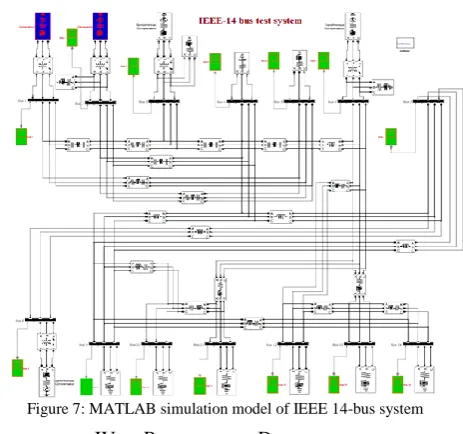
This paper produces the FACTS device in IEEE 14-bus system to power quality improvement. The system performance with and without STATCOM during single line fault and three lines fault conditions are studied. Matlab/Simulink program is utilized for simulation the system with and without STATCOM. The standard of IEEE 14-bus is illustrated in Figure (6). It contains of 5 synchronous machines, three of that are synchronous compensator (STATCOM) only applied for support of reactive power. There are 11 loads totaling 259MW & 73.5Mvar. The dynamic & static system data can be created in Appendix A. This system is vastly applied for voltage stability and low frequency stability analysis. The IEEE 14-bus was studied based Matlab/Simulink as in Figure (7).
Figure 6: Standard of IEEE 14-bus system with STATCOM [15].
Figure 7: MATLAB simulation model of IEEE 14-bus system
IV. RESULTS AND DISCUSSIONS
When the system running with & without STATCOM a single-line fault & three-line fault are applied, with fault resistance is 0.001Ω.
Study Case (1): Single-line fault
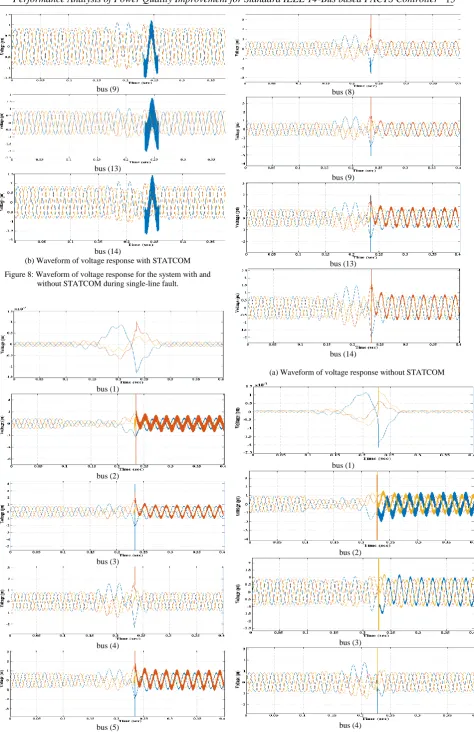
System performances with and without STATCOM are shown in Figure (8) in terms of voltage response through single-line fault at bus 1, 2, 3, 4, 5, 8, 9, 13 and 14. It is noticed that with STATCOM, the overshoot of the voltage response is better than the system without STATCOM. Table (I) summarizes the performance specification with and without STATCOM through a single-line fault disturbance in sense of overshoot.
Table I: Performance specification due to single-line fault disturbance
Study Case 2: Three-lines fault
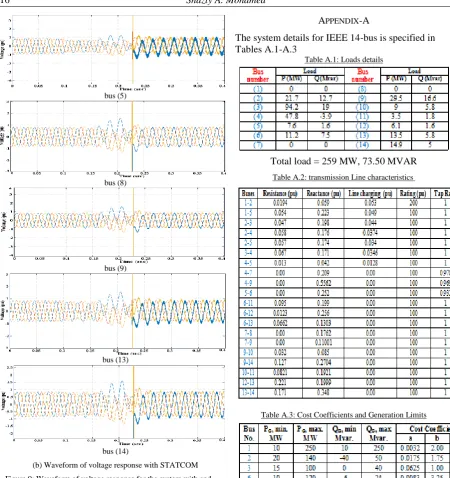
System performances with and without STATCOM are shown in Figure (9) in terms of voltage response through three-lines fault at bus 1, 2, 3, 4, 5, 8, 9, 13 and 14. It is noticed that with STATCOM, the response of the system in terms of voltage, the system with STATCOM is better than without STATCOM in sense of overshoot. Table (II) summarizes the performance specification with and without STATCOM during three lines fault disturbance.
bus (2)
bus (3)
bus (4)
bus (5)
bus (8)
bus (9)
bus (13)
bus (1)
bus (2)
bus (3)
bus (4)
bus (5)
15
bus (9)
bus (13)
bus (14)
(b) Waveform of voltage response with STATCOM Figure 8: Waveform of voltage response for the system with and
without STATCOM during single-line fault.
bus (1)
bus (2)
bus (3)
bus (4)
bus (5)
bus (8)
bus (9)
bus (13)
bus (14)
(a) Waveform of voltage response without STATCOM
bus (1)
bus (2)
bus (3)
bus (8)
bus (9)
bus (13)
bus (14)
(b) Waveform of voltage response with STATCOM Figure 9: Waveform of voltage response for the system with and
without STATCOM during three-lines fault.
V. CONCLUSION
The results indicate that, the system with STATCOM device improve effectively power quality and reduce overshoot as compared to system without STATCOM. Therefore, the results show that, system with STATCOM is strong for variation of parameters. Simulation and modeling of IEEE 14-bus system with STATCOM device is employed for PQ improvement. The system model is studied and tested based on Matlab program and the numerical simulation results owing to fault conditions such as, single-line fault & three-line fault in terms of voltage response with/without STATCOM are presented. The system power with STATCOM is preferred and is fast, chive the fault and returns the system to the stable condition compared to system without FACTS devices.
Total load = 259 MW, 73.50 MVAR
Table A.2: transmission Line characteristics
Table A.3: Cost Coefficients and Generation Limits
Generating Cost =
∑
REFERENCES
[1] Shraddha S. Khonde, S. S. Dhamse and Dr. A. G. Thosar, “Power Quality Enhancement of Standard IEEE 14 Bus System using Unified Power Flow Controller”, International Journal of Engineering Science and Innovative Technology (IJESIT), ISSN: 2319-5967 Volume 3, Issue 5, pp. 323-334, September 2014. [2] Abdel-Moamen M. A. and Shazly Abdo Mohamed, “Multilevel Inverter Based DVR for Power Quality Improvement”, IEEE 17th International Middle East Power Systems Conference (MEPCON ' 2015), Mansoura University, Egypt, Dec. 15-17, 2015.
17
[5] D. Murali, M. Rajaram & N. Reka, “Comparison of FACTS Devices for Power System Stability Enhancement”, International Journal of Computer Applications, Vol. 8, No.4, 2010.
[6] Samima A., Anulekha S., Priyanath D., “Modelling, Simulation and Comparison of various FACTS Devices in Power System”, International Journal of Engineering Research &Technology (IJERT) Vol.1, (2012).
[7] Watanabe E., Aredes M., Barbosa P., Araújo Lima F., Silva Dias R., Santos G., “Flexible AC transmission systems. In: Rashid MH (ed) Power electronics handbook”, 3rd edn. Butterworth-Heinemann, Boston, pp 851–877, 2011.
[8] Shazly A. Mohamed, N. Luo, J.R. González, T. Pujol and L. Pacheco, “FACTS Family for Voltage Sag Alleviation: Performance Study and Analysis”, Renewable Energies and Power Quality Journal (RE&PQJ), Vol. (1), No. (17), pp. 561- 566, July 2019.
[9] Shervin S. T., Peyman S. B., “Shunt Compensation for Improvement of Voltage Stability Using Static Synchronous Compensator (STATCOM) for Various Faults in Power System”, International Journal of Advanced Research in Electrical, Electronics and Instrumentation Engineering (An ISO 3297:2007 Certified Organization) Vol. 3, Issue 6, June, 2014.
[10] Shazly A. Mohamed, A. Z. Diab, N. Luo, T. Pujol, L. Pacheco, “Static Series Compensator for the compensation of voltage-quality
disturbances based on particle swarm optimization techniques”, Renewable Energies and Power Quality Journal (RE&PQJ), Vol. (1), No. (16), pp. 71-76, April 2018.
[11] Abinash S., Balwinder S. S., “Power Quality Improvement Using FACTS Devices: A Review”, International Journal of Engineering and Advanced Technology (IJEAT) ISSN: 2249-8958, Vol. 3, Issue-2 December (2013).
[12] Amit Debnath and Champa Nandi, “Voltage Profile Analysis during Fault with STATCOM”, International Journal of Computer Applications (0975 – 8887), Volume 72– No.11, May 2013. [13] Abinash Singh, Balwinder Singh Surjan, “Power Quality Improvement Using FACTS Devices: A Review”, International Journal of Engineering and Advanced Technology (IJEAT) ISSN: 2249 – 8958, Volume-3, Issue-2, pp. 383-390, December 2013. [14] Tariq Masood, R.K. Aggarwal, S.A. Qureshi, R.A.J Khan, “STATCOM Model against SVC Control Model Performance Analyses Technique by MATLAB”, International Conference on Renewable Energies and Power Quality (ICREPQ’10), Granada (Spain), pp. 1314-1321, 23rd to 25th March 2010.
![Figure 1: Basic circuit arrangement of STATCOM [13].](https://thumb-us.123doks.com/thumbv2/123dok_us/7805537.2085001/2.595.76.273.359.551/figure-basic-circuit-arrangement-statcom.webp)