ISSN: 2278-3369
International Journal of Advances in Management and Economics
Available online at:
www.managementjournal.info
RESEARCH ARTICLE
Heri Kuncoro et. al. | Sept.-Oct. 2018 | Vol.7| Issue 5 |18-27 18
The Influence of Organizational Culture, Work Engagement to Job
Satisfaction in Realizing Employee Performance
Heri Kuncoro
*Master of Management Student, Universitas Negeri Surabaya, Indonesia.
*Corresponding Author: E-mail: [email protected]
Abstract:
This study aims to examine the influence of Organizational Culture, Work Engagement, Job Satisfaction on Employee Performance PT. Bank BRI Syariah, Tbk., Malang. Samples taken were 56 permanent employees scattered in 9 locations of PT. Bank BRI Syariah, Tbk., Malang, analysis of the research using Structural Equation Modeling (SEM) approach using Partial Least Square (PLS) analysis method. The results of the tests on the variables show that Organizational Culture has a significant positive effect on Employee Performance, Work engagement has no effect on Employee Performance, Organizational Culture has a positive effect on Job Satisfaction, Work engagement has a positive effect on Job Satisfaction, Job satisfaction has a positive effect on Employee Performance. The results of this study can be used as reference material for subsequent research, and can be used for policy making of PT. Bank BRI Syariah Tbk., Malang.Keywords:Organizational Culture, Work Engagement, Job Satisfaction, Employee Performance.
Article Received: 01 August 2018 Revised: 11 August 2018 Accepted: 27 August 2018
Introduction
Business competition in the current era of globalization directs all business actors to be able to compete in running management in managing their businesses. Business Strategy is a key component for the company (1), for growing development of digital modernization in the face of future technological advancements that are effective so that the capacity of business people will be increasingly at stake, Human Resource Management is an updated solution that must be run in an organization (2).
Human Resource Management looks at various aspects of needs, including paying attention to the needs of the owner, the needs of the employee and the needs of the company itself, towards the achievement of effectiveness, efficiency, productivity and company performance (3). Human Resource Management plays an important role in creating strategies to link employee activities to organizational goals in order to create business performance (4).
The performance of an organization that grows will have an impact on the increasing business world in an area, with a greater positive impact on the economy of a country. The growth of a country's economy cannot be separated from the role of the banking.
Islamic Banking is an option to determine the influence of several factors related to Organizational Culture, Work Engagement on Job satisfaction in realizing Employee Performance at PT. Bank BRI Syariah Tbk., Malang. According to Hofstede (5), arguing that in the perspective of a strong organizational culture has a high potential for performance. This condition is in line with the results of the thesis study by Arifin (6) that there is a significant influence of organizational culture on employee performance.
According to Suwandi (7) found that Organizational Culture has no effect on employee performance, this shows that the weak or strong organizational culture in an Organization does not affect performance.Chasanah (8) found a positive influence between organizational culture on job satisfaction, this happens because employees have understood the meaning of organizational culture in their daily work activities.
Heri Kuncoro et. al. | Sept.-Oct. 2018 | Vol.7| Issue 5 |18-27 19 values and characteristics of organizational
culture have little influence in creating an impact on employee job satisfaction. According to Karatepe (9) stated that Work engagement and positive work results are one way for employees to pay off the benefits provided by an organization, employees are enthusiastically willing to devote all the resources in completing their work. This theory reinforces the findings of Xiaobei et al (10), Hasanah (11) and Septiadi et al (12) who found a significant positive relationship between Work engagement on employee performance.
According to Belias et al.(13), resulting in a study of the assessment of organizational culture and Greek banking job satisfaction with the results there are significant differences in all aspects of the type of organizational culture. Researchers take cultural aspects and job satisfaction for comparison through analysis of banking research with different locations and methods
Literature Review Organizational Culture
Culture is an element or heritage inherited from generation to generation, this condition is not much different from the culture in an organization, where the rules, norms, behavior, habits and formally in the form of policies that have been carried out continuously from year to year year by itself will form a culture. Organizational Culture is defined as a basic style and assumptions developed in a group to overcome group problems, from internal and external adaptations that have worked well, are quite relevant to consider (14). According to O’Reilly and Chatman (15) Culture is defined as a set of norms and values that are widely
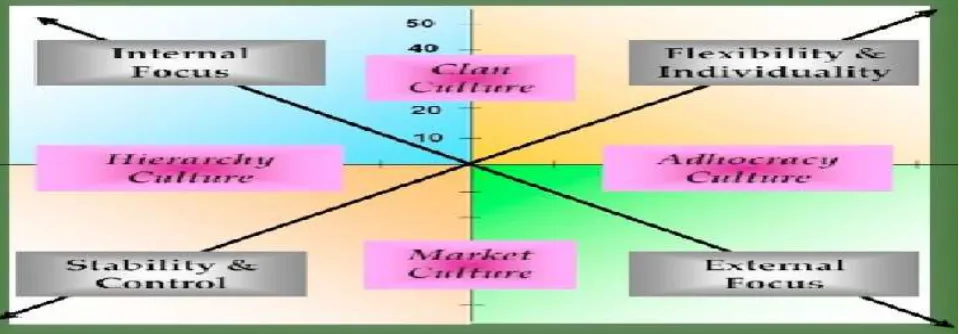
owned and strongly owned throughout the organization. Organizational culture brings members of the organization to think and act against various problems and opportunities (16). According to Cameron and Quinn (17) there is a model of Organizational Culture measurement based on the Competing Values Framework dividing into 4 types of culture: 1) Clan Culture; 2) Adhocracy Culture; 3) Market Culture; 4) Hierarchy Culture. (Figure 2.1).
Dominant characteristics Organizational leadership Employee Management Organizational Glue Strategic Emphasis Success criteria Work Engagement
In a work environment there is a strength that is latent but will be able to influence the work process as a whole, a high level of concern among colleagues to be able to help each other in trouble, together discussing to one point a solution to a problem, translating the boss's commands positively towards desired destination.
An employee who shows high job involvement identifies himself with his work and thinks of the job even when he is out of work (18). Work engagement is a positive state of mind, associated with work activities and manifested in Vigor, dedication, and Absorption (19). Several factors that influence work engagement include organizational characteristics, supervisory behavior, and individual differences (20). Schaufeli et al (19) describes several dimensions in work engagement, namely : 1) Vigor; 2) Dedication; 3) Absorption.
Heri Kuncoro et. al. | Sept.-Oct. 2018 | Vol.7| Issue 5 |18-27 20 The above cultural types are applied in all
organizations, BRI Syariah Bank implements seven elements of Organizational Culture in a productive work environment, strengthened by the rules arranged in Standard Operation (SOP) and various very strict Business Policies from Management, supported by a very strong control system from the level of directors to the operation unit level.
The conditions of applying this culture can be concluded that BRI Syariah Bank applies the culture type "Hierarchy Culture" (17) Explanations of the four types are summarized in the Competing Values Framework as follows:Rich et al. (21), in his study found no significant direct relationship in the model that includes a shared relationship with the direct effect of the independent variable on the dependent variable.
In previous research it was also said that engagement that employees must have is very important, because they tend to display high-quality performance in the workplace and meet the requirements of their formal role for business success (9). Work engagement is a positive mind condition, related to work activities and manifested in Vigor, dedication, and Absorption (19).
Job Satisfaction
Job satisfaction is a reflection of conditions that are subjective so that it is difficult to measure, there are differences in the nature, attitudes and character of each human being, in terms of the fulfillment of the desire, there will be other desires, the effect on behavior is quite large (22). Job Satisfaction in an Organization is a Multidimensional Phenomenon, which is influenced by several internal and external factors such as the values, principles, personality and expectations of individuals, the nature of work, the opportunities given and others (23).
According to Mathis and Jackson (24) that job satisfaction is a form of emotional employees who are constructive on the results of evaluating a work experience. Job satisfaction is also defined as the extent to which people like their work both in its entirety or with respect to certain conditions or rewards (25).
According to Rivai and Sagala (3) There
are Various Reasons why an
Organization Must pay Attention to job Satisfaction, Namely
Humans have the right to get fair and respectful treatment. Job satisfaction is part of the expression which is an extension of reflection on good treatment.
Job Satisfaction can foster positive behavior towards work functions and activities.
According to Marihot (22) Describes About 6 (six) Factors of Influence of job Satisfaction, Namely
Salary, is a sum of money in the form of reciprocity for the work done
The work itself, meaning work activities carried out whether there is an element of fun and satisfying or not.
Co-workers, meaning to whom an employee interacts, whether his coworkers can support each other or not
one up level, namely the methods applied by a superior in giving instructions in accordance with the way we want or not. Promotion, meaning that the process of
promotion / rank is open or not, because on average a person will feel that he / she is able to assume a higher position.
Work Environment, the purpose includes the physical and environmental environment in the sense of psychology. According to Lawler III (26), that the size of the effect of job satisfaction depends on a reality can be accepted as part of the compensation and labor provided. Edward Lawler in his theory model known as the Equity Model Theory is explained that the main cause between Satisfaction and dissatisfaction is based on the difference between a hope and reality received by an employee. Some indicators that influence the level of job satisfac tion according to Lawler are
1) Attendance;
2) Employee Turnover; 3) Work discipline; 4) Loyalty;
5) Conflict in the work environment. Employee Performance
Heri Kuncoro et. al. | Sept.-Oct. 2018 | Vol.7| Issue 5 |18-27 21 role in an organization (3). Performance is
also a testament to the results or level of success of a person in completing a task and or job with a certain level of ability and with detailed understanding of the work plan and how and what to do it, compared to the target or target or criteria as standard work that has been determined in advance and mutually agreed (3). According to Rivai and Jauvani Sagala (3), states that an organization carries out performance appraisal based on two main reasons, namely:
Manager's interests, an objective evaluation of employee performance is needed, so that it can be used to make HR decisions in the future.
Employee interests, a manager must assist employees in improving their performance, so that effective tools are needed.
Gomes (27) argues, based on the description of behavior then concluded several types of job performance criteria: Work Quantity (Quantity of work), namely
the acquisition of work results in a certain period.
Quality of work, namely the quality of production in accordance with the standards that have been set.
Knowledge (Job knowledge), namely the skills and knowledge as support in working.
Creativity (Creativeness), namely the emergence of ideas and actions in solving problems
Cooperative, which is easy to coordinate, work well together between members of the organization.
Dependability, which can be trusted through awareness that has grown especially in the presence and completion of work
Initiative (Initiative), which is a large responsibility capable of fostering enthusiasm in deciphering new tasks. Personal qualities, including leadership,
personality, self integrity & hospitality According to Dessler (4), suggests that work performance or performance is a form of comparison between work results and expected standards in an organization.
management creates work standards for the job description of each position in an organization. There are 6 categories used as a measure of employee performance (Dessler), namely:
Quality: the result of an activity that has fulfilled the expected goals according to the standard set.
Quantity: the amount that has been completed (recorded in the unit)
Timeliness: completion of activities at the limit of a time determined as standard completion
Effectiveness: maximize resources in an organization to increase profits and reduce costs optimally.
Independence: work functions performed by employees without the help of others and utilizing the supervisory function to avoid losses.
Work commitment: discipline of an employee in carrying out his responsibility activities towards the organization.
Methodology Research Design
This study utilizes a combination of two research methods that are quite effective in its application, namely: descriptive and explanatory. According Sugiyono (2011) delivered descriptive method is the application of methods to describe and analyze a research result but not used to create broader conclusions.
In this study descriptive method is used to explain the relationship of the variables in the study, namely how the respondent responds about the existence of organizational culture, work engagement, job satisfaction and employee performance.
While explanatory research presents an explanation of the influence of organizational culture and work engagement on employee performance and whether there is influence of organizational culture and work engagement on job satisfaction and job satisfaction on employee performance at PT Bank BRI Syariah Malang.
Heri Kuncoro et. al. | Sept.-Oct. 2018 | Vol.7| Issue 5 |18-27 22 in detail we submit in the following Table 1.
Population and Sample
Determination of the population in this study were all employees of PT. Bank BRI Syariah, Tbk., Malang Main Branch Office as many as 152 employees consisting of 9 locations of Sub-Branch Office under the coordination of Malang Main Branch Office.
Determination of a decent number of samples in the study is between 30 to 500, and can use purposive sampling, which is a sample determination technique with certain considerations (28), so that the sample in this study is permanent employees of PT. Bank BRI Syariah Tbk., Malang as many as 56 employees, 37% of the total employee
population of BRI Syariah Malang. Data Collection
The procedure for collecting and collecting data that is used by researchers in the preparation of this thesis. : 1) observation, 2) Interview, 3) Questionnaire, 4) documentation
Research Instruments
This study uses a questionnaire with all the statements provided by the answer (closed method), the respondent receives a questionnaire directly. Spread is evenly distributed and structured where there are 9 locations of questionnaire distribution which will be used as distribution objects.
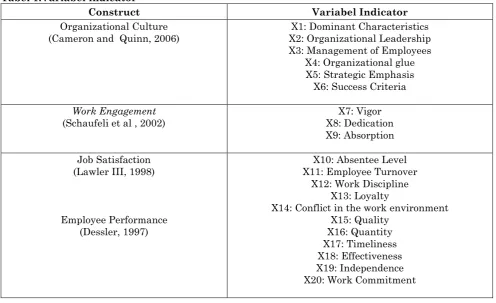
Tabel 1:Variabel indicator
Construct Variabel Indicator
Organizational Culture
(Cameron and Quinn, 2006) X2: Organizational Leadership X1: Dominant Characteristics
X3: Management of Employees X4: Organizational glue X5: Strategic Emphasis X6: Success Criteria
Work Engagement
(Schaufeli et al , 2002) X8: Dedication X7: Vigor
X9: Absorption
Job Satisfaction
(Lawler III, 1998) X11: Employee Turnover X10: Absentee Level
X12: Work Discipline X13: Loyalty
X14: Conflict in the work environment Employee Performance
(Dessler, 1997) X16: Quantity X15: Quality
X17: Timeliness X18: Effectiveness X19: Independence X20: Work Commitment
The measurement scale of the value to be obtained using a Likert scale, the meaning is that there is a measure of value by presenting a certain number so as to facilitate respondents in filling out. A respondent will mark how much the degree of agreement or disagreement from each statement is presented. There are 5 choice answers from respondents with a range of answers strongly disagree to very agree (29). Data Analysis
Data analysis in the study using Structural Equation Modeling (SEM) approach using
Partial Least Square (PLS) analysis method and with the help of SmartPLS 3.0
application program
Result
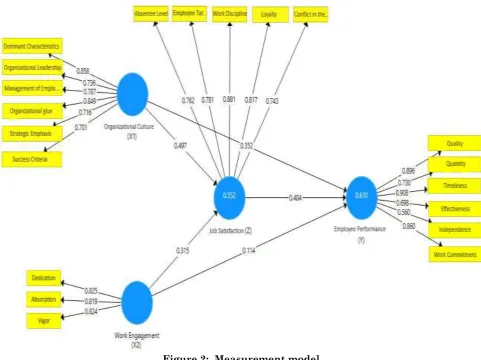
Measurement Models
Heri Kuncoro et. al. | Sept.-Oct. 2018 | Vol.7| Issue 5 |18-27 23
Figure 2: Measurement model Source : Output SmartPLS (2018)
A variable is declared to satisfy discriminant
validity if it has a AVE value > 0.50. Here are the results of the Average Variance Extracted (AVE) test:
Tabel 2 :Result average variance extracted (AVE)
AVE
Organizational Culture 0.604
Work Engagement 0.677
Job Satisfaction 0.637
Employee Performance 0.617
Source : Output Smart PLS (2018)
Variables are declared reliable if the
composite reliability value is above 0.70. Here are the results of the composite reliability process:
Tabel 3: Result composite reliability
Composite Reliability
Organizational Culture 0.901
Work Engagement 0.863
Job Satisfaction 0.897
Employee Performance 0.904
Source :Output SmartPLS (2018)
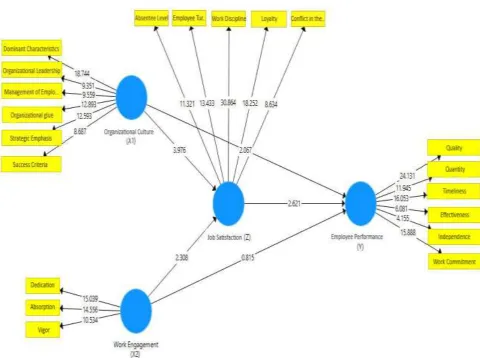
The Measurement Model Bootstrapping (Figure 4.2), is used to see the relationships between constructs and significance values. Ghozali (30) describes the Path Coefficients
Heri Kuncoro et. al. | Sept.-Oct. 2018 | Vol.7| Issue 5 |18-27 24
Fiture 3: Measurement model bootstraping Source : data SmartPLS (2018)
The Results of Testing Hypotheses Are Summarized in the Following Table
Tabel 4:Result path coefficients
Direct Effect Original Sample (O) (|O/STERR|) T Statistics P Values Keterangan
Organizational Culture (X1) -> Employee
Performance (Y) 0.352 2.067 0.039 Significant
Work Engagement (X2) -> Employee
Performance (Y) 0.114 0.815 0.416 Non Significant
Organizational Culture (X1) -> Job
Satisfaction (Z) 0.497 3.976 0.000 Significant
Work Engagement (X2) -> Job Satisfaction
(Z) 0.315 2.308 0.021 Significant
Job Satisfaction (Z) -> Employee Performance
(Y) 0.404 2.621 0.009 Significant
Sumber : Output SmartPLS (2018)
The Explanation for the Results of the Analysis Process Above is as Follows Hypothesis 1: Organizational Culture has a positive effect on Employee PerformanceThe results of the analysis based on the Path Coefficients table indicate that the positive path coefficient is 0.352 with a statistical T value of 2.067 which is greater than 1.96 with a value of p <0.05. so that the first hypothesis is proven and accepted. The
Heri Kuncoro et. al. | Sept.-Oct. 2018 | Vol.7| Issue 5 |18-27 25 This finding is in line with Hofstede's (5),
theory and confirms the previous research conducted by Arifin (6).
Leadership from leaders is able to act as role models for employees. Emphasis on action through setting high work targets will produce quite good performance. Togetherness created through regulations and management policies of PT. Bank BRI Syariah, Tbk., Malang is able to foster mutual trust, as well as mutual support among employees. Hypothesis 2: Work Engagement has a positive effect on employee performance Statistical T value of 0.815 is smaller 1.96 with a value of p> 0.05. so that the second hypothesis is not proven and rejected, so it is concluded that Work engagement has no effect on Employee Performance.
Strong or weak engagement on BRI Syariah has no impact on employee performance figures. Increasing or decreasing factors of enthusiasm, dedication and comfort level of employees does not affect the rise or fall of employee performance in supporting the organization's business development. This condition is not in line with the study conducted by Rich et al (21), Karatepe (9), Xiaobei et al. (10), Hasanah (11), Septiadi et al.(12).
The survey results illustrate that employees lack recognition and / or praise when employees successfully complete their tasks and responsibilities. Employee dedication is pretty good, they understand the best performance and maximum results expected by management, but due to lack of recognition from leaders or management it will reduce the employee's comfort factor at work. The superior assessment of employee dedication should be used positively by PT.
BRI Syariah Syariah Malang to increase employee enthusiasm and comfort factors so as to support the creation of good performance. This result requires verification and confirmation in further research in different organizations to find out the comparison of the deeper problems. Hypothesis 3: Organizational culture has a positive effect on job satisfaction Based on the results of data analysis, it shows that organizational culture has a significant effect on employee job satisfaction, with a statistical value of 3.976 and a significant
value of 0.000. These results prove the third hypothesis in this study which reads "Organizational culture has an influence on Employee Job Satisfaction of PT. Bank BRI Syariah Malang "is proven and accepted. These results can be seen from the coefficient of organizational culture variables of 0.497, meaning that any changes in organizational culture variables will have a positive effect on employee job satisfaction of 0.497.
The results of this study are in line with Chasanah's (8) opinion that there is a positive influence between organizational culture on job satisfaction, this is because employees have understood the intent and purpose of an organization in implementing organizational culture. and in line with the opinion of Robbins (31) who argued that employees feel the importance of organizational culture in increasing job satisfaction.
Organizational Culture is well understood and implemented by all employees, management has been able to create a familiar place in the office, help each other in various problems between employees and are controlled by leaders who can be used as role models, all of which will have an impact on job satisfaction each employee.
Hypothesis 4: Work engagement has a positive effect on job satisfaction Work Engagement has a positive and significant effect on employee job satisfaction, with a statistical T value of 2,308 and a significant value of 0.021. These results prove the fourth hypothesis in this study which reads "Work Engagement Has a Positive Effect on Job Satisfaction of PT. Bank
BRI Syariah Branch Malang "is proven and accepted. The results of the study are in accordance with the opinion of Schaufeli et al. (19), Work engagement derives from positive and satisfying mind conditions related to work, this condition is characterized by vigor , dedication and comfort. Likewise with the opinion of Lawler III (26) who argued that Work engagement in an organization will bring a strong sense of togetherness, problems that arise will be easily resolved so that there will be a sense of satisfaction in taking responsibility for its task activities.
Heri Kuncoro et. al. | Sept.-Oct. 2018 | Vol.7| Issue 5 |18-27 26 employees, it will have an impact on other
instruments in an organization, for example employees become lazy to work Hypothesis 5: Job satisfaction has a positive effect on employee performance Work Engagement has a positive and significant effect on employee job satisfaction, with a statistical T value of 2,621 and a significant value of 0.009.
These results prove the fifth hypothesis in this study which reads "Allegedly Job Satisfaction has a positive effect on Employee Performance of PT. Bank BRI Syariah Malang Branch "is proven. The results of the study are in accordance with the opinion of Chasanah (8) who found that job satisfaction has a positive effect on employee performance.
In line with the opinion of Lum et al., who argued that creating good relations between employees and management, providing promotion opportunities as well as providing a clear increase in salary scale will be able to increase the role of employees towards performance. Job satisfaction is part of a measure of the quality of living in an organization. The results of the survey on the level of employee satisfaction in working at PT.
Bank BRI Syariah, Tbk., Quite well, discipline in carrying out corporate order is a positive factor that must be maintained in the organization. The level of attendance and concern among employees also plays a very important role. Employees are able to work effectively and efficiently, but little need to get attention regarding the elements of work environment conflict that will affect performance if not immediately handled properly by management
Conclusion
Based on the Results of the Research, and the Previous Discussion, Some Conclusions Can be Drawn, so That the Questions can be Answered
Organizational Culture has a positive effect on Employee Performance of PT. Bank BRI Syariah Branch Malang. Therefore, organizational culture contains a meaning of the fundamental values, methods and thinking norms that are owned by BRI Syariah Bank so that it influences the actions and behavior of organizational
members to improve their performance. Work engagement has no effect on Employee
Performance of PT. Bank BRI Syariah Branch Malang. Therefore, Work engagement is a condition of someone who is not just just knowing, a positive emotional state of the activities of employees of Bank BRI Syariah Malang Branch, the spirit factor needs to be improved in quality so as to maintain the dedication that has grown well among employees.
Organizational Culture has a positive effect on Job Satisfaction of PT. Bank BRI Syariah Branch Malang. Employee satisfaction of Bank BRI Syariah employees has been fulfilled by management, the survey results of all indicators show a fairly good value, most dominantly formed by work discipline, which is in line with the high results-oriented corporate culture, the work done is compulsory and employees are very competitive and work-oriented. The better the organizational culture of the company, the greater the effect on employee job satisfaction.
Work engagement has a positive effect on Job Satisfaction of PT. Bank BRI Syariah Branch Malang. This is consistent with the results of the research description that BRI Syariah Malang Employees generally prioritize responsibility for their obligations as employees, as evidenced by the results of the analysis of dedication to get the highest score. Understanding to be given the freedom to work as well as possible from management is interpreted positively by all employees, this condition has a major influence on employee satisfaction.
Job Satisfaction has a positive effect on Employee Performance of PT. Bank BRI Syariah Branch Malang. The analysis results illustrate that the average employee has understood his duties and responsibilities properly. Performance results in the form of numbers (quantity) become the top priority that must be fought for, commitment and responsibility of employees deserve appreciation.
Heri Kuncoro et. al. | Sept.-Oct. 2018 | Vol.7| Issue 5 |18-27 27
References
1. Triwijayati D, Iriani SS, Kautsar A (2018) Adoption of E-Commerce, Entrepreneurship Orientation Mediated by Business Strategy on The Performance Food Industries. Int., J,Civ., Eng.,Technol,9 (5):896-902.
2. Kistyanto A, Budiono, Indawati N, Fazlurrahman H,
Kautsar A, Zainur (2018) Food Industry
Performance: Entrepreneurial Leadership And Human Capital Perspective. Int., J,Mech., Eng., Technol, 9(6):1199-1208.
3. Rivai V, Sagala EJ (2009) Manajemen Sumber Daya
Manusia untuk Perusahaan. Edisi Kedu. Book. Jakarta: PT. Raja Grafindo Prasada. Jakarta, 1086.
4. Dessler G (2015) Manajemen Sumber Daya Manusia.
Jakarta: PT. Salemba Empat.
5. Hofstede (2005) Cultures and Organizations :
Software of the mind. New York : McGraw HIll.
6. Arifin J (2007) Analisa Pengaruh Budaya Organisasi
terhdap Kinerja Organisasi dan Kepuasan Kerja Karyawan.
7. Suwandi (2016) Pengaruh Budaya Organisasi
terhadap Prestasi Kerja Karyawan Melalui
Kepuasan Kerja, 8(2):140-7.
8. Chasanah N (2008) Analisis Pengaruh
Empowerment, Self Efficacy dan Budaya Organisasi terhadap Kepuasan Kerja dalam Meningkatkan Kinerja Karyawan, UNDIP Semarang.
9. Karatepe OM (2013) High-performance work
practices and hotel employee performance: The mediation of work engagement. Int., J, Hosp, Manag., [Internet],32(1):132-40.
10. Xiaobei, Sanders K, Frenkel S (2012) How leader-member exchange, work engagement and HRM consistency explain Chinese luxury hotel employees’
job performance. Int., J, Hosp, Manag.,
[Internet]31(4):1059-66.
11. Hasanah N (2014) Pengaruh Keterlibatan Kerja
terhadap kepuasan kerja karyawan ditjen
penyelenggara haji dan umrah kemenag RI. UIN Syarif Hidayatullah Jakarta.
12. Septiadi sebastianus alexander, Sintaasih Desak ketut, Wibawa IMA (2017) Pemediasi Komitmen Organisasional. J Nas, E-Jurnal Ekon dan Bisnis Univ Udayana 68 Bali,16:3103-32.
13. Belias D, Koustelios A, Vairaktarakis G, Sdrolias L (2015) Organizational Culture and Job Satisfaction of Greek Banking Institutions. Procedia – Soc., Behav, Sci., [Internet],175:314-23.
14. Schein EH (2010) Organizational Culture and
Leadership [Internet]. 4th ed. Book. San Francisco: by Jossey Bass.
15. O’Reilly CA, Chatman JA(1991) People And
Organizational Culture: A Profile Comparison Approach To Assessing Person-Organization Fit. Acad Manag Journal,34 (3):487-516.
16. McShane S, Glinow M Von(2008) Organizational
Behavior. Edition No. Chicago, IL: McGraw Hill.
17. Cameron K, Quinn R (2006) Diagnosing and
Changing Organizational Culture Based on the Competing Values Framework. The Jossey-Bass Business & Management Series.
18. Kanungo RN(1982) Work Alienation: An Integrative
Approach. New York: Praeger Publisher.
19. Schaufeli S, Gonzalez RV, Bakker AB(2002) The
Measurement of Engagement and Burnout: A Two Sample Confirmatory Factor Analytic Approach. J Happiness Stud,3-74
20. Brown SP, Leigh TW A(1996) New Look at
Psychological Climate and Its Relationship to Job Involvement, Effort, and Performance. J, Appl, Psychol, 81: 358-368.
21. Rich BL, Lepine JA, Crawford ER (2010) Job
engagement: Antecedents and effects on job performance. Acad, Manag, J,53(3):617-35.
22. Marihot THE(2006) Manajemen Sumber Daya
Manusia. Yogyakarta: BPFE Yogyakarta, Grasindo Jakarta, 91.
23. Davis K(2006) Newstorm. Perilaku Dalam
Organisasi. Edisi Tuju. Erlangga, Jakarta.
24. Mathis RL, Jackson JH (2006) Human Resource
Management: Manajemen Sumber Daya Manusia. Terjemahan Dian Angelia. In Jakarta: Salemba Empat.
25. Spector PE (1997) Job Satisfaction. USA : SAGE
Publications, Inc.
26. Lawler III (1998) Job Satisfaction and Expression Of
Emotion in Organizations. University of California.
27. Gomes F(2000) Manajemen Sumber Daya Manusia.
Yogyakarta: Andi Offset.
28. Sugiyono(2011) Metode Penelitian Bisnis. Bandung:
CV. Alfabeta.
29. Kinnear TC, Taylor JR(2003) Riset Pemasaran,
(Terjemahan oleh Thamrin). Edisi Tiga. Jakarta: Erlangga.
30. Ghozali I (2014) Structural Equation Modeling,
Metode Alternatif Dengan Partial Least Squares (PLS). Four Editi. Semarang: Badan Penerbit UNDIP Semarang 410.
31. Robbins (2003) Budaya yang tumbuh menjadi kuat
mampu memacu organisasi kearah perkembangan yang lebih baik.