PERSPECTIVES ON GRADUATE EMPLOYABILITY ATTRIBUTES
FOR MANAGEMENT SCIENCES GRADUATES
R. S. Shivoro*
e-mail: [email protected]
R.K. Shalyefu*
e-mail: [email protected]
N. Kadhila*
e-mail: [email protected]
*University of Namibia Windhoek, Namibia
ABSTRACT
Universities need to take stock of the current state of graduate employability from both the employers’ and the graduates’ perspectives if they are to respond effectively to the knowledge and skills requirements of the industry. Globally, graduate employability is a concept that is becoming increasingly popular in the higher education sector. The underlying assumption is that graduates need attributes other than those skills needed in the subject-specific discipline. This article provides an assessment of stakeholders’ perceptions on graduate employability attributes for management sciences graduates in Namibia. The study applied a survey method, with questionnaires being administered to the three types of stakeholder, namely, employers, lecturers and graduates. The study found a mismatch in responses between these stakeholders regarding the attributes that are important for the job market, those that are emphasised in curricula, and those that graduates need more training on. The argument presented by the article is that mapping stakeholders’ perceptions will enable universities to equip their graduates with employability attributes needed by the industry.
Keywords: Graduate employability; labour market; higher education; human capital; graduate attributes; employability skills
INTRODUCTION
Graduate employment patterns seem to have changed worldwide (Tran 2016). The labour
market is inundated with graduates with similar qualifications competing for graduate jobs. In
addition, organisations and companies are shrinking their workforce due to unpredictable and
inconsistent economies. It is therefore clear that the labour market has become competitive and
globalisation, and the expansion of the global economy, which are influencing the hiring needs
of employers (Al-Harthi 2011; Cai 2013; Tran 2016). For employers, the decision to hire a
graduate is based on the graduate’s qualities and abilities in addition to discipline-specific
knowledge and skills. Brown and Hesketh (as cited in Tomlinson 2008) note that employers are
relating the employability discourse to behavioural competence and the wider range of personal,
performative and organisational abilities. To this end, universities and students alike have
become aware of the changing nature of employment patterns, and are working to incorporate
employability attributes in degree programme provision (Cai 2013). This realisation has led to
studies to determine what employability attributes are sought after by employers in a given
context.
In Namibia, as elsewhere, employers’ concerns about graduate employability attributes
have become more pronounced (Links 2010; National Council for Higher Education 2011;
Schade and Amunkete 2011). There are claims from various stakeholders, especially
employers, that graduates from universities often do not fully possess the types of graduate
employability attributes essential for the workplace. Marope (2006) notes that there is a general
impression that diverse employers are dissatisfied with the quality of higher education output.
This observation is echoed by the Namibian National Council for Higher Education (2011),
which states that university graduates are often not adequately prepared for work, and that the
training is not relevant to the needs of the workplace. In reference to higher education, the
National Human Resource Plan document has identified a critical challenge facing human
resources development in Namibia. This challenge includes the inadequate attention paid to the
development of graduate employability attributes, which has a negative impact on the
preparedness of university graduates for high-skilled jobs (National Planning Commission
2010).
Although employers in Namibia have raised concerns about the lack of employability
attributes in graduates, no study has investigated the issue of the employability attributes that
are important for job performance; those attributes that should be to be included in curricula;
and those in which graduates need more training. Therefore, the aim of this article is to analyse
the need for graduate attributes in Namibia, as perceived by graduates, employers and lecturers,
using the discipline of management sciences as a case. The article argues that assessing the
needs of higher education stakeholders provides an understanding of which graduate attributes
should be enhanced by higher education institutions (HEIs) in order to boost employability
prospects of graduates.
university education and the economy, conceptualising graduate employability attributes,
stakeholders in graduate employability, and the types of attributes sought after by the labour
market elsewhere.
UNIVERSITY AND THE ECONOMY
The link concerning university education and the economy, specifically the labour market
outcomes, can be well explained using human capital (HC) and signalling theories. Research
on HC has established that higher education is an investment for productivity in the labour
market (Fincher 2007; Jonck 2014). This is supported by (Cai 2013, 3) who states that
‘education increases individuals’ productivity, which consequently enhances job performance’.
This investment is manifested by an increase in abilities that subsequently increase throughput
and growth of organizations. In addition, Weber (2014) notes that persons with more education
are likely to be in a position to adjust more easily than those with less education. In other words,
higher education avails sought-after capabilities that are relevant for succesfull execution of
tasks. Therefore, individuals who have obtained more knowledge and skills stands a better
chance to be more successful in work, and receive better remuneration, and they are more likely
to receive more job offers than those with lesser knowledge and skills (Weber 2014). Equipping
individuals with more knowledge and skills contributes to the quality of work assigned to them;
more rewards to them in the form of income, more employment opportunities, and a financial
comfortability (Kaplan and Norton 2004). Melink and Pavlin (2012) substantiate that education
is an investment process geared towards prospect of better life earnings.
Like HC, signalling theory (Stiglitz 1975, as cited in Cai 2013) assumes a relationship
between graduates seeking a job and the employers. Based on this theory, a graduates applying
for a job sends a signal of their capabilities to prospective employers, by showcasing knowledge
and skills they have acquired in university. Prospective employers assess the application to
determine graduate’s abilities. Therefore, the graduate’s portfolio of knowledge and skills is
treated as a determinant of quality expected from the applicant. This perspective assumes that
higher education is simply an apparatus for graduates to indicate the capabilities they possess
to those that are hiring. Rospigliosi, Greener, Bourner and Sheehan (2014) write that the
industry identifies individals with innate marketable qualities that are hard to observe, by
looking at their educational achievements. This view regards education as a window to observe
inborn qualities of a graduates, rather than a process of developing knowledge and skills that
are needed for productivity in the industry. Therefore, a higher education qualification is a
The two views on the relationship between the university and industry have provided
justification for the importance of graduate employability attributes. Graduate attributes are
necessary in the 21st Century, taking cognisant of the knowledge economy, globalisation and
the ever-changing conditions of the labour market (Yorke 2006). Therefore it is important that
universities in general and in Namibia in particular align learning provisions to address the
labour market requirements by enhancing employability attributes. Conceptualising graduate
employability therefore warrants deeper scrutiny.
CONCEPTUALISING GRADUATE EMPLOYABILITY ATTRIBUTES
Graduate qualities and skills are conceptualised differently by different universities and higher
education systems. Terminologies commonly used are words such as transferrable skills, key
skills, soft skills, generic attributes, employability skills, key competencies, core skills, and
underpinning skills. In most cases, these terms are used interchangeably to refer to graduate
employability (Tempone et al. 2012).
The concept of graduate employability encompasses a simplistic and holistic view on the
qualities of a graduate in a community. According to Hillage and Pollard (1998, 2)
‘employability as the ability to gain initial employment, maintain employment and obtain
employment if required’. Bowden, Hart, King, Trigwell and Watts, as cited in Bridgstock
(2009, 32) go further to add the contribution of a graduate to the profession and the community
as they define employability as ‘the qualities, skills and understanding a university community
agrees its students would desirably develop during their time at the institution and,
consequently, shape the contribution they are able to make to their profession and as a citizen’.
Yorke (2006, 8)provides a more abstract definition of employability as‘a set of achievements
that comprise skills, understanding and personal attributes that make an individual more likely
to secure and be successful in his/her chosen occupation to the benefit of him/herself, the
workforce, the community and the economy’.
Employability is comprised of two main aspects: subject or discipline-specific skills, and
transferrable skills. Wickramasinghe and Perera (2010) assert that subject skills are key to the
graduate’s career as they are discipline-specific knowledge and skills. They add that
transferable skills are those competencies that a graduate can apply in many different job roles
and professions through the graduate’s career. However, Barrie (2006) provides a
conceptualisation that has been considered as a lens for understanding the concept in this article,
as they view graduate attributes as the attributes that graduates have acquired at university in
has not provided one agreed definition of graduate employability, therefore this article is written
from the perspective of the latter conceptualisation.
KEY STAKEHOLDERS IN THE GRADUATE EMPLOYABILITY DISCOURSE
In different parts of the world studies have been conducted to ascertain the perceptions of
students and/or graduates, lecturers and employers in industry. Some studies have focused on
individual stakeholders, some a combination of two, and others a combination of the three types
of stakeholder. What follows is a review of the literature related to graduate employability
stakeholders.
Students/graduates
The inclusion of students/graduates in the employability discourse is important as these are the
key stakeholders in employability. As Tymon (2013) asserts, they are the primary recipients of
employability attribute development and their views are therefore vital. It is thus necessary to
ascertain whether their views on employability attributes are similar to or different from other
employability stakeholders. Research has established that in the crowded and competitive
graduate labour market, students and graduates are aware that the role of their academic
qualifications in shaping employment outcomes is declining (Tomlinson 2008). Graduates are
becoming increasingly aware that they need to add value by acquiring employability attributes
to earn a competitive edge in the industry. In addition, graduates recognise the importance of
graduate attributes developed through the university curriculum. Most students and graduates
place particular importance on personal qualities (Moreau and Leathwood 2006; Crebert et al.
2004). In his study, Brown (2007) indicated that students have expressed confidence that their
curriculum enhances a combination of relevant employability attributes necessary for job
performance. Given the above, the general position is that students leave university with high
hopes that the skills and attributes they have acquired at university are those that are sought by
employers. However, it is important to establish whether graduates’ views are in line with those
of employers.
Lecturers
As stakeholders in the concept of graduate employability, academics in various universities
have presented their views on graduate employability. A study by Morrison (2014) indicates
that lecturers’ views are that employers expect higher education institutions to provide
self-confidence. The lecturers in this study expressed the opinion that graduates have poor
standards of written communication than would be expected of university graduates. This is in
contrast with Ahmadl, Suhaili and Shariati (2015), whose study found that lecturers perceive
that the highest level of employability attributes graduates leave university with is
communication skills, followed by information management, leadership, teamwork and, lastly,
professional ethics. Contrasting results are a common occurrence in graduate employability
research. In a study by Lowden, Hall, Elliot and Jon (2011) on the perceptions of higher
education institutions, a list of graduate employability attributes and characteristics was
generated including communication skills, taking initiative, working independently, creativity
and problem solving, time management, networking, presentation skills, systems thinking,
leadership skills, self-confidence, enthusiasm, and work ethics.
Employers
Like graduates and lecturers, employers in different countries have offered their perspective on
graduate attributes. In scoping interviews with employers, Wimalasiri (2015) found that
specific roles in a workplace require a combination of different transferable skills. Such
qualities and attributes are working in teams, solving problems, managing oneself,
understanding of the business, literacy and numeracy skills that are relevant the graduate’s area
key responsibilities, information communication technology skills, interpersonal relations,
taking initiative, receptive to guidance, and leadership skills. While some employers found
graduates to be highly competent in personal qualities and skills (Wye and Lim 2009), others
found a high mismatch in attributes including critical analysis, organising, problem-solving,
ability to articulate, decision-making, and influencing the process (Lowden et al. 2011).
Although prior to this study no study has been conducted in Namibia to determine
attributes that are desired by the labour market, employers in other countries have prioritised
and ranked employability attributes. For example, employers in Malaysia ranked personal
qualities and interpersonal skills as highly important, and systems thinking and technology
skills of lower importance (Husein et al. 2010; Omar et al. 2012). In New Zealand, a study by
Hodges and Burchell (2003) found that employers’ top five preferences inculde ability and
willingness to learn; working in teams; good interpersonal relations; providing excellent service
to clients; and being accurate, organised, and maintaining excellent standards. The same goes
for the United Kingdom as Martin, Villeneuve-Smith, Marshall and Mckenzie (2008) list
time-keeping, literacy and numeracy, eagerness and dedication, communication, and personal
Tempone et al. (2012) suggested that employers require graduates to possess communication,
teamwork and self-management skills.
Although there seems to be agreement to a certain extent, the information presented here
is isolated as it does not provide a direct comparison of graduates, employers and academic
staff in a given profession or country. In an attempt to provide a comparison between
stakeholders in one context, Rosenberg, Heimler and Morote (2012) found out that in that
specific context, the most important attributes rated by graduates are leadership and work ethics.
This differs from those of HEIs and employers who scored lower on this dimension. HEIs
indicated that interpersonal skills are most needed for job performance, while employers
perceive literacy and numeracy as most needed for job performance. Thus there is clearly a gap
between attributes that are perceived to be important by employers, graduates and HEIs. This
is affirmed by Griesel and Parker (2009), who concluded in a study in South Africa that graduate
employability competencies enhanced by universities are in many ways incongruent with the
requirements of the contemporary labour market. Given the difference in desired graduate
employability attributes in other countries, it is appropriate to conclude that the labour market
needs for attributes are contextual. Therefore, this study is significant in determining the
perspectives of employers, HEIs and graduates in Namibia so that concerted efforts can be made
to synchronise graduate skills with the needs of the labour market.
TYPES OF GRADUATE EMPLOYABILITY ATTRIBUTE
The literature on graduate employability has generated varying lists of the graduate attributes
presumably required by the labour market. Although the lists differ in terms of categorisation
and prioritisation of attributes, there does seem to be a certain degree of similarity.
The graduate employability attributes presented in Table 1 show that different agencies
and universities prioritise attributes differently. Table 1 shows a considerable variation in the
prioritisation of attributes. While some providers consider communication a priority, others lean
toward critical thinking and teamwork. Therefore, it could be cumbersome for the higher
education system to have an agreed framework. The table also shows that some attributes might
be the same but worded differently. For example, ‘self-motivation’ could be the same as ‘ability
to work on your own’, or ‘self-management’. There is a need to consider that although the
wording of attributes might vary the meaning might be the same. That being said, there is no
substantial difference in the attributes presented in the table but the prioritisation of the
attributes differs.
as ‘basic literacy and numeracy skills, critical thinking skills, leadership skills, management
skills, interpersonal skills, information technology (IT) skills, systems thinking skills, and work
ethics’ (Rosenberg, Heimler and Morote 2012, 8). The explanation provided below is taken
from Kennedy (2010); Rosenberg et al. (2012) and Schermerhorn (as cited in Rosenberg et al.
2012, 11). These are explained as follows:
Table 1: Employability attributes in the literature – adopted from Markes (2006)
Middlesex University (2003)
AgCAS (2005) Heitmann
(2003) Markes et al. (2004) DfEE (2000)
HEA Engineering Subject Centre (2005a) • Personal and
career • development • effective
learning • communication • teamwork • IT and • numeracy.
Further surveys have shown that at the top of this list (which usually emphasises • teamwork and • written and oral • communication)
is
• imagination and creativity
The ability to analyse information critically and produce creative solutions to problems: • communication
and customer-facing skills • initiative-taking • ability to work
on your own and in a team • computing
skills and technical skills (CAD), visual and spatial awareness (added to these are: foreign language and international mobility, knowledge of industrial processes and techniques, 3D conceptual ability, commercial awareness, coping with pressure and deadlines as well as project management, time management and effective negotiating skills). Personal and professional skills and attributes: • engineering
reasoning and problem-solving (with 5 sub-skills)
• experimentation and
• knowledge discovery • (4 sub-skills); • system thinking • (4 sub-skills) • personal skills
and attitudes (7 sub-skills and attitudes) • professional
skills and attitudes (4 sub-skills and attitudes) Interpersonal skills:
• Team working skills (5 sub-skills)
• Communication skills (6 sub-skills). Plus 32 conceive, design, implement and operate sub-skills under 6 headings. (66 skills under three headings in total).
• Key skills
(communication, IT, working with others, application of number, improving own learning and performance, problem solving) • Personal and
professional development skills (self-management, organisational management, interacting with others, professional conduct/awareness, intellectual skills) • Technical skills
(core skills: tendering, managing costs, project management, technical reports, technical drawings) • Personal attributes
(Adaptability, assertiveness, creativity, initiative-taking, motivation and resilience). Software RAPID – developed by Loughborough University: 62 skills in total.
• Oral
communication • teamwork, • self-confidence
(although, in fact this a personal attribute) • Self-motivation
and
presentation. Essential skills: • networking, • taking
initiative, • creativity • the ability to
establish • collaborations • negotiating
and research skills Important skills: strategic planning skills, time management and IT skills. Most important skills (with highest scores) for course development: • communication • initiative and •
Self-confidence. Skills of lower importance (with lowest scores): • oral
communication • self-promotion • time
management and IT. 1. Effective communication (77%) 2. Teamwork (75%) 3. Ability to solve
problems (62%) 4. Analytical skills
(59%)
5. Flexibility (58%) 6. Numeracy
(42%)
7. Use of IT (20%) A later survey (1994) ranks personal
skills/attributes as 1) willingness to
learn 2) commitment 3) reliability 4) self-motivation 5) teamwork 6) communication. Employers’ skills for employability are then presented separately as: • team working,
networking • self-reliance; the
ability to manage own learning and recognise professional development needs • management
Basic literacy and numeracy – includes reading, writing, speaking, listening and performing
basic mathematical calculations. Graduates are competent to read when they are able to construe
and undertand written information. writing refers to the competency to convey one’s views or
ideas through written material such a memos and reports. Numeracy skills refers to the
competency of using diverse mathematical procedures to provide solutions.
• Critical thinking – refers tousing intellectual or reasoning to bring about a needed change. Is needed in decision-making and addressing challenges and making the best out of
challenging situations.
• Management – include the ability to plan, organise, coordinate, facilitate activities to achieve pre-determined objectives.
• Leadership attributes – the ability to motivate and positively influence others to achieve organisational goals. Graduates should develop and lead individual or team activities,
address challenging situations arising in the course of the implementation of activitites.
• Interpersonal attributes – refers to graduate’s competency to relate positively with other members of the group, support other team members’ learning, manage conflicts, and
perform well in a culturally diverse environment. It also include the ability to work
comfortably with members of the team at different levels of an organization.
• Information technology (IT) – refers to the use of technology that contributes to the effective execution of tasks. This includes the ability to use computer devices and
applications to communicate and execute tasks.
• Systems thinking – refers to the ability to comprehend interface of systems such as functions of different departments in an organisation, or linkages between applications
within a computerized system, different subsets of society in relation to political and
socio-economic setup, including the economics of the world.
• Work ethic – includes the graduate’s attitude and character towards the job. This includes being present, beginning work on time, enthusiasm, completing assigned tasks on time,
trustworthiness, tolerance, reliability, professional conduct, and eagerness to learn and
further the career.
These employability attributes seem to be congruent, less complex, easy to explain, and more
generally agreed upon by various authors. Therefore, this article’s quest – to determine
stakeholders’ perspectives on employability attributes in Namibia – has been aligned to the
METHODOLOGY
A quantitative approach using a survey method was employed (Creswell 2003). A questionnaire
adapted from Rosenberg et al. (2012), containing 51 items, was administered to management
sciences graduates from HEIs in Namibia who had less than two years of employment after
graduation, management sciences lecturers, and employers. The questionnaire contained
demographic questions as well as those to obtain nominal data by a five-point Likert scale
(strongly agree, agree, neutral, disagree, and strongly agree). The reliability of the questionnaire
was tested using Cronbach’s alpha technique scoring .925, which indicates that dependability
of the instrument is excellent. The study employed a purposeful sampling technique to select
management sciences graduates and lecturers from HEIs in Namibia. The study further
employed snowball sampling to select employers of these graduates. The sample size for each
group was determined using a sampling table calculated with the Krejcie and Morgan formula s = X2NP(1-P) ÷ d2 (N-1) + X2P(1-P). The formula was found to be the most appropriate as it has a 95 per cent confidence level, and a 5 per cent margin of error (Krejcie and Morgan 1970).
Using the formula, the researcher distributed survey questionnaires to 135 graduates, 35
lecturers, and 50 employers. Of these, 80 completed questionnaires were returned by graduates,
23 by lecturers, and 39 by employers.
Data were analysed with the help of IBM Statistical Package for Social Sciences (SPSS)
version 24. Analysis was done in the form of descriptive statistics using frequencies and
percentages. Categorical variables were also generated to ascertain the difference in responses
between the groups of participants, i.e. lecturers, graduates and employers.
RESULTS AND DISCUSSION
The results are presented in summaries of percentages for each of the eight categories of
graduate employability attributes as follows:
Basic literacy and numeracy attributes
Results on basic literacy and numeracy attributes indicate that 90 per cent of graduates and
employers perceive these attributes to be important for job performance, compared to about 70
per cent of management sciences lecturers. Graduates and employers also strongly agree that
these are included in the curriculum. Although less than 50 per cent of the graduates indicated
that they need remedial training in this attribute, about 75 per cent of lecturers and employers
thought that graduates do indeed need remedial training in this attribute. Graduates think they
Critical thinking attributes
Ninety per cent of graduates and employers share the opinion that critical thinking is needed
for graduate job performance, compared to only 63 per cent of lecturers. This shows a difference
in opinion between employers and lecturers. Only 50 per cent of the lecturers are in agreement
that critical thinking is emphasised in management sciences curricula in Namibia. This shows
uncertainty as to whether critical thinking is indeed emphasised in curricula. Both lecturers and
employers (70%) considered that graduates need more training on critical thinking after
graduation. This is in contrast to the opinion of less than 50 per cent of graduates.
Interpersonal attributes
Interpersonal attributes were considered essential for job performance by graduates and
employers with 96 per cent and 87 per cent respectively, while more than 30 per cent of lecturers
did not consider these as important for job performance. Moreover, only 50 per cent of
management sciences lecturers were certain that interpersonal attributes are emphasised in
management sciences programme curricula. More than 60 per cent of employers and about half
of graduates and lecturers indicated that more training is required in this attribute.
Leadership attributes
About 43 per cent lecturers did not agree that leadership attributes are needed by graduates to
perform in their jobs. By contrast, just less than 10 per cent of the graduates and employers
shared this opinion. Half of the lecturers indicated that the curricula do not emphasise leadership
attributes. About 70 per cent of employers indicated that more leadership training is required,
while just over half of graduates did not think that they need more leadership training.
Management attributes
Only 4 per cent and 10 per cent of graduates and employers respectively, and more than 40 per
cent of lecturers thought that management attributes are not needed for graduate job
performance. However, 85 per cent, 60 per cent and 75 per cent of graduates, lecturers and
employers, respectively, indicated that the curriculum does include management aspects. This
shows that there are more employers who think that the university can do more to enhance
management attributes. About 60 per cent of lecturers and 75 per cent of the employers opined
Information technology attributes
Respondents indicated that IT skills are needed for graduate job performance. Specifically, 91
per cent of graduates, 73 per cent of lecturers, and 75 per cent of employers were in agreement.
Respondents also agreed that to a certain extent, the curricula places an emphasis on IT.
However, about 85 per cent employers indicated that more training is required in this regard,
with 61 per cent of lecturers and 55 per cent of graduates being in agreement.
Systems thinking attributes
Close to 90 per cent of employers were certain that graduates need systems thinking attributes
to excel in their jobs, with 82 per cent of graduates and 60 per cent of the lecturers agreeing.
Less than 60 per cent of the lecturers indicated that systems thinking training is included in
curricula and more than 80 per cent of the employers thought that more training in this attribute
is required when graduates enter the workforce.
Work ethics
Only about 60 per cent of the graduates and 66 per cent of the lecturers considered work ethics
as important for job performance. Employers seem to consider this attribute more important
than lecturers and graduates, with 81 per cent indicating the importance of work ethics. Less
than 60 per cent of the lecturers and graduates indicated that work ethics are included in
management sciences curriculum. More lecturers (74%) and employers (72%) called for more
training on work ethics, with half of graduates being in agreement.
In general, lecturers are not assertive with regard to attributes that are important for job
performance and are uncertain whether the curricula does indeed emphasise such attributes.
However, they were of the opinion that more training should be provided to graduates. The
graduates felt that they needed less remedial training in all attributes and rated themselves very
highly as compared to lecturers and employers. They thought that the attributes they possess
had been aquired as a result of their participation in the degree programme. On the other hand,
employers expressed a strong position in terms of the importance of employability attributes
for job performance and asserted that graduates need more remedial training in the graduate
attributes.
Prioritisation of graduate employability attributes needed by management sciences graduates
Table 2 shows how respondents prioritised the graduate employability attributes needed in
Both graduates and employers considered management attributes highly important, while
lecturers prioritised IT as most important. Graduates further prioritised interpersonal attributes.
The least important attributes were rated by graduates as work ethics, lecturers critical thinking,
and employers IT. This ranking of attributes depicts the mismatch in priorities between
stakeholders.
Table 2: Ranking of attributes by importance for job performance
Rank Graduates % Lecturers % Employers %
1 1
Interpersonal 95.8 Management 95.8
IT 72.8 Management 90.3
2 Literacy and Numeracy 94.6 Literacy and numeracy 68.2 Critical thinking 89.0 3 Critical thinking 94.2 Interpersonal 67.1 Systems thinking 88.7 4 Leadership 93.9 Work ethics 66.2 Literacy and numeracy 87.0 5 IT 90.8 Critical thinking 63.5 Interpersonal 86.8
6 Systems thinking 81.6 Systems thinking 59.1 Leadership 85.7 7 Work ethics 59.1 Leadership 56.6 Work ethics 81.1
8 - Management 55.0 IT 74.6
Other important employability attributes
The questionnaire encompassed an open-ended question for survey participants to add any
other attribute that they perceived to be important for job performance and that should be
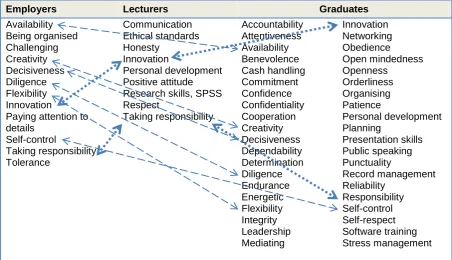
emphasised in management sciences curricula. See Figure 1 for the attributes generated by
respondents.
Employers Lecturers Graduates
Availability Being organised Challenging Creativity Decisiveness Diligence Flexibility Innovation
Paying attention to details Self-control Taking responsibility Tolerance Communication Ethical standards Honesty Innovation Personal development Positive attitude Research skills, SPSS Respect Taking responsibility Accountability Attentiveness Availability Benevolence Cash handling Commitment Confidence Confidentiality Cooperation Creativity Decisiveness Dependability Determination Diligence Endurance Energetic Flexibility Integrity Leadership Mediating Innovation Networking Obedience Open mindedness Openness Orderliness Organising Patience Personal development Planning Presentation skills Public speaking Punctuality Record management Reliability Responsibility Self-control Self-respect Software training Stress management
From Figure 1, there seems to be areas of similarity. Specifically, employers, lecturers, and
graduates listed innovation as an important aspect. This implies that the university should teach
students how to be innovative. Another attribute held in common is taking responsibility for
outcomes. To a large extent, graduates seemed to be more aware of what employers want than
the lecturers. The lists generated above are similar to lists generated by studies elsewhere, which
provokes the question of whether employability attributes for management sciences are
universal.
CONCLUSION
The aim of the article was to provide an analysis of the graduate attributes needed in Namibia
as perceived by graduates, employers and lecturers, using the discipline of management
sciences as a case. The article focused on graduate employability attributes, which are qualities
and skills beyond the subject-specific skills. Employers have expressed concern over the lack
of these attributes among the graduates in Namibia. The first step was then to determine the
perceptions of the stakeholders using a survey.
The findings have indicated a mismatch between the perceptions of the stakeholders with
regard to the graduate attributes regarded as essential for performing a job performance, those
that are emphasised in curricula, and those in which graduates will require more training. A
difference was found in the priorities of employers, HEIs and graduates regarding employability
attributes. This means that HEIs in Namibia are not responding to the hiring needs of the
management sciences labour market because they are not emphasising the development of
employability attributes. As a result, apart from disciplinary knowledge, graduates leave
university with inadequate training on employability attributes. The role of higher education is
to produce graduates that can perform well in a 21st century workplace, which means that
employability attributes should be emphasised. Graduates would like to leave university with
the attributes needed by the contemporary labour market so that they can become productive
members of the workforce, which will eventually lead to a competitive national economy.
This study has brought to light the employability attributes sought after by employers.
HEIs should align curricula to enhance these attributes by working together with employers
during curriculum development. Moroever, students should be sensitised as to which attributes
are sought after by employers. The article argued that assessing the needs of higher education
stakeholders provides an understanding of the scenario of graduate employability in a given
context. Accordingly, the graduate attributes which should be enhanced through curricula were
complementary role in developing graduate employability. Further research should determine
how employability attributes are embedded in curricula and what possible approaches can be
developed to enhance the required attributes in the curricula of management sciences.
Furthermore, future research should assess whether graduate employability attributes for
management sciences are universal across countries.
REFERENCES
Ahmadl, Esa, Padil Suhaili and Hassan Shariati. 2015. Perception lecturers of the soft skills of engineering students in Malaysian Polytechnics. Multidisciplinary Studies 2: 487–495.
Al-Harthi, Hamood K. 2011. University student perceptions of the relationship between university
education and the labour market in Egypt and Oman. Prospects 41(4): 535–551.
doi:10.1007/s11125-011-9216-4.
Barrie, Simon C. 2006. Understanding what we mean by the generic attributes of graduates. Sydney: University of Sydney.
Bridgstock, Ruth. 2009. The graduate attributes we’ve overlooked: Enhancing graduate employability through career management skills. Higher Education Research and Development 28(1): 31–44. doi:10.1080/07294360802444347.
Brown, R. 2007. Enhancing student employability?: Current practice and student experiences in HE
performing arts. Arts and Humanities in Higher Education 6(1): 28–49.
doi:10.1177/1474022207072198.
Cai, Yuzhuo. 2013. Graduate employability: A conceptual framework for understanding employers’ perceptions. Higher Education 65(1): 457–469. doi:10.1007/s10734-012-9556-x.
Crebert, G., M. Bates, B. Bell, C. J. Patrick and V. Cragnolini. 2004. Developing generic skills at university, during work placement and in employment: Graduate’s perceptions. Higher Education Research and Development 23(2): 147–165. doi:10.1080/0729436042000206636.
Creswell, John W. 2003. Research design. In Research design: Quantitative, qualitative, and mixed methods approaches, 1–26. 2nd Edition. London: Sage Publications. https://isites.harvard.edu/ fs/docs/icb.topic1334586.files/2003_Creswell_A Framework for Design.pdf.
Fincher, Mark. 2007. Governments as human capital providers: A rationale for strong government support of broad higher education access. Competitiveness Review: An International Business Journal 17(1): 67–76. doi:10.1108/10595420710816623.
Griesel, Hanlie and Ben Parker. 2009. Graduate attributes: A baseline study on South African graduates from the perspective of employers. South African Qualifications Authority.
Hillage, J. and E. Pollard. 1998. Employability: Developing a framework for policy analysis. https://s3.amazonaws.com/academia.edu.documents/43539201/Employability_Developing_a_fra mework_for20160309-24658-1ix1nw2.pdf?AWSAccessKeyId=AKIAIWOWYYGZ2Y53UL3A &Expires=1519668812&Signature=txf2prQfak3C0gY8rN5iqz7xKbw%3D&response-content-disposition=inline%3B%20filename%3DEmployability_developing_a_framework_for.pdf
Hodges, Dave and Noel Burchell. 2003. Business graduate competencies: Employers’ views on importance and performance. Asia-Pacific Journal of Cooperative Education 4(2): 16–22.
Husein, Mohd Yusof, Seri Bunian Mokhtar, Abdul Aziz Ahmad and Ramlee Mustapha. 2010. Importance of employability skills from employers’ perspective. Procedia: Social and Behavioral Sciences 7(2): 430–438. doi:10.1016/j.sbspro.2010.10.059.
Kaplan, Robert and David Norton. 2004. Measuring the strategic readiness of intangible assets. Harvard Business Review. https://hbr.org/2004/02/measuring-the-strategic-readiness-of-intangible-assets
Kennedy, Sophie. 2010. Infusing critical thinking into an employability skills program: The effectiveness of an immersion approach. Edith Cowan University.
Krejcie, Robert V. and Daryle W. Morgan. 1970. ACTIVITIES. Educational and Psychological Measurement 38: 607–610.
Links, Frederico. 2010. Namibia’s skills deficits : Cross-sectoral perceptions and experiences. Windhoek: Namibia Employers Federation.
Lowden, Kevin, Stuart Hall, Dely Elliot and Lewin Jon. 2011. Employers’ perceptions of the employability skills of new graduates. University of Glasgow.
Markes, Imren. 2006. A review of literature on employability skill needs. European Journal of Engineering Education 31(6): 637–650.
Marope, Mmantsetsa Toka. 2006. Namibia human capital and knowledge development for economic growth with equity. Africa Region Human Development: Working Paper Series No. 84. http://siteresources.worldbank.org/INTAFRICA/Resources/No84.pdf
Martin, Rob, Frank Villeneuve-smith, Liz Marshall and Ewan Mckenzie. 2008. Employability skills explored employability skills. London.
Melink, Mateja and Samo Pavlin. 2012. Employability of graduates and higher education management systems. Final Report of DEHEMS Project. University of Ljubljana. http://www.dehems-project.eu/static/uploaded/files/files/resoults/DEHEMS_REPORT_final.pdf
Moreau, Marie-Pierre and Carole Leathwood. 2006. Graduates’ employment and the discourse of employability: A critical analysis. Journal of Education & Work 19(4): 305–324. doi:10.1080/13639080600867083.
Morrison, Andrew. 2014. A class act ? Lecturers’ views on undergraduates’ employability. British Journal of Sociology of Education 35(4): 487–505. doi:10.1080/01425692.2013.802420.
National Council for Higher Education. 2011. Tracer study of graduates from higher education institutions 1999‒2008. Windhoek.
National Planning Commission. 2010. National Human Resources Plan. Windhoek: Government of the Republic of Namibia.
Omar, Nik Hairi, Azmi Abdul Manaf, Rusyda Helma Mohd, Arena Che Kassim and Khairani Abd Aziz. 2012. Graduates’ employability skills based on current job demand through electronic advertisement. Asian Social Sciences 8(9): 103–111. doi:10.5539/ass.v8n9p103.
Rosenberg, Stuart, Ronald Heimler and Elsa-Sofia Morote. 2012. Basic employability skills: A triangular design approach. Education + Training 54(1): 7–20. doi:10.1108/00400911211198869.
Rospigliosi, Asher Pericles, Sue Greener, Tom Bourner and Maura Sheehan. 2014. Human capital or signalling: Unpacking the graduate premium. International Journal of Social Economics 41(5): 420–432. doi:10.1108/IJSE-03-2013-0056.
Schade, By Klaus and Taimi Amunkete. 2011. Democracy report: Namibia Labour Force Survey 2008. Windhoek.
Tempone, Irene, Marie Kavanagh, Naomi Segal, Phil Hancock, Bryan Howieson, Jenny Kent, Irene Tempone, et al. 2012. Desirable generic attributes for accounting graduates into the twenty-first
century: The views of employers. Accounting Research Journal 25(1): 41–55.
doi:10.1108/10309611211244519.
Tomlinson, Michael. 2008. ‘The degree is not enough’: Students’ perceptions of the role of higher education credentials for graduate work and employability. British Journal of Sociology of Education 29(1): 49–61. doi:10.1080/01425690701737457.
Tymon, Alex. 2013. The student perspective on employability. Studies in Higher Education 38(6): 841– 856. doi:10.1080/03075079.2011.604408.
Weber, Sylvain. 2014. Human capital depreciation and education level. International Journal of Manpower 35(5): 613–642. doi:10.1108/IJM-05-2014-0122.
Wickramasinghe, Vathsala and Lasantha Perera. 2010. Employers’ perceptions towards employability skills. Education + Training 52(3): 226–244.
Wimalasiri, H. S. 2015. ‘Employer’s perception on employability skills and attitudes of new graduates’. Qualitative insights from the employers in Sri Lanka Hashan. Asian Journal of Multidisciplinary Studies 3(11): 112–120.
Wye, Chung-Khain and Yet-Mee Lim. 2009. Perception differential between employers and undergraduates on the importance of employability skills. International Education Studies 2(1): 95–105.