Available on-line at: www.oapub.org/edu
Copyright © The Author(s). All Rights Reserved. doi: 10.5281/zenodo.2562280 Volume 5 │ Issue 4 │ 2019
INTERRELATIONSHIP OF STRESS, BODY IMAGE, NEGATIVE
MOOD STATE AND SUSCEPTIBILITY TO ABNORMAL EATING
BEHAVIOUR AMONG GAME SPECIFIC FEMALE ATHLETES:
AN EXPLORATORY APPROACH
Madhurima Roy, Subhra Chatterjee,
Swapan Kr Deyi
Human performance laboratory, Sports Authority of India,
Indıa
Abstract:
Purpose: To achieve and maintain a perfect body shape athlete often follows restrictive
well-being among female athletic population. Interventions programmes should be designed to cope up with competitive pressure to avoid abnormal eating behaviour.
Keywords: abnormal eating behaviour; fast food; stress; body shape concern; female
athletes; different sports
1. Introduction
Eating disorders can be described as serious illnesses that cause severe disturbances to a person’s eating behaviours. It refers to a wide range of abnormal eating behaviours such as excessive or insufficient food intake, obsessions with food, body weight and shape. (NIMH, Eating Disorders) Depending on the severity and duration of the eating disorders illness, they may exhibit various kinds of physical symptoms like weight loss, amenorrhea, low blood pressure, depressed body temperature, chronic and unexplained vomiting and the growth of soft, fine hair on the body and face. Prolong untreated eating disorders ultimately lead to malnutrition. Eating disorder is a well-known health problem among female athletes than their male counterpart (Ramesh, 2014; Martinsen and Sundgot-Borgen, 2013). Elite athletes are too often experience competitive stressors and anxiety which leads them to a negative emotional state (Eysenck et al., 2007). Research found that weight category sports like endurance, aesthetic and strength game participants are more likely to develop abnormal eating habits to achieving and maintaining the desired body shape for those particular sports. (Torstveit et al., 2008) To get their desired thinness they usually adopt risky behaviours, such as restrictive eating, fasting, frequent skipping meals, diet pills, laxatives, diuretics, enemas, and purging, these behaviours also including bulimia, anorexia, overeating and binge eating. (Sundgot-Borgen and Torstveit, 2010; Milligan and Pritchard, 2006; Martinsen, 2010.)
│ │
There are limited data on susceptibility eating disorders and its relation with other psychological factors like stress, negative mood state, body image dissatisfaction etc. In India, most of the recorded data is about prevalence of eating disorders among athletes (Singh et al., 2015; Kumar et al., 2016) though the influence of game specificity on it is still hazy. Moreover, the relation of abnormal eating habits with stress, mood state and food choice is not explored much. The present study is undertaken to partially address this lacuna. The primary objective of the present study was to identify whether there is an interrelationship of abnormal eating behaviours, perceived stress, negative mood state and self-perception of body image among athletic population and another was to observe the consequences of negative psychological well-being and game specificity on food choices and frequency. A secondary purpose of this study was to identify the ‚at risk-eating disorder‛ participants who were involved in different sports category.
2. Material & methods
Anthropometric measurement: Height and weight of all the participants were measured by anthropometric rod and digital weighing machine respectively and Body Mass Index (BMI) was calculated (kg·m-2) at the Human performance laboratory of SAI,
Kolkata.
Assessment of psychological parameters and lifestyle: A self-administered questionnaire was used to collect information regarding their injury occurrence, training regimen, years of athletic involvement and dietary pattern including frequency of meal consumption, snacking, food frequency, eating out habits, supplements intake etc.
Cohen’s Perceived Stress scale: Cohen’s Perceived Stress scale was used to measure stress. This scale assesses stress experienced over the past one month. Each item is rated on a 5-point scale ranging from 0 (never) to 4 (almost always) (Cohen et al., 1983).
Eating Attitude Test (EAT-26): Eating Attitude Test (EAT-26) (Garner and Garfinkel, 1979) was used to determine the risk of eating disorders. It has three subscales including dieting, bulimia and food preoccupation and oral control. According to this test individuals who scores 20 or more, may have some eating disorders and The Emotional Eating Questionnaire by Garaulet (Garaulet et al., 2012) was used to assess emotional eating in participants.
Emotional eating questionnaire (EEQ): EEQ comprised of 10 questions and each question has 4 options. EEQ test classified subjects in four groups, Score between 0-5, 6-10, 11-20, 21-30 is classified as non-emotional eater, low emotional eater, emotional eater and very emotional eater respectively. (Garaulet et al., 2012)
Body shape questionnaire (BSQ): The BSQ is a self-report measure of the body shape preoccupations typical of bulimia nervosa and anorexia nervosa. It was first reported by Cooper et al., 1986. In this study, we used the short version of BSQ which comprises 16 items. Each item rated on a 6- point likert scale. High score indicates (>66) marked concern with shape whereas low score specify (<38) no concern.
Profile of Mood States (POMS): The POMS questionnaire is a standard validated psychological test used in research to evaluate mood state. The first Profile of Mood States was developed by M. McNair et al., 1971. Several version of this questionnaire are available but for this study POMS was used. POMS consist of 65 adjectives rated on 5-point scale (0= not at all; 1=a little; 2=moderately; 3=quite a bit; 4=extreme). POMS is divided into 6 subscales including tension-anxiety (9 items, score range: 0-36), depression (15 items, range 0-60), anger-hostility (12 items, range 0-48), vigour-activity (8 items, range 0-32), fatigue (7 items, range 0-28), confusion-bewilderment (7 items, range 0-28). To complete the POMS, participants were asked to rate ‘How you have been feeling during the past week, including today‛ on the basis of scales.
│ │
2.1 Statistical analysis
Data was analyzed using the Statistical Program for the Social Sciences (SPSS) version 16.0 for Windows (SPSS Inc., Chicago, Il, USA). All values expressed as means ± standard deviation (SD). A confidence level at 95% (p < 0.05) was considered as significant. One way ANOVA followed by Scheffe’s Post Hoc was used to quantify the mean difference among all the groups. The Pearson correlation coefficient was used for testing correlations among the Eat score, perceived stress, body shape concern components, and mood states for each group. Multiple regression analyses were applied to examine how body shape concern components, emotional eating, perceived stress, body mass index, fast food eating and mood contributed to variance in EAT score and stress score.
3. Results
3.1 Anthropometric profile
Comparison of mean, SD and level of significance of physical characteristics of four different groups were shown in Table 1. Average BMI of aesthetic game groups, endurance, strength and control group was 20.5±1.40, 20.3±2.72, 21.1±3.71, 21.1±3.71, 21.1±1.79 kgm-2 respectively. According to BMI classification 21% of the subject was
accounted for underweight group, the normal weight group was 63%, the overweight group was 12% and the pre obese and obese group was 4% of all subjects.
Table 1: Comparison of mean, SD and level of significance of
physical characteristics of different sports and control groups
Parameters Aesthetic game (n=28) Endurance (n=30) Strength (n=32) Control (n=48)
Age (years) 16.9±2.60 17.4±2.59 17.2±1.86 16.9±2.61
Height (m) 1.5±0.04 1.6±0.05 1.6±0.07 1.6±0.05
Weight (kg) 47.5±3.47 52.3±9.77 54.8±10.85 53.6±5.87
BMI (kgm-2) 20.5±1.40 20.3±2.72 21.1±3.71 21.1±1.79
# Underweight = 21% (n=29); Normal= 62% (n=84); overweight=13% (n=17); Pre obese and obese= 4% (n=6)
*p<0.05; **p<0.01
3.2 Assessment of eating behaviours, mood, body shape concern and perceived stress
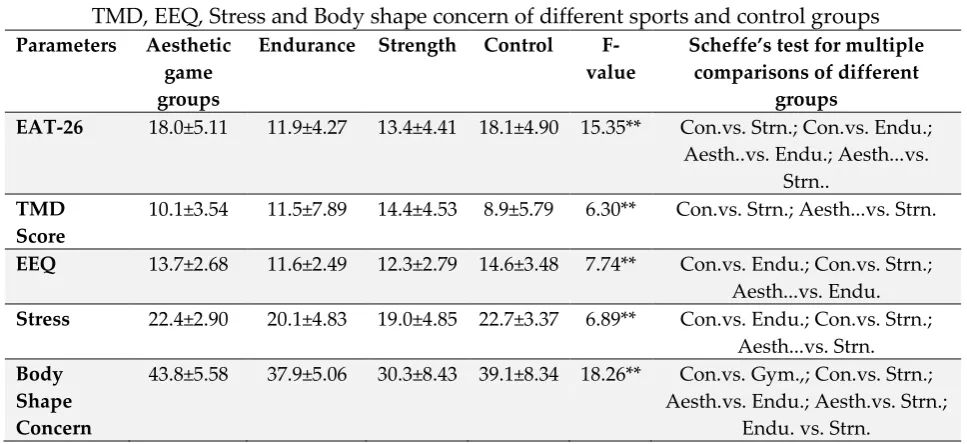
control group (8.9±5.79). The difference was found to be statistically significant. The table further revealed that Emotional eating score and stress score was highest in control group, 14.6±3.48 and 39.1±8.34 respectively whereas aesthetic game group scored highest in body shape concern. Control and strength group showed significant difference in all the three scores. Aesthetic game group scored higher EEQ and BSQ score when it was compared with endurance group. BSQ score was significantly differed in aesthetic game group vs. strength group and endurance vs. strength group respectively.
Table 2: Comparison of mean SD and level of significance of EAT-26,
TMD, EEQ, Stress and Body shape concern of different sports and control groups
Parameters Aesthetic game groups
Endurance Strength Control F-value
Scheffe’s test for multiple comparisons of different
groups
EAT-26 18.0±5.11 11.9±4.27 13.4±4.41 18.1±4.90 15.35** Con.vs. Strn.; Con.vs. Endu.; Aesth..vs. Endu.; Aesth...vs.
Strn.. TMD
Score
10.1±3.54 11.5±7.89 14.4±4.53 8.9±5.79 6.30** Con.vs. Strn.; Aesth...vs. Strn.
EEQ 13.7±2.68 11.6±2.49 12.3±2.79 14.6±3.48 7.74** Con.vs. Endu.; Con.vs. Strn.; Aesth...vs. Endu. Stress 22.4±2.90 20.1±4.83 19.0±4.85 22.7±3.37 6.89** Con.vs. Endu.; Con.vs. Strn.;
Aesth...vs. Strn. Body
Shape Concern
43.8±5.58 37.9±5.06 30.3±8.43 39.1±8.34 18.26** Con.vs. Gym.,; Con.vs. Strn.; Aesth.vs. Endu.; Aesth.vs. Strn.;
Endu. vs. Strn. *p<0.05; **p<0.01
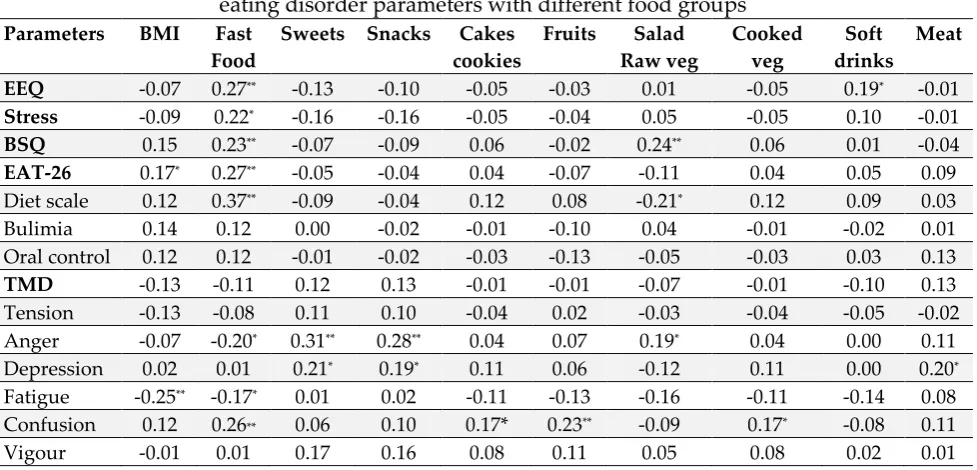
3.3 Pearson’s Correlation coefficients of various parameters
│ │
Table 3: Spearman Rank correlation coefficient of
eating disorder parameters with different food groups
Parameters BMI Fast Food
Sweets Snacks Cakes cookies
Fruits Salad Raw veg Cooked veg Soft drinks Meat
EEQ -0.07 0.27** -0.13 -0.10 -0.05 -0.03 0.01 -0.05 0.19* -0.01
Stress -0.09 0.22* -0.16 -0.16 -0.05 -0.04 0.05 -0.05 0.10 -0.01
BSQ 0.15 0.23** -0.07 -0.09 0.06 -0.02 0.24** 0.06 0.01 -0.04
EAT-26 0.17* 0.27** -0.05 -0.04 0.04 -0.07 -0.11 0.04 0.05 0.09
Diet scale 0.12 0.37** -0.09 -0.04 0.12 0.08 -0.21* 0.12 0.09 0.03
Bulimia 0.14 0.12 0.00 -0.02 -0.01 -0.10 0.04 -0.01 -0.02 0.01 Oral control 0.12 0.12 -0.01 -0.02 -0.03 -0.13 -0.05 -0.03 0.03 0.13 TMD -0.13 -0.11 0.12 0.13 -0.01 -0.01 -0.07 -0.01 -0.10 0.13 Tension -0.13 -0.08 0.11 0.10 -0.04 0.02 -0.03 -0.04 -0.05 -0.02 Anger -0.07 -0.20* 0.31** 0.28** 0.04 0.07 0.19* 0.04 0.00 0.11
Depression 0.02 0.01 0.21* 0.19* 0.11 0.06 -0.12 0.11 0.00 0.20*
Fatigue -0.25** -0.17* 0.01 0.02 -0.11 -0.13 -0.16 -0.11 -0.14 0.08
Confusion 0.12 0.26** 0.06 0.10 0.17* 0.23** -0.09 0.17* -0.08 0.11
Vigour -0.01 0.01 0.17 0.16 0.08 0.11 0.05 0.08 0.02 0.01
3.4 Predictors of abnormal eating behaviour and perceived stress
Regression analyses for EAT scores and perceived stress scores revealed that total mood disturbance was a common contributor of the prediction of eating disorder and stress. Table 6 summarizes the results of the regression analyses. In athletes, Body mass index, Body shape concern and Total mood disturbance were the significant predictor of EAT scores (R2 adj = 0.201, F = 4.83, p = 0.000). Emotional eating and Total mood disturbance was also the significant predictor of Perceived stress scores in athletes (R2 adj = 0.621, F = 26.68, p =0.000).
Table 4: Multiple regression analysis for possible predictors of EAT scores and Perceived stress
R2 Adjusted R2 Beta t-value Sig.
EAT-26 0.254 0.201
Body Mass Index 0.171 2.136 .035
Body Shape Concern 0.291 3.643 .000
Total Mood Disturbance 0.321 3.760 .000
Fast Food 0.204 2.471 .015
Perceived Stress 0.652 0.621
Emotional eating Questionnaire 0.704 12.295 .000
Total Mood Disturbance -0.216 -3.371 .000
p<0.05; **p<0.01
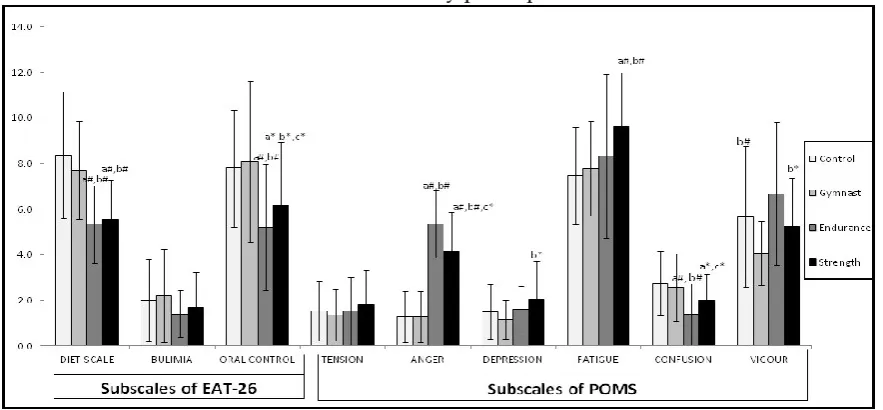
3.5 Subscales of EAT-26 and Profile of Mood Score
group secured the highest diet scale score (8.4±2.76) while endurance group exhibited the lowest score (5.3±1.69). On the other hand aesthetic game group and endurance group showed highest (8.1±3.52) and lowest score (5.2±2.76) in oral control subscale respectively. Among all the subscales of total mood disturbance anger score was significantly differed from each and every group except control vs. aesthetic game group. Endurance group showed the highest score of anger (4.1±1.76) and vigour and depression (2.1±1.66) and fatigue score was highest in strength group.
Figure 1: Mean, SD and level of significance of different subscale of EAT-26 and
POMS of Study participant
a = significantly different from group ‚control‛; b = significantly different from group ‚aesthetic game group‛; c = significantly different from group ‚endurance‛; d = significantly different from group ‚strength‛ *= p<0.05; #=p<0.01
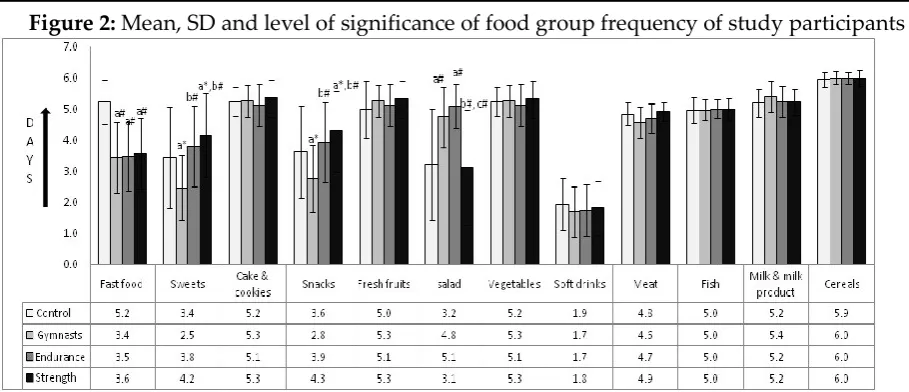
3.6 Frequency of different food group consumption among study participants:
│ │
Figure 2: Mean, SD and level of significance of food group frequency of study participants
a = significantly different from group ‚control‛; b = significantly different from group ‚aesthetic game group‛; c = significantly different from group ‚endurance‛; d = significantly different from group ‚strength‛; *= p<0.05; #=p<0.01
4. Discussion
period of time (Currie, 2010). Probably for these reasons, body shape concerned is also high in athletes especially who play aesthetics games like aesthetic game group, synchronized swimming, dancing show a desire for thinness to achieve good result in competitions. These populations found to be more prone to eating disorders and precursory eating disorder behaviours (Fátima et al., 2003). If we focus on control group, BSQ score is also high among them which indicate even though body dissatisfaction concerns have been linked to female athletes; some female non-athletes also have similar or higher levels of body dissatisfaction than female athletes, which suggests that negative body image can be found among various female populations (McLester et al., 2014). We have also observed that there was a strong correlation with body shape concern and eating disorder. From the present study, it is clear that Body shape concern can be a strong predictor of disordered eating behaviour. This finding was corroborated with the previous research done by Petrie et al. 2009 and they have stated that individuals may have personality and psychological characteristics, such as their self-concept and satisfaction with their body and appearance, which affect their susceptibility to eating disorders (Petrie et al., 2009).
Elite competitors are directly and continuously exposed to both physiological and psychological stressors which can affect their mood status (Salvador and Costa, 2009). It is well documented that negative mood encompassing high anger, confusion, depression, fatigue, tension and low vigour and it is associated with an inability to cope with training demands. This study noticed that endurance and strength group both achieved high level of total mood disturbance score which is significantly different from other two groups. If we focus on subscales of POMS, it is evident that anger and fatigue score is markedly high in endurance and strength group than other two groups and which ultimately affect total mood disturbance score.
Nowadays Stress also becoming a growing concern among youth. We have found that all our study participants were suffering from moderate to high stress condition. This incidence was more prevalent in control group followed by aesthetic game group. Sports activity may have some positive effect on stress though the contradictions are also there (Matthew, 2014). Depending on the level of Stress, feeding behaviour can also change resulting in either increased or reduced food intake. Studies showed that palatable food has an ability to reduce stress induced complication on a short term basis (Singh, 2014). The present study also identified that a strong significant positive correlation between stress and fast food intake.
│ │
eating is triggered where food intake can either increase or decrease within the same individuals. In our study, emotional eating is significantly prevalent among control and aesthetic game group groups while Kim Van Durme et al found that athletic group is more prone to eating disorders than general population (Durme et al., 2012). This contradiction may be noticed because our study control group found to be more concerned regarding their body image and dieting behaviour. Result further revealed that a strong significant positive correlation between emotional eating and stress and also with fast food consumption. This finding was found to be corroborated with the previous study as reported Sing et al (Singh et al. 2014).
5. Conclusion
The finding of this study revealed that controls and aesthetic game group exhibited more abnormal eating behaviours and high stress than other athletic population. Abnormal eating behaviours were associated with various psychological factors like mood, body dissatisfaction etc. Emotional eating identified as a strong predictor of perceived stress. Moreover, fast food eating positively correlated with abnormal eating behaviour and stress. Though controls groups showed more susceptibility to eating disorders, athletes were also engaged in detrimental eating behaviours. On the individual level, they should follow the mental training process to handle stress in a better way. A team of doctors, nutritionists and psychologists are needed to make them aware regarding healthy lifestyle and motivate them to manage competitive pressure.
Acknowledgement
The author expresses her sincere gratitude to the players who participated in the present study and SAI, Eastern Centre, Kolkata for providing facilities and expertise in conducting the research study.
References
Ackard D.M., Croll J.K., Kearnedy-Cooke A., 2002. Dieting frequency among college females: association with disordered eating, body image, and related psychological problems. Journal of Psychosomatic Research 52(3): 129–136. Bartoszek A., Domżał-Drzewicka R., Kachaniuk H., Kocka K., Muzyczka K., 2015. The
state of nutrition and the self-assessment of symptoms of depression in the group of seniors living in the countryside of Lublin province – preliminary report. Przeglad Gastroenterologiczny 10(4): 208–214.
Cooper P., Taylor M.J., Cooper Z., Fairburn C.G., 1987. The development and validation of the body shape questionnaire. International Journal of Eating Disorders 6(4): 485–494.
Currie A., 2010. Sport and Eating Disorders - Understanding and Managing the Risks. Asian Journal of Sports Medicine 1(2): 63–68.
Definition of Stress. Oxford University Press, Oxford. 2010
http://www.oxforddictionaries.com/definition/english/stress, Last accessed on 8th
Aug, 2018
Durme K.V., Goossens L., Braet C., 2012. Adolescent aesthetic athletes: A group at risk for eating pathology?. Eating Behaviors 13(2): 119-122.
Eysenck M.W., Derakshan N., Santos R., et al., 2007. Anxiety and cognitive performance: attentional control theory. Emotion 7: 336–53.
Faith M.S., Allison D.B., Geliebter A., 1997. Emotional eating and obesity: theoretical considerations and practical recommendations. In: Dalton´s, Editor. Obesity and weight control: the health professional´s guide to understanding and treatment. Aspen pp.439-465.
Fátima P.D.O., Maria L.M.B., Patrícia D.S.V., Renata D.S.V., 200. Eating Behavior And Body Image In Athletes. Revista Brasileira de Medicina do Esporte 9.
Ferrand C., Brunet E., 2004. Perfectionism and risk for disordered eating among young french male cyclists of high performance. Perceptuor Motor Skills 99: 958-967. Garaulet M., Canteras M., Morales E., López-Guimera G., Sánchez-Carracedo
D., Corbalán-Tutau M.D., 2012. Validation of a questionnaire on emotional eating for use in cases of obesity; the Emotional Eater Questionnaire (EEQ). Nutricion Hospitalaria 27(2): 645-51.
Garner D.M., Garfinkel PE, 1979. The eating attitudes test: an index of the symptoms of anorexia nervosa. Psychological Medicine 9: 273-279.
Garner D.M., Olmsted M.P., Polivy J., 1983. Development and validation of a multidimensional eating disorder inventory for anorexia nervosa and bulimia. International Journal Eating Disorders 2: 25-34.
Hall J., Lane A.M., 2001. Effects of rapid weight loss on mood and performance among amateur boxers, British Journal of Sports Medicine 35: 390–395.
Henriques G.R., Calhoun L.G., Cann A., 1996. Ethnic differences in women's body satisfaction: an experimental investigation. The Journal of Social Psychology 136(6): 689–697.
Kumar S., Singh A.K., Kaur M., Sharma A., 2016. The Prevalence of eating disorder among young girls and boys by using eating attitude Test (Eat-26). International Journal of Physical Education, Sports and Health 3(5): 378-381.
│ │
Martinsen M., Sundgot-Borgen J., 2013. Higher prevalence of eating disorders among adolescent elite athletes than controls. Medicine & Science in Sports & Exercise 45: 1188–1197.
Martinsen M., Bratland-Sanda S., Eriksson A.K., Sundgot-Borgen J. (2010). Dieting to win or to be thin? A study of dieting and disordered eating among adolescent elite athletes and non-athlete controls. British Journal of Sports Medicine 44: 70-76.
Matthew A., Stults-Kolehmainen, Sinha R., 2014. The Effects of Stress on Physical Activity and Exercise. Sports Medicine 44(1): 81–121.
McLester C.N., Hardin R., Hoppe S., 2014. Susceptibility to Eating Disorders among Collegiate Female Student–Athletes. Journal of Athletic Training 49(3): 406–410. McNair D.M., Lorr M., Droppleman L.F., 1971. Manual for the Profile of Mood States. San
Diego, CA: Educational and Industrial Testing Services.
Melin A., Tornberg Å.B., Skouby S., Møller S.S., Sundgot-Borgen J, Faber J, Sidelmann J.J., Aziz M., Sjödin A., 2015. Energy availability and the female athlete triad in elite endurance athletes. Scandinavian Journal of Medicine & Science in Sports 25(5): 610-22.
Milligan B., Pritchard M., 2006. The relationship between gender, type of sport, body dissatisfaction, self-esteem and disordered eating behaviors in division I athletes. Athletic Insight 8: 32-46.
National Eating Disorder Association (NEDA) (2012) Factors That May Contribute to Eating Disorders, New York. https://www.nationaleatingdisorders.org/factors-may-contribute-eating-disorders, Last accessed on 12th Aug,2018
National institute of mental health. Eating Disorders: About More than Food. NIH Publication No. TR 14-4901 Revised 2014.
NIMH » Eating Disorders - National Institute of Mental Health
https://www.nimh.nih.gov/health/topics/eating-disorders/index.shtml, Last accessed on 12th JULY,2018
Paquet C., Arnaud-Mckenzie D., Kergoat M.J., Ferland G., Dubé L., 2003. Direct and indirect effects of everyday emotions on food intake of elderly patients in institutions. The journals of gerontology. Series A, Biological sciences and medical sciences 58: 153-158.
Petrie T.A., Greenleaf C., Reel J., Carter J., 2009. Personality and psychological factors as predictors of disordered eating among female collegiate athletes. Journal of Eating Disorder 17(4): 302-21.
Ramesh S., 2014. Eating disorders – Malnutrition for women. Apollo Medicine 11 (1): 18-23.
Rao T.S.S., Asha M.R., Ramesh B.N., Rao K.S.J., 2008. Understanding nutrition, depression and mental illnesses. Indian Journal of Psychiatry 50(2): 77–82.
European Journal of Physical Education and Sport Science - Volume 5│ Issue 4 │ 2019 Singh K., Kerketta I., Mishra M.K., 2015. A comparison of eating disorders between
female athletes and non-athletes of G.G.V Bilaspur. Academic sports scholar 4 (4).
Singh M., 2014. Mood, food, and obesity. Frontiers in Psychology 5: 925.
Sundgot-Borgen J., 1993. Prevalence of eating disorders in elite female athletes. International Journal of Sport Nutrition and exercise 3: 29-34.
Sundgot-Borgen J., Torstveit MK, 2010. Aspects of disordered eating continuum in elite high-intensity sports. Scandinavian Journal of Medicine & Science in Sports 20: 112-121.
Torstveit M.K., Rosenvinge J.H., Sundgot-Borgen J., 2008. Prevalence of eating disorders and the predictive power of risk models in female elite athletes: a controlled study. Scandinavian Journal of Medicine & Science in Sports 18:108–118.
Unusan N., 2006. Linkage between Stress and Fruit and Vegetable Intake among University Students: An Empirical Analysis On Turkish Students. Nutrition Research 26: 85-390.
European Journal of Physical Education and Sport Science - Volume 5│ Issue 4 │ 2019 Creative Commons licensing terms
European Journal of Physical Education and Sport Science - Volume 5│ Issue 4 │ 2019 Open Access Publishing requirements and can be freely accessed, shared, modified, distributed and used in educational, commercial and