Economic evaluation of Cardiac Contractility
Modulation (CCM) therapy with the optimizer
IVs in the management of heart failure
patients
Nikos Maniadakis
1, Vasilios Fragoulakis
2, Charalambos Mylonas
2, Rakesh Sharma
3, Andrew J
Stewart Coats
41 Professor, Department of Health Services Organisation & Management and Associate Dean, National School of Public Health, Athens, GR
2 Research Fellow, Department of Health Services Organisation & Management, National School of Public Health, Athens, GR 3 Consultant Cardiologist, The Royal Brompton Hospital, London, UK
4 Professor, Monash University, Australia and University of Warwick, UK
Introduction
Heart failure (HF) is a complex clinical syndrome caused by structural and/or functional cardiac disorders that impair the heart’s ability as a pump to support the circulation1-3. It is
associated with a broad spectrum of signs and symptoms resulting in a wide range of clinical expressions. Its prevalence is approximately 1-2% of the population and increases rapidly with age, reaching double digits in those above the age of sixty five4-7. Hence, due to the aging of the population and the
improved survival of patients presenting with acute coronary syndromes, the number of HF patients is constantly rising. People with HF exhibit high mortality rates and very poor quality of life, both of which are comparable to or even worse than that of many cancer patients. Moreover, HF patients are hospitalized very frequently and they consume significant amount of healthcare resources8-10. Therefore, HF represents a
significant cost burden for health systems and a considerable cause of productivity loss for society5-7.
Evidence based treatment of heart failure is effective in lowering morbidity and mortality and improving patient quality of life. According to published guidelines optimal pharmacological treatment (OMT) is effective for the initial management of HF patients1-3. However, as the condition becomes more severe,
cardiac function and symptoms may no longer be controlled by pharmacological treatments alone. In a subset of patients with advanced heart failure, symptoms and survival may be improved by the implantation of cardiac devices to restore atrio-ventricular synchrony1-3. These are known as cardiac
resynchronisation therapy (CRT) devices and are indicated for patients with low left ventricular ejection fraction (EF) and a broad QRS duration, typically with a left bundle branch block
Abstract
Aims
Heart failure represents a major burden for health systems and societies. Cardiac contractility modulation (CCM) therapy was developed in recent years for patients with normal QRS in whom optimal pharmacological (OMT) treatment has failed to control symptoms adequately. This study presents an economic evaluation of CCM therapy for the UK.
Methods
A Markov model was built to simulate the management of patients under two therapy scenarios, on OMT alone and CCM+OMT respectively. The horizon is the patient’s life time and the cycle is 4 weeks. The model estimates life year (LYs), quality adjusted life years (QALYs) and overall treatment costs. Data to populate it came from relevant CCM trials, the literature and other sources.
Results
The total mean life-time cost was £37,467 in the CCM+OMT arm and £16,885 in the OMT arm. Patients in the OMT arm gained 7.00 LYs and 4.00 QALYs and those on CCM+OMT 7.96 and 5.26 respectively. The incremental cost per QALY was £16,405 and the incremental cost per LY £21,415. Sensitivity analysis indicates that the results are pretty stable and stochastic analysis indicates that at a £30,000 per QALY threshold the likelihood of CCM+OMT being cost-effective is 99.8% and at £25,000 per QALY 97%.
Conclusion
The present analysis indicates that CCM may be cost-effective therapy. This early conclusion should be viewed in the light of the caveats of the modeling methods used, due to data availability limitations. Long-term studies directly collecting hospitalization and mortality data should be undertaken to provide more robust evidence.
Key words: Heart Failure, Cardiac Contractility Modulation, Optimizer, Economic Evaluation, Cost Effectiveness Analysis, Cost Utility Analysis
Citation: Maniadakis N., Fragoulakis V., Mylonas C., Sharma R. and Stewart Coats A.J. Economic Evaluation Of Cardiac Contractility Modulation (CCM) Therapy With The Optimizer Ivs In The Management Of Heart Failure Patients International Cardiovascular Forum Journal. 2015;4:43-52 DOI: 10.17987/icfj.v4i0.173
(LBBB) pattern1-3. Several randomized controlled trials have
shown that CRT may be beneficial for patients with a QRS duration > 120 milliseconds (ms), whilst they have no benefit or possibly even harm in patients with normal QRS (i.e. ≤ 120 ms)11-12. Therefore, only a third of HF patients whose symptoms
persist despite medical therapy are suitable candidates for CRT.
This therapeutic gap has raised the need for the development of new device-based treatments, specifically for patients with a normal QRS and persistent symptoms despite use of medical therapy. For this reason, cardiac contractility modulation (CCM) therapy has been developed in recent years. It is a device-based approach that applies non-excitatory electrical signals to the cardiac muscle during the absolute refractory period, via an implantable stimulation device, similar in its structure to the mechanism of pacemakers13-15. CCM signals enhance
the strength of left ventricular contraction without increasing myocardial oxygen consumption and improve exercise tolerance as well as quality of life (QoL) in patients with heart failure13-15.
The OPTIMIZER™ IVs System (OPTIMIZER thereafter) is the only currently available device available for the application of CCM therapy. Three clinical trials have evaluated it, in Europe and the USA, namely: FIX-CHF-416, FIX-HF-5 pilot17 and
FIX-HF-518. In the FIX-CHF-4 study one hundred and
sixty-four subjects with EF ≤ 35% and New York Heart Association (NYHA) Class II (24%) or III (76%) received a CCM pulse generator. Patients were randomly assigned to Group 1 (n = 80, CCM treatment 3 months, sham treatment second 3 months) or Group 2 (n = 84, sham treatment 3 months, CCM treatment second 3 months). Efficacy was evaluated in terms of changes in the peak oxygen consumption (pVO2) and the Minnesota Living with Heart Failure Questionnaire (MLWHFQ). During the first 3 months of the study, pVO2 increased in both sham and active group, but in the second three month period pVO2 decreased in the group switched to sham (-0.86 ± 3.06 mL/ kg/min) and further increased in patients switched to active treatment (0.16 ± 2.50 mL/kg/min). MLWHFQ also trended better with treatment (-12.06 ± 15.33 vs. -9.70 + 16.71) during the first 3 months, worsened during the second 3 months in the group switched to sham (4.70 ± 16.57), whilst improved further in patients switched to active treatment (-0.70 ± 15.13). A comparison of values at the end of active treatment periods vs. end of sham treatment periods indicated statistically
significantly improved pVO2 and MLWHFQ (P = 0.03 for each parameter).
The FIX-HF-5 Pilot study was a randomized, double-blind, pilot study to determine the feasibility of safely and effectively delivering cardiac contractility modulation signals in patients with heart failure. Forty-nine subjects with EF ≤ 35%, normal QRS duration and NYHA class III or IV heart failure, despite medical therapy, received a cardiac contractility modulation pulse generator. Patients were randomized to have their devices programmed to deliver cardiac contractility modulation signals (n = 25, treatment group) or to remain off (n = 24, control group) for 6 months. Efficacy evaluations considered NYHA class, 6-minute walk, and MLWHFQ. Compared with baseline, 6-minute walk (13.4 m), pVO2 (0.2 mL O2/kg/min), and anaerobic threshold (0.8 mL O2/kg/min) tended to increase more in the treatment group than in control. None of these differences were statistically significant due to a small sample size.
In the FIX-HF-5 pivotal study, 428 NYHA class III or IV, narrow QRS (≤ 130 ms) heart failure patients with EF ≤ 35% randomized to OMT plus CCM (n = 215) versus OMT alone (n = 213). Efficacy was assessed by ventilatory anaerobic threshold (VAT), the primary end point, and by pVO2 and MLWFQ. While VAT did not improve at 6 months, CCM significantly improved pVO2 (0.65 mL O2/kg/min [P = 0.024]) and MLWHFQ (−9.7 points [P = 0.0001]), respectively over OMT.
Moreover, in a further pre-specified analysis of the above trial, in the subgroup with NYHA functional class III and EF ≥ 25% (comprising 97 OMT and 109 CCM patients, ~48% of the entire population) VAT increased by 0.10 ± 2.36 mL O2/kg/min in CCM and decreased by -0.54 ± 1.83 mL O2/kg/min in OMT (P = 0.03), pVO2 increased by 0.34 ± 3.11 mL O2/kg/min in CCM and decreased by -0.97 ± 2.31 mL O2/kg/min (P = 0.001) in OMT at 24 weeks compared with baseline. Moreover, 44% of CCM versus 23% of OMT subjects showed improvement of ≥
1 NYHA functional class (P = 0.002), and 59% of CCM versus 42% of OMT subjects showed a 10-point reduction in MLWHFQ (P = 0.01). All of these findings were similar to those observed at 50 weeks.
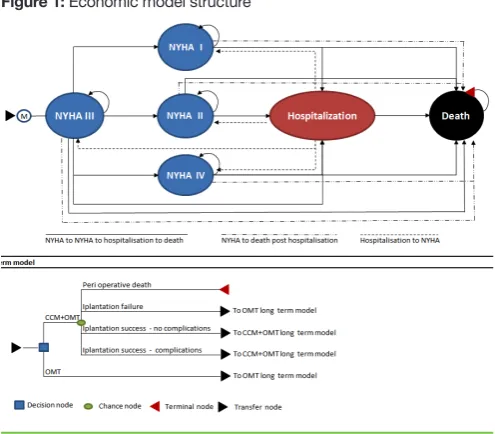
A recent meta-analysis of individual patient data from all three CCM trials showed that CCM significantly improved pVO2 Figure 1: Economic model structure
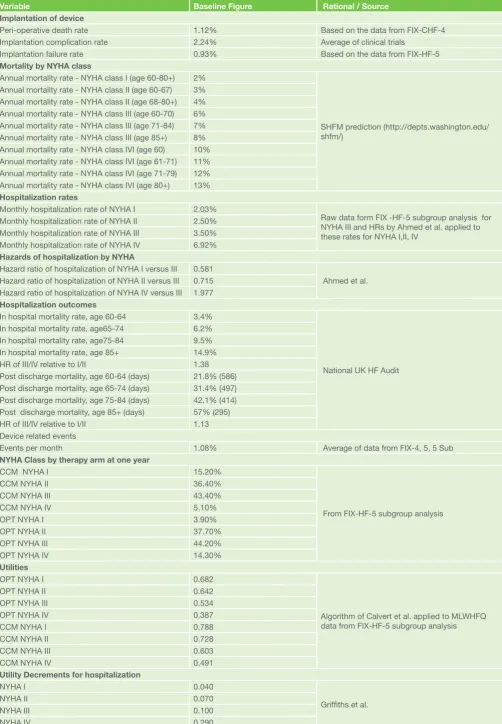
Table 1: Summary of clinical variables used in the economic model
Variable Baseline Figure Rational / Source
Implantation of device
Peri-operative death rate 1.12% Based on the data from FIX-CHF-4
Implantation complication rate 2.24% Average of clinical trials
Implantation failure rate 0.93% Based on the data from FIX-HF-5
Mortality by NYHA class
Annual mortality rate - NYHA class I (age 60-80+) 2%
SHFM prediction (http://depts.washington.edu/ shfm/)
Annual mortality rate - NYHA class II (age 60-67) 3% Annual mortality rate - NYHA class II (age 68-80+) 4% Annual mortality rate - NYHA class III (age 60-70) 6% Annual mortality rate - NYHA class III (age 71-84) 7% Annual mortality rate - NYHA class III (age 85+) 8% Annual mortality rate - NYHA class IVI (age 60) 10% Annual mortality rate - NYHA class IVI (age 61-71) 11% Annual mortality rate - NYHA class IVI (age 71-79) 12% Annual mortality rate - NYHA class IVI (age 80+) 13% Hospitalization rates
Monthly hospitalization rate of NYHA I 2.03%
Raw data form FIX -HF-5 subgroup analysis for NYHA III and HRs by Ahmed et al. applied to these rates for NYHA I,II, IV
Monthly hospitalization rate of NYHA II 2.50% Monthly hospitalization rate of NYHA III 3.50% Monthly hospitalization rate of NYHA IV 6.92% Hazards of hospitalization by NYHA
Hazard ratio of hospitalization of NYHA I versus III 0.581
Ahmed et al. Hazard ratio of hospitalization of NYHA II versus III 0.715
Hazard ratio of hospitalization of NYHA IV versus III 1.977 Hospitalization outcomes
In hospital mortality rate, age 60-64 3.4%
National UK HF Audit In hospital mortality rate, age65-74 6.2%
In hospital mortality rate, age75-84 9.5% In hospital mortality rate, age 85+ 14.9% HR of III/IV relative to I/II 1.38 Post discharge mortality, age 60-64 (days) 21.8% (586) Post discharge mortality, age 65-74 (days) 31.4% (497) Post discharge mortality, age 75-84 (days) 42.1% (414) Post discharge mortality, age 85+ (days) 57% (295) HR of III/IV relative to I/II 1.13 Device related events
Events per month 1.08% Average of data from FIX-4, 5, 5 Sub
NYHA Class by therapy arm at one year
CCM NYHA I 15.20%
From FIX-HF-5 subgroup analysis
CCM NYHA II 36.40%
CCM NYHA III 43.40%
CCM NYHA IV 5.10%
OPT NYHA I 3.90%
OPT NYHA II 37.70%
OPT NYHA III 44.20%
OPT NYHA IV 14.30%
Utilities
OPT NYHA I 0.682
Algorithm of Calvert et al. applied to MLWHFQ data from FIX-HF-5 subgroup analysis
OPT NYHA II 0.642
OPT NYHA III 0.534
OPT NYHA IV 0.387
CCM NYHA I 0.788
CCM NYHA II 0.728
CCM NYHA III 0.603
CCM NYHA IV 0.491
Utility Decrements for hospitalization
NYHA I 0.040
Griffiths et al.
NYHA II 0.070
NYHA III 0.100
(mean difference: 0.71, 95% C.I. (confidence interval) 0.20 to 1.21 mL O2/kg/min, P = 0.006), 6-minute walk test distance (mean difference: 13.92, 95% C.I. -0.08 to 27.91 m, P = 0.05) and quality of life measured by MLWHFQ (mean difference: -7.17, 95% C.I. -10.38 to -3.96, P < 0.0001)19.
With regard to safety, in the FIX-CHF-4, the incidences of death and adverse events were relatively low and were balanced between active and sham treatments during the randomized phases of the study. In the FIX-HF-5 Pilot study the incidence of serious adverse events and hospitalizations were low, and the overall event-free survival tended to be better in the active treatment group. Serious adverse cardiac events occurred more frequently in the control compared with the treatment group (9 versus 4 events, respectively). In the FIX-HF-5 study for the composite safety end point of all-cause hospitalizations and all-cause mortality, 4 subjects in the CCM group and 14 subjects in the OMT group were withdrawn from the study before experiencing a safety end point and therefore lost to follow-up. For the intent-to-treat population (assuming subjects lost to follow-up did not have any events), there were 103 events in the 213 subjects randomized to the OMT group (48.4%) and 112 events in the 215 subjects randomized to the CCM group (52.1%). The primary safety end point of the study was met. With an intention-to-treat analysis, 13 (6.0%) of the 215 subjects randomized to the CCM group died during the 50-week follow-up period (P = 0.25 vs OMT alone by Fisher
exact test). Another recent meta-analysis of the aforementioned trials, indicated that that CCM is not associated with excess all-cause mortality, all-cause hospitalizations or adverse effects over OMT20.
In conclusion, evidence indicates that CCM therapy is safe and effective for use in patients, greater than 18 years of age, with symptomatic heart failure due to left ventricular systolic dysfunction and normal QRS duration (i.e. ≤ 120 ms), despite the use of appropriate optimal medical therapy. The benefits are maximized in patients with NYHA functional class III and EF between 25% and 45%. The technology is already reimbursed in some health care systems, whilst is being evaluated in others by their health technology assessment agencies. Comprehensive knowledge of the cost and cost-effectiveness of therapy is important not only for reimbursement purposes but also for guiding physicians in the responsible allocation of scarce resources7. Nonetheless, there is no published economic
evaluation today for this new therapy. Hence, an economic evaluation was undertaken to evaluate the cost-effectiveness of CCM therapy with OPTIMIZER plus optimal medical therapy (CCM+OMT) versus optical medical therapy (OMT) alone in HF patients. As economic evaluations should make reference to a particular health system setting, the UK was chosen. This is the first economic evaluation, to our knowledge, for this new therapy option and the rest of the paper reports its methodology and results.
Methods
Modeling Approach
The outcomes associated with each alterative treatment option are estimated by means of a state transition Markov model, which simulates over time the progression and the management of a patient cohort under the two hypothetical therapy scenarios. The model estimates in each case the mean expected survival, quality of life, health events, and treatment cost. The simulation runs on a monthly cycle basis until the death of everybody in the cohort. No half cycle correction was deemed necessary. The perspective adopted is that of the National Health Service in the UK and a 3.5% discount rate is applied for all outcomes. Baseline event rates are applied in the OMT arm and those of the CCM+OMT, wherever applicable, are estimated by application of relative risk rates. The base line population considered is that of the sub-group analysis of the FIX-HF-5 study.
The model has a short and a long term part. Its structure is presented graphically in Figure 1. Patients in the OMT arm are entered immediately in the long term part of the model. The short term part is designed to reflect the events around the implantation of the device. The entire CCM+OMT therapy cohort starts first in the short term part of the model. During implantation, a small but otherwise non-negligible risk of death is assumed. Moreover, the procedure may fail in some cases and these patients inevitably move in the long run to pharmacotherapy and assume the same event rates with those in the OMT alone arm. Surviving patients in whom the implantation is successful move the long term part of the CCM+OMT arm. Nonetheless, a portion of these patients may also experience complications during the implantation, in which case they consume more resources and assume thus a higher cost.
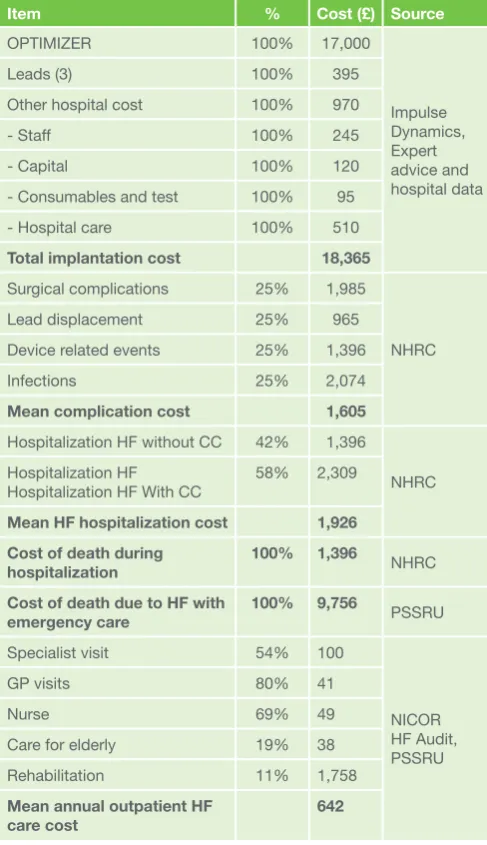
In each run in the long term part, based on corresponding transition probabilities, the model estimates the number of patients in each state and the associated health and economic Table 2: Unit cost items used in the analysis
Item % Cost (£) Source
OPTIMIZER 100% 17,000
Impulse Dynamics, Expert advice and hospital data
Leads (3) 100% 395
Other hospital cost 100% 970
- Staff 100% 245
- Capital 100% 120
- Consumables and test 100% 95
- Hospital care 100% 510
Total implantation cost 18,365
Surgical complications 25% 1,985
NHRC
Lead displacement 25% 965
Device related events 25% 1,396
Infections 25% 2,074
Mean complication cost 1,605
Hospitalization HF without CC 42% 1,396
NHRC Hospitalization HF
Hospitalization HF With CC
58% 2,309
Mean HF hospitalization cost 1,926
Cost of death during hospitalization
100% 1,396
NHRC
Cost of death due to HF with
emergency care 100% 9,756 PSSRU
Specialist visit 54% 100
NICOR HF Audit, PSSRU
GP visits 80% 41
Nurse 69% 49
Care for elderly 19% 38
Rehabilitation 11% 1,758
Mean annual outpatient HF care cost
outcomes. Specifically, patients over time may move from NYHA class III to another NYHA class status, which in turn defines their probability of hospitalization. Moreover, NYHA class and age define the general probability of dying. In addition, hospitalized patients may die during hospitalization and in addition they carry for twelve months post hospitalization a higher risk of death relative to those not hospitalized. Patients on the CCM+OMT arm may also experience a device related event, requiring hospitalization, during the first year post implantation. Patient quality of life depends on their NYHA class and a decrement is applied for each hospitalization. Relevant costs are associated with each health state in the model. The model accumulates outcomes and estimates mean results per patient.
Clinical Inputs
Peri-operative event rates Based on the FIX-HF-4 study16 a
death rate of 1.12% was estimated. This figure is used even it is probably an overestimate as the device in use to-date is less than about half the size of the device used at the time of the above study. Moreover, from the FIX-HF-5 study an implantation failure rate of 0.93% was estimated, and these patients are switched to OMT, assuming thereafter the corresponding event rates. From the FIX-HF-4 and the FIX-HF-5 study a complication rate of 2.24%, was estimated at implantation and these patients are continue at the device arm but incur extra costs.
NYHA class transition rates Over time transition rates to different NYHA classes were estimate from the subgroup analysis of the FIX-HF-5 clinical trial21. Follow up data on
number of patients per NYHA class and therapy arm were available in 12, 24 and 50 weeks. Linear interpolation was used to get estimates for the intermediate months. The last observation in week 50 is carried forward and hence the benefit of CCM+OMT is assumed only for a year and there is no other benefit assumed thereafter. It is also assumed that reversion from that point onwards is not possible and assumption which is supported by trends observed in the 50 week data.
General mortality rates
Mortality rates from the clinical trials done to evaluate CCM therapy are not available, as they were powered for other efficacy end points. Hence, the interactive version (available at http://depts.washington.edu/shfm/) of the Seattle Heart Failure Model was used to predict mortality by NYHA class and age for HF patients with the characteristics of those evaluated here22-23. Annual mortality rates derived
from the model are converted to monthly ones using the following formula: Monthly mortality rate =1-(1-annual mortality rate)^(1/12).
Hospitalization rates
Based on the data available from FIX-HF-5 subgroup analysis21
all cause hospitalizations and re-hospitalizations were estimated at 3.5% on a monthly basis. These reflect mainly NYHA class III patients. A study by Ahmed et al.24 indicates that higher NYHA
class is associated with increased rates of hospitalizations. The adjusted hazard ratios, obtained by multivariate analysis, for HF hospitalizations relative to class I, were: 1.16 (95% C.I. = 0.76-1.77), 2.27(95% C.I. = 1.45-3.56), and 3.71 (95% C.I. = 1.25-11.02) for NYHA class II to IV respectively. These were converted using NYHA III as a benchmark and were applied to the aforementioned NYHA III hospitalization rates derived Table 3: Cost (£) per therapy arm *
CCM+OMT OMT Incremental
Implantation 18,365
(18,365;18,323/18,407) - (18,365;18,323/18,407)18,365 Drug Acquisition 1,365
(582;508/663)
1,362 (629;552/710)
3 (-46;-44/-47) Implantation
Complications (36;23/52)36 - (36;23/52)36
Post-Implantation
Complications t (21;17/25)21 - (21;17/25)21
Heart Failure Hospitalizations
4,579 (4,356;4,232/4,483)
4,913 (4,920;4,209/5,681)
-334 (-564;-1,197/24) Outpatient Visits 3,446
(3,292;3,198/3,382) (3,049;2,956/3,139)3,048 (243;242/244)398 Device
Replacement
3,090 (2,883;2,709/3,052)
- 3,090
(2,883;2,709/3,052) Worsening health
state (222;174/279)224 (704;635/776)704 (-482;-461/-498)-480
Death 6,231
(6,415;6,325/6,510)
6,858 (6,857;6,774/6,940)
-627 (-442;-449/-430) Implantation
Failure - Death (109;89/132)109 - (109;89/132)109 Total Therapy
Cost (36,282;36,029/36,532)37,467 (16,158;15,438/16,917)16,885 (20,124;19,331/20,872)20,582
* The numbers in parenthesis are the mean and the 95% uncertainty intervals obtained from the stochastic analysis
Table 4: Cost-Effectiveness Analysis*
CCM+OMT OMT Incremental
Cost (£) 37,467
(36,282;36,029 /36,532) (16,158;15,438/16,917)16,885 (20,124;19,331/20,872) 20,582
LYG 7.96
(7.6;7.40/7.81) (7.00;6.58/7.38)7.00 (0.61;0.18/1.06)0.96
QALYs 5.26
(5.04;4.88/5.20) (4.00;3.59/4.37)4.00 (1.04;0.64/1.48)1.25
ICER/LYG - - 21,415
(36,057;22,543/64,580)
ICER/QALY - - 16,405
(19,683;15,851/25,220)
ICER, incremental cost-effectiveness ratio; LYG, life years gained; QALYs, quality-adjusted life years
from the FIX-HF-5 to estimate rates for the other three NYHA classes.
Mortality rates of hospitalized patients
Hospitalized patients exhibit high mortality rates in the hospital and after hospitalization. The last HF audit in the UK indicated and in-hospital mortality was about 9.4% in the period between 2009-1013, ranging from 3.4% in those at 60 years of age to 14.9% in those above 8525. A Cox proportional hazards model
indicated also a hazard ratio of 1.38 (95% C.I. = 1.3 - 1.46) for NYHA class III/IV relative to I/II. Moreover, according to the last National Audit over the period 2009-2013 about 40.2% of patients died post discharge with a median follow up period of 363 days. Mortality was from 21.8% in those at 60 years (median follow up 586 days) to 57% (median follow up 295 days) in those above 85 years of age. A Cox proportional hazards model indicated a hazard ratio of 1.13 (95% C.I. = 1.09 - 1.16) for NYHA class III/IV relative to I/II25. These in and post
hospitalization rates by age band are used and are adjusted for NYHA class III/V based on the above hazards. Mortality rates are converted to monthly ones using the approach presented earlier.
Post operative device related event rates
The following monthly rates were estimated from the CCM clinical trials, CHF-4: 0.51%, HF-5: 1.19%, and FIX-HF-5 subgroup analysis: 0.76%. In an observational study which reported long term results of CCM use, a monthly rate of 0.95% was derived26. Hence the average of these estimates
(0.878%) is used. As in other similar modeling exercises it is assumed that these events reach a floor after a year 27.
Because of the low prevalence of events it is assumed that they are evenly distributed in the following categories: surgical complications, lead displacements, device related events and infections.
Battery replacement rate
The OPTIMIZER is powered by a rechargeable lithium-ion battery made by Quallion specifically for implantable devices. Quallion’s lithium-ion chemistry has been designed to last 25 years implanted in the human body and has demonstrated so far at least over 11 years of long life since its introduction in 2003 (Quallion, Implantable Medical Batteries, http://www. quallion.com/sub-mm-implantable.asp, last retrieved: October 6, 2014). The expected lifetime for the OPTIMIZER battery was estimated by the manufacturer using special methodologies to be at least 15 years, a figure which is supported by a long term
observational study of CCM therapy26.
Quality of Life Measurement
Calvert et al.28 reported a methodology for eliciting Euroqol
EQ-5D (http://www.euroqol.org/) estimates from MLWHFQ values, using the following formula: EQ-5D = 0.9554 - 0.00795 (95% C.I. = -0.00885 to 0.00706) * MLWHFQ score. This approach was applied to the MLWHFQ scores corresponding to the subgroup of the FIX-HF-5 study being considered here. However, at the baseline of the study, the CCM group had lower quality values and hence all scores in the CCM+OMT arm were adjusted by a decrement representing the difference in the two arms at baseline. In the sensitivity analysis results are also computed without this correction. Moreover, Griffiths et al.29 obtained EQ-5D scores by NYHA class and decrements in
cases of hospitalisations for a HF population similar to the one considered here. The decrements associated to hospitalisations by NYHA class are utilized in the present analysis. Furthermore, in the sensitivity analysis the utility scores from this study, which were elicited directly, are also assessed instead of the ones obtained indirectly through conversion from the CCM trials, using the aforementioned formula. The clinical data used are summarised in Table 1.
Cost Estimation
The data used in the study for costing the therapies are presented in Table 2. All patients are assumed to have a monthly OMT drug cost which depends on their corresponding NYHA class. This was estimated based on expert advice and information from the British National Drug Formulary, taking into account the share, type and dose of drugs used in each group of patients. The monthly cost of OMT for NYHA class I to IV was £6.23, £15.84, £20.78, and £24.65 respectively.
Patients with the device are also associated with the initial cost of device implantation, plus the cost of any device related events and if they live long enough the cost of device replacement. The cost of OPTIMIZER and the implantation procedure is based on the study of relevant data derived from a hospital located in London it is presented in Table 2. The average time of the procedure was assumed at about 120 minutes and the average length of hospital stay 2 days. In terms of complications during and post surgery for the device implantation the surgical complications tariff from the National Schedule of Reference Costs is used30.
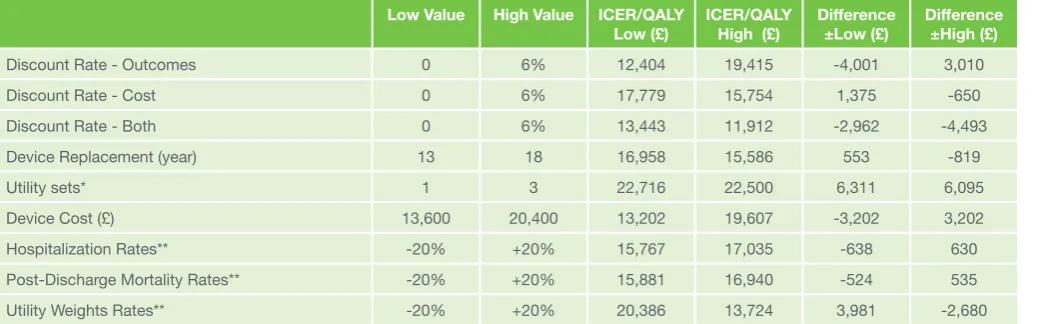
Table 5: One way sensitivity analysis
Low Value High Value ICER/QALY
Low (£) ICER/QALY High (£) Difference ±Low (£) Difference ±High (£)
Discount Rate - Outcomes 0 6% 12,404 19,415 -4,001 3,010
Discount Rate - Cost 0 6% 17,779 15,754 1,375 -650
Discount Rate - Both 0 6% 13,443 11,912 -2,962 -4,493
Device Replacement (year) 13 18 16,958 15,586 553 -819
Utility sets* 1 3 22,716 22,500 6,311 6,095
Device Cost (£) 13,600 20,400 13,202 19,607 -3,202 3,202
Hospitalization Rates** -20% +20% 15,767 17,035 -638 630
Post-Discharge Mortality Rates** -20% +20% 15,881 16,940 -524 535
Utility Weights Rates** -20% +20% 20,386 13,724 3,981 -2,680
All hospitalized patients - independently of whether they survive or die in hospital - assume a corresponding hospitalization cost. For survivors, it is assumed based on data from National Schedule of Reference Costs30, that 20% of cases are
more complex. Particularly in relation to those dying during hospitalization, the cost tariff related to HF hospitalization with complications is applied from the National Schedule of Reference Costs30. Patients who move to NYHA class IV
due to worsening health status are associated with a cost of hospitalization.
According to evidence from the Personal Social Services Research Unit31 the cost per HF decedent is significant and is
mainly associated emergency. The cost per HF descendent from the aforementioned study is utilized for those dying from HF in general without hospitalization. This is particularly relevant for the case of the patient group under evaluation, who are not dying from sudden cardiac death but because of worsening heart status.
From the last National HF audit there are data on the services used on an outpatient basis to manage HF patients and these are used here25. These are deemed relevant as the great
majority of patients upon the which the audit reports data are at the NYHA class II and IV. The unit costs of these services are taken from the Personal Social Services Research Unit31.
Two visits are assumed per year except for rehabilitation were a single course is assumed.
For device complications tariffs from the National Schedule of Reference Costs are used30. In particular for surgical
complications it is assumed that on average the cost is that corresponding to surgical complications with intermediate risk. For the cost of lead displacement it is assumed a new lead and two days of hospital stay. For infections the cost of managing infections is used. For the cost of device related events the cost of Heart Failure or Shock without complications is assumed. In the CCM trials so far post implantation complications did not require explantation and implantation of new device and hence such an event was not accounted for.
Analytical Aspects
The main outcomes of the model concern the mean total therapy cost, life years and quality adjusted life years (QALYs) for each therapy option. Incremental results are used to evaluate the cost-effectiveness of the device arm. One-way sensitivity analysis is used to test the impact of individual variables on the results. Moreover, the model has been designed to quantify uncertainty probabilistically. Monte Carlo simulation is used to generate distributions of total costs and QALYs, which are then utilized to construct cost-effectiveness acceptability curves (CEACs), which show the probability of each therapy being optimal given a particular threshold value for cost-effectiveness. The predictions of the model are compared to the actual figures attained from an observational CCM study to assess its predictive ability an reliability.
Results
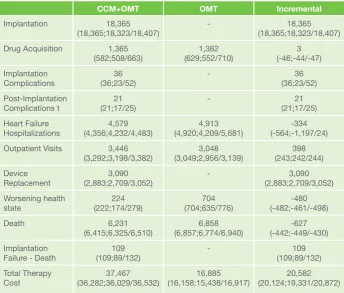
The total mean life-time cost (discounted) of therapy is £37,467 in the CCM+OMT arm and £16,885 in the OMT arm (Table 3). As expected, the cost in the CCM+OMT arm is driven by the cost of the device and its replacements. Moreover, despite improvements in their health status, because patients with the device are predicted to live longer, overall they are also associated with higher cost for outpatient care and hospitalizations. Moreover, as shown in Table 4, patients in
the OMT arm are expected to have 7.00 LYs and 4.00 QALYs, where as those on CCM+OMT 7.96 and 5.26 respectively. Hence, patients in the CCM+OMT arm gain 0.96 LYs and 1.25 QALYs. The incremental cost per QALY is £16,405 and the incremental cost per LY £21,415. The results of stochastic analysis are somewhat higher with a cost per QALY at £19,683 and the incremental cost per LY at £36,057, due to extreme values in some of the simulations.
One-way sensitivity analysis is presented in Table 5. For simplicity reasons, only the variables with significant impact (> £500) in the ICER per QALY are presented. The most important parameters in the analysis include: the utility weights, the discounting rate, the device replacement rate, the overall mortality rates, the post discharge mortality rates, the hospitalization rates and the device cost. Nonetheless, notably most of them have marginal impact and only utilities affect significantly the results, however the maximum impact is £6,311 and the corresponding incremental cost per QALY raised at £22,716.The cost effectiveness acceptability curve is depicted in Figure 2. It is seen the at £30,000 per QALY the likelihood of CCM+OMT being cost-effective is 99.8% and at £25,000 per QALY 97%.
Discussion
Based on a modeling approach, and the assumption that long term improved pVO2 and NYHA class will lead to improved survival, the present analysis has given a strong indication that the use of CCM is likely to improve survival and patient quality of life. In the UK technologies are adopted when they fall below thresholds of about £20,000 to £30,000 per QALY. In a recent guidance (http://www.nice.org.uk/guidance/ta314) NICE issued a positive recommendation for use of ICDs and CRTs devices whose ICERs relative to OMT were in line with those obtained here. Thus, CCM therapy may be also considered cost-effective from different perspectives. Nonetheless, conclusions should be viewed in the light of the inevitable caveats of economic studies as the present one, which synthesize data from many different sources under various assumptions, which need to be thoroughly justified and assessed in terms of their impact.
When a technology is in its first stages of development and evaluation, long term comparative data are not always available and decisions need to be made based on extrapolation from intermediate end points. This approach was inevitable here as randomized controlled trials have not been designed to collect long term data on hospitalization, quality of life and mortality rates associated with CCM relative to OMT. Hence, the intermediate end points observed in the trials were utilized to predict long terms outcomes. In particular NYHA status is used to obtain hospitalization and mortality rates and hence improved survival and hospitalization rates are modeled on the assumption of improved patient pVO2 and NYHA class status, which has been seen not to be the case in certain interventions, such as for instance positive inotropic agents. Also quality of life has been modeled on the assumption of improved performance on the MLWHFQ. Nonetheless, a recent review of economic models in HF has indicated that quite often this is the chosen approach to economic modeling for several new pharmaceuticals and medical devices in HF patients32. This is because whilst NYHA class classification
and hospitalization24, 28, 34-37, 40, 43-47 rates and it is not a surprise
therefore that there are a few heart failure economic studies in the literature, where NYHA class is used to model disease progression in a similar way48-55. In this light it should be noted
that NYHA assessment is the CCM studies was long enough to exclude transient placebo impacts due to the subjective assessment and the effect in this parameter is sustained throughout a year, so the reliance on the NYHA assessment seems proper and valid.
Additionally, CCM clinical studies show an improvement in pVO2 which in the literature has been shown to be associated and to predict outcomes such as hospitalizations, mortality and quality of life in heart failure patients56-65. In particular, a recent
study has shown that even modest improvements in pVO2 levels are leading to better health status and hospitalization and mortality rates60. Thus, in light of the benefit of CCM in
this parameter, one may reasonably assume that this therapy arm will be associated with better survival and hospitalization rates. Moreover, better quality of life has also been shown to predict hard health outcomes like death and hospitalizations. A recent study showed that a 10 point decrement in the MLWHFQ was associated with a 23%-36% change in the risk of death or hospitalization for HF and hence it was recommended that quality of life is a predictor of survival and hospitalizations61.
Hence for all three intermediate outcomes for which CCM trials have shown an improvement there is evidence that their improvement leads to hospitalization and mortality benefits. Also QoL was measured using a mapping approach, however three different methods were applied to deal with uncertainty. It is worth noting that according to a recent observational study which followed 81 CCM patients for sometime66 the first year
mortality in the CCM+OMT arm was 29.5% whilst the one predicted by MAGGIC was 40.0%, yielding a relative risk of 0.74 for CCM+OMT relative to OMT alone. At 3 years the present modes for its population predicts 25% mortality for the OMT arm and 19.5% for the CCM+OMT arm yielding a relative risk of 0.78. Hence, the mortality benefit predicted by the model is similar in relative terms to that obtained in an observational setting.
It should be noted this study addresses only direct costs. However, there are indirect costs also involved, but due to the perspective adopted economic benefits in this area were not considered. In addition, it needs to be considered that the results presented here reflect a subgroup of patients and it is hard to extrapolate them more broadly. In any case modeling cannot replace log terms well designed studies with hard end points. These areas could be considered for further research. Any future trials must be of sufficient size to ensure statistical power and should collect information on long term hard outcomes such as mortality and hospitalization rates.
The use of CCM therapy in the NHS is not expected to have significant training and resource implications for the NHS. It is assumed that operators and the conditions of usage will be as those in the RCTs. If CCM were to be recommended as standard practice, further insight is required whether operators perform interventions as assumed here, that is as easily as other standard procedures, even though one may argue that operators implanting CRT devices will find this application easier. Finally, an assumption was made about the lifetime of the battery, based on best available evidence from the manufacturer and implantations so far and this assumption needs to be verified with real data.
In conclusion, the clinical effectiveness evidence available to
date is fairly consistent in pointing out that CCM therapy leads to improved quality of life and exercise capacity according to several metrics. The evidence is strongest for implantation in heart failure NYHA III patients with LVEF between 25-45%. No published evidence addressing the costs or cost-effectiveness of CCM therapy has been published in the literature. A Markov decision model was used thus to analyze its cost-effectiveness. This model was populated using RCT effectiveness data, evidence from the literature, expert opinion and UK cost data. The analysis provides evidence that the use of CCM may promote survival and quality of life and is cost effective compared to optimal medical therapy alone. These conclusions are based on several assumptions and data hence they should be viewed in their light. At this stage modeling was the best available approach to assess cost effectiveness given the lack of long term hospitalization and mortality data and clinical trials should be undertaken to provide this missing evidence.
Acknowledgments
The authors are grateful to Peter Davey for reviewing the model and its methods. The authors state that they adhere to the statement of ethical publishing of the International Cardiovascular Forum Journal.67
Conflict of interest:
RKS has received speaker honoraria and/or research grants from Boston Scientific, Medtronic, Biotronik, St Jude and Servier; AJSC has received honoraria and lecture fees from Impulse Dynamics; NM has received speaker honoraria and/or research grants from Johnson and Johnson, St Jude, Servier, Impulse Dynamics, Bayer, Novartis, Aventis, Amgen, Pfizer, Baxter, Roche, and Actelion.
Address for correspondence:
Prof. Nikos ManiadakisHealth Services Organisation & Management National School of Public Health
196 Alexandras Avenue 115 21 Athens, Greece Tel: +30 213 201 01 88 Fax: +30 210 643 39 80 Sec: +30 213 201 01 95 Mob: +30 694 523 77 16
E-mail: [email protected]
References
1. McMurray, J.J., et al., ESC Guidelines for the diagnosis and treatment of acute and chronic heart failure 2012: The Task Force for the Diagnosis and Treatment of Acute and Chronic Heart Failure 2012 of the European Society of Cardiology. Developed in collaboration with the Heart Failure Association (HFA) of the ESC. Eur Heart J, 2012. 33(14): p. 1787-847. doi: 10.1093/eurjhf/hfs105.
2. (NICE), Chronic heart failure: the management of chronic heart failure in adults in primary and secondary care. . NICE Clinical Guidance No 108. 2010., 2010. London: National Clinical Guideline Centre. Available from: http://guidance.nice.org.uk/CG108/Guidance/pdf/English.
3. Lindenfeld, J., et al., HFSA 2010 Comprehensive Heart Failure Practice Guideline. J Card Fail, 2010. 16(6): p. e1-194. doi: 10.1016/j. cardfail.2010.04.004
4. Bleumink, G.S., et al., Quantifying the heart failure epidemic: prevalence, incidence rate, lifetime risk and prognosis of heart failure The Rotterdam Study. Eur Heart J, 2004. 25(18): p. 1614-9. DOI: http://dx.doi. org/10.1016/j.ehj.2004.06.038
5. Bundkirchen, A. and R.H. Schwinger, Epidemiology and economic burden of chronic heart failure European Heart Journal Supplements 2004. 6(Supplement D): p. 57-60. DOI: http://dx.doi.org/10.1016/j. ehjsup.2004.05.015
7. Braunschweig, F., M.R. Cowie, and A. Auricchio, What are the costs of heart failure? Europace, 2011. 13 Suppl 2: p. ii13-7. DOI: http://dx.doi. org/10.1093/europace/eup304
8. Komajda, M., et al., The EuroHeart Failure Survey programme--a survey on the quality of care among patients with heart failure in Europe. Part 2: treatment. Eur Heart J, 2003. 24(5): p. 464-74. DOI: http://dx.doi. org/10.1016/S0195-668X(02)00700-5
9. Cleland, J.G., et al., The EuroHeart Failure survey programme-- a survey on the quality of care among patients with heart failure in Europe. Part 1: patient characteristics and diagnosis. Eur Heart J, 2003. 24(5): p. 442-63. DOI: http://dx.doi.org/10.1016/S0195-668X(02)00823-0
10. Maggioni, A.P., et al., Are hospitalized or ambulatory patients with heart failure treated in accordance with European Society of Cardiology guidelines? Evidence from 12,440 patients of the ESC Heart Failure Long-Term Registry. Eur J Heart Fail, 2013. 15(10): p. 1173-84. doi: 10.1093/ eurjhf/hft134
11. Beshai, J.F., et al., Cardiac-resynchronization therapy in heart failure with narrow QRS complexes. N Engl J Med, 2007. 357(24): p. 2461-71. DOI: 10.1056/NEJMoa0706695
12. Ruschitzka, F., et al., Cardiac-resynchronization therapy in heart failure with a narrow QRS complex. N Engl J Med, 2013. 369(15): p. 1395-405. doi: 10.1056/NEJMoa1306687
13. Borggrefe, M. and D. Burkhoff, Clinical effects of cardiac contractility modulation (CCM) as a treatment for chronic heart failure. Eur J Heart Fail, 2012. 14(7): p. 703-12. doi: 10.1093/eurjhf/hfs078
14. Kuck, K.H., et al., New devices in heart failure: an European Heart Rhythm Association report: developed by the European Heart Rhythm Association; endorsed by the Heart Failure Association. Europace, 2014. 16(1): p. 109-28. doi: 10.1093/europace/eut311
15. Winter, J., K.E. Brack, and G.A. Ng, Cardiac contractility modulation in the treatment of heart failure: initial results and unanswered questions. Eur J Heart Fail, 2011. 13(7): p. 700-10. doi: 10.1093/eurjhf/hfr042
16. Borggrefe, M.M., et al., Randomized, double blind study of non-excitatory, cardiac contractility modulation electrical impulses for symptomatic heart failure. Eur Heart J, 2008. 29(8): p. 1019-28. doi: 10.1093/eurheartj/ehn020 17. Neelagaru, S.B., et al., Nonexcitatory, cardiac contractility modulation
electrical impulses: feasibility study for advanced heart failure in patients with normal QRS duration. Heart Rhythm, 2006. 3(10): p. 1140-7. DOI: http://dx.doi.org/10.1016/j.hrthm.2006.06.031
18. Kadish, A., et al., A randomized controlled trial evaluating the safety and efficacy of cardiac contractility modulation in advanced heart failure. Am Heart J, 2011. 161(2): p. 329-337 e1-2. doi: 10.1016/j.ahj.2010.10.025 19. Giallauria, F., et al., Effects of cardiac contractility modulation by
non-excitatory electrical stimulation on exercise capacity and quality of life: an individual patient’s data meta-analysis of randomized controlled trials. Int J Cardiol, 2014. 175(2): p. 352-7. doi: 10.1016/j.ijcard.2014.06.005 20. Kwong, J.S., J.E. Sanderson, and C.M. Yu, Cardiac contractility
modulation for heart failure: a meta-analysis of randomized controlled trials. Pacing Clin Electrophysiol, 2012. 35(9): p. 1111-8. doi: 10.1111/j.1540-8159.2012.03449.x
21. Abraham, W.T., et al., Subgroup analysis of a randomized controlled trial evaluating the safety and efficacy of cardiac contractility modulation in advanced heart failure. J Card Fail, 2011. 17(9): p. 710-7. doi: 10.1016/j. cardfail.2011.05.006
22. Levy, W.C., et al., The Seattle Heart Failure Model: prediction of survival in heart failure. Circulation, 2006. 113(11): p. 1424-33. DOI: 10.1161/ CIRCULATIONAHA.105.584102
23. Mozaffarian, D., et al., Prediction of mode of death in heart failure: the Seattle Heart Failure Model. Circulation, 2007. 116(4): p. 392-8. DOI: 10.1161/CIRCULATIONAHA.106.687103
24. Ahmed, A., W.S. Aronow, and J.L. Fleg, Higher New York Heart
Association classes and increased mortality and hospitalization in patients with heart failure and preserved left ventricular function. Am Heart J, 2006. 151(2): p. 444-50. DOI: http://dx.doi.org/10.1016/j.ahj.2005.03.066 25. Cleland J., D.H., Hardman S., McDonagh T., Mitchell P., National Heart
Failure Audit, April 2012 - March 2013. NICOR (National Institute for Cardiovascular Outcomes Research) and The British Society for Heart Failure (BSH), 2013(http://www.ucl.ac.uk/nicor/audits/heartfailure/). 26. Schau, T., et al., Long-term outcome of cardiac contractility modulation in
patients with severe congestive heart failure. Europace, 2011. 13(10): p. 1436-44. doi: 10.1093/europace/eur153
27. Fox, M., et al., The clinical effectiveness and cost-effectiveness of cardiac resynchronisation (biventricular pacing) for heart failure: systematic review and economic model. Health Technol Assess, 2007. 11(47): p. iii-iv, ix-248. DOI: http://dx.doi.org/10.3310/hta11470
28. Calvert, M.J., N. Freemantle, and J.G. Cleland, The impact of chronic heart failure on health-related quality of life data acquired in the baseline phase of the CARE-HF study. Eur J Heart Fail, 2005. 7(2): p. 243-51. Eur J Heart Fail, 2005. 7(2): p. 243-51
29. Griffiths, A., et al., The cost effectiveness of ivabradine in the treatment of chronic heart failure from the U.K. National Health Service perspective. Heart, 2014. 100(13): p. 1031-6. doi: 10.1136/heartjnl-2013-304598
30. NHS, National Schedule of Reference Costs Year : 2010-11 - NHS Trusts HRG Data. 2014.
31. Unit Costs of Health and Social Care 2013. Personal Social Services Research Unit, Cornwallis Building, The University of Kent, Canterbury, Kent CT2 7NF.
32. Goehler, A., et al., Decision-analytic models to simulate health outcomes and costs in heart failure: a systematic review. Pharmacoeconomics, 2011. 29(9): p. 753-69. doi: 10.2165/11585990-000000000-00000 33. Rolandi, E., et al., Long-term therapy of chronic congestive heart failure
with ibopamine: a multicenter trial. J Cardiovasc Pharmacol, 1989. 14 Suppl 8: p. S93-103.
34. Ahmed, A., W.S. Aronow, and J.L. Fleg, Predictors of mortality and hospitalization in women with heart failure in the Digitalis Investigation Group trial. Am J Ther, 2006. 13(4): p. 325-31.
35. Ahmed, A., A propensity matched study of New York Heart Association class and natural history end points in heart failure. Am J Cardiol, 2007. 99(4): p. 549-53. DOI: http://dx.doi.org/10.1016/j.amjcard.2006.08.065 36. Ahmed, A., et al., A propensity-matched study of the effects of chronic
diuretic therapy on mortality and hospitalization in older adults with heart failure. Int J Cardiol, 2008. 125(2): p. 246-53. DOI: http://dx.doi. org/10.1016/j.ijcard.2007.05.032
37. Borer, J.S., et al., Efficacy and safety of ivabradine in patients with severe chronic systolic heart failure (from the SHIFT study). Am J Cardiol, 2014. 113(3): p. 497-503. doi: 10.1016/j.amjcard.2013.10.033
38. Muntwyler, J., et al., One-year mortality among unselected outpatients with heart failure. Eur Heart J, 2002. 23(23): p. 1861-6. doi:10.1053/ euhj.2002.3282
39. Bouvy, M.L., et al., Predicting mortality in patients with heart failure: a pragmatic approach. Heart, 2003. 89(6): p. 605-9. doi:10.1136/ heart.89.6.605
40. Gheorghiade, M., et al., Effect of oral digoxin in high-risk heart failure patients: a pre-specified subgroup analysis of the DIG trial. Eur J Heart Fail, 2013. 15(5): p. 551-9. DOI: 10.1093/eurjhf/hft010
41. Lindenfeld, J., et al., Effects of cardiac resynchronization therapy with or without a defibrillator on survival and hospitalizations in patients with New York Heart Association class IV heart failure. Circulation, 2007. 115(2): p. 204-12. DOI: 10.1161/CIRCULATIONAHA.106.629261
42. Pocock, S.J., et al., Predicting survival in heart failure: a risk score based on 39 372 patients from 30 studies. Eur Heart J, 2013. 34(19): p. 1404-13. doi: 10.1093/eurheartj/ehs337
43. Cowie, M.R., et al., Survival of patients with a new diagnosis of heart failure: a population based study. Heart, 2000. 83(5): p. 505-10. doi:10.1136/heart.83.5.505
44. Cowie, M.R., et al., Hospitalization of patients with heart failure: a population-based study. Eur Heart J, 2002. 23(11): p. 877-85. doi:10.1053/ euhj.2001.2973
45. Cleland, J.G., et al., Effects of cardiac resynchronization therapy on long-term quality of life: an analysis from the CArdiac Resynchronisation-Heart Failure (CARE-HF) study. Am Resynchronisation-Heart J, 2009. 157(3): p. 457-66. doi: 10.1016/j.ahj.2008.11.006
46. Anand, I.S., et al., Cardiac resynchronization therapy reduces the risk of hospitalizations in patients with advanced heart failure: results from the Comparison of Medical Therapy, Pacing and Defibrillation in Heart Failure (COMPANION) trial. Circulation, 2009. 119(7): p. 969-77. doi: 10.1161/ CIRCULATIONAHA.108.793273
47. Ouwerkerk, W., A.A. Voors, and A.H. Zwinderman, Factors Influencing the Predictive Power of Models for Predicting Mortality and/or Heart Failure Hospitalization in Patients With Heart Failure. JACC Heart Fail, 2014. 2(5): p. 429-436. doi:10.1016/j.jchf.2014.04.006
48. van Hout, B.A., et al., Effects of ACE inhibitors on heart failure in The Netherlands: a pharmacoeconomic model. Pharmacoeconomics, 1993. 3(5): p. 387-97.
49. Glick, H.A., et al., Economic evaluation of the randomized aldactone evaluation study (RALES): treatment of patients with severe heart failure. Cardiovasc Drugs Ther, 2002. 16(1): p. 53-9.
50. Glick, H., et al., Costs and effects of enalapril therapy in patients with symptomatic heart failure: an economic analysis of the Studies of Left Ventricular Dysfunction (SOLVD) Treatment Trial. J Card Fail, 1995. 1(5): p. 371-80.
51. Cook, J.R., et al., The cost and cardioprotective effects of enalapril in hypertensive patients with left ventricular dysfunction. Am J Hypertens, 1998. 11(12): p. 1433-41.
52. Yao, G., et al., The long-term cost-effectiveness of cardiac
resynchronization therapy with or without an implantable cardioverter-defibrillator. Eur Heart J, 2007. 28(1): p. 42-51. DOI: http://dx.doi. org/10.1093/eurheartj/ehl382
53. Miller, G., et al., Long-term cost-effectiveness of disease management in systolic heart failure. Med Decis Making, 2009. 29(3): p. 325-33. doi: 10.1177/ 0272989X08327494
55. Banz, K., Cardiac resynchronization therapy (CRT) in heart failure--a model to assess the economic value of this new medical technology. Value Health, 2005. 8(2): p. 128-39. DOI: 10.1111/j.1524-4733.2005.03092.x 56. Francis, D.P., et al., Cardiopulmonary exercise testing for prognosis in chronic heart failure: continuous and independent prognostic value from VE/VCO(2)slope and peak VO(2). Eur Heart J, 2000. 21(2): p. 154-61. DOI: http://dx.doi.org/10.1053/euhj.1999.1863
57. Myers, J., et al., Validation of a cardiopulmonary exercise test score in heart failure. Circ Heart Fail, 2013. 6(2): p. 211-8. DOI: 10.1161/ CIRCHEARTFAILURE.112.000073
58. Flynn, K.E., et al., Effects of exercise training on health status in patients with chronic heart failure: HF-ACTION randomized controlled trial. JAMA, 2009. 301(14): p. 1451-9. doi: 10.1001/jama.2009.457
59. Blumenthal, J.A., et al., Effects of exercise training on depressive symptoms in patients with chronic heart failure: the HF-ACTION randomized trial. JAMA, 2012. 308(5): p. 465-74. doi:10.1001/ jama.2012.8720
60. Swank, A.M., et al., Modest increase in peak VO2 is related to better clinical outcomes in chronic heart failure patients: results from heart failure and a controlled trial to investigate outcomes of exercise training. Circ Heart Fail, 2012. 5(5): p. 579-85. DOI: 10.1161/ CIRCHEARTFAILURE.111.965186
61. Alla, F., et al., Self-rating of quality of life provides additional prognostic information in heart failure. Insights into the EPICAL study. Eur J Heart Fail, 2002. 4(3): p. 337-43.
62. Ingle, L., et al., Development of a composite model derived from cardiopulmonary exercise tests to predict mortality risk in patients with mild-to-moderate heart failure. Heart, 2014. 100(10): p. 781-6. doi: 10.1136/heartjnl-2013-304614
63. Ingle, L., J.G. Cleland, and A.L. Clark, The long-term prognostic significance of 6-minute walk test distance in patients with chronic heart failure. Biomed Res Int, 2014. 2014: Article ID: 505969. http://dx.doi. org/10.1155/2014/505969
64. Arena, R., et al., Influence of subject effort on the prognostic value of peak VO2 and the VE/VCO2 slope in patients with heart failure. J Cardiopulm Rehabil, 2004. 24(5): p. 317-20. DOI: 10.1097/00008483-200409000-00006
65. Arena, R., et al., Peak VO2 and VE/VCO2 slope in patients with heart failure: a prognostic comparison. Am Heart J, 2004. 147(2): p. 354-60. DOI: http://dx.doi.org/10.1016/j.ahj.2003.07.014
66. Kuschyk J, Roeger S, Schneider R, et al. Efficacy and survival in
patients with cardiac contractility modulation: Long-term single
center experience in 81 patients. Int J Cardiol. 2015;183C:76-81.
DOI: 10.1016/j.ijcard.2014.12.178