Extraction of UO2 with complexone derivatives of 8-hydroxyquinoline Section E-Research Paper
NEW COMPLEXONE DERIVATIVES OF
8-HYDROXY-QUINOLINE AND THEIRS APPLICATION IN UO
22+
EXTRACTION
Fatiha Zaoui,
[a]Didier Villemin,
[b]Nathalie Bar
[b]and Mohamed Amine Didi
[a]*
Keywords: Multicomponent Mannich reactions; microwave irradiation; 7-(alkylaminomethyl)quinolin-8-ol type complexones;
uranyl-ion extracturanyl-ion; 7-(dioctylaminomethyl)quinolin-8-ol.
New complexone derivatives of 8-hydroxyquinoline (quinolinol) were synthesized by the Mannich reaction from secondary and primary amines. Our syntheses were carried out either at room temperature, at reflux or under microwave irradiation, in good yields. The use of the 7-(dioctylamino) methyl) quinolin-8-ol (3f) as new extractant for the uptake and removal of UO22+was investigated. Conditions for an
effective sorption were optimized. The total sorption capacity was 102 (mg.g-1) under optimum experimental conditions.
Corresponding Authors Tel: +213552639237 Fax: +21343213198
E-Mail: [email protected]; [email protected] [a] Laboratoire des Technologies de Séparation et de
Purification, Département de chimie, Faculté des Sciences, Université de Tlemcen, BP119, Algeria
[b] Ecole Nationale Supérieure des Ingénieurs de CAEN & Centre de Recherche, Université de Normandie, LCMT, UMR CNRS 6507, Labex EMC3, Labex SynOrg, F-14050, Caen, France.
Introduction
Complexones according to Schwarzenbach definition are small chelating agents able to form chelate with metal
ions.1,2 One of the most well known examples of
complexone is ethylenediaminetetraacetic acid (EDTA).3 It
was used for the chelation of metallic ions in analytical chemistry and as antioxidative compound. More generally, complexones present many applications in analytical chemistry and are also used in prevention of action of metallic ions as stabilising, anti-oxidative product.
8-Hydroxyquinoline (1) (8-HQ or quinolinol) is a
non-specific ligand chelating a large variety of metal ions.4,5
8-Hydroxyquinoline is able to chelate essential metallic ions for metabolism of bacteria and fungi, so 8-HQ derivatives are used as antibacterial and antifungal. 8-HQ complexes of Zn or Mn can be also used for such applications.6
Polymer containing 8-HQ group have been described as
chelating polymers.7 Generally these polymers were
obtained by a Beckland reaction of 8-HQ with formaldehyde. Such chelating polymer derivatives can be used in hydrometallurgy for the extraction of metals, such as iron, copper, nickel and uranium.8
Recently, metal complexes of 8-hydroxyquinolines were used in supramolecular chemistry as luminescent or fluorescent solids.9 We are interested in the synthesis of new
chelating molecules possessing 8-hydroxyquinoline group
for the metal extraction8 and as precursor of new
luminescent complexes.10,11
As application, we suggested applying the compound 3f as
an extracting agent for the uptake and removal of the uranyl ion, using liquid-liquid extraction.
Experimental
All commercial reagents were purchased from Agfa or Aldrich, and were used as received without further purification. Reaction times were monitored by TLC until no starting material remained. TLC was performed using Silica gel 60 F254 precoated aluminium sheets. 1H and 13C
NMR spectra are recorded on a Bruker AC 400 spectrometers. Mass spectra were recorded on a QTOF Micro (Waters) spectrometer with electrospray ionization (ESI, positive mode), lockspray orthophosphoric acid, infusion introduction at 10 μL min-1, a source temperature of
80°C and desolvation temperature of 120°C. Molecular modelisation and energy minimisations were performed with MP3 using Spartan Software. Microwave irradiations were performed at 2450 MHz with a Synthewave 402 oven (Prolabo). Analytik Jena SPECORD 210 Double Beam UV-VIS was used for spectra recording and absorbance measurements. Spectra were recorded in the range from 400 to 800 nm with 0.2 nm resolution in 10 mm quartz cells. Data were processed with WinLab software.
pH measurements for all solutions were taken on a potentiometer Consort C831, with combined glass electrode, that was calibrated with pH 4.00, 7.00 and 10.00 buffer standards.
7-(morpholinomethyl)quinolin-8-ol (3a, C14H16N2O2)
Extraction of UO2 with complexone derivatives of 8-hydroxyquinoline Section E-Research Paper
ethanol. The resulting mixture was stirred overnight (12 h) at room temperature (20 °C). After evaporation under vacuum, an orange viscous liquid was obtained. Yield: 4.73 g (97 %); mp=66 °C (ethanol-water) (lit: mp=66 °C);141H
NMR (400 MHz, CDCl3): = 2.67 (m, 4H, NCH2CH2), 3.76
(m, 4H, CH2O), 3.88 (s, 2H, NCH2), 7.27 (s, 2H, H5 and
H6), 7.38 (dd, 1H, J=4.2 Hz and J=8.4 Hz, H3), 8.07 (dd, 1H,
J=1.2 Hz and J=8.4 Hz, H4), 8.85 (dd, 1H, J=1.2 Hz and
J=4.2 Hz, H2) ppm; 13C NMR (CDCl3, 100.6 MHz) = 152.8,
149.0, 148.7, 139.2, 135.8, 128.5, 128.1, 121.4, 117.7, 67.0, 60.1, 53.3 ppm. The NMR spectra were identical to the litterature.14
7-(thiomorpholinomethyl)quinolin- 8-ol (3b, C14H16N2OS)
Thiomorpholine (2.08 mL, 20 mmol) and aqueous solution of formaldehyde (37 %, 1.2 mL) was added to 8-hydroxyquinoline (2.90 g, 20 mmol) dissolved in 35 mL of EtOH. The resulting mixture was stirred 12 h at room temperature. After evaporation under vacuum, a yellow viscous liquid was obtained 5.14 g (99 %). 1H NMR (400
MHz, CDCl3): = 2.82-2.83 (m, 4H,SCH2CH2), 2.94-2.95
(m, 4H, NCH2CH2), 3.95 (s, 2H, NCH2Ar), 7.31 (s, 2H, H5
and H6), 7.39 (dd, 1H, J=4.2 Hz and J=8.4 Hz, H3), 8.11 (dd,
1H, J=1.6 Hz and J=8.4 Hz, H4), 8.88 (d, 1H, J=1.6Hz and
J=4.2 Hz, H2) ppm ; 13C NMR (CDCl3, 100.6 MHz) =
152.7, 148.9, 139.1, 135.7, 128.4, 127.9, 121.4, 117.7, 117.6, 60.8, 54.7, 28.1 ppm; IR (neat): = 3354, 2921, 2791, 1503,
1454, 1365, 1283 cm-1; MS (m/z) %: 261 (70 M+H),
158(100); ESI-HRMS calcd for C14H17N2OS 261.1062,
found 261.1069.
7,7’-(piperazine-1,4-diylbis(methylene))diquinolin-8-ol (3c, C24H24N4O2)
Piperazine (0.86 g, 10 mmol) and aqueous solution of formaldehyde (37 %, 2.7 mL) were added to 8-hydroxyquinoline (2.90 g, 20 mmol) dissolved in 35 mL of EtOH. The resulting mixture was stirred overnight (12 h) at room temperature (20 °C). A yellow precipitate was observed; after filtration, it was washed with diethyl ether (25 mL) to give the product namely (3c) as a yellow solid,
2.48 g (62 %). m.p: 204 °C. 1H NMR (400 MHz,
DMSO-d6): = 2.50 (s, 2×4H, NCH2(CH2N)), 3.75 (s, 2×2H,
ArCH2N), 7.36 (d, 2×H, J= 8.4 Hz, H6), 7.47 (d, 2×H, J=8.4
Hz, H5), 7.50 (dd, 2×H, J=4.4 Hz, and J=8.4 Hz, H3), 8.28
(dd, 2×H, J=1.6 Hz and J=8.4 Hz, H4), 8.82 (dd, 2×H, J=1.6
Hz and J=4.4 Hz, H2) ppm; 13C NMR (DMSO-d6, 100.6
MHz) = 151.4, 148.1, 138.2, 135.9, 128.8, 127.6, 121.4, 119.6, 116.9, 56.5, 52.6 ppm ; IR (neat):= 2947, 1504, 1464, 1376 cm-1; MS m/z (%): 401 (40, M+H), 244 (30),
158 (100); ESI-HRMS calcd for C24H25N4O2 401.1978,
found 401.1989.
7,7’-(ethane-1,2-diylbis(methylazanediyl))bis(methylene)diqui-nolin-8-ol (3d, C24H26N4O2)
N,N’-dimethylethylenediamine (0.53 mL, 5 mmol) and
aqueous solution of formaldehyde (37 %, 1 mL) was added to 8-hydroxyquinoline (1.45 g, 10 mmol) dissolved in 20 mL of EtOH. The resulting mixture was stirred and heated at 50 °C for 5 hours. After cooling and evaporation under vacuum, a brown viscous liquid was obtained, which
crystallizes at room temperature, 1.68 g (84 %). Mp= 60 °C (ethanol); 1H NMR (400 MHz, CDCl
3): = 2.36 (s, 2×3H,
NCH3), 2.77 (s, 2×2H, NCH2CH2), 3.86 (s, 2×2H, ArCH2N),
7.21 (d, 2H, J=8.4 Hz, H6), 7.29 (d, 2×H, J=8.4 Hz, H5),
7.36 (dd, 2×H, J=4.2 Hz and J=8.4 Hz, H3), 8.07 (dd, 2H,
J=1.6 Hz and J=8.4 Hz, H4), 8.84 (dd, 2H, J=2.5 Hz and
J=4.2 Hz, H2) ppm; 13C NMR (CDCl3, 100.6 MHz) =
152.7, 148.8, 139.2, 135.8, 128.4, 128.3, 121.4, 118.9, 117.5, 58.6, 54.5, 42.4 ppm ; IR (neat): = 2924, 1501, 1457, 1371, 1271 cm-1; SM: (m/z) %: 403 (80 M+H), 246 (100), 158
(60); ESI-HRMS calcd for C24H27N4O2 403.2134, found
403.2125.
7-((dicyclohexylamino)methyl)quinolin-8-ol) (3e, C22H30N2O)
Dicyclohexylamine (3.98 mL, 20 mmol) and aqueous solution of formaldehyde (37 %, 1.7 mL) was added to 8-hydroxyquinoline (2.90 g, 20 mmol) dissolved in 17 mL of EtOH. The resulting mixture was stirred at 70 °C for 2 hours. After evaporation under vacuum and extraction with diethyl ether (25 mL), a brown viscous liquid is obtained 3.90 g
(58 %). 1H NMR (400 MHz, CDCl
3): = 1.01-1.96 (m, 20
H, 2x(CH2)5), 2.74-2.81 (m, 2×H, NCH), 4.13 (s, 2H,
ArCH2N), 7.13 (d, 1H, J=8.4 Hz, H6), 7.19 (d, 1H, J=8.4 Hz,
H5), 7.33 (dd, 1H, J= 4.4 Hz and J=8.0 Hz, H3), 8.04 (dd, 1H,
J=1.6 Hz and J= 8.0 Hz, H4), 8.86 (dd, 1H, J=1.6 Hz and
J=4.4 Hz, H2) ppm; 13C NMR (CDCl3, 100.6 MHz) = 154.8,
149.0, 139.8, 135.6, 128.3, 126.9, 121.0, 119.5, 116.8, 58.2, 49.9, 30.6, 26.2, 26.1 ppm ; IR (neat): = 3342, 2924, 2850, 1505, 1379, 1278 cm-1; SM (m/z) %: 339 (100 M+H), 182
(40), 158 (10); ESI-HRMS calcd for C22H31N2O 339.2436,
found 339.2433.
7-((dioctylamino)methyl)quinolin-8-ol (3f, C26H42N2O)
Dioctylamine (4,82 g, 20 mmol), and aqueous solution of formaldehyde (37 %, 1.7 mL) were added to 8-hydroxyquinoline (2.90 g, 20 mmol) dissolved in 40 mL of EtOH. 1.3 mL of hydrochloric acid (37%) was added to the mixture. The mixture was heated at 60°C for 6 hours under stirring. After cooling, a precipitate was observed. After filtration and washing with diethyl ether (25 mL), a yellow
solid was obtained 4.61 g (58 %). m.p: 252 °C. 1H
NMR (400 MHz, CDCl3): = 0.75-0.90 (m, 2×3H, CH3),
1.10-1.40 (m, 2x10H, (CH2)5CH3), 1.86-1.90 (m, 2x2H,
NCH2CH2), 2.87-2.89 (m, 2x2H, NCH2), 4.48 (s, 2H,
NCH2Aro or p), 4.56 (s, 2H, NCH2Aro or p), 7.10-7.60 (m,
2x3H, ArHo,p), 8.02-8.18 (m, 2xH, ArHo,p), 8.66-8.80 (m,
2xH, HAro,p) ppm; 13C NMR (CDCl3, 100.6 MHz) = 149.6,
149.3, 139.3, 135.9, 128.0, 126.0, 121.2, 118.7, 118.0, 54.8, 50.5, 31.7, 30.5, 29.8, 28.0, , 27.1, 22.5, 14.0 ppm; IR (cm-1): 3359, 2923, 1504, 1464, 1374; SM (m/z): 399 (30
M+H), 242 (100), 158 (30); ESI-HRMS calcd for C26H43N2O 399.3375, found 399.336. Ratio 60/40.
7-(octylamino) methyl)quinolin-8-ol (3g, C18H26N2O)
N-octylamine (1.65 mL, 10 mmol) and aqueous solution of formaldehyde (37 %, 1.7 mL) was added to 8-hydroxyquinoline (1.45 g, 10 mmol) dissolved in 25 mL of EtOH. The resulting mixture was refluxed for 1 hour. After evaporation under vacuum, a yellow viscous liquid was obtained 2.80 g (98 %). 1H NMR (400 MHz, CDCl
Extraction of UO2 with complexone derivatives of 8-hydroxyquinoline Section E-Research Paper
0.84-0.87 (m, 3H, CH3), 1.17-1.24 (m, 5×2H, (CH2)5CH3),
1.57-1.63 (m, 2H, NCH2CH2), 2.80-2.83 (m, 2H, NCH2CH2),
4.15 (s, 2H, ArCH2N), 7.14 (d, 1H, J=8.4 Hz, H6), 7.31 (d,
1H, J=8.4 Hz, H5), 7.38 (dd, 1H, J=4.2 Hz and J=8.4 Hz, H3),
8.07 (dd, 1H, J=1.6 Hz and J=8.4 Hz, H4) 8.89 (dd, 1H,
J=1.6 Hz and J=4.2 Hz, H2) ppm; 13C NMR (CDCl3,100.6
MHz) = 149.6, 149.3, 139.3, 135.8, 128.0, 126.1, 121.1, 118.7, 118.1, 51.7, 50.5, 31.7, 29.4, 29.2, 28.1, 27.1, 22.5, 14.0 ppm; IR (neat): =3370, 2923, 2852, 1501, 1463, 1371 cm-1; SM (m/z) %: 287 (45 M+H), 158 (100); ESI-HRMS
calcd for C18H27N2O 287.2123, found 287.2135.
Results and Discussion
8-Hydroxyquinoline is a phenol able to react in a reaction of Mannich.12 The reaction of 8-HQ was described with
different aldehydes(Betti reaction13) and some amines.
Scheme 1: Synthesis of 8-hydroxyquinoline derivatives (3) from
secondary amines by Mannich reaction
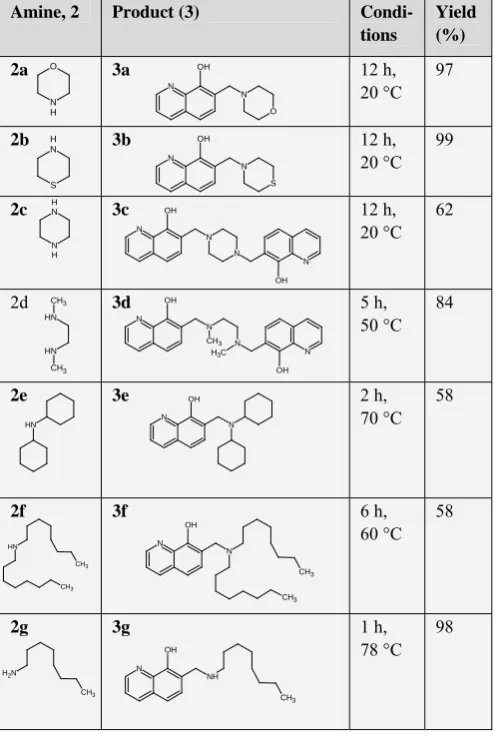
In our work, we have studied the reaction of formaldehyde and different amines in order to obtain molecules with one or two 8-HQ units for the coordination of metal ion. The reaction of morpholine with formaldehyde and 8-hydroxyquinoline was already described and was used as a basis of our work.14
First, we have been interested in using new 8-HQ derivatives as ligand of metals in complexes formation. We have synthesized ligands with a second site of coordination in the molecule (oxygene with morpholine, sulfur with thiomorpholine) or with two HQ units with diamines. The reaction with thiomorpholine introduced a sulfur atom, a soft site of coordination on the ligand according to R.G. Pearson.15,16 With diamine such as piperazine
(2c) a
compound (3c) with two 8-HQ units, is obtained. The
N,N’-1,2-dimethylenediamine (2d) is not so reactive so the
reaction required heating. By comparison by molecular modelisation, the compound (3d) obtained with
N,N’-1,2-dimethylenediamine is more flexible than the preceding one with piperazine.
3d
3c
Scheme 2. Molecular representation of (3c) and (3d).
In a second approach, we were interested in the synthesis of a lipophilic molecule with 8-HQ ligand, such molecule can be used as metal extractant in liquid-liquid extraction process. In this aim, we have used bicyclohexylamine, bisoctylamine and monooctylamine as starting amines.
Table 1. New complexone derivatives of 8-hydroxyquinoline obtained under Mannich conditions.
Amine, 2 Product (3)
Condi-tions
Yield (%)
2a 3a 12 h,
20 °C 97
2b 3b 12 h,
20 °C 99
2c 3c 12 h,
20 °C 62
2d 3d 5 h,
50 °C 84
2e 3e 2 h,
70 °C 58
2f 3f 6 h,
60 °C 58
2g 3g 1 h,
78 °C 98
Under microwave irradiation (10min, 300W) the yield obtained were similar to those obtained under classical conditions. In all the products synthesized by the Mannich reaction, the addition of amine was at the position 7 of 8-hydroxyquinoline. However, in the case of dioctylamine (2f),
two products (substituted in 5 or 7 position) were obtained in a mixture.
We can propose two probable mechanisms: the first involved the attack of the iminium (A) by 8-hydroxyquinoline and the second one the reaction of benzyl cation (B) with amine in this Mannich reaction.
Scheme 3: Mechanism (A).
N OH + HN R' R + N OH N R R' HCHO
1 2 3
N N OH N N OH N N OH N N OH O N H N N O OH N N S OH N H S N H N H N N N OH N OH N H N H CH3 CH3 N N N OH N OH CH3 C H3 N H N N OH N H CH3 CH3 N N OH CH3 CH3 N H2 CH3 N NH OH CH3
H2C O + NR R
H + H H2O + N
R
R H2C (A)
N N
R
H2C R
Extraction of UO2 with complexone derivatives of 8-hydroxyquinoline Section E-Research Paper
Scheme 4. Mechanism (B)
The new compound (3f) was used in the liquid-liquid
extraction of uranyl ion:3f which is soluble in ethyl acetate,
was taken as the organic solvent throughout this study. Equal volumes of organic and aqueous phases (5 mL) were agitated for 30 minutes (enough for equilibrium) at 22 °C under the desired experimental conditions. The two phases were then separated by decantation and assayed by taking known aliquots from the aqueous phases. The concentration
of UO22+ in the sample was determined by Arsenazo(III)
visible spectrophotometric analysis at 650 nm,17 and that in
the organic phase was obtained by subtracting the aqueous concentration from the total initial aqueous concentration of UO22+.
Effect of molar ratio Q
The extraction experiment results are discussed in term of the extraction yield (Y) defined as follows:
(1)
where
mi = initial mass of UO22+ in aqueous phase and
mf = mass of UO22+ after extraction.
The variable Q is the ratio of the number of moles of
ligand in organic phase to the number of moles of metal in aqueous phase before extraction; Q = nligand /nmetal.
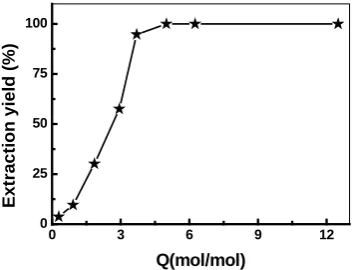
Figure 1. Extraction yield of UO22+ by 3f as a function of Q.
Vorg =5.0 mL, [Ex]=1.0 mmol L-1, Vaq =5 mL, pHi = 0.6, t = 30
min, T =22 °C.
The extraction results of uranyl ion as a function of Q, are reported in Fig.1. We observe that the best performance is achievedforQequal to5.0. For the extractionof one mole of UO22+ in aqueous phase,5.0mol ofextractantin organic phase are required, under the operating conditions listed above.
Effect of initial concentration of UO2 2+
Figure 2 shows thatthe extraction yield of UO22+ extracted
by the 3f increased from 0.0 % to 100.0 % with an increase
in the initial concentration from 0.00 (mol.L-1) to 16.2 ppm,
and thereafter remains constant at 41.59 ppm. At initial concentrations, higher than 41.59 ppm, the extraction yield decreases. With increasing concentrations, the ratio of the available sorption sites of ligand to the initial number of moles of metal ions becomes lower, and hence, the extent of metal removal depends on the initial concentration.
The extraction results of uranyl ions as a function of Q are reported in Fig. 2.
0 200 400 600
0 25 50 75 100
Ex
tr
a
c
ti
o
n
yi
el
d
(%
)
[UO22+], ppm
Figure 2. UO22+extraction yield versus initial molar
UO22+concentration. Vorg = 5.0 mL, [Ex.] = 1.0 mmol L-1, Vaq =5.0
mL, pHi =0.65, t=30 min, T=22 °C
The curve in Figure 2 shows that the extraction is quantitativefordilute solutions of UO22+.
Effect of initial pH
The effect of the initial pH on the extraction yield of UO22+ was studied in the pH range of 0.65 to 1.67 (see
Figure 3). The extraction yield (99.4 %) was found to be higher at pH = 1.13. The extractant is suitable for chelate formation with UO22+ ions, as it has a nitogen atom and an
OH group. As the complex formation is strongly pH dependent, careful adjustment of proper pH was necessary.13
The extraction results of UO22+ ion as a function of pH are
reported in Figure 3.
Figure 3. pH effect on the extraction of UO22+
Vorg = 5.0 ml, [Ex] = 1.0 mmol L-1, Vaq = 5 mL, [UO22+]initial = 60
ppm, t = 30 min, T = 22 °C H2C O +H H2COH
N OH
OH H2C
N OH
N OH
CH2OH CH2 + H2O
H
(B)
N OH
NR R H CH2
i f
i
( )
(%) 100 m m
Y
m
0 3 6 9 12
0 25 50 75 100
Ext
rac
tion y
ield
(%
)
Q(mol/mol)
0,6 0,8 1,0 1,2 1,4 1,6 1,8
40 60 80 100
Ex
tra
c
tion yield
(%)
Extraction of UO2 with complexone derivatives of 8-hydroxyquinoline Section E-Research Paper The negative effect ofpH increase on the extraction yield
can be attributed to the formation, in aqueous phase, of
hydroxide species like UO2(OH)2 and (UO2)6(OH)12, larger and more stable than UO22+ and UO2 (OH)+majority in the more acidic medium.
In conclusion, the Mannich reaction of 8-hydroxyquinoline, formaldehyde and amines allowed a rapid, convenient and easy synthesis of new ligands and new extractants.
The 7-(dioctylaminomethyl)quinolin-8-ol obtained has exhibited high efficiency for the uptake and removal of uranyl ion from water and the recovery was quantitative (100 %).
Acknowledgements
The authors thank Mr Rémy Legay and Mr Baptiste Rigaud for NMR spectra and Mrs Karine Jarsalé for HRMS analysis.
References
1Schwarzenbach, G., Analyst, 1955, 80, 713 and references cited 2Schwarzenbach, G.,
Helv. Chim Acta, 1952, 35, 2344.
3Hart, R. J., Ethylenediaminetetraacetic Acid and Related
Chelating Agents in: Ullmann's Encyclopedia of Industrial Chemistry, Wiley-VCH, Weinheim, 2005.
4Hollingshead, R. G. W.,
Oxine and its Derivatives, Vol. 1-4,
Butterworth, London, 1954.
5Phillips, J. P.,
Chem. Rev., 1956, 56,271.
6Shen, A. Y., Wu, S. N., Chiu, C. T.,
J. Pharm. Pharmacol., 1999, 51, 543.
7Degeiso, R. C., Donaruma, L. G., Tomic, E. A.,
J. Appl. Polym. Sci., 1965, 9, 411.
8Gloe, K., Stephan, H., Krüger, T., Möckel, A., Woller, N.,
Subklew, G., Schwuger, M. J., Neumann, R., Weber, E.,
Progr. Coll. Polym. Sci., 1996, 101, 145.
9Sarmiento, L. E., Rodriguez, M., Echevarria, L., Lubes, V.,
J. Sol. Chem., 2010, 39, 1484.
10Zhigang, Y., Bingxi, W., Guihua, C., Mingjian, Z.,
J. Mater. Sci., 2011, 46, 2397.
11Albrecht, M., Fiege,M., Osetska, O.,
Coord. Chem. Rev., 2008, 252, 812.
12Blicke, F. F.,
The Mannich reaction, in Organic Reactions, 1947,
vol. 1., Chap 10., 303., John Wiley, Chichester:
13Phillips, J. P., Barall, E.,
J. Org. Chem., 1956, 21, 692 and
references cited.
14Albrecht, M., Blau, O.,
Synthesis, 1997, 28, 213.
15Pearson, R. G.,
J. Chem. Educ., 1968, 45, 581.
16Pearson, R. G.,
J. Chem. Educ., 1968, 45, 643.
17Bouhoun-Ali, M., Badjah Hadj Ahmed, A. Y., Attou, M., Elias,
A., Didi, M. A., Solvent Extr. Ion Exch., 2012, 30(5), 469.