KINETIC AND MECHANISTIC STUDIES IN THE OXIDATIVE
REGENERATION OF CARBONYL COMPOUNDS FROM
OXIMES BY BIS[DIPYRIDINESILVER(I)] DICHROMATE
Lokesh Mathur,
[a]Vasudha Ranga,
[a]Garima Goswami,
[a]Saraswati Agarwal
[b]and Pradeep K. Sharma
*[a]Keywords: carbonyl compounds; bis[dipyridinesilver(I)] dichromate, kinetics; mechanism; oxidation; oximes.
The oxidative deoximination of several aldo- and keto-oximes by bis[dipyridinesilver(I)] dichromate (BDSD), in dimethylsulphoxide (DMSO), exhibited a first order dependence on BDSD. A Michaelis-Menten type kinetics was observed with respect to oximes. The oxidation of ketoximes is slower than that of aldoximes. The rates of oxidation of aldoximes correlated well in terms of Pavelich-Taft dual substituent-parameter equation. The low positive value of polar reaction constant indicated a nucleophilic attack by a chromate-oxygen on the carbon. The reaction is subject to steric hindrance by the alkyl groups. The reaction of acetaldoxime has been studied in nineteen different organic solvents. The solvent effect has been analysed by multiparametric equations. A mechanism involving the formation of a cyclic intermediate, in the rate-determining step is suggested.
Corresponding Authors
E-mail: [email protected]
[a] Chemical Kinetics Laboratory, Department of Chemistry, J.N.V. University, Jodhpur, India
[b] Department of Chemistry, Govt. JDB College, Kota (Rajasthan) India
INTRODUCTION
Regeneration of carbonyl compounds from its derivatives under mild conditions is an important process in synthetic organic chemistry. Several oxidative methods are available for deoximation.1 Salts of Cr(VI) have long been used as
oxidizing reagents in synthetic organic chemistry. However, these salts are drastic and non-selective oxidants in nature. Further, they are insoluble in most of the organic solvents also. Thus miscibility is a problem. To overcome these limitations, a large number of organic derivatives of Cr(VI) have been prepared and used in synthetic organic syntheses as mild and selective oxidants in non-aqueous solvents.2
One such compound is bis[dipyridinesilver(I)] dichromate (BDSD) reported by Firouzabadi and co-workers.3 Only a
few reports are available in literature regarding oxidation aspects of BDSD.4-6 It is known that the mode of oxidation
depends on the nature of the counter-ion attached to the chromium anion. Therefore, in continuation of our earlier work,7 we report here the kinetics of the oxidative
deoximation of several aldo- and keto-oximes by BDSD in several organic solvents but mainly in dimethylsulphoxide (DMSO). Mechanistic aspects have also been discussed.
EXPERIMENTAL
Materials
Oximes were prepared by the reported standard methods8
and their mp were checked with the literature values. BDSD also was prepared by the reported method.3 Solvents were
purified by the usual procedure.9
Product Analysis
The oxidation of the oximes results in the regeneration of corresponding carbonyl compounds, as confirmed by TLC (eluent: CCl4/Et2O). Isolation of the product was attempted
in the oxidation of oximes of benzaldehyde and acetophenone.
In a typical experiment, the oxime (0.2 mol) and BDSD (0.02 mol) were dissolved in 50 ml of DMSO and allowed to stand for ca. 10 h for the completion of the reaction. Silica gel (5 g) was then added to the reaction mixture and the mixture was stirred for 15 min.10 It was then filtered and
the solid residue was washed with the solvent (2 15 ml). The solvent was removed on a rotary evaporator and the residue was purified on a silica-gel column (eluent: CCl4/Et2O). Evaporation of the solvent afforded the pure
carbonyl compound. Yields of benzaldehyde and acetophenone were 1.85 g (87.0 %) and 2.13 g (89.0 %) respectively. The presence of HNO2 in completely reduced
reaction mixtures was confirmed by a positive starch-iodide test.11 The oxidation state of chromium in a completely
reduced reaction mixture, as determined by an iodometric method, is 3.900.10.
Kinetics Measurements
The reactions were studied under pseudo-first-order conditions by keeping a large excess ( 10 or greater) of the oxime over BDSD. The solvent was DMSO, unless mentioned otherwise. The reactions were studied at constant temperature (0.1 K). The reactions were followed by monitoring the decrease in the concentration of BDSD at 370 nm spectrophotometrically. The pseudo-first-order rate constant, kobs, was evaluated from the linear least-squares
RESULTS AND DISCUSSION
Stoichiometry
The analysis of products indicated the following overall reaction.
R2C = NOH+Cr2O72- + 10H+
R
2C=O +HNO2 + 5H2O + 2Cr+3 (1)
Rate Laws
The reactions are of first order with respect to BDSD. Further, the pseudo-first order rate constant, kobs is
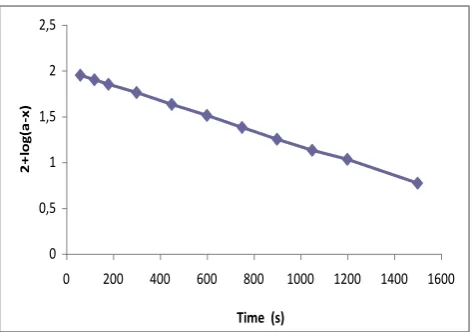
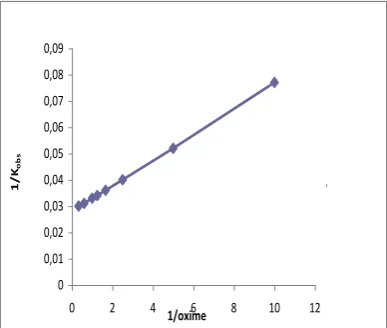
independent of the initial concentration of BDSD. The reaction rate increases with increase in the concentration of the oximes but not linearly (Table 1). The Fig. 1 depicts a typical kinetic run. A plot of 1/kobs against 1/[Oxime]
is linear (r > 0.995) with an intercept on the rate-ordinate. Thus, Michaelis-Menten type kinetics is observed with respect to oximes. This leads to the postulation of following overall mechanism (2) and (3) and rate law (4).
(2)
(3)
(4)
The dependence of kobs on the concentration of oxime was
studied at different temperatures and the values of K and k2
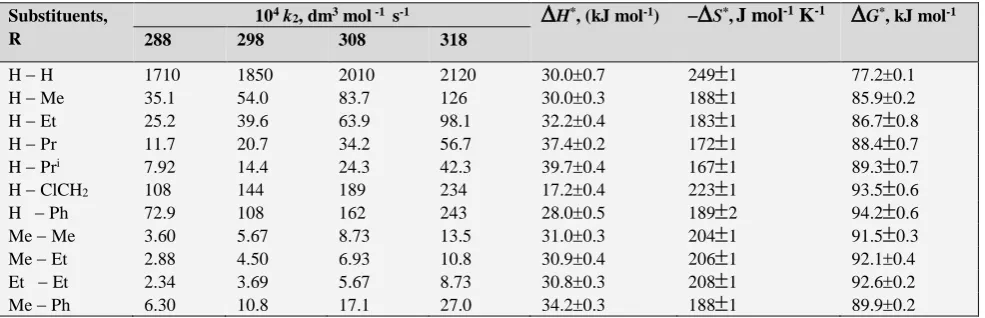
were evaluated from the double reciprocal plots (Fig. 2). The thermodynamic parameters for the complex formation and activation parameters of the disproportionation of the complexes, at 298 K, were calculated from the values of K
and k2 respectively at different temperatures (Tables 2 and
3).
Table 1. Rate constants for the oxidation of acetaldoxime by BDSD at 288 K
103[BDSD], mol dm-3 [Oxime], mol dm-3 104 k obs, s-1
1.00 0.10 12.9
1.00 0.20 18.9
1.00 0.40 24.6
1.00 0.60 27.3
1.00 0.80 28.9
1.00 1.00 30.0
1.00 1.50 31.5
1.00 3.00 33.2
2.00 0.20 25.2
4.00 0.20 23.4
6.00 0.20 25.0
8.00 0.20 24.3
1.00 0.40 24.0
*contained 0.001 mol dm-3 acrylonitrile
Figure 1. Oxidation of acetaldoxime by BDSD: A typical Kinetic Run
Effect of Solvents
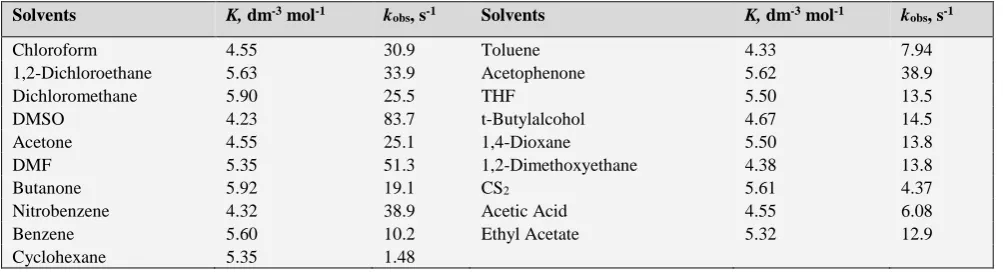
The oxidation of acetaldoxime was studied in nineteen different solvents. The choice of solvents was limited due to the solubility of the reactants and the reaction of BDSD with primary and secondary alcohols. There was no reaction with chosen solvents. The kinetics were similar in all the solvents. The values of k2 are recorded in Table 4.
There is no significant isokinetic relationship between activation entropy and enthalpy of the oxidation of oximes (r2 = 0.4329). A correlation between the calculated values of
enthalpies and entropies of activation is often vitiated by the experimental errors associated with them. Exner12 has
suggested an alternative method of testing the validity of the isokinetic relationship. An Exner’s plot between log k2 at
288 and 318 K was linear (r2 = 0.9985; slope = 0.7198
0.0199) (Fig. 3). The value of isokinetic temperature evaluated from this plot is 43515 K. The linear isokinetic correlation suggests that all the oximes are oxidized by the same mechanism and are governed by the changes in both the enthalpy and entropy of the activation.
A perusal of the data shows that the formation constants do not vary much with the nature of the solvents. However, the rate constants, k2 varied considerably with the solvents.
The rate constants for oxidation, k2, in eighteen solvents
(CS2 was not considered, as the complete range of solvent
parameters was not available) were correlated in terms of the linear solvation energy relationship (Eq.5) of Kamlet et al.13
log k2 = A0 + p* + b + a (5)
In this equation, * represents the solvent polarity, the
hydrogen bond acceptor basicities and is the hydrogen bond donor acidity. A0 is the intercept term. It may be
mentioned here that out of the 18 solvents, 12 have a value of zero for . The results of correlation analyses in terms of Eq. (5), a biparametric equation involving * and , and
separately with * and are given below [Eqs. (6) - (9)].
2
2
Oxime + BDSD Complex
Complex Products
Oxime BDSD Rate =
1 Oxime
K
k
k K
K
0 0,5 1 1,5 2 2,5
0 200 400 600 800 1000 1200 1400 1600
Time (s)
2
+
lo
g
(a
Table 2. Rate constants and activation parameters for the oxidation of BDSD-oximes (R1R2C=N–OH) complexes Substituents,
R
104 k
2, dm3 mol -1 s-1
H*, (kJ mol-1)
S*,J mol-1 K-1
G*, kJ mol-1288 298 308 318
H H 1710 1850 2010 2120 30.00.7 249
1 77.20.1 H Me 35.1 54.0 83.7 126 30.00.3 188
1 85.90.2 H Et 25.2 39.6 63.9 98.1 32.20.4 183
1 86.7
0.8 H Pr 11.7 20.7 34.2 56.7 37.40.2 172
1 88.4
0.7 H Pri 7.92 14.4 24.3 42.3 39.70.4 167
1 89.3
0.7H ClCH2 108 144 189 234 17.20.4 223
1 93.5
0.6H Ph 72.9 108 162 243 28.00.5 189
2 94.2
0.6 Me Me 3.60 5.67 8.73 13.5 31.00.3 204
1 91.5
0.3 Me Et 2.88 4.50 6.93 10.8 30.90.4 206
1 92.10.4 Et Et 2.34 3.69 5.67 8.73 30.80.3 208
1 92.60.2 Me Ph 6.30 10.8 17.1 27.0 34.20.3 188
1 89.90.2log k2 = 3.78 + 1.47(0.18)* + 0.19(0.18) +
0.03(0.14) (6)
R2 = 0.8517; sd = 0.17; n = 18; = 0.42
log k2 = 3.79 + 1.48(0.17)* + 0.18(0.14) (7)
R2 = 0.8511; sd = 0.21; n = 18; = 0.41
log k2 = 3.75 + 1.53(0.17)* (8)
r2 = 0.8351; sd = 0.17; n = 18; = 0.25
log k2 = 2.92 + 0.44(0.32) (9)
r2 = 0.1043; sd = 0.39; n = 18; = 0.97
Here n is the number of data points and is Exner's statistical parameter.14
Kamlet's13 triparametric equation explains ca. 85.2 % of
the effect of solvent on the oxidation. However, by Exner's criterion14 the correlation is not even satisfactory (cf. Eq. 6).
The major contribution is of solvent polarity. It alone accounted for ca. 83.5 % of the data. Both and play relatively minor roles.
The data on the solvent effect were analysed in terms of Swain's equation15 of cation- and anion-solvating concept
of the solvents also [Eq. (10)].
log k2 = aA + bB + C (10)
Here A represents the anion-solvating power of the solvent
C is the intercept term. (A + B) is postulated to represent the solvent polarity. The rates in different solvents were analysed in terms of Eq. (7), separately with A and B and with (A + B).
log k2 = 0.72(0.06)A + 1.54(0.04)B 3.92 (11)
R2 = 0.9890; sd = 0.05; n = 19; = 0.11
log k2 = 0.50(0.51)A 2.93 (12)
r2 = 0.0530; sd = 0.41; n = 19; = 1.00
log k2 = 1.49(0.13)B 3.75 (13)
r2 = 0.8802; sd = 0.15; n = 19; = 0.36
log k2 = 1.270.11(A+B) 3.94 (14)
r2= 0.8853; sd = 0.14; n = 19; = 0.35
The rates of oxidation of acetaldehyde in different solvents showed an excellent correlation in Swain's equation
[cf. Eq.(11)] with both the anion- and
cation-solvating powers playing almost equal role. However, individually A and B are able to account for only 5.3 % and 88.0 % of the data only. The solvent polarity, represented by (A+B), also exhibited an excellent correlation. In view of the fact that solvent polarity is able to account for
ca. 98.9 % of the data, an attempt was made to correlate the rate with the relative permittivity of the solvent. However, a plot of log k2 against the inverse of the relative permittivity
is not very significant (r2 = 0.5515; sd = 0.28; = 0.69).
Table 3. Formation constants and thermodynamic parameters of the oxidation of BDSD-oximes (R1R2C=N–OH) complexes Substituent,
R
K, dm3 mol -1
H*, kJ mol-1
S*, J mol-1 K-1
G*, kJ mol-1288 298 308 318
H H 6.45 5.65 4.82 4.05 14.3
0.5 26
2 6.74
0.4 H Me 5.36 5.07 4.32 3.42 16.1
0.7 33
2 6.46
0.6 H Et 5.72 4.90 4.12 3.24 16.7
0.9 35
3 6.38
0.7 H Pr 6.51 5.72 4.90 4.05 14.5
0.7 26
2 6.77
0.5 H Pri 6.08 5.22 4.41 3.69 15.2
0.4 29
1 6.56
0.3H ClCH2 5.85 5.06 4.23 3.45 15.9
0.7 32
2 6.46
0.5H Ph 5.30 4.50 3.69 2.95 17.3
0.7 38
2 6.17
0.5 Me Me 5.77 4.95 4.14 3.35 16.2
0.7 33
2 6.41
0.5 Me Et 6.21 5.42 4.60 3.80 14.9
0.6 28
2 6.44
0.5 Et Et 5.52 4.70 3.92 3.12 16.9
0.7 36
2 6.28
0.6 Me Ph 5.34 4.52 3.75 2.95 17.0
0.6 37
2 6.19
0.5Correlation Analysis of Reactivity
We could not find any report about the mechanism of the reaction between a C=N bond and a halochromate derivative. However, the reaction of alkenes with chromium (VI) has been well studied.16 Since, olefinic bonds are not usually
subject to a nucleophilic attack, it has been suggested that in the alkene-chromate reaction, an organometallic derivative is formed initially.16 The organometallic derivative then
changes to a chromium (IV) diester in the rate-determining step. However, carbon-nitrogen double bonds, being dipolar in nature, can be easily attacked by a nucleophile. The data in Table 2 showed that the rate of oxidation of ketoximes is much less as compared to that of the aldoximes. The reason for the slower reaction of ketoximes must be steric. As the central carbon changes from a trigonal to a tetragonal state, the crowding around it increases. This increase in the steric crowding will be more in the case of ketoximes as compared to that in aldoximes. This observation is supported by the correlation analysis of the reactivity of the aldoximes also. The rate of oxidation of the aliphatic oximes did not yield significant correlation separately with Tafts’s and ES
values [Eqs. (15) and (16)]. The rates were, therefore, correlated with Pavelich-Taft’s17 dual substituent-parameter
Eq. (17).
log k2 = 1.020.60* 2.32 (15)
r2 = 0.4204, sd = 0.65, n = 6, = 0.86, T = 298 K
log k2 = 1.140.23ES – 2.15 (16)
r2 = 0.8566, sd = 0.32, n = 6, = 0.38, T = 298 K
log k2 = ** + ES + log k0 (17)
The rates exhibited excellent correlations in terms of the Pavelich-Taft equation (Table 5); the reaction constants are being positive.
Figure 2. Oxidation of acetaldoxime by BDSD: A double reciprocal plot
Figure 3. Exner’s isokinetic relationship in the oxidation of oximes by BDSD
0 0,01 0,02 0,03 0,04 0,05 0,06 0,07 0,08 0,09
0 2 4 1/oxime6 8 10 12
1
/
Ko
b
s
Fig 3
0 0.5 1 1.5 2 2.5 3 3.5 4
0 1 2 3 4
log k288
lo
g
k
3
1
Table 4. Effect of solvents on the oxidation of acetaldoxime by BDSD at 298 K
Solvents K, dm-3 mol-1 k
obs, s-1 Solvents K, dm-3 mol-1 kobs, s-1
Chloroform 4.55 30.9 Toluene 4.33 7.94
1,2-Dichloroethane 5.63 33.9 Acetophenone 5.62 38.9
Dichloromethane 5.90 25.5 THF 5.50 13.5
DMSO 4.23 83.7 t-Butylalcohol 4.67 14.5
Acetone 4.55 25.1 1,4-Dioxane 5.50 13.8
DMF 5.35 51.3 1,2-Dimethoxyethane 4.38 13.8
Butanone 5.92 19.1 CS2 5.61 4.37
Nitrobenzene 4.32 38.9 Acetic Acid 4.55 6.08
Benzene 5.60 10.2 Ethyl Acetate 5.32 12.9
Cyclohexane 5.35 1.48
Table 5. Reaction constants for the oxidative deoximination of aliphatic aldoximes by BDSDa
Temperature, K * r2 sd
288 0.71
0.01 1.08
0.02 0.9999 0.004 0.02 298 0.63
0.02 0.98
0.01 0.9998 0.006 0.01 308 0.55
0.01 0.90
0.02 0.9989 0.005 0.01 318 0.45
0.01 0.82
0.02 0.9989 0.003 0.02a Number of compounds is 6
Mechanism
The low positive polar reaction constant points to an almost cyclic transition state in which the formation of the bond between chromate-oxygen and the carbon is somewhat ahead of the formation of N – O bond. This supports a nucleophilic attack by a chromate-oxygen on the carbon. The positive steric reaction constant points to a steric hindrance by the substituents. Therefore, the following mechanism (Scheme 1) is proposed for the reaction. The mechanism is supported by the values of activation parameters also. The low values of enthalpy of activation indicate that the bond-cleavage and bond-formation are almost synchronous. The large negative entropies of activation support the formation of a rigid cyclic activated complex from two acyclic molecules. The faster oxidation of benzaldoxime may be attributed to the resonance stablization of the cyclic activated complex. The oxidation of benzphenoxime is much slower. This may well be due to steric hindrance by the bulky phenyl and methyl groups. Hydroxynitrene (N-OH) has been recently reported as a very reactive intermediate.18
Scheme 1. The mechanism of the oxidation.
CONCLUSION
Oxidation of oximes by BDSD is a reaction subject to the steric hindrance by the alkyl group. Oxidation of ketoximes is slower than acetaldoximes. The reaction proceeds through a cyclic intermediate in the rate-determining step.
ACKNOWLEDGEMENTS
Thanks are due to University Grants Commission, New Delhi for financial support in the form of BSR-One Time Grant (PKS), No. F. 410/2010 (BSR) dated 07.03.2012, Minor Research Project to (LM) to Professor KK Banerji, Dean, Sciences, NLU, Jodhpur for his critical suggestions and helpful discussions.
REFERENCES
1Firouzabadi, H., Sadarian, A. Synth. Commun., 1983, 13, 863;
Drabowicz, J., Synthesis, 1980, 125; Hopkins, P.B., Kim, S., Yoo, S., Nambiar, K.P., Flack, J.R. J. Am. Chem. Soc., 1979,
101,7131; Sankhla, R., Kothari, S., Kótai, L., Banerji, K.K.
J. Chem. Res. S,2001(4), 127-12; Kumar, A., Mishra, P., Kotai, L., Banerji K. K., Ind. J. Chem. Sect. A. Inorg. Bio-Inorg. Phys. Theor. Anal. Chem., 2003. 42(1), 72-74; Garnovskii, D. A., Kukushkin, V. Y., Usp. Khim., 2006, 75(2), 125-140;
2Mahanti , M.K., Banerji, K.K. J. Indian Chem. Soc., 2002, 79, 31. 3Firouzabadi, H., Sardarian, A., Giaribi, H. Synth. Comm., 1984, 14,
89.
4Meena, A. K., Daiya, A., Banerji, J., Sajo, I., Kotai, L., and
Sharma, V., J. Indian Chem. Soc., 2011, 88, 1887.
C N OH Cr O
O O
OAgPy2
+
C O
C
O Cr
O N OH
N OH +
N OH HNO2 + Cr (IV)
K CrO2OAgPy2
OPy2Ag OCrO2AgPy2
+ O Cr OAgPy2
OCrO2OAgPy2
5Meena, A. K., Daiya, A., Sharma, A., Choudhary, A., Banerji, J.,
Kotai, L., Sajo, I., and Sharma, V., Int. J. Chem., 2012, 1(1), 55.
6Daiya, A., Sharma, D., Baghmar, M., Mishra, P., Sharma, S. and
Sharma, V., Eur. Chem. Bull., 2012, 1(3-4), 75.
7Sharma, P. K., Int. J. Chem., 2013, 2(3), 294.
8Vogel, A.I. “A Text Book of Practical Organic Chemistry”, ELBS,
London, 1973, 343.
9Perrin, D. D., Armarego, L., Perrin, D. R., “Purification of
Organic Compounds,” 1966 (Pergamon, Oxford ).
10Baltrok, I. M., Sadegi, M. M., Mahmoodi, N., Kharamesh, B.
Indian J. Chem., 1997, 36B, 438.
11 Feigl, F., Anger, V. “Spot Tests in Organic Analysis”, Elsevier
Publ., 1966.
12 Exner, O. Prog. Phys. Org. Chem.,1973, 10, 411.
13Kamlet, M. J., Abboud, J. L. M., Abraham, M. H., Taft, R. W., J.
Org. Chem., 1983, 48, 2877.
14Exner, O. Collect. Chem. Czech. Commun., 1966, 31, 3222. 15Swain, C. G., Swain, M. S., Powell, A. L., Alumni, S., J. Am.
Chem. Soc., 1973, 105, 502.
16Freeman, F., Fuselier, C. O., Armstead, C. R., Dalton, C. E.,
Davidson, P. A., Karchefski, E., Krochman, D. F., Johnson, M. N., Jones, N. K., J. Am. Chem. Soc., 1983, 103, 1154.
17Pavelich, W.A., Taft, R. W., J. Am. Chem. Soc., 1957, 79, 4935. 18Maier, G., Reisenauer, H. P., Marco, M. D., Angew. Chem.Int.
Ed., 1999, 38, 108.