©Science and Education Publishing DOI:10.12691/bse-5-2-1
Does Temperature Effects the Growth of the
Microcracks in a Broken Femur with
Intramedullary Nailing
ΤGN?
Mary Tsili*, D. Zacharopoulos
Department of Civil Engineering, Democritus University of Thrace, Xanthi, Greece *Corresponding author: [email protected]
Abstract
In present paper we considered a broken femur with an intramedullary nailing TGN. We were interested locally for three particular points of fracture area of bone. We based upon theory of adaptive elasticity (accounting and neglecting temperature) and upon energy density theory and showed that aftera long time femur at points of our interest: i) will be (quickly or normally or delayed) united or ii) will be not united. Our results are verified by clinical studies. Thus we concluded that temperature does not effects the growth of microcracks.Keywords
: broken femur, intramedullary nailing TGN, locally at three points, theory of adaptive elasticity, densitystrain energy theory
Cite This Article:
Mary Tsili, and D. Zacharopoulos, “Does Temperature Effects the Growth of the Microcracks in a Broken Femur with Intramedullary Nailing ΤGN?” Biomedical Science and Engineering, vol. 5, no. 2 (2017): 9-13. doi: 10.12691/bse-5-2-1.1. Introduction
The purpose of this paper is to study if temperature effects the growth of microcracks in a broken femur with intramedullary nailing TGN. For that reason we will use
theory of adaptive elasticity [1,2] neglecting and
accounting temperature and energy density theory [3,4,5]. Macroscopically the bone has a volume V and a surface S. The volume V microscopically consists of microvolumes
ΔV which generally are not homogenous [4,5]
Expanding the theory of adaptive elasticity [[2], p. 322] at microscopic areaweassume:
i) Every microvolume ΔV of bone consists of a elastic micovolume ΔV (micromatrix bone) and of microporous (microcracks) that is:
V+ p
ΔV = ∆ ∆ (1)
where Δp is the volume of microcracks.
From the other hand Sih [[5], p.179] showed that every mi-crovolume ΔV contains an homogenous microvolume. Thus we suppose that an elastic microvolume ΔV given by (1) is homogenous microvolume.
ii) The mechanical properties of microvolume of bone
ΔV coincides with the mechanical properties of
homogenous microvolume ΔV of micromatrix bone. iii) The fraction of microvolume of the micromatrix bone Δξ is defined as [[2], p. 322]:
V / V /
ξ ρ γ
∆ = ∆ ∆ = (2)
where ρ is the density of microvolume ΔV, while γ is the density of material (bone) and assume to be constant. From the above it follows 0< Δξ <1.
v) The porosity that is the mean length of microcraks of
microvolume ΔV alters with mass added /removal to
/from micro matrix bone and linearly depends from the history of microstrain [[1], p. 322].The above is characterized by a parameter ê [2]:
( )
t( )
tê = ∆ξ − ∆ξο (3)
where Δξο is the initial fraction of the microvolume of micromatrix bone. With other words parameter ê is the change of the mean value of microcracks
2. The Problem and Its Physical
Approximation
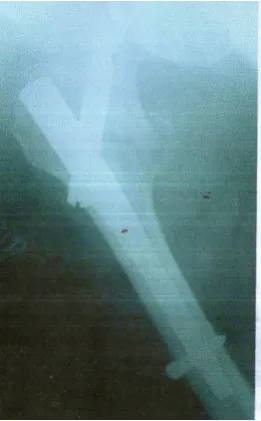
Assume that someone breaks his /her left femur due to fall or traffic accident. Suppose that we deal with an intertrochanteric fracture type Α1 and case 3 [6,7]. The fracture starts from proximal femur and ends to last third of its diaphysis. We impose into bone an intramedullary nail TGN as indicated in Figure 1, and we suggest the patient to stay at bed immobilization three months. We want to predict the situation of the femur when patient starts again walking, locally at three particularly points. The lasts indicated in Figure 2 and are the followings:
Δ: at endosteal surface and at 5/6 of the distance between origin and end of femur’s diaphysis.
Ε: at periosteal surface and at 2/3 of the distance between origin and end of femur’s diaphysis.
Figure 1. Intramedullary nailing TGN in a left broken femur. Taken
from [[6], p. 87]
Figure 2. A circular length L, with inner and outer radii a and b
respectively and pointsΓ, Δ and Ε. The fracture area of upper segment of the cylinder is defined with intense black
At t=0 the last third of diaphysis of femur was separated into two pieces due to fracture. Consequently all points that belonged to fracture area had êο=+∞ and the same goes for points of our interest Γ, Δ and Ε. At t >0 we impose an intramedullary nail TGN into broken femur as indicated in Figure 1. Then points Γ and Δ are under a constant internal pressure P due to the above device. We want to predict their ê(t) after long time.
3. A Hollow Circular Cylinder Subjected
to a Constant Internal Pressure
As we stated before femur’s diaphysis is a hollow circular with cylinder length L, inner and outer radii a and b respectively. These radii corresponds to endosteal and periosteal surfaces of bone and are constant, due to
internal remodeling [8]. Since we deal with microscopic area, we use density energy theory [3,4,5].
The equations of above theory in cylindrical coordinates are:
i) the stress relations between macroscopic and microscopic area [[4], p.182]
(
)
(
)
(
)
(
)
(
)
(
)
(
)
(
)
2 2
rr rr r r
2 2
r r r
2 2
rz rz z z r
2 2
r r r
2 2
2 2
z z z
2 2
zr zr r r z
2 2
r r r
(d / dt ) dV / dA (d / dt ) dV / dA (d / dt ) dV / dA (d / dt ) dV / dA
(d / dt ) dV / dA (d / dt ) dV / dA
(d / dt ) dV / dA (d / dt ) dV / dA
θ θ θ
θ θ θ
θθ θθ θ θ
θ θ θ
θ θ
τ σ ρ
τ σ ρ
τ σ ρ
τ σ ρ
τ σ ρ
τ σ
τ σ ρ
τ σ ρ
= +
= +
= +
= +
= +
= +
= +
= +
ǔ
ǔ
ǔ
ǔ
ǔ
ǔ
ǔ
ǔ
(
)
2 2
zz zz (d z/ dt ) dV / dA z and
θ
τ =σ +ρ ǔ
(4)1-2-3-4-5-6-7-8-9
where ǔi τij, σij and (dV/dA) are respectively: the
macroscopic displacement, the stress on microvolume, the stress at macrovolume and the change of volume with surface [4,5].
ii) the macrostress - equations [[5], p.182]:
2 2
rz,r z,z r zz,z rz z
2 2
rr,r r , rz,z rr r
2 2
r ,r , z,z
2 / r (d / dt )
/ r (d / dt )
/ r 2 r (d / dt )
and
θ θ
θ θ θθ
θ θθ θ θ θ
σ σ σ σ σ γ
σ σ σ σ σ γ
σ σ σ σ θ γ
+ + + + =
+ + + − =
+ + + =
ǔ ǔ
ǔ
(5)1-2-3
iii) the microstress equations [[5], p.182]:
2 2
rr,r r , rz,z rr r
2 2
r ,r ,
2 2
rz,r z,z r zz,z rz z
/ r (d / dt )
/ r z, z 2 r (d / dt )
2 / r (d / dt )
ú
ú
ú
θ θ θθ
θ θθ θ θ
θ θ
τ τ τ τ τ ρ
τ τ τθ σ θ ρ
τ τ τ τ τ ρ
+ + + − =
+ + + =
+ + + + =
(6)1-2-3
iv) the microstrain-microdisplacement relations [[5], p.179]:
rr r r r
zz z z r r rz
r/ z z r z z z/
e 2 / e 2( / ) / r
e 2 / e / / re
/ e /
ú ú ú
ú ú ú
ú ú ú ú
θθ θ θ
θ θ θ
θ θ θ
= ∂ ∂ = ∂ ∂ +
= ∂ ∂ = ∂ ∂ −
= ∂ ∂ + ∂ ∂ = ∂ ∂ + ∂
(7)1-2-3-4-5-6
v) the microstress - microstrain relations:
(
)
(
)
(
) (
)
rr 2 2 rr 2 1 zz
2 rr 2 2 1 zz zz
1 rr 1 1 zz r
2r r rz rz z z
2 e e e
e 2 e e
e e 2 e
2 e 2 e and 2 e
θθ θθ
θθ
θθ θ
θ θ θ
τ λ µ λ λ τ
λ λ µ λ τ
λ λ µ τ
µ τ µΑ τ µΑ
= + + +
= + + +
= + + +
= = =
(8)1-2-3-4-5-6
where: λ1= vΑΕΑΕΤ /(1− vΤ)ΕΑ− 2ν²ΑΕΤ.
(
)
2 2
1 T A A A T
2 2
2 T T A
2
T
2 T
2 (1 v )E v E E / (1 v )E 2
v E E / (1 v )
2 (1 v )
and 2 / 1 v
µ ν
λ ν
ν µ
Τ Α Τ
Τ Τ Α
Τ Τ
= − − − − ΑΕ
= + ΑΕ − Ε
− ΑΕ +
= Ε +
where ΕΑ, ΕΤ and vA,, vΤ are Young’s modulus and
Poisson ratio in transverse and axial direction at macroscopic area.
Finally rate remodeling equation [2] at microscopic area without /and accounting temperature are respectively:
( )
( )
( )
( )
( )
T rr zz
T rr
zz
d / dt A( ) A ( )(e e ) ( )e
and
d t / dt A A (e +e )
e B
ê ê ê ê
ê ê ê
ê ê
θθ
θθ
θ
Α
Α
= + + + Α
= +
+ Α +
(10)1-2
where AT(ê), ΑΑ(ê) are rate remodeling coefficients in
transverse and axial direction respectively while B(ê) is a rate remodeling coefficient depends from temperature.
The boundary conditions of our problem are: i) at point Γ:
(
)
rr
rz z r zz 0
at r a b / 2 and z L
θθ
θ θ
τ τ
τ τ τ τ
= = Ρ
= = = =
= + =
(11)1-2-3-4-5-6
ii) at point Δ:
rr
rz z r zz 0
at r a and z 5L / 6
θθ
θ θ
τ τ
τ τ τ τ
= = Ρ
= = = =
= =
(12)1-2-3-4-5-6
iii) at point Z:
rr rz z r zz 0
at r b and z 2L / 3.
θθ θ θ
τ τ τ τ τ
= = = = = =
= = (13)1-2-3-4-5-6
Our problem has a unique solution [[5], p.186] and assume that microdisplacements are of the form:
( )
( )
( )
r
z
A t r B t / r 0
C t z
θ
= + =
=
ǔ ǔ
ǔ (14)1-2-3
where A(t), B(t), C(t) are unknowns. Then (7) are written as
( )
( )
( )
( )
( )
2 rr
2
zz r
rz z
e 2A t 2B t / r e
2A t 2B t / r e 2C t e 0
e 0 and e 0.
θθ
θ θ
= −
= + = =
= =
(15)1-2-3-4-5-6
Therefore the microstress- microstrains (8) because of (12) take the forms:
(
) ( )
( )
( )
(
) ( )
( )
( )
( ) (
) ( )
2
rr 2 2 2
1
2
2 2 2
1 zz
1 1 1
r rz z
4 A t 4 B t / r
2 C t
4 A t 4 B t / r
2 C t
4 A t 2 2 C t
0, 0 and 0.
θθ
θ θ
τ λ µ µ
λ τ
λ µ µ
λ τ
λ λ µ
τ τ τ
= + −
+
= + +
+
= + +
= = =
(16)1-2-3-4-5-6
Applying the boundary conditions (11)-(12)-(13) into (16) it is possible to obtain A(t), B(t), and C(t):
i) at point Γ:
( ) (
)
( )
(
)
( )
2
1 1 1 1
1 1
t 2 / 8f, t a b / 32
and C t / 4f
λ µ µ
λ
Α = + Ρ Β = −Ρ +
= − Ρ (17)1-2-3
ii) at point Δ:
( ) (
)
( )
( )
2 2
2 1 1 2
2 1
t 2 / 4f, B t a / 8
and C t / 4f
λ µ µ
λ
Α = + Ρ = −Ρ
= − Ρ (18)1-2-3
iii) at point E:
( )
( )
( )
3 3 3
A t =0, B t = 0 and C t =0 (19)1-2-3
where:
(
)(
)
22 2 1 1 1
f= λ +µ λ +2µ −λ . (20) Employing (17)-(18)-(19) into (14) it is possible to calculate the microdisplacements at points Γ, Δ and Ε. Also employing (8) because of (17)- (18)- (19) becomes:
i) at point Γ:
( )
(
)
(
)
( )
(
)
(
)
( )
2 1
rr 1 1
2 1
1 1
1
zz 1
e t P[ 2 / 4f a b / 16 ]
e t P[ 2 / 4f a b / 16 ]
and e t / 2f
θθ
λ µ µ
λ µ µ
λ
= + + +
= + − +
= − Ρ
(21)1-2-3
ii) at point Δ:
( )
(
)
( )
(
)
( )
2 2
rr 1 1
2 2
1 1
2
zz 1
e t P[ 2 / 4f a / 8 ]
e t P[ 2 / 4f a / 8 ]
and e t / 2f
θθ
λ µ µ
λ µ µ
λ
= + +
= + −
= Ρ
(22)1-2-3
iii) at point Ε:
( )
( )
( )
3 3 3
rr zz
e t =0, eθθ t =0 and e t =0. (23)1-2-3
At continuity we distinguish the following cases:
i) Internal remodeling of femur does not depends upon temperature:
Then substituting (21),(22),(23) into (10)1 it follows
i)at point Γ:
(
)
1 T 1 1
d / dtê = A( )ê − Ρ Α[λ Α( ) A ( )ê − ê λ +2µ ] / 2f(24)
ii) at point Δ:
(
)
1 T 1 1
d / dtê =A( )ê − Ρ Α[λ Α( ) A ( )ê − ê λ +2µ ] / 2f (25)
iii) at point Ε:
d / dtê =A( ).ê (26)
Since living bone is continually remodeling [9,10] we assume that Young’s modulus and Poisson’s ratio depends upon ê [11,12]. Then from (9) it results that λ1, λ2, μ1, μ2
depend also ê. At continuity we impose:
2
2 1 o T
T A A 1
1 1 2 2 2 1
1 1 2 2 2
( ) c c c A ( )
A ( ) ( )
( ) ( )
( ) .
ê ê ê ê ê
ê ê ê
ê ê ê ê
ê ê ê
α α
α α λ
λ µ
µ
Τ Τ
Α = + + = +
= +
= Λ + Λ = Λ + Λ
= Μ + Μ = Μ + Μ
(27)1-2-3-4-5-6-7
Therefore (24)-(25)-(26) conclude to the following form:
(i) 2 (i) (i)
d / dtê =α (ê −2β ê ), i+γ =1, 2, 3 (28)
where:
(
)
(1) (1)
2 1 2
(1)
o 2 1 1 T 1 A 2
c c / 2c and
c / c [ 2 )]P / c F
α β
γ α α
= = −
= + Λ + Μ − Λ (29)1-2-3
ii) at point Δ:
(
)
(2) (2)
2 1 2
(2)
o 2 1 1 T 1 A 2
c c / 2c and
c / c [ 2 )]P / c F
α β
γ α α
= = −
= + Λ + Μ − Λ (30)1-2-3
iii) at point Ε:
(3) (3) (3)
2 1 2 o 2
c c / 2c and c / c
α
=β
= −γ
= (31)1-2-3where:
(
)(
)
22 2 1 1 1
F= Λ + Μ Λ + Μ − Λ2 . (32)
The solution of (28) must satisfy the following condition
( )
(i)
0<ê t , i< +∞ =1, 2, 3. (33) From the other hand (28) satisfies the initial condition:
(i) (i)
(0) , i 1, 2, 3
ê
ο
=ê = +∞ = (34)because as we stated earlier the points Γ, Δ and Ε belong to fracture area. We defined Δ(i)= 4β(i)²−4α(i)γ(i) and
distinguish the following cases [12]:
1) Δ(i) <0. The solution of (28) that satisfies (34) is:
( )
(
( ))
( )
(
)
i 2
(i) (i) (i)
i 2
(i) (i)
t
tg t / 2 ,
i 1, 2, 3
ê β γ β
α γ β π
= + √ −
√ − +
=
(35)
i) If α(i) < 0, then for t →− π /2α(i) √(γ(i)−β(i)2), then it results that ê(i)(t) = β(i)< +∞. We distinguish the following subcases: ia) If β(i) <0 the solution has no physical sense,
since contradicts to (33). ib)If β(i) =0then when the patient
get of the bed immobilization, femur at points Γ, Δ and Ε will be under osteopetrosis. Ic) Finally if 0< β(i)<+∞, then
when patient get of bed immobilization, femur at points Γ, Δ, Ε will be united. In addition if value of parameter α(i) is
great, then value of t1 =−π /2α
(i) √(γ(i)−β(i)2
) is small. The last means that femur at points of our interest will be quickly united. If value of parameter α(i) is small, then the value of t1=−π /2α(i) √(γ(i)−β(i)2) is great. The last means that
femur at points of our interest will be normally united. ii) If α(i) > 0, then for t→+∞ it follows that limê(i)(t) →
+∞. The last means that femur at points Γ, Δ and Ε, may be under a delayed union.
iii) If α(i) = 0 then ê(i)(t)= +∞. This is the worst case because it means that the femur at points of our interest has not been united.
2) Δ(i) =0. The solution of (28) is:
( )
(
)
(i) (i) (i)
1
e t =β −1 / α t+K , i=1, 2, 3 (36)
i) If K = 0, then employing initial condition (34) into (36) it results that e(i)(t)= −∞. The last contradicts to (34) and there is no solution. ii) If K≠0, then employing initial
condition (33) into (36) it possible to obtain Kβ (i)1− 1=+∞.
Specially if K >0 then β (i)
1=+∞, that is e(i)(t)= +∞ and we
coincide with case 1. iii). From the other hand if K<0 then β (i)
1=−∞, that is e(i)(t)= −∞ and we coincide with case i).
3) Δ(i) >0. Then the solution of (28) that satisfies (34) is:
( )
(i) (i) (i) (i) (i)
1 2 1 2
(i)
(i) (i) (i)
1 2
e Ke exp (e e )t
e t
1 Kexp (e e )t
α
α
− −
=
− − (37)
where:
( )
( ) 2 i
(i) (i) (i)
1
2 i
(i) (i) (i)
2 e
and e , i 1, 2, 3.
β β γ
β β γ
= + √ −
= − √ − =
(38)1-2
From the above it follows that:
(i) (i)
1 2
e > e , i=1, 2, 3. (39)
Employing the initial condition (34) into (37) it is possible to obtain:
(i) (i)
1 2
e −e K / 1 K − = −∞. (40)
From the above we conclude that K=1 and e(i)1 −e(i)2 <0.
The last contradicts to (39). Therefore (37) has no solution. The solutions of our problem for finite t. are given by
Table 1. Accordingly to these results when patient get of the bed immobilization, femur locally at points of our interested: i) will be quickly or normally united or ii) will be delay united or iii) will under osteopetrosis. Also the solutions of problem for infinite t are given by Table 2. Accordingly to these results when patient get of the bed immobilization, femur locally at points of our interested: i) will be delayed united or ii) will not be united.
ii) Internal remodeling depends upon temperature: Τhen (10)2 because of(21), (22), (23) is written as:
i) at point Γ:
(
)
1
T 1 1
( )
d / dt A( ) / 2f ( )
A ( ) 2
ê
ê ê ê
ê
λ
θ
λ µ
Α Α
= − Ρ + Β
− +
(41)
ii) at point Δ:
(
)
1
T 1 1
( )
d / dt A( ) / 2f ( )
A ( ) 2
ê
ê ê ê
ê
λ
θ
λ µ
Α Α
= − Ρ + Β
− +
(42)
iii) at point Ε:
d / dtê =A( )ê + Β( ) .êθ (43)
Finally substituting (27) and
( )ê d dê
Β = + (44)
into (21), (22), (23) we again result to (28), where: i) at point Γ:
(
)
(1)
o 2 1 1 T 1 A 2
(1) (1)
2 1 2
(c d) / c [ 2 )]P / c F.
c (2d c ) / 2c
and
γ α α
α β
= + + Λ + Μ − Λ
= = − +
Table 1. The solutions for finite t
Case Δ(i) = 4β(i)²−4α(i)γ(i
)<0 The solution for t→−π/2α(i)√(γ(i)−β(i)2) The physical meaning of solutions.
α(i)< 0 0< β(i) <+∞, and α(i) is great lime(t)= β(i) >0 Femur at points Γ, Δ and Ε is quickly united.. α(i)< 0 0< β(i) <+∞, and α(i) is small lime(t) = β(i) >0 Femur at points Γ, Δ and Ε is normally united.
α(i)< 0 and β(i)=0 lime(t) = β(i) =0 Femur at points Γ, Δ and Ε is under osteopetrosis
α(i)=0 e(t) =+∞ Femur at points Γ, Δ and Ε is not united
Table 2. The solutions for infinite t
Case The solution for t→+∞ The physical sense of solution
Δ(i) =4β(i)²−4α(i)γ(i) <0 and α(i) > 0, lime(t)=+∞ Femur at points Γ, Δ and Ε is delayed united. Δ(i) = 4β(i)²−4α(i)γ(i)=0, K>0 e(t)=+∞ Femur at points Γ, Δ and Ε is not united.
ii) at point Δ:
(
)
(2)
o 2 1 1 T 1 A 2
(2) (2)
2 1 2
(c d) / c [ 2 )]P / c F
c (2d c ) / 2c and
γ α α
α β
= + + Λ + Μ − Λ
= = − +
(46)1-2-3
iii) at point E:
(3) (3)
2 1 2
(3)
o 2
c (2d c ) / 2c and (c d) / c .
α β
γ
= = − +
= + (47) 1-2-3
The solution of (28) satisfying initial condition (34) are given by (35), (36) and (37). The acceptable solutions of our problem are the same as previous case and given by
Table 1 and Table 2.
4. Discussion -Conclusion
Our results at both cases: neglecting and accounting temperature are verified by clinical studies. Particularly it has been showed that at most cases > 95% femur is normally united [13-19] while at very few cases <5% is delay united [7,13,14,15,16,17].
Also Papasimos [6,17] studied 40 cases of broken femur with intramedullary nail TGN. Fracture was united at 38 cases (fraction 96%). Particularly the union was quick, normal and delay at: 24 cases (45days), 12 cases (3 months) and 2 cases (6 months) respectively. At rest 2 cases (fraction 5%) femur was not united due to fracture of intramedullary nail. Finally the pathological condition of osteopetrosis has been reffered [11]. From the above we result that temperature plays no role to growth of microcracks at our case.
References
[1] Cowin S. and Hegedus D. (1976). “Bone remodeling I: Theory of adaptive elasticity”, J. Elastic. 6, pp. 313-326.
[2] Hegedus D. and Cowin S. (1976). “Bone remodeling II: Theory of adaptive elasticity”, J. Elastic. 6, pp. 337-352.
[3] Sih G.C (1972 - 1982), “Mechanics of fracture, Introductory chapters”, Vol. I- VII, edited by G.C. Sih, Martinus Nijhoff, The Hague.
[4] Sih G.C. (1985). “Mechanics and Physics of energy density theory”, Theoret., Appl., Fract., Mech., 44, pp. 157-173.
[5] Sih GC (1988). “Thermomechanics of solids: nonequili-brium and irreversibility”, Theoretical and Applied Fracture Mechanics, 99, pp. 175-198.
[6] Papasimos S. (2005). Phd Thesis. University of Patras, Greece. Also in: KATAΓΜΑ/69.pdf (in Greek), p.120.
[7] Muller ME, Nazarian S, Koch P, Schatzker J (eds) (1990). “The comprehensive classification of fractures of long bones. Springer, Berlin, Heidelberg, New York, p. 120.
[8] Frost H.M (1964). “Dynamics of bone remodeling in bone biodynamics” (edited by Frost H.M) Little and Brown 316, Boston. [9] Wolff. J. (1884). “Das gesetz der transformation der inneren architecture knocken bei pathologism veranderungen der aussen knochenform”. Sitz Ber. Preuss Acad. d. Wiss 22, Sitz Physik-Math. K1.
[10] Wolff J. (1892). “Das gesetz der transformation knocken hirschald”, Berlin.
[11] Cowin S. and Van - Burskirk W. (1978). “Internal bone remodeling induced by a medullary pin”, J. Biomech. 11, pp. 269-275.
[12] Tsili M. (2000). “Theoretical solutions for internal bone remodeling of diaphyseal shafts using adaptive elasticity theory” J. Biomech. 33 pp. 235-239.
[13] Wiss DA, Brien WW, Stetson WB (1990). “Interlocked nailing for treatment of segmental fractures of the femur”. J. Bone Joint Surg. Am., 72(5): 724-728.
[14] Lahoud, J. C., Asselineau, A., Salengro, S., et., al., (1997), “Subtrochanteric fractures. “A comparative study between gamma nail and angularosteosynthesis with lateral cortical sup-port. Rev. Chir., Orthop. Reparatrice Appar. Mot. 83 (4) pp., 335-342. [15] Giannoudis PV, Furlong AJ, Macdonald DA, Smith RM (1997).
“Reamed against unreamed nailing of the femoral diaphysis: a retrospective study of healing time”. Injury, 28 (1): 15-18. [16] Gopa lS, and Giannoudis PV (2001). “Prospective randomized
study of reamed versus unreamed femoral intramedullary nailing: an assessment of procedures”. J. Orthop. Trauma 15 (6): 458-460. [17] Papasimos S., Koutsojannis C. M., Panagopoulos A., Megas P.
and E. Lambiris (2005). “A randomised comparison of AMBI, TGN and PFN for treatment of unstable trochenteric fractures”, Arch., Orthop. Trauma, 125: 462-468.
[18] Kazakos K. (2011). “Biomechanics of intramedullary nailing” Chapter 2, pp. 23-25. In : Intramedullary Nailing, Greek Union of Orthopaedics Surgeon and Traumatiology, Medicine Editions, Athens.
[19] Dagiopoulos P., Αsimakopoulos Α. and Αnastasopoulos G. (2011). “Orthonormal ‘Intramedullary nail of fracture of femur, Chapter. 5 in book: “Intramedullary nail”, Greek Com pany of Orthopaedics Surgey, Medicine Editions Kostantaras, Athens.