Available on-line at: www.oapub.org/edu
Copyright © The Author(s). All Rights Reserved.
doi: 10.5281/zenodo.821824 Volume 5 │ Issue 5 │ 2019
EFFECT OF 8 WEEKS HIGH INTENSITY INTERVAL
TRAINING ON MAXIMUM OXYGEN UPTAKE CAPACITY AND
RELATED CARDIO-RESPIRATORY PARAMETERS AT ANAEROBIC
THRESHOLD LEVEL OF INDIAN MALE FIELD HOCKEY PLAYERS
Surojit Sarkar, Subhra Chatterjee,
Swapan Kr Deyi
Human Performance Laboratory, Sports Authority of India,
India
Abstract:
Aim: In order to achieve maximal performance, need for high oxygen uptake is complemented with rigorous training program. To evaluate the effect of 8 weeks high intensity interval training (HIIT) on maximum oxygen uptake capacity and related
cardio-respiratory parameters at anaerobic threshold level. Materials and methods:
High intensity interval training programme was implemented among 20 trained young male hockey players for 3 days/week. The training set included 2 minutes of intense sprint workout followed by a minute each of active recovery and complete rest. The point of anaerobic threshold was identified with ventilatory equivalent method while
the players were subjected to exercise on computerized bicycle ergometer. Results:
Present study depicts significant increase in maximum oxygen consumption (+8%, p=0.000), maximum heart rate (+3%, p=0.01) and glycogen content (+3%, p=0.421) with significant decrease in pre-exercise heart rate (-7%, p=0.001), recovery heart rate (-7%, p=0.000) and average breathing frequency (-6%, p=0.014) after 8 weeks of interval training. Oxygen consumption (p=0.505), heart rate (p=0.000) and work load (p=0.004) were also improved significantly at anaerobic threshold level by 11%, 6% and 9%
respectively. Conclusion: HIIT protocol ultimately allows the athlete to exercise at
higher workload with greater cardiac proficiency within the aerobic zone.
Keywords: anaerobic threshold, ventilatory equivalent, interval training, heart rate,
hockey players, VO2max
1. Introduction
The intensity of exercise at which aerobic metabolism is taken over by anaerobic metabolism complemented by the generation of ATP that further results in exponential increase of blood lactate is termed as ‘anaerobic threshold’ (Wasserman, 1984; Ghosh, 2004). The Anaerobic Threshold (AT) point is reached once the blood lactate level exceeds the normal range and start to accumulate (approximately 2.5 - 6.0 mmol/L) during hypoxic condition in the skeletal muscle (Messonnier et al., 2013). The terms ‘ventilatory threshold’ (VT) is also been used to define AT (Ghosh, 2004; Debray & Dey, 2007). Field hockey is a very intense, intermittent sport that requires a wide variety of motor skills as well as high level of fitness to compete successfully at elite level. As it is being an intermittent game demand of maximum aerobic power superimposed with brief though frequent anaerobic needs (Hottenrott, Ludyga, & Schulze, 2012).
High-intensity interval training (HIIT) is a time-efficient strategy to induce aerobic adaptations involving alternating bouts of intensive exercise with low-intensity recovery periods which lead to pronounced AT improvement (Whyte, Gill, & Cathcart, 2010; Talanian, Galloway, Heigenhauser, Bonen, & Spriet, 2007; Weston, Wisløff, &
Coombes, 2014).Skeletal muscle adapts to aerobic interval training (1:1=work: recovery
time) with an increased capacity for aerobic metabolism and a decreased lactate
production (Jansson, Esbjomsson, Holm, & Jacobs, 1990).Talanian et al. (2007) showed
that 2 weeks of HIIT can lead to a 7-12% increase in maximum oxygen uptake (VO2max).
Weston et al. (2014) meta-analyzed ten studies and reported that HIIT typically performed at 85–95% of maximum heart rate (HRmax), increased cardio-respiratory fitness by almost double to that of moderate intensity continuous training. Slordahl (2004) employed 8 weeks of HIIT with 4-minute intervals at 90-95% of HRmax in 12
young untrained women.They demonstrated that HIIT increased left ventricular (LV)
mass, LV contractility during exercise, and VO2max by 12%, 13%, and 18%, respectively.
Burgomaster, Cermak, and Phillips (2007) have documented an increase in maximal mitochondrial enzyme activity, reduction in glycogen utilization and lactate accumulation as an HIIT induced adaptations (Burgomaster et al., 2007). In addition, HIIT may be more effective than conventional endurance training for improving muscle buffering capacity to ultimately improve low lactate accumulation and reduction in glycogen utilization as improve adaptation to aerobic part of an endurance-running (Bacon, Carter, Ogle, & Joyner, 2013; Edge, Bishop, & Goodman, 2006).
Interval training can increase the time to both blood lactate threshold and
ventilatory threshold, but endurance training can delay the onset of venous blood lactate threshold, showing less effect on VT (Ghosh, 2004). In endurance sports, it has
been suggested that AT might be a better indicator of endurance capacity than VO2max,
as AT may change without changes in VO2max (Bacon et al., 2013).Edwards, Clark, and
Macfadyen (2003) have indicated that VO2max is less sensitive indicator to changes in
│ │
or VT. So, the exact physiological factors regarding AT and HIIT for improvement in cardio-respiratory parameters are still need further attention.
So, the present study was undertaken with an aim to investigate the effect of
high intensity interval training on various cardio-respiratory parameters and also to see whether any changes takes place to these parameters at AT level of junior male hockey players.
2. Methods and materials
2.1 Subject
Twenty male field hockey players belonging to Sports Authority of India (SAI), eastern region (mean age = 16.4±1.51 years) with minimum of 4 yrs of formal training history were voluntarily participated in the present study. The subjects were considered homogenous as they belong to same socioeconomic status, having similar dietary habits, residing in same geographical and climatic condition and were also following similar training regimen. Informed consent was obtained from each subject included in the study and the study protocol conforms to the ethical guidelines of the Declaration of Helsinki, 1975. The present studied research work was approved by the ethical committee of Sports Authority of India.
Before the commencement of test all the players were clinically examined by the
physicians of SAI, Kolkata, who are specialized in Sports Medicine following standard procedure. The players who was found to be medically fit, healthy and with no history of any hereditary and cardio respiratory diseases, were finally selected for the present study. All the subjects performed graded exercise protocol on a bicycle ergometer (Ergoline, VIA sprint 150P, Germany). Assessments were performed in two different phases i.e., ‘before training’ and ‘after training’. ‘After training’ was performed eight weeks after ‘before training’. Subjects were evaluated for various anthropometric and cardio-respiratory parameters. They were asked to refrain from any exercise, consumption of alcohol, tobacco or caffeine for 48 h prior to testing (Weston et al., 2014; Naimo et al., 2015; Ross & Leveritt, 2011).
2.2 Training programme
The formulation and implementation of systematic training program was made by the qualified coaches with the guidance of the scientific experts. The training regimen for these subjects was held on an average 4 to 5 hours every day except Sundays and which comes about 30 hours in a week. There were two sessions in a day i.e. morning and evening session and both of which comprised of physical conditioning for one hour and skill training for about two hours. The physical training schedule includes different strength, endurance, speed etc. along with HIIT programme.
The HIIT programme consisted of 8 weeks duration and was implemented in pre
every alternate day. Each training session was began with a warm up session and ended with a cool down session (both session consists 15-20 min of slow running at
around 50% HRmax). In HIIT the subject was asked to perform a set of exercise consisting
2 min intense sprint workout (at 90-95% HRmax) followed by an active recovery for 1
min (60-70% HRmax) and followed by a 1 min complete rest. Each interval training set
consists of 3 repetitions. During 8 weeks HIIT protocol all the subjects undergone following sets of repetitions according to the weeks i.e., 5 sets in 1st-2nd week, 6 sets in
3rd-4th week, 7 sets in 5th-6th week and finally 8 sets in 7th-8th weeks. The whole training
workload was maintaining a work: recovery = 1:1 (Weston et al., 2014; Naimo et al., 2015; Ross & Leveritt, 2011).
2.3 Assessment of anthropometric parameters and body composition
The physical characteristics of the subjects including height (cm) and weight (kg) were measured by anthropometric rod and digital weighing machine respectively followed by standard procedure (Debray & Dey, 2007). Body composition including body fat % (BF %), muscle mass (MM, kg) and glycogen content (gm) were measured using
Bioelectrical Impedance Analysis (BIA) (Maltron Bioscan 920- 2, Made in UK). Total
body electrical impedance to an alternate current (0.2 mA) with four different frequencies (5, 50, 100 and 200 KHz) was measured using a multi-frequency analyzer (Maltron Bioscan 920-2 operating and service manual. 1999). Measurements were taken following standard testing manual of Maltron International. Before taking the measurement, the players were instructed according to Heyward and Stolarczyk (1996).
2.4 Measurement of cardio-respiratory parameters
A breath by breath automated pre-calibrated telemetric metabolic gas analyzer (Meta-Max 3B, CORTEX Biophysik GmbH, Leipzig, Germany) was used for determining different cardio-respiratory variables: heart rate (HR, beats /min), breathing frequency
(BF, min-1), oxygen pulse (VO2/HR, ml/beats), pulmonary ventilation or minute
ventilation (VE, l/min), ventilatory equivalent for oxygen production (VE/VO2),
ventilatory equivalent for carbon dioxide excretion (VE/VCO2) and VO2max etc (Dhawan,
Shenoy, & Sandhu, 2014).Polar heart rate monitor (Polar RS800CX, Polar Electro OY, Kempele, Finland) was used to monitor heart rate during the whole exercise protocol.
Prior to commencement of the exercise test, each participant was briefed about
the incremental exercise test protocol on bicycle ergometer. Subjects were given a brief rest about 2-3 min while sitting on the ergometer for attaining their steady state condition and the pre exercise heart rate was recorded. They were asked to pedal the
cycle without any load for 1st min, and initially 25Watt workload was applied for 2 min
│ │
an integrated computer system attached with the Meta-Max 3B. The breath by breath cardio-respiratory data were then averaged over 30sec of sampling period and recorded.
VO2max was determined by observing the following criteria: a) plateau in VO2
(leveling off) (2 ml.kg-1.min-1) despite of a further increase in workload; b) respiratory
exchange ratio (RER) ≥ 1.0; c) maximal heart rate ˃ 90% of age predicted HRmax ±5% and
d) the subject could not maintain the pedaling rate at 60 revolutions per minute (rpm) (Debray & Dey, 2007; Edvardsen, Hem, & Anderssen, 2014).
AT was determined following the ventilatory equivalent method (visual
inspection). It is the point when there is a certain increase in the VE/VO2 without the
concurrent increase in the VE/VCO2 (Nogueira & Pompeu, 2010). For each individual,
AT determination method was analyzed visually by two experienced investigators. The whole experiment was performed at room temperature varying from 23-25ºC with the relative humidity varying between 50-60%.
2.5 Statistical analysis
Data were analyzed using the Statistical Program for the Social Sciences (SPSS) version 16.0 for Windows (SPSS Inc., Chicago, Il, USA, 2009). Shapiro-Wilk normality test was done and all data were found to be normally distributed. Hence, parametric statistics was done. Differences between groups for all variables according to their specific sport disciplines were calculated using a two-tailed paired sample t-test. All values were expressed as means ± standard deviation (SD). A confidence level at 95% (p ≤ 0.05) was considered as significant.
3. Results
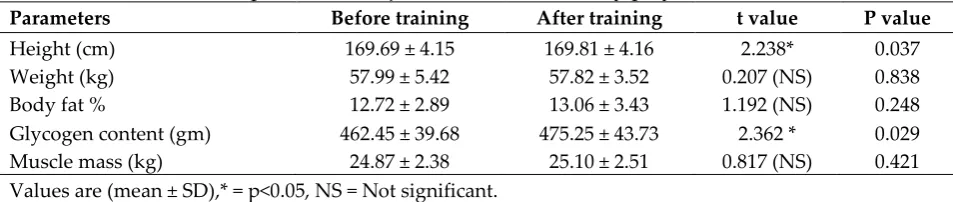
Table 1 represents the comparison of anthropometric parameters of young male field hockey players before and after HIIT. Height and glycogen content of the hockey players have shown a significant (p<0.05) increase after the HIIT programme. But body weight, BF% were decreased after training though the difference was statistically insignificant. On the other hand muscle mass showed an insignificant increase after 8 weeks of training.
Table 1: Comparison of mean, SD and level of significance of selected anthropometric parameters of junior male field hockey players
Parameters Before training After training t value P value
Height (cm) 169.69 ± 4.15 169.81 ± 4.16 2.238* 0.037
Comparison of mean, SD and level of significance of selected cardio-respiratory parameters of young male field hockey players at resting and recovery condition are listed in table 2. Pre-exercise HR (p<0.001) and HRrecovery (p<0.001) were found to be
significantly decreased after the training.
Table 2: Comparison of mean, SD and level of significance of selected Cardio-respiratory parameters of young male field hockey players at resting and recovery condition
Parameters Before training After training t value P value
Pre-exercise heart rate (beats/min) 70.05 ± 5.47 65.25 ± 3.40 3.861*** 0.001
HRrecovery (beats/min) (after 1min) 153.85 ± 7.53 142.50 ± 10.40 5.555 *** 0.000
Values are (mean ± SD), ***=p<0.001, HRrecovery = Recovery heart rate.
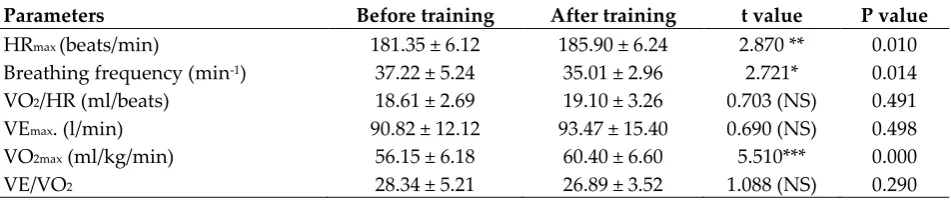
Table 3 depicts the comparison of mean, SD and level of significance of selected cardio-respiratory parameters of young male field hockey players maximal condition Breathing frequency (p<0.05) was found to be significantly decreased after the training.
Whereas, HRmax (p<0.01) and VO2max (p<0.001) were found to be increased significantly
as compared after training. Maximum pulmonary ventilation (VEmax), oxygen pulse
(VO2/HR) and ventilatory equivalent (VE/VO2) of the boys were also differed after
training though the difference was statistically insignificant.
Table 3: Comparison of mean, SD and level of significance of selected
Cardio-respiratory parameters of young male field hockey players at maximal condition
Parameters Before training After training t value P value
HRmax (beats/min) 181.35 ± 6.12 185.90 ± 6.24 2.870 ** 0.010
Breathing frequency (min-1) 37.22 ± 5.24 35.01 ± 2.96 2.721* 0.014
VO2/HR (ml/beats) 18.61 ± 2.69 19.10 ± 3.26 0.703 (NS) 0.491
VEmax. (l/min) 90.82 ± 12.12 93.47 ± 15.40 0.690 (NS) 0.498
VO2max (ml/kg/min) 56.15 ± 6.18 60.40 ± 6.60 5.510*** 0.000
VE/VO2 28.34 ± 5.21 26.89 ± 3.52 1.088 (NS) 0.290
Values are (mean ± SD),* = p<0.05, **=p<0.01, ***=p<0.001, NS = not significant, HRmax= heart rate
maximum, VEmax= maximum pulmonary ventilation or minute ventilation, VO2/HR= oxygen pulse.
Table 4 demonstrated the comparison of mean, SD and level of significance of selected cardio-respiratory parameters of young male field hockey players at the point of anaerobic threshold before and after HIIT. The table reveals that all most all the parameters were improved after training. Work load (p<0.01), heart rate (p<0.001) and VO2 (p<0.001) showed significantly higher mean values at ‘AT’ level (p<0.001) after 8
│ │
Table 4: Comparison of mean, SD and level of significance of some Cardio-respiratory parameters of junior male field hockey players at anaerobic threshold point
Parameters Before training After training t value P value
Work load at AT (watt) 155.25 ± 15.85 169.25 ± 19.49 3.302 ** 0.004 HR at AT (beats/min) 149.70 ± 8.60 158.90 ± 3.68 4.493 *** 0.000 VE at AT (l) 55.98 ± 8.29 60.27 ± 9.70 1.580 (NS) 0.131 VO2 at AT (ml/kg/min) 40.10 ± 3.95 44.70 ± 3.48 5.510 *** 0.000
VE/VO2 at AT 24.35 ± 4.12 23.47 ± 3.95 0.679 (NS) 0.505
Values are (mean ± SD), **=p<0.01, ***=p<0.001, NS = Not significant, AT= anaerobic threshold, HR= heart rate, VE= pulmonary ventilation or minute ventilation, VO2= consumption of oxygen per minute,
VE/CO2= ventilatory equivalent for carbon dioxide excretion.
4. Discussion
Present study reveals insignificant changes in BF% and muscle mass (MM) after sprint interval training and the obtained result is in agreement with the findings of Burgomaster et al. (2007). However, the slight increase in BF% was may due to the unaffected muscle content of fatty acid transport proteins (FABPpm or FAT/CD36), which suggests proteins associated with carbohydrate (CHO) metabolism are more responsive to the sprint interval training in humans (Burgomaster et al., 2007). Naimo et al., (2015), Kubukeli, Noakes, and Dennis (2002) and Ross, and Leveritt (2011) have also reported an insignificant increase in MM after intense resistance training which might due to the muscular hypertrophy or a bidirectional shift of type I muscle fibers to type IIa fibers. A significant increase in glycogen content (p<0.05) was also depicted by the present study. Burgomaster et al. (2007) have reported an increase in resting glycogen content with a reduction in glycogen utilization during exercise after 2 week of HIIT and they have indicated the increase in protein content of GLUT4 in human skeletal muscle as the probable reason.
Present findings depict a significant decrease in pre-exercise heart rate and
recovery heart rate (7%, p<0.001) with a significant increase in HRmax (3%, p<0.01), HR at
AT (6%, p<0.001) and the results were corroborated with the findings of Debray and Dey (2007) and Slordahl (2004). The improvement in cardio-respiratory parameters may due to the increase in stroke volume, left ventricular (LV) muscle mass, LV contractility during exercise (Debray & Dey, 2007; Slordahl, 2004). The above fact in reducing the pre-exercise HR was also reported by Wisløff, Ellingsen, and Kemi (2009). Reilly,
Secher, Snell, and Williams (1993) have reported that after interval training HRmax does
not reduced much or remain almost same though the stroke volume was higher than normal and they have concluded that higher stroke volumes are the consequence of increased LV size.
A significant increase in VO2max (8%), VO2 at AT (11%) of the present study
weeks can improve VO2max from 4 to 46% respectively. According to some researchers
the probable reason of improvement in VO2max is the increase in LV muscle mass, LV
contractility during exercise, stroke volume which ultimately increased cardiac output (Slørdahl, 2004; Debray & Dey, 2007; Little, Safdar, & Wilkin, 2010). On the other hand, Kubukeli et al. (2002) and Ross and Leveritt (2011) have also reported that HIIT induced
improvement in VO2max is the result of an increase in muscular mitochondrial content,
mitochondrial enzyme activity (glycogen phosphorylase, phosphofruktokinase), muscle fiber buffering capacity and ionic adaptation including increased in Na+-K+ ATPase
activity. The above facts may be true in case of present study as well for significant increase in maximum oxygen consumption.
Gaskill et al. (2001) have observed the same interval training induced
improvement in tidal volume accompanied by a reduction in breathing frequency (p<0.05) as in the present study. But as per the present data VE/VO2 at AT point was
decreased after interval training and the result is corroborated with the findings of Cardozo, Oliveira, and Farinatti (2015). Cardozo et al. (2015) have concluded that such results may obtain due to an abrupt increase in oxygen consumption after sudden implementation of sprint interval protocol. Gaskill et al. (2001) have further reported that if the subject’s lungs are very efficient for gaseous exchange then there is no need of
high VE for a given VO2. Although recent studies reported that various
cardio-respiratory indices were found to be improved after several weeks of intense, interval-based training which can increase both MCT1 and MCT4 (monocarboxylate transporter) along with the changes in mitochondrial enzymatic level in human skeletal muscle (Edge et al., 2006; Burgomaster et al., 2007).
5. Conclusion
The present study concluded that 8 weeks HIIT protocol as an effective and time efficient training strategy for pre-competitive phase to improve cardio-respiratory
variables mainly the VO2max, RHR and recovery heart rate of field hockey players. HIIT
protocol ultimately allows the athlete to exercise at higher workload with higher cardiac proficiency still within the aerobic zone by pushing the limit of anaerobic threshold level. However, results of the present study may be useful for future research and comparison in this field. Further, these data may also be helpful in preparation of suitable HIIT protocol for the players of endurance / intermittent game like field hockey, soccer, etc. to improve in cardio-respiratory fitness.
5.1 Practical applications
│ │
implement HIIT programme should be chalked out and intervened accordingly for better results.
Conflict of interest
All the authors have no conflicts of interest.
References
Bacon A.P., Carter R.E, Ogle E.A., Joyner M.J., 2013. VO2max Trainability and High
Intensity Interval Training in Humans: A Meta-Analysis. Plos One 8(9): 1-7. Burgomaster K.A., Cermak N.M., Phillips S.M., 2007. Divergent response of metabolite
transport proteins in human skeletal muscle after sprint interval training and detraining. American Journal of Physiology-Regulatory, Integrative & Comparative Physiology 292(5): R1970-1976.
Cardozo G.G., Oliveira R.B., Farinatti P.T., 2015. Effects of High Intensity Interval versus Moderate Continuous Training on Markers of Ventilatory and Cardiac Efficiency in Coronary Heart Disease Patients. The Scientific World Journal, 192479.
Debray P., Dey S.K., 2007. A companion of the point of deflection from linearity of heart rate and the ventilatory threshold in the determination of the anaerobic threshold in Indian boys. Journal of Physiological Anthropology 26 (1): 31-37.
Dhawan M., Shenoy S., Sandhu J.S., 2014. Physiological, Biochemical and Strength Profile of Indian Cyclists and Boxers - A Comparative Study. International Journal of Scientific Research 3(12): 98-101.
Edge J., Bishop D., Goodman C., 2006. The effects of training intensity on muscle buffer capacity in females. European Journal of Applied Physiology 96(1): 97-105.
Edvardsen E., Hem E., Anderssen S.A0, 2014. End Criteria for Reaching Maximal Oxygen Uptake Must Be Strict and Adjusted to Sex and Age: A Cross-Sectional Study. Plos One 9(1): e85276.
Edwards A.M., Clark N., MacFadyen A.M., 2003. Lactate and ventilatory thresholds reflect the training status of professional soccer players where maximum aerobic power is unchanged. Journal of Sports Science & Medicine 2(1): 23-29.
Gaskill S.E., Ruby B.C., Walker A.J., Sanchez O.A., Serfass R.C., Leon A.S., 2001. Validity and reliability of combining three methods to determine ventilatory threshold. Medicine & Science in Sports & Exercise 33(11): 1841-1848.
Ghosh A.K., 2004. Anaerobic threshold: its concept and role in endurance sport. Malaysian Journal of Medical Science 11(1): 24-36.
Hottenrott K., Ludyga S., Schulze S., 2012. Effects of high intensity training and continuous endurance training on aerobic capacity and body composition in recreationally active runners. Journal of Sports Science & Medicine 11(3): 483-488. Jansson E., Esbjomsson M., Holm I., Jacobs I., 1990. lncrease in the proportion of
fast-twitch muscle fibers by sprint training in males. Acta Physiologica Scandinavica 140(3): 359-363.
Jones N.L., Marrides L., Hitchock M.C., Chypchar T., McCartney N., 1985. Norman standards for an incremental progressive cycle ergometer test. American Review of Respiratory Diseases 131(5): 700-708.
Kubukeli Z.N., Noakes T.D., Dennis SC, 2002. Training techniques to improve endurance exercise performances. Sports Medicine 32(8): 489-509.
Little J.P., Safdar A.S., Wilkin G.P., 2010. A practical model of low-volume high-intensity interval training induces mitochondrial biogenesis in human skeletal muscle: potential mechanisms. Journal of Physiology 588(6): 1011-1022.
Messonnier L.A., Emhoff C.W., Fattor J.A., Horning M.A., Carlson T.J., Brooks G.A., 2013. Lactate kinetics at the lactate threshold in trained and untrained men. Journal of Applied Physiology 114(11): 1593-1602.
Naimo M.A., De Souza E.O., Wilson J.M., Carpenter A.L., Gilchrist P., Lowery R.P., Averbuch B., White T.M., Joy J., 2015. High-intensity Interval Training Has Positive Effects on Performance in Ice Hockey Players. International Journal of Sports Medicine 36(1): 61-66.
Nogueira F.S., Pompeu F.A.M.S., 2010. Measurement Precision of the Anaerobic
Threshold by means of a Portable Calorimeter. Arquivos Brasileiros De Cardiologica 95(3): 354-363.
Reilly T., Secher N., Snell P., Williams C., 1993. Physiology of sports. 313-318.
Ross A., Leveritt M., 2011. Long-term metabolic and skeletal muscle adaptations to short-sprint training: implications for sprint training and tapering. Sports Medicine 31(15): 1063-1082.
Slørdahl S.A., 2004. Atrioventricular plane displacement in untrained and trained females. Medicine & Science in Sports & Exercise 36(11): 1871-1875.
Talanian J.L., Galloway S.D., Heigenhauser G.J., Bonen A., Spriet L.L., 2007. Two weeks of high-intensity aerobic interval training increases the capacity for fat oxidation during exercise in women. Journal of Applied Physiology 102(4): 1439-1447. Wasserman K., 1984. The anaerobic threshold measurement to evaluate exercise
performance. American Review of Respiratory Disease 129: S35-S40.
│ │
Whyte L.J., Gill J.M., Cathcart A.J., 2010. Effect of 2 weeks of sprint interval training on health-related outcomes in sedentary overweight/obese men. Metabolism 59(10): 1421-1428.
Wisløff U., Ellingsen Ø., Kemi O.J., 2009. High-intensity interval training to maximize cardiac benefits of exercise training? Exercise & Sport Science Review 37(3): 139-146.
Creative Commons licensing terms