International Journal Advances in Social Science and Humanities
Available Online at:
www.ijassh.com
RESEARCH ARTICLE
Using Sketch Engine to Investigate Synonymous Verbs
Complete
and
Finish
in English
Xu Yuting
Faculty of English Language and Culture, Guangdong University of Foreign Studies, Guangzhou, China.
Abstract: Objective: Synonymy is an important yet intricate linguistic feature in the field of lexical semantics. Method: Using the 100 million-word British National Corpus (BNC) as data and the software Sketch Engine (SkE) as analyzing tool, this study examines the usage differences between complete and finish, two synonymous verbs that are often misused for their complex semantic and syntactic usage patterns. In addition to examining the collocates of the verbs, the study also investigated the syntactic patterns that the verbs typically occupy in the sentence structure and their functional implications.
Result: The data analysis yields an informative description of the internal semantic structure of the synonym set. The results also show the need for the corpus approach to go beyond collocational analysis in the study of synonymous verbs. The limitations of using Sketch Engine to extract and disambiguate synonyms are also addressed. Conclusion: This paper ends by discussing the pedagogical implications that this research may have when the results are introduced into the classroom teaching.
Keywords: Synonymy, Semantic and syntactic usage patterns, Collocational analysis.
Article Received: 25 Feb. 2020 Revised: 20 March 2020 Accepted: 27 March 2020
Introduction
Synonym is an important yet complicate area in the field of lexical semantics. Synonyms are not completely interchangeable; rather, they differ in shades of meaning and vary in their connotations, implications, and register. There is a considerable number of synonymous words in any language among which English is particular rich in them.
This enables English speakers “to convey meanings more precisely and effectively for the right audience and context” [16]; they also constitute a thorny area for EFL (English as a Foreign Language) learners because of their subtle nuances and variations in meaning and usage. An important aspect of English linguistics is to find the proper measures of automatically identifying and extracting synonyms [8] and of distinguishing one word
from its synonyms or near-synonyms [13], [3], [11], [25], [4], [15].Although these two areas of researching synonymous words are equally important, the main orientation of this study is methodological in that we will discover what the relative strengths and weaknesses of using Sketch Engine to research synonyms and what their relative scope of applicability is.
implications for future research and teaching.
Related Work
Corpus Studies of Lexical Semantics
In the field of lexical semantics, there are a number of closely related key issues such as “How do we know what words mean? What evidence do we have? Is this evidence observable and objective? How can large text collections (corpora) be used to study what words mean?” [24]. For centuries, researchers, language teachers and dictionary makers have used both their intuitions and the attested uses of words from printed books. However, it is only since the mid-1980s that corpus methods have been able to provide evidence about word meaning by searching across large text collections.
The pioneering figures in using corpus evidence to study meanings of words and phrases are called neo-Firthian corpus linguists. John Sinclair might be the first one to bring Firth’s ideas together with a corpus linguistic methodology [23]. Other important neo-Firthians include Michael Hoey, Susan Hunston, Bill Louw, Michael Stubbs, Wolfgang Teubert and Elena Tognini-Bonelli [17].
At the core of corpus linguistics is searching for the units of meaning. Words and lemmas have been viewed as the main unit of meaning for hundreds of years. However, Sinclair and his associates provide a considerable amount of evidence that units of meaning are phraseological units rather than single words. Inspired by “you shall know a word by the company it keeps”, the maxim in Firth’s work in 1957, Sinclair paid much attention to the context in which a word is used. He firmly believes in the principle of “trust the text” [20] and claims that “the language looks rather different when you look at a lot of it at once” [18].
Reading concordance and calculating collocates from corpus are two important ways to study a lexical item in its context
used by Sinclair, hence his well-cited book is entitled as Corpus, Concordance, Collocation
[18]. For Sinclair [18], “A concordance is a collection of the occurrences of a word-form, each in its own textual environment. In its simplest form, it is an index. Each word-form is indexed, and a reference is given to the place of each occurrence in a text”.
Closely related to concordance is the notion of collocation. Firth [7] defines collocations of a given word as “statements of the habitual and customary places of that word”. Nevertheless, Firth’s research on collocation is largely intuition-based, which is in sharp contrast with most corpus linguists’ belief that the only way to reliably identify the collocates of a given word is to study patterns of co-occurrence in a corpus [4]. For example, Hunston [6] argues, “Collocation may be observed informally in any instance of language, but it is more reliable to measure it statistically, and for this a corpus is essential.”
Sinclair and associates’ early work from 1970 (reprinted in 2004) is considered a methodological elaboration on the concordance. A collocation is a co-occurrence pattern that exists between two items that frequently occur in proximity to one another-but not necessarily adjacently or, indeed, in any fixed order. Closely related to collocation is the notion of node and collocates. A node is an item whose total pattern of co-occurrence with other words is under examination; a collocate is any one of the items which appears with the node within a specified span [20].
The usual measure of proximity is a maximum of four words intervening”. On the basis of Sinclair’s work, Hoey [5] defines collocation as “a psychological association between words (rather than lemmas) up to four words apart and is evidenced by their occurrence together in corpora more often than is explicable in terms of random distribution”.
In sum, Sinclair and his associates have shown that lexical items tend to occur in particular linguistic contexts, e.g. they tend to co-occur or collocate with certain other words, phrases, and/or grammatical structures, and these distributional tendencies help define their meanings. Sinclair’s pioneering work has shaped contemporary research on lexical semantics, leading to experimental and corpus approaches to the synonymous words.
Corpus Approaches to Synonyms
Boosted by the computer era and the central ideas of corpus linguistics, the past decades have witnessed significant advances in the studies on synonym. Based on the Brown Corpus, Miller & Charles [9] found that the more two words are judged to be substitutable in the same linguistic context (i.e. the same location in a sentence), the more synonymous they are in meaning.
Employing a “lexical substitutability” test in a corpus study of the near-synonyms ask for,
request and demand, Church et al. [5] produced the same finding: the substitutability of lexical items in the same linguistic context constitutes a good indicator of their semantic similarity. Gries [11] quantifies the similarity between English adjectives ending in -ic or -ical (like economic
and economical) on the basis of the overlap between their collocations. Gilquin [9] investigates the difference between the English causative verbs get and have, Glynn [10] compares intra- and extralinguistic factors in the contexts of hassle, bother and
annoy, and Gries & Otani [12] study the synonyms big, great and large and their antonyms little, small and tiny.
Other sets of synonyms that have attracted attention include strong and powerful [5],
absolutely, completely and entirely [17], big,
large and great [3], quake and quiver [2],
principal, primary, chief, main and major [15], and actually, genuinely, really, and truly [16],
raise and increase [4].
One corpus-based approach to synonym is sometimes called corpus-based behavioral profile (BP) study. Generally, a BP study uses corpus data to examine the distributional patterns of lexical items, such as the linguistic contexts a word is typically used in and the words it usually collocates with, so as to identify its unique semantic and usage patterns [4]. In recent years, the BP approach has been developed by Gries and associates [6], [11], [12], which is more sophisticated in examining both adjectives and verbs.
Although BP approach proves to be effective in studying synonyms, it might be complex for pedagogical purpose and thus it may have limited scope of application. This study, based on corpus tool Sketch Engine, aims to introduce a simple method that can be widely used by researchers, language teachers and even EFL learners.
Method
Corpus Data: BNC
The British National Corpus (BNC) is a 100-million-word collection of samples of written and spoken language from a wide range of British English from the later part of the 20th century, both spoken and written [1].
formal business or government meetings to radio shows and phone-ins.
BNC is, by nature, monolingual, synchronic, general and sample-based, in that it deals with modern British English, it covers British English of the late twentieth century, it includes many different styles and varieties instead of being limited to any particular subject field, genre or register, and that it contains many samples which allows for a wider coverage of texts within the 100 million limit.
The corpus is encoded according to the Guidelines of the Text Encoding Initiative (TEI) to represent both the output from CLAWS (automatic part-of-speech tagger) and a variety of other structural properties of texts (e.g. headings, paragraphs, lists etc.). Full classification, contextual and bibliographic information is also included with each text in the form of a TEI-conformant header.
Corpus Tool and Analysis Procedure
The Sketch Engine is a leading corpus tool, widely used in lexicography, language teaching, translation and the like [14]. Sketch
Engine is the ultimate tool to explore how language works. Its algorithms analyze authentic texts of billions of words (text corpora) to identify instantly what is typical in language and what is rare, unusual or emerging usage. It is also designed for text analysis or text mining applications. Sketch Engine has a number of core functions: Thesaurus, Wordlist, Concordance, Word Sketches and Word Sketch Difference, which will be elaborated in the following sections.
Thesaurus
In Sketch Engine, the automatic identification and summary of synonymy is achieved by Thesaurus. The synonym list may contain words which should not be included; this is a result of automatic processing. Sketch Engine cannot compare the meanings directly but determine the collocates according to a large computation. If two words share the same collocates, they will be in each other’s synonym list in Thesaurus even though they are dissimilar in meaning. To avoid this, we can use a large corpus to search a word with a relatively higher frequency.
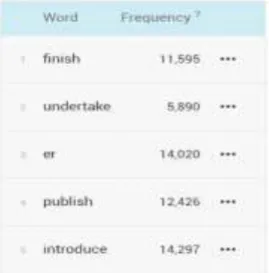
Figure 1: Top 5 synonyms of complete in BNC
Figure 1 demonstrates the top 5 words in the synonym list generated by Thesaurus. Obviously, only the first word finish has similarity in meaning with the search word
complete while the others do not.
The word complete and finish have many collocates in common, among which the “work” in object position (complete the work and
Concordance
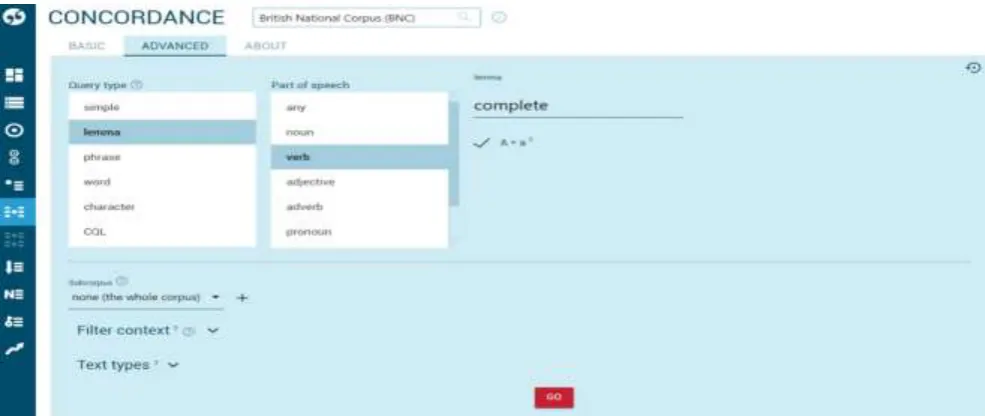
The basic method in Sketch Engine to generate concordance is to use the basic search function. However, uses may want more control over the searched item. By clicking on “ADVANCED”, they can see the
options in Figure 2, and can specify the query type: simple, lemma, phrase, word, character or CQL as well as the part of speech of a lemma: noun, verb, adjective, adverb, pronoun or any (with an option to match for case).
Figure 2: The advanced concordance of complete
If users click the button “GO”, the software will generate the concordance lines as Figure 3.
Figure 3: Search hits for the verb complete in BNC
Collocations
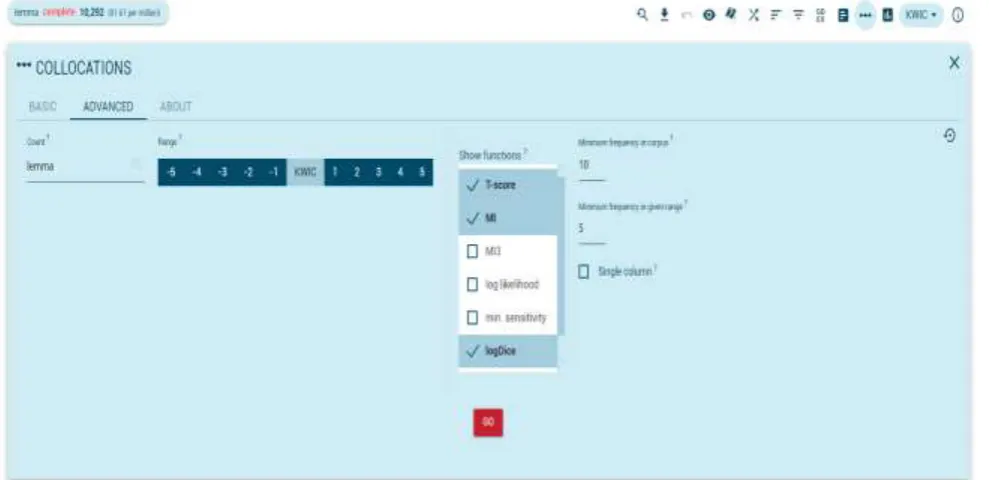
Closely related to Concordance is Collocates. In the concordancing interface like Figure 3,
Figure 4: Collocation candidates
In “Count” we should choose an attribute that will be used. Since some collocates of complete
may have different forms (for example, work
and works). Lemma will count different word forms as one. In “Count”, we choose lemma. The span (the number of words left and right of the search word) is (-5, 5), the minimum frequency of each collocate being set 10 and minimum frequency in a given range (in our study -5, 5) 5. Of seven measures to calculate the strength of collocation (T-score, MI, MI3, log likelihood, min. sensitivity, and logDice), I choose the default one logDice which is considered more reliable than the frequently used MI (mutual information) measure.
Word Sketch
A word sketch processes the word’s collocates and other words in its surroundings. It is a summary of the word’s grammatical and collocational behavior. The results are organized into grammatical relations, such as the words that serve as an object of the verb, a subject of the verb and words that modify the verb etc. Figure 5 shows part of the word sketch for the verb complete in BNC. In the second column, a lot of words like
questionnaire, form, course, task, project are classified in the category of object, i.e., they are used as the object of complete.
Word Sketch Difference
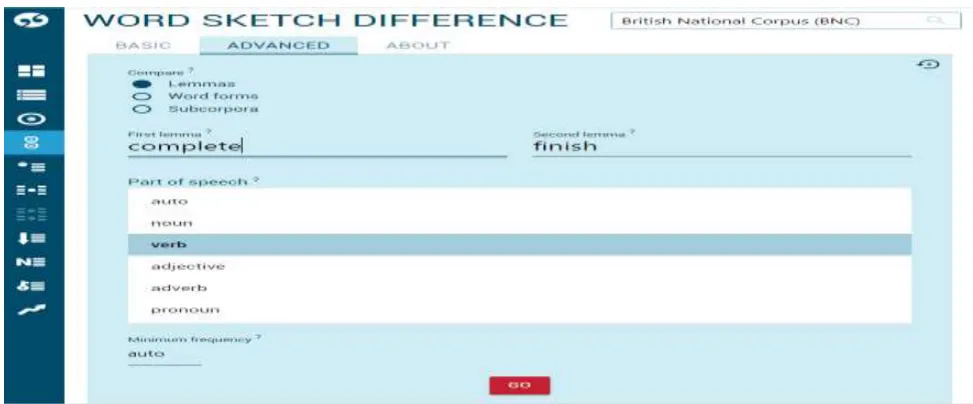
The word sketch difference is designed for making comparisons by contrasting collocations. This function is probably the most straightforward when researching synonymous words. Three options are available: lemma-compares the use of two
different lemmas via their collocations; word forms-compares the use of two different word forms of the same lemma via their collocates; subcorpora: compares the use of the same lemma in two different subcorpora of the same corpus via their collocates. Figure 6 presents the interface of Word Sketch Difference.
Figure 6: The interface of Word Sketch Difference
If we click the button “GO”, the software will generate a summary of the two synonymous verbs complete and finish according to the collocates arranged by the grammatical categories.
Results and Analysis
Frequencies of complete and finish
Concordance helps the researchers to compare the frequencies of the synonymous verbs in BNC. As is shown in Table 1, the synonymous words complete and finish are
quite close in term of frequencies. The two verbs under study are defined in Oxford English Dictionary as follows:
Complete: transitive. To bring to an end, finish (an action, performance, work, a distance, period of time, etc.)
Finish: transitive. To bring to an end; to come to the end of, go through the last period or stage of. Often with gerund (formerly with infinitive) as object: To ‘make an end of’, cease (doing something). †Also, rarely, To put an end to, cause to cease.
Table 1: Frequencies of complete and finish in BNC
Lemma Frequency Frequency per million
Complete 10292 91.61
Finish 11595 103.21
The results provide substantial evidence that
complete and finish are two verbs that are quite comparable in BNC.
Collocates of Complete and Finish
puts it, “You shall know a lot about a word from the company it keeps.” Collocation is thus “a way of understanding meanings and associations between words” [3]. The software generates a list of the collocates for the searched words. We download the first 1000 rows of the collocates of complete and finish in
BNC.
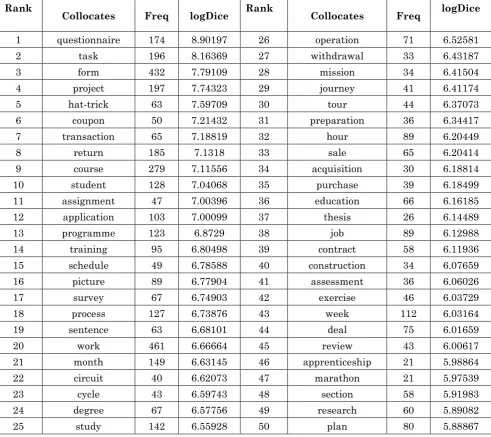
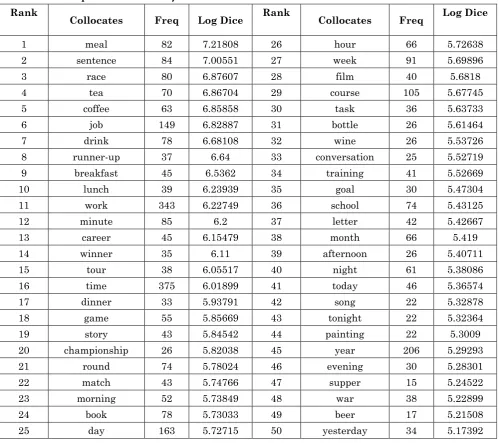
The dominate content collocates of the two verbs are nouns. We summarize the top 50 nominal collocates of each verbs and the results are demonstrated as Table 2 and Table 3.
Table 2: The top 50 collocates of complete in BNC
Rank
Collocates Freq logDice Rank Collocates Freq logDice
1 questionnaire 174 8.90197 26 operation 71 6.52581
2 task 196 8.16369 27 withdrawal 33 6.43187
3 form 432 7.79109 28 mission 34 6.41504
4 project 197 7.74323 29 journey 41 6.41174
5 hat-trick 63 7.59709 30 tour 44 6.37073
6 coupon 50 7.21432 31 preparation 36 6.34417
7 transaction 65 7.18819 32 hour 89 6.20449
8 return 185 7.1318 33 sale 65 6.20414
9 course 279 7.11556 34 acquisition 30 6.18814
10 student 128 7.04068 35 purchase 39 6.18499
11 assignment 47 7.00396 36 education 66 6.16185
12 application 103 7.00099 37 thesis 26 6.14489
13 programme 123 6.8729 38 job 89 6.12988
14 training 95 6.80498 39 contract 58 6.11936
15 schedule 49 6.78588 40 construction 34 6.07659
16 picture 89 6.77904 41 assessment 36 6.06026
17 survey 67 6.74903 42 exercise 46 6.03729
18 process 127 6.73876 43 week 112 6.03164
19 sentence 63 6.68101 44 deal 75 6.01659
20 work 461 6.66664 45 review 43 6.00617
21 month 149 6.63145 46 apprenticeship 21 5.98864
22 circuit 40 6.62073 47 marathon 21 5.97539
23 cycle 43 6.59743 48 section 58 5.91983
24 degree 67 6.57756 49 research 60 5.89082
25 study 142 6.55928 50 plan 80 5.88867
As is shown in Table 2, the dominant content collocates of complete can be grouped into four categories:
Learning-related activity: course, student, assignment, picture, sentence, degree, study, education, thesis, exercise, apprenticeship, section, research;
Abstract activities with temporal
continuity: project, programme, process, circuit, cycle, operation, withdrawal, mission, journey, tour, preparation;
Items that needs further information: questionnaire, form, coupon, application, survey, contract, assessment;
Table 3: The top 50 collocates of finish in BNC Rank
Collocates Freq Log Dice Rank Collocates Freq Log Dice
1 meal 82 7.21808 26 hour 66 5.72638
2 sentence 84 7.00551 27 week 91 5.69896
3 race 80 6.87607 28 film 40 5.6818
4 tea 70 6.86704 29 course 105 5.67745
5 coffee 63 6.85858 30 task 36 5.63733
6 job 149 6.82887 31 bottle 26 5.61464
7 drink 78 6.68108 32 wine 26 5.53726
8 runner-up 37 6.64 33 conversation 25 5.52719
9 breakfast 45 6.5362 34 training 41 5.52669
10 lunch 39 6.23939 35 goal 30 5.47304
11 work 343 6.22749 36 school 74 5.43125
12 minute 85 6.2 37 letter 42 5.42667
13 career 45 6.15479 38 month 66 5.419
14 winner 35 6.11 39 afternoon 26 5.40711
15 tour 38 6.05517 40 night 61 5.38086
16 time 375 6.01899 41 today 46 5.36574
17 dinner 33 5.93791 42 song 22 5.32878
18 game 55 5.85669 43 tonight 22 5.32364
19 story 43 5.84542 44 painting 22 5.3009
20 championship 26 5.82038 45 year 206 5.29293
21 round 74 5.78024 46 evening 30 5.28301
22 match 43 5.74766 47 supper 15 5.24522
23 morning 52 5.73849 48 war 38 5.22899
24 book 78 5.73033 49 beer 17 5.21508
25 day 163 5.72715 50 yesterday 34 5.17392
As is shown in Table 3, the dominant content collocates of complete can be grouped into three categories:
Food, drinks and meals: food, tea, coffee, drink, breakfast, lunch, dinner, bottle, wine, supper, beer;
Specific time: minute, time, day, hour, week, month, night, today, tonight, year, evening, yesterday;
Sports activity: race, runner-up, winner, game, championship, round, match;
It can be evidently observed that the verb
complete tend to occur with nouns that refers to complex and abstract activities like learning, business, etc. In contrast, finish is
more frequently used in referring to the ending of specific action such as eating, drinking, reading, writing etc. More often, the action object –ing is omitted and the verb finish occur with the patient of the action verb. For example, finish (drinking) coffee,
finish (eating) breakfast, finish (reading) the book etc.
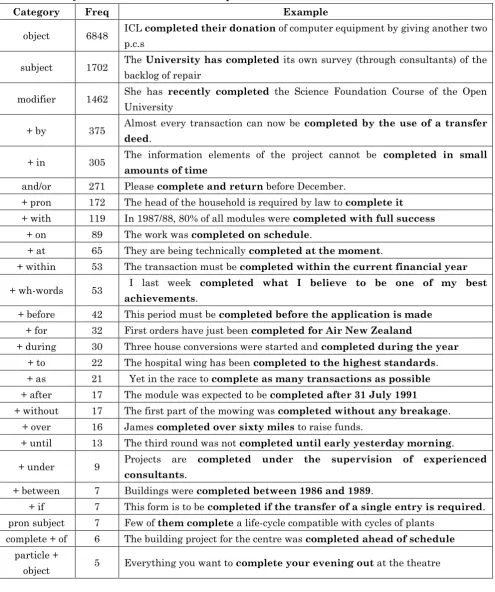
Syntactic patterns of complete and finish
Table 4: The syntactic behavior of verb complete in BNC
Category Freq Example
object 6848 ICL completed their donation of computer equipment by giving another two p.c.s
subject 1702 The University has completed its own survey (through consultants) of the backlog of repair
modifier 1462 She has recently completed the Science Foundation Course of the Open University
+ by 375 Almost every transaction can now be completed by the use of a transfer
deed.
+ in 305 The information elements of the project cannot be completed in small
amounts of time
and/or 271 Please complete and return before December.
+ pron 172 The head of the household is required by law to complete it
+ with 119 In 1987/88, 80% of all modules were completed with full success
+ on 89 The work was completed on schedule.
+ at 65 They are being technically completed at the moment.
+ within 53 The transaction must be completed within the current financial year
+ wh-words 53 I last week completed what I believe to be one of my best
achievements.
+ before 42 This period must be completed before the application is made
+ for 32 First orders have just been completed for Air New Zealand
+ during 30 Three house conversions were started and completed during the year
+ to 22 The hospital wing has been completed to the highest standards. + as 21 Yet in the race to complete as many transactions as possible
+ after 17 The module was expected to be completed after 31 July 1991
+ without 17 The first part of the mowing was completed without any breakage. + over 16 James completed over sixty miles to raise funds.
+ until 13 The third round was not completed until early yesterday morning.
+ under 9 Projects are completed under the supervision of experienced
consultants.
+ between 7 Buildings were completed between 1986 and 1989.
+ if 7 This form is to be completed if the transfer of a single entry is required. pron subject 7 Few of them complete a life-cycle compatible with cycles of plants
complete + of 6 The building project for the centre was completed ahead of schedule
particle +
object 5 Everything you want to complete your evening out at the theatre
Table 5: The syntactic behavior of verb finish in BNC
Categories Freq Example
object 3825 She wouldn't finish that sentence
pron subjects 2521 Let us finish by reminding ourselves of the traditional skills modifier 2211 you're nearly finished with your script
subject 2005 When the song finished we were both silent.
+ particles 428 Who would finish up as victor ludorum?
+ with 389 You have completely finished with a file or device for this program. particles + object 357 I've got to finish off this term's work
+ in 321 Come on and we'll finish in time.
and/or 239 We can continue and try and finish the business
+ at 182 It's easier to get if an afternoon meeting can finish at a reasonable time + on 104 She finished on a slightly bitter note.
+ wh-words 83 The drafter's job is not quite finished when the terms are drawn up. + by 72 It must be finished by Friday
+ of 36 Northampton's new Visitor Centre, the start and finish of our tour. + adj and noun 32 Swindon finished fifth Leicester sixth... on equal points
+ as 31 It was finished as a political force + for 26 He was finished for the day.
+ before 17 And these, too, he hastened to finish before September.
+ to 16 It's finished to a very high standard and the hardware is equally attractive + until 13 Thus it did not finish until two o'clock in the morning
+ within 12 The instruction cache unit will be finished within a week + after 11 Of the 102 starters, 81 finished after six days of hard driving. + till 8 The monument won't be finished till the millennium
+ under 7 Whether lambs from the first cross to be finished under hill conditions. + from 6 I think that's 26 minutes from start to finish from the bare canvas'. + over 6 Did he not get it finished over the weekend or samething?
+ about 5 We were finished about five minutes before
+ among 5 She and Genesis could well finish among the leaders.
It has to be noted that although the syntactic patterns of the two verbs are similar in many ways; there are also some differences in terms of specific collocational patterns. For example,
-ing object only collocates with finish and the prepositional word during is only used with
complete. In order to investigate more about the differences, we will use Word Sketch Difference of the software. The results will be presented in the following section.
Direct Comparison of Lexical and Grammatical collocates
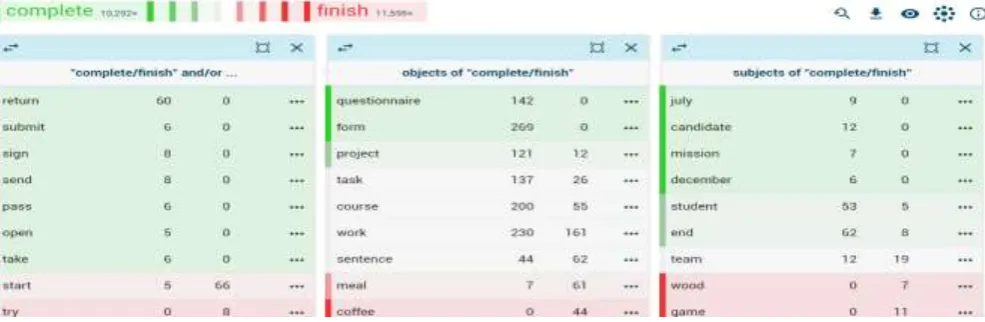
The Word Sketch Difference function of the software allows users to visually compare and contrast synonymous words according to their salient collocational context. Figure 7 is part of the result when clicking “GO” in Figure 6. In the figure, the greener a word is, the more closely it relates to complete. The redder a word is, the more closely it relates to finish.
Obviously, despite the fact that the two verbs
complete and finish have a lot of syntactic patterns in common, the collocates in each pattern differ considerably. For example, in “and/or” pattern, return frequently collocates with complete but never used with finish. On the other hand, complete occurs 66 times with
finish but only 5 times with finish, in which big discrepancy exists.
In the object pattern, the collocation tokens for complete are 6848 and only 3825 for finish, which indicates that there are more words used as object of complete. Words like
questionnaire, form, hat-trick, coupon,
transaction, cycle, circuit and operation only collocate with complete instead of finish. Words that refer to the food and drink like
sandwich, cake, supper, dinner, coffee, tea
only collocate with finish but are never used with complete.
Discussion
In the preceding sections, we have introduced how to use the corpus tool Sketch Engine to research the two synonymous verbs complete
and finish in English. Each function has both advantages and disadvantages. Concordance not only enables us to look at the linguistic context of the words under investigation but also presents their respective frequency as in Table 1, which helps to judge the comparability of the words. Concordance can also make the invisible patterns visible as wisely pointed out by Tognini-Bonelli [17].
“In an individual text, we can observe neither repeated syntagmatic relations nor any paradigmatic relations at all, but it is precisely these two things which concordance make visible”. Because it gives access to many important language patterns in texts, the concordance is considered “at the center of corpus linguistics” [18].
Given the fact that the concordance of both
complete and finish consist of nearly more than 10 thousands of concordance lines, it would be more valuable to generate a list of collocates which tend to occur near or next to
the verbs under investigation. Collocation plays a central role in the research of synonyms, as strongly articulated by Gries [11]: the meaning of words can be defined “in terms of their significant collocates”. Word Sketch enriches the traditional study of collocation by providing syntactic patterns and the collocates, as demonstrated in Figure 5 and Table 4 & 5. An apparent limitation is that when the words under investigation has more than one sense under a certain part of speech, the list generated by Sketch Engine would include the syntactic patterns that is irrelevant with the target meaning.
For example, one meaning of the verb finish
under investigation is “a decorative texture or appearance of a surface (or the substance that gives it that appearance)”. In prepositional phrases summarized by Word Sketch function of the software, some phrases occur when the verb is used with the meaning of decoration and perfection.
The process can be carried out during the normal dyeing and finishing of fabrics (BNC)
Just the three parts of the project, he wrote: the finishing of the glass, the showing of the glass, and the end. (BNC)
These concordance lines constitute noisy information for the precise comparison of
complete and finish in the study.
Word Sketch Difference may be the most straightforward method to discriminate between the synonymous words. Nevertheless, Word Sketch Difference alone is insufficient to demonstrate the semantic and syntactic features of the words under investigation.
In addition to what has mentioned above, using Word Sketch Difference will make the users fail to take a whole look at the collocates and syntactic patterns of synonyms as a whole. For example, we may lose the opportunity to observe and classify the nominal or adjective collocates of the words under investigation, which will help us to find the semantic prosody of the target item.
In a word, while using Word Sketch Difference alone can give the researchers a quick look at the apparent differences between synonyms in the light of both collocations and syntactic patterns, it would be rewarding to examine synonymous words by using other core functions of Sketch Engine.
It has to be pointed out the software Sketch Engine itself has some limitations. One apparent limitation is its automatic extraction of synonyms or similar words. In Figure 1, some synonymous words seem to have little similarity with the searched item.
Conclusion
Despite its intricacy, researching synonym is a crucial task in lexical semantics. This paper has introduced the leading corpus Sketch Engine and its advantages in investigating synonymous words. Different functions of Sketch Engine can make different contributions to discriminate between
complete and finish.
This study also has a lot of pedagogical implications. It has been noticed that students tended to confine their use of
complete into a limited scope such as complete
this dialogue/this form. In contrast, they tend to overuse finish because it tends to occur with more specific activities in our life such as food, drink, meal and some work in everyday life, which more frequently occurs in usage patterns.
Studies in language acquisition show that people memorize not only words in isolation, but also, to a large extent, groups (or chunks) of words. These chunks are viewed as building blocks of language. Thus, if EFL
teachers aim to help their students to achieve a great amount proficiency and fluency, they may hope to use examples extracted from corpus as in Table 4 & 5.
Due to the fact that English is so rich in synonymous words that the it is impossible for the teachers to teach all of them to the students. It might be more promising to teach the students how to use the Sketch Engine to investigate the synonymous words that are to their interests. This paper might provide a clear instruction to such investigation.
Acknowledgement
This work is sponsored by the Postgraduate Research Innovation Project of Guangdong University of Foreign Studies “A Corpus-based Comparative Study of English and Chinese Human Metaphor in Economic Discourse” (Project No.: 19GWCXXM-03).