© 2019 by the Serbian Biological Society How to cite this article: Radojević A, Mirčić D, Živić M, Perić-Mataruga V, Božanić 225 M, Stojanović K, Lukičić J, Živić I. Influence of trout farm effluents on selected
oxidative stress biomarkers in larvae of Ecdyonurus venosus (Ephemeroptera, Heptageniidae). Arch Biol Sci. 2019;71(2):225-33.
Influence of trout farm effluents on selected oxidative stress biomarkers in larvae of
Ecdyonurus venosus
(Ephemeroptera, Heptageniidae)
Anđelina Radojević1, Dejan Mirčić2, Miroslav Živić1, Vesna Perić-Mataruga3, Milenka Božanić1,
Katarina Stojanović1, Jovana Lukičić1 and Ivana Živić1,*
1Faculty of Biology, University of Belgrade, 11000 Belgrade, Serbia
2Department of Biomedical Sciences, State University of Novi Pazar, 36300 Novi Pazar, Serbia
3 Institute for Biological Research “Siniša Stanković”, University of Belgrade, 11060 Belgrade, Serbia
*Corresponding author: [email protected]
Received: December 20, 2018; Revised: January 29, 2019; Accepted: January 30, 2019; Published online: February 1, 2019
Abstract: The aim of the present study was to establish the extent to which the outlet waters of trout farms affect the ecosystems of the Crnica and Skrapež rivers in Serbia. We monitored selected biomarkers of oxidative stress: superoxide dismutase (SOD), glutathione peroxidase (GPx) and total glutathione (GSH) in larvae of the species Ecdyonurus venosus, and simultaneously analyzed the changes in the physical and chemical parameters. The investigations were carried out in spring at four localities along the Skrapež and Crnica rivers: one upstream (the control localities), and three downstream from the fish farm outlets. On the Skrapež River, the fish farm was clearly visible and was markedly changed by the chemical parameters of the water, manifested as a decreased concentration of dissolved oxygen, increased concentrations of nitrates, nitrites, ammonium ions, total phosphorus and total organic carbon, and increased SOD and GPx activities and decreased GSH concentration in larvae from the first downstream locality as compared to the control locality. On the Crnica River, due to the high values of water flow (around 3 m3/s), effluents from the fish farm had no effect on the chemical parameters of the water or on the tested biomarkers.
Keywords: antioxidant enzymes; biomarkers; Ecdyonurus venosus; organic pollution; oxidative stress
INTRODUCTION
Freshwater ecosystems are exposed to direct anthro-pogenic influence that negatively affects water quality and the ecological status of aquatic ecosystems [1]. The construction of dams and reservoirs modifies the flow of water, altering ecological characteristics [2]. Highland streams like the Skrapež and Crnica rivers are the least disturbed, primarily because of their inaccessibility [3]. In recent years, trout aquaculture has been observed to exert a strong influence on these sensitive aquatic ecosystems. With more intensive production in aqua-culture, there has been an increase in the amount of fish-food and waste material, including organic matter, nutrients and suspended solid materials in the water, which directly affects the concentration of oxygen, eutrophication, and turbidity [4-6].
In Serbia, there has been a constant increase in the number of trout farms. In the 10-year period up to 2000,
their number has doubled and annual production has reached as much as 2000 tons of fish [7]. Trout farms in Serbia occupy an area of about 14 ha [8], but it can be expected that this area will increase even as much as from three- to five-fold [9]. How this will affect the environment depends on the size of the fish farm, the presence and types of water purification systems, the composition and structure of fish food, and on the characteristics of the stream itself, such as slope, capacity and the number of tributaries [10]. Aquatic ecosystems need to be protected from the negative influence of trout farms by legislation. This is a prob-lem in developing countries where such regulation is inadequate or completely nonexistent [10]. To ensure effective legal regulation, it is necessary to conduct monitoring, which will give us an idea of the state of the aquatic ecosystems where fish farms are located.
limited mobility, high abundance and diversity, and their varying sensitivity to pollutants [11-13]. Larvae of Ephemeroptera are one of the most sensitive groups of macroinvertebrates [14]. They feed on detritus and are consequently very sensitive to changes in the sub-strate and to all toxic substances present. Moreover, the larvae are stenovalent in relation to water temperature, dissolved oxygen, pH, substrate type and river speed and size [15,16]. In aquatic organisms (including the larvae of Ephemeroptera), changes in the concentra-tions and activities of certain enzymatic antioxidants have been shown to be useful biomarkers of oxidative stress caused by pollutants [6,17-22]. These molecular biomarkers represent the most appropriate method of detecting the early influence of pollutants [18,23-26] and predicting their effects at the level of populations. They have wide application in the ecotoxicology of aquatic organisms exposed to various pollutants [27,28] and were therefore selected for the present research on the genus Ecdyonurus, which is one of the key bioindicators of water quality [29], and the species E. venosus, which is very sensitive to organic pollution that is especially pronounced downstream from trout farms.
In Serbia, among aquatic invertebrates, molecu-lar biomarkers of oxidative stress have mainly been analyzed in Mollusca and Crustacea [20-22,30-33]. As far as the influence of outlet waters of trout farms is concerned, investigators have to date mainly con-centrated their efforts on studying the structure of macrozoobenthic communities [3,10,34]. Investiga-tions of the effects of trout farms on aquatic insects at the molecular level are still in their infancy [6]. In view of these facts and because the number of trout farms in Serbia is constantly increasing, the timely detection of negative influence of pollutants on aquatic ecosystems is especially important in order to prevent chronic negative effects of outlet waters from fish farms. Therefore, the aim of this study was to investigate the influence of effluents from two trout farms on selected components of antioxidative defense in the larvae of E. venosus as a model organism sensitive to pollution.
MATERIALS AND METHODS Study area and sampling sites
Investigations into the influence of trout farms were carried out on the Crnica (CR) and Skrapež (SK)
rivers in April 2015 at four localities. One locality on both rivers (CR1, SK1) was upstream from the fish farm, while three localities (CR2, CR3, CR4; SK2, SK3, SK4) were downstream from it. Localities CR1 and SK1 represent the control localities above the fish farm. There is a trout farm with different production capacity on each of the rivers, a fact that makes them suitable for determination and comparison of the ef-fects of organic pollution on the antioxidative status of E. venosus larvae. For nutrition, both trout farms used extruded fish food (Skreting Optiline he 3p gal) with a low phosphate content (0.9 %) and 42-44% protein.
The Crnica River is one of the most significant right-hand tributaries of the River Morava. It is 28.6
km long and has a drainage area of 338 km2 [35]. The
“Sisevac” Fish Farm is located at the very source of the Crnica, at the foot of the Kučaj Mountains. With
a production area of 4200 m2, it has 43 concrete basins
of different dimensions arranged in five batteries. The
farm’s production capacityis 70 tons of consumer
rainbow trout. When the sampling was carried out in April 2005, the quantity of fish in the fish farm was 39.6 tons.
Locality CR1 was 250 m upstream from the fish farm, at latitude 43° 57ʹ 19.6ʹʹ N, longitude 21° 35’ 24.4ʹʹ E and elevation 348 m above sea level (a.s.l.). The second locality (CR2) was 20 m downstream from the outlet of water from the fish farm, at latitude 43° 57ʹ 17.8ʹʹ N, longitude 21° 34ʹ 55.1ʹʹ E, and elevation of 342 m a.s.l. At a distance of 400 downstream from the second locality, the third (CR3) was at 43° 57ʹ 16.7ʹʹ N, 21° 34ʹ 41.3ʹʹ E and 340 m a.s.l. Locality CR4 was 900 m downstream from locality CR3, at 43° 57ʹ 16.4’’ N, 21° 34ʹ 07.1ʹʹ E and 336 m a.s.l.
The Skrapež River is a left-hand tributary of the Đetinja (western Serbia). It is 47.7 km long and has a
drainage area of 647.65 km2 [35]. On the Skrapež, the
“Kraj Vodenice” Trout Farm is located in the wider region of the village of Radanovci on the left-hand bank of the river, about 2 km downstream from the spring Taorska Vrela. The fish farm consists of four independent basins, supplied with water by a 220-m-long concrete canal. Water from the fish farm is emp-tied into the recipient through a common canal that passes over a pre-settler and settler. The farm’s total
is 29 tons of trout. In April of 2015, the quantity of fish in the fish farm was 1 ton.
The control locality on the Skrapež River (SK1) was 180 m upstream from the fish farm at latitude 44° 04ʹ 00.8ʹʹ N, longitude 19° 50ʹ 13.3ʹʹ E, and elevation of 573 m a.s.l. Locality SK2 was 30 m downstream from the fish farm at the common channel, at 44° 03’ 55.9ʹʹ N, 19° 50ʹ 21.2ʹʹ E, and 566 m a.s.l. Locality SK3 was 300 m downstream from the second locality, at 44° 03’ 47.8ʹʹ N, 19° 50ʹ 28.6ʹʹ E and 552 m a.s.l. Locality SK4 was 300 m downstream from the third locality, at 44° 03ʹ 40.9ʹʹ N, 19˚ 50ʹ 28.1ʹʹ E and 550 m a.s.l.
Sample collection
At the investigated localities, from 20 to 25 larvae of Ecdyonurus venosus in stage IV were collected by quali-tative methods (using benthos sieves and tweezers) in April 2015. In the field, the larvae were put in a portable container with liquid nitrogen and transported to the laboratory, where the mass of each individual speci-men was measured using a balance with a precision of 0.0001 g (AE163, Mettler-Toledo International). From each locality prior to freezing in liquid nitrogen, five larvae were separated and fixed with 96% alcohol for later identification. Identification was performed us-ing a Zeiss Discovery V8 instrument and a Celestron CELE-822477 stereomicroscope, in addition to the key for identification [36].
Analysis of physical and chemical parameters
The following basic physical and chemical parameters of the water were measured with the aid of a MULTI 340i/SET device (WTW, Germany) directly in the field: temperature (wt), pH, electroconductivity (ec) and dissolved oxygen concentration (DO) and saturation (DO%). Measurements at all localities were performed between 12:00 pm and 1:00 pm by immersing the corresponding electrodes 0.05 m below the water surface. Water flow rates (Q) were calculated from the cross-sectional area and longitudinal velocity data for every sampling site. The cross-sectional area was first determined by depth (d) and width (w) measure-ments and then divided into vertical sections where river velocity (v) was measured using a GEOPACKS Stream Flowmeter (Geopacks, UK). Total flow was
computed by summing the flow increments for all the vertical sections [3].
At every locality, water samples for laboratory analysis were taken with the aid of 500-mL polyeth-ylene bottles, which were immersed 30 cm below the water surface against the current. In a laboratory of the Agency for Environmental Protection, the following chemical parameters were analyzed using methods prescribed by standards (SRPS ISO/IEC 17025:2006, ISO/IEC 17025:2005, http://www.sepa.gov.rs):
con-centrations of anions (SO42-, NO
2-, NO3-, PO43-, HCO3-,
and Cl-); concentrations of cations (Ca2+, Mg2+, NH
4+,
Na+, and K+); the content of organic nitrogen (N
org),
total nitrogen (Nt) and total phosphorus (Pt); total
water hardness (WH); alkalinity (al); total alkalinity
(alt); biological oxygen demand (BOD5); chemical
oxygen demand (COD); and the content of total or-ganic carbon (TOC).
Preparation of homogenates for biomarker analysis
Homogenates of whole larvae were used to determine components of antioxidative defense. Larvae were homogenized on ice in sucrose buffer (pH 7, 100 mg/2 mL) using an Ultra-Turrax homogenizer (IKA-Werke, Staufen, Germany) for 3 x 10 s at 2000 rpm followed by 3 x 15 s sonication steps using a 50-W sonifier (Bandelin Sonopuls HD2070, Berlin, Germany). After centrifugation at 105000 x g and 4°C (Beckman L7-55 ultracentrifuge, Beckman, Nyon, Switzerland), the supernatant was separated and kept at -24°C until use. The number of replications were as follows: n=5 at SK2, n=7 at SK1, n=8 at SK4 and CR2, n=9 at CR1 and CR4, n=10 at SK3 and n=11 at CR3.
Determination of protein concentration and enzymatic activity
10% sulfosalicylic acid, and GSH was measured after centrifugation for 20 min at 10000 x g and 4°C (using a Model 5417R instrument from Eppendorf, Hamburg, Germany) by the Griffith (1980) method [40].
Statistical analyses
Data were expressed as the mean±standard error. The values of enzyme activities and GSH concentrations were compared statistically using one-way ANOVA followed by the post hoc Fisher least significant dif-ference (LSD) test. In order to meet the assumption of equal variance, data were log(x+1) transformed prior to one-way ANOVA. Pearson’s product mo-ment correlation was used to measure the strength of association among pairs of variables. Results were considered to be statistically significant at P<0.05. One-way ANOVA and determination of the Pearson product moment correlation were performed with the
aid of Sigma Plot 12 software (Systat Software Inc., USA). Principal component analysis (PCA) of the cor-relation matrix was used to describe the cor-relationship between environmental parameters at the investigated localities, and was performed with the aid of XLSTAT (version 7.5.2) software (Addinsoft).
RESULTS
Influence of the trout farms on the abiotic parameters of the water
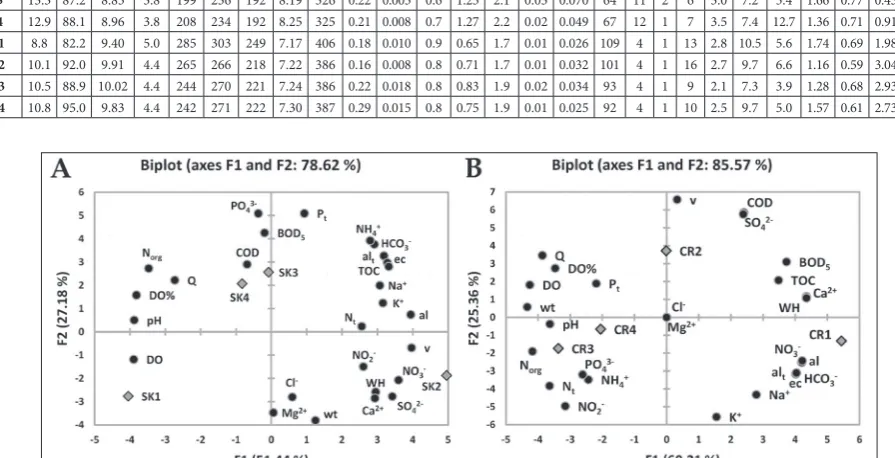
The values of abiotic parameters of the water in the Skrapež and Crnica rivers are given in Table 1. PCA of abiotic parameters of the water at the investigated localities on the Skrapež River (Fig. 1A) revealed a clear influence of the fish farm, since the locality upstream from the fish farm (control locality, SK1) and the one
Table 1. Values of abiotic parameters of the water at localities along the Skrapež (SK1, SK2, SK3 and SK4) and Crnica (CR1, CR2,CR3 and CR4) rivers.
wt
(°C)
D
O%
(%)
DO (mg/l) al (mm
ol/l)
WH
(m
g/l)
HC
O3
- (m
g/l)
alt
(m
g/l)
pH ec (µS/cm) NH
4
+ (m
g/l)
NO
2
- (m
g/l)
NO
3
- (m
g/l)
Norg
(m
g/l)
Nt
(m
g/l)
PO
4
3- (m
g/l)
Pt
(m
g/l)
Ca
2+ (m
g/l)
Mg
2+ (m
g/l)
Cl
- (m
g/l)
SO
4
2- (m
g/l)
BOD
5
(m
g/l)
TO
C
(m
g/l)
COD
(m
g/l)
Na
+ (m
g/l)
K
+ (m
g/l)
Q
(m
3/s)
v
(m/s)
SK1 13.4 88.7 9.28 3.7 204 224 184 8.28 323 0.10 0.006 0.6 1.24 2.1 0.01 0.017 66 12 2 7 2.7 6.0 5.3 1.25 0.70 0.60 0.28 SK2 13.5 82.4 8.60 3.9 218 235 193 8.09 326 0.21 0.009 1.1 0.83 2.2 0.01 0.035 71 12 2 17 2.8 7.6 5.1 1.62 0.77 0.16 0.70 SK3 13.3 87.2 8.85 3.8 199 236 192 8.19 326 0.22 0.005 0.6 1.25 2.1 0.03 0.070 64 11 2 6 3.0 7.2 5.4 1.66 0.77 0.43 0.42 SK4 12.9 88.1 8.96 3.8 208 234 192 8.25 325 0.21 0.008 0.7 1.27 2.2 0.02 0.049 67 12 1 7 3.5 7.4 12.7 1.36 0.71 0.91 0.39 CR1 8.8 82.2 9.40 5.0 285 303 249 7.17 406 0.18 0.010 0.9 0.65 1.7 0.01 0.026 109 4 1 13 2.8 10.5 5.6 1.74 0.69 1.98 0.70 CR2 10.1 92.0 9.91 4.4 265 266 218 7.22 386 0.16 0.008 0.8 0.71 1.7 0.01 0.032 101 4 1 16 2.7 9.7 6.6 1.16 0.59 3.04 1.01 CR3 10.5 88.9 10.02 4.4 244 270 221 7.24 386 0.22 0.018 0.8 0.83 1.9 0.02 0.034 93 4 1 9 2.1 7.3 3.9 1.28 0.68 2.93 0.70 CR4 10.8 95.0 9.83 4.4 242 271 222 7.30 387 0.29 0.015 0.8 0.75 1.9 0.01 0.025 92 4 1 10 2.5 9.7 5.0 1.57 0.61 2.73 0.64
Fig. 1. Influence of trout farms on abiotic parameters of water. Correlation matrix principal component analysis (PCA) biplot of the hydrological and water chemistry parameters (black circles; codes are presented in the Material and
immediately downstream from it (SK2) are on opposite sides of the F1 axis, which explains the greatest part of variability (51%), while the other two downstream localities (SK3 and SK4) are between them, indicating recovery from the influence of the fish farm. Therefore, values of abiotic parameters of the water located at the positive end of the F1 axis increased and those located at its negative end decreased at locality SK2 when compared to the control locality (Table 1). The most pronounced changes in abiotic parameters of the water at SK2 compared to SK1 were a decrease in
DO and increases in NO2-, NO
3-, SO42-, NH4+, Pt and
TOC (Table 1, Fig. 1A).
In the case of the Crnica River, PCA showed no visible influence of the fish farm on the chemical pa-rameters of the water (Fig. 1B), since the investigated localities are arranged along the F1 axis, which again explains the bulk of variability (60%) in a regular downstream series from CR1 at the positive end of the axis to CR3 and CR4 at its negative end.
One of the most pronounced differences in the abiotic parameters of the water between two rivers, which could account for the differences in the trout farms’ influence observed by PCA, is in the water flow that is several times higher in the Crnica River as compared to the Skrapež River (Table 1).
Influence of the trout farms on selected components of antioxidative defense
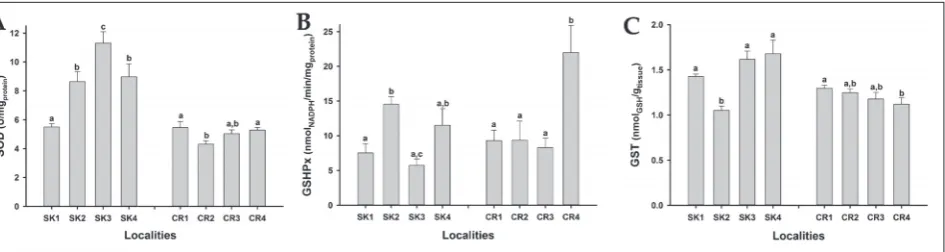
On the Skrapež, the influence of the trout farm on the activity of the tested molecular biomarkers in the
larvae of E. venosus mimicked the described effects on the chemistry of the water (Fig. 2). Thus, ANOVA showed that in the cases of all three molecular markers, statistically significant variation occurred between the investigated localities as follows: F=14.00, P<0.001 for activity of SOD; F=5.94, P=0.003 for activity of GPx; and F=7.28, P=0.001 for the concentration of total GSH in the larvae. Moreover, the Fisher LSD test used to compare pairs of localities indicated that in the cases of all three molecular markers a difference exists between SK1 and SK2. As regards SOD and GPx, there was an increase in activity at SK2 (Fig. 2A, B), whereas the concentration of GSH declined at SK2 (Fig. 2C), which clearly indicates that the observed statistically significant changes were the consequence of the action of the trout farm. In the case of SOD, the increase continued at SK3 (P=0.037), while at SK4, a statistically significant decline was observed in relation to SK3 (P=0.026) (Fig. 2A). Such changes in SOD activity are in strong posi-tive correlation with changes in the total phosphorus concentration (R=0.971, P=0.029). The activity of GPx declined at SK3 (P<0.001) and increased again at SK4 (P=0.009) (Fig. 2B), which correlates with the changes in nitrite concentration (R=0.995, P=0.005) and total water hardness (R=0.973, P=0.027). The concentration of GSH at SK3 and SK4 returned to the values recorded at the control locality (Fig. 2C).
On the Crnica River, ANOVA (Fig. 2) revealed statistically significant variation between the investi-gated localities only in the case of GPx activity (F=5.00, P=0.006), while such variation was absent in the cases of SOD activity and GSH concentration. The activity
Fig. 2. Influence of trout farms on selected components of antioxidative defense. Activities of SOD (A) and GPx (B), and the
concentra-tions of total GSH (C) in Ecdyonurus venosus at the investigated localities along the Skrapež (SK1, SK2, SK3, and SK4) and Crnica (CR1,
of GPx was practically identical at the first three lo-calities, but increased markedly at locality CR4 (Fig. 2B), which cannot be a consequence of the action of the trout farm.
DISCUSSION
The products of fish metabolism, remains of food, and dissolved nutrients from fish farms are the main pollutants released by them [41], and they represent one of the most frequent problems in pollution of the recipient [42]. Only about 30% of fish food is trans-formed into biomass of the object of aquaculture, while the remainder flows into the recipient and constitutes the most important parameter when considering the influence of a fish farm on an aquatic environment [43,44]. In view of this and the fact that certain amounts of phosphorus and nitrogen (which fish food contains) can cause eutrophication, in the present study, for comparison of the effects of trout farms with differ-ent production capacities, we selected the same type of fish food (see Materials and Methods). Enzymes of the antioxidative defense system (SOD and GPx), and total GSH were used as biomarkers.
In the present study, the influence of outlet waters from the fish farm on abiotic parameters of the water was recorded only in the case of the Skrapež River.
The greatest increases in NO2-, NO
3-, SO42-, NH4+, Pt
and TOC concentrations were recorded directly below the fish farm at locality SK2, where its influence was the most noticeable.
SOD is an effective and sensitive biomarker and a reliable indicator of oxidative stress and the negative effects of various toxins [6], and it is considered to be the first line of defense against the harmful action of reactive oxygen species (ROS) [45,46]. GPx is an
enzyme responsible for the reduction of H2O2 and
elimination of organic hydroperoxides [47]. It is of
key significance to the detoxification of H2O2 when
the latter is present in low concentrations, whereas saturation of GPx by the substrate occurs at high
concentrations of H2O2 [33,48].
We analyzed the changes in the activities of both enzymes in E. venosus under the influence of waste waters from the trout farms. The results of this test-ing indicate that the activities of both SOD and GPx
were increased at locality SK2 on the Skrapež River, where the fish farm’s influence was most pronounced, whereas an opposite trend in the activities of these two enzymes was in evidence at localities SK3 and SK4. At locality SK2, where the strongest influence of the fish farm was manifested, a rapid increase in the concentration of the superoxide radical probably occurred because of the powerful influence of the en-vironmental stressor, which caused the activity of SOD to increase. Vranković et al. [20] also noticed a similar phenomenon, namely increased activity of SOD in the species Holandriana holandrii, indicating the presence of an increased concentration of the superoxide radical. However, in our study the increased activity of SOD probably was not effective enough to rapidly detoxify the increase in concentration of this radical. It can be
concluded from this that the concentration of H2O2 was
not excessively high and that the increased activity of GPx was sufficient for its elimination at locality SK2. At locality SK3 the activity of SOD increased, which
led to an increase in the concentration of H2O2 and
decreased GPx activity. Such a hypothesis is based on the results obtained by Łukaszewicz-Hussain and Moniuszko-Jakoniuk (2004) [48] when examining the changes in the activities of GPx, GR and CAT, and GSH
and H2O2 concentrations in the liver of rats after acute
intoxication with an organophosphate insecticide. The authors noted a statistically significant negative
cor-relation between H2O2 concentration and GPx activity.
Thus it is possible to explain the correlation of SOD and GPx activities at all localities on the Skrapež River investigated in the present study.
while changes in GPx activity correlate with changes in nitrite concentration. It can therefore be concluded that these chemical parameters of the water exert a strong influence on the activities of the investigated enzymes of E. venosus larvae in the Skrapež River. This is also supported by the results of Kelso et al. [49], who con-ducted nitrite toxicity tests on the genera Ephemerella and Hexagonia and reported that both genera exhib-ited high sensitivity. They were also among the most sensitive to nitrite toxicity in comparison with other tested macroinvertebrates [50]. Additionally, values
of Pt between 0.01 and 0.02 mg/L are considered to
be critical levels [51] above which eutrophication is accelerated in surface waters, and they were exceeded at all three localities on the Skrapež River downstream from the trout farm, making it a good candidate for a prime stressor that caused changes in SOD activity.
The metabolism of reduced GSH is one of the main antioxidative defense mechanisms of living organisms [46]. For its realization, GPx utilizes low-molecular-weight thiols such as GSH [51], which can explain the decrease in its concentration in the Skrapež River at locality SK2, since the activity of GPx was signifi-cantly elevated. Despotović et al. [32] also noted that a decrease in GSH concentration was in positive cor-relation with the increase in GPx activity in snails of the species Viviparus acerosus.
In the case of the Crnica River, in contrast to the Skrapež River, the influence of the fish farm on the abiotic parameters of water and tested molecular bio-markers was lacking.
Comparing the results obtained on the two inves-tigated rivers, it is clear that the characteristics of the watercourse have a very significant role in determining the influence of the fish farms on macrozoobenthic organisms. The absence of effects of the fish farm on abiotic parameters of the water and the investigated molecular markers in the Crnica River is a consequence of increased water flow. At the time of sample taking, the Crnica was characterized by very high values of water flow because of which the influence of the fish farm was reduced to below the limits of sensitivity of the analyzed biomarkers. Also, it is known that the influence of fish farms is inversely proportional to the water flow in streams [3]. In comparison with the Crnica, the water flow in the Skrapež River was significantly lower, and
influence of the fish farm on both chemical parameters and molecular markers was clearly discernible.
On the basis of the obtained results, it can be con-cluded that the trout farm on the Skrapež River exerted a mild but clear influence on both the water chemistry parameters in the receiving watercourse and the tested molecular biomarkers in the larvae of E. venosus, whereas such effects were lacking in the case of the trout farm on the Crnica River, probably because of the high water flow. Therefore, the changes in GPx, SOD and GSH in E. venosus proved to be reliable and sensitive biochemical biomarkers of environmental stress caused by the trout farm effluents, making this species an excellent bioindicator of freshwater pollution.
Funding: The study was supported by the Serbian Ministry of Education, Science, and Technological Development (Project No. TR 31075).
Author contributions: Anđelina Radojević, Vesna Perić-Mataruga and Ivana Živić designed the study. Anđelina Radojević, Miroslav Živić, Milenka Božanić, Katarina Stojanović, Jovana Lukičić and Ivana Živić collected the samples in the field. Dejan Mirčić, Vesna Perić-Mataruga and Anđelina Radojević determined antioxidative enzyme activities. Miroslav Živić, Anđelina Radojević and Dejan Mirčić analyzed the obtained data. All authors participated in the interpretation of the data and critical revision of the manuscript. Anđelina Radojević and Ivana Živić wrote the paper and are re-sponsible for its final content. All authors contributed sufficiently to the work to be included as coauthors, and approved final ver-sion of manuscript.
Conflict of interest disclosure: The authors do not have a conflict of interest to disclose.
REFERENCES
1. Søndergaard M, Jeppesen E. Anthropogenic impacts on lake and stream ecosystems, and approaches to restoration.
J Appl Ecol.2007;44:1089-94.
2. Benetti CJ, Pérez-Bilbao A, Garrido J. Macroinvertebrates as indicators of water quality in running waters: 10 years of research in rivers with different degrees of anthropogenic
impacts. In:Voudouris K, editor. Ecological water quality
- water treatment and reuse. Rijeka:InTech Press; 2012. p.
95-125.
3. Stojanović KZ. Uticaj pastrmskih ribnjaka na zajednice mak-rozoobentosa tekućica sa posebnim osvrtom na larve roda
Baetis (Ephemeroptera, Insecta). [dissertation]. [Belgrade]:
University of Belgrade, Faculty of Biology; 2017. 375 p. 4. Lin CK, Yi Y. Minimizing environmental impacts of
5. Pulatsu S, Rad F, Aksal G, Aydin F, Benil AC, Topcu A. The impact of rainbow trout farm effluents on water quality of Karasu stream, Turkey. Turk J Fish Aquat Sci. 2004;4:9-15. 6. Mirčić D, Stojanović K, Živić I, Todorović D, Stojanović D,
Dolićanin Z, Perić-Mataruga V. The trout farm effect on Dinocras megacephala (Plecoptera: Perlidae) larvae: Anti-oxidative defense. Environ Toxicol Chem. 2016;35:1775-82. 7. Marković Z, Poleksić V, Mitrović Tutundžić V. Aquaculture
in Serbia. In: Marković Z, editor. III International Confer-ence “Fishery”; 2007 Feb 1-3; Belgrade, Serbia. Belgrade (Serbia): Faculty of Agriculture University of Belgrade; 2007. p. 35-40.
8. Marković Z, Poleksić V. Ribarstvo u Srbiji (Fishery in Ser-bia). Belgrade Serbia: Prof. dr Zoran Marković, Beograd, Srbija. 2011. 289 p. Serbian
9. Marković Z, Stanković M, Dulić Z, Živić I, Rašković B, Spasić M, Poleksić V. Aquaculture and fishery in Serbia-status and potentials. In: Marković Z, ed. V International conference Aquaculture & Fishery, 2011 Jun 1-3; Belgrade, Serbia. Belgrade (Serbia): Faculty of Agriculture University of Belgrade; 2011, p. 36-40.
10. Živić I, Marković Z, Filipović - Rojka Z, Živić M. Influence of a trout farm on water quality and macrozoobenthos com-munities of the receiving stream (Trešnjica River, Serbia). Int Rev Hydrobiol. 2009;94:673-87.
11. Soofiani NM, Hatami R, Hemami MR, Ebrahimi E. Effects of trout farm effluent on water quality and the macrobenthic invertebrate community of the Zayandeh-Roud River, Iran.
North Amer J Aquacult.2012;74:132-41.
12. Kripa PK, Prasanth KM, Sreejesh KK, Thomas TP. Aquatic macroinvertebrates as bioindicators of stream water qual-ity - a case study in Koratty, Kerala, India. Res J Recent Sci. 2013;2:217-22.
13. Uherek CB, Gouveia, PBF. Biological monitoring using mac-roinvertebrates as bioindicators of water quality of Maroaga stream in the Maroaga Cave System, Presidente Figueiredo, Amazon, Brazil. Int J Ecol. 2014;2014: 308149.
14. Lock K, Goethals PLM. Distribution and ecology of the mayflies (Ephemeroptera) of Flanders (Belgium). Int J Lim-nol. 2011;47:159-65.
15. Landa V, Soldán T. Mayflies as bioindicators of water quality and environmental change on a regional and global scale. In: Corkum LD, Ciborowski JJH, editors. Current Directions in Research on Ephemeroptera. Toronto, Canada: Canadian Scholars’ Press, Inc.; 1955. p. 21-9.
16. Alhejoj A, Salameh E, Bandel K. Mayflies (Order Ephemer-optera): an effective indicator of water bodies conditions in Jordan. IJSRES. 2014;2:361-70.
17. Winston GW, Di Giulio RT. Prooxidant and antioxi-dant mechanisms in aquatic organisms. Aquat Toxicol. 1991;19:137-61.
18. Valavanidis A, Vlahogianni T, Dassenakis M, Scoullos M. Molecular biomarkers of oxidative stress in aquatic organ-isms in relation to toxic environmental pollutants. Ecotoxi-col Environ Saf. 2006;64:178-89.
19. Stoliar OB, Lushchak VI. Environmental pollution and oxi-dative stress in fish. In: Lushchak VI, editor. Oxioxi-dative stress - environmental induction and dietary antioxidants. Rijeka, Croatia: InTech,; 2012. p 132-66.
20. Vranković J, Labus-Blagojević S, Csanyi B, Makovinska J, Cvetković O, Gačić Z, Blagojević D, Paunović M. Antioxi-dant enzymes and GST activity in natural populations of
Holandriana holandrii from the Bosna River. Turk J Biol.
2012;36:477-85.
21. Vranković J.Environmental impact on the antioxidant
responses in Corbicula fluminea (Bivalvia: Veneroida:
Corbi-culidae) from the Danube River. Ital J Zool 2015;82:378-86. 22. Vranković J. Age-related changes in antioxidant and glu-tathione S-transferase enzyme activities in the Asian clam. Biochem (Mosc). 2016;81:339-49.
23. Lam PKS, Gray JS. The use of biomarkers in environmental monitoring programmes. Mar Pollut Bull. 2003;46:182-86. 24. Choi J. Biomarkers in environmental monitoring and its
application in Chironomus spp. In: Hong SK, Lee JL, Ihm
BS, Farina A, Son Y, Kim ES, editors. Ecological issues in a changing world - status, response and strategy. Dordrecht: Springer; 2004. p. 203-15.
25. Conti ME. Biomarkers for environmental monitoring. In: Conti ME, editor. Biological monitoring: Theory and appli-cations. Wit Press; 2008; p. 25-46.
26. Hook SE, Gallagher EP, Batley GE. The Role of Biomark-ers in the Assessment of Aquatic Ecosystem Health. Integr Environ Assess Manag. 2014;10:327-41.
27. Livingstone DR. Contaminant-stimulated reactive oxygen species production and oxidative damage in aquatic organ-isms. Marine Poll Bull. 2001;42:656-66.
28. Livingstone DR. Oxidative stress in aquatic organisms in relation to pollution and aquaculture. Rev Med Vet. 2003;154:427-30.
29. Walsh A. Reference conditions and eutrophication impacts in Irish Rivers: Meeting the requirements of the water frame-work directive (2000-FS-2-M1): synthesis report. Wexford Ireland: Environmental Protection Agency. 2005; 353 p. 30. Borković SS, Šaponjić JS, Pavlović SZ, Blagojević DP,
Milošević SM, Kovačević TB, Radojičić RM, Spasić MB, Žikić RV, Saičić ZS. The activity of antioxidant defence
enzymes in mussel (Mytilus galloprovincialis) from the
Adriatic Sea. Comp Biochem Physiol C Toxicol Pharmacol. 2005;141:366-74.
31. Šaponjić, JS, Borković SS, Kovačević TB, Pavlović SZ, Labus-Blagojević SD, Labus-Blagojević DP, Saičić ZS, Radojičić RM, Žikić RV, Spasić MB. Activity of antioxidant defense enzymes in
Mediterranean sea shrimp (Parapenaeus longirostris):
rela-tion to the presence of PCBs and PAHs in the south Adriatic
Sea. Period Biol.108:2006;117-25.
32. Despotović SG, Perendija BR, Gavrić JP, Borković-Mitić SS, Paunović MM, Pavlović SZ, Sajčić ZS. Seasonal changes
in oxidative stress biomarkers of the snail Viviparus
ace-rosus from the Velika Morava river, Serbia. Arch Biol Sci.
2012;64:953-62.
33. Vranković Ј, Slavić M. Biomarker responses in Corbicula
fluminea to the presence of dioxin-like polychlorinated
biphenyls and seasonal changes. Ecol Indic. 2015;48:99-106. 34. Bjelanović K, Živić I, Dulić Z, Živić M, Đorđević J,
Serbia. Belgrade (Serbia): Faculty of Agriculture University of Belgrade; 2013. p. 349-57.
35. Gavrilović Lj, Dukić D. Reke Srbije. Belgrade Serbia: Zavod za udžbenike i nastavna sredstva; 2002. 218 p. Serbian. 36. Bauernfeind E, Soldan T. The Mayflies of Europe
(Ephem-eroptera). Ollerup, Denmark: Apollo Books. 2012. 781 p. 37. Bradford MM. Arapid and sensitive method for the quantity
of microgram quantities of protein utilizing the principle of
protein - dye binding. Anal Biochem.1976;72:248-54.
38. Misra HP, Fridovich I. The role of superoxide anion in the antioxidation of epinephrine and a simple assay for
superox-ide dismutase. J Biol Chem. 1972;247:3170-175.
39. Tamura M, Oschino N, Chance B. Some characteristics of hydrogen and alkyl-hydroperoxides metabolizing systems in cardiac tissue. J Biochem. 1982;92:1019-31.
40. Griffith OW. Determination of glutathione and glutathione disulfide using glutathione reductase and 2-vinylpyridine. Anal Biochem. 1980;106:207-12.
41. Namin JI, Sharifinia M, Makrani AB. Assessment of fish farm effluents on macroinvertebrates based on biological indices in Tajan River (north Iran). CJES. 2013;11:29-39. 42. Boyd CE. Guidelines for aquaculture effluent management
at the farm-level. Aquaculture.2003;226:101-12.
43. Cho CY, Bureau DP. A review of diet formulaon strategies and feeding systems to reduce excretory and feed wastes in aquaculture. Aquacult Res. 2001;32:349-60.
44. Moraes MAB, Carmo CF, Tabata YA, Vaz-Dos-Santos AM, Mercante CTJ. Environmental indicators in effluent
assess-ment of rainbow trout (Oncorhynchus mykiss) reared in raceway system through phosphorus and nitrogen. Braz J
Biol.2016;76:1021-8.
45. Birben E, Sahiner UM, Sackesen C, Erzurum S, Kalayci O. Oxidative Stress and Antioxidant Defense. World Allergy Organ J. 2012;5:9-19.
46. Shonouda ML, El-Samad LM, Mokhamer H, Toto N. Use of oxidative stress and genotoxic biomarkers of aquatic beetles
Anaceana globulus (Coleoptera: Hydrophilidae) as
biomoni-tors of water pollution. J Entomol. 2016;13:122-31. 47. Fridovich I. Superoxide anion radical (OFormula2),
superoxide dismutases, and related matters. J Biol Chem. 1997;272:18515-7.
48. Łukaszewicz-Hussain A, Moniuszko-Jakoniuk J. Liver cata-lase, glutathione peroxidase and reductase activity, reduced glutathione and hydrogen peroxide levels in acute intoxica-tion with chlorfenvinphos, an organophosphate insecticide. Pol J Environ Stud Polis. 2004;13:303-9.
49. Kelso BHL, Glass DM, Smith RV. Toxicity of nitrite in fresh-water invertebrates. In: Wilson WS, Ball AS, Hinton RH, editors. Managing risks of nitrates to human and the envi-ronment. Cambridge: Royal Society of Chemistry; 1999. p. 175-88.
50. Alonso A, Camargo JA. Toxicity of nitrite to three species of freshwater invertebrate. Environ Toxicol. 2006;21:90-4. 51. Daniel TC, Sharpley AN, Lemunyon JL. Agricultural