ISSN:1991-8178
Australian Journal of Basic and Applied Sciences
Journal home page: www.ajbasweb.com
Corresponding Author: M. Yusoff, Anisa, PHd candidate, University of Malaysia Pahang, Faculty of Industrial Management, Lebuhraya Tun Razak, 26300 Gambang Kuantan Pahang Darul Makmur, Malaysia. Tel No: +6095444575, Email: [email protected]
Product-Service Success: The Linkage of Knowledge Exploration-Exploitation,
Integration Capabilities and Knowledge Creation Process
1M. Yusoff, Anisa and 2Azizan, N. Azlinna
1PHd candidate, University of Malaysia Pahang, Faculty of Industrial Management, Lebuhraya Tun Razak, 26300 Gambang Kuantan Pahang Darul Makmur, Malaysia.
2Professor, University of Malaysia Pahang, Faculty of Industrial Management, Lebuhraya Tun Razak 26300 Gambang, Kuantan Pahang Darul Makmur, Malaysia.
A R T I C L E I N F O A B S T R A C T Article history:
Received 3 October 2015 Accepted 10 October 2015 Published Online 13 November 2015
Keywords:
Knowledge creation, knowledge exploration, exploitation, Product-service, knowledge integration capabilities, product-service success.
Background: This study emphasizes the balance of exploring customer knowledge and exploiting existing product-service knowledge; and knowledge integration capabilities to enhance knowledge creation activities during Product-service development, to improve product-service success. Objective: The study investigates the effect of balancing customer knowledge exploration (KR) and firm exploitation of previous product-service knowledge (KT) on knowledge creation activities (KC) during new Product-Service development (NPSD). The study also examines how firm capabilities in terms of knowledge integration (KI) enhance the relationship between KR, KT and KC. Finally, the study discusses how the KCP in NPSD enhance product-service success (PSS). Results: The study main findings are the importance of capturing customer knowledge, and integrate them with employee’s previous experiences to create more new and innovative knowledge. Having knowledge integration capabilities may enhance knowledge creation activities and lead to product-service success. Conclusion: The paper has two contributions: first, it offers novel views of how equally contribution of KR and KT enhance new knowledge creation during NPSD and PSS. Second, how KI capabilities assist firm to enhance new knowledge creation; and third the study demonstrates the four factors of KR, KT, KI, and KC are well predictors of integrated product-service success.
© 2015 AENSI Publisher All rights reserved. To Cite This Article: M. Yusoff, Anisa and Azizan, N. Azlinna., Product-Service Success: The Linkage of Knowledge Exploration-Exploitation, Integration Capabilities and Knowledge Creation Process. Aust. J. Basic & Appl. Sci., 9(34): 154-161, 2015
INTRODUCTION
The integrated product-service (PS) has a long-term business relationship with customers, as customer will involve directly during consumption phase. A new PS is developed through specific activities by converting a market demand into a required product by capturing, understanding and integrating customer demand into integrated products and services (Ueda, Takenaka, Váncza, & Monostori, 2009). For example, customer's experience are explored to improve existing firm core product concept and manufacturing capabilities and also reduce the needs for service throughout the product consumption phase. In addition, PS focus on lengthening the durability of a PS which in turn reduce material/resource usage but at the same time maintain the quality (Mont, 2002). Subsequently, PSS enhance customer value (Kang & Snell, 2007), and generate more profit (Husted & Allen, 2009; Zhang & Wang, 2010). However, designing and developing a new PS is not an easy task due its
systemic characteristics, and actors involved (Kimita, Shimomura, & Arai, 2009; Pezzotta, Cavalieri, & Gaiardelli, 2012).
listed but not limited to the following (see e.g. Ahmed-Kristensen & Vianello, (2014); Baxter, Roy, Doultsinou, Gao, & Kalta, (2009); Leary (2001); Roy
et al. (2014); Dongmin Zhang et al. (2012)). Issues
from a different stage of product development are crucial input for PSS design, as customers or the designers’ experiences can be transferred to facilitate future product improvements (Ahmed-Kristensen & Vianello, 2014). This study highlights two issues regarding customer knowledge and firm internal knowledge. First, although customer knowledge from use-phase and retirement stage are relevant for design phase, product designer seldom acquires adequate knowledge from service engineer, which result to inadequate of knowledge transfer between the two teams (Ahmed-Kristensen & Vianello, 2014). Second, although crucial ideas from the customer are captured, and firm skills and experiences are enormous, that knowledge has less impact if they cannot be converted, integrated, applied and shared. New knowledge captured with highly tacit knowledge will lead to knowledge conversion process. Since new knowledge is the source of innovation, it is crucial to interpreting knowledge obtained and integrate with firm’s owned knowledge to improve current product design and its capabilities. The previous research has proven knowledge creation process affect new product development (Jing & Yang, 2010; Richtnér & Åhlström, 2010; Wan Zaaimuddin, Goh, & Eze, 2009; Winegard, 2010) product success (Schulze & Hoegl, 2005), service quality (Tseng, 2012) and co-creation for new product development (Kohlbacher, 2008). However, those study related knowledge creation and product development focus on the development of traditional product or service instead of the integration of both into one final solution. Furthermore, although there are many literatures admitting exploration of new knowledge from customers is crucial, knowledge requires for new product-service keep changing, thus fast access to the existing knowledge is much easier than creating a new one. As such, it is important to make clear the impact of both learning in product-service towards creating new knowledge.
During new product development, existing knowledge from other departments such as service department is seldom integrated with the design department, hence latest updates and changes captured during service consumption are unexploited. With adequate resources and support, supposedly firm will not face difficulty to create new knowledge. However, the absence of integration capabilities may reduce the relationship strength between knowledge exploration-exploitation and knowledge creation, which competitors may take advantage over the firm’s weakness.
This article investigates the effect of balancing customer knowledge exploration (KR) and firm exploitation of previous product-service knowledge
(KT) on knowledge creation activities (KC) during new Product-Service development (NPSD). This study also examines how firm capabilities in terms of knowledge integration (KI) capabilities enhance the relationship between KR, KT and KC. Finally, the study discusses how the KCP in NPSD enhance product-service success (PSS). The paper has two contributions: first, it offers novel views of how KR and KT enhance new knowledge creation during NPSD and PSS. Second, how KI capabilities assist firm to enhance new knowledge creation; and third the study demonstrates the four factors of KR, KT, KI, and KC are well predictors of integrated product-service success.
The paper is structured as follows. First, a brief discussion of the research methodology is discussed. Second, we briefly review the literature on Product-service system, knowledge exploration or exploitation, integrative capabilities, knowledge creation and product-service success. Third, we posited theoretical framework that linked four areas in the context of new product-service development. Finally, we discuss the implications of the model and direction for future research.
Research Methodology:
The research is established on literature review involving publications on the PS, and knowledge management. The literature review was limited to the following scientific search engines: Science Direct, Ebscohost, Emerald, Springer and Google Scholar.
Literature Review:
A. Knowledge exploration-exploitation:
might not be the solution to maximize business performance. The firm with high expectation may prefer more explorative learning and may neglect the exploitative learning. On the other hand, a moderate firm may restore both learning by a simultaneous search of explorative and exploitative learning (Filippini, Güttel, & Nosella, 2012). The option either to implement explorative of external sourcing (such as knowledge) and exploitative of internal sourcing is depending on firm’s scarce resources (Gupta et al., 2006). As mentioned by several authors, pursuing both exploitative and explorative simultaneously are possible due to both activities do not compete the same scarce resource (Birkinshaw & Gibson, 2004; Jansen, Tempelaar, Bosch, & Volberda, 2008)(Gupta et al., 2006). Integration of new customer knowledge created with experience and skills poses by the team (Rowley, 2002), may create new product ideas that benefit customers (Menguc, Auh, & Uslu, 2013).
B. Firm knowledge integration capabilities:
Several researchers discuss about knowledge integration in the previous literature and focus on firm knowledge integration as the main predictor for innovation success (Hong, Ling, Zhang, & Li, 2010; Kita & Ohtsuka, 2011; Liao, Tsai, & Hsu, 2012). (Jie-mei, 2011) described knowledge integration based on three dimensions: features, elements, mechanism, process and its model. The features of knowledge integration can be classified into three: scope, efficiency and flexibility. The scope refers to the content of the integrated knowledge. The efficiency measure how well knowledge is integrated based on the difference knowledge input and knowledge output. Whereas, the integration flexibility measures how firm familiarize, maintain and modify knowledge integration according to meeting environmental requirement.
(Kita & Ohtsuka, 2011) discuss knowledge integration process to create value propositions in either close, open and crowd innovation process. The important findings are knowledge integration is one of the most important driving forces behind new technologies and products; individual technology and fundamental technology in products or services are core competencies for companies demonstrate knowledge integration as a competitive advantage; knowledge integration cannot function alone without strong leadership and objective goal setting and technologies equipment is crucial to integrate knowledge in future innovations. (Huang & Newell, 2003) measure knowledge integration performance based on these three criteria in the context of cross-functional project team. (Winegard, 2010) in his thesis argue knowledge integration mechanisms were identified as essential predictor for new product novelty; enhance development speed and product performance. Knowledge is integrated through explicit instruction, organizational routines and
adhocracy. Using socio-network theory and transitive memory theory, (Hong et al., 2010) point out the term combinative capability to synthesis and apply new and existing knowledge in future innovation. Meanwhile (Koch, 2011) in his paper proposes a conceptual framework that takes into account firm-internal knowledge integration of human and technological assets. The author analyzes and discusses knowledge integration mechanisms such as operational routines, which includes functional diversity, team dedication, and team autonomy for innovation deployment. Whereas (Patnayakuni, Rai, & Tiwana, 2007) focus on two aspects of organizational integrative practices mechanism: 1) formal practices, such as job rotation, team-based, and participative decision-making; 2) informal practices, such as interaction and communication. The research emphasized on integration of knowledge across knowledge boundaries during the information system development process.
C. New product-service development:
The central them of PSS is the integration of a products and services systems that lead to competitive strategy, environmental sustainability, and distinguished offering from competitors (Baines
et al., 2007; Beuren, Gomes Ferreira, & Cauchick
Miguel, 2013; Park & Lee, 2009). This integrated product-service oriented demonstrated a new method of meeting customer needs that shift the emphasis of selling pure product (Isaksson, Larsson, & Rönnbäck, 2009) to selling function (Allen Hu et al., 2012) through systemizing products-services, its networks and infrastructures (Cavalieri, Pezzotta, & Shimomura, 2012). Through products and services integration, firms may achieve competitiveness (Barquet et al., 2013). Despite this different approaches may be used to integrate product and service in single offering. Traditionally, product development is defined as the process of converting raw materials into finished good, sell and deliver it to customer (Aurich et al., 2009). Conversely, a service development is a process or activity to provide services to customers. A PSS development integrates tangible product and intangible service to provide a solution to customers (Exner et al., 2014) instead of providing a physical product or service separately.
D. Knowledge creation in NPSD:
other team members known as SECI (Socialization,
Externalization, Combination and Externalization)
(Nonaka & Konno, 1998). A true new knowledge or new in the context it is introduced and demonstrate its usefulness can be considered as innovation. Andreeva and Kiantor (2011) define knowledge creation as ability to develop new and useful ideas and solution to organization activity.
The new knowledge creation is the key process of strengthening the efficiency of NPD and contribute positive effect on NPD performance (Jing & Yang, 2009) such as increase in NPD speed and quality (Wan Zaaimuddin, Goh, & Eze, 2009). In this research, Nonaka and Takuechi model is applied to elaborate the process of new knowledge creation. In order to ensure, new and previous knowledge are relevant for new PS development, besides the existing SECI approach, additional criteria used to filter the knowledge captured: safety, newness and relevance (The new knowledge creation process is now refer to as SEfCI, where lower case ‘f’ referring to Filter process). The first criterion is to ensure information gathered is not harmful to firm, thus filtering process reduce the consequences. Second, the relevancy of the knowledge captured. Relevant knowledge should be access from inventories at the right time and where it is needed becomes crucial. In addition important knowledge today may not be important for future changes, thus filtering process may avoid overloaded irrelevance knowledge. Third, the level of newness of knowledge captured is new to the firm, which may provide potential innovation either incremental or radical.
E. NSPD success:
Product success is measured through the product performance such as its functionality, durability and product-service compatibility (Schulze & Hoegl, 2005). Product functionality is defined as the incorporation of service offers into the traditional product offer, together with extending product lifecycle (Lindström, Dagman, & Karlberg, 2014). Durability of product is affected by the
materials selected during product design (Aktas, 2011), training, maintenance, repair and reuse (Barquet et al., 2013). Similarly, it is very important to ensure that product features can enable the service to be implemented or in another word, product design is compatible to the service that will be
carried out. Service quality is defined as when customer
expect to get better service compare to the actual service delivery by the provider (Prakash & Mohanty, 2012). Service quality can be visualized through a model: product, process and resource model. Product model describes the service and what aspects of service quality.
Firm may offer product (service) to customers in several stages: services at point of sale, product delivery, after sales service/customer support service, and revalorization services (Kuo, 2010). Services involve at point of sale is a service where firm try to capture customer information as much as possible in order to provide assistant in choosing the right product offering. During selling or product delivery, customer is trained to familiarize with the product, and the payment method. After-sales service is the services provided to customer such as installation, regular maintenance and preventive maintenance, and repair. Revalorization services include reusing, recycling and refurbishing. However, these services especially after-sales service requires endless additional services, which may not economical to either customers or provider unless the duration of warranty is prolong, which incur cost to both actors.
A process model defines the processes involved, and how it works. A resource model provide resources for service delivery such as raw materials, employees and infrastructures (Prakash & Mohanty, 2012). The service quality measures the effective and efficient transformation of resources in the form of services that satisfy customer’s need (Yoon, Kim, & Rhee, 2012).
I. Theoretical Framework:
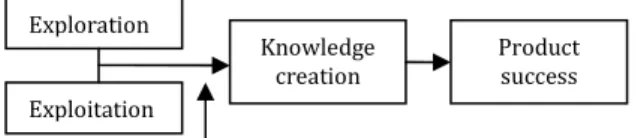
Fig. 1: Theoretical framework
A. Customer knowledge exploration and product-service knowledge exploitation on knowledge creation in new product-service development:
New product-service development requires knowledge-intensive activity. A firm may reuse previous product design and service knowledge. The
most crucial previous knowledge owned by product design engineers is about the designs projects which will be reused in future project. In addition, previous knowledge owned by service engineers can be reused by transferring them from service department to product design department, sharing latest updates,
Exploration
Exploitation
Knowledge creation
Product success
issues and improvements (Ahmed-Kristensen & Vianello, 2015). The option to utilize existing sourcing is to enhance the existing operational efficiency. At the same time, firms need to explore new sources due to several reasons: insufficiency of required knowledge to perform a particular task; inability to sustain internal capacity in various areas, which require a broad of knowledge to compete with competitors, and inability to sustain long term benefit (Denford, 2013). New knowledge exploration and existing knowledge exploitation are basic organizational capabilities to deliver value propositions (Schiuma, Carlucci, & Lerro, 2012) through product offering. During product-service development, new and previous knowledge are integrated to create innovative ideas. Increase in customer knowledge exploration and exploitation of existing knowledge will increase in new knowledge creation in PS.
However, firm focusing on exploitation will lessen firm effectiveness, meanwhile firm focusing on exploration will face high risk and reduce the returns available from using newly gained knowledge (Vorhies, Orr, & Bush, 2010). Similarly, as cited by Gupta et al. (2006) (Vorhies et al., 2010) ability to use knowledge exploration-exploitation activity at equally portray better result than individual learning. Simultaneous exploration and exploitation processes are essential to acquiring and generating knowledge (Ahuja & Lampert, 2001). Zhaohui (2010) suggests that there is connection between explorative and exploitative learning, and thus firm have to retain equal between exploration and exploitation dynamically for endless innovation (Zhaohui, 2010). Ambidextrous firm is projected to retain a high degree of both exploration and exploitation (March, 1991) and more relevant to high technology firms (Auh & Menac, 2005, as both learning are inseparable (Chandrasekaran et al., 2012). There are several reason why firm need to balance exploration-exploitation. First, it is for firm success and endurance through short term and long term goal (Lavie & Rosenkopf, 2006). Second, ambidextrous organization has the capability to implement both effectiveness and efficiency and incorporate organization regeneration and improvement through exploration and exploitation activities. Third, firm may sustain its competitiveness by managing several modes at the same time such as focusing on current system efficiency and long term innovation (Lavie & Rosenkopf, 2006). Hence, balancing with exploitation of previous product-service knowledge will create better knowledge in new product-service development as compared to individual learning effect.
Hypothesis 1: Balance of customer knowledge exploration and previous product-service knowledge exploitation provide better new knowledge creation in product-service development as compared to individual exploration-exploitation learning.
B. Firm knowledge integrative capability
strengthened the effect of exploration-exploitation activities on knowledge creation in new product-service development:
Product-service development integrate alignment of existing design and its realization processes of both product and services (Aurich et al., 2009) which apparently becomes a challenge to firm, when the firm processes and approaches have to match with the new system (Marques, Cunha, Valente, & Leitão, 2013). In addition, the provider core capabilities in developing physical products and its corporate culture may lead to anticipated solutions related to the product but in restrict manner (Aurich
et al., 2009). The NPSD process must ensure the
integrated product-service development integrate tangible product and intangible service to provide solution to customers (Exner et al., 2014).
In earlier product oriented, firm technical product knowledge is required, however, designing and developing a PSS is not an easy task due its systemic characteristics, actors involved and its related components (Kimita et al., 2009; Pezzotta et
al., 2012). Systematic planning is required to
continually improve and enhance customer demand. Innovation in PSS can be done in two ways, include employee ideas or customer feedbacks (Schenkl, Schmidt, Schockenhoff, & Maurer, 2014) from the consumption phase (Beuren, Gomes Ferreira, & Cauchick Miguel, 2013). Offering PSS requires firm (product designer) and customer interaction and produce in depth and wider scope of knowledge (Schenkl et al., 2014) could enhance the quality of its design solutions (Akasaka et al., 2012).
Based on resource-based view, knowledge signifies one of the key elements for capturing, transforming and combining other resources to positively affect performance (Chang, Chang, Chi, Chen, & Deng, 2012). Knowledge integration capability is defined as integrating, aligning ability for organizational connectedness and applying previous project knowledge to future project; encourage cross-functional learning; and enhance and integrate technological capabilities and new product development (Chang et al., 2012). The absence of this capability may jeopardize firm as new knowledge created is not unique or new, which competitors can gain advantage over the firm’s weakness. As such, knowledge integration will strengthened the capability of firm to create new knowledge during NPSD.
and team autonomy. Knowledge integration is the capability to combine existing and new potential knowledge through communication between employees (Jie-mei, 2011). Knowledge integration mechanism enables knowledge exchange among units through knowledge integration structures and processes such as the use of documentation, sharing information, analysis of previous performance such as successful and failed projects, description of project and reviews, and briefings by external experts and consultants (Liao et al., 2012).
Here the research proposes during new product-service development, increase in knowledge integration capabilities will strengthen the relationship between customer knowledge exploration and firm previous product-service knowledge exploitation and knowledge creation.
Hypothesis 2: During new product-service development, knowledge integration capabilities strengthened the relationship between customer knowledge exploration and firm previous product-service knowledge exploitation and knowledge creation.
C. The effect of knowledge creation during new product-service development on product-service success:
PSS innovation search for new ways to produce unique and difficult to imitate by competitors. Exploring customer ideas when designing PS and integrating with existing skills and experience (Beuren et al., 2013) may help fulfill customer needs and reduce the needs for after sale service.
During knowledge creation process, the customer may share their personalized experience (Hosseini, 2011) with the team members for example personal expertise, value that they search (Paswan, D’Souza, & Rajamma, 2014), feeling, emotion, experience and mental model (Hosseini, 2011) through creative dialogue (Song, 2008). This knowledge provides idea generation to solve the current problem by focusing on lead users as they represent strong influences of a future product or process (Schulze & Hoegl, 2005). Socialization during concept development with customers enable customer experiential learning using product offering in terms of design of products, production plans, and shared costs (Claycomb, Dröge, & Germain, 2005). Customer knowledge is later externalized into metaphors or concept creation. This phase is crucial during product design for both product and service modeling. Besides that, PSS design focus on the durability of a product by reducing resources usage without jeopadising the quality (Mont, 2002). This allow PSS provider to be in a better position to integrate their knowledge for innovative product concept (Schulze & Hoegl, 2005); and ensure the concept for the new functionality meets its requirements (Kimita & Shimomura, 2014).
Knowledge from service designers or customers feedbacks on service, maintenance and product retirement are combined with employees knowledge and technical skills. These combination process create new complicated and systematic concepts: diagrams, flowcharts, graphs, and models, which will enhance previous design, improve service processes and performances and may distinguish from competitor’s product (Hara, Shimada, & Arai, 2013). These new ideas are internalized via application or participation (Kenney & Gudergan, 2006), simulation or experiment (Nonaka and Toyama, 2003) and later distribute or share with team members from other functional unit. Hence, it is argued that activity of knowledge creation itself will improve product quality and services offered to customer.
Hypothesis 3: Knowledge creation activities during product-service development is positively correlated with product-service success.
II. Conclusion And Future Research:
The study has implication on theoretical and practical. First, in terms of theoretical the paper offers novel views of how balance of knowledge exploration (KR)-exploitation (KT) affect knowledge creation (KC) using SfECI approach during product-service development. We further examined how firm integration capabilities strengthened the relationship between KR, KT and KC. The linkage of these four factors contribute to the ultimate objective, product-service success. Future study will include the measurements of each dimensions for empirical study.
REFERENCES
Ahmed-Kristensen, S. and G. Vianello, 2015. A model for reusing service knowledge based on an empirical case. Research in Engineering Design, 26(1): 57-76.
Aktas, C.B., 2011. Impact of product lifetime on
life cycle assessment results. University of
Pittsburgh.
Allen Hu, H., S.H. Chen, C.W. Hsu, C. Wang and C.L. Wu, 2012. Development of sustainability evaluation model for implementing product service systems. International Journal of Environmental Science and Technology, 9(2): 343–354.
Aurich, J.C., N. Wolf, M. Siener and E. Schweitzer, 2009. Configuration of product-service systems. Journal of Manufacturing Technology Management, 20(5): 591-605.
Barquet, A.P.B., M.G. de Oliveira, C.R. Amigo, V.P. Cunha and H. Rozenfeld, 2013. Employing the business model concept to support the adoption of product–service systems (PSS). Industrial Marketing Management, 42(5): 693-704.
Beuren, F.H., M.G. Gomes Ferreira and P.A. Cauchick Miguel, 2013. Product-service systems: a literature review on integrated products and services. Journal of Cleaner Production, 47: 222–231.
Brown, S.L., and K.M. Eisenhardt, 1995. Product Development: Past Research, Present Findings, and Future Directions. The Academy of Management Review, 20(2): 343-378.
Cavalieri, S., G. Pezzotta and Y. Shimomura, 2012. Product–service system engineering: From theory to industrial applications. Computers in Industry, 63(4): 275-277.
Chandrasekaran, A., K. Linderman and R. Schroeder, 2012. Antecedents to ambidexterity competency in high technology organizations. Journal of Operations Management, 30(1-2): 134-151.
Chang, Y.-C., H.-T. Chang, H.-R. Chi, M.-H. Chen and L.-L. Deng, 2012. How do established firms improve radical innovation performance? The organizational capabilities view. Technovation, 32(7-8): 441-451.
Exner, K., K. Lindow, C. Buchholz and R. Stark, 2014. Validation of Product-Service Systems – A Prototyping Approach. Procedia CIRP, 16: 68-73.
Hong, D.C., H. Ling, C.H. Zhang and Y.M. Li, 2010. Theoretical Insight into The Mechanism of Knowledge Integration. The 2nd IEEE International Conference on Information Management and Engineering (ICIME), pp: 11-13.
Huang, J.C. and S. Newell, 2003. Knowledge integration processes and dynamics within the context of cross-functional projects. International Journal of Project Management, 21(3): 167-176.
Husted, B.W. and D.B. Allen, 2009. Strategic Corporate Social Responsibility and Value Creation. Management International Review, 49(6): 781-799.
Isaksson, O., T.C. Larsson and A.Ö. Rönnbäck, 2009. Development of product-service systems: challenges and opportunities for the manufacturing firm. Journal of Engineering Design, 20(4): 329-348. Jie-mei, Z., 2011. The Review and Prospect of Theoretical Research on Knowledge Integration. The Review and Prospect of Theoretical Research on Knowledge Integration, pp: 1-4.
Jing, N.N. and C. Yang, 2009. The interrelationship among quality planning, knowledge process and new product development performance. 2009 16th International Conference on Industrial Engineering and Engineering Management, pp: 1051-1055.
Kimita, K., Y. Shimomura and T. Arai, 2009. Evaluation of customer satisfaction for PSS design. Journal of Manufacturing Technology Management, 20(5): 654-673.
Kita, T. and M. Ohtsuka, 2011. Describing Knowledge Integration in Innovation Processes. In IEEE Int’l Technology Management Conference, pp: 819-826.
Koch, A., 2011. Firm-internal knowledge integration and the effects on innovation. Journal of Knowledge Management, 15(6): 984-996.
Kuo, T.C., 2010. Simulation of purchase or rental decision-making based on product service system. The International Journal of Advanced Manufacturing Technology, 52(9-12): 1239-1249.
Lavie, D. and L. Rosenkopf, 2006. Balancing exploration and exploitation in alliance formation. Academy of Management Journal, 49(4): 797-818.
Liao, Y., K. Tsai and T.T. Hsu, 2012. Knowledge Integration Mechanisms and Product Innovativeness : Toward a Contingent perspective. In Proceedings of the 2012 IEEE ICMIT pp: 777-782.
Lindström, J., A. Dagman and M. Karlberg, 2014. Functional Products Lifecycle: Governed by sustainable Win-Win Situations. Procedia CIRP, 22: 163-168.
Marques, P., P.F. Cunha, F. Valente and A. Leitão, 2013. A Methodology for Product-service Systems Development. Procedia CIRP, 7: 371-376.
Maxwell, D. and R. van der Vorst, 2003. Developing sustainable products and services. Journal of Cleaner Production, 11(8): 883-895.
Mont, O.K., 2002. Clarifying the concept of product – service system. Journal of Cleaner Production, 10: 237-245.
Morschett, D., 2006. Firm-specific influences on the internalization of after-sales service activities in foreign markets. Journal of Services Marketing, 20(5): 309-323.
Nonaka, I., and N. Konno, 1998. The Concept of “Ba”: Building a Foundation for Knowledge Creation. California Management Review, 40(30): 40–15.
Park, Y., and H. Lee, 2009. Towards Integration of Products and Services : Literature Review and Phraseology. In Management and Service Science.
MASS’09. International Conference on. IEEE.
MASS’09. International Conference on. IEEE. Patnayakuni, R., A. Rai and A. Tiwana, 2007. Systems Development Process Improvement : A Knowledge Integration Perspective. IEEE Transaction on Engineering Management, 54(2): 286-300.
Pezzotta, G., S. Cavalieri and P. Gaiardelli, 2012. A spiral process model to engineer a product service system: An explorative analysis through case studies. CIRP Journal of Manufacturing Science and Technology, 5(3): 214-225.
Prakash, A., and R.P. Mohanty, 2012. Understanding service quality. Production Planning & Control, pp: 1–16.
VINE: The Journal of Information and Knowledge Management Systems, 42(1): 4-14.
Tseng, S.-M., 2012. Correlations between external knowledge and the knowledge chain as impacting service quality. Journal of Retailing and Consumer Services, 19(4): 429-437.
Ueda, K., T. Takenaka, J. Váncza and L. Monostori, 2009. Value creation and decision-making in sustainable society. CIRP Annals - Manufacturing Technology, 58(2): 681-700.
Vorhies, D.W., L.M. Orr and V.D. Bush, 2010. Improving customer-focused marketing capabilities and firm financial performance via marketing exploration and exploitation. Journal of the Academy of Marketing Science, 39(5): 736-756.
Wan Zaaimuddin, W.A., G.G.G. Goh and U.C. Eze, 2009. Knowledge management process and new
product development performance in a Malaysian research and development organisation. 2009 IEEE International Conference on Industrial Engineering and Engineering Management, pp: 997-1001.
Winegard, B.L., 2010. Knowledge creation in
new product development teams: A contingency theory of the effectiveness of knowledge integration mechanism. York University Toronto, Ontario.
Yoon, B., S. Kim and J. Rhee, 2012. An evaluation method for designing a new product-service system. Expert Systems with Applications, 39(3): 3100-3108.