ASSEMBLER: A BGP-compatible Multipath
Inter-Domain Routing Protocol
Jos´e M. Camacho, Alberto Garc´ıa-Mart´ınez, Marcelo Bagnulo, and Francisco Valera
Abstract—The amount of redundant paths among ASes has
dramatically increased throughout the Internet. Unfortunately, the unipath nature of BGP constrains border routers to course traffic across a single path at a time. Although, multipath inter-domain routing is able to provide richer routing configurations, the lack of incentives to replace BGP as inter-domain routing protocol implies that multipath solutions must be backwards compatible with BGP. Existing multipath solutions are limited by those requirements or their deployment requires coordination among ASes that are likely to have different stakes. This paper presents ASSEMBLER, the first BGP-compatible multipath pro-tocol that can be progressively deployed by each AS individually and provide border routers with reachability information to forward traffic through multiple paths simultaneously.
Index Terms—IEEEtran, journal, LATEX, paper, template. I. INTRODUCTION
The provision of multiple paths between two nodes has been envisioned for many years as a natural way to enhance communication networks. Once multiple paths are in place, nodes can divert traffic from failed links or split load among them, achieving fast recovery [1] and load balancing [2], [3] respectively. Those techniques should improve the reliability and the performance of the network.
Recent contributions [4], [5], [6] point out that the usage of multipath routing can be advantageous in inter-domain scenarios. Since most of the ASes through the Internet al-ready have redundant connections with their neighbors [7], by embracing multipath inter-domain routing they could benefit from a more flexible use of their resources [8]. The reachability information advertised through these redundant connections should provide ASes with multiple alternatives to route the traffic towards a destination. Those alternative paths could be used simultaneously and enable the aforementioned recovery and balance techniques. Unfortunately, in most cases the
unipath nature of the Border Gateway Protocol [9] impedes
the use of those multiple paths concurrently.
Most ASes have no choice but to rely on techniques such as prefix deaggregation [9] or load sharing [10] to relax the constrains of BGP. Nevertheless, those techniques present their own limitations. For instance, per flow load balancing among paths [11], [12], [3] cannot be achieved using load sharing, since every time the traffic is switched to a different path a new BGP advertisement is generated and the network needs to converge. In practice, only stub ASes exploit their multi-homing connections to perform load balancing among different egress ASes, provided that they do not have to re-advertise BGP information.
The previous example shows that ASes are keen on more flexible routing configurations. However, in spite of the po-tential benefits that using multipath routing can bring about, so far, the lack of economic incentives to replace BGP has hindered Internet-wide deployments. Moreover, the latter imposes that any approach to deploy multipath inter-domain must be BGP-compatible.
Aimed at hastening large-scale deployments, some back-wards compatible solutions have appeared in the literature in the latest years. BGP extensions such as [14], [15] provide multipath capabilities by taking advantage of the multiple interconnections between two ASes. Those paths have the same BGP attributes, such that every selected path can be advertised by the same BGP update. Whereas that ensures backwards compatibility with BGP, the set of multiple paths (i.e. hereafter multipath set) yielded by these solutions is rather limited, e.g. traffic cannot be forwarded across different egress ASes simultaneously even though available paths exist.
An alternative to exploit richer multipath sets is to forward-ing packets among all available paths and advertise only one. That would require additional mechanisms to detect traffic loops [1], [5] or advertise paths that may be less attractive to legacy routers (e.g. longer paths [31]). Other solutions rely on a separate protocol to incrementally request or advertise additional paths [4], [16]. Those solutions can provide very flexible multipath configurations. Yet, they require that at least two neighbor ASes must coordinate to deploy that type of solutions, which represents a main drawback for those approaches.
In this work, a novel protocol for multipath inter-domain routing, ASSEMBLER, is presented. ASSEMBLER stands for AS-SEt-based Multipath BLending Routing since the protocol operation resembles a mixing of paths. It is the first inter-domain routing protocol that features both, flexible multipath routing and backwards compatibility with BGP, without any kind of coordination between ASes or additional protocols.
Furthermore, not only is ASSEMBLER backwards com-patible with BGP, but also it adheres to its philosophy. Current routing policies, path import and export rules, and traffic engineering techniques are supported and in some cases extended. It is able to support and map to routing policies the existing business relationships among ASes. ASSEM-BLER advertisements do not incur in any penalization when
compared to BGP thanks to its path assembling technique.
In addition, its selection process (so-called K-Best Routing
Optimizer) can be locally tuned to cover a myriad of multipath configurations ranging from unequal AS path length multipath
mimics exactly the BGP behaviour.
This work is structured as follows, Section II introduces the requirements that are aimed for the protocol design. The protocol itself in presented in Section III along with an example to show the flexibility supported by ASSEMBLER in its configurations. A group of important deployment con-siderations are detailed in Section IV. The stability of the protocol is proven and configuration guidelines to guarantee stability are given in Section V. The work is completed with a comparison between ASSEMBLER and the existing multipath inter-domain proposals in the related work in Section VI. The conclusions are due to Section VII.
II. PROTOCOLREQUIREMENTS
The main goal of ASSEMBLER is to provide ASes with a backwards compatible solution for inter-domain routing that enables multipath routing. In this section, the defining require-ments for ASSEMBLER are introduced prior to describing the relevant parts of the protocol in depth. Those requirements motivate the design choices that are presented in the next section and provide a clear view of the main features of the protocol. The discussion addresses the issues of target mul-tipath configurations, backwards compatible updates, stability and data plane growth.
A. Flexible Multipath Routing
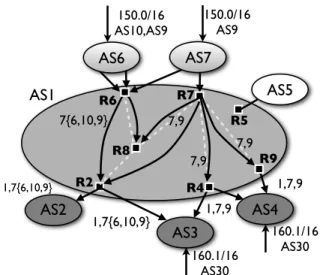
ASSEMBLER must flexibly let administrators choose the characteristics and the amount of paths yielded by the routing system. The multipath protocol must feature enough flexibility to concurrently select paths that, (1) have different next AS, (2) have different AS path length and (3) have different internal cost. Moreover, the protocol must be able to select a subset of the paths matching the previous conditions using a determin-istic tie-break. ASSEMBLER must empower administrators with the tools to implement such a broad range of routing policies. For example, in Fig.1 for the prefix 150.0/16, R6 is able to get up to 3 paths, 2 from AS6 and another from AS7. In some cases, the administrator would like to provide R6 with the whole set of paths and in other cases, administrators may prefer keeping only those with certain attributes, (e.g. shortest AS path length).
The first requirement that we impose on ASSEMBLER is that regardless how the selection process of multiple paths is
tuned, the BGPwinnerpath is always included in the multipath
set. In addition to the BGP winner, according to criterium (1), a router can either include paths through different egress ASes or limit the multipath set to go through the same next AS. Referring to R6, it can choose the paths from AS6 and AS7 or only from one of them. The criterium (2)
defines ifequal AS length multipath(i.e. ELMP) is enabled or
additional paths, longer than the shortest one, can be selected. If ELMP is enabled, then R6 can select only the path from AS7, which is the shortest. Criterium (3) implies that internal equal cost multipath routing (i.e. ECMP) is supported and additionally, the administrator can tune how much the internal paths deviates from the hot-potato routing behaviour [18]. Assuming R4 has a lower cost to R7 than to R6 and it performs
AS1
AS2
AS4
AS5
R2 R4
R6 R7
R5 150.0/16
AS10,AS9
150.0/16 AS9
AS3
160.1/16 AS30
160.1/16 AS30 7{6,10,9}
1,7{6,10,9}
1,7{6,10,9} 1,7,9
1,7,9
AS7
AS6
R9 R8
7,9 7,9 7,9
Fig. 1: Model of a transit AS with Path ASSEMBLER Routers ECMP routing, thus it only selects the path through R7. A strong requirement is that ASSEMBLER must allow every AS to select the type of multipath that they need independently from other ASes, i.e. without any type of coordination. B. BGP-Compatible Advertising Scheme
ASes advertise each other reachability information by means of BGP updates. Whereas processing regular BGP updates should not present any shortcoming for multipath routers, advertising multiple paths per network prefix in a single BGP update is not a trifle. Multipath routers should respect the structure and the semantic of the attributes included in the updates, such that legacy routers can keep on processing them. Concatenating multiple paths to the BGP update is not enough, provided that legacy routers sequentially process all of them and each path replace the state created by the previous one.
Therefore, ASSEMBLER must carry out some additional processing to merge information from multiple paths and accommodate them into regular BGP updates. To that extent, path assembling (Section III-B), a particular case of prefix aggregation [9] seems an outstanding candidate. It is a crucial requirement that generated advertisements must be represen-tative of the aggregated paths, such that a router (legacy or not) can perform any regular BGP processing over the advertisement, as if the paths were announced separately. For instance, when a router receives an announcement containing an aggregate of paths, it must be able to derive the local preference for the aggregate or apply MED values comparison consistently. The protocol must identify those cases in which the advertisements are not representative and do not perform aggregation. Even for BGP, RFC4271 [9] identifies different situations where it is not consistent to aggregate multiple prefixes due to conflicting attributes. Thus, the protocol must avoid those situations in which inconsistent network adver-tisements may be created as a consequence of the aggregation process.
C. Controlled Routing Table Growth
The design must address the well known problem of the inter-domain routing table growth. Whereas routers feature more processing and memory capacity at the control plane, the situation at the data-forwarding plane is completely different. The hardware that forwards packets at wire-speed is expensive and its storage space constrained. The adoption of multipath does nothing but worsening the problem as multiple next-hops are stored per prefix. A growth in the amount of paths selected can potentially rise issues with the limitations of the data plane.
Therefore, the protocol must be aware of those constrains and limit the amount of paths relayed to the data plane. The requirement for the protocol is to be able to select a
subset of k-best paths per prefix, such that the size of each
routing table entry is limited. Every path in the subset must
be compliant with the routing policy and the k-best tie-break
must be deterministic. In our example, if R6 can only store two next-hops in its routing table for the same prefix, it has to discard one of its paths towards the prefix 150.0/16. D. Stable under Common Configurations
BGP has been proven to be unstable under conflicting rout-ing policies. The existrout-ing relation among those routrout-ing policies
that cannot be fulfilled simultaneously is calleddispute-wheel
[19]. In presence of dispute-wheels BGP is not guaranteed to converge and the network may end up in a permanent oscillation. Permanent oscillations do not happen often in practice since routing policies are typically overruled by the business relationships among ASes. It can be proven that when routing policies align with those relationships dispute-wheels cannot be created.
The work in [20] presents a more abstract framework for the analysis of the stability in policy-based routing protocols. The
framework extends the concept of dispute-wheels to reflexive
policy relations. The concept of reflexive relations is more powerful in the sense that it covers the BGP dispute-wheels and allows to extent stability results to multipath policy-based routing protocols. ASSEMBLER must be able to converge in absence of reflexive relations among policies. Relaying on the abstract framework in [20], the protocol must be proven stable in those situations in which conflicting policies do not exists, specially in those that align with business relations among ASes.
III. PATHASSEMBLER
ASSEMBLER is a novel multipath inter-domain routing protocol inspired in the BGP prefix aggregation to compact the multipath information. ASSEMBLER stands for
AS-Set-based Multipath BLEnding Routing, since the protocolblends
the additional AS PATHs and stores the result in AS SETs. ASSEMBLER keeps backwards compatibility and allows for a progressive deployment of multipath-capable routers. The specification of ASSEMBLER relies on two main corner-stones: a multipath selection process and a BGP-compatible multipath advertising scheme.
Fig.2 shows the block diagram of an ASSEMBLER process running in the control plane of a router. There are some differences between Fig.2 and a BGP process diagram. The
import policy (ingress filtering in Fig.2) is applied first, like
in BGP. The BGP decision process has been replaced by the multipath selection algorithm K-BESTRO (pronounced cabestro) that stands forK-Best Routes Optimizer. K-BESTRO is presented in detail in Section III-A. The output of the
K-BESTRO block is a set of K paths instead of a single
winner path. K-BESTRO features three parameters to tune the characteristics of the multipath set. The parameter ELMP defines the maximum difference in AS path length between the shortest and the longest AS path. ECMP defines the difference in internal cost among selected paths. Finally, the KBEST parameter limits the maximum size of the multipath set, which should be set depending on the capacity of the routing table to store prefixes with multiple next-hops.
The paths in the multipath set are passed to the RIB in order to be installed in the data plane (through the FIB). Afterwards, they undergo the export policy. The export policy (egress filtering) generates the same advertisement for all the peering sessions that the router maintains. Therefore, a neighbor is either advertised or the export policy discards the whole multipath set as soon as one path matches a filter. Otherwise, different paths could be discarded for each peering
session, generating different advertisements. Adding
neighbor-specificannouncements [21] is out of the scope of this paper. Next to the egress filtering block, there is the new block
called Assembling, which is responsible for generating the
advertisements. The assembling algorithm ensures backwards compatibility, creating special BGP announcements that can be processed by legacy routers, do not incur in penalization when competing with regular unipath BGP announcements in the selection process and allow multipath capable ASes to use several paths concurrently. The algorithm takes its name from the way of constructing those announcements that resembles an assembling of pieces (e.g. AS NUMBERs in this case). The announcement is an aggregated version of the multipath set that cannot be distinguished from the outcome of a regular prefix aggregation. See Section III-B for details about the assembling procedure for external (i.e. eASSM) and internal (i.e. iASSM) ASSEMBLER peering sessions (eASSM/iASSM are also used to refer BGP peering sessions unless stated otherwise). Finally, the advertisement containing theassembled path is propagated to the neighbor routers. A. Decision Process: The K-BESTRO Algorithm
The decision process of ASSEMBLER is carried out over the set of advertisements for a given prefix that are not discarded by the import policy. The decision rules resemble those for BGP except for some subtleties. Meanwhile the BGP decision process clearly has a tie-breaking character and paths are trimmed from the set of candidates on the look out for the most suitable path. The requirements regarding flexibility of K-BESTRO completely redefines its philosophy and it is inspired in the decision process of Morpheus [22]. In the
Adj-RIB-In Adj-RIB-Out
Ingr
ess Filtering
Egr
ess Filtering Assembling
K-BESTR
O
RIB
FIB
Fig. 2: Path ASSEMBLER Process Architecture of the candidate paths according to some configurable criteria rather than discarding them. Afterwards, the set of best paths is selected, possibly according to different criteria, this time
applied over the paths already sorted (e.g. select the first k
paths in the ranking with MED value equal to 10). Therefore, K-BESTRO can be seen as a particular instance of a Morpheus ranking with the criteria presented in the next paragraphs. Each of them is mapped into a phase of the algorithm depicted in Table I,
a) The ranking criteria of K-BESTRO respect the
seman-tic of the BGP attributes: As a consequence, K-BESTRO
ranks the BGP winner in first position. Rules 1 to 5 discard paths like a regular BGP decision process. The BGP winner is never discarded by those rules and rules 6.a-d give higher ranks following the order used by BGP to tie-break the paths. Therefore the BGP winner is always ranked first. Generally speaking, the algorithm must always advertise the winner and propagate other aggregatable paths whenever possible.
In addition, in order to keep the semantic of BGP attributes and make the paths sortable, some of them must be discarded before the remaining paths are sorted in a rank. Otherwise, inconsistent multipath decisions can be made with respect to the semantic of the attributes. For instance, it is not consistent that two paths with different LOCAL PREF appear in the final ranking or in the selected multipath set. It is not sounded either that two paths coming from the same AS and with different MED values are simultaneously used, since the customer is explicitly stating that it prefers one path to the other to receive the traffic.
The first phase starts with rules 1-2, which keep just the paths with highest local preference and with lowest ORIGIN value. The next step in BGP is to keeping paths with shortest AS path length. Instead, K-BESTRO considers paths that
satisfy the relation AS PATH LENGTH<=shortest-l+ELMP,
beingshortest-lthe shortest AS path length value found in the
candidate set and ELMP is the parameter introduced earlier. The latter is implemented in rule 3.
b) The ranking criteria of K-BESTRO keep the order of the BGP rules: For example, the latter implies that the BGP AS path length rule must not be overridden by the MED rule, i.e. a path with lower MED but longer AS path must not cause any path with shorter AS path length to be overlooked by the algorithm. K-BESTRO ensures that every path taken into
account in the ranking honours the highest LOCAL PREF, highest ORIGIN, lowest MED per AS and session TYPE (i.e. eASSM or iASSM) criteria exactly as BGP does.
The second phase applies these criteria (rules 4-5). For each AS advertising a path for the prefix, the algorithm looks for the paths of shortest length through that AS and the lowest MED value of that path. Every path from that AS and different MED value is removed at rule 4.c. The phase is completed by leaving paths only from one session TYPE. If there is a path from an external session, i.e. eASSM, paths with session TYPE iASSM are removed (rule 5). This is needed to avoid that two border routers try to course traffic through the external path of the other (see [9] for further details).
c) The final ranking of paths must be performed over monotonically increasing and bounded attribute values: Applying rules 1-5 leads to consistent results regarding the selected multipath set. Once the considered paths are com-pliant with those rules, the ranking can be performed upon the remaining attributes without violating the specified routing policy and the order of BGP rules. For example, two paths with equal preference, origin and coming from different ASes, can be ranked according to their AS path length without creating any inconsistency.
The algorithm executes the third phase (rule 6) and ranks the paths according to the criterium of shortest AS PATH LENGTH first. If a several paths in a subset draw in AS path length, it sorts the subset from lower internal cost to higher. Within the subset, if the first ranked path has a
cost oflowest-cit removes the paths with internal cost higher
than lowest-c+ECMP, where ECMP is a parameter that can
be tuned by the administrator. While either tunnelling or IGP equal cost multipathare used inside the AS, ECMP should be
equal to0. If at this point some paths have the same AS path
length and interior cost towards the next-hop, the paths with lower BGP ID are ranked first. If several paths have the same BGP ID attribute, then the ones advertised from the interface with the lowest address are ranked first.
d) The K-BESTRO algorithm selects paths in order of appearance in the ranking and selected paths are aggregat-able: As described at the beginning of the section, the selected multipath set ends up aggregated into a single BGP adver-tisement. Therefore, the selected paths must be aggregatable, otherwise the generated announcement is not representative of the multipath set and that may lead to routing inconsistencies. RFC4271 [9] defines that two path with different MED values should not be aggregated. This restriction only applies to paths advertised through iBGP sessions. Similarly, only paths with the same NO EXPORT:X Community (i.e. do not export this path to a specific peer X) can be aggregated, since as mentioned above, neighbor-specific configurations are not supported by ASSEMBLER. If the first ranked path does not include the NO EXPORT:X community for any peer, the algorithm should overlook other paths in the ranking including any NO EXPORT:X community when selecting the multipath set.
This last criteria is implemented in the fourth phase (rules 7-10) is executed. The parameter KBEST is defined by the administrator and limits the maximum size of the multipath
TABLE I: K-BESTRO Algorithm
1.- Keep paths with highest LOCAL PREF value 2.- Keep paths with lowest ORIGIN value
3.- Look for the shortest AS path, store the length in shortest-l and keep paths with AS PATH LENGTH<=shortest-l+ELMP.
4.- For each advertising AS,
4.a.- Look for the subset of paths with lowest AS path length 4.b.- Select the lowest MED value in that subset
4.c.- Delete the paths from that AS with different MED value 5.- If there is a remaining path with session TYPE eASSM,
delete paths with TYPE iASSM 6.- Rank the paths according to,
6.a.- Paths with shortest AS PATH LENGTH go first 6.b.- If a subset paths have the same length, paths with lowest
internal cost goes first
Discard paths within the subset with internal cost>lowest-cost+ECMP (Default ECMP=0)
6.c.- If equal cost, lowest BGP ID goes first 6.d.- If same BGP ID, lowest peer address goes first 7.- If the first ranked path has the NO EXPORT:X
Com-munity,
7.a.- Then select only the first KBEST ranked path with the same NO EXPORT:X Community
7.b.- Else, delete paths with any NO EXPORT:X Community 8.- If the ranked paths have session TYPE iASSM, select
the firstKBEST paths
9.- Else if the ranked paths have session TYPE eASSM, select the firstKBEST paths from the same AS and
MED value as the first ranked path 10.- Return the selection. K-BESTRO ENDs
set. The fourth phase takes care of selecting a maximum of KBEST paths that can be aggregated and advertised to-gether. According to the previous paragraph, if the first ranked path is tagged with the BGP Community NO EXPORT:X, then the multipath set contains only the first KBEST ranked paths with the same community. Otherwise, paths with any NO EXPORT:X community are deleted from the rank to avoid aggregation conflicts. Thereafter, if the ranked paths come from an iASSM session, then select the first KBEST paths in the ranking. Else if they come from eASSM sessions, select the first ranked KBEST paths coming from the same AS and with the same MED value as the first ranked path, as stated in RFC4271.
The algorithm finishes relaying the set of KBEST paths to the egress filtering block that implements the export policy. B. Route Dissemination: Path Assembling
The decision process constructs a multipath set compliant with the preferences of the administrator. The multipath set must be advertised to every neighboring AS with an es-tablished peering session. Advertising an array of paths for
each network prefix is not supported by BGP. The algorithm presented in this section is applied to the set of paths to embed the multipath information into a single BGP advertisement.
The algorithm follows the philosophy used in prefix aggre-gation to compact the multipath information. Prefix aggrega-tion defined in [9] defines how the attributes of two advertise-ments can be combined under some conditions, such that two contiguous prefixes propagated within each advertisement can be combined into a larger prefix and advertised in a single BGP update message. The attributes of the new message are the
result of aggregating those in the two advertisements. Ourpath
assembling can be understood as the aggregation of several advertisements carrying the same prefix.
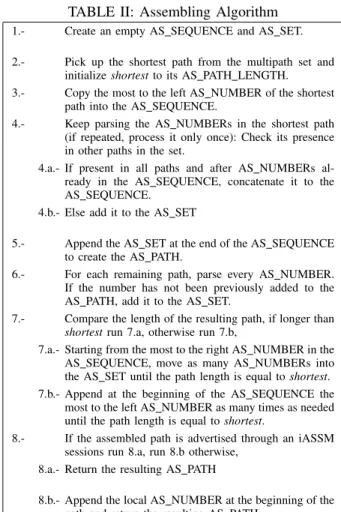
Besides other attributes like the NEXT-HOP or the ORIGIN, of special interest is the AS PATH attribute aggregation. When two contiguous prefixes are aggregated, it is necessary to keep the AS PATH information to maintain path loop-freeness. In [9] the minimum requirements for the path aggregation algorithm are specified. Any algorithm compliant with those minimum specifications can safely combine the AS PATH information from several announcements. The algorithm used by ASSEMBLER meets the minimum requirements of [9] and creates an AS PATH following the most commonly found format in current routing tables. Data sets collected at some Internet vantage points [23], [7] brings out that recorded aggregations construct always an AS PATH with an AS SEQUENCE followed by an AS SET. For example, the
aggregate of paths P = 1,2,3,5 and Q = 2,3,4,5 should
look likeA= 2,3,{1,4,5}.
In addition, the algorithm tries to be consistent in the assem-bling and keep meaningful information. For example, it creates AS PATHs whose length is equal to the path length BGP would advertise. Thus, using assembling neither represents a penalty nor an advantage to multipath nodes, what we believe is fair. Moreover, the algorithm also preserves the last AS added to the AS PATH as it is consider meaningful in some policies (e.g. neighboring AS filtering). The algorithm does not preserve the position of the origin AS, given that typically ASes rely on RIRs to check the origin and ASes included in an advertisement [24].
The algorithm is displayed in Table II. The AS SEQUENCE is constructed with the AS NUMBERs common to all the paths in the multipath set as suggested in RFC4271. The order between AS NUMBERs is kept. If two AS NUMBERs X and Y appear always one after the other in every path (even though some AS NUMBERs may appear in the middle), they are said to be in order (rule 4.a). If two ASes, common to all paths, are not in order, then the second in appearance within the shortest path is put in the
AS SET (rule 4.b). Theassembled AS PATH is the result of
concatenating the AS SET at the end of the AS SEQUENCE (rule 5). The remaining AS NUMBERs not common to every path are added to the AS SET (rule 6). Afterwards, rules 7.a-b check that the AS PATH LENGTH of the resulting AS PATH is exactly the same as the shortest path in the multipath set. Rules 8.a-b deal with the fact that the local AS NUMBER is not added to the advertisements until it is propagated to a peering router outside the AS.
TABLE II: Assembling Algorithm
1.- Create an empty AS SEQUENCE and AS SET. 2.- Pick up the shortest path from the multipath set and
initializeshortestto its AS PATH LENGTH. 3.- Copy the most to the left AS NUMBER of the shortest
path into the AS SEQUENCE.
4.- Keep parsing the AS NUMBERs in the shortest path (if repeated, process it only once): Check its presence in other paths in the set.
4.a.- If present in all paths and after AS NUMBERs al-ready in the AS SEQUENCE, concatenate it to the AS SEQUENCE.
4.b.- Else add it to the AS SET
5.- Append the AS SET at the end of the AS SEQUENCE to create the AS PATH.
6.- For each remaining path, parse every AS NUMBER. If the number has not been previously added to the AS PATH, add it to the AS SET.
7.- Compare the length of the resulting path, if longer than
shortestrun 7.a, otherwise run 7.b,
7.a.- Starting from the most to the right AS NUMBER in the AS SEQUENCE, move as many AS NUMBERs into the AS SET until the path length is equal toshortest. 7.b.- Append at the beginning of the AS SEQUENCE the
most to the left AS NUMBER as many times as needed until the path length is equal toshortest.
8.- If the assembled path is advertised through an iASSM sessions run 8.a, run 8.b otherwise,
8.a.- Return the resulting AS PATH
8.b.- Append the local AS NUMBER at the beginning of the path and return the resulting AS PATH
C. Example: An ASSEMBLER-Capable Autonomous System This example refers always to the AS depicted in Fig.1. The figure represents a transit AS (AS1) with three customers (AS2,AS3,AS4), one peer (AS5) and two providers (AS6 and AS7) connected to AS1 by means of ASSEMBLER-capable routers. Router (R5,R7,R9) set (ELMP=0,ECMP=0,KBEST=1) and (R2,R4,R6,R8) aggregate the maximum number. Routers establish a full-mesh of intra-AS peering sessions to redistribute routing information. The example present two cases, a prefix propagated downstream from providers to customers and another prefix propagated upstream from the customers.
1) Downstream Advertisement: In the first case, two paths are advertised to AS6 and AS7 towards 150.0/16. The paths are propagated further and four paths reach AS1 and all of them are assigned with the same local preference. The egress routers for the paths in AS1 are R6 and R7. The router R6 can aggregate up to three paths depending on the ELMP parameter. If ELMP=0, then only the path from AS7 is selected according to rule 3 in Table I. Otherwise, if ELMP=1 or higher the three paths can be aggregated as depicted in the figure. The aggregated path from R6 is constructed using the algorithm in Table II. The first AS NUMBER of the shortest path, AS7 leads the AS SEQUENCE. Only AS9 is common to all paths and it is aggregated to the AS SEQUENCE, as well. The remaining ASes are added to the AS SET, AS6
and AS10. The length of the aggregated path is checked and it is 3 where it should be 2, therefore AS9 is moved into the AS SET to compensate the length. Finally, the update is re-advertised through iASSM. Router R7 is unipath and selects only the path through AS7. Routers R2 and R8 receives both announcements from R6 and R7. The announcements have equal AS path length and equal IGP cost, therefore they are aggregated by the routers, although in this case the resulting aggregated paths are the same as for R6. Routers R4 and R9 are advertised as well. Both paths from R6 and R7 have the same AS PATH LENGTH therefore the ranking is done according to the IGP cost. Routers R4 and R9 has its ECMP parameter equal to 0 and consider only paths with lowest internal cost. Both, R4 and R9 select in this case the path through R7. Routers R2,R4 and R9 propagate the paths towards AS1 clients adding the AS NUMBER 1 to the advertised AS PATH.
2) Upstream Advertisement: In this second case, a couple of customers of AS1, AS3 and AS4 advertise a path towards their customer AS30. The effect of the MED values on the ranking function is shown in this second case. AS3 advertises two paths towards AS30, one to R2 with MED=20 and another one to R4 with MED=10. AS4 does not use MED values. Every path is assigned with the same local preference. Hence, three routers end up with a path from eBGP sessions and redistribute them through iASSM. The router R4 discards the internal path through R2-AS3 with highest MED and selects the eASSM path from AS3 and from AS4. Nevertheless, the two paths cannot be aggregated since the path from AS3 has MED value, therefore only the path through AS3, which has a lower BGP ID, is ranked first and selected. R2 discards its own eASSM path an selects the internal path through R4 with the lowest MED for AS3. Assuming there is no restriction for R2 on the IGP cost to R9, it can aggregate the internal path through R9 as well, since the aggregated path is advertised only through eASSM sessions and the MED values are not taken into account.
IV. DEPLOYMENTCONSIDERATIONS
When it comes to the deployment of ASSEMBLER in a real AS there are some considerations to be taken into account beforehand. This section outlines them and points out how the main shortcomings that may appear during the deployment can be solved using the appropriated settings. As mentioned during the introduction and shown in the previous section, ASSEMBLER does not required of any kind of coordination between ASes to take advantage of multiple paths with high flexibility. Therefore, the deployment issues may rise while deploying it inside an AS. The issues are collected in three categories, problems related to mixed configurations, inconsistent multipath routing policies and traffic engineering techniques.
A. Deployments with Legacy Routers
Two different types of intra-AS techniques to forward the traffic are considered: internal redistribution and tunnelling. Internal redistribution implies that every router inside the AS
understands reachability information and fills in the routing tables accordingly. An internal protocol such as iBGP/iASSM is required to perform the redistribution. Tunnelling techniques rely on the encapsulation of packets. Only the ingress and the egress routers need to be aware of the paths advertised to the AS. In this discussion we consider IP over IP tunnelling and MPLS tunnelling [25] as representative techniques.
If the AS performs a full deployment, such that every legacy router is replaced inside the AS, both internal redistribution and tunnelling can be used without any kind of limitation. The only potential advantage of tunnelling is the addition of eiBGP configurations [15] but that topic is out of the scope of this work. On the other hand, if the AS is not planning a full upgrade of the network, ASSEMBLER can still be deployed progressively. The difference in this case is that any router in the network can be randomly replaced if tunnelling is used, whereas special attention must be paid for internal redistribution. Using redistribution and legacy routers, ASSEMBLER routers must not aggregate paths received from internal peering sessions. The reason is that that internal aggregation may lead to routing inconsistencies. For instance in Fig.1, assuming that R2,R6 and R7 are unipath routers, if R2 receives the paths from R6 and R7 through the iASSM sessions and chooses the one from R6. R8 is multipath and aggregates the paths through R6 and R7, however it does not advertise the aggregate through iASSM to R2 to avoid internal loops RFC4271. If the IGP path between R2 and R6 passes through R8. The router R2 announces to the AS2 and AS3 its choice through AS6, however when packets get to R8, the multipath router can forward some of them towards R3 which is inconsistent with the network view that R2 is advertising. B. Multipath Routing Policies
In addition to the considerations regarding the deployment of ASSEMBLER along with legacy routers, some other issues may arise related to the policy configurations of the ASSEM-BLER routers. Defining simultaneously import and export policies for several paths that match a given criteria is sup-ported nowadays in regular BGP routers. For instance, Cisco
IOS uses theroute-mapsto define policies for several paths at
once. ASSEMBLER-capable routers should support the same definition of policies. A BGP router can be transparently replaced and provide the same functionality configuring the sameroute-mapsand setting K-BESTRO with the combination (ELMP=0,ECMP=0,KBEST=1).
However, the combination of policies for multiple paths with more lax K-BESTRO configurations may lead to in-consistent states regarding the export of paths. In contrast to BGP, the ASSEMBLER decision process yields a set of
KBEST paths instead of a winner path. If several paths are
assigned with the same LOCAL PREF, and the import policy is not design appropriately, a path coming from a provider may end up in the selected multipath set with a path coming from a customer, which cannot be exported together. No AS-SEMBLER advertisement is generated towards the providers whereas BGP would advertise the path from the customer. Therefore, LOCAL PREF assigned by the import policy of
a router should be the same only for paths coming from the same type of neighbor AS, or at least the export policy should be modified accordingly. E.g., even though an AS ends up carrying traffic from one provider to another.
C. Enhanced Traffic Engineering
Once several paths are selected and advertised by an AS-SEMBLER router they can be used simultaneously to forward packets. Outgoing traffic engineering (hereafter TE) is usually based on those local preference settings in the import policy. Nevertheless, in BGP only one path at a time is selected and the most flexible outgoing TE techniques are load-sharing [10] and tuning of IGP costs. Multipath BGP defined in [15], [14] allows for load-balancing among multiple parallel connections between two ASes but they only support load sharing to split the traffic among multiple ASes. ASSEMBLER allows to perform load-balancing across multiple ASes and in contrast to the proposals in [15], [14], the traffic can be switched from one egress AS to another without re-advertising additional routing information. In addition, how much traffic balance over each path becomes a new TE parameter.
Regarding TE using IGP costs, currently ASes send the traffic to the closest egress point in the network, which can be used a form of performing TE. ASSEMBLER extends this TE technique and administrators can modify the ECMP parameter of K-BESTRO to define how close to this hot-potato routing they want to sticks to.
On the other hand, the most widespread incoming TE techniques acccording to [26], [27] are prefix deaggregation, path prepending and TE with BGP Communities. Prefix deag-gregation and BGP Communities for TE are supported. Yet, in order to respect the TE performed by neighbor ASes using path prepending, a maximum value must be setup for the ELMP parameter. That maximum value does not have to be public since in practice downstream ASes tune the amount of AS numbers to prepend on a trial and error basis [27].
V. STABILITYANALYSIS
The stability analysis presented in this section is aimed at showing under which conditions ASSEMBLER converges. The analysis begins with a high-level discussion about the effect on the stability of the network of allowing nodes to choose multiple paths towards a given prefix. In order to give the discussion a formal formulation, the framework presented in [20] is used. The results focus on the consequences of using
differentk-best flavours at each node (e.g. unipath, multipath
or mixed scenarios).
After the analytical model of the protocol is introduced, the
stability analysis continues with the proof of thesynchronous
convergence of the protocol. If synchronous convergence is not achieved, then it is shown that the conflicting relation among policies exists. The stability proof is completed with results that prove the convergence of the protocol in asynchronous executions.
Provided that ASes choose their policies independently, the absence of conflicting policy relation in multipath cannot be guaranteed unless some policy guidelines, such as those
suggested for current unipath scenarios [17], are followed. The proposed multipath guidelines and the economic incentives of ISPs to follow them are presented in Section V-E after the stability analysis. In addition, it is shown that if nodes follow those multipath guidelines, it is not possible to have conflicting policies and the protocol should be able to find a stable state in finite time.
A. On Dispute Wheels in Unipath and Multipath Scenarios The goal of this section is to introduce a discussion about the impact of multipath in the stability of policy-based routing protocols. Some notation is introduced before the discussion. The notation comes from the framework defined in [20].
In policy-based scenarios where a path vector protocol is running, paths propagate from one node to another as they are chosen in the ranking procedure as most preferred and announced to the routers with peering sessions. When a path
P is preferred over a pathQaccording to the preferences of
a node, that relationship ofpreferencecan be denoted like,
P C Q (1)
If a pathP is announced and it is chosen as most preferred
by an arbitrary number of nodesvi+n, . . . , vi+1in the network,
the assigned path to vi+n is a propagated version of P, i.e.
P0 =v
i+n, . . . , vi+1, vi, . . . , v0 = (vi+n, . . . , vi+1)P and its
relationship of compositionwithP can be expressed like,
P J P0 (2)
Using these two simple concepts different relations among the policies of the different nodes and the paths announced by them can be denoted. A particular type of relations between
paths caused by routing policies are the reflexive relations.
Hereby, just a fair definition is introduced for the shake of
clarity. For a formal and rigorous definition of anti-reflexive
and reflexive relations see [20]. If there is an alternating
sequence of preference (C) and composition (J) relations
created among a set of pathsP1, P2, . . . , Pn, Q1, Q2, . . . , Qn,
it is said that the relation is a reflexive relation if there is a path for which the sequence is cyclic, e.g.
P1JQnCPnJ . . .C. . .J Q2C P2JQ1C P1 (3)
Reflexive relations cannot be fulfilled simultaneously. For
instance the pathQncomposed by an arbitrary path andP1is
more preferred than P1, which is a contradiction since when
Qn selectedP1 is not selected and Qn is feasible only if P1
is selected. Hence, the protocol cannot find a solution and it is likely to oscillate.
The first reflexive relations depicted in the literature for
policy-based routing are the BGP dispute wheels shown in
[19]. Although the analysis in [19] shows the stability results using an abstraction of the ranking function, which covers all the different rankings that can be configured for ASSEM-BLER, the analysis does not cover the case in which multiple paths are ranked as most preferred instead of just one. The framework in [20] considers multiple equally preferred paths and provided that our ultimate goal is to analyze the stability in mixed environments in which multipath nodes coexist with
unipath nodes, it is interesting to study the stability for the different flavours of the protocol under that framework.
The condition used in the framework to guarantee existence of multipath solution is that the preferences assigned by the ranking functions do not create a reflexive relation among the paths propagated throughout the network [20]. Since the gen-eration of a dispute wheel involves a specific relation among the ranking functions, by changing the ranking functions and announcing additional paths, it is expected that the relation among them changes as well. The stable state of the initial scenario is no longer likely to be reachable, a different solution may exist or there may not be solution anymore. Before addressing the formal analysis of the problem, two examples are provided to show that the propagation of additional paths can provide a network running ASSEMBLER with an stable solution in unstable unipath scenarios, whereas in stable cases it can activate a dispute wheel.
Example 1: In Fig.3 a network is depicted in which
every node is running the1-bestflavour of ASSEMBLER (e.g.
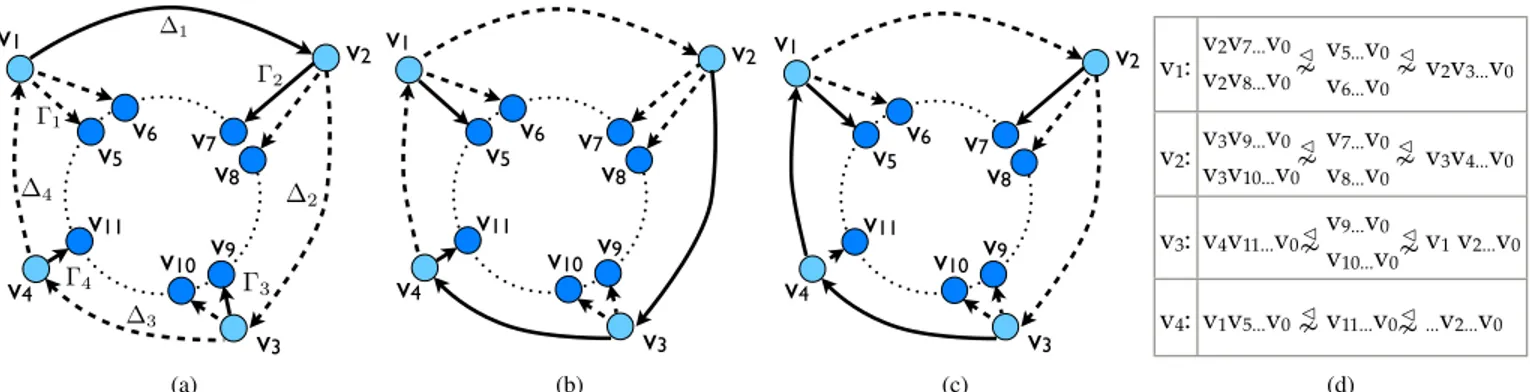
ELMP=0,ECMP=0,KBEST=1) which is equivalent to BGP. The path ranked in first position by each node is displayed with a solid arrow. Paths with lower rank are displayed in dashed arrows. The combination of each node preferences and the 1-best ranking creates the relation of paths shown in the
table at Fig.3d. In Fig.3a the node v1 receives three paths
through v2, v5 andv6 respectively. The three paths are of the
same AS length andv1 chooses the path v2v7. . . v0 with the
lowest BGP ID. The node v2 has three paths of equal path
length through v7, v8 and v3. It is not aware yet of the path
v3v9. . . v0 and chooses to go through v7 using the lowest
BGP ID criteria. Node v3 is configured in a similar way,
it chooses v9 as next-hop since it is not aware of the path
v4v11. . . v0 . The nodev4receives a path throughv11but it is
not aware of the pathv1v5. . . v0, therefore it choosesv11even
though its highest preference is to usev1v5. . . v0. In addition,
v4 filters any AS path containing v2.
In Fig.3b, v2 becomes aware of the path through v3 and
changes its assignment, forcing v1 to change its path as
well. Node v1 does not select the new path of v2 because
is longer than the path through v5. However, v3 becomes
aware of the path through v4 and changes as well. The path
assignment is again modified in Fig.3c. Nodev2looses its path
v2v3v9. . . v0 as it is longer thanv2v7. . . v0andv4prefers the
path announced byv1. In the next step, the nodes go back to
the initial assignment shown in Fig.3a completing a cycle in the oscillation. The reflexive relation can be expressed in this case as follows,
v1v5. . . v0Jv4v1v5. . . v0Cv4v11. . . v0J J
v3v4v11. . . v0C v3v9. . . v0Jv2v3v9. . . v0C C
v2. . . v0J v1v2v7. . . v0C v1v5. . . v0 (3)
If the K-BESTRO selection algorithm is tuned to (ELMP=0,ECMP=0,KBEST=2), the scenario becomes stable. Every node chooses the path through one neighbor node on the dashed circle and a path through an outer neighbor except