Nordic Balance Settlement
Handbook for Market Participants (DRAFT)
17.12.2013
Business process: Nordic Balance settlement Version: 0
Foreword
This handbook is an overview of the Nordic imbalance settlement model. The handbook will be constantly developed and revised so that it always contains the latest available information. Currently, the design and preparation of the NBS model is still ongoing and therefore this first version of the handbook is not yet providing the complete view of the model. The purpose of the first version(s) of the handbook is to serve as a guideline for preparing and adapting to the coming changes in the Nordic imbalance settlement. The purpose is also to keep stakeholders up to date on agreed and open items and on the same time increase knowledge about the model. Some parts of this Handbook include areas and methods of the Nordic imbalance settlement model that have not yet been approved by the concerned stakeholders. These parts have been highlighted with blue background colour.
The purpose of the Nordic Balance Settlement Handbook is to collect the essential information of the target state of the Nordic Balance Settlement model from market participant’s perspective so that market participants can start preparing for the coming transformation. The handbook collects information about rules, regulations and standards which acts as requirements for market participants operating in different roles. All market participants operating in the countries involved in the Nordic Balance Settlement are to follow the defined rules, standards and regulations as defined in this handbook. It is to be noted that after the implementation of the Nordic Balance Settlement model some national differences in the imbalance settlement may remain.
The handbook will be updated with the latest agreed items and enhancements every half a year. All the changes are listed in the change log included at the end of this document.
Terminology
Terminology
Term Abbrevation Explanation
Balance Responsible
Party BRP
A Balance Responsible Party is a party that has a contract proving financial security and identifying balance responsibility with ISR. Balance Responsibility means obligations to ensure that a balance exists between the supply and withdrawal and for the purchase and sale agreements it has entered into.
Distribution System
Operator DSO
A Distribution System Operator is the distribution grid owner with the responsibility to distribute electricity from producers to its customers. The DSOs have the
responsibility to meter production, consumption, exchange and report the metered data to the involved stakeholders. This responsibility includes also non-concessional grid operators.
Key Performance
Indicator KPI
KPIs are utilized to measure the performance of different market participants. KPIs are a transparent way to display how TSOs, DSOs, BRPs and Res carry out their respective responsibilities.
Market Balance Area MBA
A Market Balance Area is an area that provides (exchange) schedules that represent a basis for monitoring of imbalances. The Elspot price is always the same within a MBA.
Market Entity ME A collective term for MBA, MGA, PU and RO.
Market Entity
Connection MEC
Market Entity Connection is a collective term for different kinds of connections either between different MPs (e.g. bilateral trades between parties) or MPs and MEs (e.g. MP’s metered consumption in MGA or MP’s production plan per PU). The MEC’s time series data is the core of the balance settlement.
Market Participants
Market Participants are the main stakeholders in the settlement: the TSOs, DSOs, BRPs and retailers. These enter into transactions in one or more wholesale energy market.
Metered Data
Metered (metering) data is, in this Handbook, used as a general term for all the data that the market participants meter, collect and report to ISR for balance settlement purpose.
Metering Grid Area MGA
A Metering Grid Area is a physical area where consumption, production and exchange can be metered. It is delimited by the placement of meters for period measurement for input to, and withdrawal from the area. It can be used to establish the sum of consumption and production with no period measurement and network losses. MGAs are decided on national level.
Nord Pool Spot NPS
The Nordic energy exchange and the company that organises the physical electricity market in the Nordic countries. Operates in Norway, Denmark, Sweden, Finland, Estonia, and Lithuania.
Production Unit PU A Production Unit is a generator or a set of generators within same power plant.
Regulation Object RO
A Regulation Object is a set of one or more generators and stations within a MBA decided by the respective Transmission System Operator (TSO) and the BRP. One RO can only include production of a certain technology (wind, hydro, nuclear, etc.). There can only be one BRP per RO.
Retailer RE
A Retailer sells electricity to an end user. It sells and buys electricity directly from a producer, another retailer or via NordPoolSpot. A retailer has to have an agreement with a BRP. A BRP can also have a RE role in the NBS model. The definition of a retailer might be updated in the next version of the handbook.
Service Provider SP
A Service Provider is a party that provides operational balance management and settlement services for the market participants e.g. BRPs, REs and DSOs. According to what services the SP provides to the market participant, the SP performs the corresponding tasks towards ISR and the imbalance settlement system.
Imbalance Settlement
Responsible ISR
The organisation with the responsibility to operate the NBS settlement. ISR is responsible for settlement of the difference between the contracted quantities and the realised quantities of energy products for the Balance Responsible Parties in a Market Balance Area.
Transmission System
Operator TSO
A Transmission System Operator has the responsibility for both the security of supply and the high-voltage grid. In this document TSO refers to following Nordic TSOs: Statnett, Fingrid, and Svenska Kraftnät.
Table of Contents
Foreword
1
Terminology
2
Table of Contents
4
Introduction
1
1.
Nordic Balance Settlement Model
8
2.
Settlement Structure Management
14
3.
Settlement Data Metering and Reporting
21
4.
Imbalance Settlement
33
5.
Invoicing
42
6.
Communication
49
7.
Collateral Management
54
8.
Market Behaviour Reporting
57
9.
Appendices
60
Detailedcontentsofthechapters
Chapter Contents
1. Introduction
· Basic information about Nordic Balance Settlement project
· Purpose of the handbook
· Essential changes compared to national models
· Information sources to national regulations
· Introduction of the balance settlement organization
2. Nordic Balance Settlement Model
· High level description of the model and functions
· Roles and responsibilities of each market participant
· Contents of the agreements between ISR and market participants
3. Settlement structure management
· Description of the settlement structure
· Responsibilities and time schedules for reporting settlement structure information
· Examples of the settlement structure changes
4. Settlement data metering and reporting
· Metering of settlement data
· Responsibilities and schedules for reporting settlement data
· Instructions how reporting for production and consumption is done, including calculation examples for profiling
5. Imbalance settlement
· Principles of imbalance settlement
· Calculation of production and consumption imbalance
· Example of imbalance calculation
· National reconciliation procedures
6. Invoicing
· Invoicing process and invoicing of imbalances and reserves
· Calculation of imbalance price components
· Fee structures
· Invoicing procedure and schedule
· Consideration of taxes
7. Communication
· Applied data communication standard
· Services provided by ISR; information service and online service
· Reports provided by ISR
8. Collateral management
· Collateral management model
· Calculation of collateral demands
9. Market behavior reporting
· Monitoring of market behavior including published reports
· Key performance indicators
· Sanctions and controls from bad market behavior
10. Appendices
· Instructions for becoming a new BRP
· Handling of balance errors after gate closure
Introduction
1.
There must always be a balance between supply and consumption of electricity. To achieve this, the TSOs use balancing power procured in the balancing power market. Imbalances arise from uncertainties in plans and failures in generation, consumption and grid. Imbalance
settlement is therefore a necessary function in a
commercial based electricity market. Historically, Fingrid, Svenska Kraftnät and Statnett each have been operating their own imbalance settlement and have been
responsible for supervising the balance of the electricity systems in Finland, Sweden and Norway respectively. In 2010, Fingrid, Svenska Kraftnät and Statnett agreed to form a joint project with the objective to establish a harmonised imbalance settlement model for three of the Nordic countries; called Nordic Balance Settlement (NBS).
The model provides harmonized operational
preconditions for all Nordic balance responsible parties, regardless of the country or market balance area. Nordic level business processes for reporting, performing settlement, invoicing, collateral management and corrections are established. Consequently, similar rules and standards for information exchange are created. The harmonised solution will require changes in all the countries; however, the changes may differ between the countries.
The most significant change will be the establishment of a new Imbalance Settlement Responsible (ISR) organisation which is owned by the three TSOs; Fingrid, Statnett and Svenska Kraftnät with equal share. The new common operational unit is responsible for performing imbalance settlement and invoicing BRPs for imbalances and balancing services. Each TSO is still responsible for national settlement according to national regulations and in verifying that the NBS model and ISR fulfils such regulations.
In order to compile all the NBS information into one easily accessible source, this Nordic Balance Settlement Handbook has been created. It is the main source of information needed for each market participant to understand their role and responsibility in the settlement process. A market participant can have several roles in the NBS model (e.g. TSO can have roles as BRP, RE and DSO).
One of the most important goals of the handbook is to provide the information in a structured and understandable way so that all market participants can adapt and prepare for the NBS model and eventually work equally in the electricity market in all Nordic countries. Inevitably, there will remain some national differences which may not be possible to harmonise in short term and therefore the national regulations are an important source of information, in addition to this handbook. This handbook also
This chapter provides the
basic information about the
Nordic imbalance settlement
model including its benefits
and scope as well as the main
changes needed when
harmonising the settlement
procedures in the Nordic
countries. Additionally, the
purpose and contents of the
Nordic Balance Settlement
(NBS) Handbook along with
information sources for
national regulations are
presented.
includes references to information sources to national regulation. As the NBS project is on-going the handbook is considered a draft and its main objective is to give market participants, in different market roles, the possibility to prepare for the coming transformation in relation to NBS model.
Nordic Balance Settlement Project
1.1
A common imbalance settlement solution is supported by the governments and regulators in the Nordic countries. Harmonising the imbalance settlement in Finland, Norway and Sweden is regarded as an important step towards a fully functional common end user market. In order to set up this Nordic Balance Settlement model, the NBS project has been initiated.
Imbalance settlement is a natural monopoly and a necessary function in a commercial based electricity market. Traditionally Fingrid, Statnett and Svenska Kraftnät have had the role as “Imbalance Settlement Responsible” as well as “System Operator” in Finland, Norway and Sweden respectively. This has led to situation where only few retailers operate in more than one country. Due to differences in the national end user markets, a retailer had to have parallel supply functions in all countries it operates through most of the value chain. Imbalance settlement acts as a significant part of the retailer’s value chain, and different national rules and routines in this area have created barriers for entry to market. Common imbalance settlement is therefore a prerequisite for a common end user market. Objectives of the NBS model are presented in Table 1 below.
ObjectivesoftheNordicBalanceSettlementmodel
· Imbalance settlement between different Market Balancing Areas with as similar principles as possible through one Imbalance Settlement Responsible.
· Design and provide similar operational preconditions for balance responsible parties regardless of Market Balance Area. Harmonise common rules and standards for information exchange.
· Contribute to the implementation of a common Nordic retailer market.
· Be a forerunner in imbalance settlement issues on the European level. Table 1.Objectives of the Nordic Imbalance Settlement model.
1.1.1 Background
Regulators in Finland, Norway and Sweden have decided to support the implementation of NBS and started the processes for the needed regulatory changes in the respective countries. The first NBS design report was published in 2011.
There has been a close communication with the reference group of stakeholders, both industry and regulators, to discuss the development plans of the NBS model. Stakeholders have provided their industry opinions on prevailing issues to help the NBS project group to find the best solution for issues in question.
As the NBS project work is currently on-going the first version of the handbook is preliminary and it is obvious that there will be changes, additions and more details in the model before the go live of the settlement model.
1.1.2 Scope
The main function encompassed by the NBS model is the common imbalance settlement. The model is based on the present harmonised model with two balances; production and consumption. Imbalance power for production and consumption is calculated and settled separately.
The Imbalance Settlement Responsible (ISR) performs the imbalance settlement and manages invoicing as well as collaterals towards the Balance Responsible Parties (BRP) on behalf of the Transmission System Operator (TSO) in each country. All matters directly related to system operations, for example procurement of balancing services, are outside the scope of NBS model. The NBS model will take all necessary volumes into account when calculating the imbalance and furthermore, ISR is responsible for invoicing of the balancing services as a part of the imbalance settlement.
In parallel with establishing a common Nordic imbalance settlement several other harmonisation processes have been initiated by NordREG. The long term aim is to create a common Nordic end user market for electricity in the Nordic region. A harmonised imbalance settlement acts as one part of this Nordic harmonisation. This handbook describes the imbalance settlement and does not give answers to all harmonisation necessary to establish a common end user market in the Nordic region.
The reconciliation settlement will not be harmonized on Nordic Level at this stage and current national procedures will apply.
1.1.3 Benefits
The model includes several benefits for the electricity market. The Nordic Balance Settlement is the platform for a common balance settlement in Finland, Norway and Sweden. This means that a Balance Responsible Party (BRP) always has a single interface (the imbalance settlement responsible unit) and one set of rules when settling its imbalances in the Nordic electricity market. The main reason for establishing a common imbalance settlement solution is the creation of a competitive end user market. Lack of end-user competition in the Nordic electricity market gives a loss for the society. Increased competition and reduced margins for the electricity providers will give a socioeconomic efficiency gain. Competition through a common Nordic retail market is considered to be essential in order to ensure high quality services at the lowest price, to stimulate innovation and maximise social welfare in the Nordic region.
In general, the NBS model will lower the threshold of being a BRP because the model gives one common access to all countries. In addition, the operational procedures of a BRP are simplified. This makes it easier for a retailer to enter the market and also reduces costs as more BRPs are competing and the price for handling an RE’s balance could therefore be lower. Besides, an RE can more easily choose to act as a BRP rather than RE.
In the NBS model, meter data quality will improve as the Distribution System Operators must notify and be responsible for data errors after the imbalance settlement period is closed. Improved data quality will not only improve the quality of the imbalance settlement but also the settlement and invoicing of end customer as both BRPs and REs get access to the same meter data.
A larger market with a common rule set will make it more attractive to invest in innovation. BRPs and REs will face a larger potential for innovative solutions, especially for the core IT systems and new payment and credit management solutions. This will also make the vendor market more attractive as the offers from the various service providers will cover a larger market.
A common Nordic approach to imbalance settlement procedures will have more influence on the EU development than if there were several different Nordic solutions. NBS will, in the long run, lower the operational costs of imbalance settlement because one organisation with one common IT solution will be more efficient than several separate ones. NBS will also make the related costs more transparent as these will be separated from cost elements at each respective TSO. Such transparency is a condition for operational cost efficiency.
Essential Changes in the Balance Settlement
1.2
NBS model encompasses several changes for the imbalance settlement. Required changes differ by country due to current solutions and processes. A harmonised model will, in overall, require changes in all countries and all levels of the market. Major changes are described in this sub-chapter and more specific changes by country are described later in the chapters.
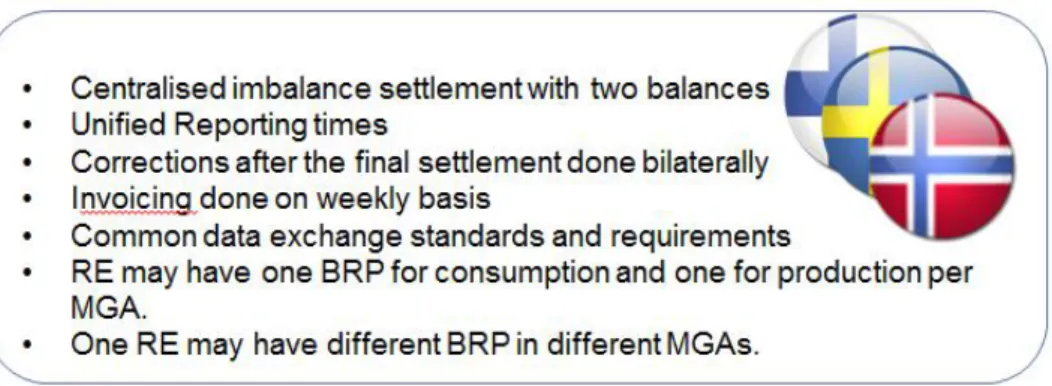
The starting point for NBS model is the common principles agreed in 2009, consisting of two balances with national imbalance power pricing, cost structures, payment components and gate closure times for reporting settlement data. The common Nordic electricity retail market aims to have a common Nordic balance with common imbalance settlement and reporting, single balance agreement and unified gate closure times, though some national differences may apply. The main changes are illustrated in Figure 1 below.
Figure 1.The most essential changes in the settlement model.
National changes caused by the NBS model have been collected into a table in Appendix 3
Regulation
1.3
Common rules in the electricity law and secondary legislations in the Nordic countries provide additional information and set requirements for the market participants. This chapter includes the information sources to national legislation and regulations per each respective country.
1.3.1 Finland
In Finland following laws and secondary regulations guide the electricity market: · Electricity market act (EMA) (588/2013) (Finnish version)
http://www.finlex.fi/fi/laki/alkup/2013/20130588
· Decrees of the Finnish government and decrees of the ministry of the employment and the economy:
o The Finnish Government decree of electricity deliveries settlement and measurement (dated 2009-02-05)
o The Ministry of the Employment and the Economy decree of the information exchange concerning electricity deliveries settlement (809/2008)
http://www.finlex.fi/fi/laki/alkup/2008/20080809?search%5Btype%5D=pika&search%5Bpi ka%5D=809%2F2008
1.3.2 Norway
In Norway following laws and secondary regulations guide the electricity market:
· Primary act: LOV 1990-06-29 nr 50: Lov om produksjon, omforming, overføring, omsetning, fordeling og bruk av energi m.m. (energiloven) - ”The Energy Act” http://www.lovdata.no/all/hl-19900629-050.html
· Secondary Legislation: FOR 1999-03-11 nr 301: Forskrift om måling, avregning og samordnet opptreden ved kraftomsetning og fakturering av nettjenester - ”MAF” http://www.lovdata.no/cgi-wift/ldles?doc=/sf/sf/sf-19990311-0301.html
1.3.3 Sweden
In Sweden following laws and secondary regulations guide the electricity market: · Energy market act: SFS 1997:857 Ellag
http://www.riksdagen.se/sv/Dokument-Lagar/Lagar/Svenskforfattningssamling/Ellag-1997857_sfs-1997-857/
· National Energy Authority's regulations and general guidelines on measurement, calculation and reporting of electricity: STEMFS 2007:5 Mätningsföreskrift
http://www.energimarknadsinspektionen.se/Documents/Publikationer/foreskrifter/Upph%c3%a4vd a%20f%c3%b6reskrifter/Statens_energimyndighets_foreskrifter_och_allmanna_rad_om_matning _berakning_och_rapportering_av_overford_el_STEMFS_2007_5.pdf
· Power regulation: SFS 1999:716 Mätnings förordning
http://rkrattsdb.gov.se/SFSdoc/99/990716.PDF
The Nordic Imbalance Settlement Responsible eSett
1.4
A new operational company, eSett, has been established in Finland. The company is owned by Fingrid, Svenska Kraftnät and Statnett. The company will act and operate in the role of Nordic Imbalance Settlement Responsible. It must be noted, that the national regulations stipulate that each national Transmission System Operator (TSO) is still ultimately responsible for balancing operations. The company will operate in English but manages customer services by serving all three countries with their local languages. The company’s relations to other market participants are illustrated in Figure 2.
Figure 2. Relations between eSett and the market participants.
1.4.1 ISR Operations
ISR has many operational tasks. Daily processes include collection and verification of data, controlling master data and making collected data available for market participants, conduct preliminary balance settlement, follow up reported data and do final imbalance settlement. Weekly duties for ISR are invoicing of the imbalance settlement, invoicing of other fees on behalf of TSOs, controlling collaterals and follow-up of BRPs in relation to risk and collaterals, and cash
management. On a monthly basis ISR will monitor, publish and follow-up Key Performance Indicator (KPIs) of the imbalance settlement process. Some of the KPIs are also monitored daily or on a weekly basis. ISR does market monitoring, customer support and reporting, and publishing of settlement results (including incoming data) continuously.
Most of the ISR operations are done in the ISR’s
imbalance settlement solution which consists of an imbalance settlement system to be used by ISR personnel and an Online Service and Information Service to be used by external stakeholders. These tools are described in chapter 7.
www.nbs.coop [email protected]
Nordic Balance Settlement Model
2.
The Nordic Balance Settlement model is based on the present harmonised model with separate balances for production and consumption which are calculated and settled separately. At the core of the NBS model is the common operational Imbalance Settlement Responsible unit (eSett) which is responsible for settlement of imbalances. The ISR performs services on behalf of the three TSOs.
The balance agreement is a legal contract between the balance responsible party and the ISR including liabilities, collateral requirements and procedures for exclusion and legal items such as place of court. The main stakeholders in the NBS model are the Retailers (RE), the Balance Responsible Parties (BRP), the Distribution System Operators (DSO), the Transmission System Operators (TSO), Nord Pool Spot (NPS) and the Imbalance Settlement Responsible (ISR). The role of these stakeholders is presented in the Terminology table in the beginning of this Handbook.
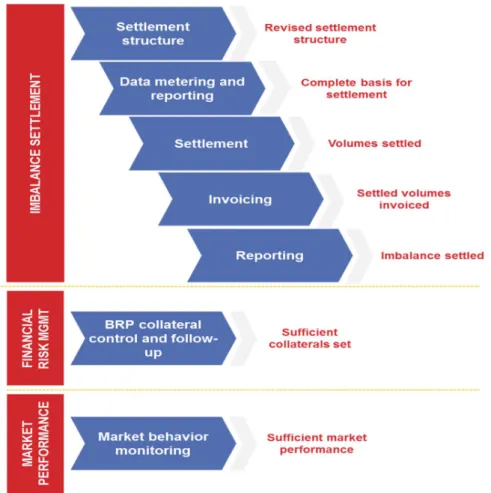
The different procedures and operations of the Nordic Balance Settlement model are divided into five core functions: settlement structure management, metering and reporting data, settlement, invoicing and reporting.
In addition the NBS model includes own functions for collateral management and market behaviour monitoring.
NBS Model
2.1
The main objective of the NBS model is to perform imbalance settlement on Nordic level. The model is based on two balances; production balance and consumption balance. Both are calculated and settled separately. The NBS model ensures a transparent and common imbalance settlement and equal treatment of market participants. The model provides identical and necessary procedures for imbalance settlement in all countries participating in NBS:
· Settlement structure defines how the information about the imbalance settlement structure and hierarchy (relations) is collected and managed, e.g. information about a new Metering Grid Area (MGA) or the contact information of a market participant.
· Metering and reporting data handles the imbalance settlement data reception, validation, storing and reporting.
This chapter presents the
Nordic Balance Settlement
model and its functions in
more detail. The roles and
responsibilities for the
different market participants
are described as well as the
concept of balance
responsibility and legal
agreements related to it.
· Settlement handles the production and consumption imbalance settlement calculations, quality assurance and publishing of results.
· Invoicing function handles the ISR’s invoicing of market participants, based on realised imbalances.
· Reporting includes the creation, distribution and publishing of various reports and files provided by the ISR (eSett). Reporting is also done through the online service and information service that is provided to market participants.
· Collateral management includes control of the BRPs’ collateral demands, as defined and calculated by ISR, as well as follow-up of the placed collateral deposits in comparison to demands.
· Market behaviour monitoring is based on the analysis of the BRPs' imbalances. These are analysed by calculating a set of KPIs, which show the BRPs market performance (e.g. quality of reported data, reporting frequency, relative imbalances, absolute imbalances and imbalance costs per unit). The quality of DSOs reporting will also be monitored.
All functions in the settlement model are described in Figure 3 below.
Roles and Responsibilities
2.2
The main stakeholders (i.e. market participants) in the Nordic Balance Settlement model along with related roles and responsibilities are presented below.
2.2.1 Imbalance Settlement Responsible (ISR)
ISR is responsible for settlement of imbalances:· Perform the imbalance settlement and invoice/credit the Balance Responsible Parties for the balancing power.
· Set the collateral levels so that they cover the imbalance settlement risk exposure.
· Collect and monitor the BRP´s collaterals and take necessary actions to adjust collaterals when needed.
· Collect fees from BRPs to cover:
o The operational costs of ISR
o The reserve costs and related operational costs for the TSO.
· Monitor imbalances and assess whether they are in accordance with published guidelines and regulations.
· Publish a set of KPIs to provide statistics on reporting and settlement.
· Operate and provide an imbalance settlement system that the market participants can use to access and report settlement data.
· Report imbalance settlement data including statistics, KPIs and other market information.
2.2.2 Transmission System Operator (TSO)
TSOs have the responsibility to supervise the balance of the electricity system and take actions to rebalance the system. In the NBS model a TSO has the same responsibilities as a BRP and in addition the following:
· Balance the production/import with the consumption/export during the delivery hour to meet the overall demand of frequency at 50 Hz.
· Calculate regulation power prices per hour and determine imbalance prices.
· Submit necessary information per BRP to the ISR for the imbalance settlement of the BRPs; e.g. production plan and activated regulation power during the operation hour.
· Act as the financial counterpart towards the BRP for all reservations of reserves (ISR is the financial counterpart for the corresponding reserves related to the imbalance settlement.
2.2.3 Distribution System Operator (DSO)
A DSO is a grid operator with the responsibility to connect producers and consumers to its grid. The DSOs have the responsibility to meter production, consumption and exchange with other grids in addition to report the metered data to the entitled parties. This includes also non-concessional grid operators
.
The DSO has several obligations in relation to imbalance settlement. DSO’s responsibilities are the following:· Register BRPs and REs metering points in the respective Metering Grid Areas
· Operate the metering system and submit metering data to the Retailers, Balance Responsible Parties and ISR.
· Calculate and report load profile shares (according to national guidelines).
· Calculate the final profiled consumption and the reconciled energy when all metering for a grid area is completed (according to national guidelines, see sub chapter 5.6. Reconciliation). · Imbalance corrections after the balance settlement reporting is closed shall be settled between
the DSO and RE. See appendix 2 for more details.
2.2.4 Balance Responsible Party (BRP)
A BRP is a party having signed an agreement with the ISR. BRP’s responsibilities are following: · Have a balance agreement with the ISR and provide the required collaterals.
· Plan balanced schedules on an hourly basis.
· Submit production plans to the TSO which will forward them to the ISR. · Submit bilateral trade information.
· Act as the financial counterpart for the settlement of imbalances, activated regulation power and reconciliation according to national guidelines
· Verify that all relevant data reported by the ISR, and notify deviations.
· Inform the imbalance settlement responsible of which REs that the BRP is responsible for
2.2.5 Retailer (RE)
An RE sells electricity to final consumers and balances the sales with purchases in bilateral and organised markets. The RE’s responsibility regarding balance settlement is:
· Have an agreement with a BRP
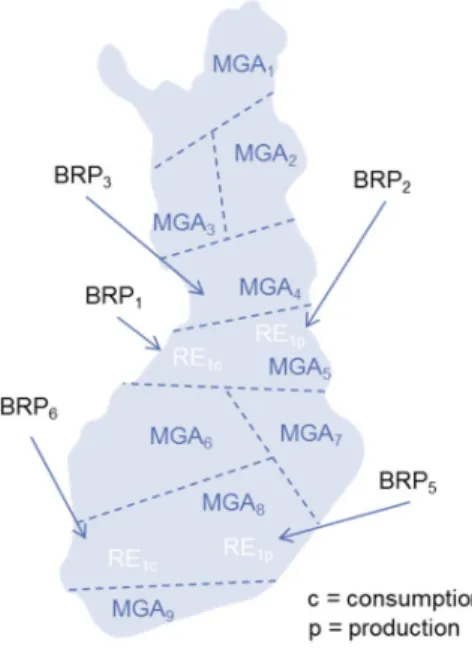
· Retailer can use one BRP for consumption and one BRP for production in the same MGA and use different BRPs in different MGAs, this division is highlighted in the following Figure 4 where Finland is used as an example.
Figure 4. Model for Retailers using different BRPs per MGA.
2.2.6 Market Operator (Nord Pool Spot)
The responsibilities for Nord Pool Spot, in its role as power exchange and in regard to imbalance settlement are following:
· Report trade data for Elspot- and Elbas trade per BRP/RE and Market Balance Area to ISR (and TSO if needed).
· Report cross border trade with other power exchanges (market coupling) to TSOs. · Report to ISR into which MBA each MGA belongs to.
Balance Responsibility and Agreements
2.3
The parties of the balance agreements will be the Imbalance Settlement Responsible and the BRP. Only one balance agreement is required per BRP, regardless of how many countries the BRP is active in. The scope of the balance agreement will be limited to issues regarding the settlement and invoicing of activated regulation power.
As before, a BRP shall have an agreement with the TSO if the BRP is providing reserves in the ancillary service markets.
2.3.1 Agreement between ISR and BRP
Only a company that has a valid agreement with the ISR may act as a BRP. This agreement regulates the relations between the parties. The purpose of the balance agreement is to assure financial liability for and planning of imbalances between the generation and consumption of power.
The purpose of the balance agreement is to assure financial liability for and planning of imbalances between the generation and consumption of power:
· Liability of the ISR · Collateral requirement
· Procedures when contract is breached by the BRP · Law and place of court
· Etc. (will be finalised later) Detailed agreement will be published later
Settlement Structure
3.
Management
The settlement structure is one of the key elements in the NBS model. Each market participant is responsible for informing and updating structural information. Structural information is information about market participants and their relations to each other (e.g. the relationship between a BRP and an RE) and to the market entities and market entity connections (e.g. the relationship between a BRP and a MGA). Every party in the market has to register for acceptance to operate in the market. The parties
themselves are responsible for registering and keeping their information up to date.
Distribution System Operators will be responsible for updating the structure of the Metering Grid Area they are accountable for (e.g. MGA exchange per MGA per adjacent MGA) and Balance Responsible Parties and Retailers will control their own information (e.g. which RE in the different MGA they are responsible for).
The market participants shall send the information of changes in the settlement structure to the ISR either electronically in a market message or by entering the changes via the NBS Online Service. Market message for settlement structure shall be defined later. In exceptional situations, the changes can also be reported by e-mail or phone. When the changes are entered into the imbalance settlement system of the ISR, the changes are validated and approved. Once the changes are approved they will be used in the balance settlement. The structure information is published on the NBS Online Service where market participants can view the up to date settlement structure information. The viewing of the settlement structure is restricted with access rights in accordance with legislation.
Settlement Structure
3.1
Up-to-date structural information is essential to manage the reporting and other imbalance settlement functions. Settlement structure contains the information related to different market participants: TSOs, DSOs, BRPs and Res, and information on the relationship between the market participants.
Information regarding who the BRP is for an RE in all MGAs, and during which period of time, is essential to enable correct reporting of data to ISR. One common structure information overview for the market is therefore developed and maintained in the ISR’s imbalance settlement system.
Chapter three presents the
settlement structure and
hierarchy management in the
Nordic Balance Settlement
model. It describes the
reporting responsibilities and
the rules and guidelines for
reporting changes in the
structural information as well
as reporting schedules and
methods.
Every entity of structural information has a validity period, defining the period of time during which the entity is considered active.
Detailed information on how the structural information will be managed will be added later.
Market Entity Connections
3.2
A large amount of settlement information is exchanged between market participants within the Nordic imbalance settlement. The information is organised into so called Market Entity Connections (MEC). The MECs are very central in the balance settlement structure.
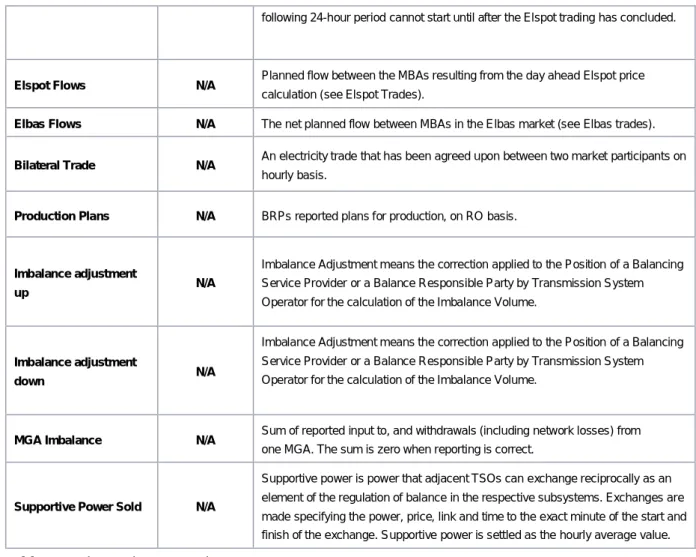
Market Entity Connections (MECs) aredifferent kinds of connections either between different market participants (e.g. bilateral trades between parties) or between market participants and market entities (e.g. market participant’s metered consumption in MGA or market participant’s production per Production Unit). The Market Entity Connection’s time series data is the core of the balance settlement. Table 2 explains the MECs utilized in the NBS model.
MarketEntityConnections
Name Abbrevation Description
Market Balance Area MBA
Market Balance Area means an area that provides (exchange) schedules that represent a basis for monitoring of imbalances. It is always the same Elspot price within a MBA.
Metering Grid Area MGA
A Metering Grid Area is a physical area where consumption, production and exchange can be metered. It is delimited by the placement of meters for period measurement for input to, and withdrawal from the area. It can be used to establish the sum of consumption and production with no period measurement and network losses. MGAs are decided on national level.
Production Unit PU Generator or a set of generators within same power plant.
Regulation Object RO
A Regulation Object (RO) is a set of one or more generators and stations within a
MBA decided by the respective Transmission System Operator (TSO) and the BRP. One RO can only include production of a certain technology (wind, hydro, nuclear, etc.). There can only be one BRP per RO.
Preliminary Profiled
consumption PPC
Estimate of profiled consumption per RE on hourly basis used in imbalance settlement. Estimated as the RERE share of load profile.
Metered Consumption N/A Metered consumption per MGA per RE on hourly basis used in imbalance
settlement.
Metered Production N/A Metered production per PU on hourly basis used in imbalance settlement.
MGA Exchanges N/A The exchange of energy sum that occurs between Metering Grid Areas adjacent to
each other. Measured in the border points and reported hourly.
Elspot Trades N/A Day-Ahead-based market. The Nordic auction-based market for transactions in
physical power for each hour during the subsequent 24-hour trading period.
Elbas Trades N/A
Intraday market. The continuous hourly market for transactions in physical power for the present 24-hour period, until one hour before delivery. Trading for the
following 24-hour period cannot start until after the Elspot trading has concluded.
Elspot Flows N/A Planned flow between the MBAs resulting from the day ahead Elspot price
calculation (see Elspot Trades).
Elbas Flows N/A The net planned flow between MBAs in the Elbas market (see Elbas trades).
Bilateral Trade N/A An electricity trade that has been agreed upon between two market participants on
hourly basis.
Production Plans N/A BRPs reported plans for production, on RO basis.
Imbalance adjustment
up N/A
Imbalance Adjustment means the correction applied to the Position of a Balancing Service Provider or a Balance Responsible Party by Transmission System Operator for the calculation of the Imbalance Volume.
Imbalance adjustment
down N/A
Imbalance Adjustment means the correction applied to the Position of a Balancing Service Provider or a Balance Responsible Party by Transmission System Operator for the calculation of the Imbalance Volume.
MGA Imbalance N/A Sum of reported input to, and withdrawals (including network losses) from
one MGA. The sum is zero when reporting is correct.
Supportive Power Sold N/A
Supportive power is power that adjacent TSOs can exchange reciprocally as an element of the regulation of balance in the respective subsystems. Exchanges are made specifying the power, price, link and time to the exact minute of the start and finish of the exchange. Supportive power is settled as the hourly average value.
Table 2.Market Entity Connections.
Settlement Structure Management Function
3.3
The Settlement Structure Management function handles the collection and management of the imbalance settlement structure information. The balance settlement structure is formed as part of this function. In short, the activities are the following: the ISR receives a message from one of the market participants containing balance settlement structure information that should be added, updated, or closed in the imbalance settlement system. The message is either sent directly electronically from the participants’ system to the system or entered via the NBS Online Service (described more detailed in chapter 7), or in abnormal situations by e-mail or phone to ISR personnel. The new or changed structure information is validated by the ISR’s imbalance settlement system or ISR employee where needed. When the settlement structure has been updated, ISR publishes the settlement structure to market participants in the Online Service and the Information Service.
Reporting Responsibilities and Schedules
3.4
Every participant in the electricity wholesale market will have to apply for acceptance into the settlement structure from the ISR. The parties themselves are responsible for registering and verifying that their information is up-to-date. Responsibilities regarding the settlement structure information management are explained in the following sub-chapters.
3.4.1 ISR
ISR hosts the common settlement structure information. The related responsibilities are the following: · Setting BRPs as active when the balance agreement is set into force.
o This includes all prerequisites for a valid balance agreement as e.g. complying with the collateral requirements.
· Setting BRPs as inactive when the balance agreement has been terminated. · Setting DSOs as active when they fulfill all requirements as DSO.
· Setting DSOs as inactive when DSOs activity has ended.
o The DSO has for example been merged with another DSO.
· Setting REs as active when they fulfill the requirements set upon them by the regulators.
o Since an RE may have a different BRP in every MGA it's most efficient that ISR perform this control instead of many DSOs or BRPs controlling the same RE.
o An active retailer will be able to handle consumption, trade and production. · Setting REs as inactive when their activity has ended.
· Manage MECs for MGA imbalance. · Manage MECs for MGA exchange trade.
3.4.2 RE
RE is responsible for reporting the following structure information to ISR: · Registering company as an RE.
· Retailer initiates the switch of supplier process. This process can only be initiated when the RE has a valid BRP in the MGA where the delivery will take place.
3.4.3 BRP
BRPs are responsible to report their bilateral trades and connections between production units and Regulation objects. BRP is responsible of reporting following structure information to ISR:
· Registering company as a BRP.
· Registering for which REs they take on the responsibility for production imbalance, and in which MGAs. It is the new BRP that is responsible for applying the correct structure.
· Registering for which REs they take on the responsibility for consumption/trade imbalance, and in which MGAs. It is the new BRP that is responsible for applying the correct structure.
· Manage MECs for bilateral trade for REs that they are responsible for. The BRP representing the seller and the BRP representing the buyer must both register the bilateral trade.
· Assigning production units (PU) to correct regulation object (RO). · Update own contact information.
3.4.4 DSO
DSOs have the main responsibility in maintaining the correct and up-to-date settlement structure. DSO is responsible for reporting the following structure information to ISR:
· Registering company as a DSO. · Manage MECs for consumption. · Manage MECs for production.
· Manage MECs for MGA exchange. Both DSOs must register the MEC.
· The DSO must for every MGA select one RE that handles the DSOs losses, end-users without supplier, MGA-imbalance and MGA-exchange trade.
· Update own contact information.
3.4.5 NPS
NPS is required to register as a BRP in the settlement structure. In addition NPS is responsible of reporting occurred Elspot and Elbas trades. NPS is responsible of reporting following structure information to ISR:
· Manage MECs for Elspot. · Manage MECs for Elbas.
· Relationship between MBAs and MGAs. · Update own contact information.
· Informing ISR if any market participant is misusing the market or is behaving abnormally.
3.4.6 TSO
TSOs have, in addition to below mentioned responsibilities, the similar responsibilities as BRPs (if applicable):
· Determine the Metering Grid Areas (MGAs).
· Determine which MGAs make up each Market Balance Area (MBA).
· The TSO must for its MGAs select an RE that handles the TSOs losses, end-users without supplier, MGA-imbalance and MGA-exchange trade. The TSO may register as an RE itself. · Manage MECs for imbalance adjustment.
· Manage MECs for production plans.
3.4.7 Reporting Schedule
Different settlement structure information needs to be reported according to different schedules and different parties are responsible for updating the structure information. The gate closure times (presented in Table 3 below) are administered and defined by the ISR.
Gate closure times are not final and therefore shown with blue background.
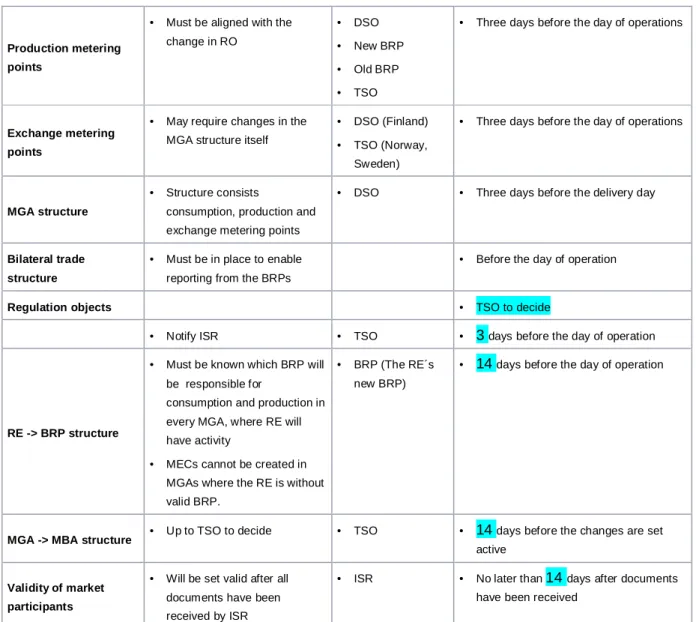
Gateclosuretimesforupdatingstructureinformation Structure
information Prerequisites/remarks Responsibleparty
Gateclosuretime
Consumption metering points
• RE must be valid
• RE must have agreement with BRP
Production metering points
• Must be aligned with the change in RO
• DSO • New BRP • Old BRP • TSO
• Three days before the day of operations
Exchange metering points
• May require changes in the MGA structure itself
• DSO (Finland) • TSO (Norway,
Sweden)
• Three days before the day of operations
MGA structure
• Structure consists
consumption, production and exchange metering points
• DSO • Three days before the delivery day
Bilateral trade structure
• Must be in place to enable reporting from the BRPs
• Before the day of operation
Regulation objects • TSO to decide
• Notify ISR • TSO • 3days before the day of operation
RE -> BRP structure
• Must be known which BRP will be responsible for
consumption and production in every MGA, where RE will have activity
• MECs cannot be created in MGAs where the RE is without valid BRP.
• BRP (The RE´s new BRP)
• 14days before the day of operation
MGA -> MBA structure • Up to TSO to decide • TSO • 14days before the changes are set
active Validity of market
participants
• Will be set valid after all documents have been received by ISR
• ISR • No later than14days after documents have been received
Settlement Data Metering and
4.
Reporting
The metered data shall be reported to the Imbalance Settlement Responsible (ISR) by the DSOs. The metered data is reported either via market messages or via the NBS Online Service. The reported data is further aggregated by ISR in order to establish the consumption and production imbalances.
All metered data is organized per Metering Grid Area (MGA). One MGA can only be situated in one market balance area (MBA). Aggregated meter data should be aggregated per MGA on BRP level or/and Retailer level. The gate closure times for reporting data and the related reporting requirements are defined in the NBS model. Gate closure times differ depending on what data that is reported.
The BRPs are responsible for reporting bilateral trade to ISR. They shall report production plans and bids for up and down regulation to the TSOs. They are also obliged to keep their production plans updated, i.e. report updated values. Nord Pool Spot (NPS) reports Elspot and Elbas trade results to the TSO and ISR.
Metered data for production per PU and aggregated metered consumption data per RE and MGA are reported after the delivery to ISR. ISR performs validations on the received metered data and publishes the data in the NBS Online Service. The settlement calculations and the weekly invoicing are then performed as automated processes in the imbalance settlement system.
TSOs check the consistency of the data reported by BRPs and report all activated regulation power between BRP(s) and TSO(s). TSOs also report binding production plans to ISR.
The verification of the bilateral trades and MGA exchanges is performed by verifying that values reported by the two counterparts are equal. If the values do not match, they will be changed according to pre-defined correction rules and a notification will be sent to both counterparts.
In the NBS model the hourly data is collected weekly and within the stipulated 13 days, this data should be used in the balance settlement. However, if the hourly data is collected less frequently than weekly this part of the consumption will be included in the load profile. This rule is applicable for all consumption without respect to level of yearly consumption or the size of the main fuse. Production used only in exceptional situations can be handled in the consumption balance, this is clarified in chapter 4.5.
Chapter four presents the
settlement data metering and
reporting activities. It
contains information about
the reporting responsibilities
and time schedules for each of
the market entities. Moreover,
management of bilateral trade
corrections and metering grid
area exchange corrections are
described.
Validation of Reported Data
4.1
The data is either sent electronically from the market participant’s system directly to the imbalance settlement system of ISR or entered via the Online Service. In abnormal situations the data can be reported by e-mail or phone directly to ISR personnel. Before aggregation, the syntax and content of the incoming data is validated by the ISR’s imbalance settlement system in order to ensure that the data can be used in the settlement calculations. The reporting parties are informed about the validation result (e.g. via acknowledgement messages). After the validation the data is stored in the ISR’s imbalance settlement system and the imbalance settlement calculations are performed. Both the data sent by market
participants and the final calculated settlement data is published on the Online Service, so that it can be verified and so that possible errors can be reported to the ISR. In addition, the market participants are given the possibility to utilise the Information Service, which provides the market participants such settlement data (time series data) that they are entitled to see. The Information Service (presented in chapter 7.2) is established as a machine-to-machine interface and made available to market participants authorised by ISR.
Market participants themselves are responsible for the accuracy and quality of the reported data. ISR sends and publishes the data received from the parties and is not able to verify the correctness of the received data.
Reporting Responsibilities and Schedules for Reporting
4.2
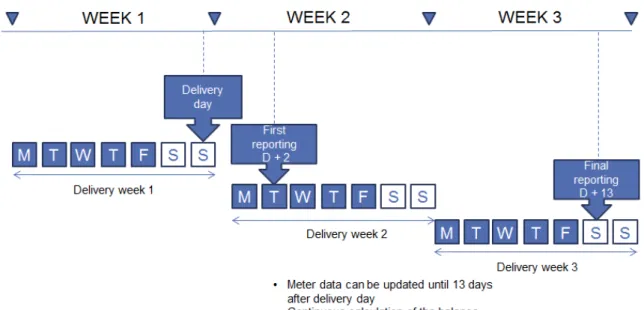
The basis for the reporting schedule is a 13 day period during which the settlement data must be reported to ISR. The ISR conducts preliminary balance settlement based on the reported data every day starting from the second day after the deliver until 13 days afterwards. The final settlement report can be done at the latest 13 days after delivery. During the next working day after the final reporting day, ISR publishes the final result of the imbalance settlement. The data reporting period has been defined in number of days in order to harmonize the delivery schedule within the NBS countries.
An illustrative picture of the settlement data reporting schedule for one delivery day in September is presented inFigure 5. In the picture, metered data for Sunday in week 1 should be updated at the latest 13 days after delivery day, i.e. on Saturday week 3 in the illustration below. On Saturday all metered data for the whole week 1 is considered to be final and the final settlement is performed. Invoicing of week 1 is done on the first working day after the final reporting day (see more information about the invoicing in chapter 6).
Figure 5.Time schedule for reporting balance settlement data.
The reporting roles and responsibilities per each market participant role are presented below. Data reporting tasks have been divided by the market role and the time when the data reporting takes place. In the last column of the tables the counterpart in each action is marked.
4.2.1 BRP
4.2.1.1Reporting of Production Plans
A Regulation Object (RO) is a set of one or more generators and stations within one MBA. The TSO decides which PUs that is included in a RO. One RO can only include production of a certain technology (i.e. wind, hydro, nuclear). Production units settled in the consumption balance cannot be in the same RO as production settled in the production imbalance. There can be only one responsible BRP per RO and all production included in RO. BRPs shall, for imbalance settlement, submit the binding production plans per RO before gate closure to the relevant TSO. ISR will receive settlement binding production plans per RO from the respective TSO. The plans shall not include activated reserves before gate closure. Activated regulation power shall be reported separately by the respective TSO.
The definition of a RO will be described in later version of the handbook.
4.2.1.2Bilateral Trade reporting
All bilateral trades shall be reported before gate closure (delivery hour). A bilateral trade shall be primarily reported on a BRP level, but the reporting can be divided on RE level as well. In the imbalance settlement ISR will aggregate data on BRP level.
BRPs are responsible for reporting their bilateral trades. Bilateral trade values are verified by the ISR’s imbalance settlement system. The reported values by the two counterparts must match. If the values do not match the imbalance settlement system corrects the values according to pre-defined correction rules and sends notification to both parties involved. In case of inconsistency between values, the values can be updated until next day after the gate closure.
The correction rules are the following (in case of values not matching): · If both BRPs report a sale, zero will be used.
· If both BRPs report a purchase, zero will be used.
· If one BRP reports sale and the other reports purchase, the lowest absolute value per hour will be used.
· If only one of the BRPs have reported values, those values will be used. It is then possible for the BRP to choose one of the following actions:
· If the time period is closed, BRP can, within x days, do the following: 1. Choose to accept the corrected values.
2. Choose to accept the counterpart’s values.
· If the time period is open, the BRP can do one of the following: 1. Choose to accept the corrected values.
2. Choose to accept the counterpart’s values. 3. Enter new values via the Online Service. 4. Send new values in a message electronically.
If the BRP does not perform any actions, the corrected values will remain as the final values. The counterpart BRP also has the same possibilities. If the time period is closed, the counterpart that accepts the value (corrected or counterpart’s value) first, determines the final bilateral trades value that will be used in the settlement.
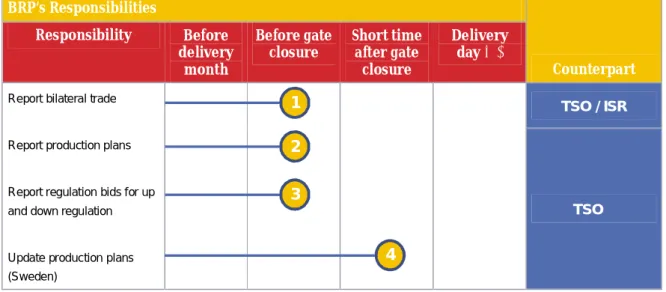
4.2.1.3Reporting Schedule BRP
BRP’sResponsibilities
Counterpart Responsibility Before
delivery month
Beforegate
closure Shortaftergatetime closure
Delivery day + x Report bilateral trade
Report production plans
Report regulation bids for up and down regulation
Update production plans (Sweden)
TSO / ISR
TSO
Table 4. BRP’s responsibilities.
Before delivery hour:
1. Report bilateral trades (except NPS trades to TSO)
o 20 minutes before delivery hour in Finland
o 45 minutes before delivery hour in Sweden and Norway
2. Report production plans per Regulation Object to TSO at the latest 45 minutes before delivery hour
3. Report regulation bids for up and down regulation to TSO at the latest 45 minutes before delivery hour
After gate closure:
4. Update production plans during the delivery hour for operational purposes (Sweden)
4.2.2 DSO
4.2.2.1 MGA Exchange Reporting
DSOs are responsible for reporting MGA exchanges. The imbalance settlement system verifies the reported MGA exchanges and checks if the values match between the two counterparts. If the values do not match, the system changes the values according to pre-defined correction rules. After this the
imbalance settlement system sends a notification to the counterparts. The notification is sent to the DSO’s
1
2
<
3
and also to the Online Service so that the DSOs are alerted. The notification contains information about the new corrected value.
Correction rules for MGA exchanges:
· If both DSOs report export, zero will be used. · If both DSOs report import, zero will be used.
· If one DSO reports export and the other reports import, the lowest absolute value per hour will be used.
· If only one of the DSOs have reported values, these values will be used.
The DSO verifies the corrected MGA exchanges values. If the time period is still open, the DSO can initiate the sending of new values either via the Online Service or in an electronically sent message. If the time period is closed, the DSO can only view what the corrected value was set to.
4.2.2.2 Reporting of production
DSO (or other metering responsible per generator or station) will be responsible for distributing hourly metered data per production unit to ISR. ISR will then aggregate metered data on BRP level per MBA. The production types can be the following: hydro, wind, nuclear, gas turbine/diesel production, solar, wave or unspecified production.
More detailed information regarding production types, process when values are missing and reporting of small production will be added in next version of the handbook.
4.2.2.3 Reporting of consumption
DSO will be responsible for distributing hourly metered data to ISR.Consumption will be reported on following types: Preliminary profiled consumption, metered consumption, losses, pumped storage, interruptible consumption and industry consumption over 50 MW.
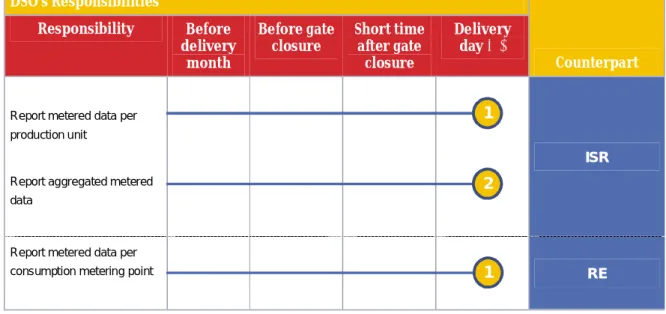
4.2.2.4 Reporting Schedule DSO
DSO’sResponsibilities
Counterpart Responsibility Before
delivery month
Beforegate
closure Shortaftergatetime closure
Delivery day + x
Report metered data per production unit
Report aggregated metered data
ISR
Report metered data per
consumption metering point RE
Table 5. DSO’s responsibilities.
2-13 days after the delivery day:
1. Report metered data before 10:00 AM (CET) the second day after delivery day
o Hourly metered data on production reported to ISR and RE per production unit
o Hourly metered data per consumption metering point reported to RE
2. Report aggregated metered data before 10:00 AM (CET) on the second day after delivery day. Metered data should be available at ISR’s database for BRP and RE as an aggregated volume per RE. Missing daily collected metered data in a single metering point must be estimated by the DSO before aggregation. Updated metered data shall be reported before 12:00 (CET) of day 13.
o Per MGA aggregated metered data from exchange metering points to ISR
o Per MGA aggregated metered consumption data per RE to ISR
o Per MGA aggregated preliminary profiled consumption per RE to ISR
1
2
2
3
1
2
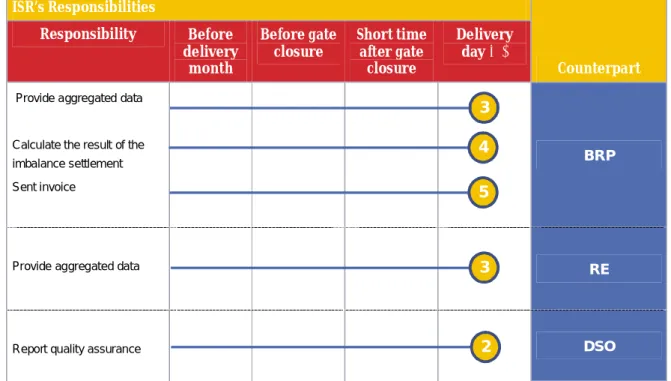
4.2.3 ISR
ISR’sResponsibilities
Counterpart Responsibility Before
delivery month
Beforegate closure
Shorttime aftergate
closure
Delivery day + x Provide aggregated data
Calculate the result of the imbalance settlement Sent invoice
BRP
Provide aggregated data RE
Report quality assurance DSO
Table 6.ISR’s responsibilities.
2-13 days after delivery:
2. Report quality assurance (QA) on area balance per MGA to DSO
3. Provide aggregated RE hourly metered data on consumption and production to BRP and RE
After final imbalance settlement:
4. Calculate the results of the imbalance settlement for settlement day (calculated every day until 13th day after the delivery day)
5. Send invoice for one delivery week electronically to the BRP on the next working day after the final reporting day.
3
4
5
3
4.2.4 NPS
NPS’sResponsibilities Counterpart Before delivery month Beforegate closure Shorttime aftergate closure Delivery day + x Report Elspot tradesReport Elbas trades
TSO
Report Elspot trades
Report Elbas trades
ISR
Table 7. NPS’s Responsibilities.
Before gate closure:
1. Report all Elspot trades made for the next day to TSO/ISR and BRP 2. Report all Elbas trades 1 hour before the delivery hour to TSO and BRP
4.2.5 TSO
TSO’sResponsibilities Counterpart
Responsibilities Before delivery
month
Beforegate
closure Shortaftergatetime closure
Delivery day + x
Report all balancing reserves BRP
Report all activated trades
Report binding production plans
ISR
Table 8.TSO’s responsibilities
Before gate closure:
Check consistency of the data reported by BRP and request correction if needed
After gate closure:
1
2
1
2
1
1
2
2
1. All activated trades in regulation power market and any other agreed BRP-TSO trades during delivery hour are reported to BRP and ISR. (Incl. Elspot and Elbas trades, bilateral trades and trades between BRP and TSO)
2. Report binding production plans to ISR
Metering
4.3
All metering is organised into Metering Grid Areas (MGA). One MGA can only be situated in a single Market Balancing Area (MBA) . Aggregated meter data shall be aggregated per MGA per RE by the DSO. It is the TSO who define the MGA and rules might differ between the countries. Description of how MGAs are defined in the countries will be added in a later version of the handbook.
There are different types of metered data utilised in the NBS model: 1. Exchange metering point to other MGAs
a. Hourly metered exchange with adjacent MGAs 2. Production metering points
a. Metered input to the MGA from production 3. Consumption metering points
a. Metered consumption from the MGA 4. Losses
a. Calculated based on 1-3 above metering points. L= - (1+2+3)
4.3.1 Exchange metering
Detailed description will be added in a later version.
4.3.2 Production metering
All production metering in the NBS model is based on netted metering. Netted metering is defined as: metering after own consumption used for power generation. Until harmonised, the NBS model will handle both gross and net metered production. Until the legislations of Finland, Norway and Sweden are
harmonised the production can be metered, calculated and reported according to principles presented here below.
More details and information regarding metering and reporting of minor production will be added in a later version of the handbook. Furthermore, if there will be differences between the countries, this will be presented in this section. Figure 10 shows one example.
4.3.2.1 Description of gross metering for production
Gross metering has been implemented so that meter 1 is for production metering and meter 2 for own consumption1 metering. Meter 1 will be the reported production of the PU. Metered values from Meter 2 will be aggregated together with other meters that the RE has in this MGA before it is reported to ISR.
Figure 6.Own meters for production and own consumption.
4.3.2.2 Description of net metering for production
Net metering has been implemented so that both generator and own consumption of the production unit are "behind" the same meter. In this first case, the meter is a so called two-way meter and it is possible to measure energy in both directions. If production energy exceeds the own consumption, it is reported as production. If there is no production during the hour then the own consumption will be reported as consumption and handled in the consumption balance of the respective MGA.
1
Figure 7.One meter for production and own consumption.
Net metering of production units ≥ 1 MW with own consumption and an additional consumption (C) can/will be set up according to figure 8. The consumption will in this case be calculated as: C=1+2 Net metering of production units <1MW can/will be set up according to figure 6.
Figure 8 Meter for production, own consumption and consumption
4.3.3 Consumption metering
Imbalance Settlement
5.
In the Nordic Balance Settlement model the settlement of BRPs’ imbalances is based on a harmonised Nordic model which was implemented in all Nordic countries 2009. There are two imbalances calculated and settled in the model; production imbalance and consumption imbalance. Production imbalance volume is calculated as the deviation between metered production, planned production and imbalance adjustment. Consumption imbalance is calculated as the deviation between metered consumption, planned production, trades and imbalance adjustment.
The production imbalance volume is priced with the less favourable price of the market balancing area's spot price and imbalance price. This is called the “two price model”. The consumption imbalance volume is always priced with the balancing area's imbalance price. This is called the “one price model”.
ISR will conduct a preliminary imbalance settlement every day starting from the second day after the day of delivery until 13 days after delivery. Imbalance settlement per BRP will be available in the NBS Online Service for BRPs to follow and control their positions. Furthermore the imbalance volumes and amounts, along with time-stamps, are published in the NBS Online Service directly after the calculation is finalised. In the NBS model there are two imbalances being calculated and settled: one for production power and one for consumption power. Calculation equations for the imbalances are the following: